Sharing at
       Adult Education Network
        Special Interest Group
        (Instructional Design)


  Instructional Design for
Competence-based Learning

                                 Tang Buay Choo
                                 buaytang@gmail.com
2


Agenda

           Overview of Instructional Design
             • What is instructional Design?
             • ADDIE Instructional Design Model

           Nature of competence & its implication for
           instructional design

           Situate, sequence, scaffold & support Learning
              • Authentic & Integrated acquisition of
                 competence
              • Cognitive Load Theory


  © 2012
3


What is instructional design?
  • What?…systematic development of instructional specifications, and
    supporting learning materials
  • How?…applying learning and instructional theories or research
  • Why?….to ensure the quality of instruction
  • Process includes…
       –   analysis of learning needs and goals
       –   design of a instructional activities to meet those needs
       –   development of instructional materials and delivery systems
       –   Implementation of learning activities
       –   evaluation of effectiveness of learning activities
                                  Pre-session Activity
  Recall….Which instructional design (ID) models do you know?

  Write…List 2 to 3 ID models you know on a piece of paper. Write big enough for the
  class to see. You will be requested to show the class when the session starts.

  © 2012
                                                                   Strategy: Entry Slip
4


Instructional Design Models – which do you know?

                  Pre-session Activity – cont’d
  • Recall….Which instructional design (ID) models do you
      know?

  • Write…List the ID models you know on a piece of paper.
      Write big enough for the class to see.

  • Show….Upon signal from the facilitator, hold your paper
      up and show the class the ID models you know.


                                                      Strategy: Polling
  © 2012
5


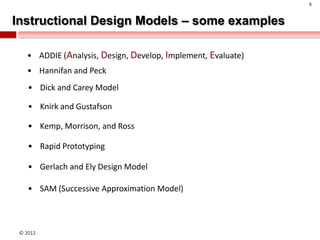
Instructional Design Models – some examples

   • ADDIE (Analysis, Design, Develop, Implement, Evaluate)
   • Hannifan and Peck
    • Dick and Carey Model

    • Knirk and Gustafson

    • Kemp, Morrison, and Ross

    • Rapid Prototyping

    • Gerlach and Ely Design Model

    • SAM (Successive Approximation Model)


 © 2012
6


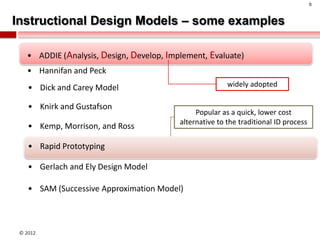
Instructional Design Models – some examples

   • ADDIE (Analysis, Design, Develop, Implement, Evaluate)
   • Hannifan and Peck
    • Dick and Carey Model                               widely adopted

    • Knirk and Gustafson
                                               Popular as a quick, lower cost
                                          alternative to the traditional ID process
    • Kemp, Morrison, and Ross

    • Rapid Prototyping

    • Gerlach and Ely Design Model

    • SAM (Successive Approximation Model)


 © 2012
7


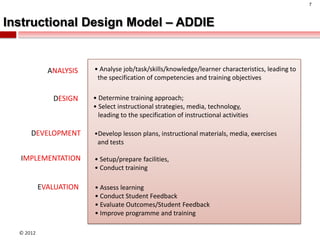
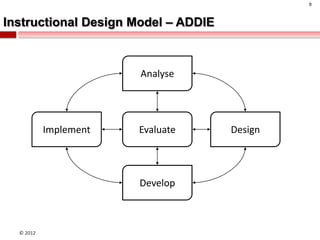
Instructional Design Model – ADDIE


             ANALYSIS   • Analyse job/task/skills/knowledge/learner characteristics, leading to
                         the specification of competencies and training objectives

              DESIGN    • Determine training approach;
                        • Select instructional strategies, media, technology,
                          leading to the specification of instructional activities

      DEVELOPMENT       •Develop lesson plans, instructional materials, media, exercises
                         and tests

  IMPLEMENTATION        • Setup/prepare facilities,
                        • Conduct training

           EVALUATION   • Assess learning
                        • Conduct Student Feedback
                        • Evaluate Outcomes/Student Feedback
                        • Improve programme and training

  © 2012
8


Instructional Design Model – ADDIE


                       Analyse


           Implement   Evaluate      Design


                       Develop


  © 2012
9


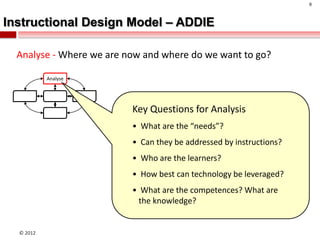
Instructional Design Model – ADDIE

  Analyse - Where we are now and where do we want to go?

           Analyse


                          Key Questions for Analysis
                          • What are the “needs”?
                          • Can they be addressed by instructions?
                          • Who are the learners?
                          • How best can technology be leveraged?
                          • What are the competences? What are
                           the knowledge?


  © 2012
10


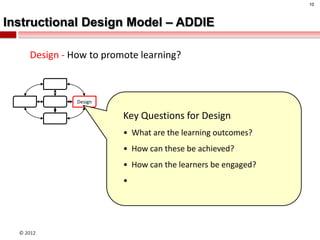
Instructional Design Model – ADDIE

     Design - How to promote learning?


               Design

                         Key Questions for Design
                         • What are the learning outcomes?
                         • How can these be achieved?
                         • How can the learners be engaged?
                         •


  © 2012
11


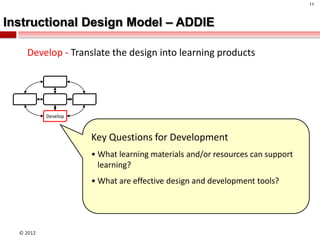
Instructional Design Model – ADDIE

    Develop - Translate the design into learning products


           Develop


                     Key Questions for Development
                     • What learning materials and/or resources can support
                       learning?
                     • What are effective design and development tools?


  © 2012
12


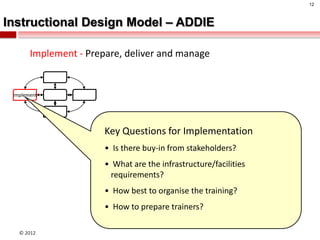
Instructional Design Model – ADDIE

       Implement - Prepare, deliver and manage


 Implement


                       Key Questions for Implementation
                       • Is there buy-in from stakeholders?
                       • What are the infrastructure/facilities
                        requirements?
                       • How best to organise the training?
                       • How to prepare trainers?

   © 2012
13


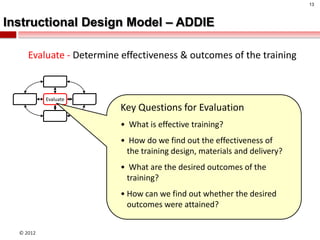
Instructional Design Model – ADDIE

     Evaluate - Determine effectiveness & outcomes of the training


           Evaluate
                          Key Questions for Evaluation
                          • What is effective training?
                          • How do we find out the effectiveness of
                           the training design, materials and delivery?
                          • What are the desired outcomes of the
                           training?
                          • How can we find out whether the desired
                            outcomes were attained?


  © 2012
14


Instructional Design for Competence-based learning

                                 Key purpose

           To facilitate learner acquisition of competence

                 Activity: What is a competence?
  • Think… On your own think about
       – What is the definition of competence?
       – What are the elements of competence?
  • Write… Write your views on a piece of paper
  • Show… Upon signal from the facilitate, show your views to your
    group members
  • Discuss and negotiate… Within your group, discuss and come to a
    consensus on the definition and elements of a competence
  • Share… Present your group’s view on a flipchart. You can use any
    format, text, pictures, diagrams….
                                                       Strategy: Show Down
  © 2012
15


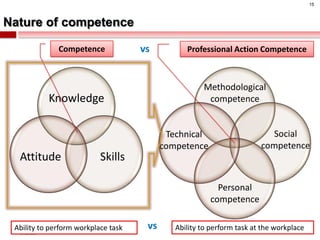
Nature of competence

              Competence             vs          Professional Action Competence


                                                      Methodological
           Knowledge                                   competence


                                            Technical                     Social
                                           competence                   competence
  Attitude                 Skills

                                                          Personal
                                                        competence

 Ability to perform workplace task    vs      Ability to perform task at the workplace
  © 2012
16
Nature of competence - Important considerations
for competence-based instructional design
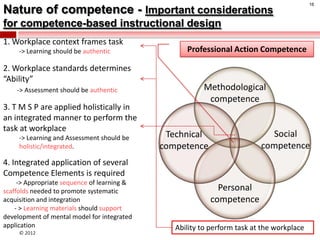
1. Workplace context frames task
     -> Learning should be authentic               Professional Action Competence

2. Workplace standards determines
“Ability”
    -> Assessment should be authentic                   Methodological
                                                         competence
3. T M S P are applied holistically in
an integrated manner to perform the
task at workplace
     -> Learning and Assessment should be     Technical                     Social
     holistic/integrated.                    competence                   competence
4. Integrated application of several
Competence Elements is required
     -> Appropriate sequence of learning &
scaffolds needed to promote systematic                      Personal
acquisition and integration                               competence
    - > Learning materials should support
development of mental model for integrated
application                                     Ability to perform task at the workplace
     © 2012
17
Nature of competence - Important considerations
for competence-based instructional design
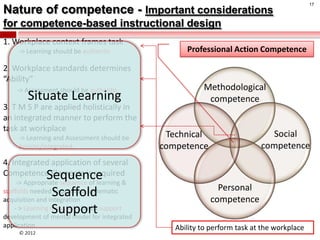
1. Workplace context frames task
     -> Learning should be authentic               Professional Action Competence

2. Workplace standards determines
“Ability”
    -> Assessment should be authentic                   Methodological
        Situate Learning                                 competence
3. T M S P are applied holistically in
an integrated manner to perform the
task at workplace
     -> Learning and Assessment should be     Technical                     Social
     holistic/integrated.                    competence                   competence
4. Integrated application of several
              Sequence
Competence Elements is required
     -> Appropriate sequence of learning &
                                                            Personal
               Scaffold
scaffolds needed to promote systematic
acquisition and integration                               competence
               Support
    - > Learning materials should support
development of mental model for integrated
application                                     Ability to perform task at the workplace
     © 2012
Analyse


      SITUATE LEARNING
19


Situate Learning

  Purpose
  • Provide authentic context for learning in terms of task
    performed at workplace
  • Set the stage for determining the
       – content (which Competence Units/Elements)
       – relationship between CU/CE hence nature of integrated application
         of CU/CE
       – MSP
       – relationship between T M S P hence the nature of integrated
         application of T M S P
  • Guide the design of learning activities/contexts to promote
    systematic acquisition of competence and develop cognitive
    flexibility to handle varying workplace situations

                               An Example

  © 2012
20


Situate Learning

       – Identifying authentic workplace task
       – Determining content, M S P and the relationships
       – Designing authentic contexts


                Keep a look out for future sessions


  © 2012
21


         Questions?


© 2012
Design Learning Structure


      IDENTIFY & SEQUENCE LEARNING
      CHUNKS
23


Structuring Learning – Sequence learning chunks

           Guidelines:
            Logical sequence, and/or

            Simple to complex

            Provide students with varied
             exposures

                               How to:
                      • Identify learning chunks
                     • Sequence learning chunks

                  Keep a look out for future sessions
  © 2012
Design Learning Activities/ Develop Learning Materials


       SCAFFOLD & SUPPORT
25


Scaffold & Support Learning

  • Design learning activities to
       - facilitate learners' processing, organising & retention of content
       - encourage learners to take ownership of their own learning


  • Design learning resources (e.g. instructional
    presentation, notes, activity sheets) that support
    learning

                                 How? – 2 suggestions
                      Apply Cognitive Load Theory
                   Promote Assessment for/as Learning


  © 2012
Scaffold & Support Learning                                      26


– Applying Cognitive Load Theory

                                    Main ideas

    • Working memory is limited while long term memory is
      not
    • Learning is about changes in the schematic structures
      of long term memory or increased automation
    • Well organised and highly connected schemas aids
           – retrieval of prior knowledge; and
           – processing of new information.
    • For effective schema acquisition (or learning) to occur,
      instruction should be designed to reduce the working
      memory load.


  © 2012
Scaffold & Support Learning                                          27


– Applying Cognitive Load Theory

                                What is cognitive load?

    • Cognitive load is the load in the working memory needed
      to process and encode the new information to enhance
      the schematic structures in the long term memory

    • 3 types of cognitive load
           – Intrinsic
           – Extraneous
           – Germane
                            Objectives of instructional design
                              - reduce extraneous load
                              - increase germane load
  © 2012                 More to be covered in future SIG sessions
28
Scaffold & Support Learning
– Applying Cognitive Load Theory

  • On your own
       – Study the 2 examples assigned to your group


  • In your group
       – Discuss
           • Which example better applied cognitive load theory? Why?

           You may want to refer to the following articles:
           http://www.instructionaldesign.org/theories/cognitive-load.html
           http://dixieching.wordpress.com/2010/02/28/cognitive-load-theory-learning-
           difficulty-and-instructional-design-sweller/
           http://www.southalabama.edu/oll/mobile/theory_workbook/cognitive_load_t
           heory.htm

       – Be prepared to share your group’s view with the class

                                                                     Strategy: Groupwork
  © 2012
29
Scaffold & Support Learning
– Applying Cognitive Load Theory

  • Post session discussion
       – Share 1 instance you have applied cognitive load
         theory
           • Briefly describe the instance, and
           • How you have applied cognitive load theory?
       – Comment on others application
       – Share your views on the relevance of cognitive load
         theory in designing quality learning activities and/or
         learning materials


  © 2012
30


         Questions?


© 2012
31


         Thank you


© 2012

Instructional Design for Competence-based Learning

  • 1.
    Sharing at Adult Education Network Special Interest Group (Instructional Design) Instructional Design for Competence-based Learning Tang Buay Choo buaytang@gmail.com
  • 2.
    2 Agenda Overview of Instructional Design • What is instructional Design? • ADDIE Instructional Design Model Nature of competence & its implication for instructional design Situate, sequence, scaffold & support Learning • Authentic & Integrated acquisition of competence • Cognitive Load Theory © 2012
  • 3.
    3 What is instructionaldesign? • What?…systematic development of instructional specifications, and supporting learning materials • How?…applying learning and instructional theories or research • Why?….to ensure the quality of instruction • Process includes… – analysis of learning needs and goals – design of a instructional activities to meet those needs – development of instructional materials and delivery systems – Implementation of learning activities – evaluation of effectiveness of learning activities Pre-session Activity Recall….Which instructional design (ID) models do you know? Write…List 2 to 3 ID models you know on a piece of paper. Write big enough for the class to see. You will be requested to show the class when the session starts. © 2012 Strategy: Entry Slip
  • 4.
    4 Instructional Design Models– which do you know? Pre-session Activity – cont’d • Recall….Which instructional design (ID) models do you know? • Write…List the ID models you know on a piece of paper. Write big enough for the class to see. • Show….Upon signal from the facilitator, hold your paper up and show the class the ID models you know. Strategy: Polling © 2012
  • 5.
    5 Instructional Design Models– some examples • ADDIE (Analysis, Design, Develop, Implement, Evaluate) • Hannifan and Peck • Dick and Carey Model • Knirk and Gustafson • Kemp, Morrison, and Ross • Rapid Prototyping • Gerlach and Ely Design Model • SAM (Successive Approximation Model) © 2012
  • 6.
    6 Instructional Design Models– some examples • ADDIE (Analysis, Design, Develop, Implement, Evaluate) • Hannifan and Peck • Dick and Carey Model widely adopted • Knirk and Gustafson Popular as a quick, lower cost alternative to the traditional ID process • Kemp, Morrison, and Ross • Rapid Prototyping • Gerlach and Ely Design Model • SAM (Successive Approximation Model) © 2012
  • 7.
    7 Instructional Design Model– ADDIE ANALYSIS • Analyse job/task/skills/knowledge/learner characteristics, leading to the specification of competencies and training objectives DESIGN • Determine training approach; • Select instructional strategies, media, technology, leading to the specification of instructional activities DEVELOPMENT •Develop lesson plans, instructional materials, media, exercises and tests IMPLEMENTATION • Setup/prepare facilities, • Conduct training EVALUATION • Assess learning • Conduct Student Feedback • Evaluate Outcomes/Student Feedback • Improve programme and training © 2012
  • 8.
    8 Instructional Design Model– ADDIE Analyse Implement Evaluate Design Develop © 2012
  • 9.
    9 Instructional Design Model– ADDIE Analyse - Where we are now and where do we want to go? Analyse Key Questions for Analysis • What are the “needs”? • Can they be addressed by instructions? • Who are the learners? • How best can technology be leveraged? • What are the competences? What are the knowledge? © 2012
  • 10.
    10 Instructional Design Model– ADDIE Design - How to promote learning? Design Key Questions for Design • What are the learning outcomes? • How can these be achieved? • How can the learners be engaged? • © 2012
  • 11.
    11 Instructional Design Model– ADDIE Develop - Translate the design into learning products Develop Key Questions for Development • What learning materials and/or resources can support learning? • What are effective design and development tools? © 2012
  • 12.
    12 Instructional Design Model– ADDIE Implement - Prepare, deliver and manage Implement Key Questions for Implementation • Is there buy-in from stakeholders? • What are the infrastructure/facilities requirements? • How best to organise the training? • How to prepare trainers? © 2012
  • 13.
    13 Instructional Design Model– ADDIE Evaluate - Determine effectiveness & outcomes of the training Evaluate Key Questions for Evaluation • What is effective training? • How do we find out the effectiveness of the training design, materials and delivery? • What are the desired outcomes of the training? • How can we find out whether the desired outcomes were attained? © 2012
  • 14.
    14 Instructional Design forCompetence-based learning Key purpose To facilitate learner acquisition of competence Activity: What is a competence? • Think… On your own think about – What is the definition of competence? – What are the elements of competence? • Write… Write your views on a piece of paper • Show… Upon signal from the facilitate, show your views to your group members • Discuss and negotiate… Within your group, discuss and come to a consensus on the definition and elements of a competence • Share… Present your group’s view on a flipchart. You can use any format, text, pictures, diagrams…. Strategy: Show Down © 2012
  • 15.
    15 Nature of competence Competence vs Professional Action Competence Methodological Knowledge competence Technical Social competence competence Attitude Skills Personal competence Ability to perform workplace task vs Ability to perform task at the workplace © 2012
  • 16.
    16 Nature of competence- Important considerations for competence-based instructional design 1. Workplace context frames task -> Learning should be authentic Professional Action Competence 2. Workplace standards determines “Ability” -> Assessment should be authentic Methodological competence 3. T M S P are applied holistically in an integrated manner to perform the task at workplace -> Learning and Assessment should be Technical Social holistic/integrated. competence competence 4. Integrated application of several Competence Elements is required -> Appropriate sequence of learning & scaffolds needed to promote systematic Personal acquisition and integration competence - > Learning materials should support development of mental model for integrated application Ability to perform task at the workplace © 2012
  • 17.
    17 Nature of competence- Important considerations for competence-based instructional design 1. Workplace context frames task -> Learning should be authentic Professional Action Competence 2. Workplace standards determines “Ability” -> Assessment should be authentic Methodological Situate Learning competence 3. T M S P are applied holistically in an integrated manner to perform the task at workplace -> Learning and Assessment should be Technical Social holistic/integrated. competence competence 4. Integrated application of several Sequence Competence Elements is required -> Appropriate sequence of learning & Personal Scaffold scaffolds needed to promote systematic acquisition and integration competence Support - > Learning materials should support development of mental model for integrated application Ability to perform task at the workplace © 2012
  • 18.
    Analyse SITUATE LEARNING
  • 19.
    19 Situate Learning Purpose • Provide authentic context for learning in terms of task performed at workplace • Set the stage for determining the – content (which Competence Units/Elements) – relationship between CU/CE hence nature of integrated application of CU/CE – MSP – relationship between T M S P hence the nature of integrated application of T M S P • Guide the design of learning activities/contexts to promote systematic acquisition of competence and develop cognitive flexibility to handle varying workplace situations An Example © 2012
  • 20.
    20 Situate Learning – Identifying authentic workplace task – Determining content, M S P and the relationships – Designing authentic contexts Keep a look out for future sessions © 2012
  • 21.
    21 Questions? © 2012
  • 22.
    Design Learning Structure IDENTIFY & SEQUENCE LEARNING CHUNKS
  • 23.
    23 Structuring Learning –Sequence learning chunks Guidelines:  Logical sequence, and/or  Simple to complex  Provide students with varied exposures How to: • Identify learning chunks • Sequence learning chunks Keep a look out for future sessions © 2012
  • 24.
    Design Learning Activities/Develop Learning Materials SCAFFOLD & SUPPORT
  • 25.
    25 Scaffold & SupportLearning • Design learning activities to - facilitate learners' processing, organising & retention of content - encourage learners to take ownership of their own learning • Design learning resources (e.g. instructional presentation, notes, activity sheets) that support learning How? – 2 suggestions Apply Cognitive Load Theory Promote Assessment for/as Learning © 2012
  • 26.
    Scaffold & SupportLearning 26 – Applying Cognitive Load Theory Main ideas • Working memory is limited while long term memory is not • Learning is about changes in the schematic structures of long term memory or increased automation • Well organised and highly connected schemas aids – retrieval of prior knowledge; and – processing of new information. • For effective schema acquisition (or learning) to occur, instruction should be designed to reduce the working memory load. © 2012
  • 27.
    Scaffold & SupportLearning 27 – Applying Cognitive Load Theory What is cognitive load? • Cognitive load is the load in the working memory needed to process and encode the new information to enhance the schematic structures in the long term memory • 3 types of cognitive load – Intrinsic – Extraneous – Germane Objectives of instructional design - reduce extraneous load - increase germane load © 2012 More to be covered in future SIG sessions
  • 28.
    28 Scaffold & SupportLearning – Applying Cognitive Load Theory • On your own – Study the 2 examples assigned to your group • In your group – Discuss • Which example better applied cognitive load theory? Why? You may want to refer to the following articles: http://www.instructionaldesign.org/theories/cognitive-load.html http://dixieching.wordpress.com/2010/02/28/cognitive-load-theory-learning- difficulty-and-instructional-design-sweller/ http://www.southalabama.edu/oll/mobile/theory_workbook/cognitive_load_t heory.htm – Be prepared to share your group’s view with the class Strategy: Groupwork © 2012
  • 29.
    29 Scaffold & SupportLearning – Applying Cognitive Load Theory • Post session discussion – Share 1 instance you have applied cognitive load theory • Briefly describe the instance, and • How you have applied cognitive load theory? – Comment on others application – Share your views on the relevance of cognitive load theory in designing quality learning activities and/or learning materials © 2012
  • 30.
    30 Questions? © 2012
  • 31.
    31 Thank you © 2012

Editor's Notes

  • #4 This slide will be shown before session starts. Participants will be requested to do this activity when they register. Participants who do not know any models will indicate “Nil”.[Resources – Need to provide A4 size paper at each table]
  • #15 ResourcesA4 paperPens or pencilsFlipchart paperMarkersMasking tape or Blu tack
  • #20 Need CS from WDA to design an example
  • #24 Notes to instructor:Explain the guidelines for sequencing learning chunks to facilitate effective competence acquisition.