“ 21st century’s teacher should be a
Techno-pedagogue ”
Techno-pedagogy
“Electronically mediated courses that integrate
sound pedagogic principles of teaching/learning
with the use of technology”
~H. Connors~
The objective is not to prepare technocrats, but to
develop techno-pedagogues.
Techno-pedagogy is the art of incorporating
technology in designing teaching learning experiences
so as to enrich the learning outcome
i.e., to make use of Internet technology, exploring it,
accessing information from it to use in teaching
learning process.
Scope of techno-pedagogy
• Enhance linguistic abilities
• Develop teaching learning process
• Improve to develop study materials
• Design multi-grade instruction
Scope of techno-pedagogy
• Plan specific pedagogy
• Support in Distance Education through e-
learning
• Guide and Counsel for career choices
• Stimulate Self Learning ability
• Enhance enrollment and examination process
Scope of techno-pedagogy
• Assist in research activities
• Reinforce for cognitive learning
• Development of life skills
• Develop aesthetic sensibility.
Techno-pedagogic Skills/
Competencies
• Skill to assess the potential and limits of
technologies for learning.
• Skill to carry out a need analysis to introduce
technologies in a pedagogical sequence.
• Skill to handle basic tools and applications, and
solve simple technical problems.
Techno-pedagogic Skills/
Competencies
• Skill to design appropriate tasks.
• Skill to design for intersections within and outside
the classroom.
• Skill to invest new and interactive technologies
congruence with the nature of the subject.
• Skill to manage time and optimize the integration
of technologies.
TPACK
TECHNOLOGICAL PEDAGOGICAL CONTENT
KNOWLEDGE
TPACK
TPACK is a frame work to understand and
describe the kinds of knowledge needed by a
teacher for effective pedagogical practice in a
technology enhanced learning environment.
It simply means the technological and
pedagogical analysis of content knowledge
TPACK
Mishra & Koehler added technology as a
modeling element to Lee Shulman’s Pedagogical
Content Knowledge (PCK).
Teachers, according to Shulman, need to master
the interaction between pedagogy and content in
order to implement strategies that help students
to fully understand the content.
TPACK
The TPACK framework extends Shulmans’ notion
of PCK by including knowledge of technology.
They proposed that addressing content knowledge,
pedagogical knowledge and technological knowledge
concurrently provides a frame work for
technological integration in the curriculum.
TPACK
The TPACK focuses on the mutual influence of
technological knowledge, pedagogical knowledge
and content knowledge so as to ensure fruitful
learning situation.
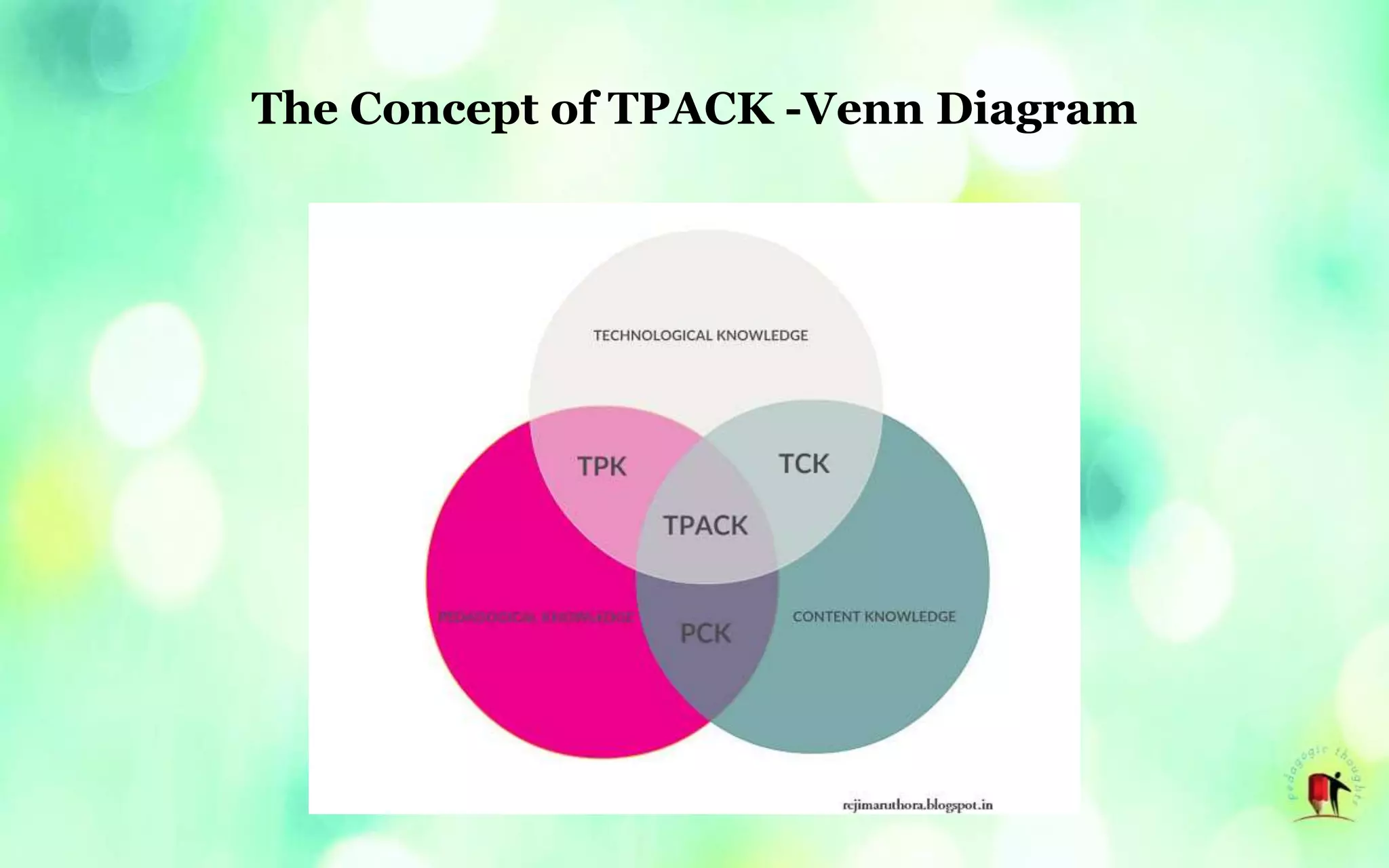
The Seven Components of TPACK
• Technological Knowledge (TK)
• Content Knowledge (CK)
• Pedagogical Knowledge (PK)
• Pedagogical Content Knowledge (PCK)
• Technological Content Knowledge (TCK)
• Technological Pedagogical Knowledge (TPK)
• Technological Pedagogical Content Knowledge
(TPACK)
The Concept of TPACK -Venn Diagram
Technological Knowledge (TK)
TK includes an understanding of how to use
computer software and hardware, presentation
tools such as document presenters and projects,
and other technologies used in educational
contexts.
Technological Knowledge (TK)
Knowledge about certain ways of thinking about and
working with technology, its tools and resources.
This includes understanding information technology
broadly enough to apply it productively at work and
everyday life, being able to recognize the role of IT in the
attainment of a goal and being able to adapt with changes
in the information technology.
Technological Knowledge (TK)
Nowadays, IT can be utilized for a variety of
pedagogical tasks, such as research,
communication, media consumption and
creation.
Content Knowledge (CK)
CK refers to the teacher’s knowledge about the subject
matter to be learned or taught.
This includes the knowledge about scientific terms, facts,
concepts, laws, principles, hypotheses, theories, ideas as
well as established practices and approaches towards
developing such knowledge.
In short, CK represents the subject competency of the
teacher.
Pedagogical Knowledge (PK)
Pedagogical knowledge is the set of skills that
teachers must develop in order to manage and
organize teaching and learning activities for
intended learning outcomes. It is the teacher’s
deeper knowledge about the processes/practices and
methods/techniques of teaching and learning.
Pedagogical Knowledge (PK)
This knowledge involves, understanding how
students learn, understanding of classroom
management activities, the role of student
motivation, lesson planning, proper use of
improvised learning aids for knowledge
construction and assessment of learning.
Pedagogical Knowledge (PK)
In short PK refers to the conducive way of
planning, organizing and executing the teaching
learning process so as to ensure maximum
output.
Pedagogical Content Knowledge (PCK)
PCK refers to the knowledge of understanding the unique
interplay between content and pedagogy.
The nature of the subject/topic, psychology of the learner,
psychology of learning etc. are the important factors that
determine the appropriate selection of the
methods/techniques for teaching.
(e.g.; art, drama, puppetry, role play, nature rambling,
field trips, laboratory method, project method etc.)
Pedagogical Content Knowledge (PCK)
The teacher interprets the subject matter
(CK- facts, concepts, principles etc.), finds multiple
ways to represent it (method), and adopts most
suitable instructional materials (learning aids),
based on students’ prior knowledge.
This promotes fruitful learning by interlinking
pedagogy, assessment and curriculum.
Technological Content Knowledge (TCK)
TCK describes knowledge of the reciprocal relationship
between technology and content.
An understanding of the manner in which technology and
content influences one another.
Teachers need to master more than the subject matter
they teach; also they must have deep understanding of the
manner in which the subject matter can be changed by the
application of particular technologies.
Technological Content Knowledge (TCK)
Teacher should be aware of the innovative
technologies available in the global market for the
effective transaction of the subject matter.
E.g,: Edubuntu, Virtual Labs, Virtual field trips, e-
brary, educational software like Kalzium, Dynamic
periodic table, Celestia, Rasmol, PhET etc.
Technological Pedagogical Knowledge (TPK)
TPK identifies the reciprocal relationship
between technology and pedagogy.
An understanding of how teaching and learning
can change when technologies are used in
particular ways.
This includes knowing technological tools for
appropriate pedagogical designs and strategies
Technological Pedagogical Knowledge (TPK)
Technological pedagogical knowledge makes it
possible to understand what technology can do
for certain pedagogic goals, and for teachers to
select the most appropriate tool based on its
appropriateness for the specific pedagogical
approach.
Technological Pedagogical Knowledge (TPK)
For example, collaborative writing can take place
with Google Docs or Google Hangouts instead of
face-to-face meetings, extending collaborative
activities over distances.
Technological Pedagogical Knowledge (TPK)
The advent of online learning is an outcome of
techno-pedagogical knowledge.
Incorporating technological knowledge in
pedagogical designs and strategies.
LMS, MOOCs, MOODLE etc. are best examples.
Technological Pedagogical Content Knowledge
(TPACK)
TPACK as a synthezised resource of Technological
knowledge (TK), Content knowledge (CK), Pedagogical
knowledge (PK), Pedagogical content knowledge (PCK),
Technological content knowledge (TCK), Technological
pedagogical knowledge (TPK) with a focus upon how
technology can be uniquely crafted to meet pedagogical
needs to teach certain content in specific contexts so as to
ensure fruitful learning.
TPACK as a tool for effective learning;
• As a knowledge for the representation of
concepts using technologies.
• As a knowledge about pedagogical techniques
that use technologies in constructive way to
teach the content.
TPACK as a tool for effective learning;
• As a knowledge of how technology makes
concepts difficult or easy to learn and how
technology can help to redress some of the
problems that learners’ face.
21st century is the digital era of global learning.
We the teachers should be competent in
advanced techno-pedagogical skills.
As a knowledge of students’ prior knowledge and
theories of epistemology and knowledge of how
technologies can be used to build on existing
knowledge to develop new epistemology or
strengthen old ones.
pedagogicthoughts.blogspot.in

TPCK

  • 2.
    “ 21st century’steacher should be a Techno-pedagogue ”
  • 3.
    Techno-pedagogy “Electronically mediated coursesthat integrate sound pedagogic principles of teaching/learning with the use of technology” ~H. Connors~
  • 4.
    The objective isnot to prepare technocrats, but to develop techno-pedagogues.
  • 5.
    Techno-pedagogy is theart of incorporating technology in designing teaching learning experiences so as to enrich the learning outcome
  • 6.
    i.e., to makeuse of Internet technology, exploring it, accessing information from it to use in teaching learning process.
  • 7.
    Scope of techno-pedagogy •Enhance linguistic abilities • Develop teaching learning process • Improve to develop study materials • Design multi-grade instruction
  • 8.
    Scope of techno-pedagogy •Plan specific pedagogy • Support in Distance Education through e- learning • Guide and Counsel for career choices • Stimulate Self Learning ability • Enhance enrollment and examination process
  • 9.
    Scope of techno-pedagogy •Assist in research activities • Reinforce for cognitive learning • Development of life skills • Develop aesthetic sensibility.
  • 10.
    Techno-pedagogic Skills/ Competencies • Skillto assess the potential and limits of technologies for learning. • Skill to carry out a need analysis to introduce technologies in a pedagogical sequence. • Skill to handle basic tools and applications, and solve simple technical problems.
  • 11.
    Techno-pedagogic Skills/ Competencies • Skillto design appropriate tasks. • Skill to design for intersections within and outside the classroom. • Skill to invest new and interactive technologies congruence with the nature of the subject. • Skill to manage time and optimize the integration of technologies.
  • 12.
  • 13.
    TPACK TPACK is aframe work to understand and describe the kinds of knowledge needed by a teacher for effective pedagogical practice in a technology enhanced learning environment. It simply means the technological and pedagogical analysis of content knowledge
  • 14.
    TPACK Mishra & Koehleradded technology as a modeling element to Lee Shulman’s Pedagogical Content Knowledge (PCK). Teachers, according to Shulman, need to master the interaction between pedagogy and content in order to implement strategies that help students to fully understand the content.
  • 15.
    TPACK The TPACK frameworkextends Shulmans’ notion of PCK by including knowledge of technology. They proposed that addressing content knowledge, pedagogical knowledge and technological knowledge concurrently provides a frame work for technological integration in the curriculum.
  • 16.
    TPACK The TPACK focuseson the mutual influence of technological knowledge, pedagogical knowledge and content knowledge so as to ensure fruitful learning situation.
  • 17.
    The Seven Componentsof TPACK • Technological Knowledge (TK) • Content Knowledge (CK) • Pedagogical Knowledge (PK) • Pedagogical Content Knowledge (PCK) • Technological Content Knowledge (TCK) • Technological Pedagogical Knowledge (TPK) • Technological Pedagogical Content Knowledge (TPACK)
  • 18.
    The Concept ofTPACK -Venn Diagram
  • 19.
    Technological Knowledge (TK) TKincludes an understanding of how to use computer software and hardware, presentation tools such as document presenters and projects, and other technologies used in educational contexts.
  • 20.
    Technological Knowledge (TK) Knowledgeabout certain ways of thinking about and working with technology, its tools and resources. This includes understanding information technology broadly enough to apply it productively at work and everyday life, being able to recognize the role of IT in the attainment of a goal and being able to adapt with changes in the information technology.
  • 21.
    Technological Knowledge (TK) Nowadays,IT can be utilized for a variety of pedagogical tasks, such as research, communication, media consumption and creation.
  • 22.
    Content Knowledge (CK) CKrefers to the teacher’s knowledge about the subject matter to be learned or taught. This includes the knowledge about scientific terms, facts, concepts, laws, principles, hypotheses, theories, ideas as well as established practices and approaches towards developing such knowledge. In short, CK represents the subject competency of the teacher.
  • 23.
    Pedagogical Knowledge (PK) Pedagogicalknowledge is the set of skills that teachers must develop in order to manage and organize teaching and learning activities for intended learning outcomes. It is the teacher’s deeper knowledge about the processes/practices and methods/techniques of teaching and learning.
  • 24.
    Pedagogical Knowledge (PK) Thisknowledge involves, understanding how students learn, understanding of classroom management activities, the role of student motivation, lesson planning, proper use of improvised learning aids for knowledge construction and assessment of learning.
  • 25.
    Pedagogical Knowledge (PK) Inshort PK refers to the conducive way of planning, organizing and executing the teaching learning process so as to ensure maximum output.
  • 26.
    Pedagogical Content Knowledge(PCK) PCK refers to the knowledge of understanding the unique interplay between content and pedagogy. The nature of the subject/topic, psychology of the learner, psychology of learning etc. are the important factors that determine the appropriate selection of the methods/techniques for teaching. (e.g.; art, drama, puppetry, role play, nature rambling, field trips, laboratory method, project method etc.)
  • 27.
    Pedagogical Content Knowledge(PCK) The teacher interprets the subject matter (CK- facts, concepts, principles etc.), finds multiple ways to represent it (method), and adopts most suitable instructional materials (learning aids), based on students’ prior knowledge. This promotes fruitful learning by interlinking pedagogy, assessment and curriculum.
  • 28.
    Technological Content Knowledge(TCK) TCK describes knowledge of the reciprocal relationship between technology and content. An understanding of the manner in which technology and content influences one another. Teachers need to master more than the subject matter they teach; also they must have deep understanding of the manner in which the subject matter can be changed by the application of particular technologies.
  • 29.
    Technological Content Knowledge(TCK) Teacher should be aware of the innovative technologies available in the global market for the effective transaction of the subject matter. E.g,: Edubuntu, Virtual Labs, Virtual field trips, e- brary, educational software like Kalzium, Dynamic periodic table, Celestia, Rasmol, PhET etc.
  • 30.
    Technological Pedagogical Knowledge(TPK) TPK identifies the reciprocal relationship between technology and pedagogy. An understanding of how teaching and learning can change when technologies are used in particular ways. This includes knowing technological tools for appropriate pedagogical designs and strategies
  • 31.
    Technological Pedagogical Knowledge(TPK) Technological pedagogical knowledge makes it possible to understand what technology can do for certain pedagogic goals, and for teachers to select the most appropriate tool based on its appropriateness for the specific pedagogical approach.
  • 32.
    Technological Pedagogical Knowledge(TPK) For example, collaborative writing can take place with Google Docs or Google Hangouts instead of face-to-face meetings, extending collaborative activities over distances.
  • 33.
    Technological Pedagogical Knowledge(TPK) The advent of online learning is an outcome of techno-pedagogical knowledge. Incorporating technological knowledge in pedagogical designs and strategies. LMS, MOOCs, MOODLE etc. are best examples.
  • 34.
    Technological Pedagogical ContentKnowledge (TPACK) TPACK as a synthezised resource of Technological knowledge (TK), Content knowledge (CK), Pedagogical knowledge (PK), Pedagogical content knowledge (PCK), Technological content knowledge (TCK), Technological pedagogical knowledge (TPK) with a focus upon how technology can be uniquely crafted to meet pedagogical needs to teach certain content in specific contexts so as to ensure fruitful learning.
  • 35.
    TPACK as atool for effective learning; • As a knowledge for the representation of concepts using technologies. • As a knowledge about pedagogical techniques that use technologies in constructive way to teach the content.
  • 36.
    TPACK as atool for effective learning; • As a knowledge of how technology makes concepts difficult or easy to learn and how technology can help to redress some of the problems that learners’ face.
  • 37.

    21st century isthe digital era of global learning. We the teachers should be competent in advanced techno-pedagogical skills.
  • 38.
    As a knowledgeof students’ prior knowledge and theories of epistemology and knowledge of how technologies can be used to build on existing knowledge to develop new epistemology or strengthen old ones.
  • 39.