
Sharing at

        Institute of Adult Learning, Singapore
               Adult Education Network
                 Special Interest Group
                  (Instructional Design)


Whole Task Approach to Holistic Learning
of Vocational Competences


                   Tang B
                   T    Buay Ch
                             Choo
                 buaytang@gmail.com
While waiting for the session to start
At your table,
• Di
   Discuss th diff
           the difference b t
                          between
       • Holistic Education
       • Holistic Learning of Competence
• Get one of the members to post your table’s view at the
  Facebook ID SIG 13 Jan Group.    p
  If none of you are member of the Facebook Group, post
   your table’s view of a flip chart
• You may want to refer to the following articles (printed
   copies at your table):
    Holistic education: An interpretation for teachers in the IB programmes
   http://blogs.ibo.org/positionpapers/files/2010/09/Holistic-education_John-Hare.pdf

  Structural characteristics and target categories of holistic vocational training
               www.cedefop.europa.eu/etv/Upload/.../122/17_en_ott.pdf
Outline
• Recap: Concept of competence
• Holistic Education vs Holistic Learning of Competence
• Why Holistic Learning of competence?
• Whole Task Approach to Holistic Learning of
  Competence
• Components of a Whole Task
• Holistic Design for complex competence-based learning
  – an introduction
Recap:
Instructional Design for Competence-based learning

                                 Key purpose

           To facilitate learner acquisition of competence

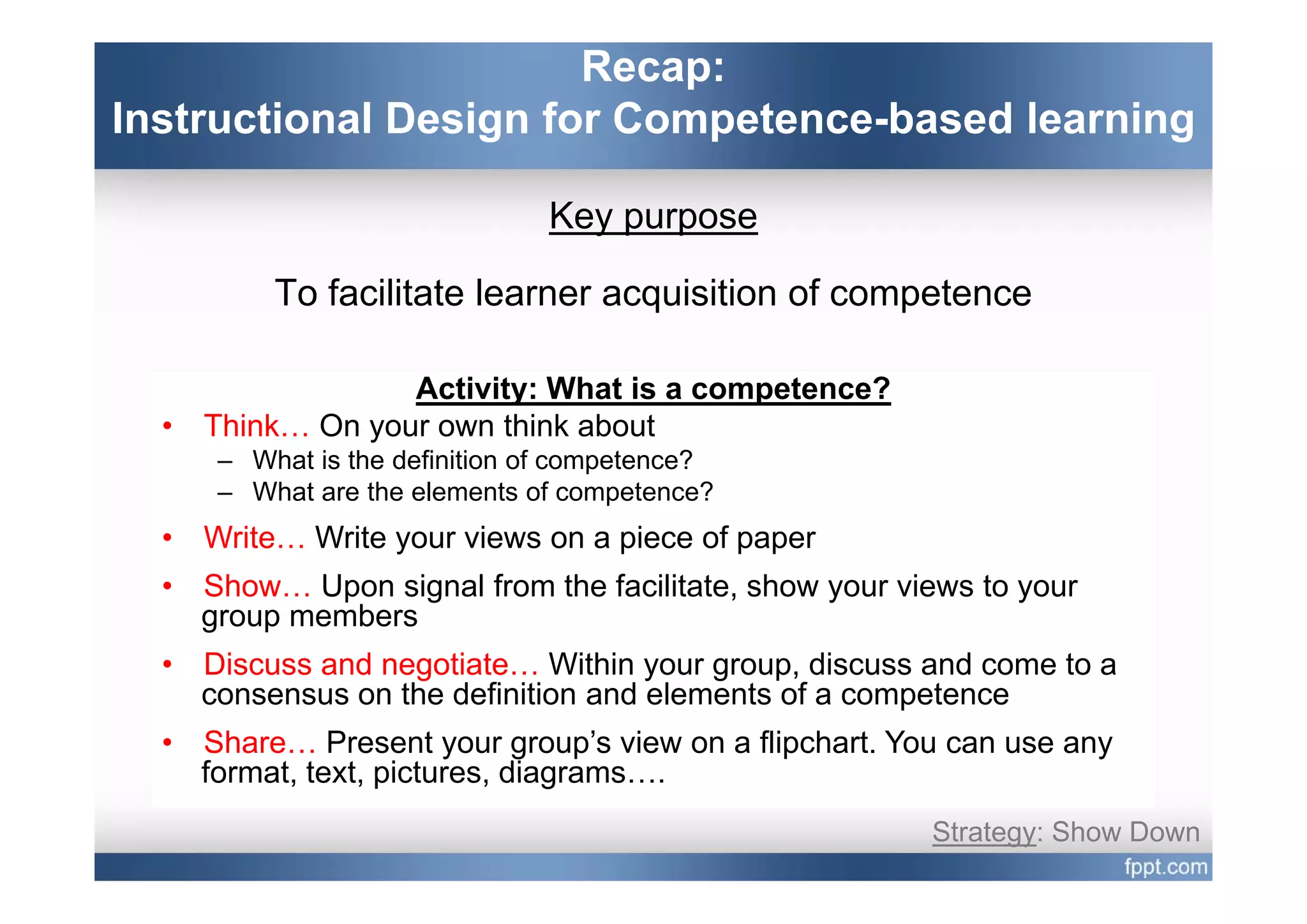
                   Activity: What is a competence?
  •   Think… On your own think about
       – What is the definition of competence?
       – What are the elements of competence?
  •   Write… Write your views on a piece of paper
  •   Show… Upon signal from the facilitate, show your views to your
      group members
  •   Discuss and negotiate Within your group discuss and come to a
                  negotiate…              group,
      consensus on the definition and elements of a competence
  •   Share… Present your group’s view on a flipchart. You can use any
      format, text pictures, diagrams….
      format text, pictures diagrams
                                                         Strategy: Show Down
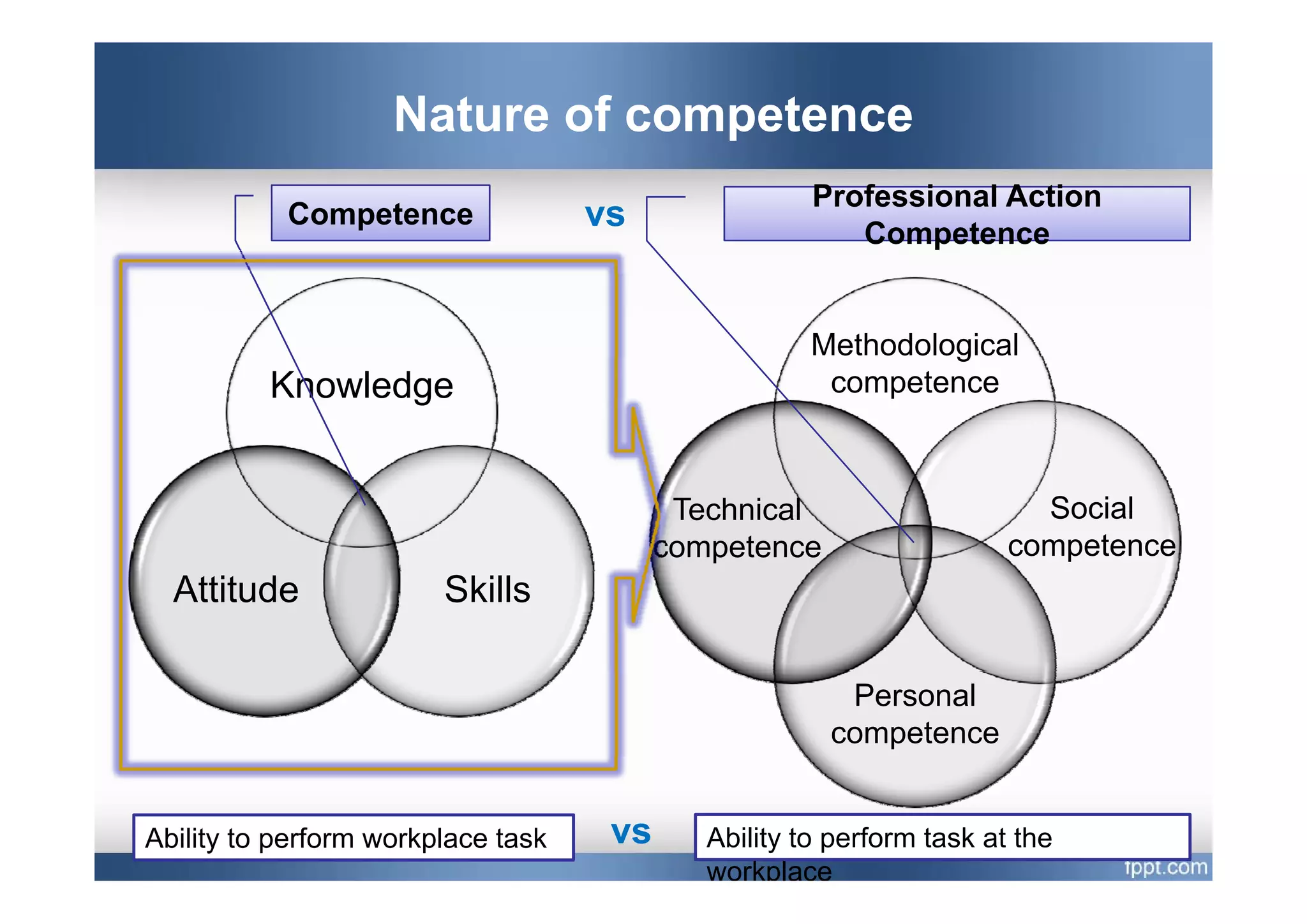
Nature of competence
                                                      Professional Action
                                                      P f    i   l A ti
           Competence               vs                   Competence


                                                      Methodological
                                                               g
          Knowledge                                    competence


                                           Technical                     Social
                                          competence                   competence
  Attitude              Skills

                                                        Personal
                                                       competence


Ability to perform workplace task    vs      Ability to perform task at the
                                             workplace
Nature of competence –
   Important considerations for competence-based instructional design
                                competence based
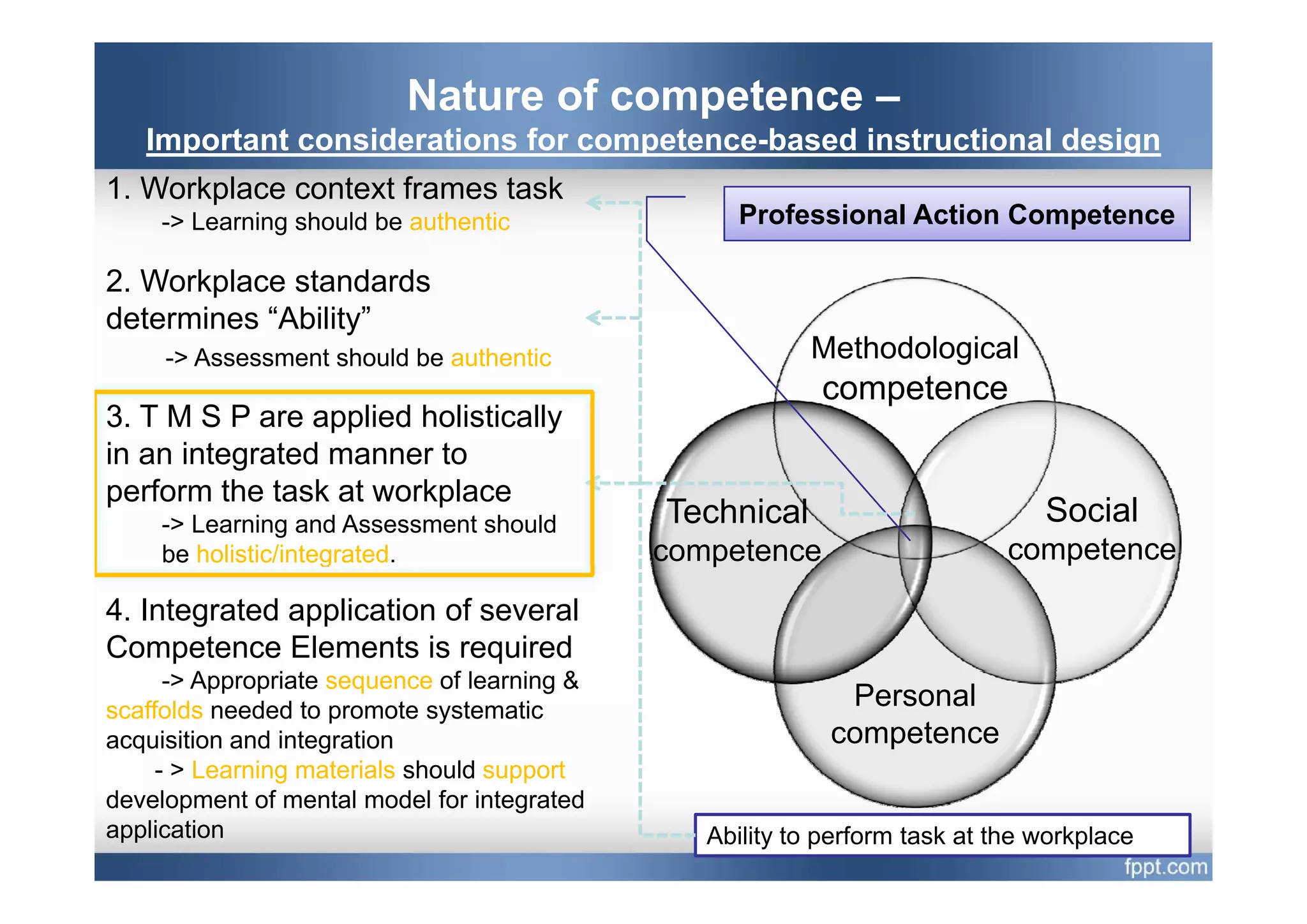
1. Workplace context frames task
     -> Learning should be authentic                Professional Action Competence

2. Workplace standards
determines “Ability”
     -> Assessment should be authentic
      >                                                   Methodological
                                                           competence
3. T M S P are applied holistically
in an integrated manner to
perform the task at workplace
     -> Learning and Assessment should        Technical                         Social
     be holistic/integrated.
                     g                        competence
                                                 p                           competence
4. Integrated application of several
Competence Elements is required
      -> A
         Appropriate sequence of learning &
                i               fl    i
scaffolds needed to promote systematic
                                                             Personal
acquisition and integration                                 competence
     - > Learning materials should support
development of mental model for integrated
application                                      Ability to perform task at the workplace
Holistic Learning and Holistic Education
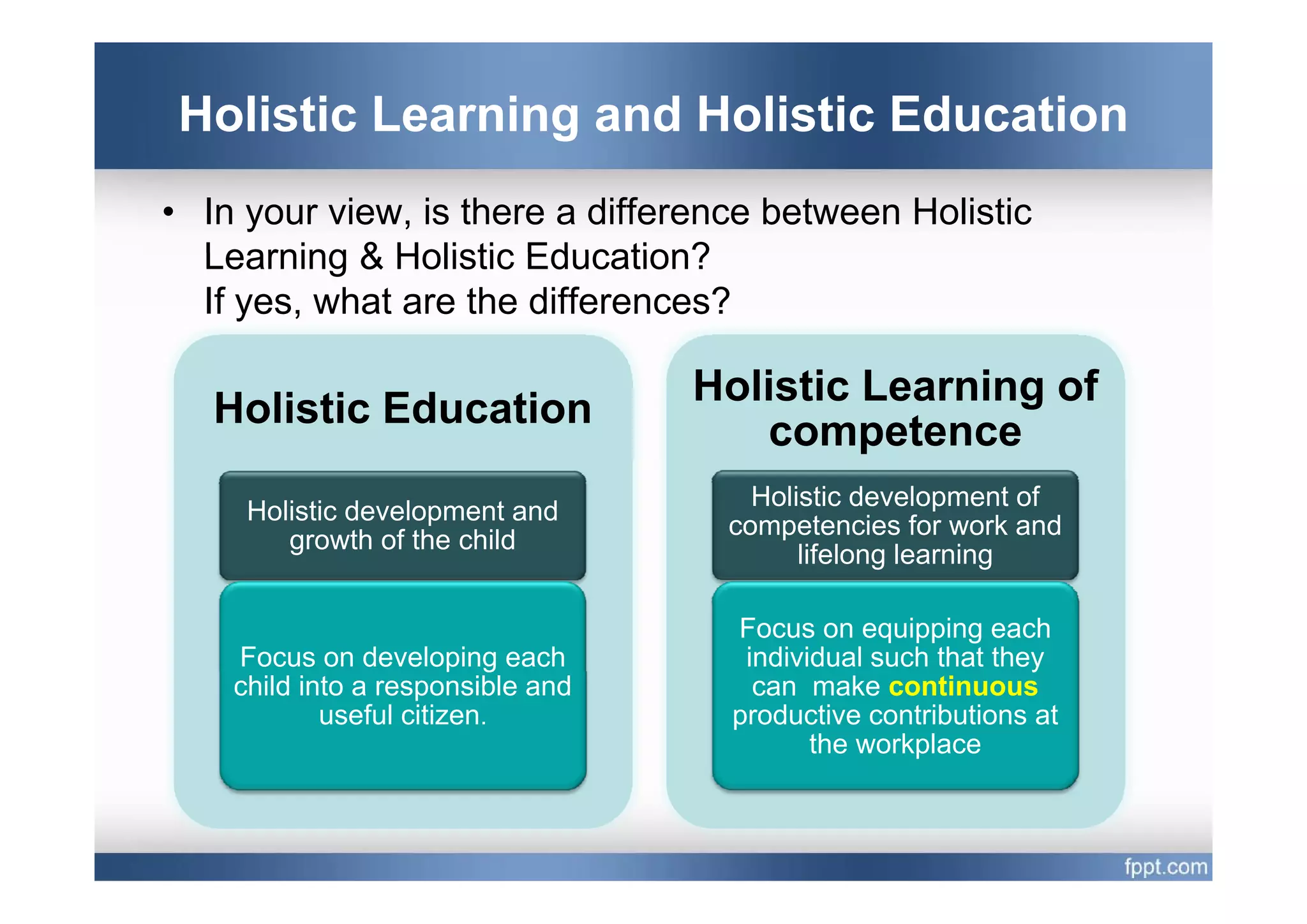
• In your view, is there a difference between Holistic
  Learning & Holistic Education?
  If yes, what are the differences?

                                   Holistic Learning of
   Holistic Education
                                      competence
                                      Holistic development of
     Holistic development and
                                    competencies for work and
        growth of the child
                                          lifelong learning
                                                 g        g

                                    Focus on equipping each
    Focus on developing each
                        p g          individual such that they
                                                             y
    child into a responsible and      can make continuous
            useful citizen.         productive contributions at
                                           the workplace
Why Holistic Learning of Competence?
• Read the story “Every Curriculum Tells A Story” by
  Roger Schank
  http://www.socraticarts.com/docs/SCCwhitepaper.pdf
            Activity: Wh t i
            A ti it What is wrong with the curriculum?
                                         ith th i l ?
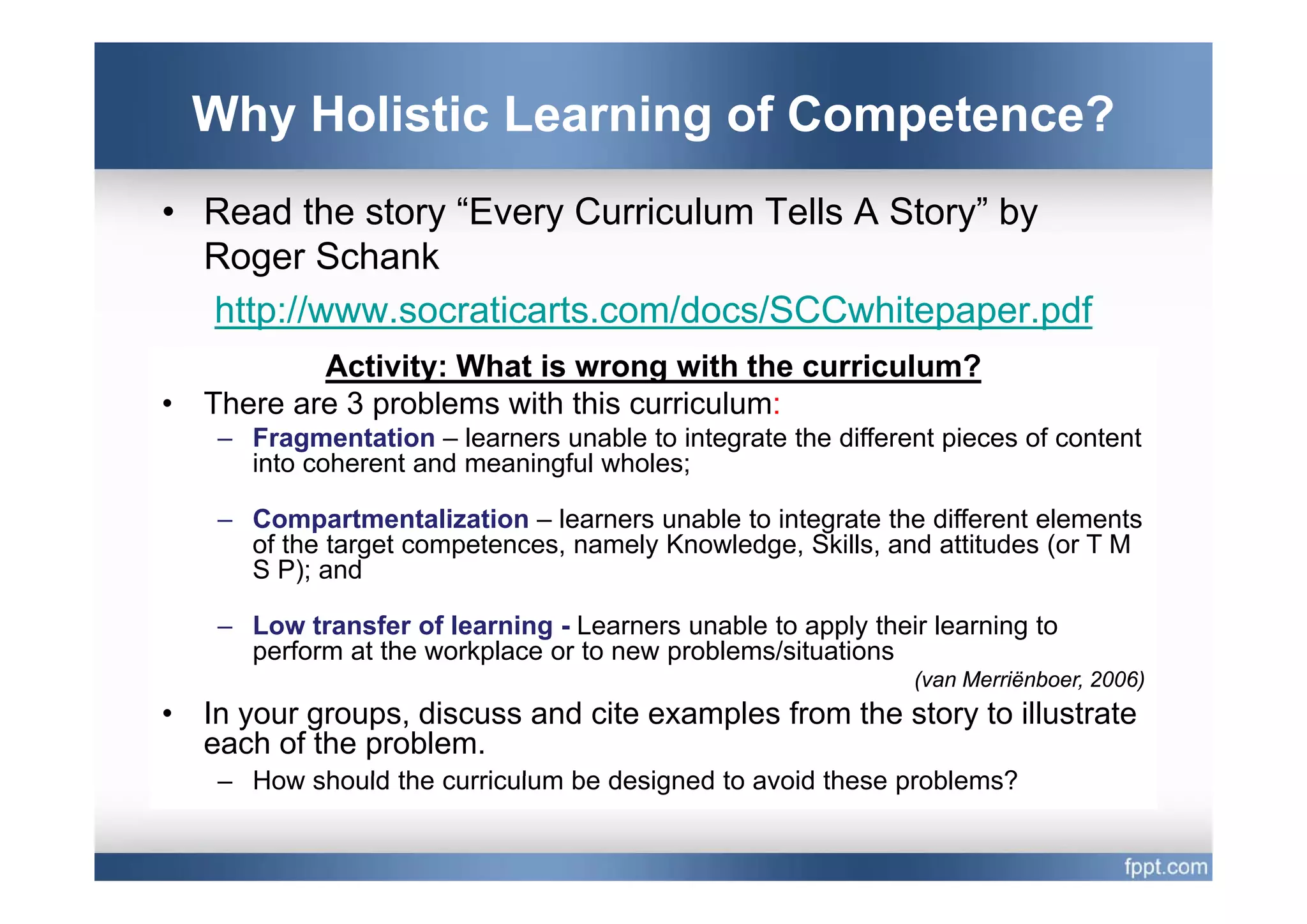
•   There are 3 problems with this curriculum:
     – Fragmentation – learners unable to integrate the different pieces of content
       into coherent and meaningful wholes;

     – Compartmentalization – learners unable to integrate the different elements
       of the target competences, namely Knowledge, Skills, and attitudes (or T M
       S P); and

     – Low transfer of learning - Learners unable to apply their learning to
       perform at the workplace or to new problems/situations
                                                               (van M i b
                                                               (    Merriënboer, 2006)
•   In your groups, discuss and cite examples from the story to illustrate
    each of the problem.
     – How should the curriculum be designed to avoid these problems?
Why Holistic Learning of Competence?
                      Theoretical Basis
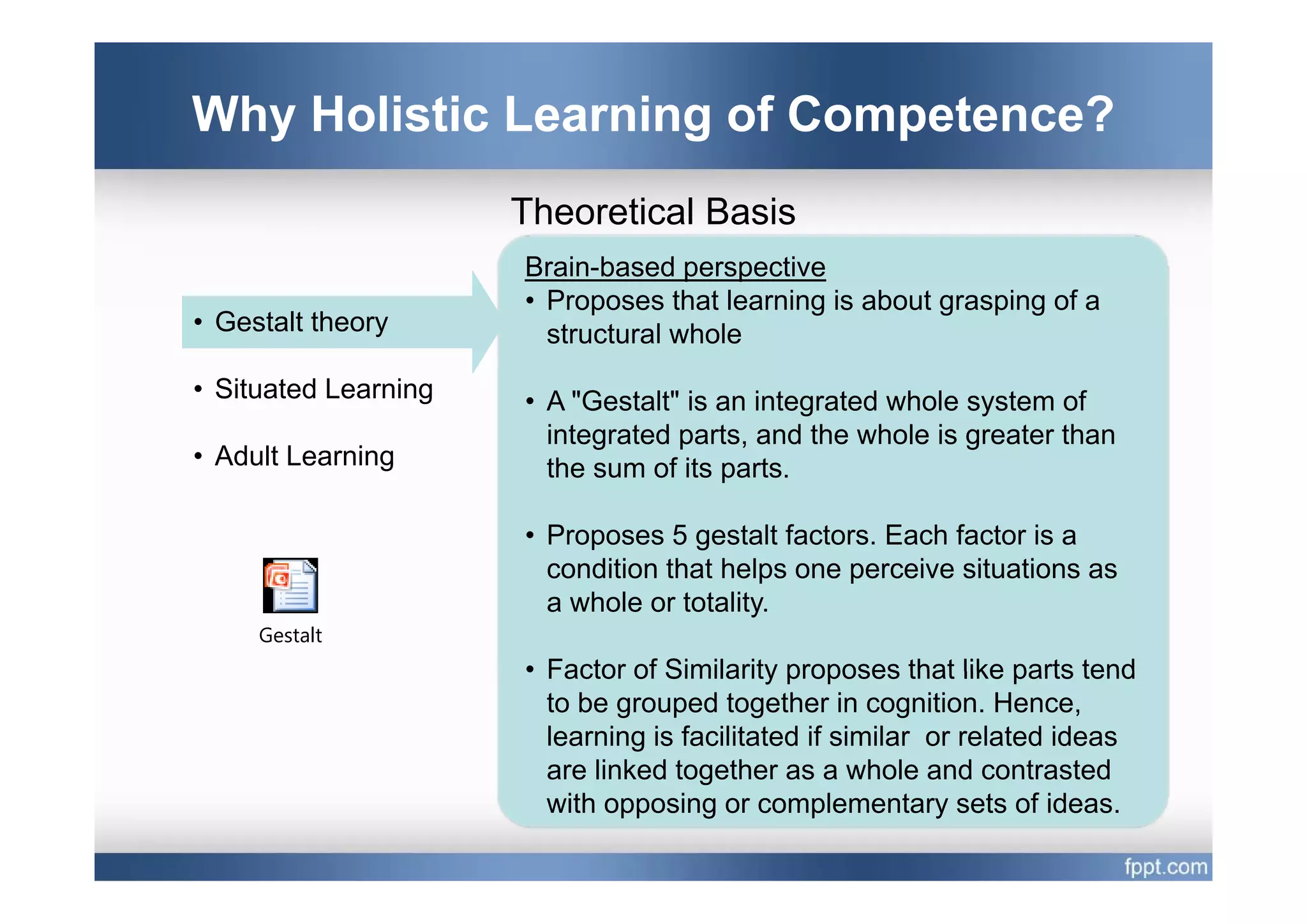
                      Brain-based perspective
                      • Proposes that learning is about grasping of a
• Gestalt theory        structural whole
• Situated Learning   • A "Gestalt" is an integrated whole system of
                        integrated parts, and the whole is greater than
• Adult Learning        the
                        th sum of its parts.
                                  f it     t

                      • Proposes 5 gestalt factors. Each factor is a
                        condition that helps one perceive situations as
                        a whole or totality.
     Gestalt
                      • Factor of Similarity proposes that like parts tend
                        to be grouped together in cognition. Hence,
                        learning is facilitated if similar or related ideas
                        are linked together as a whole and contrasted
                        with opposing or complementary sets of ideas.
Why Holistic Learning of Competence?
                      Theoretical Basis
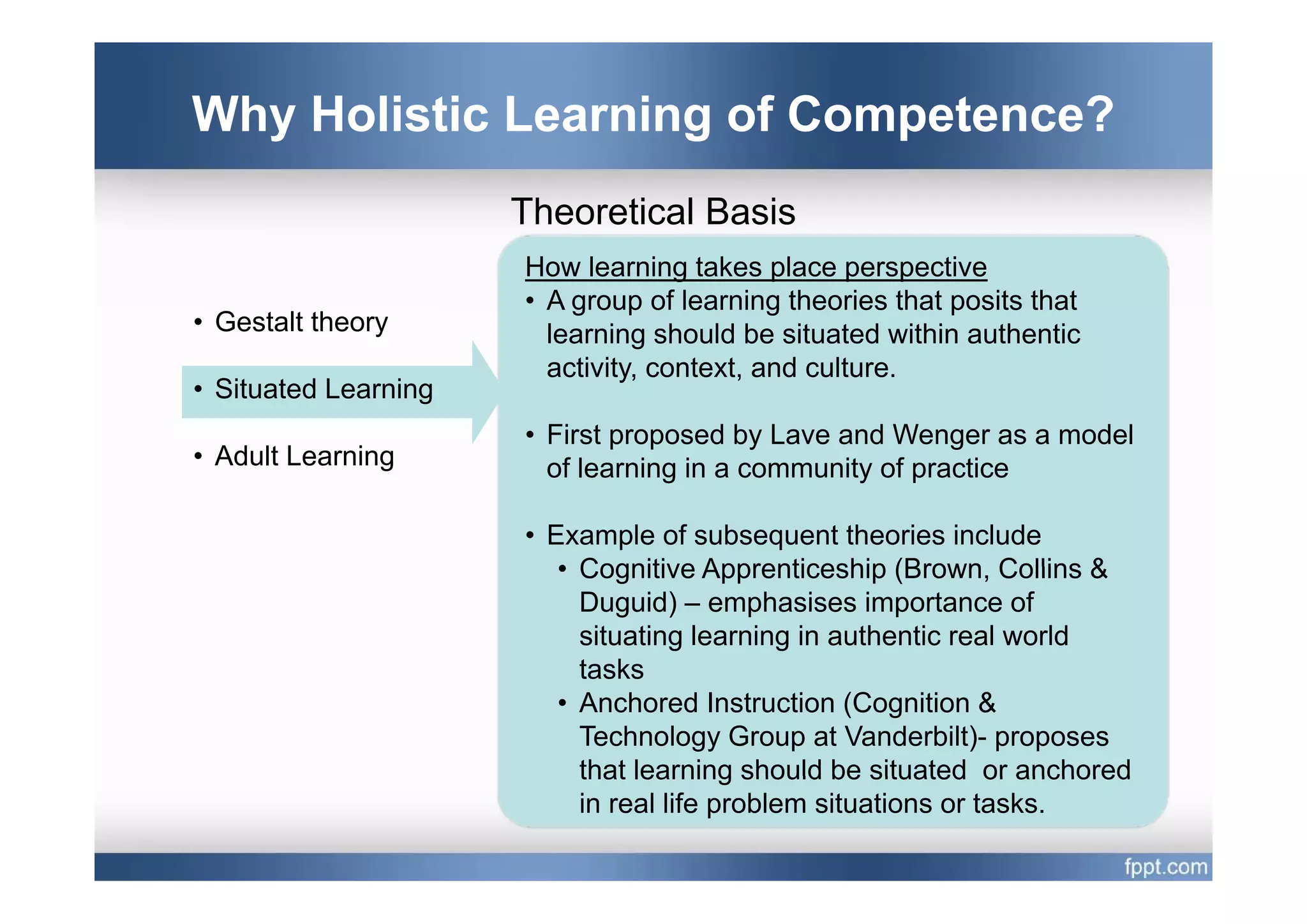
                      How learning takes place perspective
                      • A group of learning theories that posits that
• Gestalt theory        learning should be situated within authentic
                           i i               d l
                        activity, context, and culture.
• Situated Learning
                      • First proposed by Lave and Wenger as a model
• Adult Learning        of learning i a community of practice
                         fl     i in           it f      ti

                      • Example of subsequent theories include
                         • Cognitive Apprenticeship (Brown, Collins &
                                                       (Brown
                           Duguid) – emphasises importance of
                           situating learning in authentic real world
                           tasks
                         • Anchored Instruction (Cognition &
                           Technology Group at Vanderbilt)- proposes
                           that learning should be situated or anchored
                           in real life problem situations or tasks.
Why Holistic Learning of Competence?
                      Theoretical Basis
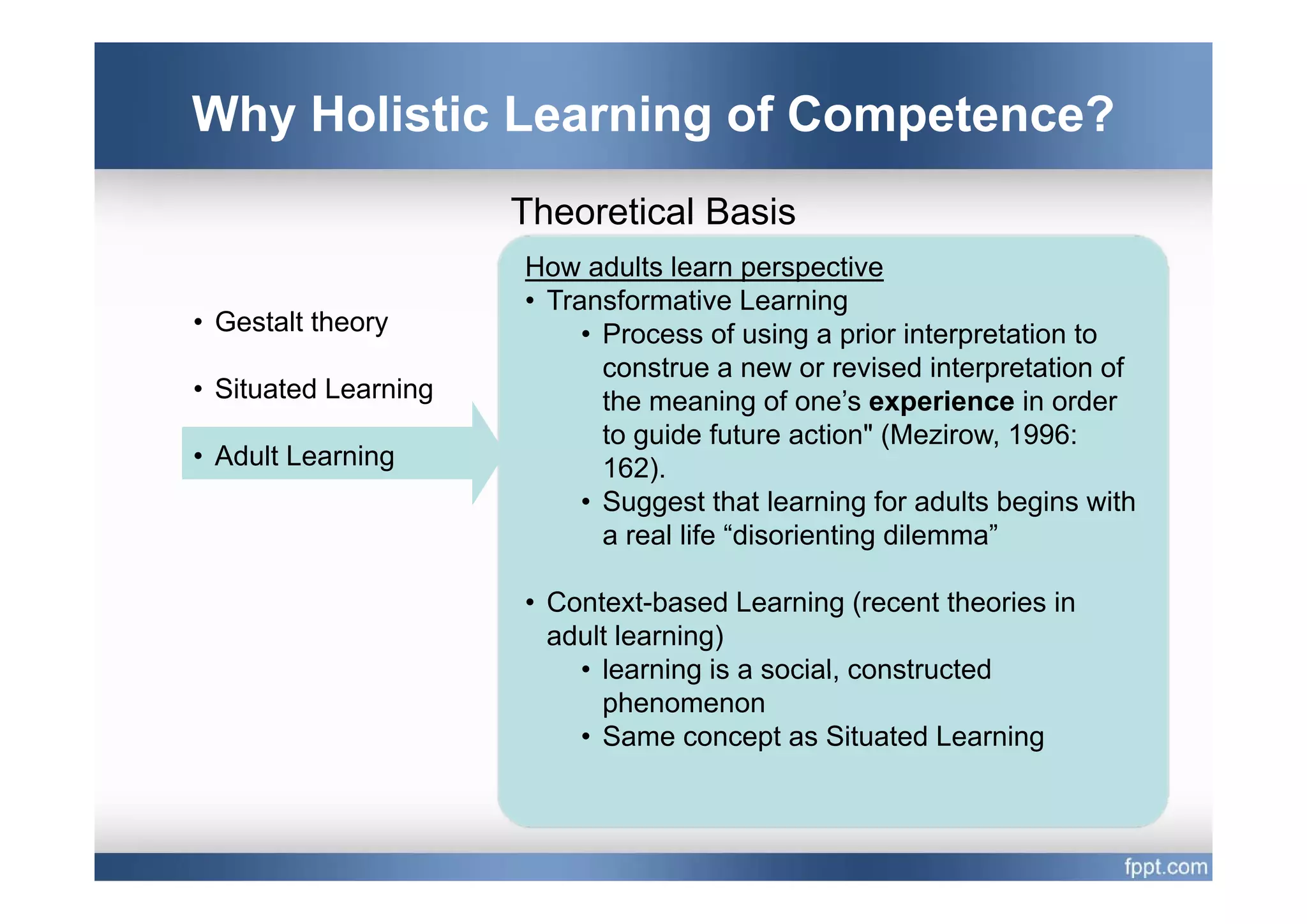
                      How adults learn perspective
                      • Transformative Learning
• Gestalt theory           • Process of using a prior interpretation to
                             construe a new or revised i
                                                      i d interpretation of
                                                                     i    f
• Situated Learning          the meaning of one’s experience in order
                             to guide future action" (Mezirow, 1996:
• Adult Learning             162).
                             162)
                           • Suggest that learning for adults begins with
                             a real life “disorienting dilemma”

                      • Context-based Learning (recent theories in
                        adult learning)
                          • learning is a social constructed
                                          social,
                            phenomenon
                          • Same concept as Situated Learning
Why Holistic Learning of Competence?
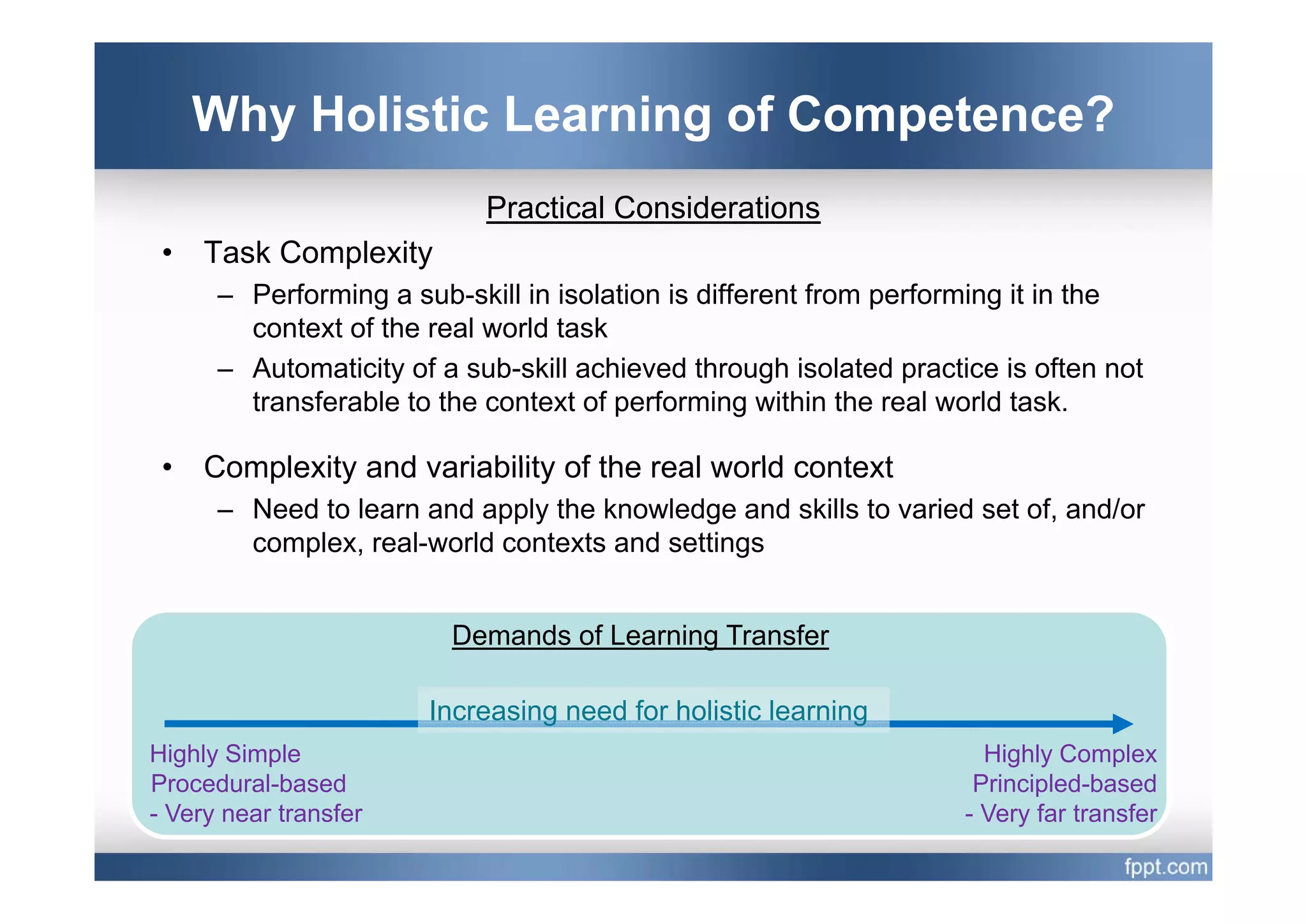
                            Practical Considerations
 •   Task Complexity
      – Performing a sub-skill in isolation is different from performing it in the
        context of the real world task
      – Automaticity of a sub-skill achieved through isolated practice is often not
        transferable to the context of performing within the real world task.

 •   Complexity and variability of the real world context
      – Need to learn and apply the knowledge and skills to varied set of, and/or
        complex, real-world contexts and settings


                         Demands of Learning Transfer

                       Increasing need for holistic learning
Highly Simple                                                         Highly Complex
Procedural-based
P     d lb       d                                                   Principled-based
                                                                     Pi i l db        d
- Very near transfer                                                - Very far transfer
Whole Task Approach
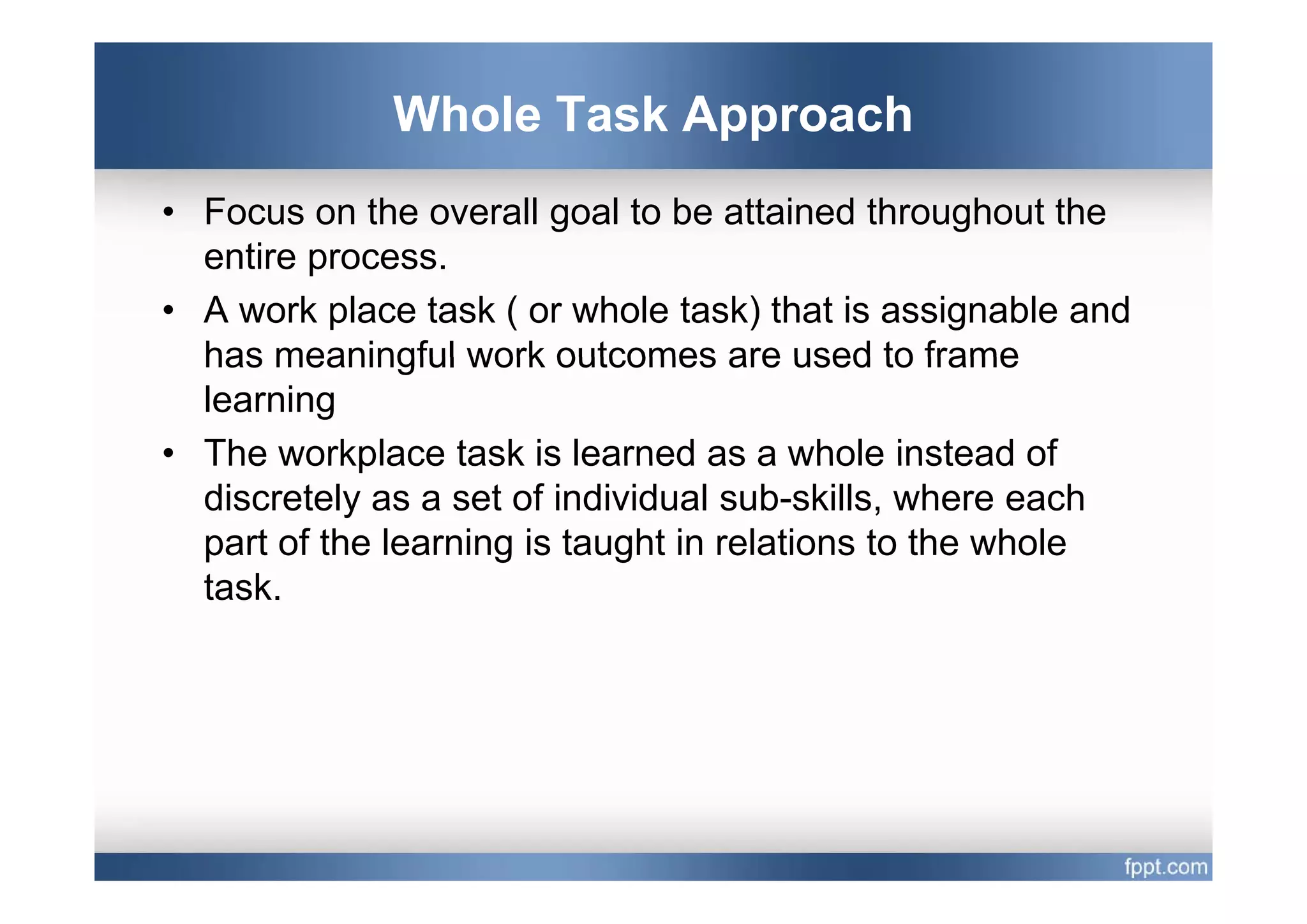
• Focus on the overall goal to be attained throughout the
  entire process
         process.
• A work place task ( or whole task) that is assignable and
  has meaningful work outcomes are used to frame
  learning
• The workplace task is learned as a whole instead of
  discretely as a set of individual sub-skills, where each
  part of the learning is taught in relations to the whole
  task.
Whole Task Approach
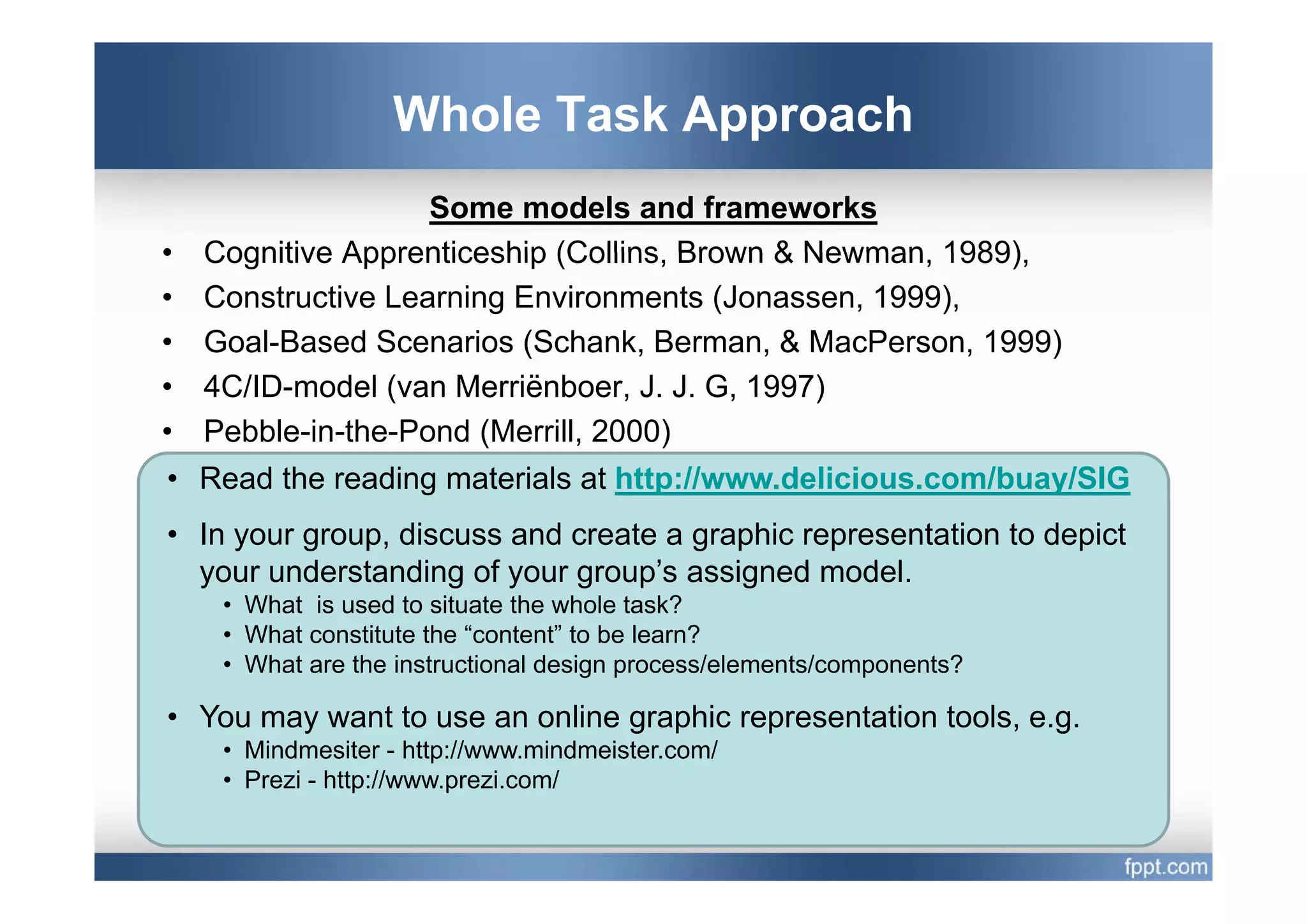
                    Some models and frameworks
•   Cognitive Apprenticeship (Collins Brown & Newman 1989)
                             (Collins,        Newman, 1989),
•   Constructive Learning Environments (Jonassen, 1999),
•   Goal-Based Scenarios (Schank, Berman, & MacPerson, 1999)
                          (                                  )
•   4C/ID-model (van Merriënboer, J. J. G, 1997)
•   Pebble-in-the-Pond (Merrill, 2000)
• Read the reading materials at http://www.delicious.com/buay/SIG
• In your group, discuss and create a graphic representation to depict
  your understanding of your group’s assigned model
                                               model.
     • What is used to situate the whole task?
     • What constitute the “content” to be learn?
     • What are the instructional design process/elements/components?

• You may want to use an online graphic representation tools, e.g.
     • Mindmesiter - http://www.mindmeister.com/
     • Prezi - http://www prezi com/
               http://www.prezi.com/
Whole Task Approach to
              Competence based
              Competence-based Learning
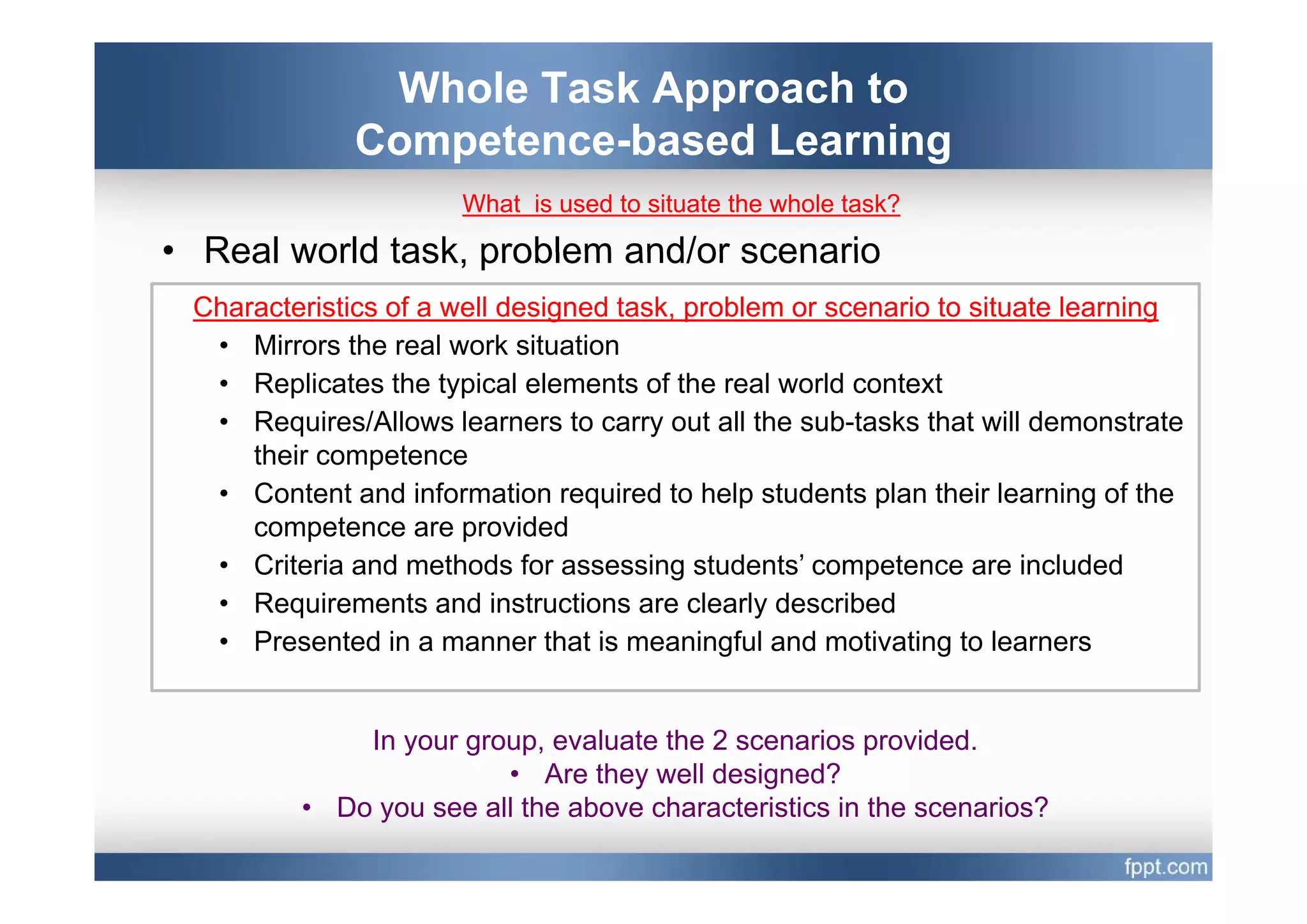
                      What is used to situate the whole task?

• Real world task problem and/or scenario
             task,
 Characteristics of a well designed task, problem or scenario to situate learning
  • Mirrors the real work situation
  • Replicates the typical elements of the real world context
  • Requires/Allows learners to carry out all the sub-tasks that will demonstrate
     their competence
  • Content and information required to help students plan their learning of the
     competence are provided
  • Criteria and methods for assessing students’ competence are included
                                           students
  • Requirements and instructions are clearly described
  • Presented in a manner that is meaningful and motivating to learners


             In your group, evaluate the 2 scenarios provided.
                        • Are they well designed?
         • Do you see all the above characteristics in the scenarios?
Whole Task Approach to
         Competence based
         Competence-based Learning
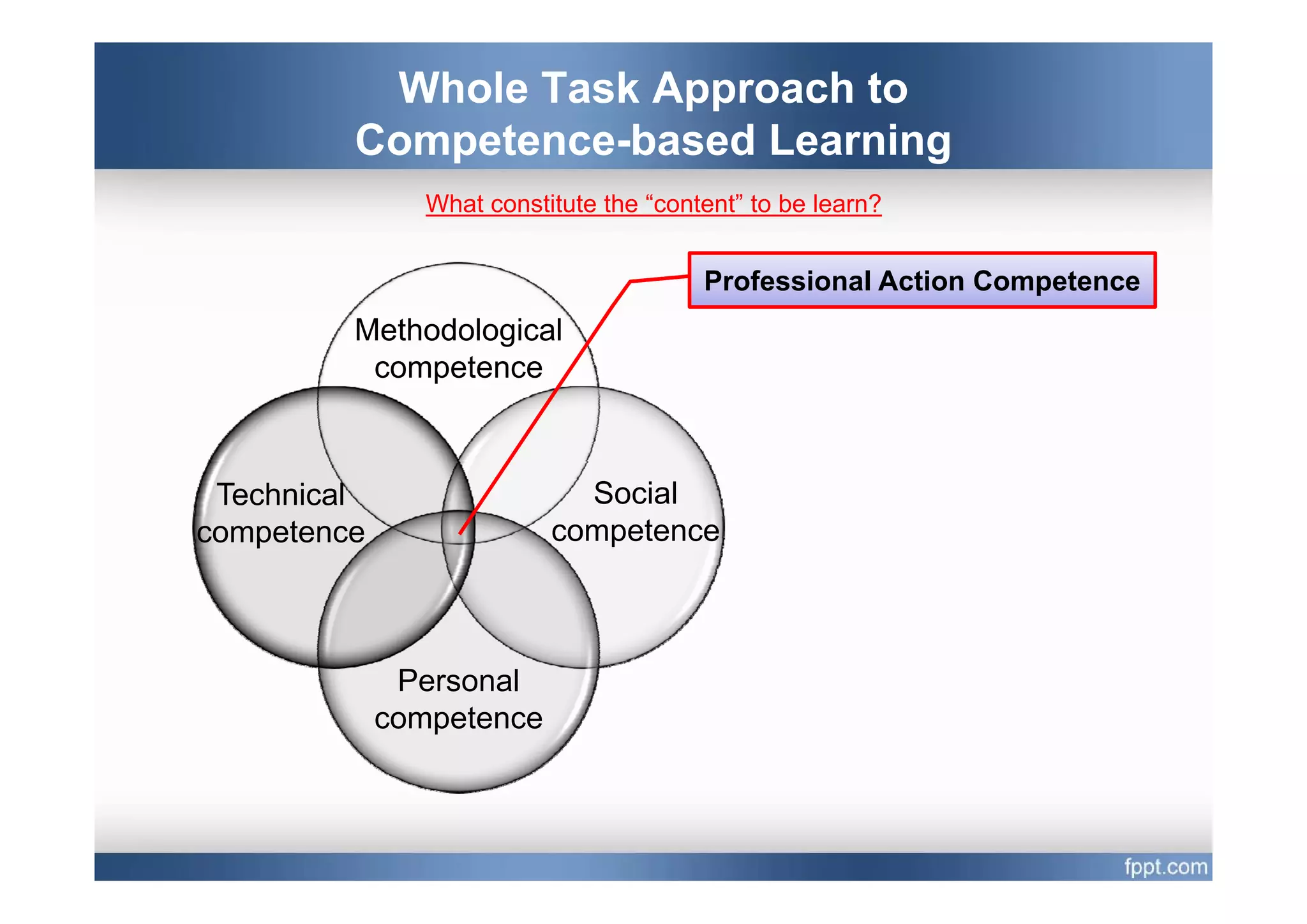
                What constitute the “content” to be learn?


                                         Professional Action Competence
         Methodological
          competence
                t


 Technical                   Social
competence                 competence


              Personal
              P      l
             competence
Whole Task Approach to
               Competence based
               Competence-based Learning
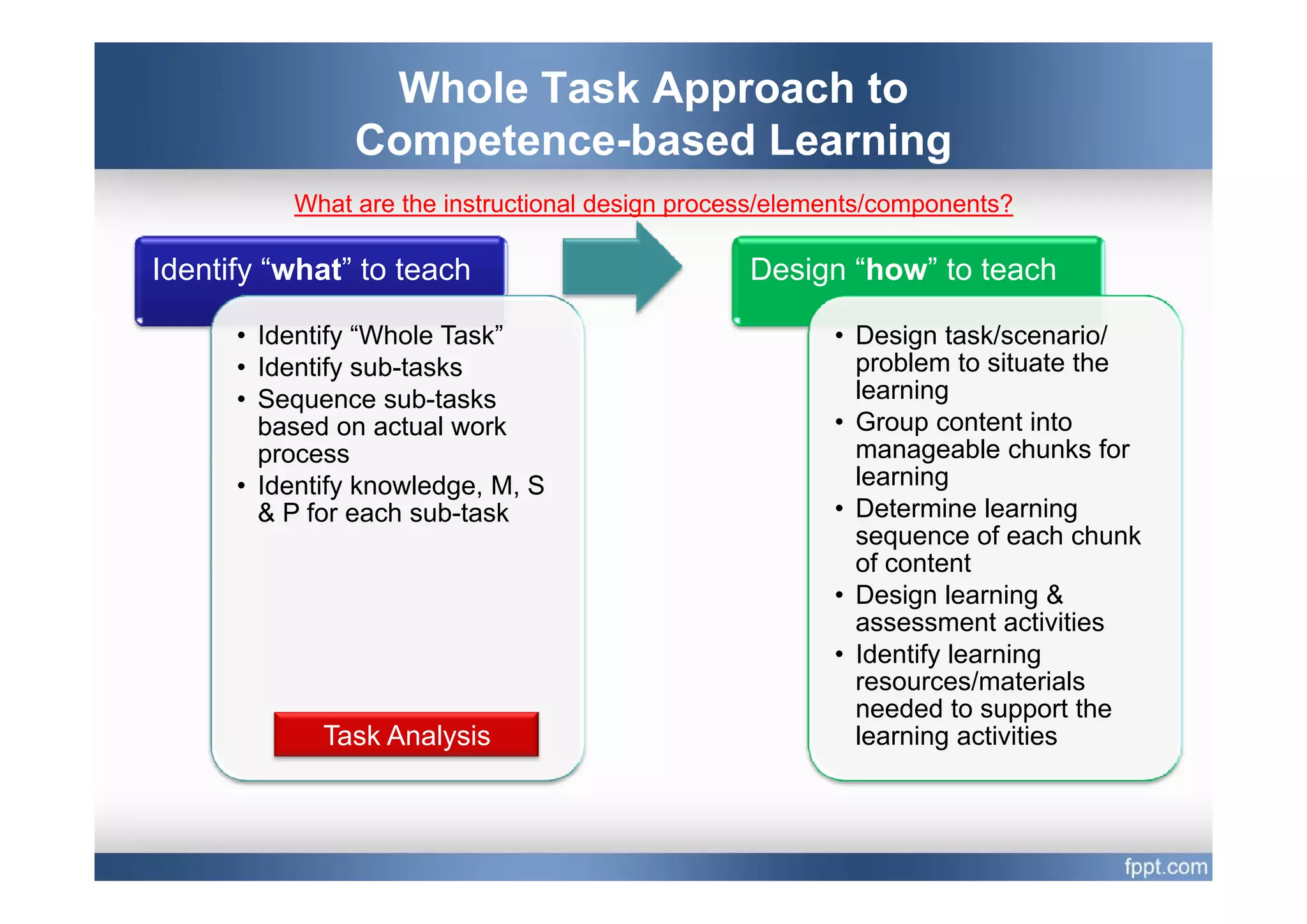
          What are the instructional design process/elements/components?

Identify “what” to teach                         Design “how” to teach

      • Identify “Whole Task”                           • Design task/scenario/
      • Identify sub-tasks
              f                                           problem to situate the
                                                              bl    t it t th
      • Sequence sub-tasks                                learning
        based on actual work                            • Group content into
        process                                           manageable chunks for
                                                                 g
      • Identify knowledge, M, S                          learning
        & P for each sub-task                           • Determine learning
                                                          sequence of each chunk
                                                          of content
                                                        • Design learning &
                                                          assessment activities
                                                        • Identify learning
                                                          resources/materials
                                                                     /
                                                          needed to support the
             Task Analysis                                learning activities
Whole Task Approach to
                Competence based
                Competence-based Learning
          What are the instructional design process/elements/components?


Ways to do Task Analysis – further readings
• Cognitive Task Analysis
    http://www.cogtech.usc.edu/publications/clark_etal_cognitive_task_analysis_chapter.pdf
       p         g             p                         g                y       p p

• Perform a Task Analysis
    http://classweb.gmu.edu/ndabbagh/Resources/Resources2/taskanalysis2.htm

• Task Analysis
    www.cs.uga.edu/~eileen/4800/Notes/task.pptSimilarShare

• Cognitive Task Analysis
    http://siteresources.worldbank.org/WBI/Resources/213798-1194538727144/3Final-
    Cog Task_Analysis.pdf
       g_            y p
Whole Task Approach to
              Competence based
              Competence-based Learning
         What are the instructional design process/elements/components?


Framework/Models for structuring learning activities
• Cognitive Apprenticeship (Collins, Brown & Newman, 1989),
• Constructive Learning Environments (Jonassen, 1999),
• Goal-Based Scenarios (Schank, Berman, & MacPerson, 1999)
• 4C/ID-model (van Merriënboer, J. J. G, 1997)
• Pebble-in-the-Pond (Merrill, 2000)
                      (      ,     )


Further readings - http://www.delicious.com/buay/SIG
Thank you

Whole Task Approach to Holistic Learning of Vocational Competences - full sharing in Jan and Mar 13

  • 1.
    Sharing at Institute of Adult Learning, Singapore Adult Education Network Special Interest Group (Instructional Design) Whole Task Approach to Holistic Learning of Vocational Competences Tang B T Buay Ch Choo buaytang@gmail.com
  • 2.
    While waiting forthe session to start At your table, • Di Discuss th diff the difference b t between • Holistic Education • Holistic Learning of Competence • Get one of the members to post your table’s view at the Facebook ID SIG 13 Jan Group. p If none of you are member of the Facebook Group, post your table’s view of a flip chart • You may want to refer to the following articles (printed copies at your table): Holistic education: An interpretation for teachers in the IB programmes http://blogs.ibo.org/positionpapers/files/2010/09/Holistic-education_John-Hare.pdf Structural characteristics and target categories of holistic vocational training www.cedefop.europa.eu/etv/Upload/.../122/17_en_ott.pdf
  • 3.
    Outline • Recap: Conceptof competence • Holistic Education vs Holistic Learning of Competence • Why Holistic Learning of competence? • Whole Task Approach to Holistic Learning of Competence • Components of a Whole Task • Holistic Design for complex competence-based learning – an introduction
  • 4.
    Recap: Instructional Design forCompetence-based learning Key purpose To facilitate learner acquisition of competence Activity: What is a competence? • Think… On your own think about – What is the definition of competence? – What are the elements of competence? • Write… Write your views on a piece of paper • Show… Upon signal from the facilitate, show your views to your group members • Discuss and negotiate Within your group discuss and come to a negotiate… group, consensus on the definition and elements of a competence • Share… Present your group’s view on a flipchart. You can use any format, text pictures, diagrams…. format text, pictures diagrams Strategy: Show Down
  • 5.
    Nature of competence Professional Action P f i l A ti Competence vs Competence Methodological g Knowledge competence Technical Social competence competence Attitude Skills Personal competence Ability to perform workplace task vs Ability to perform task at the workplace
  • 6.
    Nature of competence– Important considerations for competence-based instructional design competence based 1. Workplace context frames task -> Learning should be authentic Professional Action Competence 2. Workplace standards determines “Ability” -> Assessment should be authentic > Methodological competence 3. T M S P are applied holistically in an integrated manner to perform the task at workplace -> Learning and Assessment should Technical Social be holistic/integrated. g competence p competence 4. Integrated application of several Competence Elements is required -> A Appropriate sequence of learning & i fl i scaffolds needed to promote systematic Personal acquisition and integration competence - > Learning materials should support development of mental model for integrated application Ability to perform task at the workplace
  • 7.
    Holistic Learning andHolistic Education • In your view, is there a difference between Holistic Learning & Holistic Education? If yes, what are the differences? Holistic Learning of Holistic Education competence Holistic development of Holistic development and competencies for work and growth of the child lifelong learning g g Focus on equipping each Focus on developing each p g individual such that they y child into a responsible and can make continuous useful citizen. productive contributions at the workplace
  • 8.
    Why Holistic Learningof Competence? • Read the story “Every Curriculum Tells A Story” by Roger Schank http://www.socraticarts.com/docs/SCCwhitepaper.pdf Activity: Wh t i A ti it What is wrong with the curriculum? ith th i l ? • There are 3 problems with this curriculum: – Fragmentation – learners unable to integrate the different pieces of content into coherent and meaningful wholes; – Compartmentalization – learners unable to integrate the different elements of the target competences, namely Knowledge, Skills, and attitudes (or T M S P); and – Low transfer of learning - Learners unable to apply their learning to perform at the workplace or to new problems/situations (van M i b ( Merriënboer, 2006) • In your groups, discuss and cite examples from the story to illustrate each of the problem. – How should the curriculum be designed to avoid these problems?
  • 9.
    Why Holistic Learningof Competence? Theoretical Basis Brain-based perspective • Proposes that learning is about grasping of a • Gestalt theory structural whole • Situated Learning • A "Gestalt" is an integrated whole system of integrated parts, and the whole is greater than • Adult Learning the th sum of its parts. f it t • Proposes 5 gestalt factors. Each factor is a condition that helps one perceive situations as a whole or totality. Gestalt • Factor of Similarity proposes that like parts tend to be grouped together in cognition. Hence, learning is facilitated if similar or related ideas are linked together as a whole and contrasted with opposing or complementary sets of ideas.
  • 10.
    Why Holistic Learningof Competence? Theoretical Basis How learning takes place perspective • A group of learning theories that posits that • Gestalt theory learning should be situated within authentic i i d l activity, context, and culture. • Situated Learning • First proposed by Lave and Wenger as a model • Adult Learning of learning i a community of practice fl i in it f ti • Example of subsequent theories include • Cognitive Apprenticeship (Brown, Collins & (Brown Duguid) – emphasises importance of situating learning in authentic real world tasks • Anchored Instruction (Cognition & Technology Group at Vanderbilt)- proposes that learning should be situated or anchored in real life problem situations or tasks.
  • 11.
    Why Holistic Learningof Competence? Theoretical Basis How adults learn perspective • Transformative Learning • Gestalt theory • Process of using a prior interpretation to construe a new or revised i i d interpretation of i f • Situated Learning the meaning of one’s experience in order to guide future action" (Mezirow, 1996: • Adult Learning 162). 162) • Suggest that learning for adults begins with a real life “disorienting dilemma” • Context-based Learning (recent theories in adult learning) • learning is a social constructed social, phenomenon • Same concept as Situated Learning
  • 12.
    Why Holistic Learningof Competence? Practical Considerations • Task Complexity – Performing a sub-skill in isolation is different from performing it in the context of the real world task – Automaticity of a sub-skill achieved through isolated practice is often not transferable to the context of performing within the real world task. • Complexity and variability of the real world context – Need to learn and apply the knowledge and skills to varied set of, and/or complex, real-world contexts and settings Demands of Learning Transfer Increasing need for holistic learning Highly Simple Highly Complex Procedural-based P d lb d Principled-based Pi i l db d - Very near transfer - Very far transfer
  • 13.
    Whole Task Approach •Focus on the overall goal to be attained throughout the entire process process. • A work place task ( or whole task) that is assignable and has meaningful work outcomes are used to frame learning • The workplace task is learned as a whole instead of discretely as a set of individual sub-skills, where each part of the learning is taught in relations to the whole task.
  • 14.
    Whole Task Approach Some models and frameworks • Cognitive Apprenticeship (Collins Brown & Newman 1989) (Collins, Newman, 1989), • Constructive Learning Environments (Jonassen, 1999), • Goal-Based Scenarios (Schank, Berman, & MacPerson, 1999) ( ) • 4C/ID-model (van Merriënboer, J. J. G, 1997) • Pebble-in-the-Pond (Merrill, 2000) • Read the reading materials at http://www.delicious.com/buay/SIG • In your group, discuss and create a graphic representation to depict your understanding of your group’s assigned model model. • What is used to situate the whole task? • What constitute the “content” to be learn? • What are the instructional design process/elements/components? • You may want to use an online graphic representation tools, e.g. • Mindmesiter - http://www.mindmeister.com/ • Prezi - http://www prezi com/ http://www.prezi.com/
  • 15.
    Whole Task Approachto Competence based Competence-based Learning What is used to situate the whole task? • Real world task problem and/or scenario task, Characteristics of a well designed task, problem or scenario to situate learning • Mirrors the real work situation • Replicates the typical elements of the real world context • Requires/Allows learners to carry out all the sub-tasks that will demonstrate their competence • Content and information required to help students plan their learning of the competence are provided • Criteria and methods for assessing students’ competence are included students • Requirements and instructions are clearly described • Presented in a manner that is meaningful and motivating to learners In your group, evaluate the 2 scenarios provided. • Are they well designed? • Do you see all the above characteristics in the scenarios?
  • 16.
    Whole Task Approachto Competence based Competence-based Learning What constitute the “content” to be learn? Professional Action Competence Methodological competence t Technical Social competence competence Personal P l competence
  • 17.
    Whole Task Approachto Competence based Competence-based Learning What are the instructional design process/elements/components? Identify “what” to teach Design “how” to teach • Identify “Whole Task” • Design task/scenario/ • Identify sub-tasks f problem to situate the bl t it t th • Sequence sub-tasks learning based on actual work • Group content into process manageable chunks for g • Identify knowledge, M, S learning & P for each sub-task • Determine learning sequence of each chunk of content • Design learning & assessment activities • Identify learning resources/materials / needed to support the Task Analysis learning activities
  • 18.
    Whole Task Approachto Competence based Competence-based Learning What are the instructional design process/elements/components? Ways to do Task Analysis – further readings • Cognitive Task Analysis http://www.cogtech.usc.edu/publications/clark_etal_cognitive_task_analysis_chapter.pdf p g p g y p p • Perform a Task Analysis http://classweb.gmu.edu/ndabbagh/Resources/Resources2/taskanalysis2.htm • Task Analysis www.cs.uga.edu/~eileen/4800/Notes/task.pptSimilarShare • Cognitive Task Analysis http://siteresources.worldbank.org/WBI/Resources/213798-1194538727144/3Final- Cog Task_Analysis.pdf g_ y p
  • 19.
    Whole Task Approachto Competence based Competence-based Learning What are the instructional design process/elements/components? Framework/Models for structuring learning activities • Cognitive Apprenticeship (Collins, Brown & Newman, 1989), • Constructive Learning Environments (Jonassen, 1999), • Goal-Based Scenarios (Schank, Berman, & MacPerson, 1999) • 4C/ID-model (van Merriënboer, J. J. G, 1997) • Pebble-in-the-Pond (Merrill, 2000) ( , ) Further readings - http://www.delicious.com/buay/SIG
  • 20.