KNOWLEDGE AND CURRICULUM
UNIT 6
MEANING AND NATURE OF
CURRICULUM
UNIT 6
Meaning, Definition and Concept of
Curriculum – Structure of the
Curriculum – Dynamics of Curriculum –
Changing concept of Curriculum
CURRICULUM-MEANING
• It is derived from the Latin word ‘CURRERE’
• CURRERE – Race Course / Runway.
• In the education field ---
work field of student a course of study
a kind of route which the learner travels
• All the activities going on within the school or
outside the school makes the curriculum.
CURRICULUM-MEANING
• It is the basis for the intellectual, physical, moral and
emotional development of the child
• It can be defined as a plan for action or a written
document which includes strategies for achieving
desired goals or ends
• Schools or Universities cannot exist without a
curriculum
• Curriculum refers to the “total learning experiences of
individuals not only in school but society as well”
DEFINITIONS
• “It is a tool in hands of the artist(teacher) to mould
his material(pupil) according to his ideal(objective) in
his studio(school)” – Cunninghom
• “Curriculum includes all those activities which are
utilized by a school to attain the aims of education”
– Munroe
POINT OF VIEW
• For student – It is the thing the teacher make us learn
• For teacher – The course of study provided us to follow
• For Principal – The course for which units of are given
• For Parent – The facts that are in the text book
• Curriculum is the heart of schooling.
POINT OF VIEW
• For student – It is the thing the teacher make us learn
• For teacher – The course of study provided us to follow
• For Principal – The course for which units of are given
• For Parent – The facts that are in the text book
• Curriculum is the heart of schooling.
CHARACTERISTICS
• Fulfillment of objectives
• Determined by factors – Social, Human development,
Nature of learning and nature of knowledge
• Cater individual differences
• Pre-planned but can be changed
• It is a blue print
• It is a tool in hands of a teacher
• More than teaching and learning
• Describe environment in motion
• All learning inside and outside school
CONCEPT OF CURRICULUM
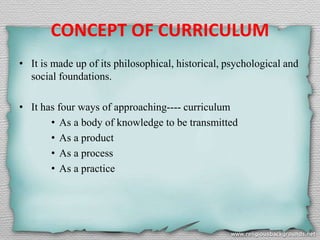
• It is made up of its philosophical, historical, psychological and
social foundations.
• It has four ways of approaching---- curriculum
• As a body of knowledge to be transmitted
• As a product
• As a process
• As a practice
CONCEPT OF CURRICULUM
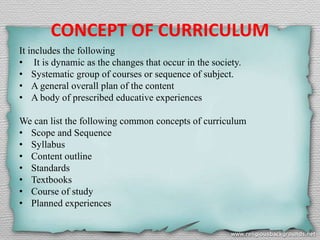
It includes the following
• It is dynamic as the changes that occur in the society.
• Systematic group of courses or sequence of subject.
• A general overall plan of the content
• A body of prescribed educative experiences
We can list the following common concepts of curriculum
• Scope and Sequence
• Syllabus
• Content outline
• Standards
• Textbooks
• Course of study
• Planned experiences
STRUCTURE OF CURRICULUM
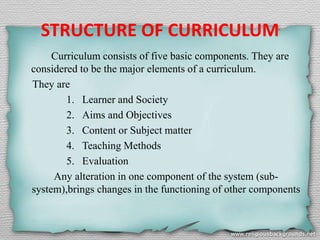
Curriculum consists of five basic components. They are
considered to be the major elements of a curriculum.
They are
1. Learner and Society
2. Aims and Objectives
3. Content or Subject matter
4. Teaching Methods
5. Evaluation
Any alteration in one component of the system (sub-
system),brings changes in the functioning of other components
STRUCTURE OF CURRICULUM
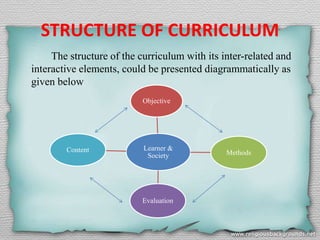
The structure of the curriculum with its inter-related and
interactive elements, could be presented diagrammatically as
given below
Learner &
Society
Objective
Methods
Evaluation
Content
STRUCTURE OF CURRICULUM
Learner and Society:
-concerned with the learner and the society in which he or
she lives.
Aims and Objectives:
-reflect the needs of the learner and society
-basis for selection of subject matter & subject experiences
Content or Subject Matter:
-facts, concepts, principles organized in such a manner to
help the learner achieve the aims and objectives
Teaching Methods:
-the techniques and methods chosen by the teacher to
present the subject-matter
Evaluation:
-it measures the learning outcomes of the learner
DYNAMICS OF CURRICULUM
• Dynamics means ‘Movement / Change’
• Dynamics of Curriculum
-refers to the forces or the factor that effect changes in it.
-changes in curriculum according to the needs of the
society’s new innovation and new education policy on
education.
• These issues as follows
- societal needs
- new innovation
- new education policy
- individual needs
- socio-political needs
- evaluation of curriculum
DYNAMICS OF CURRICULUM
• Societal needs
- Needs and demands of the society is always changing
- curriculum is dynamic and is meant to serve the society
• New innovation
- to work together for the development of the society
- classroom teaching –learning process should be changed
in accordance with new technology
• New education policy
- the curriculum has to be changed to meet the new
objectives
DYNAMICS OF CURRICULUM
• Individual needs
- the student’s needs & demands are also changing.
- curriculum designed for them- for their development
should be changed
• Socio-Political factors
- socio, political and economical are important factors
• Evaluation of Curriculum
- according to their feedback and comments, changes are
introduced in the curriculum
- some subjects may be introduced or already existing
subjects may be modified
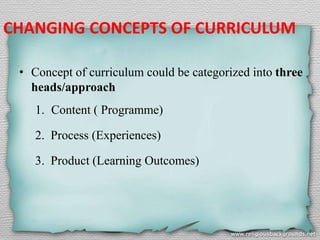
CHANGING CONCEPTS OF CURRICULUM
• Concept of curriculum could be categorized into three
heads/approach
1. Content ( Programme)
2. Process (Experiences)
3. Product (Learning Outcomes)
CHANGING CONCEPTS OF CURRICULUM
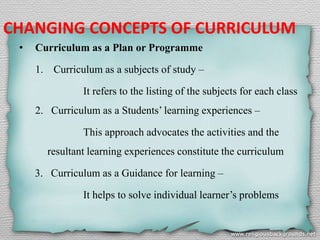
• Curriculum as a Plan or Programme
1. Curriculum as a subjects of study –
It refers to the listing of the subjects for each class
2. Curriculum as a Students’ learning experiences –
This approach advocates the activities and the
resultant learning experiences constitute the curriculum
3. Curriculum as a Guidance for learning –
It helps to solve individual learner’s problems
CHANGING CONCEPTS OF CURRICULUM
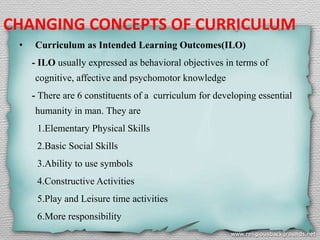
• Curriculum as Intended Learning Outcomes(ILO)
- ILO usually expressed as behavioral objectives in terms of
cognitive, affective and psychomotor knowledge
- There are 6 constituents of a curriculum for developing essential
humanity in man. They are
1.Elementary Physical Skills
2.Basic Social Skills
3.Ability to use symbols
4.Constructive Activities
5.Play and Leisure time activities
6.More responsibility
CHANGING CONCEPTS OF CURRICULUM
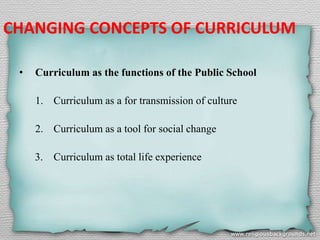
• Curriculum as the functions of the Public School
1. Curriculum as a for transmission of culture
2. Curriculum as a tool for social change
3. Curriculum as total life experience
CONCLUSION
• Curriculum denotes the totally of learning experiences of the
children in educational institution.
• The nature of curriculum is all the experience provided by the
school under the guidance of teachers and educational
administrators.
• A general overall plan of the content or specific materials of
instruction that the college should offer the student by way of
qualifying him for graduation is one of the concept of
curriculum.