TEACHING SKILLS
PRESENTED BY:
HONEY BABU ,
ASSISTANT PROFESSOR IN EDUCATION.
• Teaching is the art of blending Knowledge ,art ,
science and creativity .
• It constitutes a number of verbal and non-
verbal acts.
• The set of related behaviours or teaching acts
aiming at specific objectives and performed
with an intention to facilitate pupil’s learning
can be called a teaching skill.
TEACHING SKILLS
• A professional teacher should identify what all
are the skills needed and should practice to
master those skills.
• Professionals will always have some skills
which are present in them ,which they have
acquired through special training and practice.
TEACHING SKILLS
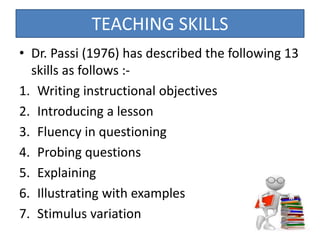
• Dr. Passi (1976) has described the following 13
skills as follows :-
1. Writing instructional objectives
2. Introducing a lesson
3. Fluency in questioning
4. Probing questions
5. Explaining
6. Illustrating with examples
7. Stimulus variation
TEACHING SKILLS
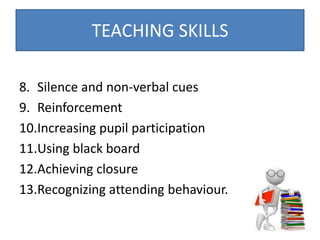
8. Silence and non-verbal cues
9. Reinforcement
10.Increasing pupil participation
11.Using black board
12.Achieving closure
13.Recognizing attending behaviour.
TEACHING SKILLS
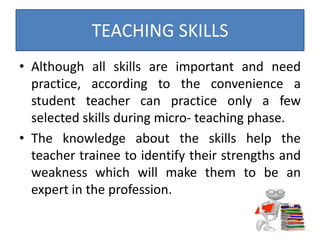
• Although all skills are important and need
practice, according to the convenience a
student teacher can practice only a few
selected skills during micro- teaching phase.
• The knowledge about the skills help the
teacher trainee to identify their strengths and
weakness which will make them to be an
expert in the profession.
TEACHING SKILLS
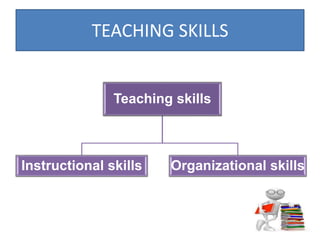
Teaching skills
Instructional skills Organizational skills
TEACHING SKILLS
Skill of Reinforcement
• The talent to appreciate the learner as they
need social approval for their behaviour .
• Appreciation for correct answer will make
them more eager to respond with correct
answers.
• It will help them to increase their
participation.
TEACHING SKILLS
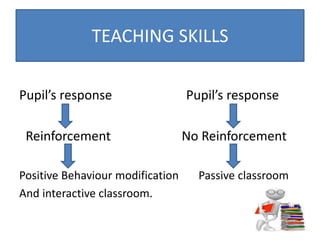
Pupil’s response Pupil’s response
Reinforcement No Reinforcement
Positive Behaviour modification Passive classroom
And interactive classroom.
TEACHING SKILLS
Skill of Reinforcement
• Both verbal and non-verbal cues can be used .
• Excellent, carry on, go ahead well, done ,good,
right, fine etc are the verbal expressions .
• Smiling, patting , friendly look etc are examples of
non-verbal reinforcement.
• Repeating and rephrasing the pupil’s answers.
• Using Extra verbal cues like um um , aha etc. to
make them continue .
TEACHING SKILLS
Skill of Reinforcement
• Writing the answers that are given by students
on the Black board.
• At the same time avoid negative
reinforcements like staring, frowning.
• Praise the students for their contribution and
practice.
• Inappropriate use of reinforcement should be
avoided.
TEACHING SKILLS
Skill of Illustrating with examples
• Examples always should be specifically relating
to concept
• It may be concrete , every day or first –hand
experiences.
• It always gives the advantage of economy time
and increase the pace of explanation.
TEACHING SKILLS
Skill of Illustrating with examples
• It may be positive or negative examples.
• It can be a connective which serves for better
understanding.
• Examples always should be simple ,
interesting, and relevant .
• Inductive and deductive approach can be
applied while illustrating with examples.
TEACHING SKILLS
Skill of Illustrating with examples
Topic: Imbibition
• Cotton dipped in water
• White Chalk dipped in Coloured Ink
• Biscuits dipped in Tea
• Paper absorbing Oil.
• Categorizing the materials involved in the examples
given into solids and liquids.
The concept of solids absorbing liquids are understood
for the learner. Collecting more examples by
themselves.
TEACHING SKILLS
Skill of Explanation
• Teacher should be confident about the concept
• Its important to research about the same
• Keep eye contact on the students
• Should be simple ,clear , and logical
• Enhance with the use of visual aids
• Pace and pauses
• Personal experiences may bring an explanation
alive .
TEACHING SKILLS
Skill of using instructional aids
• Helps the teacher to add a new and concrete
dimension.
• They are primary tools and help for content
specific orientation.
• Teacher who needs creativity in the class room
can not avoid their use.
• Examples for instructional aids
TEACHING SKILLS
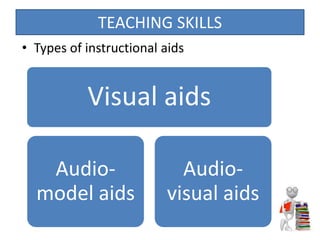
• Types of instructional aids
TEACHING SKILLS
Visual aids
Audio-
model aids
Audio-
visual aids
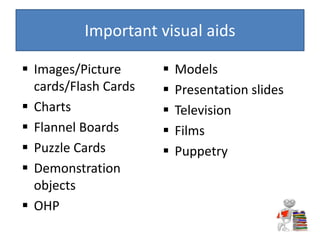
 Images/Picture
cards/Flash Cards
 Charts
 Flannel Boards
 Puzzle Cards
 Demonstration
objects
 OHP
 Models
 Presentation slides
 Television
 Films
 Puppetry
Important visual aids
Skills related with Evaluation
Practice of Teaching is not complete without some
form of evaluation.
1. Recognizing and assessing students
2. Objective specific evaluation
3. Diagnosing problems
4. Providing remedial measures
5. Encouraging self evaluation.
6. Evaluation should stress the application level
TEACHING SKILLS
TEACHING SKILLS
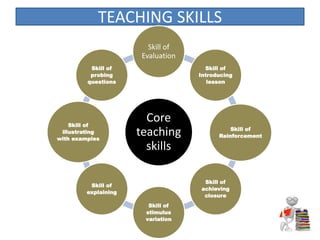
Core
teaching
skills
Skill of
Evaluation
Skill of
Introducing
lesson
Skill of
Reinforcement
Skill of
achieving
closure
Skill of
stimulus
variation
Skill of
explaining
Skill of
illustrating
with examples
Skill of
probing
questions
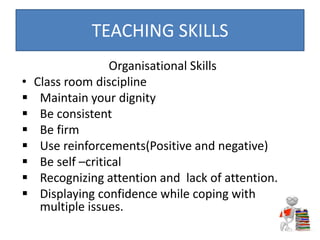
Organisational Skills
• Class room discipline
 Maintain your dignity
 Be consistent
 Be firm
 Use reinforcements(Positive and negative)
 Be self –critical
 Recognizing attention and lack of attention.
 Displaying confidence while coping with
multiple issues.
TEACHING SKILLS
Suggestions for maintaining class control
• Firm but friendly leadership
• Relaxed but distinctive teacher-pupil
relationships
• Genuine concern for welfare of pupils
• Minimum of bureaucracy
• Approachable
TEACHING SKILLS
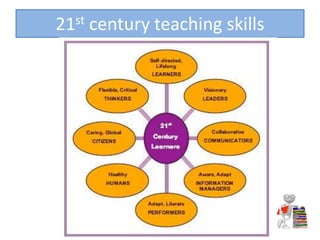
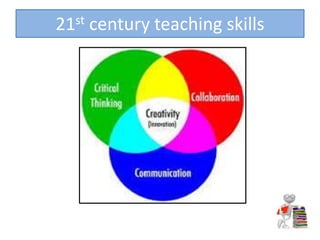
21st century teaching skills
“One time teaching means two times
learning”

Teaching skills

  • 1.
    TEACHING SKILLS PRESENTED BY: HONEYBABU , ASSISTANT PROFESSOR IN EDUCATION.
  • 2.
    • Teaching isthe art of blending Knowledge ,art , science and creativity . • It constitutes a number of verbal and non- verbal acts. • The set of related behaviours or teaching acts aiming at specific objectives and performed with an intention to facilitate pupil’s learning can be called a teaching skill. TEACHING SKILLS
  • 3.
    • A professionalteacher should identify what all are the skills needed and should practice to master those skills. • Professionals will always have some skills which are present in them ,which they have acquired through special training and practice. TEACHING SKILLS
  • 4.
    • Dr. Passi(1976) has described the following 13 skills as follows :- 1. Writing instructional objectives 2. Introducing a lesson 3. Fluency in questioning 4. Probing questions 5. Explaining 6. Illustrating with examples 7. Stimulus variation TEACHING SKILLS
  • 5.
    8. Silence andnon-verbal cues 9. Reinforcement 10.Increasing pupil participation 11.Using black board 12.Achieving closure 13.Recognizing attending behaviour. TEACHING SKILLS
  • 6.
    • Although allskills are important and need practice, according to the convenience a student teacher can practice only a few selected skills during micro- teaching phase. • The knowledge about the skills help the teacher trainee to identify their strengths and weakness which will make them to be an expert in the profession. TEACHING SKILLS
  • 7.
    Teaching skills Instructional skillsOrganizational skills TEACHING SKILLS
  • 8.
    Skill of Reinforcement •The talent to appreciate the learner as they need social approval for their behaviour . • Appreciation for correct answer will make them more eager to respond with correct answers. • It will help them to increase their participation. TEACHING SKILLS
  • 9.
    Pupil’s response Pupil’sresponse Reinforcement No Reinforcement Positive Behaviour modification Passive classroom And interactive classroom. TEACHING SKILLS
  • 10.
    Skill of Reinforcement •Both verbal and non-verbal cues can be used . • Excellent, carry on, go ahead well, done ,good, right, fine etc are the verbal expressions . • Smiling, patting , friendly look etc are examples of non-verbal reinforcement. • Repeating and rephrasing the pupil’s answers. • Using Extra verbal cues like um um , aha etc. to make them continue . TEACHING SKILLS
  • 11.
    Skill of Reinforcement •Writing the answers that are given by students on the Black board. • At the same time avoid negative reinforcements like staring, frowning. • Praise the students for their contribution and practice. • Inappropriate use of reinforcement should be avoided. TEACHING SKILLS
  • 12.
    Skill of Illustratingwith examples • Examples always should be specifically relating to concept • It may be concrete , every day or first –hand experiences. • It always gives the advantage of economy time and increase the pace of explanation. TEACHING SKILLS
  • 13.
    Skill of Illustratingwith examples • It may be positive or negative examples. • It can be a connective which serves for better understanding. • Examples always should be simple , interesting, and relevant . • Inductive and deductive approach can be applied while illustrating with examples. TEACHING SKILLS
  • 14.
    Skill of Illustratingwith examples Topic: Imbibition • Cotton dipped in water • White Chalk dipped in Coloured Ink • Biscuits dipped in Tea • Paper absorbing Oil. • Categorizing the materials involved in the examples given into solids and liquids. The concept of solids absorbing liquids are understood for the learner. Collecting more examples by themselves. TEACHING SKILLS
  • 15.
    Skill of Explanation •Teacher should be confident about the concept • Its important to research about the same • Keep eye contact on the students • Should be simple ,clear , and logical • Enhance with the use of visual aids • Pace and pauses • Personal experiences may bring an explanation alive . TEACHING SKILLS
  • 16.
    Skill of usinginstructional aids • Helps the teacher to add a new and concrete dimension. • They are primary tools and help for content specific orientation. • Teacher who needs creativity in the class room can not avoid their use. • Examples for instructional aids TEACHING SKILLS
  • 17.
    • Types ofinstructional aids TEACHING SKILLS Visual aids Audio- model aids Audio- visual aids
  • 18.
     Images/Picture cards/Flash Cards Charts  Flannel Boards  Puzzle Cards  Demonstration objects  OHP  Models  Presentation slides  Television  Films  Puppetry Important visual aids
  • 19.
    Skills related withEvaluation Practice of Teaching is not complete without some form of evaluation. 1. Recognizing and assessing students 2. Objective specific evaluation 3. Diagnosing problems 4. Providing remedial measures 5. Encouraging self evaluation. 6. Evaluation should stress the application level TEACHING SKILLS
  • 20.
    TEACHING SKILLS Core teaching skills Skill of Evaluation Skillof Introducing lesson Skill of Reinforcement Skill of achieving closure Skill of stimulus variation Skill of explaining Skill of illustrating with examples Skill of probing questions
  • 21.
    Organisational Skills • Classroom discipline  Maintain your dignity  Be consistent  Be firm  Use reinforcements(Positive and negative)  Be self –critical  Recognizing attention and lack of attention.  Displaying confidence while coping with multiple issues. TEACHING SKILLS
  • 22.
    Suggestions for maintainingclass control • Firm but friendly leadership • Relaxed but distinctive teacher-pupil relationships • Genuine concern for welfare of pupils • Minimum of bureaucracy • Approachable TEACHING SKILLS
  • 23.
  • 24.
  • 25.
    “One time teachingmeans two times learning”