2nd Scientix Conference
Bruxelles, 24-26th October 2014
A crossed approach for a competence
based learning
No 539401-LLP-1-2013-1-BG-COMENIUS-CAM
Università degli Studi “G. Marconi”
No 539401-LLP-1-2013-1-BG-COMENIUS-CAM
 Università degli Studi Guglielmo Marconi is the first Italian online university to be recognized by the
Italian Ministry of University and Research as of March 2004.
 +14,700 total students
 The structure of the University includes:
• National Centre of Teledidactics, where technologies and resources are located;
• Network of decentralized branches functioning as territory sites, alike equipped.
No 539401-LLP-1-2013-1-BG-COMENIUS-CAM
 The University has a distance technological platform that integrates communication tools (e-learning, video-
conference, mobiles) with in-class programs (workshops, seminars); students take exams in eight Marconi
centers.
• Undergraduate 5-year accredited programs in Economics, Law, Applied Science & Technologies, Human
Education, Arts, and Social Science
• One-year accredited Masters programs in Business Administration, Law, Translation Studies and Social
Studies.
 It adopts innovative learning modalities by developing suitable research strategies for most advanced
technological solutions, integrating non residential communication tools (e-learning, video-conference, mobile
learning, etc) with in presence activities (workshops, seminars, etc).
Università degli Studi “G. Marconi”
• P1 Intercultural Cooperation Foundation (ICCF), Bulgaria
• P2 Università degli Studi Guglielmo Marconi, Italy
• P3 Landcommanderij Alden Biesen, Belgium
• P4 ASİST ÖĞRETİM KURUMLARI A.Ş. (DOĞA Schools), Turkey
• P5 Space Camp - Turkey (SCT), Turkey
The KEYS Project Partnership
No 539401-LLP-1-2013-1-BG-COMENIUS-CAM
Key competences in the shape of knowledge, skills and attitudes appropriate to each context
are fundamental for each individual in a knowledge-based society.
They provide added value for the labour market, social cohesion and active citizenship by
offering flexibility and adaptability, satisfaction and motivation.
KEYS competences for lifelong learning
No 539401-LLP-1-2013-1-BG-COMENIUS-CAM
• RECOMMENDATION OF THE EUROPEAN PARLIAMENT AND OF THE COUNCIL
of 18 December 2006 on key competences for lifelong learning (2006/962/EC):
1) Communication in the mother tongue;
2) Communication in foreign languages;
3) Mathematical competence and basic competences in science and technology;
4) Digital competence;
5) Learning to learn;
6) Social and civic competences;
7) Sense of initiative and entrepreneurship; and
8) Cultural awareness and expression
KEYS competences for lifelong learning
No 539401-LLP-1-2013-1-BG-COMENIUS-CAM
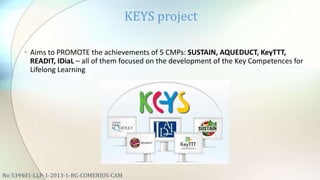
• Aims to PROMOTE the achievements of 5 CMPs: SUSTAIN, AQUEDUCT, KeyTTT,
READIT, IDiaL – all of them focused on the development of the Key Competences for
Lifelong Learning
KEYS project
No 539401-LLP-1-2013-1-BG-COMENIUS-CAM
KEYS projects
No 539401-LLP-1-2013-1-BG-COMENIUS-CAM
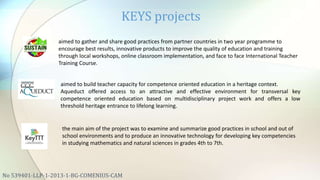
aimed to gather and share good practices from partner countries in two year programme to
encourage best results, innovative products to improve the quality of education and training
through local workshops, online classroom implementation, and face to face International Teacher
Training Course.
aimed to build teacher capacity for competence oriented education in a heritage context.
Aqueduct offered access to an attractive and effective environment for transversal key
competence oriented education based on multidisciplinary project work and offers a low
threshold heritage entrance to lifelong learning.
the main aim of the project was to examine and summarize good practices in school and out of
school environments and to produce an innovative technology for developing key competencies
in studying mathematics and natural sciences in grades 4th to 7th.
KEYS projects
No 539401-LLP-1-2013-1-BG-COMENIUS-CAM
the innovative aspect of the READ IT didactic methodology was to combine the technology in
terms of Digital Storytelling and book trailer production with writing techniques such as
narrative and screenplay to reinforce teaching of reading and writing in an interactive, creative
and authentic way.
the project focused on the literature as main instrument of impact with incontestable
potential. Nevertheless, this project was not about teaching literature. It was about learning
and personal development through literature.
• Partners will perform also cross-examination and analysis of the
methodical grounds of the products of the 5 projects and to produce
a report about the methodical foundations of the competence-
based teaching/ learning
(what to do, what teaching techniques and approaches teachers can
use to perform a meaningful competence-based education)
Project Aims & key deliverables
No 539401-LLP-1-2013-1-BG-COMENIUS-CAM
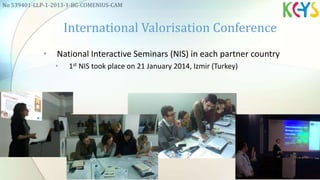
• National Interactive Seminars (NIS) in each partner country
• 1st NIS took place on 21 January 2014, Izmir (Turkey)
International Valorisation Conference
No 539401-LLP-1-2013-1-BG-COMENIUS-CAM
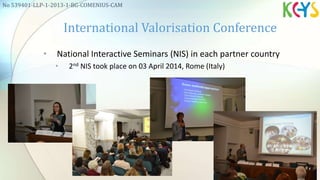
• National Interactive Seminars (NIS) in each partner country
• 2nd NIS took place on 03 April 2014, Rome (Italy)
International Valorisation Conference
No 539401-LLP-1-2013-1-BG-COMENIUS-CAM
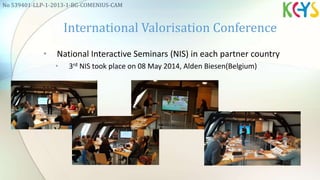
• National Interactive Seminars (NIS) in each partner country
• 3rd NIS took place on 08 May 2014, Alden Biesen(Belgium)
International Valorisation Conference
No 539401-LLP-1-2013-1-BG-COMENIUS-CAM
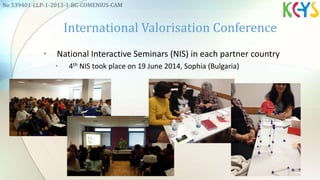
• National Interactive Seminars (NIS) in each partner country
• 4th NIS took place on 19 June 2014, Sophia (Bulgaria)
International Valorisation Conference
No 539401-LLP-1-2013-1-BG-COMENIUS-CAM
• The project partners have the important task - to collect feedback
about the applicability, transferability and effectives of these
approaches from the project target group representatives
Indeed at the end of each seminar the target group filled in the
questionnaire and shared with the KEYS staff opinions and
feedbacks about the methods and projects presented!
Project Aims & key deliverables
No 539401-LLP-1-2013-1-BG-COMENIUS-CAM
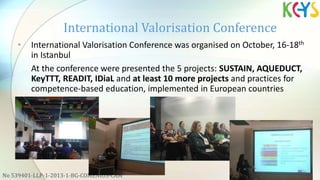
• International Valorisation Conference was organised on October, 16-18th
in Istanbul
At the conference were presented the 5 projects: SUSTAIN, AQUEDUCT,
KeyTTT, READIT, IDiaL and at least 10 more projects and practices for
competence-based education, implemented in European countries
International Valorisation Conference
No 539401-LLP-1-2013-1-BG-COMENIUS-CAM
• The KEYS project web site www.keysproject.eu
• Facebook profile https://www.facebook.com/keysprojecteu?ref=hl
• Valorisation Conference Proceedings - Collection with summaries of the
conference reports and presentations (electronic version on the project web-site)
Dissemination media & channels
No 539401-LLP-1-2013-1-BG-COMENIUS-CAM
Thank you for listening!
Michela Tramonti
m.tramonti@unimarconi.it
Università degli Studi “Guglielmo Marconi”- (USGM)
Via Plinio, 44, 00193 Rome, Italy
www.unimarconi.it
www.keysproject.eu

A crossed approach for a competence-based learning , Michela Tramonti

  • 1.
    2nd Scientix Conference Bruxelles,24-26th October 2014 A crossed approach for a competence based learning No 539401-LLP-1-2013-1-BG-COMENIUS-CAM
  • 2.
    Università degli Studi“G. Marconi” No 539401-LLP-1-2013-1-BG-COMENIUS-CAM  Università degli Studi Guglielmo Marconi is the first Italian online university to be recognized by the Italian Ministry of University and Research as of March 2004.  +14,700 total students  The structure of the University includes: • National Centre of Teledidactics, where technologies and resources are located; • Network of decentralized branches functioning as territory sites, alike equipped.
  • 3.
    No 539401-LLP-1-2013-1-BG-COMENIUS-CAM  TheUniversity has a distance technological platform that integrates communication tools (e-learning, video- conference, mobiles) with in-class programs (workshops, seminars); students take exams in eight Marconi centers. • Undergraduate 5-year accredited programs in Economics, Law, Applied Science & Technologies, Human Education, Arts, and Social Science • One-year accredited Masters programs in Business Administration, Law, Translation Studies and Social Studies.  It adopts innovative learning modalities by developing suitable research strategies for most advanced technological solutions, integrating non residential communication tools (e-learning, video-conference, mobile learning, etc) with in presence activities (workshops, seminars, etc). Università degli Studi “G. Marconi”
  • 4.
    • P1 InterculturalCooperation Foundation (ICCF), Bulgaria • P2 Università degli Studi Guglielmo Marconi, Italy • P3 Landcommanderij Alden Biesen, Belgium • P4 ASİST ÖĞRETİM KURUMLARI A.Ş. (DOĞA Schools), Turkey • P5 Space Camp - Turkey (SCT), Turkey The KEYS Project Partnership No 539401-LLP-1-2013-1-BG-COMENIUS-CAM
  • 5.
    Key competences inthe shape of knowledge, skills and attitudes appropriate to each context are fundamental for each individual in a knowledge-based society. They provide added value for the labour market, social cohesion and active citizenship by offering flexibility and adaptability, satisfaction and motivation. KEYS competences for lifelong learning No 539401-LLP-1-2013-1-BG-COMENIUS-CAM
  • 6.
    • RECOMMENDATION OFTHE EUROPEAN PARLIAMENT AND OF THE COUNCIL of 18 December 2006 on key competences for lifelong learning (2006/962/EC): 1) Communication in the mother tongue; 2) Communication in foreign languages; 3) Mathematical competence and basic competences in science and technology; 4) Digital competence; 5) Learning to learn; 6) Social and civic competences; 7) Sense of initiative and entrepreneurship; and 8) Cultural awareness and expression KEYS competences for lifelong learning No 539401-LLP-1-2013-1-BG-COMENIUS-CAM
  • 7.
    • Aims toPROMOTE the achievements of 5 CMPs: SUSTAIN, AQUEDUCT, KeyTTT, READIT, IDiaL – all of them focused on the development of the Key Competences for Lifelong Learning KEYS project No 539401-LLP-1-2013-1-BG-COMENIUS-CAM
  • 8.
    KEYS projects No 539401-LLP-1-2013-1-BG-COMENIUS-CAM aimedto gather and share good practices from partner countries in two year programme to encourage best results, innovative products to improve the quality of education and training through local workshops, online classroom implementation, and face to face International Teacher Training Course. aimed to build teacher capacity for competence oriented education in a heritage context. Aqueduct offered access to an attractive and effective environment for transversal key competence oriented education based on multidisciplinary project work and offers a low threshold heritage entrance to lifelong learning. the main aim of the project was to examine and summarize good practices in school and out of school environments and to produce an innovative technology for developing key competencies in studying mathematics and natural sciences in grades 4th to 7th.
  • 9.
    KEYS projects No 539401-LLP-1-2013-1-BG-COMENIUS-CAM theinnovative aspect of the READ IT didactic methodology was to combine the technology in terms of Digital Storytelling and book trailer production with writing techniques such as narrative and screenplay to reinforce teaching of reading and writing in an interactive, creative and authentic way. the project focused on the literature as main instrument of impact with incontestable potential. Nevertheless, this project was not about teaching literature. It was about learning and personal development through literature.
  • 10.
    • Partners willperform also cross-examination and analysis of the methodical grounds of the products of the 5 projects and to produce a report about the methodical foundations of the competence- based teaching/ learning (what to do, what teaching techniques and approaches teachers can use to perform a meaningful competence-based education) Project Aims & key deliverables No 539401-LLP-1-2013-1-BG-COMENIUS-CAM
  • 11.
    • National InteractiveSeminars (NIS) in each partner country • 1st NIS took place on 21 January 2014, Izmir (Turkey) International Valorisation Conference No 539401-LLP-1-2013-1-BG-COMENIUS-CAM
  • 12.
    • National InteractiveSeminars (NIS) in each partner country • 2nd NIS took place on 03 April 2014, Rome (Italy) International Valorisation Conference No 539401-LLP-1-2013-1-BG-COMENIUS-CAM
  • 13.
    • National InteractiveSeminars (NIS) in each partner country • 3rd NIS took place on 08 May 2014, Alden Biesen(Belgium) International Valorisation Conference No 539401-LLP-1-2013-1-BG-COMENIUS-CAM
  • 14.
    • National InteractiveSeminars (NIS) in each partner country • 4th NIS took place on 19 June 2014, Sophia (Bulgaria) International Valorisation Conference No 539401-LLP-1-2013-1-BG-COMENIUS-CAM
  • 15.
    • The projectpartners have the important task - to collect feedback about the applicability, transferability and effectives of these approaches from the project target group representatives Indeed at the end of each seminar the target group filled in the questionnaire and shared with the KEYS staff opinions and feedbacks about the methods and projects presented! Project Aims & key deliverables No 539401-LLP-1-2013-1-BG-COMENIUS-CAM
  • 16.
    • International ValorisationConference was organised on October, 16-18th in Istanbul At the conference were presented the 5 projects: SUSTAIN, AQUEDUCT, KeyTTT, READIT, IDiaL and at least 10 more projects and practices for competence-based education, implemented in European countries International Valorisation Conference No 539401-LLP-1-2013-1-BG-COMENIUS-CAM
  • 17.
    • The KEYSproject web site www.keysproject.eu • Facebook profile https://www.facebook.com/keysprojecteu?ref=hl • Valorisation Conference Proceedings - Collection with summaries of the conference reports and presentations (electronic version on the project web-site) Dissemination media & channels No 539401-LLP-1-2013-1-BG-COMENIUS-CAM
  • 18.
    No 539401-LLP-1-2013-1-BG-COMENIUS-CAM Thank youfor listening! Michela Tramonti m.tramonti@unimarconi.it Università degli Studi “Guglielmo Marconi”- (USGM) Via Plinio, 44, 00193 Rome, Italy www.unimarconi.it www.keysproject.eu

Editor's Notes

  • #7 Communication in the mother tongue, which is the ability to express and interpret concepts, thoughts, feelings, facts and opinions in both oral and written form (listening, speaking, reading and writing) and to interact linguistically in an appropriate and creative way in a full range of societal and cultural contexts; communication in foreign languages, which involves, in addition to the main skill dimensions of communication in the mother tongue, mediation and intercultural understanding. The level of proficiency depends on several factors and the capacity for listening, speaking, reading and writing; mathematical competence and basic competences in science and technology. Mathematical competence is the ability to develop and apply mathematical thinking in order to solve a range of problems in everyday situations, with the emphasis being placed on process, activity and knowledge. Basic competences in science and technology refer to the mastery, use and application of knowledge and methodologies that explain the natural world. These involve an understanding of the changes caused by human activity and the responsibility of each individual as a citizen; digital competence involves the confident and critical use of information society technology (IST) and thus basic skills in information and communication technology (ICT); learning to learn is related to learning, the ability to pursue and organise one's own learning, either individually or in groups, in accordance with one's own needs, and awareness of methods and opportunities; social and civic competences. Social competence refers to personal, interpersonal and intercultural competence and all forms of behaviour that equip individuals to participate in an effective and constructive way in social and working life. It is linked to personal and social well-being. An understanding of codes of conduct and customs in the different environments in which individuals operate is essential. Civic competence, and particularly knowledge of social and political concepts and structures (democracy, justice, equality, citizenship and civil rights), equips individuals to engage in active and democratic participation; sense of initiative and entrepreneurship is the ability to turn ideas into action. It involves creativity, innovation and risk-taking, as well as the ability to plan and manage projects in order to achieve objectives. The individual is aware of the context of his/her work and is able to seize opportunities that arise. It is the foundation for acquiring more specific skills and knowledge needed by those establishing or contributing to social or commercial activity. This should include awareness of ethical values and promote good governance; cultural awareness and expression, which involves appreciation of the importance of the creative expression of ideas, experiences and emotions in a range of media (music, performing arts, literature and the visual arts).