M O V I N G F R O M
P E D A G O G Y T O A N D R A G O G Y
M D . K AY S H E R H A M I D
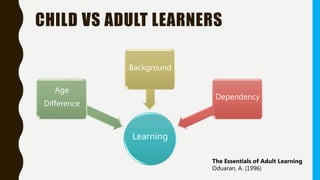
CHILD VS ADULT LEARNERS
Learning
Age
Difference
Background
Dependency
The Essentials of Adult Learning
Oduaran, A. (1996)
HISTORICAL
DEVELOPMENT
HISTORICAL DEVELOPMENT
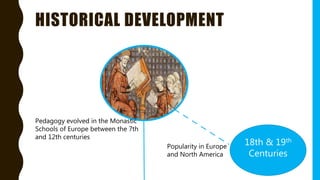
Pedagogy evolved in the Monastic
Schools of Europe between the 7th
and 12th centuries
18th & 19th
Centuries
Popularity in Europe
and North America
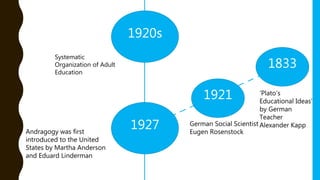
Systematic
Organization of Adult
Education
1920s
1921
1833
1927
‘Plato’s
Educational Ideas’
by German
Teacher
Alexander KappGerman Social Scientist
Eugen RosenstockAndragogy was first
introduced to the United
States by Martha Anderson
and Eduard Linderman
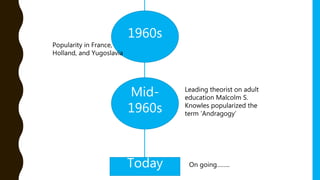
1960s
Mid-
1960s
Leading theorist on adult
education Malcolm S.
Knowles popularized the
term ‘Andragogy’
Popularity in France,
Holland, and Yugoslavia
Today On going……..
PEDAGOGY
PEDAGOGY
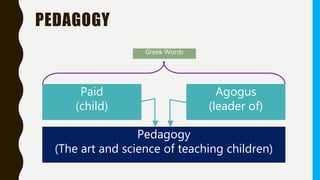
Pedagogy
(The art and science of teaching children)
Paid
(child)
Agogus
(leader of)
Greek Words
PEDAGOGY
“A teacher or trainer-centered approach to instruction where the
teacher assumes responsibility for making decisions about what will be
learned, how it will be learned, when it will be learned, and why it is of
value to the learner.”
- Kyle Freedman, Association for Talent Development (ATD)
PEDAGOGY
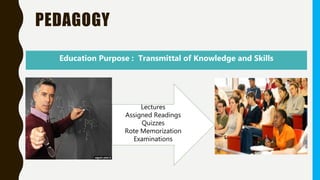
Education Purpose : Transmittal of Knowledge and Skills
Lectures
Assigned Readings
Quizzes
Rote Memorization
Examinations
ASSUMPTIONS OF PEDAGOGY
• Learners only need to know what the instructor teaches.
• The instructor’s perception of the learner is that of a dependent entity.
• The learner’s previous knowledge is of little consequence as a resource for learning.
• Learners become ready to learn what the instructor tells them.
• Learners are subject-centered in their orientation to learning.
• Learners are motivated by external factors (e.g., parental or instructor approval, good
grades).
Gessner, R. Pedagogy or Andragogy: What’s the Difference?.
PEDAGOGICAL EDUCATIONAL PLAN
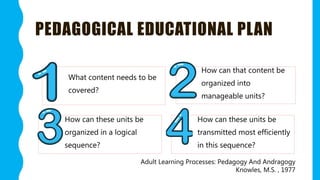
What content needs to be
covered?
How can that content be
organized into
manageable units?
How can these units be
organized in a logical
sequence?
How can these units be
transmitted most efficiently
in this sequence?
Adult Learning Processes: Pedagogy And Andragogy
Knowles, M.S. , 1977
ANDRAGOGY
ANDRAGOGY
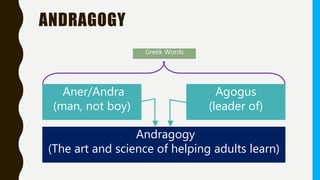
Andragogy
(The art and science of helping adults learn)
Aner/Andra
(man, not boy)
Agogus
(leader of)
Greek Words
ANDRAGOGY
“A learner-centered approach to instruction where the teacher acts as a
facilitator to help bridge the gap between student and knowledge. The
learner is viewed as an independent entity who enters the learning
experience with a unique set of experiences and motivators.”
- Kyle Freedman, Association for Talent Development (ATD)
ASSUMPTIONS OF ANDRAGOGY
Self-concept
As a person matures his/her self-concept moves from one of being a dependent
personality toward one of being a self-directed human being.
Experience
As a person matures she/he accumulates a growing reservoir of experience that becomes
an increasing resource for learning.
Readiness to learn
As a person matures his/her readiness to learn becomes oriented increasingly to the
developmental tasks of his/her social roles.
Knowles, M.S., Holton III, E.F., & Swanson, R.A. (2005). The Adult Learner, P. 57-58
ASSUMPTIONS OF ANDRAGOGY
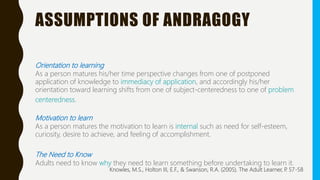
Orientation to learning
As a person matures his/her time perspective changes from one of postponed
application of knowledge to immediacy of application, and accordingly his/her
orientation toward learning shifts from one of subject-centeredness to one of problem
centeredness.
Motivation to learn
As a person matures the motivation to learn is internal such as need for self-esteem,
curiosity, desire to achieve, and feeling of accomplishment.
The Need to Know
Adults need to know why they need to learn something before undertaking to learn it.
Knowles, M.S., Holton III, E.F., & Swanson, R.A. (2005). The Adult Learner, P. 57-58
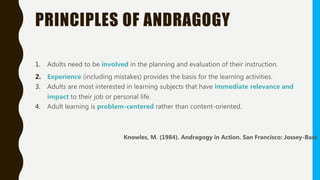
PRINCIPLES OF ANDRAGOGY
1. Adults need to be involved in the planning and evaluation of their instruction.
2. Experience (including mistakes) provides the basis for the learning activities.
3. Adults are most interested in learning subjects that have immediate relevance and
impact to their job or personal life.
4. Adult learning is problem-centered rather than content-oriented.
Knowles, M. (1984). Andragogy in Action. San Francisco: Jossey-Bass
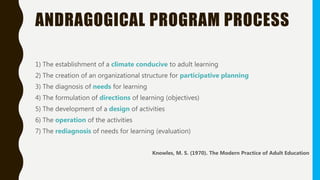
ANDRAGOGICAL PROGRAM PROCESS
1) The establishment of a climate conducive to adult learning
2) The creation of an organizational structure for participative planning
3) The diagnosis of needs for learning
4) The formulation of directions of learning (objectives)
5) The development of a design of activities
6) The operation of the activities
7) The rediagnosis of needs for learning (evaluation)
Knowles, M. S. (1970). The Modern Practice of Adult Education
PEDAGOGY
VS
ANDRAGOGY
ASSUMPTIONS OF LEARNERS
Assumptions Pedagogy Andragogy
Concept of the Learner Dependent personality Self-directed
Experience Little value A rich resource for learning
Readiness to learn Standardized curriculum
Develops from life tasks &
problems
Orientation to learning Subject-centered Task or problem centered
Motivation to learn
External rewards and
punishments
Internal incentives, curiosity
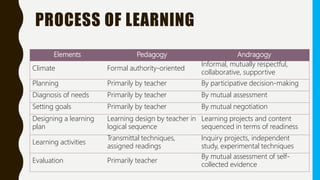
PROCESS OF LEARNING
Elements Pedagogy Andragogy
Climate Formal authority-oriented
Informal, mutually respectful,
collaborative, supportive
Planning Primarily by teacher By participative decision-making
Diagnosis of needs Primarily by teacher By mutual assessment
Setting goals Primarily by teacher By mutual negotiation
Designing a learning
plan
Learning design by teacher in
logical sequence
Learning projects and content
sequenced in terms of readiness
Learning activities
Transmittal techniques,
assigned readings
Inquiry projects, independent
study, experimental techniques
Evaluation Primarily teacher
By mutual assessment of self-
collected evidence
Moving from Pedagogy to Andragogy

Moving from Pedagogy to Andragogy

  • 1.
    M O VI N G F R O M P E D A G O G Y T O A N D R A G O G Y M D . K AY S H E R H A M I D
  • 2.
    CHILD VS ADULTLEARNERS Learning Age Difference Background Dependency The Essentials of Adult Learning Oduaran, A. (1996)
  • 4.
  • 5.
    HISTORICAL DEVELOPMENT Pedagogy evolvedin the Monastic Schools of Europe between the 7th and 12th centuries 18th & 19th Centuries Popularity in Europe and North America
  • 6.
    Systematic Organization of Adult Education 1920s 1921 1833 1927 ‘Plato’s EducationalIdeas’ by German Teacher Alexander KappGerman Social Scientist Eugen RosenstockAndragogy was first introduced to the United States by Martha Anderson and Eduard Linderman
  • 7.
    1960s Mid- 1960s Leading theorist onadult education Malcolm S. Knowles popularized the term ‘Andragogy’ Popularity in France, Holland, and Yugoslavia Today On going……..
  • 8.
  • 9.
    PEDAGOGY Pedagogy (The art andscience of teaching children) Paid (child) Agogus (leader of) Greek Words
  • 10.
    PEDAGOGY “A teacher ortrainer-centered approach to instruction where the teacher assumes responsibility for making decisions about what will be learned, how it will be learned, when it will be learned, and why it is of value to the learner.” - Kyle Freedman, Association for Talent Development (ATD)
  • 11.
    PEDAGOGY Education Purpose :Transmittal of Knowledge and Skills Lectures Assigned Readings Quizzes Rote Memorization Examinations
  • 12.
    ASSUMPTIONS OF PEDAGOGY •Learners only need to know what the instructor teaches. • The instructor’s perception of the learner is that of a dependent entity. • The learner’s previous knowledge is of little consequence as a resource for learning. • Learners become ready to learn what the instructor tells them. • Learners are subject-centered in their orientation to learning. • Learners are motivated by external factors (e.g., parental or instructor approval, good grades). Gessner, R. Pedagogy or Andragogy: What’s the Difference?.
  • 13.
    PEDAGOGICAL EDUCATIONAL PLAN Whatcontent needs to be covered? How can that content be organized into manageable units? How can these units be organized in a logical sequence? How can these units be transmitted most efficiently in this sequence? Adult Learning Processes: Pedagogy And Andragogy Knowles, M.S. , 1977
  • 14.
  • 15.
    ANDRAGOGY Andragogy (The art andscience of helping adults learn) Aner/Andra (man, not boy) Agogus (leader of) Greek Words
  • 16.
    ANDRAGOGY “A learner-centered approachto instruction where the teacher acts as a facilitator to help bridge the gap between student and knowledge. The learner is viewed as an independent entity who enters the learning experience with a unique set of experiences and motivators.” - Kyle Freedman, Association for Talent Development (ATD)
  • 17.
    ASSUMPTIONS OF ANDRAGOGY Self-concept Asa person matures his/her self-concept moves from one of being a dependent personality toward one of being a self-directed human being. Experience As a person matures she/he accumulates a growing reservoir of experience that becomes an increasing resource for learning. Readiness to learn As a person matures his/her readiness to learn becomes oriented increasingly to the developmental tasks of his/her social roles. Knowles, M.S., Holton III, E.F., & Swanson, R.A. (2005). The Adult Learner, P. 57-58
  • 18.
    ASSUMPTIONS OF ANDRAGOGY Orientationto learning As a person matures his/her time perspective changes from one of postponed application of knowledge to immediacy of application, and accordingly his/her orientation toward learning shifts from one of subject-centeredness to one of problem centeredness. Motivation to learn As a person matures the motivation to learn is internal such as need for self-esteem, curiosity, desire to achieve, and feeling of accomplishment. The Need to Know Adults need to know why they need to learn something before undertaking to learn it. Knowles, M.S., Holton III, E.F., & Swanson, R.A. (2005). The Adult Learner, P. 57-58
  • 19.
    PRINCIPLES OF ANDRAGOGY 1.Adults need to be involved in the planning and evaluation of their instruction. 2. Experience (including mistakes) provides the basis for the learning activities. 3. Adults are most interested in learning subjects that have immediate relevance and impact to their job or personal life. 4. Adult learning is problem-centered rather than content-oriented. Knowles, M. (1984). Andragogy in Action. San Francisco: Jossey-Bass
  • 20.
    ANDRAGOGICAL PROGRAM PROCESS 1)The establishment of a climate conducive to adult learning 2) The creation of an organizational structure for participative planning 3) The diagnosis of needs for learning 4) The formulation of directions of learning (objectives) 5) The development of a design of activities 6) The operation of the activities 7) The rediagnosis of needs for learning (evaluation) Knowles, M. S. (1970). The Modern Practice of Adult Education
  • 21.
  • 22.
    ASSUMPTIONS OF LEARNERS AssumptionsPedagogy Andragogy Concept of the Learner Dependent personality Self-directed Experience Little value A rich resource for learning Readiness to learn Standardized curriculum Develops from life tasks & problems Orientation to learning Subject-centered Task or problem centered Motivation to learn External rewards and punishments Internal incentives, curiosity
  • 23.
    PROCESS OF LEARNING ElementsPedagogy Andragogy Climate Formal authority-oriented Informal, mutually respectful, collaborative, supportive Planning Primarily by teacher By participative decision-making Diagnosis of needs Primarily by teacher By mutual assessment Setting goals Primarily by teacher By mutual negotiation Designing a learning plan Learning design by teacher in logical sequence Learning projects and content sequenced in terms of readiness Learning activities Transmittal techniques, assigned readings Inquiry projects, independent study, experimental techniques Evaluation Primarily teacher By mutual assessment of self- collected evidence