Definition:
A simplified representation of reality which is
often depicted in diagrammatic form
Purpose:
To develop a curriculum, models are used to
examine elements of a curriculum and how these
elements interrelate.
There are
three types
of
curriculum
models
•Rational/objectives
models
•(Ralph Tyler & Hilda
Taba)
•Cyclical models
•(Wheeler & Nichols)
•Dynamic/interaction
models
•(Walker & Skilbeck)
Audrey Nicholls and Howard
Nicholls
 The cyclical model of curriculum developed after
and appears to have a significant connection to
the rational/objective models of curriculum.
 Although an important difference is that the
cyclical model views the curriculum process as
circular or
 a continuing activity, rather than the fixed and
rigid processes
 which the rational/objective model of curriculum
is associated with.
 The Cyclical model is responsive to needs,
which are on-going, necessitating constant
updating of the curriculum process.
 They are flexible.
 These models view elements of the
curriculum as interrelated and
interdependent.
 The Cyclical models involve Situational
Analysis, which involves the analysis of those
factors, which exist in the environment where
the curriculum is going to be introduced.
Nicholls and Nicholls model of curriculum,
developed in 1976, has been taken to be more
representative of the cyclical approach.
 The real notion of the cyclical nature of this
model
 is present in this version of the model rather
than the Wheeler version 1974.
Its cyclical nature is emphasized by Nicholls,
who indicates that with this model
“there is no starting-point…it is a
never ending process”.
 But this becomes somewhat
 confused by Nicholls and Nicholls who also
state that learning
 needs to be specifically planned if a “pupil’s
learning is to be
 directed towards desired ends”
Thus making it implicit that
 at some stage there must be a starting
point and also an end
 point depending on the need for formative
assessment at a future point in time.
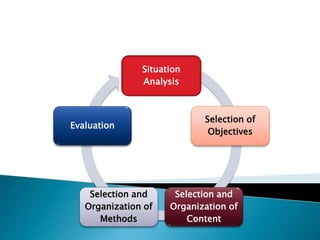
Situation
Analysis
Selection of
Objectives
Selection and
Organization of
Content
Selection and
Organization of
Methods
Evaluation
 In this situation as it means that educators
can
 continually come back to their work and
make changes, rather
 than go back to the beginning and start
again every time there
 is even the smallest of changes needed to
the curriculum
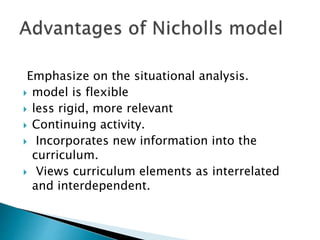
Emphasize on the situational analysis.
 model is flexible
 less rigid, more relevant
 Continuing activity.
 Incorporates new information into the
curriculum.
 Views curriculum elements as interrelated
and interdependent.
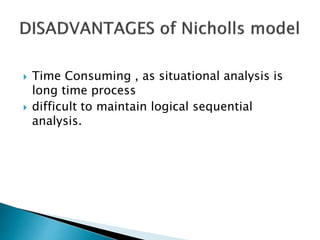
 Time Consuming , as situational analysis is
long time process
 difficult to maintain logical sequential
analysis.
Curriculum model by nicholls

Curriculum model by nicholls

  • 2.
    Definition: A simplified representationof reality which is often depicted in diagrammatic form Purpose: To develop a curriculum, models are used to examine elements of a curriculum and how these elements interrelate.
  • 3.
    There are three types of curriculum models •Rational/objectives models •(RalphTyler & Hilda Taba) •Cyclical models •(Wheeler & Nichols) •Dynamic/interaction models •(Walker & Skilbeck)
  • 4.
    Audrey Nicholls andHoward Nicholls
  • 5.
     The cyclicalmodel of curriculum developed after and appears to have a significant connection to the rational/objective models of curriculum.  Although an important difference is that the cyclical model views the curriculum process as circular or  a continuing activity, rather than the fixed and rigid processes  which the rational/objective model of curriculum is associated with.
  • 6.
     The Cyclicalmodel is responsive to needs, which are on-going, necessitating constant updating of the curriculum process.  They are flexible.  These models view elements of the curriculum as interrelated and interdependent.
  • 7.
     The Cyclicalmodels involve Situational Analysis, which involves the analysis of those factors, which exist in the environment where the curriculum is going to be introduced.
  • 8.
    Nicholls and Nichollsmodel of curriculum, developed in 1976, has been taken to be more representative of the cyclical approach.  The real notion of the cyclical nature of this model  is present in this version of the model rather than the Wheeler version 1974.
  • 9.
    Its cyclical natureis emphasized by Nicholls, who indicates that with this model “there is no starting-point…it is a never ending process”.  But this becomes somewhat  confused by Nicholls and Nicholls who also state that learning  needs to be specifically planned if a “pupil’s learning is to be  directed towards desired ends”
  • 10.
    Thus making itimplicit that  at some stage there must be a starting point and also an end  point depending on the need for formative assessment at a future point in time.
  • 12.
    Situation Analysis Selection of Objectives Selection and Organizationof Content Selection and Organization of Methods Evaluation
  • 13.
     In thissituation as it means that educators can  continually come back to their work and make changes, rather  than go back to the beginning and start again every time there  is even the smallest of changes needed to the curriculum
  • 14.
    Emphasize on thesituational analysis.  model is flexible  less rigid, more relevant  Continuing activity.  Incorporates new information into the curriculum.  Views curriculum elements as interrelated and interdependent.
  • 15.
     Time Consuming, as situational analysis is long time process  difficult to maintain logical sequential analysis.