Creativity to Innovation.


                     www.create‐learning.com
Draw one.


www.create‐learning.com
If the pig is drawn . . .
•Toward the top of the paper, you are a positive, optimistic person.
•Toward the middle of the paper, you are a realist.
•Toward the bottom of the paper, you are a pessimist and have a tendency to be
negative.
•Facing left, you are traditional, friendly, and good at remembering dates,
including birthdays.
•Facing forward (or angled forward), you are direct, enjoy playing "the devil‘s
advocate,“ and neither fear nor avoid discussions.
•Facing right, you are innovative and active but do not have a strong sense of
family, and you are not good at remembering dates.
•With many details, you are analytical, cautious, and distrustful.
•With few details, you are emotional and naive, care little for details, and are a
risk-taker.
•With four legs showing, you are secure and stubborn, and you stick to your
ideals.
•With less than four legs, you are insecure or are going through a period of
major change.
•With large ears, you are a good listener. The larger the ears, the better listener
you are.
•With a long tail, you have a good sex life. The longer the tail, the better it is.

                                   www.create‐learning.com
www.create‐learning.com
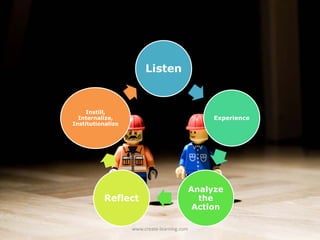
Listen


    Instill,
  Internalize,                                    Experience
Institutionalize


                                             Analyze
           Reflect                             the
                                              Action

                   www.create‐learning.com
Inward Spiraling Doom Loops of
        Asphyxiation


           www.create‐learning.com
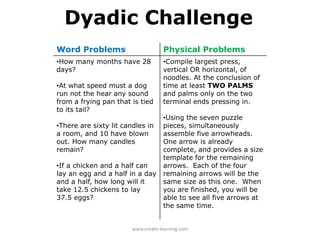
Dyadic Challenge
Word Problems                       Physical Problems
•How many months have 28            •Compile largest press,
days?                               vertical OR horizontal, of
                                    noodles. At the conclusion of
•At what speed must a dog           time at least TWO PALMS
run not the hear any sound          and palms only on the two
from a frying pan that is tied      terminal ends pressing in.
to its tail?
                                    •Using the seven puzzle
•There are sixty lit candles in     pieces, simultaneously
a room, and 10 have blown           assemble five arrowheads.
out. How many candles               One arrow is already
remain?                             complete, and provides a size
                                    template for the remaining
•If a chicken and a half can        arrows. Each of the four
lay an egg and a half in a day      remaining arrows will be the
and a half, how long will it        same size as this one. When
take 12.5 chickens to lay           you are finished, you will be
37.5 eggs?                          able to see all five arrows at
                                    the same time.


                        www.create‐learning.com
www.create‐learning.com
Think about it.
•How did your initial 1st thought response, differ from a more thoughtful
response?
•What past constructs (experiences) impacted your responses?
•How does working in a group change the outcomes?
•How fast does that dog have to run?
•In the past, when faced with challenges similar what was effective?
•What can be done to ensure solutions to problems are as “true” as possible
and are able to overcome psychological inertia?

DEFINITION OF PSYCHOLOGICAL INERTIA.
The psychological meaning of the word "inertia" implies an indisposition to change – a
certain "stuckness" due to human programming. It represents the inevitability of
behaving in a certain way – the way that has been indelibly inscribed somewhere in
the brain. It also represents the impossibility – as long as a person is guided by his
habits – of ever behaving in a better way.
http://www.triz-journal.com/archives/1998/08/c/index.htm


                                  www.create‐learning.com
Routine causes of psychological inertia are;

•Having a fixed vision (or model) of the solution or root cause.
•False assumptions (trusting the data).
•Language that is a strong carrier of psychological inertia. Specific
terminology carries psychological inertia.
•Experience, expertise and reliance upon previous results.
•Limited knowledge, hidden resources or mechanisms.
•Inflexibility (model worship; trying to prove a specific theory,
stubbornness).
•Using the same strategy. Keep thinking the same way and you will
continue to get the same result.
•Rushing to a solution – incomplete thinking.

-the 8 causes are found in TRIZICS;
http://www.amazon.com/Trizics-yourself-impossible-technical-
systematically/dp/1456319892/ref=sr_1_1?ie=UTF8&s=books&qid=1300803014&sr=1-1


                                               www.create‐learning.com
The re-birth of slick
              like my gangsta stroll?
Challenge:
•Create an opening within your teams index card wide enough to pass a
team member through it, Without further damage to the card?
•Resources – index card, scissors, knowledge of psychological inertia, each
other.
•Constraint – You and your assumptions
•Think – How can we maximize the surface area and use space


                              www.create‐learning.com
Assumptions?


   www.create‐learning.com
www.create‐learning.com
Quick TRIZ: Theory of
       inventive problem solving.

       •Created in 1940 by G.S Altschuller

       •Initially reviewed ~200,000
       patents to understand how
       inventive solutions are created. To
       date over 3 million have been
       reviewed and the original results
       have stayed essentially the same.


www.create‐learning.com
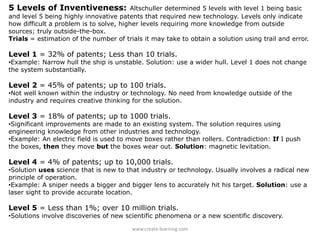
5 Levels of Inventiveness:              Altschuller determined 5 levels with level 1 being basic
and level 5 being highly innovative patents that required new technology. Levels only indicate
how difficult a problem is to solve, higher levels requiring more knowledge from outside
sources; truly outside-the-box.
Trials = estimation of the number of trials it may take to obtain a solution using trail and error.

Level 1 = 32% of patents; Less than 10 trials.
•Example: Narrow hull the ship is unstable. Solution: use a wider hull. Level 1 does not change
the system substantially.

Level 2 = 45% of patents; up to 100 trials.
•Not well known within the industry or technology. No need from knowledge outside of the
industry and requires creative thinking for the solution.

Level 3 = 18% of patents; up to 1000 trials.
•Significant improvements are made to an existing system. The solution requires using
engineering knowledge from other industries and technology.
•Example: An electric field is used to move boxes rather than rollers. Contradiction: If I push
the boxes, then they move but the boxes wear out. Solution: magnetic levitation.

Level 4 = 4% of patents; up to 10,000 trials.
•Solution uses science that is new to that industry or technology. Usually involves a radical new
principle of operation.
•Example: A sniper needs a bigger and bigger lens to accurately hit his target. Solution: use a
laser sight to provide accurate location.

Level 5 = Less than 1%; over 10 million trials.
•Solutions involve discoveries of new scientific phenomena or a new scientific discovery.

                                        www.create‐learning.com
Rope Cuffs?
             Nail Balance?

             Which level are these?


www.create‐learning.com
Non-TRIZ specific Problem Solving Models


Plan:Do:Check:Act model originally credited to Shewhart

                                                   www.create‐learning.com
Plan:Do:Check:Act model originally credited to Shewhart


5 Questions;
1.What is the target condition? (the challenge)
2.What is the actual condition now?
3.What obstacles are now preventing you from reaching your target condition?
Which one are you addressing now?
4.What is your next step?
5.When can we go and see what we have learned from taking that step?

                                         www.create‐learning.com
www.create‐learning.com
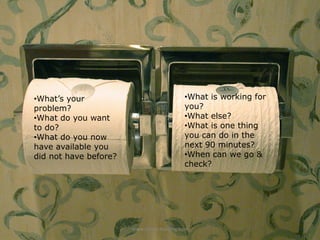
•What’s your                                •What is working for
problem?                                    you?
•What do you want                           •What else?
to do?                                      •What is one thing
•What do you now                            you can do in the
have available you                          next 90 minutes?
did not have before?                        •When can we go &
                                            check?


                       www.create‐learning.com
mike@create-learning.com
    www.create-learning.com
    www.facebook.com/teambuildingwny
    Twitter: @teambuildingny
    716 629 3678


www.create‐learning.com
Photo Attributions
Ansik
michaelcardus
Abulic Monkey
Magnusfranklin
http://a5.sphotos.ak.fbcdn.net/photos‐ak‐snc1/v1397/172/6/40002763702/n40002763702_1069610_4906.jpg?dl=1
FaceMePLS
Elaphurus

Content Resources:
TRIZICS: Teach yourself TRIZ, how to invent, innovate an solve “impossible” technical problems systematically;  Cameron, Gordon
Create Space 2010


                                                          www.create‐learning.com

Creativity to Innovation

  • 1.
    Creativity to Innovation. www.create‐learning.com
  • 2.
  • 3.
    If the pigis drawn . . . •Toward the top of the paper, you are a positive, optimistic person. •Toward the middle of the paper, you are a realist. •Toward the bottom of the paper, you are a pessimist and have a tendency to be negative. •Facing left, you are traditional, friendly, and good at remembering dates, including birthdays. •Facing forward (or angled forward), you are direct, enjoy playing "the devil‘s advocate,“ and neither fear nor avoid discussions. •Facing right, you are innovative and active but do not have a strong sense of family, and you are not good at remembering dates. •With many details, you are analytical, cautious, and distrustful. •With few details, you are emotional and naive, care little for details, and are a risk-taker. •With four legs showing, you are secure and stubborn, and you stick to your ideals. •With less than four legs, you are insecure or are going through a period of major change. •With large ears, you are a good listener. The larger the ears, the better listener you are. •With a long tail, you have a good sex life. The longer the tail, the better it is. www.create‐learning.com
  • 4.
  • 5.
  • 6.
    Listen Instill, Internalize, Experience Institutionalize Analyze Reflect the Action www.create‐learning.com
  • 7.
    Inward Spiraling DoomLoops of Asphyxiation www.create‐learning.com
  • 8.
    Dyadic Challenge Word Problems Physical Problems •How many months have 28 •Compile largest press, days? vertical OR horizontal, of noodles. At the conclusion of •At what speed must a dog time at least TWO PALMS run not the hear any sound and palms only on the two from a frying pan that is tied terminal ends pressing in. to its tail? •Using the seven puzzle •There are sixty lit candles in pieces, simultaneously a room, and 10 have blown assemble five arrowheads. out. How many candles One arrow is already remain? complete, and provides a size template for the remaining •If a chicken and a half can arrows. Each of the four lay an egg and a half in a day remaining arrows will be the and a half, how long will it same size as this one. When take 12.5 chickens to lay you are finished, you will be 37.5 eggs? able to see all five arrows at the same time. www.create‐learning.com
  • 9.
  • 10.
    Think about it. •Howdid your initial 1st thought response, differ from a more thoughtful response? •What past constructs (experiences) impacted your responses? •How does working in a group change the outcomes? •How fast does that dog have to run? •In the past, when faced with challenges similar what was effective? •What can be done to ensure solutions to problems are as “true” as possible and are able to overcome psychological inertia? DEFINITION OF PSYCHOLOGICAL INERTIA. The psychological meaning of the word "inertia" implies an indisposition to change – a certain "stuckness" due to human programming. It represents the inevitability of behaving in a certain way – the way that has been indelibly inscribed somewhere in the brain. It also represents the impossibility – as long as a person is guided by his habits – of ever behaving in a better way. http://www.triz-journal.com/archives/1998/08/c/index.htm www.create‐learning.com
  • 11.
    Routine causes ofpsychological inertia are; •Having a fixed vision (or model) of the solution or root cause. •False assumptions (trusting the data). •Language that is a strong carrier of psychological inertia. Specific terminology carries psychological inertia. •Experience, expertise and reliance upon previous results. •Limited knowledge, hidden resources or mechanisms. •Inflexibility (model worship; trying to prove a specific theory, stubbornness). •Using the same strategy. Keep thinking the same way and you will continue to get the same result. •Rushing to a solution – incomplete thinking. -the 8 causes are found in TRIZICS; http://www.amazon.com/Trizics-yourself-impossible-technical- systematically/dp/1456319892/ref=sr_1_1?ie=UTF8&s=books&qid=1300803014&sr=1-1 www.create‐learning.com
  • 12.
    The re-birth ofslick like my gangsta stroll? Challenge: •Create an opening within your teams index card wide enough to pass a team member through it, Without further damage to the card? •Resources – index card, scissors, knowledge of psychological inertia, each other. •Constraint – You and your assumptions •Think – How can we maximize the surface area and use space www.create‐learning.com
  • 13.
    Assumptions? www.create‐learning.com
  • 14.
  • 15.
    Quick TRIZ: Theoryof inventive problem solving. •Created in 1940 by G.S Altschuller •Initially reviewed ~200,000 patents to understand how inventive solutions are created. To date over 3 million have been reviewed and the original results have stayed essentially the same. www.create‐learning.com
  • 16.
    5 Levels ofInventiveness: Altschuller determined 5 levels with level 1 being basic and level 5 being highly innovative patents that required new technology. Levels only indicate how difficult a problem is to solve, higher levels requiring more knowledge from outside sources; truly outside-the-box. Trials = estimation of the number of trials it may take to obtain a solution using trail and error. Level 1 = 32% of patents; Less than 10 trials. •Example: Narrow hull the ship is unstable. Solution: use a wider hull. Level 1 does not change the system substantially. Level 2 = 45% of patents; up to 100 trials. •Not well known within the industry or technology. No need from knowledge outside of the industry and requires creative thinking for the solution. Level 3 = 18% of patents; up to 1000 trials. •Significant improvements are made to an existing system. The solution requires using engineering knowledge from other industries and technology. •Example: An electric field is used to move boxes rather than rollers. Contradiction: If I push the boxes, then they move but the boxes wear out. Solution: magnetic levitation. Level 4 = 4% of patents; up to 10,000 trials. •Solution uses science that is new to that industry or technology. Usually involves a radical new principle of operation. •Example: A sniper needs a bigger and bigger lens to accurately hit his target. Solution: use a laser sight to provide accurate location. Level 5 = Less than 1%; over 10 million trials. •Solutions involve discoveries of new scientific phenomena or a new scientific discovery. www.create‐learning.com
  • 17.
    Rope Cuffs? Nail Balance? Which level are these? www.create‐learning.com
  • 18.
  • 19.
    Non-TRIZ specific ProblemSolving Models Plan:Do:Check:Act model originally credited to Shewhart www.create‐learning.com
  • 20.
    Plan:Do:Check:Act model originallycredited to Shewhart 5 Questions; 1.What is the target condition? (the challenge) 2.What is the actual condition now? 3.What obstacles are now preventing you from reaching your target condition? Which one are you addressing now? 4.What is your next step? 5.When can we go and see what we have learned from taking that step? www.create‐learning.com
  • 21.
  • 22.
  • 23.
    •What’s your •What is working for problem? you? •What do you want •What else? to do? •What is one thing •What do you now you can do in the have available you next 90 minutes? did not have before? •When can we go & check? www.create‐learning.com
  • 24.
    mike@create-learning.com www.create-learning.com www.facebook.com/teambuildingwny Twitter: @teambuildingny 716 629 3678 www.create‐learning.com
  • 25.