Fighter Aircraft Avionics
Part II
SOLO HERMELIN
Updated: 04.04.13
1
Table of Content
SOLO
Fighter Aircraft Avionics
2
Introduction
First generation (1945-1955)
Second Generation (1950-1965)
Jet Fighter Generations
Third Generation (1965-1975)
Fourth Generation (1970-2010)
4.5Generation
Fifth Generation (1995 - 2025)
Aircraft Avionics
Cockpit Displays
Communication (internal and external)
Data Entry and Control
Flight Control
Third Generation Avionics
Fourth Generation Avionics
4.5Generation Avionics
Fifth Generation Avionics
Fighter Aircra
Table of Content (continue – 1)
SOLO
Fighter Aircraft Avionics
Earth Atmosphere
Flight Instruments
Flight Management System
Aircraft Aerodynamics
Aircraft Flight Control
Aircraft Flight Control Surfaces
Aircraft Flight Control Examples
Aircraft Propulsion System
Jet Engine
Vertical/Short Take-Off and Landing (VSTOL)
Engine Control System
Fuel System
Power Generation System
Environmental Control System
Oil System
Table of Content (continue – 2)
SOLO
4
Fighter Aircraft Avionics
Equations of Motion of an Air Vehicle in Ellipsoidal Earth Atmosphere
Fighter Aircraft Weapon System
Safety Procedures
Tracking Systems
Aircraft Sensors
Airborne Radars
Infrared/Optical Systems
Electronic Warfare
Air-to-Ground Missions
Bombs
Air-to-Surface Missiles (ASM) or Air-to-Ground Missiles (AGM)
Fighter Aircraft Weapon Examples
Air-to-Air Missiles (AAM)
Fighter Gun
Aircraft Flight Performance
Navigation
Part II
References
Avionics
I
V
Avionics III
Continue from
Fighter Aircraft Avionics
Part I
SOLO
5
Fighter Aircraft Avionics
6
Earth Atmosphere
7
Earth Atmosphere
8
Earth Atmosphere
The basic variables representing the thermodynamics state of the gas are the
Density, ρ, Temperature, T and Pressure, p.
SOLO
9
Air Data System
• The Density, ρ, is defined as the mass, m, per unit volume, v, and has units
of kg/m3
.
v
m
v ∆
∆
=
→∆ 0
limρ
• The Temperature, T, with units in degrees Kelvin ( ͦ K). Is a measure of the
average kinetic energy of gas particles.
• The Pressure, p, exerted by a gas on a solid surface is defined as the rate of
change of normal momentum of the gas particles striking per unit area.
It has units of N/m2
. Other pressure units are millibar (mbar), Pascal (Pa),
millimeter of mercury height (mHg)
S
f
p n
S ∆
∆
=
→∆ 0
lim
kPamNbar 100/101 25
==
( ) mmHginHgkPamkNmbar 00.7609213.29/325.10125.1013 2
===
The Atmospheric Pressure at Sea Level is:
Earth Atmosphere
Speed of Sound (a)
This is the speed of sound waves propagation in ambient
air. The speed of sound is given by
SOLO
10
Sa TRa ⋅⋅= γ
γ air = 1.4,
Ra =287.0 J/kg--ͦ
K
TS – Static Air Temperature
True Airspeed (TAS)
The True Airspeed is the speed of the aircraft’s center of
mass with respect to the ambient air through which is
passing.
Indicated Airspeed (IAS)
The Indicated Airspeed is the speed indicated by a
differential-pressure airspeed indicator.
Air Data System
Earth Atmosphere
Mach Number (M)
Is the ratio of the TAS to the speed of sound at the
flight condition.
SOLO
11
aTASM /=
Dynamic Pressure (q)
The force per unit area required to bring an ideal
(incompressible) fluid to rest: q=1/2∙ρ∙VT
2
(where VT is
True Air Speed-TAS, and ρ is the density of the fluid).
Impact Pressure (QC)
The force per unit area required to bring moving air to
rest. It is the pressure exerted at the stagnation point on
the surface of a body in motion relative to the air.
PT – Total Pressure, PS – Static Pressure
2
2/1 TSTC VPPQ ⋅⋅=−= ρ
Air Data System
Earth Atmosphere
12
Earth Atmosphere
Atmospheric Constants
Definition Symbol Value Units
Sea-level pressure P0 1.013250 x 10⁵
N/m2
Sea-level temperature T0 288.15 ͦ K
Sea-level density ρ0 1.225 kg/m3
Avogadro’s Number Na 6.0220978 x 10²³
/kg-mole
Universal Gas Constant R* 8.31432 x 10³
J/kg-mole -ͦ K
Gas constant (air) Ra=R*/M0 287.0 J/kg--ͦ
K
Adiabatic polytropic constant γ 1.405
Sea-level molecular weight M0 28.96643
Sea-level gravity acceleration g0 9.80665 m/s2
Radius of Earth (Equator) Re 6.3781 x 10⁶
m
Thermal Constant β 1.458 x 10⁻⁶
Kg/(m-s-ͦ K1/2)
Sutherland’s Constant S 110.4 ͦ K
Collision diameter σ 3.65 x 10⁻¹⁰
m
Return to TOC
SOLO
Fighter Aircraft Avionics
13
Flight Instruments
Air Data Calculation (Collison)
Geopotential Pressure Altitude
• Low Altitude (Troposphere) : H< 11000 m (36.089 ft ),
( ) kPaHPS
255879.55
1025577.21325.101 ⋅⋅−⋅= −
• Medium Altitude: 11000 m ≤ H ≤ 20000m (36.089 ft - 65.617 ft )
( )
kPaeP H
S
000,1110576885.1 4
6325.22 −⋅⋅− −
⋅=
Air Density Ratio ρ/ρ0
S
S
T
P
⋅
=
35164.00ρ
ρ
SOLO
Aircraft Avionics
14
Flight Instruments
Air Data Calculation (Collison)
Mach Number
• Subsonic Speeds (M ≤ 1),
( ) 2/72
2.01 M
P
P
S
T
⋅+=
• Supersonic Speeds (M ≥ 1),
Static Air Temperature TS ͦ K
10
2.01 2
<<
⋅⋅+
= r
Mr
T
T m
S
( ) 2/52
7
17
9.166
−⋅
⋅
=
M
M
P
P
S
T
True Airspeed (TAS) VT m/s
smTMV ST /0468.20 ⋅⋅=
SOLO
Aircraft Avionics
15
Flight Instruments
Air Data Calculation (Collison)
Speed of Sound a m/s
• Subsonic Speeds (VC ≤ a),
• Supersonic Speeds (VC ≥ a),
Sa TRa ⋅⋅= γ γ air = 1.4, Ra =287.0 J/kg--ͦ
K
Calibrated Airspeed (CAS) VC m/s
kPa
V
Q C
C








−














⋅+⋅= 1
294.340
2.01325.101
2/72
kPa
V
V
Q
C
C
C
















−








−





⋅






⋅
⋅= 1
1
294.340
7
294.340
92.166
325.101
2/7
2/52
2
SOLO
Aircraft Avionics
16
Air Data Computer
Air Data Computer uses Total and Static Pressure and Static Temperature
of the external Air Flow, to compute Flight Parameters.
17
Central Air Data Computer
Aircraft Avionics
Flight Instruments
18
Flow of Air Data to Key Avionics Sub-systems
Aircraft Avionics
Flight Instruments
19
Central Air Data Computer
Aircraft Avionics
Flight Instruments
Flight Instruments
SOLO
Aircraft Avionics
20
The t Flight Instruments assist the Pilot to safely fly the Aircraft.
The Flight Instrument provide information about:
* Height
* Airspeed
* Mach Number
* Vertical Speed
* Artificial Horizon
* Velocity Vector
* Pitch, Bank, Heading Angles
Thy include:
- Pitot – Static Flight Instruments
- Gyroscopic Instruments
- Magnetic Compass
Flight Instruments
SOLO
Aircraft Avionics
21
The Flight Panel - Understand Your Aircraft, Youtube
SOLO
22
Aircraft Avionics
Flight Instruments
Flight Instruments
SOLO
Aircraft Avionics
23
zdgpd ⋅⋅−= ρ
TRp ⋅⋅= ρ KsmR 22
/287=
zdaTd ⋅−=
aR
g
T
za
p
p ⋅





 ⋅
−=
00
1
Altimeter
Flight Instruments
SOLO
Aircraft Avionics
24
Altimeter
SOLO
25
Aircraft Avionics
Flight Instruments
Altimeters
SOLO
26
Aircraft Avionics
Flight Instruments
Altimeters
SOLO
Aircraft Avionics
27
Flight Instruments
Airspeed Indicators
2
2
1
vpp StatTotal ⋅+= ρ
The airspeed directly given by the differential pressure is called
Indicated Airspeed (IAS). This indication is subject to positioning errors of the pitot
and static probes, airplane altitude and instrument systematic defects.
The airspeed corrected for those errors is called Callibrated Airspeed (CAS).
Depending on altitude, the critic airspeeds for maneuvre, flap operation etc change
because the aerodynamic forces are function of air density. An equivalent airspeed
VE (EAS) is defined as follows:
0ρ
ρ
VVE =
V – True Airspeed
ρ – Air Density
ρ0 – Air Density at Sea Level
SOLO
28
Aircraft Avionics
Flight Instruments
Airspeed Indicator (ASI)
White Arc – Flaps Operation Range
VSO – Stalling Speed Flaps Down
VSI - Stalling Speed Flaps Up
VFE – Maximum Speed Flaps Down (Extendeed)
Green Arc – Normal Operation Range
VNO – Maximum Speed Normal Operation
Yellow Arc - Caution Range
VNE – Not to Exceed Speed
Private Pilot Airplane – Flight Instruments ASA, Movie
SOLO Aircraft Avionics
29
Flight Instruments
Airspeed Indicators
SOLO Aircraft Avionics
30
Flight Instruments
Airspeed Indicators
2
2
1
VPQPP StatCStatTotal ⋅+=+= ρ
V – True Airspeed
ρ – Air Density
ρ0 – Air Density at Sea Level
Air Density changes with altitude. Assuming an Adiabatic Flow, the
relation between Pressure and Density is given by
constC
P
==γ
ρ
γ = Cp/CV= 1.4 for air
Momentum differential equation for the Air Flow is
VdV
C
P
PdVdVPd
C
P
γρ
γ
ρ
/1
/1
0 





+=+=






=
Subsonic Speeds
SoundofSpeed
P
a S
ρ
γ ⋅
=
SOLO
Aircraft Avionics
31
Flight Instruments
Airspeed Indicators
In the free stream P = PS and V = VT,
At the Probe face P = PT and V=0
0
1 0
/1
/1
=+ ∫∫ T
T
S V
P
P
VdV
C
PdP γ
γ
Subsonic Speeds (continue)
2
1
1
2
/1
11
T
ST
V
C
PP γ
γ
γ
γ
γ
γ
γ
=


 −
−
−−
γγ
ρ
/1/1
1
SPC
=
1
2
12
2
1
1
2
1
1
2
−
=
−














⋅
−
+=





⋅⋅
−
+= γ
γ
ρ
γ
γ
γ
γ
γ
ργ
a
V
V
PP
P T
P
a
T
SS
T
S








−














⋅
−
+=





−=−= −
1
2
1
11 1
2
γ
γ
γ
a
V
P
P
P
PPPQ T
S
S
T
SSTC
SOLO
Aircraft Avionics
32
Flight Instruments
Airspeed Indicators
In the free stream P = PS and V = VT,
At the Probe face P = PT and V=0
Supersonic Speeds
1
1
2
12
1
1
1
2
2
1
−
−








+
−
−





⋅
+














⋅
+
=
γ
γ
γ
γ
γ
γ
γ
γ
a
V
a
V
P
P
T
T
S
T


















−








+
−
−





⋅
+














⋅
+
=





−=−=
−
−
1
1
1
1
2
2
1
1
1
1
2
12
γ
γ
γ
γ
γ
γ
γ
γ
a
V
a
V
P
P
P
PPPQ
T
T
S
S
T
SSTC
Assume Supersonic Adiabatic Air Flow
we obtain
SOLO
Aircraft Avionics
33
Flight Instruments
Airspeed Indicators
Mach Number
1
1
2
1
2
1
1
1
2
2
1
−
−






+
−
−⋅
+




⋅
+
=
γ
γ
γ
γ
γ
γ
γ
γ
M
M
P
P
S
T
Subsonic Speeds (M ≤ 1)
γ
γ
γ
1
1
2
1
−






⋅
−
−==
S
TT
P
P
a
V
M
12
2
1
1
2
−
=






⋅
−
+= γ
γρ
γ
γ
M
P
P
SP
a
S
T
From
Supersonic Speeds (M ≥ 1)
SOLO
Aircraft Avionics
34
Flight Instruments
Airspeed Indicators (Calibrated Airspeed)
Calibrated Airspeed is obtained by substituting
the Sea Level conditions, that is PS = PS0 ,
VT = VC , a0 = 340.294 m/s.
Subsonic Speeds (VC < a0=340.294 m/s)








−














⋅
−
+= −
1
2
1
1 1
2
0
0
γ
γ
γ
a
V
PQ C
SC
2
0
00
2
0
2
0
2
1
/2
1
2
1 C
S
C
S
C
S
aV
C V
P
V
P
a
V
PQ
C
⋅⋅=
⋅
⋅⋅=








−





⋅+≈
<<
ρ
ργ
γγ
Supersonic Speeds (VC > a0=340.294 m/s)


















−








+
−
−





⋅
+














⋅
+
=
−
−
1
1
1
1
2
2
1
1
1
2
0
12
0
0
γ
γ
γ
γ
γ
γ
γ
γ
a
V
a
V
PQ
C
C
SC
( ) mmHginHgkPamkNmbarPS 00.7609213.29/325.10125.1013 2
0 ====
γ air = 1.4
SOLO
Aircraft Avionics
35
Flight Instruments
Airspeed Indicators
By measuring (TT) the Temperature of Free
Airstream TS, we can compute the local Speed
of Sound
Sa TRa ⋅⋅= γ
True Airspeed (TAS)
By using the Mach Number computation we
can calculate the True Airspeed (TAS)
M
M
T
RMTRMaV T
aSaT ⋅
⋅
−
+
⋅⋅=⋅⋅⋅=⋅=
2
2
1
1
γ
γγ
Vertical Speed Indicator
SOLO
36
Aircraft Avionics
Flight Instruments
SOLO
37
Aircraft Avionics
Flight Instruments
Gyroscopic Flight Instruments
Turn Indicator
SOLO
38
Aircraft AvionicsFlight Instruments
Attitude Indicator
SOLO
39
Aircraft AvionicsFlight Instruments
Attitude Indicator
SOLO
40
Aircraft Avionics
Flight Instruments
Turn Coordinator
SOLO
41
Aircraft Avionics
Flight Instruments
Turn-and Slip Indicator
SOLO
42
Aircraft Avionics
Flight Instruments
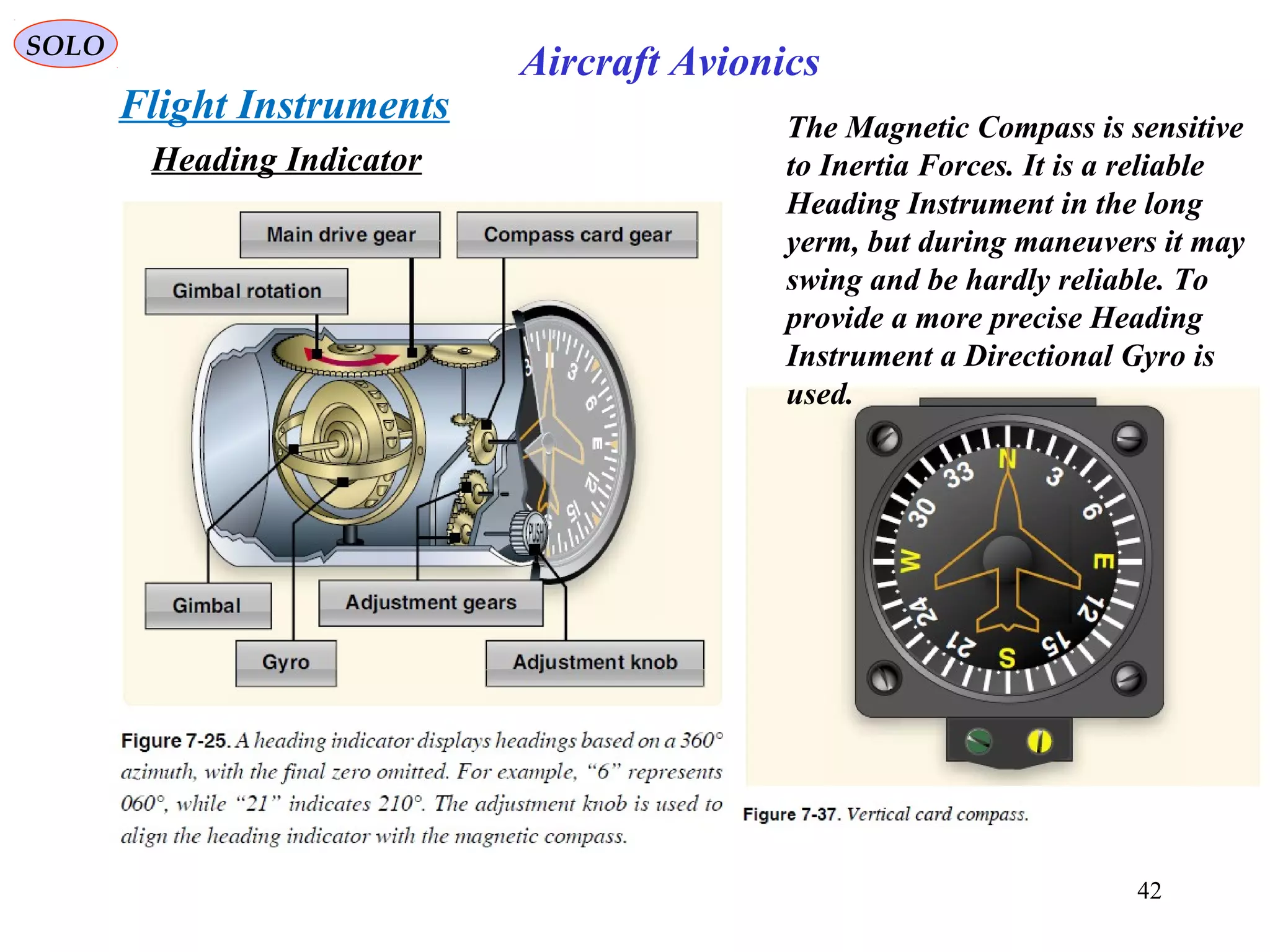
Heading Indicator
The Magnetic Compass is sensitive
to Inertia Forces. It is a reliable
Heading Instrument in the long
yerm, but during maneuvers it may
swing and be hardly reliable. To
provide a more precise Heading
Instrument a Directional Gyro is
used.
SOLO
43
Aircraft Avionics
Flight Instruments
The Earth is a huge Magnet, spinning in space, surrounded by a Magnetic Field made up
of invisible lines of flux. These lines leave the surface of the Magnetic North Pole and
reenter at the magnetic South Pole. The Magnetic Poles are not coincident with the
Geographic Poles (located on the Axis of Rotation of the Earth.
Lines of Magnetic Flux have two important characteristics:
1Any Magnet that is free to rotate will align with them.
2An Electrical Current is induced into any conductor that moves and cuts across them.
Most direction indicators installed in aircraft make use of one of these two characteristics.
SOLO
44
Magnetic Compass
Flight Instruments
Aircraft Avionics
SOLO
45
Aircraft Avionics
Flight Instruments
Flux Gate Compass System
The Gate Compass System is connected to Radio Magnetic Indicator (RMI)
and to Heading Situation Indicator (HSI).
Heading Situation Indicator (HSI).Radio Magnetic Indicator (RMI)
SOLO
46
Aircraft Avionics
Flight Instruments
SOLO
47
Aircraft Avionics
Flight Instruments
SOLO
48
Aircraft Avionics
Flight Instruments
SOLO
49
Aircraft Avionics
Flight Displays
In Modern Aircraft the Flight Instruments are provided on Panel Displays.
Flight Instruments
New Integrated Flight Control System
SOLO
50
Aircraft Avionics
Flight Displays
Chelton’s Flight Logic Reconfigurable Panel Display
Flight Instruments
SOLO
51
Aircraft Avionics
Flight Displays
Avidyne’s Entegra Reconfigurable Panel Display
Flight Instruments
SOLO
52
Aircraft Avionics
Flight Cockpit
Flight Instruments
SOLO
53
Aircraft Avionics
Flight Displays
Flight Instruments
SOLO
54
Aircraft Avionics
Flight Instruments
Automatic Dependent Surveillance
(ADS)
SOLO
55
Aircraft Avionics
Flight Instruments
SOLO
56
Aircraft Avionics
Flight Instruments
Alert Systems
SOLO
57
Aircraft Avionics
Flight Instruments
Alert Systems
SOLO
58
Aircraft Avionics
Flight Instruments
Alert Systems
SOLO
59
Aircraft Avionics
Flight Instruments
Helmet-up-Display
Return to Table of Content
SOLO
60
Aircraft Avionics
Cockpit
SOLO
61
Aircraft Avionics
Instrument Flight
Return to TOC
SOLO
62
Navigation
Flight Management System
Top Level Flight Management System Functions
Return to TOC
63
Aircraft Aerodynamics
Me 109
Elliptical
Wing
(Moderate
Aspect Ratio)
1940
M=0.55
Pure
Subsonic
Spitfire
Trapezoidal
Wing
(High
Aspect Ratio)
Me 262
Sweptback
Wing
(High
Aspect Ratio)
M=0.8
High
Subsonic
1945
MIG 15F86 Sabre
Sweptback
Wing
(Moderate
Aspect Ratio)
1950
M=0.9-0.98
High
Subsonic
(Transonic)
64
Aircraft Aerodynamics
MIG 25
MIG 21
Delta Wing
(Low
Aspect Ratio)
1960
M=2.2-2.4
Supersonic
F4 Phantom
Delta-Like
Trapezoidal
Wing
(Low
Aspect Ratio)
F-111
Large
Sweptback
(Low
Aspect Ratio)
M=2.2-3.0
Supersonic/
High
Supersonic
1970 Trapezoidal
Wing
F16
Strake
Wing
(Hybrid
Wing)
1980
M=2.0
Maneuvrability
(High Angle
of Attack)
F18
65
Wing Parameters
. Wing Area, S, is the plan surface of the wing.
. Wing Span, b, is measured tip to tip.
. Wing average chord, c, is the geometric average. The product of the span and
the average chord is the wing area (b x c = S).
. Aspect Ratio, AR, is defined as:
( )∫−
=
2/
2/
b
b
dyycS
( )
b
S
dyyc
b
c
b
b
== ∫−
2/
2/
1
S
b
AR
2
=
Aircraft Aerodynamics
66
Wing Parameters (Continue
5. The root chord, , is the chord at the wing centerline, and the tip chord,
is the chord at the tip.
6. Taper ratio,
7. Sweep Angle,
is the angle between the line of 25 percent chord and the perpendicular
to root chord.
8. Mean aerodynamic chord,
rc
Λ
r
t
c
c
=λ
tc
λ
( )[ ]∫−
=
2/
2/
21~
b
b
dyyc
S
c
c~
Aircraft Aerodynamics
67
STREAMLINESSTREAKLINES
∞V
PRESURE FIELD
VELOCITY FIELD
WING AERODYNAMICS
68
The Effect of Leading Edge Slat, Flap, and Trailing Edge Flap
Upon Angle of Attack of Basic Wing
Darrol Stinton “ The Design of the Aircraft”
Aircraft Aerodynamics
69
Movement of Shocks with Increasing Mach Number
Aircraft Aerodynamics
70
Movement of Shocks with Increasing Mach Number
71High Angles of Attack Flows
(Development of a High Resolution CFD)
72High Angles of Attack Flows
(Development of a High Resolution CFD)
SOLO
73
Aerodynamics of Flight
Return to TOC
74
Flow of Air Data to Key Avionics Sub-systems
Aircraft Avionics
Aircraft Flight Control
SOLO
Return to TOC
75
centre stick
ailerons
elevators
rudder
Generally, the primary cockpit flight controls are arranged as follows:
a control yoke (also known as a control column), centre stick or side-stick (the
latter two also colloquially known as a control or B joystick), governs the
aircraft's roll and pitch by moving the A ailerons (or activating wing warping
on some very early aircraft designs) when turned or deflected left and right,
and moves the C elevators when moved backwards or forwards
rudder pedals, or the earlier, pre-1919 "rudder bar", to control yaw, which move
the D rudder; left foot forward will move the rudder left for instance.
throttle controls to control engine speed or thrust for powered aircraft.
Aircraft Flight Control Surfaces
Flight Controls, Movie
76
Aircraft Flight Control Surfaces
77
Aircraft Flight Control Surfaces
Differential ailerons
78
Aircraft Flight Control Surfaces
The effect of left rudder pressure
Four common types of flaps
Leading edge high lift devices
The stabilator is a one-piece horizontal tail
surface that pivots up and down about a
central hinge point.
SOLO
79
Flight Control
Aircraft Flight Control Surfaces
SOLO
80
Aerodynamics of Flight
Aircraft Flight Control Surfaces
SOLO
81
Aerodynamics of Flight
Aircraft Flight Control Surfaces
SOLO
82
Control Surfaces
Aircraft Flight Control Surfaces
Return to Table of Content
SOLO
83
Aerodynamics of Flight
SOLO
84
To be replaced
Aerodynamics of Flight
Return to TOC
SOLO
85
Aircraft Flight Control
Traditional Pitch Autopilot and Autothtrottle
SOLO
86
Aircraft Flight Control
Traditional Roll Autopilot and Yaw Damper
SOLO
87
Aircraft Flight Control
SOLO
88
Aircraft Flight Control
Un-Powered Flight Controls
Simple Hydro-Mechanical Servo-Actuator
SOLO
89
Aircraft Flight Control
Hawk-200 Push-Pull Control Rod System (BAE Systems)
SOLO
90
Aircraft Flight Control
Mechanical, Power-Boosted System
SOLO
91
Aircraft Flight Control
SOLO
92
Aircraft Flight Control
Flight Controls - Hydraulic Booster, Movie
SOLO
93
Aircraft Flight Control
SOLO
94
Aircraft Flight Control
SOLO
95
Aircraft Flight Control
SOLO
96
Aircraft Flight Control
SOLO
97
Aircraft Flight Control
Falcon 7X Digital Flight Control System, Movie
SOLO
98
Aircraft Flight Control
SOLO
99
Aircraft Flight Control
F-16 Flight Control System
SOLO
100
Aircraft Flight Control
F-16 Flight Control System Functional Schematics
SOLO
101
Aircraft Flight Control
F-16 Flight Control System Redundancy Concept
SOLO
102
Aircraft Flight Control
F-16 Pitch Functional Schematic Diagram
SOLO
103
Aircraft Flight Control
F-16 Roll Functional Schematic Diagram
SOLO
104
Aircraft Flight Control
F-16 Yaw Functional Schematic Diagram
SOLO
105
Aircraft Flight Control
Integrated Servo-Actuator Schematic Diagram
SOLO
106
Aircraft Flight Control
F-16 Flight Control System Electrical Power Schematic Diagram
SOLO
107
Aircraft Flight Control
F-16 Hydraulic Power Schematic Diagram
SOLO
108
Aircraft Flight Control
F-16 Electronic Signal Selection and Failure Monitoring
SOLO
109
Aircraft Flight Control
RSS – Relaxed Static Stability
SOLO
110
Aircraft Flight Control
F-16 Performance Benefits Derived from Relaxed Static Stability
SOLO
111
Aircraft Flight Control
Russia - SU-37 Aircraft
• Canards and thrust vectoring (TV loop not shown.).
• Longitudinal controller synthesized with classical control methods.
SU-37 Terminator
SOLO
112
Aircraft Flight Control
F/A-18 Control System Components
SOLO
113
Aircraft Flight Control
F/A-18 Flight control System Functional Diagram
SOLO
114
Aircraft Flight Control
Jaguar Fly-by-Wire Architecture
SOLO
115
Aircraft Flight Control
SOLO
116
Aircraft Flight Control
SOLO
117
Aircraft Flight Control
SOLO
118
Aircraft Flight Control
SOLO
119
Aircraft Flight Control
•Controller structure decouples flying qualities from a/c dynamics.
•Regulator/Commands implement desired.
•Effector blender optimally allocates desired acceleration commands.
•On-board model.
•Control effectiveness matrix.
•Estimated acceleration for dynamic inversion.
JSF Flight Control Laws
SOLO
120
Aircraft Flight Control
Return to TOC
121
Aircraft Propulsion System
SOLO
The Fighter Aircraft Propulsion Systems Consists of:
- One or Two Jet Engines
- The Fuel Tanks (Internal and External) and Pipes.
- Engines Control Systems
* Throttles
* Engine Control Displays
Engine Control Systems – Basic Inputs and Outputs
SOLO
http://www.ausairpower.net/APA-Raptor.html 122
Aircraft Propulsion System
Return to Table of Content
123
Aircraft Propulsion System
Diagram of a typical gas turbine jet engine
Turbojets consist of an
- Air Inlet
- Air Compressor
- Combustion Chamber
- Gas Turbine (that drives the air
compressor)
- Nozzle.
The air is compressed into the chamber,
heated and expanded by the fuel combustion
and then allowed to expand out through the
turbine into the nozzle where it is accelerated
to high speed to provide propulsion
Turbojet animationPropulsion Force
SOLO
Jet Engine
124
Propulsion Force = Thrust
SOLO
The net Thrust (FN) of a Turbojet is given by
where:
ṁ air  = the mass rate of air flow through the engine
ṁ fuel  = the mass rate of fuel flow entering the engine
ve
= the velocity of the jet (the exhaust plume) and is assumed to be
less than sonic velocity
v = the velocity of the air intake = the true airspeed of the aircraft
(ṁ air  + ṁ fuel  )ve = the nozzle gross thrust (FG)
ṁ air  v = the ram drag of the intake air
Aircraft Propulsion System
Jet Engine
125
SOLO
• Cold Section:
• Air Intake (Inlet) — The standard reference frame for a jet engine is the aircraft itself.
For subsonic aircraft, the air intake to a jet engine presents no special difficulties, and
consists essentially of an opening which is designed to minimise drag, as with any other
aircraft component. However, the air reaching the compressor of a normal jet engine
must be travelling below the speed of sound, even for supersonic aircraft, to sustain the
flow mechanics of the compressor and turbine blades. At supersonic flight speeds,
shockwaves form in the intake system and reduce the recovered pressure at inlet to the
compressor. So some supersonic intakes use devices, such as a cone or ramp, to increase
pressure recovery, by making more efficient use of the shock wave system.
• Compressor or Fan — The compressor is made up of stages. Each stage consists of
vanes which rotate, and stators which remain stationary. As air is drawn deeper through
the compressor, its heat and pressure increases. Energy is derived from the turbine (see
below), passed along the shaft.
• Bypass Ducts much of the thrust of essentially all modern jet engines comes from air
from the front compressor that bypasses the combustion chamber and gas turbine
section that leads directly to the nozzle or afterburner (where fitted).
Aircraft Propulsion System
Jet Engine
126
SOLO
• Common:
• Shaft — The shaft connects the turbine to the compressor, and runs most of the
length of the engine. There may be as many as three concentric shafts, rotating at
independent speeds, with as many sets of turbines and compressors. Other services,
like a bleed of cool air, may also run down the shaft.
• Diffuser Section: - This section is a divergent duct that utilizes Bernoulli's principle to
decrease the velocity of the compressed air to allow for easier ignition. And, at the same
time, continuing to increase the air pressure before it enters the combustion chamber.
Aircraft Propulsion System
Jet Engine
127
SOLO
• Hot section:
• Combustor or Can or Flameholders or Combustion Chamber — This is a chamber where fuel is
continuously burned in the compressed air.
• Turbine — The turbine is a series of bladed discs that act like a windmill, gaining energy from the
hot gases leaving the combustor. Some of this energy is used to drive the compressor, and in some
turbine engines (i.e. turboprop, turboshaft or turbofan engines), energy is extracted by additional
turbine discs and used to drive devices such as propellers, bypass fans or helicopter rotors. One
type, a free turbine, is configured such that the turbine disc driving the compressor rotates
independently of the discs that power the external components. Relatively cool air, bled from the
compressor, may be used to cool the turbine blades and vanes, to prevent them from melting.
• Afterburner or Reheat (chiefly UK) — (mainly military) Produces extra thrust by burning extra
fuel, usually inefficiently, to significantly raise Nozzle Entry Temperature at the exhaust. Owing to
a larger volume flow (i.e. lower density) at exit from the afterburner, an increased nozzle flow area
is required, to maintain satisfactory engine matching, when the afterburner is alight.
• Exhaust or Nozzle — Hot gases leaving the engine exhaust to atmospheric pressure via a nozzle,
the objective being to produce a high velocity jet. In most cases, the nozzle is convergent and of
fixed flow area.
• Supersonic nozzle — If the Nozzle Pressure Ratio (Nozzle Entry Pressure/Ambient Pressure) is
very high, to maximize thrust it may be worthwhile, despite the additional weight, to fit a
convergent-divergent (de Laval) nozzle. As the name suggests, initially this type of nozzle is
convergent, but beyond the throat (smallest flow area), the flow area starts to increase to form the
divergent portion. The expansion to atmospheric pressure and supersonic gas velocity continues
downstream of the throat, whereas in a convergent nozzle the expansion beyond sonic velocity
occurs externally, in the exhaust plume. The former process is more efficient than the latter.
Aircraft Propulsion System
Jet Engine
128
Aircraft Propulsion System
Diagram of a typical gas turbine jet engine
SOLO
Air Intake
Preceding the compressor is the air intake (or inlet). It is designed to be as efficient as possible at
recovering the ram pressure of the air stream tube approaching the intake. The air leaving the intake then
enters the compressor. The stators (stationary blades) guide the airflow of the compressed gases.
Klaus Hünecke, “Jet Engines – Fundamentals
of Theory, Design and Operation”, 1997
Jet Engine
129
SOLO
Air Intake
Klaus Hünecke, “Jet Engines – Fundamentals
of Theory, Design and Operation”, 1997
Aircraft Propulsion System
Jet Engine
130
SOLO
Air Intake
AERO 315
USAF ACADEMY
DEPARTMENT OF
AERONAUTICS
Aircraft Propulsion System
Jet Engine
131
Aircraft Propulsion System
Diagram of a typical gas turbine jet engine
An animation of an axial
compressor. The stationary
blades are the stators
SOLO
Compressor
The compressor is driven by the turbine. The compressor rotates at a very high speed, adding energy
to the airflow and at the same time squeezing (compressing) it into a smaller space. Compressing the
air increases its pressure and temperature.
In most turbojet-powered aircraft, bleed air is extracted from the
compressor section at various stages to perform a variety of jobs including
air conditioning/pressurization, engine inlet anti-icing and turbine cooling.
Bleeding air off decreases the overall efficiency of the engine, but the
usefulness of the compressed air outweighs the loss in efficiency.
Several types of compressor are used in turbojets and gas turbines in
general: axial, centrifugal, axial-centrifugal, double-centrifugal, etc.
Early turbojet compressors had overall pressure ratios as low as 5:1
(as do a lot of simple auxiliary power units and small propulsion
turbojets today). Aerodynamic improvements, plus splitting the compression
system into two separate units and/or incorporating variable compressor
geometry, enabled later turbojets to have overall pressure ratios of 15:1 or
more. For comparison, modern civil turbofan engines have overall pressure ratios of 44:1 or more.
After leaving the compressor section, the compressed air enters the combustion chamber.
Jet Engine
132
Aircraft Propulsion System
Diagram of a typical gas turbine jet engine
SOLO
Combustion Chamber
The burning process in the combustor is significantly different from that in a piston
engine. In a piston engine the burning gases are confined to a small volume and, as the
fuel burns, the pressure increases dramatically. In a turbojet the air and fuel mixture
passes unconfined through the combustion chamber. As the mixture burns its
temperature increases dramatically, but the pressure actually decreases a few percent.
The fuel-air mixture must be brought almost to a stop so that a stable flame can be
maintained. This occurs just after the start of the combustion chamber. The aft part of
this flame front is allowed to progress rearward. This ensures that all of the fuel is
burned, as the flame becomes hotter when it leans out, and because of the shape of the
combustion chamber the flow is accelerated rearwards. Some pressure drop is required,
as it is the reason why the expanding gases travel out the rear of the engine rather than
out the front. Less than 25% of the air is involved in combustion, in some engines as little
as 12%, the rest acting as a reservoir to absorb the heating effects of the burning fuel.
Another difference between piston engines and jet engines is that the peak flame
temperature in a piston engine is experienced only momentarily in a small portion of the
full cycle. The combustor in a jet engine is exposed to the peak flame temperature
continuously and operates at a pressure high enough that a stoichiometric fuel-air ratio
would melt the can and everything downstream. Instead, jet engines run a very lean
mixture, so lean that it would not normally support combustion. A central core of the
flow (primary airflow) is mixed with enough fuel to burn readily. The cans are carefully
shaped to maintain a layer of fresh unburned air between the metal surfaces and the
central core. This unburned air (secondary airflow) mixes into the burned gases to bring
the temperature down to something a turbine can tolerate.
Turbojet animation
Jet Engine
133
Combustion Chambers
SOLO
A Multiple Combustion Chamber
Flame Stabilizing and
General Flow Pattern
Tubo-Annular Combustion Chamber
Annular Combustion Chamber
Aircraft Propulsion System
Jet Engine
134
Combustion Chambers
SOLO
The combustion efficiency of most aircraft gas turbine
engines at sea-level takeoff conditions is almost 100%. It
decreases nonlinear to 98% at altitude cruise conditions.
Air-fuel ratio ranges from 50:1 to 130:1. For any type of
combustion chamber there is a rich and weak limit to the
air-fuel ratio, beyond which the flame is extinguished.
The range of air-fuel ratio between the rich and weak
limits is reduced with an increase of air velocity. If the
increasing air mass flow reduces the fuel ratio below
certain value, flame extinction occurs
Typical combustion
stability limits of an
aircraft gas turbine
Typical combustion efficiency of an aircraft gas
turbine over the operational range
Aircraft Propulsion System
Jet Engine
135
Aircraft Propulsion System
Diagram of a typical gas turbine jet engine
SOLO
Gas Turbine
A twin turbine and shaft arrangement. A triple turbine and shaft arrangement.
The Gas Turbine energy is used to drive the
Compressor, and in some turbine engines (i.e.
Turboprop, Turboshaft or Turbofan Engines),
energy is extracted by additional turbine discs and
used to drive devices such as propellers, bypass fans
Jet Engine
136
Aircraft Propulsion System
Diagram of a typical gas turbine jet engine
SOLO
Nozzle
The primary objective of a nozzle is to use the heat and pressure of the exhaust
gas to accelerate the jet to high speed so as to efficiently propel the vehicle. For
air-breathing engines, if the fully expanded jet has a higher speed than the
aircraft's airspeed, then there is a net rearward momentum gain to the air and
there will be a forward thrust on the airframe.
Many military combat engines incorporate an afterburner
(or reheat) in the engine exhaust system. When the system
is lit, the nozzle throat area must be increased, to
accommodate the extra exhaust volume flow, so that the
turbo machinery is unaware that the afterburner is lit. A
variable throat area is achieved by moving a series of
overlapping petals, which approximate the circular nozzle
cross-section.
Variable Exhaust Nozzle, on
the GE F404-400 low-bypass
turbofan installed on a Boeing
F/A-18 Hornet
Jet Engine
137
SOLO
Gas-Turbine Working Cycle in Pressure-Volume and Enthalpy-Entropy Diagram
Klaus Hünecke, “Jet Engines – Fundamentals
of Theory, Design and Operation”, 1997
Aircraft Propulsion System
Jet Engine
Return to Table of Content
138
SOLO
“The Jet Engine” Rolls-Royce
Vertical/Short Take-Off and Landing (VSTOL)
Reaction control system.
Aircraft Propulsion System
Harrier Jump Jet
139
SOLO
“The Jet Engine” Rolls-Royce
Vertical/Short Take-Off and Landing (VSTOL)
Deflector Nozzle
Side mounted swivelling nozzle
Thrust deflector systems
Aircraft Propulsion System
140
Aircraft Propulsion System
141
Lockheed_Martin_F-35_Lightning_II STOVL
The Unique F-35
Fighter Plane, Movie
USP 3” part F35
Joint Strike Fighter ENG,
Movie
SOLO Aircraft Propulsion System
142
Vertical/Short Take-Off and Landing (VSTOL)
Cutaway Yakovlev Yak-38 Folger
Aircraft Propulsion System
Return to Table of Content
143
SOLO
Klaus Hünecke, “Jet Engines – Fundamentals
of Theory, Design and Operation”, 1997
Military Turbofan Engines
Aircraft Propulsion System
144
Aircraft Propulsion System
SOLO
Engine Control System
Basic Inputs and Outputs
Engine Control System
Input Signals:
• Throttle Position (Pilot Control)
• Air Data (from Air Data Computer)
Airspeed and Altitude
• Total Temperature (at the Engine
Face)
• Engine Rotation Speed
• Engine Temperature
• Nozzle Position
• Fuel Flow
• Internal Pressure Ratio at different Stages of the Engine
Output Signals
• Fuel Flow Control
• Air Flow Control
145
Aircraft Propulsion SystemSOLO
A Simple Engine Control Systems :
Pilot in the Loop
A Simple Limited Authority
Engine Control Systems
TGT – Turbine Gas Temperature
NH – Speed of Rotation of Engine Shaft
Tt - Total Temperature
FCU – Fuel Control Unit
Engine Control System
146
Aircraft Propulsion SystemSOLO
A Simple Engine Control Systems :
Pilot in the Loop
A Simple Limited Authority
Engine Control Systems
Engine Control Systems :
with NH and TGT exceedence warning
Full Authority Engine Control Systems
With Electrical Throttle Signaling :
Engine Control System
147
Aircraft Propulsion SystemSOLO
A Modern Simplified Engine Control System
VSV – Variable Stator Vane
EGT– Exhaust Gas Temperature
PMA - Permanent Magnet
Alternator
FMU – Flow Management
Unit
AVM – Aircraft Vibration
Monitoring
Engine Control System
148
Aircraft Propulsion SystemSOLO
Turbojet Engine (EJ200 in Eurofighter Typhoon)
Engine Control System
Return to Table of Content
149
Aircraft Propulsion SystemSOLO
Fuel System
150
Aircraft Propulsion SystemSOLO
Fuel System
151
SOLO Aircraft Propulsion System
Fuselage and Engine Fuel System
Siphoning theFuel from the Drop Tank
To Main Tank
Pump Transfer Distributed (Left)
And Centralized (Right)
Fuel System
152
Aircraft Propulsion System
SOLO
Fuel Control System
Fuel System
153
Aircraft Propulsion SystemSOLO
Location of fuel tanks in JAS 39 Gripen
“On Aircraft Fuel Systems Conceptual Design and Modeling”
Hampus Gavel
Fuel System
154
Aircraft Propulsion SystemSOLO
Probe and drouge Air-to-Air Refueling of JAS 39 Gripen
“On Aircraft Fuel Systems Conceptual Design and Modeling”
Hampus Gavel
Fuel System
155
Aircraft Propulsion SystemSOLO
F15 C/D Fuel System
Fuel System
156
Aircraft Propulsion SystemSOLO
Fuel System
F-35 JSF Return to Table of Content
157
Aircraft Propulsion System
SOLO
Power Generation System
158
Aircraft Propulsion System
SOLO
Power Generation System
F-18E/F Variable-Speed Constant-Frequency (VSCF) Cycloconverter
159
Aircraft Propulsion System
SOLO
Power Generation System
F-22 Power Generation and Distribution System
Return to Table of Content
160
Aircraft Propulsion System
SOLO
Environmental Control System
161
Aircraft Oxigen SystemSOLO
On Board Oxygen Generation System (Honeywell Aerospace Yeovil)
Environmental Control System
Return to Table of Content
162
Aircraft Oxigen SystemSOLO
Oil System
Engine Oil system
Return to Table of Content
163
Go to
Fighter Aircraft Avionics
Part III
SOLO
Fighter Aircraft Avionics
References
SOLO
164
PHAK Chapter 1 - 17
http://www.gov/library/manuals/aviation/pilot_handbook/media/
George M. Siouris, “Aerospace Avionics Systems, A Modern Synthesis”,
Academic Press, Inc., 1993
R.P.G. Collinson, “Introduction to Avionics”, Chapman & Hall, Inc., 1996, 1997, 1998
Ian Moir, Allan Seabridge, “Aircraft Systems, Mechanical, Electrical and Avionics
Subsystem Integration”, John Wiley & Sons, Ltd., 3th Ed., 2008
Fighter Aircraft Avionics
Ian Moir, Allan Seabridge, “Military Avionics Systems”, John Wiley & Sons, LTD.,
2006
References (continue – 1)
SOLO
165
Fighter Aircraft Avionics
S. Hermelin, “Air Vehicle in Spherical Earth Atmosphere”
S. Hermelin, “Airborne Radar”, Part1, Part2, Example1, Example2
S. Hermelin, “Tracking Systems”
S. Hermelin, “Navigation Systems”
S. Hermelin, “Earth Atmosphere”
S. Hermelin, “Earth Gravitation”
S. Hermelin, “Aircraft Flight Instruments”
S. Hermelin, “Computing Gunsight, HUD and HMS”
S. Hermelin, “Aircraft Flight Performance”
S. Hermelin, “Sensors Systems: Surveillance, Ground Mapping, Target Tracking”
S. Hermelin, “Air-to-Air Combat”
References (continue – 2)
SOLO
166
Fighter Aircraft Avionics
S. Hermelin, “Spherical Trigonometry”
S. Hermelin, “Modern Aircraft Cutaway”
167
SOLO
Technion
Israeli Institute of Technology
1964 – 1968 BSc EE
1968 – 1971 MSc EE
Israeli Air Force
1970 – 1974
RAFAEL
Israeli Armament Development Authority
1974 – 2013
Stanford University
1983 – 1986 PhD AA
SOLO
168
Civilian Aircraft Avionics
Flight Cockpit
CIRRUS PERSPECTIVE
Cirrus Perspective Avionics Demo, Youtube Cirrus SR22 Tampa Landing in Heavy Rain
SOLO
169
Flight Displays
CIRRUS PERSPECTIVE
Civilian Aircraft Avionics
SOLO
170
Flight Displays
CIRRUS PERSPECTIVE
Civilian Aircraft Avionics
SOLO
171
Flight Displays
CIRRUS PERSPECTIVE
Civilian Aircraft Avionics
SOLO
172
Flight Displays
CIRRUS PERSPECTIVE
Civilian Aircraft Avionics
SOLO
173
Flight Displays
CIRRUS PERSPECTIVE
Civilian Aircraft Avionics
SOLO
174
Flight Displays
CIRRUS PERSPECTIVE
Civilian Aircraft Avionics
SOLO
175
Flight Displays
CIRRUS PERSPECTIVE
Civilian Aircraft Avionics
SOLO
176
Flight Displays
CIRRUS PERSPECTIVE
Civilian Aircraft Avionics
177

9 fighter aircraft avionics-part ii

  • 1.
    Fighter Aircraft Avionics PartII SOLO HERMELIN Updated: 04.04.13 1
  • 2.
    Table of Content SOLO FighterAircraft Avionics 2 Introduction First generation (1945-1955) Second Generation (1950-1965) Jet Fighter Generations Third Generation (1965-1975) Fourth Generation (1970-2010) 4.5Generation Fifth Generation (1995 - 2025) Aircraft Avionics Cockpit Displays Communication (internal and external) Data Entry and Control Flight Control Third Generation Avionics Fourth Generation Avionics 4.5Generation Avionics Fifth Generation Avionics Fighter Aircra
  • 3.
    Table of Content(continue – 1) SOLO Fighter Aircraft Avionics Earth Atmosphere Flight Instruments Flight Management System Aircraft Aerodynamics Aircraft Flight Control Aircraft Flight Control Surfaces Aircraft Flight Control Examples Aircraft Propulsion System Jet Engine Vertical/Short Take-Off and Landing (VSTOL) Engine Control System Fuel System Power Generation System Environmental Control System Oil System
  • 4.
    Table of Content(continue – 2) SOLO 4 Fighter Aircraft Avionics Equations of Motion of an Air Vehicle in Ellipsoidal Earth Atmosphere Fighter Aircraft Weapon System Safety Procedures Tracking Systems Aircraft Sensors Airborne Radars Infrared/Optical Systems Electronic Warfare Air-to-Ground Missions Bombs Air-to-Surface Missiles (ASM) or Air-to-Ground Missiles (AGM) Fighter Aircraft Weapon Examples Air-to-Air Missiles (AAM) Fighter Gun Aircraft Flight Performance Navigation Part II References Avionics I V Avionics III
  • 5.
    Continue from Fighter AircraftAvionics Part I SOLO 5 Fighter Aircraft Avionics
  • 6.
  • 7.
  • 8.
  • 9.
    The basic variablesrepresenting the thermodynamics state of the gas are the Density, ρ, Temperature, T and Pressure, p. SOLO 9 Air Data System • The Density, ρ, is defined as the mass, m, per unit volume, v, and has units of kg/m3 . v m v ∆ ∆ = →∆ 0 limρ • The Temperature, T, with units in degrees Kelvin ( ͦ K). Is a measure of the average kinetic energy of gas particles. • The Pressure, p, exerted by a gas on a solid surface is defined as the rate of change of normal momentum of the gas particles striking per unit area. It has units of N/m2 . Other pressure units are millibar (mbar), Pascal (Pa), millimeter of mercury height (mHg) S f p n S ∆ ∆ = →∆ 0 lim kPamNbar 100/101 25 == ( ) mmHginHgkPamkNmbar 00.7609213.29/325.10125.1013 2 === The Atmospheric Pressure at Sea Level is: Earth Atmosphere
  • 10.
    Speed of Sound(a) This is the speed of sound waves propagation in ambient air. The speed of sound is given by SOLO 10 Sa TRa ⋅⋅= γ γ air = 1.4, Ra =287.0 J/kg--ͦ K TS – Static Air Temperature True Airspeed (TAS) The True Airspeed is the speed of the aircraft’s center of mass with respect to the ambient air through which is passing. Indicated Airspeed (IAS) The Indicated Airspeed is the speed indicated by a differential-pressure airspeed indicator. Air Data System Earth Atmosphere
  • 11.
    Mach Number (M) Isthe ratio of the TAS to the speed of sound at the flight condition. SOLO 11 aTASM /= Dynamic Pressure (q) The force per unit area required to bring an ideal (incompressible) fluid to rest: q=1/2∙ρ∙VT 2 (where VT is True Air Speed-TAS, and ρ is the density of the fluid). Impact Pressure (QC) The force per unit area required to bring moving air to rest. It is the pressure exerted at the stagnation point on the surface of a body in motion relative to the air. PT – Total Pressure, PS – Static Pressure 2 2/1 TSTC VPPQ ⋅⋅=−= ρ Air Data System Earth Atmosphere
  • 12.
    12 Earth Atmosphere Atmospheric Constants DefinitionSymbol Value Units Sea-level pressure P0 1.013250 x 10⁵ N/m2 Sea-level temperature T0 288.15 ͦ K Sea-level density ρ0 1.225 kg/m3 Avogadro’s Number Na 6.0220978 x 10²³ /kg-mole Universal Gas Constant R* 8.31432 x 10³ J/kg-mole -ͦ K Gas constant (air) Ra=R*/M0 287.0 J/kg--ͦ K Adiabatic polytropic constant γ 1.405 Sea-level molecular weight M0 28.96643 Sea-level gravity acceleration g0 9.80665 m/s2 Radius of Earth (Equator) Re 6.3781 x 10⁶ m Thermal Constant β 1.458 x 10⁻⁶ Kg/(m-s-ͦ K1/2) Sutherland’s Constant S 110.4 ͦ K Collision diameter σ 3.65 x 10⁻¹⁰ m Return to TOC
  • 13.
    SOLO Fighter Aircraft Avionics 13 FlightInstruments Air Data Calculation (Collison) Geopotential Pressure Altitude • Low Altitude (Troposphere) : H< 11000 m (36.089 ft ), ( ) kPaHPS 255879.55 1025577.21325.101 ⋅⋅−⋅= − • Medium Altitude: 11000 m ≤ H ≤ 20000m (36.089 ft - 65.617 ft ) ( ) kPaeP H S 000,1110576885.1 4 6325.22 −⋅⋅− − ⋅= Air Density Ratio ρ/ρ0 S S T P ⋅ = 35164.00ρ ρ
  • 14.
    SOLO Aircraft Avionics 14 Flight Instruments AirData Calculation (Collison) Mach Number • Subsonic Speeds (M ≤ 1), ( ) 2/72 2.01 M P P S T ⋅+= • Supersonic Speeds (M ≥ 1), Static Air Temperature TS ͦ K 10 2.01 2 << ⋅⋅+ = r Mr T T m S ( ) 2/52 7 17 9.166 −⋅ ⋅ = M M P P S T True Airspeed (TAS) VT m/s smTMV ST /0468.20 ⋅⋅=
  • 15.
    SOLO Aircraft Avionics 15 Flight Instruments AirData Calculation (Collison) Speed of Sound a m/s • Subsonic Speeds (VC ≤ a), • Supersonic Speeds (VC ≥ a), Sa TRa ⋅⋅= γ γ air = 1.4, Ra =287.0 J/kg--ͦ K Calibrated Airspeed (CAS) VC m/s kPa V Q C C         −               ⋅+⋅= 1 294.340 2.01325.101 2/72 kPa V V Q C C C                 −         −      ⋅       ⋅ ⋅= 1 1 294.340 7 294.340 92.166 325.101 2/7 2/52 2
  • 16.
    SOLO Aircraft Avionics 16 Air DataComputer Air Data Computer uses Total and Static Pressure and Static Temperature of the external Air Flow, to compute Flight Parameters.
  • 17.
    17 Central Air DataComputer Aircraft Avionics Flight Instruments
  • 18.
    18 Flow of AirData to Key Avionics Sub-systems Aircraft Avionics Flight Instruments
  • 19.
    19 Central Air DataComputer Aircraft Avionics Flight Instruments
  • 20.
    Flight Instruments SOLO Aircraft Avionics 20 Thet Flight Instruments assist the Pilot to safely fly the Aircraft. The Flight Instrument provide information about: * Height * Airspeed * Mach Number * Vertical Speed * Artificial Horizon * Velocity Vector * Pitch, Bank, Heading Angles Thy include: - Pitot – Static Flight Instruments - Gyroscopic Instruments - Magnetic Compass
  • 21.
    Flight Instruments SOLO Aircraft Avionics 21 TheFlight Panel - Understand Your Aircraft, Youtube
  • 22.
  • 23.
    Flight Instruments SOLO Aircraft Avionics 23 zdgpd⋅⋅−= ρ TRp ⋅⋅= ρ KsmR 22 /287= zdaTd ⋅−= aR g T za p p ⋅       ⋅ −= 00 1 Altimeter
  • 24.
  • 25.
  • 26.
  • 27.
    SOLO Aircraft Avionics 27 Flight Instruments AirspeedIndicators 2 2 1 vpp StatTotal ⋅+= ρ The airspeed directly given by the differential pressure is called Indicated Airspeed (IAS). This indication is subject to positioning errors of the pitot and static probes, airplane altitude and instrument systematic defects. The airspeed corrected for those errors is called Callibrated Airspeed (CAS). Depending on altitude, the critic airspeeds for maneuvre, flap operation etc change because the aerodynamic forces are function of air density. An equivalent airspeed VE (EAS) is defined as follows: 0ρ ρ VVE = V – True Airspeed ρ – Air Density ρ0 – Air Density at Sea Level
  • 28.
    SOLO 28 Aircraft Avionics Flight Instruments AirspeedIndicator (ASI) White Arc – Flaps Operation Range VSO – Stalling Speed Flaps Down VSI - Stalling Speed Flaps Up VFE – Maximum Speed Flaps Down (Extendeed) Green Arc – Normal Operation Range VNO – Maximum Speed Normal Operation Yellow Arc - Caution Range VNE – Not to Exceed Speed Private Pilot Airplane – Flight Instruments ASA, Movie
  • 29.
    SOLO Aircraft Avionics 29 FlightInstruments Airspeed Indicators
  • 30.
    SOLO Aircraft Avionics 30 FlightInstruments Airspeed Indicators 2 2 1 VPQPP StatCStatTotal ⋅+=+= ρ V – True Airspeed ρ – Air Density ρ0 – Air Density at Sea Level Air Density changes with altitude. Assuming an Adiabatic Flow, the relation between Pressure and Density is given by constC P ==γ ρ γ = Cp/CV= 1.4 for air Momentum differential equation for the Air Flow is VdV C P PdVdVPd C P γρ γ ρ /1 /1 0       +=+=       = Subsonic Speeds SoundofSpeed P a S ρ γ ⋅ =
  • 31.
    SOLO Aircraft Avionics 31 Flight Instruments AirspeedIndicators In the free stream P = PS and V = VT, At the Probe face P = PT and V=0 0 1 0 /1 /1 =+ ∫∫ T T S V P P VdV C PdP γ γ Subsonic Speeds (continue) 2 1 1 2 /1 11 T ST V C PP γ γ γ γ γ γ γ =    − − −− γγ ρ /1/1 1 SPC = 1 2 12 2 1 1 2 1 1 2 − = −               ⋅ − +=      ⋅⋅ − += γ γ ρ γ γ γ γ γ ργ a V V PP P T P a T SS T S         −               ⋅ − +=      −=−= − 1 2 1 11 1 2 γ γ γ a V P P P PPPQ T S S T SSTC
  • 32.
    SOLO Aircraft Avionics 32 Flight Instruments AirspeedIndicators In the free stream P = PS and V = VT, At the Probe face P = PT and V=0 Supersonic Speeds 1 1 2 12 1 1 1 2 2 1 − −         + − −      ⋅ +               ⋅ + = γ γ γ γ γ γ γ γ a V a V P P T T S T                   −         + − −      ⋅ +               ⋅ + =      −=−= − − 1 1 1 1 2 2 1 1 1 1 2 12 γ γ γ γ γ γ γ γ a V a V P P P PPPQ T T S S T SSTC Assume Supersonic Adiabatic Air Flow we obtain
  • 33.
    SOLO Aircraft Avionics 33 Flight Instruments AirspeedIndicators Mach Number 1 1 2 1 2 1 1 1 2 2 1 − −       + − −⋅ +     ⋅ + = γ γ γ γ γ γ γ γ M M P P S T Subsonic Speeds (M ≤ 1) γ γ γ 1 1 2 1 −       ⋅ − −== S TT P P a V M 12 2 1 1 2 − =       ⋅ − += γ γρ γ γ M P P SP a S T From Supersonic Speeds (M ≥ 1)
  • 34.
    SOLO Aircraft Avionics 34 Flight Instruments AirspeedIndicators (Calibrated Airspeed) Calibrated Airspeed is obtained by substituting the Sea Level conditions, that is PS = PS0 , VT = VC , a0 = 340.294 m/s. Subsonic Speeds (VC < a0=340.294 m/s)         −               ⋅ − += − 1 2 1 1 1 2 0 0 γ γ γ a V PQ C SC 2 0 00 2 0 2 0 2 1 /2 1 2 1 C S C S C S aV C V P V P a V PQ C ⋅⋅= ⋅ ⋅⋅=         −      ⋅+≈ << ρ ργ γγ Supersonic Speeds (VC > a0=340.294 m/s)                   −         + − −      ⋅ +               ⋅ + = − − 1 1 1 1 2 2 1 1 1 2 0 12 0 0 γ γ γ γ γ γ γ γ a V a V PQ C C SC ( ) mmHginHgkPamkNmbarPS 00.7609213.29/325.10125.1013 2 0 ==== γ air = 1.4
  • 35.
    SOLO Aircraft Avionics 35 Flight Instruments AirspeedIndicators By measuring (TT) the Temperature of Free Airstream TS, we can compute the local Speed of Sound Sa TRa ⋅⋅= γ True Airspeed (TAS) By using the Mach Number computation we can calculate the True Airspeed (TAS) M M T RMTRMaV T aSaT ⋅ ⋅ − + ⋅⋅=⋅⋅⋅=⋅= 2 2 1 1 γ γγ
  • 36.
    Vertical Speed Indicator SOLO 36 AircraftAvionics Flight Instruments
  • 37.
  • 38.
  • 39.
  • 40.
  • 41.
  • 42.
    SOLO 42 Aircraft Avionics Flight Instruments HeadingIndicator The Magnetic Compass is sensitive to Inertia Forces. It is a reliable Heading Instrument in the long yerm, but during maneuvers it may swing and be hardly reliable. To provide a more precise Heading Instrument a Directional Gyro is used.
  • 43.
    SOLO 43 Aircraft Avionics Flight Instruments TheEarth is a huge Magnet, spinning in space, surrounded by a Magnetic Field made up of invisible lines of flux. These lines leave the surface of the Magnetic North Pole and reenter at the magnetic South Pole. The Magnetic Poles are not coincident with the Geographic Poles (located on the Axis of Rotation of the Earth. Lines of Magnetic Flux have two important characteristics: 1Any Magnet that is free to rotate will align with them. 2An Electrical Current is induced into any conductor that moves and cuts across them. Most direction indicators installed in aircraft make use of one of these two characteristics.
  • 44.
  • 45.
    SOLO 45 Aircraft Avionics Flight Instruments FluxGate Compass System The Gate Compass System is connected to Radio Magnetic Indicator (RMI) and to Heading Situation Indicator (HSI). Heading Situation Indicator (HSI).Radio Magnetic Indicator (RMI)
  • 46.
  • 47.
  • 48.
  • 49.
    SOLO 49 Aircraft Avionics Flight Displays InModern Aircraft the Flight Instruments are provided on Panel Displays. Flight Instruments New Integrated Flight Control System
  • 50.
    SOLO 50 Aircraft Avionics Flight Displays Chelton’sFlight Logic Reconfigurable Panel Display Flight Instruments
  • 51.
    SOLO 51 Aircraft Avionics Flight Displays Avidyne’sEntegra Reconfigurable Panel Display Flight Instruments
  • 52.
  • 53.
  • 54.
  • 55.
  • 56.
  • 57.
  • 58.
  • 59.
  • 60.
  • 61.
  • 62.
    SOLO 62 Navigation Flight Management System TopLevel Flight Management System Functions Return to TOC
  • 63.
    63 Aircraft Aerodynamics Me 109 Elliptical Wing (Moderate AspectRatio) 1940 M=0.55 Pure Subsonic Spitfire Trapezoidal Wing (High Aspect Ratio) Me 262 Sweptback Wing (High Aspect Ratio) M=0.8 High Subsonic 1945 MIG 15F86 Sabre Sweptback Wing (Moderate Aspect Ratio) 1950 M=0.9-0.98 High Subsonic (Transonic)
  • 64.
    64 Aircraft Aerodynamics MIG 25 MIG21 Delta Wing (Low Aspect Ratio) 1960 M=2.2-2.4 Supersonic F4 Phantom Delta-Like Trapezoidal Wing (Low Aspect Ratio) F-111 Large Sweptback (Low Aspect Ratio) M=2.2-3.0 Supersonic/ High Supersonic 1970 Trapezoidal Wing F16 Strake Wing (Hybrid Wing) 1980 M=2.0 Maneuvrability (High Angle of Attack) F18
  • 65.
    65 Wing Parameters . WingArea, S, is the plan surface of the wing. . Wing Span, b, is measured tip to tip. . Wing average chord, c, is the geometric average. The product of the span and the average chord is the wing area (b x c = S). . Aspect Ratio, AR, is defined as: ( )∫− = 2/ 2/ b b dyycS ( ) b S dyyc b c b b == ∫− 2/ 2/ 1 S b AR 2 = Aircraft Aerodynamics
  • 66.
    66 Wing Parameters (Continue 5.The root chord, , is the chord at the wing centerline, and the tip chord, is the chord at the tip. 6. Taper ratio, 7. Sweep Angle, is the angle between the line of 25 percent chord and the perpendicular to root chord. 8. Mean aerodynamic chord, rc Λ r t c c =λ tc λ ( )[ ]∫− = 2/ 2/ 21~ b b dyyc S c c~ Aircraft Aerodynamics
  • 67.
  • 68.
    68 The Effect ofLeading Edge Slat, Flap, and Trailing Edge Flap Upon Angle of Attack of Basic Wing Darrol Stinton “ The Design of the Aircraft” Aircraft Aerodynamics
  • 69.
    69 Movement of Shockswith Increasing Mach Number Aircraft Aerodynamics
  • 70.
    70 Movement of Shockswith Increasing Mach Number
  • 71.
    71High Angles ofAttack Flows (Development of a High Resolution CFD)
  • 72.
    72High Angles ofAttack Flows (Development of a High Resolution CFD)
  • 73.
  • 74.
    74 Flow of AirData to Key Avionics Sub-systems Aircraft Avionics Aircraft Flight Control SOLO Return to TOC
  • 75.
    75 centre stick ailerons elevators rudder Generally, theprimary cockpit flight controls are arranged as follows: a control yoke (also known as a control column), centre stick or side-stick (the latter two also colloquially known as a control or B joystick), governs the aircraft's roll and pitch by moving the A ailerons (or activating wing warping on some very early aircraft designs) when turned or deflected left and right, and moves the C elevators when moved backwards or forwards rudder pedals, or the earlier, pre-1919 "rudder bar", to control yaw, which move the D rudder; left foot forward will move the rudder left for instance. throttle controls to control engine speed or thrust for powered aircraft. Aircraft Flight Control Surfaces Flight Controls, Movie
  • 76.
  • 77.
    77 Aircraft Flight ControlSurfaces Differential ailerons
  • 78.
    78 Aircraft Flight ControlSurfaces The effect of left rudder pressure Four common types of flaps Leading edge high lift devices The stabilator is a one-piece horizontal tail surface that pivots up and down about a central hinge point.
  • 79.
  • 80.
  • 81.
  • 82.
    SOLO 82 Control Surfaces Aircraft FlightControl Surfaces Return to Table of Content
  • 83.
  • 84.
    SOLO 84 To be replaced Aerodynamicsof Flight Return to TOC
  • 85.
    SOLO 85 Aircraft Flight Control TraditionalPitch Autopilot and Autothtrottle
  • 86.
    SOLO 86 Aircraft Flight Control TraditionalRoll Autopilot and Yaw Damper
  • 87.
  • 88.
    SOLO 88 Aircraft Flight Control Un-PoweredFlight Controls Simple Hydro-Mechanical Servo-Actuator
  • 89.
    SOLO 89 Aircraft Flight Control Hawk-200Push-Pull Control Rod System (BAE Systems)
  • 90.
  • 91.
  • 92.
    SOLO 92 Aircraft Flight Control FlightControls - Hydraulic Booster, Movie
  • 93.
  • 94.
  • 95.
  • 96.
  • 97.
    SOLO 97 Aircraft Flight Control Falcon7X Digital Flight Control System, Movie
  • 98.
  • 99.
  • 100.
    SOLO 100 Aircraft Flight Control F-16Flight Control System Functional Schematics
  • 101.
    SOLO 101 Aircraft Flight Control F-16Flight Control System Redundancy Concept
  • 102.
    SOLO 102 Aircraft Flight Control F-16Pitch Functional Schematic Diagram
  • 103.
    SOLO 103 Aircraft Flight Control F-16Roll Functional Schematic Diagram
  • 104.
    SOLO 104 Aircraft Flight Control F-16Yaw Functional Schematic Diagram
  • 105.
    SOLO 105 Aircraft Flight Control IntegratedServo-Actuator Schematic Diagram
  • 106.
    SOLO 106 Aircraft Flight Control F-16Flight Control System Electrical Power Schematic Diagram
  • 107.
    SOLO 107 Aircraft Flight Control F-16Hydraulic Power Schematic Diagram
  • 108.
    SOLO 108 Aircraft Flight Control F-16Electronic Signal Selection and Failure Monitoring
  • 109.
    SOLO 109 Aircraft Flight Control RSS– Relaxed Static Stability
  • 110.
    SOLO 110 Aircraft Flight Control F-16Performance Benefits Derived from Relaxed Static Stability
  • 111.
    SOLO 111 Aircraft Flight Control Russia- SU-37 Aircraft • Canards and thrust vectoring (TV loop not shown.). • Longitudinal controller synthesized with classical control methods. SU-37 Terminator
  • 112.
    SOLO 112 Aircraft Flight Control F/A-18Control System Components
  • 113.
    SOLO 113 Aircraft Flight Control F/A-18Flight control System Functional Diagram
  • 114.
  • 115.
  • 116.
  • 117.
  • 118.
  • 119.
    SOLO 119 Aircraft Flight Control •Controllerstructure decouples flying qualities from a/c dynamics. •Regulator/Commands implement desired. •Effector blender optimally allocates desired acceleration commands. •On-board model. •Control effectiveness matrix. •Estimated acceleration for dynamic inversion. JSF Flight Control Laws
  • 120.
  • 121.
    121 Aircraft Propulsion System SOLO TheFighter Aircraft Propulsion Systems Consists of: - One or Two Jet Engines - The Fuel Tanks (Internal and External) and Pipes. - Engines Control Systems * Throttles * Engine Control Displays Engine Control Systems – Basic Inputs and Outputs
  • 122.
  • 123.
    123 Aircraft Propulsion System Diagramof a typical gas turbine jet engine Turbojets consist of an - Air Inlet - Air Compressor - Combustion Chamber - Gas Turbine (that drives the air compressor) - Nozzle. The air is compressed into the chamber, heated and expanded by the fuel combustion and then allowed to expand out through the turbine into the nozzle where it is accelerated to high speed to provide propulsion Turbojet animationPropulsion Force SOLO Jet Engine
  • 124.
    124 Propulsion Force =Thrust SOLO The net Thrust (FN) of a Turbojet is given by where: ṁ air  = the mass rate of air flow through the engine ṁ fuel  = the mass rate of fuel flow entering the engine ve = the velocity of the jet (the exhaust plume) and is assumed to be less than sonic velocity v = the velocity of the air intake = the true airspeed of the aircraft (ṁ air  + ṁ fuel  )ve = the nozzle gross thrust (FG) ṁ air  v = the ram drag of the intake air Aircraft Propulsion System Jet Engine
  • 125.
    125 SOLO • Cold Section: •Air Intake (Inlet) — The standard reference frame for a jet engine is the aircraft itself. For subsonic aircraft, the air intake to a jet engine presents no special difficulties, and consists essentially of an opening which is designed to minimise drag, as with any other aircraft component. However, the air reaching the compressor of a normal jet engine must be travelling below the speed of sound, even for supersonic aircraft, to sustain the flow mechanics of the compressor and turbine blades. At supersonic flight speeds, shockwaves form in the intake system and reduce the recovered pressure at inlet to the compressor. So some supersonic intakes use devices, such as a cone or ramp, to increase pressure recovery, by making more efficient use of the shock wave system. • Compressor or Fan — The compressor is made up of stages. Each stage consists of vanes which rotate, and stators which remain stationary. As air is drawn deeper through the compressor, its heat and pressure increases. Energy is derived from the turbine (see below), passed along the shaft. • Bypass Ducts much of the thrust of essentially all modern jet engines comes from air from the front compressor that bypasses the combustion chamber and gas turbine section that leads directly to the nozzle or afterburner (where fitted). Aircraft Propulsion System Jet Engine
  • 126.
    126 SOLO • Common: • Shaft— The shaft connects the turbine to the compressor, and runs most of the length of the engine. There may be as many as three concentric shafts, rotating at independent speeds, with as many sets of turbines and compressors. Other services, like a bleed of cool air, may also run down the shaft. • Diffuser Section: - This section is a divergent duct that utilizes Bernoulli's principle to decrease the velocity of the compressed air to allow for easier ignition. And, at the same time, continuing to increase the air pressure before it enters the combustion chamber. Aircraft Propulsion System Jet Engine
  • 127.
    127 SOLO • Hot section: •Combustor or Can or Flameholders or Combustion Chamber — This is a chamber where fuel is continuously burned in the compressed air. • Turbine — The turbine is a series of bladed discs that act like a windmill, gaining energy from the hot gases leaving the combustor. Some of this energy is used to drive the compressor, and in some turbine engines (i.e. turboprop, turboshaft or turbofan engines), energy is extracted by additional turbine discs and used to drive devices such as propellers, bypass fans or helicopter rotors. One type, a free turbine, is configured such that the turbine disc driving the compressor rotates independently of the discs that power the external components. Relatively cool air, bled from the compressor, may be used to cool the turbine blades and vanes, to prevent them from melting. • Afterburner or Reheat (chiefly UK) — (mainly military) Produces extra thrust by burning extra fuel, usually inefficiently, to significantly raise Nozzle Entry Temperature at the exhaust. Owing to a larger volume flow (i.e. lower density) at exit from the afterburner, an increased nozzle flow area is required, to maintain satisfactory engine matching, when the afterburner is alight. • Exhaust or Nozzle — Hot gases leaving the engine exhaust to atmospheric pressure via a nozzle, the objective being to produce a high velocity jet. In most cases, the nozzle is convergent and of fixed flow area. • Supersonic nozzle — If the Nozzle Pressure Ratio (Nozzle Entry Pressure/Ambient Pressure) is very high, to maximize thrust it may be worthwhile, despite the additional weight, to fit a convergent-divergent (de Laval) nozzle. As the name suggests, initially this type of nozzle is convergent, but beyond the throat (smallest flow area), the flow area starts to increase to form the divergent portion. The expansion to atmospheric pressure and supersonic gas velocity continues downstream of the throat, whereas in a convergent nozzle the expansion beyond sonic velocity occurs externally, in the exhaust plume. The former process is more efficient than the latter. Aircraft Propulsion System Jet Engine
  • 128.
    128 Aircraft Propulsion System Diagramof a typical gas turbine jet engine SOLO Air Intake Preceding the compressor is the air intake (or inlet). It is designed to be as efficient as possible at recovering the ram pressure of the air stream tube approaching the intake. The air leaving the intake then enters the compressor. The stators (stationary blades) guide the airflow of the compressed gases. Klaus Hünecke, “Jet Engines – Fundamentals of Theory, Design and Operation”, 1997 Jet Engine
  • 129.
    129 SOLO Air Intake Klaus Hünecke,“Jet Engines – Fundamentals of Theory, Design and Operation”, 1997 Aircraft Propulsion System Jet Engine
  • 130.
    130 SOLO Air Intake AERO 315 USAFACADEMY DEPARTMENT OF AERONAUTICS Aircraft Propulsion System Jet Engine
  • 131.
    131 Aircraft Propulsion System Diagramof a typical gas turbine jet engine An animation of an axial compressor. The stationary blades are the stators SOLO Compressor The compressor is driven by the turbine. The compressor rotates at a very high speed, adding energy to the airflow and at the same time squeezing (compressing) it into a smaller space. Compressing the air increases its pressure and temperature. In most turbojet-powered aircraft, bleed air is extracted from the compressor section at various stages to perform a variety of jobs including air conditioning/pressurization, engine inlet anti-icing and turbine cooling. Bleeding air off decreases the overall efficiency of the engine, but the usefulness of the compressed air outweighs the loss in efficiency. Several types of compressor are used in turbojets and gas turbines in general: axial, centrifugal, axial-centrifugal, double-centrifugal, etc. Early turbojet compressors had overall pressure ratios as low as 5:1 (as do a lot of simple auxiliary power units and small propulsion turbojets today). Aerodynamic improvements, plus splitting the compression system into two separate units and/or incorporating variable compressor geometry, enabled later turbojets to have overall pressure ratios of 15:1 or more. For comparison, modern civil turbofan engines have overall pressure ratios of 44:1 or more. After leaving the compressor section, the compressed air enters the combustion chamber. Jet Engine
  • 132.
    132 Aircraft Propulsion System Diagramof a typical gas turbine jet engine SOLO Combustion Chamber The burning process in the combustor is significantly different from that in a piston engine. In a piston engine the burning gases are confined to a small volume and, as the fuel burns, the pressure increases dramatically. In a turbojet the air and fuel mixture passes unconfined through the combustion chamber. As the mixture burns its temperature increases dramatically, but the pressure actually decreases a few percent. The fuel-air mixture must be brought almost to a stop so that a stable flame can be maintained. This occurs just after the start of the combustion chamber. The aft part of this flame front is allowed to progress rearward. This ensures that all of the fuel is burned, as the flame becomes hotter when it leans out, and because of the shape of the combustion chamber the flow is accelerated rearwards. Some pressure drop is required, as it is the reason why the expanding gases travel out the rear of the engine rather than out the front. Less than 25% of the air is involved in combustion, in some engines as little as 12%, the rest acting as a reservoir to absorb the heating effects of the burning fuel. Another difference between piston engines and jet engines is that the peak flame temperature in a piston engine is experienced only momentarily in a small portion of the full cycle. The combustor in a jet engine is exposed to the peak flame temperature continuously and operates at a pressure high enough that a stoichiometric fuel-air ratio would melt the can and everything downstream. Instead, jet engines run a very lean mixture, so lean that it would not normally support combustion. A central core of the flow (primary airflow) is mixed with enough fuel to burn readily. The cans are carefully shaped to maintain a layer of fresh unburned air between the metal surfaces and the central core. This unburned air (secondary airflow) mixes into the burned gases to bring the temperature down to something a turbine can tolerate. Turbojet animation Jet Engine
  • 133.
    133 Combustion Chambers SOLO A MultipleCombustion Chamber Flame Stabilizing and General Flow Pattern Tubo-Annular Combustion Chamber Annular Combustion Chamber Aircraft Propulsion System Jet Engine
  • 134.
    134 Combustion Chambers SOLO The combustionefficiency of most aircraft gas turbine engines at sea-level takeoff conditions is almost 100%. It decreases nonlinear to 98% at altitude cruise conditions. Air-fuel ratio ranges from 50:1 to 130:1. For any type of combustion chamber there is a rich and weak limit to the air-fuel ratio, beyond which the flame is extinguished. The range of air-fuel ratio between the rich and weak limits is reduced with an increase of air velocity. If the increasing air mass flow reduces the fuel ratio below certain value, flame extinction occurs Typical combustion stability limits of an aircraft gas turbine Typical combustion efficiency of an aircraft gas turbine over the operational range Aircraft Propulsion System Jet Engine
  • 135.
    135 Aircraft Propulsion System Diagramof a typical gas turbine jet engine SOLO Gas Turbine A twin turbine and shaft arrangement. A triple turbine and shaft arrangement. The Gas Turbine energy is used to drive the Compressor, and in some turbine engines (i.e. Turboprop, Turboshaft or Turbofan Engines), energy is extracted by additional turbine discs and used to drive devices such as propellers, bypass fans Jet Engine
  • 136.
    136 Aircraft Propulsion System Diagramof a typical gas turbine jet engine SOLO Nozzle The primary objective of a nozzle is to use the heat and pressure of the exhaust gas to accelerate the jet to high speed so as to efficiently propel the vehicle. For air-breathing engines, if the fully expanded jet has a higher speed than the aircraft's airspeed, then there is a net rearward momentum gain to the air and there will be a forward thrust on the airframe. Many military combat engines incorporate an afterburner (or reheat) in the engine exhaust system. When the system is lit, the nozzle throat area must be increased, to accommodate the extra exhaust volume flow, so that the turbo machinery is unaware that the afterburner is lit. A variable throat area is achieved by moving a series of overlapping petals, which approximate the circular nozzle cross-section. Variable Exhaust Nozzle, on the GE F404-400 low-bypass turbofan installed on a Boeing F/A-18 Hornet Jet Engine
  • 137.
    137 SOLO Gas-Turbine Working Cyclein Pressure-Volume and Enthalpy-Entropy Diagram Klaus Hünecke, “Jet Engines – Fundamentals of Theory, Design and Operation”, 1997 Aircraft Propulsion System Jet Engine Return to Table of Content
  • 138.
    138 SOLO “The Jet Engine”Rolls-Royce Vertical/Short Take-Off and Landing (VSTOL) Reaction control system. Aircraft Propulsion System Harrier Jump Jet
  • 139.
    139 SOLO “The Jet Engine”Rolls-Royce Vertical/Short Take-Off and Landing (VSTOL) Deflector Nozzle Side mounted swivelling nozzle Thrust deflector systems Aircraft Propulsion System
  • 140.
  • 141.
    141 Lockheed_Martin_F-35_Lightning_II STOVL The UniqueF-35 Fighter Plane, Movie USP 3” part F35 Joint Strike Fighter ENG, Movie SOLO Aircraft Propulsion System
  • 142.
    142 Vertical/Short Take-Off andLanding (VSTOL) Cutaway Yakovlev Yak-38 Folger Aircraft Propulsion System Return to Table of Content
  • 143.
    143 SOLO Klaus Hünecke, “JetEngines – Fundamentals of Theory, Design and Operation”, 1997 Military Turbofan Engines Aircraft Propulsion System
  • 144.
    144 Aircraft Propulsion System SOLO EngineControl System Engine Control System Basic Inputs and Outputs Engine Control System Input Signals: • Throttle Position (Pilot Control) • Air Data (from Air Data Computer) Airspeed and Altitude • Total Temperature (at the Engine Face) • Engine Rotation Speed • Engine Temperature • Nozzle Position • Fuel Flow • Internal Pressure Ratio at different Stages of the Engine Output Signals • Fuel Flow Control • Air Flow Control
  • 145.
    145 Aircraft Propulsion SystemSOLO ASimple Engine Control Systems : Pilot in the Loop A Simple Limited Authority Engine Control Systems TGT – Turbine Gas Temperature NH – Speed of Rotation of Engine Shaft Tt - Total Temperature FCU – Fuel Control Unit Engine Control System
  • 146.
    146 Aircraft Propulsion SystemSOLO ASimple Engine Control Systems : Pilot in the Loop A Simple Limited Authority Engine Control Systems Engine Control Systems : with NH and TGT exceedence warning Full Authority Engine Control Systems With Electrical Throttle Signaling : Engine Control System
  • 147.
    147 Aircraft Propulsion SystemSOLO AModern Simplified Engine Control System VSV – Variable Stator Vane EGT– Exhaust Gas Temperature PMA - Permanent Magnet Alternator FMU – Flow Management Unit AVM – Aircraft Vibration Monitoring Engine Control System
  • 148.
    148 Aircraft Propulsion SystemSOLO TurbojetEngine (EJ200 in Eurofighter Typhoon) Engine Control System Return to Table of Content
  • 149.
  • 150.
  • 151.
    151 SOLO Aircraft PropulsionSystem Fuselage and Engine Fuel System Siphoning theFuel from the Drop Tank To Main Tank Pump Transfer Distributed (Left) And Centralized (Right) Fuel System
  • 152.
    152 Aircraft Propulsion System SOLO FuelControl System Fuel System
  • 153.
    153 Aircraft Propulsion SystemSOLO Locationof fuel tanks in JAS 39 Gripen “On Aircraft Fuel Systems Conceptual Design and Modeling” Hampus Gavel Fuel System
  • 154.
    154 Aircraft Propulsion SystemSOLO Probeand drouge Air-to-Air Refueling of JAS 39 Gripen “On Aircraft Fuel Systems Conceptual Design and Modeling” Hampus Gavel Fuel System
  • 155.
    155 Aircraft Propulsion SystemSOLO F15C/D Fuel System Fuel System
  • 156.
    156 Aircraft Propulsion SystemSOLO FuelSystem F-35 JSF Return to Table of Content
  • 157.
  • 158.
    158 Aircraft Propulsion System SOLO PowerGeneration System F-18E/F Variable-Speed Constant-Frequency (VSCF) Cycloconverter
  • 159.
    159 Aircraft Propulsion System SOLO PowerGeneration System F-22 Power Generation and Distribution System Return to Table of Content
  • 160.
  • 161.
    161 Aircraft Oxigen SystemSOLO OnBoard Oxygen Generation System (Honeywell Aerospace Yeovil) Environmental Control System Return to Table of Content
  • 162.
    162 Aircraft Oxigen SystemSOLO OilSystem Engine Oil system Return to Table of Content
  • 163.
    163 Go to Fighter AircraftAvionics Part III SOLO Fighter Aircraft Avionics
  • 164.
    References SOLO 164 PHAK Chapter 1- 17 http://www.gov/library/manuals/aviation/pilot_handbook/media/ George M. Siouris, “Aerospace Avionics Systems, A Modern Synthesis”, Academic Press, Inc., 1993 R.P.G. Collinson, “Introduction to Avionics”, Chapman & Hall, Inc., 1996, 1997, 1998 Ian Moir, Allan Seabridge, “Aircraft Systems, Mechanical, Electrical and Avionics Subsystem Integration”, John Wiley & Sons, Ltd., 3th Ed., 2008 Fighter Aircraft Avionics Ian Moir, Allan Seabridge, “Military Avionics Systems”, John Wiley & Sons, LTD., 2006
  • 165.
    References (continue –1) SOLO 165 Fighter Aircraft Avionics S. Hermelin, “Air Vehicle in Spherical Earth Atmosphere” S. Hermelin, “Airborne Radar”, Part1, Part2, Example1, Example2 S. Hermelin, “Tracking Systems” S. Hermelin, “Navigation Systems” S. Hermelin, “Earth Atmosphere” S. Hermelin, “Earth Gravitation” S. Hermelin, “Aircraft Flight Instruments” S. Hermelin, “Computing Gunsight, HUD and HMS” S. Hermelin, “Aircraft Flight Performance” S. Hermelin, “Sensors Systems: Surveillance, Ground Mapping, Target Tracking” S. Hermelin, “Air-to-Air Combat”
  • 166.
    References (continue –2) SOLO 166 Fighter Aircraft Avionics S. Hermelin, “Spherical Trigonometry” S. Hermelin, “Modern Aircraft Cutaway”
  • 167.
    167 SOLO Technion Israeli Institute ofTechnology 1964 – 1968 BSc EE 1968 – 1971 MSc EE Israeli Air Force 1970 – 1974 RAFAEL Israeli Armament Development Authority 1974 – 2013 Stanford University 1983 – 1986 PhD AA
  • 168.
    SOLO 168 Civilian Aircraft Avionics FlightCockpit CIRRUS PERSPECTIVE Cirrus Perspective Avionics Demo, Youtube Cirrus SR22 Tampa Landing in Heavy Rain
  • 169.
  • 170.
  • 171.
  • 172.
  • 173.
  • 174.
  • 175.
  • 176.
  • 177.

Editor's Notes

  • #11 George M. Siouris, “Aerospace Avionics Systems, A Modern Synthesis”, Academic Press, Inc., 1993
  • #12 George M. Siouris, “Aerospace Avionics Systems, A Modern Synthesis”, Academic Press, Inc., 1993
  • #13 Frank J, Regan, Satya M. Anandakrishnan, “Dynamics of Atmospheric Re-Entry”, AIAA Education Series, 1993
  • #14 Collinson, R.,P.,G., “Introduction to Avionics”, Chapman &amp; Hall, 1996
  • #15 Collinson, R.,P.,G., “Introduction to Avionics”, Chapman &amp; Hall, 1996
  • #16 Collinson, R.,P.,G., “Introduction to Avionics”, Chapman &amp; Hall, 1996
  • #17 Collinson, R.,P.,G., “Introduction to Avionics”, Chapman &amp; Hall, 1996
  • #18 Collinson, R.,P.,G., “Introduction to Avionics”, Chapman &amp; Hall, 1996
  • #19 Collinson, R.,P.,G., “Introduction to Avionics”, Chapman &amp; Hall, 1996
  • #21 Chapter 7 Flight Instruments http://www.gov/library/manuals/aviation/pilot_handbook/media/PHAK%20-%20Chapter%2007.pdf
  • #22 Chapter 7 Flight Instruments http://www.gov/library/manuals/aviation/pilot_handbook/media/PHAK%20-%20Chapter%2007.pdf http://www.youtube.com/watch?v=B23aLyAqqRM
  • #23 Chapter 10 Aircraft Performance http://www.gov/library/manuals/aviation/pilot_handbook/media/PHAK%20-%20Chapter%2010.pdf
  • #24 Chapter 7 Flight Instruments http://www.gov/library/manuals/aviation/pilot_handbook/media/PHAK%20-%20Chapter%2007.pdf
  • #25 Chapter 7 Flight Instruments http://www.gov/library/manuals/aviation/pilot_handbook/media/PHAK%20-%20Chapter%2007.pdf
  • #26 Chapter 7 Flight Instruments http://www.gov/library/manuals/aviation/pilot_handbook/media/PHAK%20-%20Chapter%2007.pdf
  • #27 USNavy-Instrument Flightmanual.pdf
  • #28 Chapter 7 Flight Instruments http://www.gov/library/manuals/aviation/pilot_handbook/media/PHAK%20-%20Chapter%2007.pdf
  • #29 Chapter 7 Flight Instruments http://www.gov/library/manuals/aviation/pilot_handbook/media/PHAK%20-%20Chapter%2007.pdf http://www.youtube.com/watch?v=vICokuUAVAM
  • #30 Chapter 7 Flight Instruments http://www.gov/library/manuals/aviation/pilot_handbook/media/PHAK%20-%20Chapter%2007.pdf
  • #37 Chapter 7 Flight Instruments http://www.gov/library/manuals/aviation/pilot_handbook/media/PHAK%20-%20Chapter%2007.pdf
  • #38 Chapter 7 Flight Instruments http://www.gov/library/manuals/aviation/pilot_handbook/media/PHAK%20-%20Chapter%2007.pdf
  • #39 Chapter 7 Flight Instruments http://www.gov/library/manuals/aviation/pilot_handbook/media/PHAK%20-%20Chapter%2007.pdf
  • #40 Chapter 7 Flight Instruments http://www.gov/library/manuals/aviation/pilot_handbook/media/PHAK%20-%20Chapter%2007.pdf
  • #41 Chapter 7 Flight Instruments http://www.gov/library/manuals/aviation/pilot_handbook/media/PHAK%20-%20Chapter%2007.pdf Flight Instruments, Chapter 3, FAA-H-8083
  • #42 Chapter 7 Flight Instruments http://www.gov/library/manuals/aviation/pilot_handbook/media/PHAK%20-%20Chapter%2007.pdf Flight Instruments, Chapter 3, FAA-H-8083
  • #43 Chapter 7 Flight Instruments http://www.gov/library/manuals/aviation/pilot_handbook/media/PHAK%20-%20Chapter%2007.pdf
  • #44 Chapter 7 Flight Instruments http://www.gov/library/manuals/aviation/pilot_handbook/media/PHAK%20-%20Chapter%2007.pdf
  • #45 “Basic Guide to Advanced Navigation”, NATO Research and Technology Organisation Publication, SET-114/RTG-65,
  • #46 Chapter 7 Flight Instruments http://www.gov/library/manuals/aviation/pilot_handbook/media/PHAK%20-%20Chapter%2007.pdf
  • #47 Chapter 7 Flight Instruments http://www.gov/library/manuals/aviation/pilot_handbook/media/PHAK%20-%20Chapter%2007.pdf Flight Instruments, Chapter 3, FAA-H-8083
  • #48 Chapter 7 Flight Instruments http://www.gov/library/manuals/aviation/pilot_handbook/media/PHAK%20-%20Chapter%2007.pdf Flight Instruments, Chapter 3, FAA-H-8083
  • #49 Chapter 7 Flight Instruments http://www.gov/library/manuals/aviation/pilot_handbook/media/PHAK%20-%20Chapter%2007.pdf Flight Instruments, Chapter 3, FAA-H-8083
  • #50 Chapter 7 Flight Instruments http://www.gov/library/manuals/aviation/pilot_handbook/media/PHAK%20-%20Chapter%2007.pdf
  • #51 Chapter 7 Flight Instruments http://www.gov/library/manuals/aviation/pilot_handbook/media/PHAK%20-%20Chapter%2007.pdf
  • #52 Chapter 7 Flight Instruments http://www.gov/library/manuals/aviation/pilot_handbook/media/PHAK%20-%20Chapter%2007.pdf
  • #53 Chapter 7 Flight Instruments http://www.gov/library/manuals/aviation/pilot_handbook/media/PHAK%20-%20Chapter%2007.pdf
  • #54 Chapter 7 Flight Instruments http://www.gov/library/manuals/aviation/pilot_handbook/media/PHAK%20-%20Chapter%2007.pdf
  • #55 Chapter 7 Flight Instruments http://www.gov/library/manuals/aviation/pilot_handbook/media/PHAK%20-%20Chapter%2007.pdf
  • #56 Chapter 7 Flight Instruments http://www.gov/library/manuals/aviation/pilot_handbook/media/PHAK%20-%20Chapter%2007.pdf
  • #57 Chapter 7 Flight Instruments http://www.gov/library/manuals/aviation/pilot_handbook/media/PHAK%20-%20Chapter%2007.pdf
  • #58 Chapter 7 Flight Instruments http://www.gov/library/manuals/aviation/pilot_handbook/media/PHAK%20-%20Chapter%2007.pdf
  • #59 Chapter 7 Flight Instruments http://www.gov/library/manuals/aviation/pilot_handbook/media/PHAK%20-%20Chapter%2007.pdf
  • #60 Chapter 7 Flight Instruments http://www.gov/library/manuals/aviation/pilot_handbook/media/PHAK%20-%20Chapter%2007.pdf
  • #61 Chapter 7 Flight Instruments http://www.gov/library/manuals/aviation/pilot_handbook/media/PHAK%20-%20Chapter%2007.pdf
  • #62 Chapter 7 Flight Instruments http://www.gov/library/manuals/aviation/pilot_handbook/media/PHAK%20-%20Chapter%2007.pdf
  • #63 Ian Moir, Allan Seabridge, “Military Avionics Systems”, John Wiley &amp; Sons, LTD., 2006
  • #64 Klaus Hünecke, “Modern Aircraft Design”, 1984,1987
  • #65 Klaus Hünecke, “Modern Aircraft Design”, 1984,1987
  • #74 Chapter 4 Aerodynamics of Flight http://www.gov/library/manuals/aviation/pilot_handbook/media/PHAK%20-%20Chapter%2004.pdf
  • #75 Collinson, R.,P.,G., “Introduction to Avionics”, Chapman &amp; Hall, 1996
  • #76 http://en.wikipedia.org/wiki/Aircraft_flight_control_system http://en.wikipedia.org/wiki/Flight_control_surfaces http://www.youtube.com/watch?v=A2BcAMl04AI
  • #77 http://www.free-online-private-pilot-ground-school.com/Flight_controls.html
  • #78 http://www.free-online-private-pilot-ground-school.com/Flight_controls.html
  • #79 http://www.free-online-private-pilot-ground-school.com/Flight_controls.html
  • #80 Chapter 5 Flight Control http://www.gov/library/manuals/aviation/pilot_handbook/media/PHAK%20-%20Chapter%2005.pdf
  • #81 Chapter 4 Aerodynamics of Flight http://www.gov/library/manuals/aviation/pilot_handbook/media/PHAK%20-%20Chapter%2004.pdf
  • #82 Chapter 4 Aerodynamics of Flight http://www.gov/library/manuals/aviation/pilot_handbook/media/PHAK%20-%20Chapter%2004.pdf
  • #83 Chapter 4 Aerodynamics of Flight http://www.gov/library/manuals/aviation/pilot_handbook/media/PHAK%20-%20Chapter%2004.pdf
  • #85 Chapter 7 Flight Instruments http://www.gov/library/manuals/aviation/pilot_handbook/media/PHAK%20-%20Chapter%2007.pdf
  • #86 Anthony A. Lambregts, “Automatic Flight Control Systems”, Federal Aviation Administration, 1999
  • #87 Anthony A. Lambregts, “Automatic Flight Control Systems”, Federal Aviation Administration, 1999
  • #88 Toom Gretham, “Evolution of Powered Aircraft Flight Controls”, MOOG Inc. Aircraft Groop, Feb 10, 2012
  • #89 Toom Gretham, “Evolution of Powered Aircraft Flight Controls”, MOOG Inc. Aircraft Groop, Feb 10, 2012
  • #90 Toom Gretham, “Evolution of Powered Aircraft Flight Controls”, MOOG Inc. Aircraft Groop, Feb 10, 2012
  • #91 Robert Stengel, “Aircraft Control Devices and Systems”, MAE 311, Stanford University
  • #92 Toom Gretham, “Evolution of Powered Aircraft Flight Controls”, MOOG Inc. Aircraft Groop, Feb 10, 2012
  • #93 Toom Gretham, “Evolution of Powered Aircraft Flight Controls”, MOOG Inc. Aircraft Groop, Feb 10, 2012 http://www.youtube.com/watch?v=90OeBXyylds
  • #94 Toom Gretham, “Evolution of Powered Aircraft Flight Controls”, MOOG Inc. Aircraft Groop, Feb 10, 2012
  • #95 Toom Gretham, “Evolution of Powered Aircraft Flight Controls”, MOOG Inc. Aircraft Groop, Feb 10, 2012
  • #96 Toom Gretham, “Evolution of Powered Aircraft Flight Controls”, MOOG Inc. Aircraft Groop, Feb 10, 2012
  • #97 Toom Gretham, “Evolution of Powered Aircraft Flight Controls”, MOOG Inc. Aircraft Groop, Feb 10, 2012
  • #98 Toom Gretham, “Evolution of Powered Aircraft Flight Controls”, MOOG Inc. Aircraft Groop, Feb 10, 2012 http://www.youtube.com/watch?v=A0o27bPsmuc
  • #99 Toom Gretham, “Evolution of Powered Aircraft Flight Controls”, MOOG Inc. Aircraft Groop, Feb 10, 2012
  • #100 R.P. Kurzhals Ed., , “Active Control in Aircraft Design”, AGARDograph No. 234, 1978, Charles A. Anderson, “F-16 Multi-National Fighters”
  • #101 R.P. Kurzhals Ed., , “Active Control in Aircraft Design”, AGARDograph No. 234, 1978, Charles A. Anderson, “F-16 Multi-National Fighters”
  • #102 R.P. Kurzhals Ed., , “Active Control in Aircraft Design”, AGARDograph No. 234, 1978, Charles A. Anderson, “F-16 Multi-National Fighters”
  • #103 R.P. Kurzhals Ed., , “Active Control in Aircraft Design”, AGARDograph No. 234, 1978, Charles A. Anderson, “F-16 Multi-National Fighters”
  • #104 R.P. Kurzhals Ed., , “Active Control in Aircraft Design”, AGARDograph No. 234, 1978, Charles A. Anderson, “F-16 Multi-National Fighters”
  • #105 R.P. Kurzhals Ed., , “Active Control in Aircraft Design”, AGARDograph No. 234, 1978, Charles A. Anderson, “F-16 Multi-National Fighters”
  • #106 R.P. Kurzhals Ed., , “Active Control in Aircraft Design”, AGARDograph No. 234, 1978, Charles A. Anderson, “F-16 Multi-National Fighters”
  • #107 R.P. Kurzhals Ed., , “Active Control in Aircraft Design”, AGARDograph No. 234, 1978, Charles A. Anderson, “F-16 Multi-National Fighters”
  • #108 R.P. Kurzhals Ed., , “Active Control in Aircraft Design”, AGARDograph No. 234, 1978, Charles A. Anderson, “F-16 Multi-National Fighters”
  • #109 R.P. Kurzhals Ed., , “Active Control in Aircraft Design”, AGARDograph No. 234, 1978, Charles A. Anderson, “F-16 Multi-National Fighters”
  • #110 R.P. Kurzhals Ed., , “Active Control in Aircraft Design”, AGARDograph No. 234, 1978, Charles A. Anderson, “F-16 Multi-National Fighters”
  • #111 R.P. Kurzhals Ed., , “Active Control in Aircraft Design”, AGARDograph No. 234, 1978, Charles A. Anderson, “F-16 Multi-National Fighters”
  • #112 Flight Control Law Design - An Industry Perspective, GJBalas_European Control Conference 2003
  • #113 John F. Carter, “Production Support Flight Control Computers: Research Capability for F/A-18”, NASA/TM-97-206233
  • #114 “Validation of Flight Critical Control System” AGARD ADVISORY REPORT 274, December 1991 Joel R. Sitz, “F-18 Systems Research Aircraft Facility”, NASA Technical Memorandum 4433, December 1992
  • #115 “Validation of Flight Critical Control System” AGARD ADVISORY REPORT 274, December 1991
  • #116 M. Cristopher Cotting, “Aircraft Control Sizing”, VirginiaTech, 2009
  • #117 Mario V. Valdo, “Servo Hydraulic Technology in Flight Control”, MOOG Inc. Aircraft Groop, May 14-15, 2012
  • #118 Mario V. Valdo, “Servo Hydraulic Technology in Flight Control”, MOOG Inc. Aircraft Groop, May 14-15, 2012
  • #119 Mario V. Valdo, “Servo Hydraulic Technology in Flight Control”, MOOG Inc. Aircraft Groop, May 14-15, 2012
  • #120 Flight Control Law Design - An Industry Perspective, GJBalas_European Control Conference 2003
  • #121 Mario V. Valdo, “Servo Hydraulic Technology in Flight Control”, MOOG Inc. Aircraft Groop, May 14-15, 2012
  • #122 Ian Moir, Allan Seabridge, “Aircraft Systems, Mechanical, Electrical, and Avionics Subsystem Integration”, 3th Ed.
  • #124 http://en.wikipedia.org/wiki/Turbojet http://en.wikipedia.org/wiki/Components_of_jet_engines
  • #125 http://en.wikipedia.org/wiki/Turbojet http://en.wikipedia.org/wiki/Components_of_jet_engines
  • #126 http://en.wikipedia.org/wiki/Turbojet http://en.wikipedia.org/wiki/Components_of_jet_engines
  • #127 http://en.wikipedia.org/wiki/Turbojet http://en.wikipedia.org/wiki/Components_of_jet_engines
  • #128 http://en.wikipedia.org/wiki/Turbojet http://en.wikipedia.org/wiki/Components_of_jet_engines
  • #129 http://en.wikipedia.org/wiki/Turbojet http://en.wikipedia.org/wiki/Components_of_jet_engines Klaus Hünecke, “Jet Engines – Fundamentals Of Theory, Design and Operation”, 1997
  • #130 Klaus Hünecke, “Jet Engines – Fundamentals Of Theory, Design and Operation”, 1997
  • #132 http://en.wikipedia.org/wiki/Turbojet http://en.wikipedia.org/wiki/Components_of_jet_engines
  • #133 http://en.wikipedia.org/wiki/Turbojet http://en.wikipedia.org/wiki/Components_of_jet_engines
  • #134 http://en.wikipedia.org/wiki/Turbojet http://en.wikipedia.org/wiki/Components_of_jet_engines
  • #135 http://en.wikipedia.org/wiki/Jet_engine
  • #136 http://en.wikipedia.org/wiki/Turbojet http://en.wikipedia.org/wiki/Components_of_jet_engines
  • #137 http://en.wikipedia.org/wiki/Turbojet http://en.wikipedia.org/wiki/Components_of_jet_engines
  • #138 Klaus Hünecke, “Jet Engines – Fundamentals Of Theory, Design and Operation”, 1997
  • #141 http://www.zonamilitar.com.ar/foros/threads/cutaways-cortes-esquem%C3%A1ticos-de-aviones.24700/page-20
  • #142 http://www.youtube.com/watch?v=Ppq3p7Ns57o http://www.youtube.com/watch?v=SyrvFuDcZ04
  • #143 http://www.zonamilitar.com.ar/foros/threads/cutaways-cortes-esquem%C3%A1ticos-de-aviones.24700/
  • #144 Klaus Hünecke, “Jet Engines – Fundamentals Of Theory, Design and Operation”, 1997
  • #145 Ian Moir, Allan Seabridge, “Aircraft Systems, Mechanical, Electrical, and Avionics Subsystem Integration”, 3th Ed.
  • #146 Ian Moir, Allan Seabridge, “Aircraft Systems, Mechanical, Electrical, and Avionics Subsystem Integration”, 3th Ed.
  • #147 Ian Moir, Allan Seabridge, “Aircraft Systems, Mechanical, Electrical, and Avionics Subsystem Integration”, 3th Ed.
  • #148 Ian Moir, Allan Seabridge, “Aircraft Systems, Mechanical, Electrical, and Avionics Subsystem Integration”, 3th Ed.
  • #149 Ian Moir, Allan Seabridge, “Aircraft Systems, Mechanical, Electrical, and Avionics Subsystem Integration”, 3th Ed.
  • #150 Ian Moir, Allan Seabridge, “Aircraft Systems, Mechanical, Electrical, and Avionics Subsystem Integration”, 3th Ed.
  • #151 Ian Moir, Allan Seabridge, “Aircraft Systems, Mechanical, Electrical, and Avionics Subsystem Integration”, 3th Ed.
  • #152 Hampus Gavel, “On Aircraft Fuel System, Conceptual Design and Modeling”, Linkoping Studies in Science and Technology, Dissertations, No. 1067
  • #153 Ian Moir, Allan Seabridge, “Aircraft Systems, Mechanical, Electrical, and Avionics Subsystem Integration”, 3th Ed.
  • #154 Ian Moir, Allan Seabridge, “Aircraft Systems, Mechanical, Electrical, and Avionics Subsystem Integration”, 3th Ed.
  • #155 Ian Moir, Allan Seabridge, “Aircraft Systems, Mechanical, Electrical, and Avionics Subsystem Integration”, 3th Ed.
  • #157 Ian Moir, Allan Seabridge, “Aircraft Systems, Mechanical, Electrical, and Avionics Subsystem Integration”, 3th Ed.
  • #158 Ian Moir, Allan Seabridge, “Aircraft Systems, Mechanical, Electrical, and Avionics Subsystem Integration”, 3th Ed.
  • #159 Ian Moir, Allan Seabridge, “Aircraft Systems, Mechanical, Electrical, and Avionics Subsystem Integration”, 3th Ed.
  • #160 Ian Moir, Allan Seabridge, “Aircraft Systems, Mechanical, Electrical, and Avionics Subsystem Integration”, 3th Ed.
  • #161 Ian Moir, Allan Seabridge, “Aircraft Systems, Mechanical, Electrical, and Avionics Subsystem Integration”, 3th Ed.
  • #162 Ian Moir, Allan Seabridge, “Military Avionics Systems”, John Wiley &amp; Sons, LTD., 2006
  • #163 Ian Moir, Allan Seabridge, “Military Avionics Systems”, John Wiley &amp; Sons, LTD., 2006
  • #169 http://cirrusaircraft.com/multimedia/#primary
  • #170 http://cirrusaircraft.com/multimedia/#primary
  • #171 http://cirrusaircraft.com/multimedia/#primary
  • #172 http://cirrusaircraft.com/multimedia/#primary
  • #173 http://cirrusaircraft.com/multimedia/#primary
  • #174 http://cirrusaircraft.com/multimedia/#primary
  • #175 http://cirrusaircraft.com/multimedia/#primary
  • #176 http://cirrusaircraft.com/multimedia/#primary
  • #177 http://cirrusaircraft.com/multimedia/#primary
  • #178 Ian Moir, Allan Seabridge, “Aircraft Systems, Mechanical, Electrical, and Avionics Subsystem Integration”, 3th Ed.