EXTRUSION BLOW MOLDING
PRESENTED BY
Fahad Rafiq
Reg #
2014-UET-KIT-Mech-21
D.R AQ Khan Instetute Mianwali
Subject Code : 241
Name Of Subject : Manufacturing Technology
Name of Unit : Molding
Topic : Extrusion Blow Molding
“Blow molding, also known as blow forming, is a
manufacturing process by which hollow plastic parts are
formed.”
 It is used to made hollow parts such as plastic bottles.
vido
 The blow molding process begins with melting down the
plastic and forming it into a parison . The parison is a tube-
like piece of plastic with a hole in one end in which
compressed air can pass through. The parison is then
clamped into a mold and air is pumped into it. The air
pressure then pushes the plastic out to match the mold.
Once the plastic has cooled and hardened the mold opens
up and the part is ejected.

 vido
COMPNENTS FOR BLOW MOLDING:
7
Historical Development
Year Development
1930 The first applications for blow molding were for cellulose nitrate
1940 Introduction of LDPE (Low Density Polyethylene ). With LDPE, the
plastic industry growth rapidly
1942 The first polyethylene bottle was manufactured using the blow
molding process
1950 The demand for blow molding increases by the mass production of
High Density Polyethylene (HDPE) and Polypropylene (PP) for
various applications
The principle of blow molding
A simple explanation of the principle of blow molding is similar to inflating a
balloon
BASIC PROCESS
TWO MAIN PROCESSES
TO preform (or parison) of hot plastic resin in a
somewhat tubular shape is created.
A pressurized gas, usually air, is used to expand the
hot preform and press it against a mold cavity. The
pressure is held. until the plastic cools.
Blow molding processes
Extrusion blow molding Injection blow molding Stretch blow molding
( Classification based on parison/preform formation )
What is Extrusion?
Extrusion is the
process by which
a block/billet of
metal is reduced
in cross section by
forcing it to flow
through a die
orifice under high
pressure.
Vido
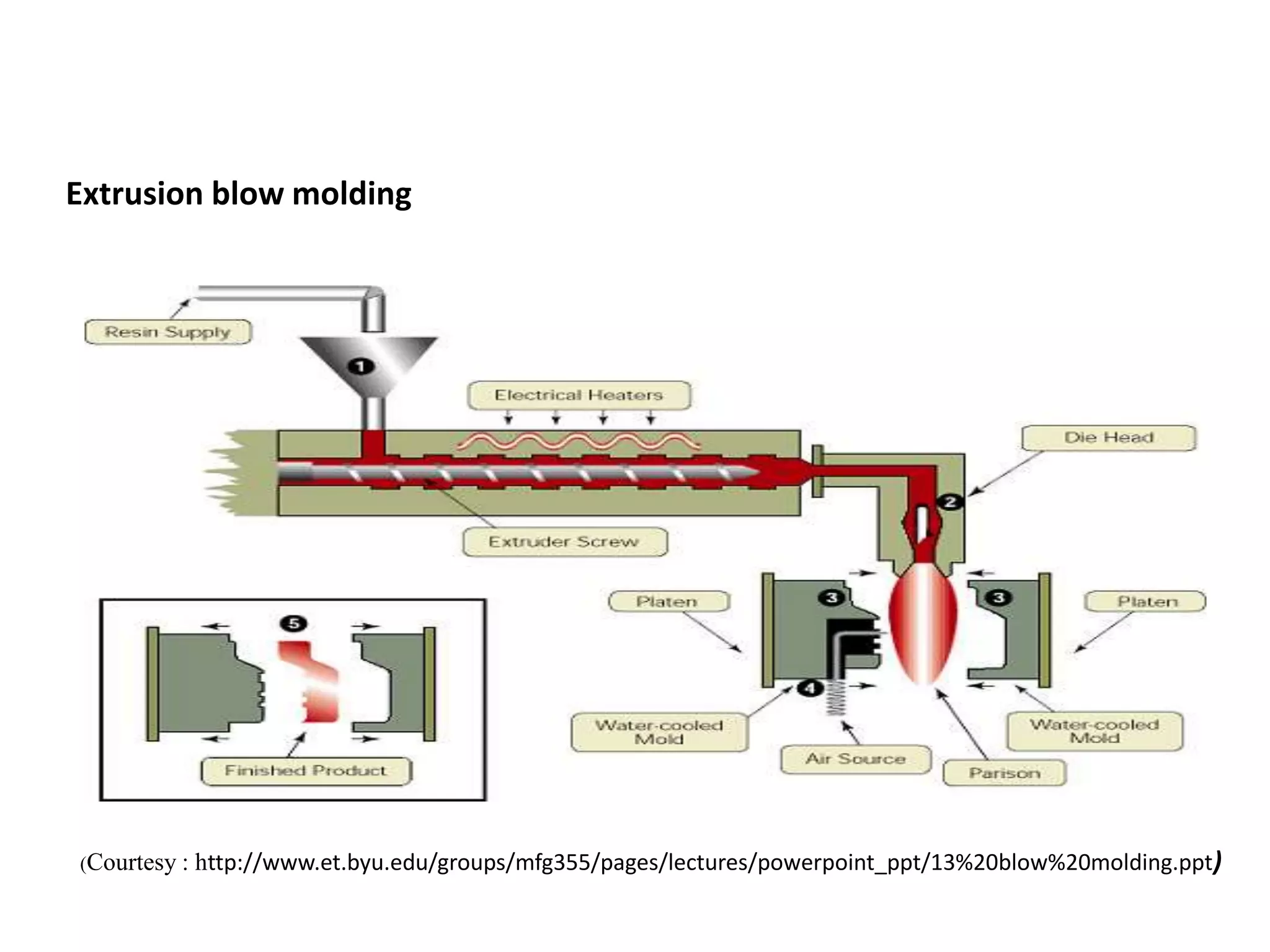
Extrusion blow molding
(Courtesy : http://www.et.byu.edu/groups/mfg355/pages/lectures/powerpoint_ppt/13%20blow%20molding.ppt)
EXTRUSION BLOW MOLDING:
 In Extrusion blow molding (EBM), plastic is melted and
extruded into a hollow tube (a parison). This parison is then
captured by closing it into a cooled metal mold. Air is then
blown into the parison, inflating it into the shape of the
hollow bottle, container or part. After the plastic has cooled
sufficiently, the mould is opened and the part is ejected.
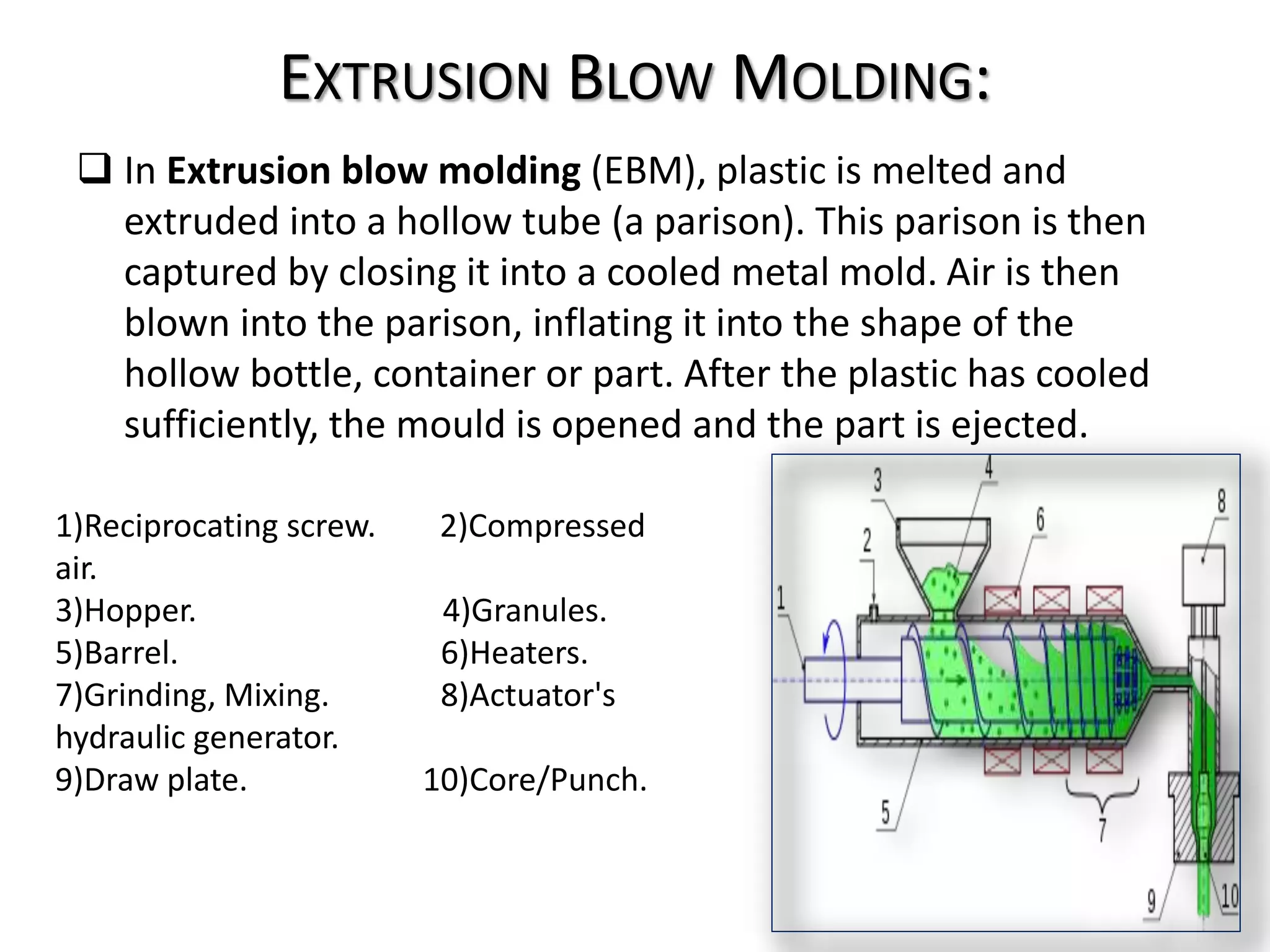
1)Reciprocating screw. 2)Compressed
air.
3)Hopper. 4)Granules.
5)Barrel. 6)Heaters.
7)Grinding, Mixing. 8)Actuator's
hydraulic generator.
9)Draw plate. 10)Core/Punch.
Neck ring insert
Pinch-off insert
Flash pocket
Mold cavity
Mold guide
pins
Cooling
channels
Extrusion Blow Mold
(Courtesy : http://industrialblowmolding.com/?page_id=22)
Extrusion Blow Mold
1. Neck-ring insert
2. Cooling water ports
3. Cut-off insert
1
2
3
1
3
2
(Courtesy : http://industrialblowmolding.com/?page_id=22)
 Extrusion blow molding:
1
2 3
4
5
Blow molding
Two important terms:
Parison and preform :
Parison is the part that is used in blow molding where air is
inflated to from the desired shape. It is closed on one end. Here
the preform is same as parison but there is thread in the open
end in preform. Preform is mostly used in bottles .
Figure: Parison Figure :Preform
Step 1
Step 2
Step 3
Step 4
(Courtesy : http://www.et.byu.edu/groups/mfg355/pages/lectures/powerpoint_ppt/13%20blow%20molding.ppt)
Blow Molding
Blow Molding
Blow Molding
Blow Molding
 Types of Extrusion blow molding:
 Continuous Extrusion molding:
In extrusion molding, plastics is continuously extruded and the individual parts
are cut off by knife. vido
 Intermittent extrusion molding:
In straight intermittent extrusion, extruder screw run ,stops and pushes melt
out. Here, accumulator is used to gather the mold.
Extrusion blow
molding
Continuous extrusion molding
Intermittent extrusion
molding
CLASSIFICATION OF EXTRUSION PROCESSES
Extrusion
By Direction
By
Equipment
By Operating
Temperature
Indirect /
Backward
Direct /
Forward
Hot Cold Horizontal Vertical
Process Parameters
Parison characteristics
size, shape, straightness, wall thickness, mechanical properties
Inflation pressure
Mold design
cooling, venting
Blow ratio= Mold diameter/Parison Diameter (1.5 to 3 are common
Most thermoplastics can be blow molded
Some typical applications are
HDPE : High Density Polyethylene (stiff bottle, toys, cases,
drum)
LDPE : Low Density Polyethylene (flexible bottle)
PP : Polypropylene (higher temperature bottle)
PVC : Polyvinyl Chloride (clear bottle, oil resistant containers)
PET : Polyethylene terephthalate (soda pop bottle)
Application
(Courtesy : http://industrialblowmolding.com/?page_id=22)
 Extrusion blow molding:
 Advantage:
 Low molding cost resulting from lower pressure used
 Low tool cost due to simple structure
 Fast production due to small processing cycle
 Ability to mold complex part
 Disadvantage:
 Limited to hollow parts
 Low strength of the product
Materials used in blow molding:
Most thermoplastics can be blow molded
 Some typical applications are
 HDPE : High Density Polyethylene (stiff bottle, toys, cases, drum)
 LDPE : Low Density Polyethylene (flexible bottle)
 PP : Polypropylene (higher temperature bottle)
 PVC : Polyvinyl Chloride (clear bottle, oil resistant containers)
 PET : Polyethylene terephthalate (soda pop bottle)
Materials Considerations
One critical requirement is that
the
polymer must have good melt
strength.
The common blow molded
plastics are:
• Polyolefins
– HDPE
– LDPE
– Polypropylene (PP)
• PVC
• PET
December
09, 2006 Mitchel Plamondon
http://upload.wikimedia.org/wikipedia/en/2/2a/Soft_drink_shelf.JPG
PET bottles are excellent barrier materials and are
widely used for soft drinks
 Factor effecting blow molding:
• Parison characteristics:
Size, shape, straightness, wall thickness, mechanical strength.
• Inflation pressure:
Pressure will be set according to the process.
• Mold design :
Size of the mold, the material the mold is made with.
• Blow ratio 
Here, the blow ratio must be 1.5 to 3
Mold diameter
Parison diameter
Process Material
Blow molded parts can be formed from a variety of
thermoplastic materials, including the following:
 Low Density Polyethylene (LDPE)
 High Density Polyethylene (HDPE)
 Polyethylene Terephtalate (PET)
 Polypropylene (PP)
 Polyvinyl Chloride (PVC)
ADVANTAGES OF Blow Molding
• Well suited to low and high production rates.
• Quick product revisions for increased flexibility.
• Tooling is less expensive than other molding.
• Each part price is less than Rotational Molding.
• Trim and flash reusable into finished parts.
DISADVANTAGES OF Blow Molding
• Environmental Disadvantages effecting.
• Process and Material Limitations.
• Inability to produce bottles with calibrated neck
finishes.
• Machines typically dedicated to a narrow range of
sizes.
• Trimming required
Blow Molding Applications
• Milk bottles
• Pharmaceutical bottles
• Antifreeze bottles
• Polypropylene bottles
• Coliseum seats
• One-piece chair
• Ice chests and coolers
• Double-wall player case
• Garbage cans
• Drums
• Fuel tanks
Tabraiz mold engineering Lahore Pakistan. ( products:
pet blow mold, machine parts, labeling parts)
Thermosole industries (pvt) ltd. Kotlakhpat. (covering
90% of blow molding automotive market in Pakistan)
Kalson engineering in Lahore. (services in mold
making)
vido
Any
question?
The end

Extrusion blow molding

  • 2.
    EXTRUSION BLOW MOLDING PRESENTEDBY Fahad Rafiq Reg # 2014-UET-KIT-Mech-21
  • 3.
    D.R AQ KhanInstetute Mianwali Subject Code : 241 Name Of Subject : Manufacturing Technology Name of Unit : Molding Topic : Extrusion Blow Molding
  • 5.
    “Blow molding, alsoknown as blow forming, is a manufacturing process by which hollow plastic parts are formed.”  It is used to made hollow parts such as plastic bottles. vido
  • 6.
     The blowmolding process begins with melting down the plastic and forming it into a parison . The parison is a tube- like piece of plastic with a hole in one end in which compressed air can pass through. The parison is then clamped into a mold and air is pumped into it. The air pressure then pushes the plastic out to match the mold. Once the plastic has cooled and hardened the mold opens up and the part is ejected.   vido
  • 7.
  • 8.
    Historical Development Year Development 1930The first applications for blow molding were for cellulose nitrate 1940 Introduction of LDPE (Low Density Polyethylene ). With LDPE, the plastic industry growth rapidly 1942 The first polyethylene bottle was manufactured using the blow molding process 1950 The demand for blow molding increases by the mass production of High Density Polyethylene (HDPE) and Polypropylene (PP) for various applications
  • 9.
    The principle ofblow molding A simple explanation of the principle of blow molding is similar to inflating a balloon
  • 10.
    BASIC PROCESS TWO MAINPROCESSES TO preform (or parison) of hot plastic resin in a somewhat tubular shape is created. A pressurized gas, usually air, is used to expand the hot preform and press it against a mold cavity. The pressure is held. until the plastic cools.
  • 11.
    Blow molding processes Blowmolding processes Extrusion blow molding Injection blow molding Stretch blow molding ( Classification based on parison/preform formation )
  • 12.
    What is Extrusion? Extrusionis the process by which a block/billet of metal is reduced in cross section by forcing it to flow through a die orifice under high pressure. Vido
  • 13.
    Extrusion blow molding (Courtesy: http://www.et.byu.edu/groups/mfg355/pages/lectures/powerpoint_ppt/13%20blow%20molding.ppt)
  • 14.
    EXTRUSION BLOW MOLDING: In Extrusion blow molding (EBM), plastic is melted and extruded into a hollow tube (a parison). This parison is then captured by closing it into a cooled metal mold. Air is then blown into the parison, inflating it into the shape of the hollow bottle, container or part. After the plastic has cooled sufficiently, the mould is opened and the part is ejected. 1)Reciprocating screw. 2)Compressed air. 3)Hopper. 4)Granules. 5)Barrel. 6)Heaters. 7)Grinding, Mixing. 8)Actuator's hydraulic generator. 9)Draw plate. 10)Core/Punch.
  • 15.
    Neck ring insert Pinch-offinsert Flash pocket Mold cavity Mold guide pins Cooling channels Extrusion Blow Mold (Courtesy : http://industrialblowmolding.com/?page_id=22)
  • 16.
    Extrusion Blow Mold 1.Neck-ring insert 2. Cooling water ports 3. Cut-off insert 1 2 3 1 3 2 (Courtesy : http://industrialblowmolding.com/?page_id=22)
  • 17.
     Extrusion blowmolding: 1 2 3 4 5
  • 18.
  • 19.
    Two important terms: Parisonand preform : Parison is the part that is used in blow molding where air is inflated to from the desired shape. It is closed on one end. Here the preform is same as parison but there is thread in the open end in preform. Preform is mostly used in bottles . Figure: Parison Figure :Preform
  • 20.
  • 21.
    Step 3 Step 4 (Courtesy: http://www.et.byu.edu/groups/mfg355/pages/lectures/powerpoint_ppt/13%20blow%20molding.ppt)
  • 23.
  • 24.
  • 25.
  • 26.
  • 28.
     Types ofExtrusion blow molding:  Continuous Extrusion molding: In extrusion molding, plastics is continuously extruded and the individual parts are cut off by knife. vido  Intermittent extrusion molding: In straight intermittent extrusion, extruder screw run ,stops and pushes melt out. Here, accumulator is used to gather the mold. Extrusion blow molding Continuous extrusion molding Intermittent extrusion molding
  • 29.
    CLASSIFICATION OF EXTRUSIONPROCESSES Extrusion By Direction By Equipment By Operating Temperature Indirect / Backward Direct / Forward Hot Cold Horizontal Vertical
  • 30.
    Process Parameters Parison characteristics size,shape, straightness, wall thickness, mechanical properties Inflation pressure Mold design cooling, venting Blow ratio= Mold diameter/Parison Diameter (1.5 to 3 are common
  • 31.
    Most thermoplastics canbe blow molded Some typical applications are HDPE : High Density Polyethylene (stiff bottle, toys, cases, drum) LDPE : Low Density Polyethylene (flexible bottle) PP : Polypropylene (higher temperature bottle) PVC : Polyvinyl Chloride (clear bottle, oil resistant containers) PET : Polyethylene terephthalate (soda pop bottle) Application (Courtesy : http://industrialblowmolding.com/?page_id=22)
  • 32.
     Extrusion blowmolding:  Advantage:  Low molding cost resulting from lower pressure used  Low tool cost due to simple structure  Fast production due to small processing cycle  Ability to mold complex part  Disadvantage:  Limited to hollow parts  Low strength of the product
  • 33.
    Materials used inblow molding: Most thermoplastics can be blow molded  Some typical applications are  HDPE : High Density Polyethylene (stiff bottle, toys, cases, drum)  LDPE : Low Density Polyethylene (flexible bottle)  PP : Polypropylene (higher temperature bottle)  PVC : Polyvinyl Chloride (clear bottle, oil resistant containers)  PET : Polyethylene terephthalate (soda pop bottle)
  • 34.
    Materials Considerations One criticalrequirement is that the polymer must have good melt strength. The common blow molded plastics are: • Polyolefins – HDPE – LDPE – Polypropylene (PP) • PVC • PET December 09, 2006 Mitchel Plamondon http://upload.wikimedia.org/wikipedia/en/2/2a/Soft_drink_shelf.JPG PET bottles are excellent barrier materials and are widely used for soft drinks
  • 35.
     Factor effectingblow molding: • Parison characteristics: Size, shape, straightness, wall thickness, mechanical strength. • Inflation pressure: Pressure will be set according to the process. • Mold design : Size of the mold, the material the mold is made with. • Blow ratio  Here, the blow ratio must be 1.5 to 3 Mold diameter Parison diameter
  • 36.
    Process Material Blow moldedparts can be formed from a variety of thermoplastic materials, including the following:  Low Density Polyethylene (LDPE)  High Density Polyethylene (HDPE)  Polyethylene Terephtalate (PET)  Polypropylene (PP)  Polyvinyl Chloride (PVC)
  • 37.
    ADVANTAGES OF BlowMolding • Well suited to low and high production rates. • Quick product revisions for increased flexibility. • Tooling is less expensive than other molding. • Each part price is less than Rotational Molding. • Trim and flash reusable into finished parts.
  • 38.
    DISADVANTAGES OF BlowMolding • Environmental Disadvantages effecting. • Process and Material Limitations. • Inability to produce bottles with calibrated neck finishes. • Machines typically dedicated to a narrow range of sizes. • Trimming required
  • 39.
    Blow Molding Applications •Milk bottles • Pharmaceutical bottles • Antifreeze bottles • Polypropylene bottles • Coliseum seats • One-piece chair • Ice chests and coolers • Double-wall player case • Garbage cans • Drums • Fuel tanks
  • 40.
    Tabraiz mold engineeringLahore Pakistan. ( products: pet blow mold, machine parts, labeling parts) Thermosole industries (pvt) ltd. Kotlakhpat. (covering 90% of blow molding automotive market in Pakistan) Kalson engineering in Lahore. (services in mold making) vido
  • 42.
  • 43.