

Injection Moulding
Aims
1. History of Injection Moulding
2. Business context
3. Process
4. Mould design
5. Comparison to other alternative processes
6. Q&A
History of Injection Moulding
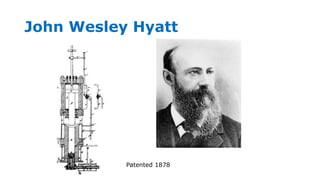
John Wesley Hyatt
Patented 1878
1930s
• Polystyrene
• PVC
• Polyolefins
• Nylon (for moulds)
• WW2 – huge boost in production
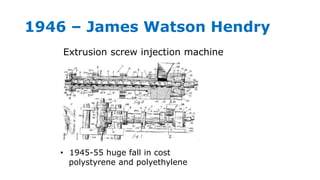
1946 – James Watson Hendry
Extrusion screw injection machine
• 1945-55 huge fall in cost
polystyrene and polyethylene
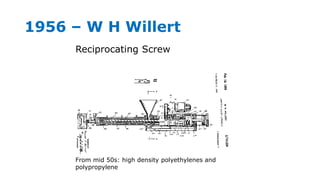
1956 – W H Willert
Reciprocating Screw
From mid 50s: high density polyethylenes and
polypropylene
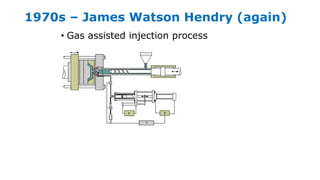
1970s – James Watson Hendry (again)
• Gas assisted injection process
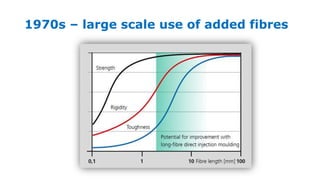
1970s – large scale use of added fibres
• 1979 - Plastic production overtakes steel
production by value
• 1985 - First all electric injection moulding
machine developed in Japan
• 1990 - Aluminium moulds widely used for
the first time
• 2000 - 2 stage IMMs have surpassed
reciprocating screw machines in popularity
Today
• Co-injecting machines
• Piezoelectric sensors
• 5 axis machines
Business context
• Mould tool: 5-12 weeks, £3000 - £20000
• Production costs – low
• Cost of plant – quite low – machines for under $50,000
• Last decade – huge move to China
• UK plastics sector 2002 - £18 billion, 2014 £3.5 billion
• China plastics sector 2015 - £194 billion (9.6% annual
growth in revenue)
Injection Process –
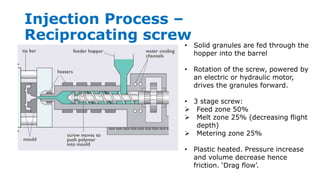
Reciprocating screw
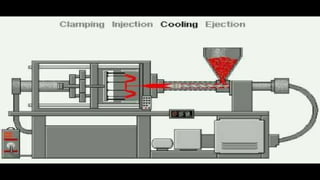
• Solid granules are fed through the
hopper into the barrel
• Rotation of the screw, powered by
an electric or hydraulic motor,
drives the granules forward.
• 3 stage screw:
 Feed zone 50%
 Melt zone 25% (decreasing flight
depth)
 Metering zone 25%
• Plastic heated. Pressure increase
and volume decrease hence
friction. ‘Drag flow’.
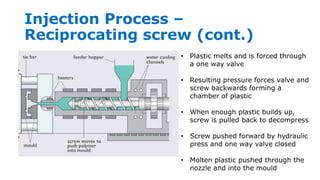
• Plastic melts and is forced through
a one way valve
• Resulting pressure forces valve and
screw backwards forming a
chamber of plastic
• When enough plastic builds up,
screw is pulled back to decompress
• Screw pushed forward by hydraulic
press and one way valve closed
• Molten plastic pushed through the
nozzle and into the mould
Injection Process –
Reciprocating screw (cont.)
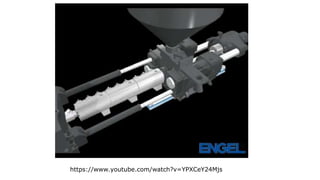
https://www.youtube.com/watch?v=YPXCeY24Mjs
Injection Process – Two Stage
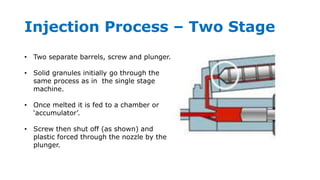
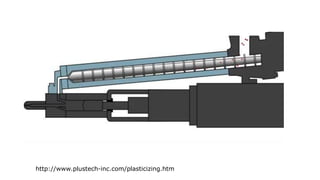
• Two separate barrels, screw and plunger.
• Solid granules initially go through the
same process as in the single stage
machine.
• Once melted it is fed to a chamber or
‘accumulator’.
• Screw then shut off (as shown) and
plastic forced through the nozzle by the
plunger.
http://www.plustech-inc.com/plasticizing.htm
• Two stage can provide comparable size shot from a
smaller machine
• Reciprocating screw machine normally bigger so greater
production costs
• Two stage system provides 100% of the shot volume
unlike the reciprocating IMM
• Reciprocating IMM more suited to larger shots,
hydraulic power advantage
Injection Process – Comparisons
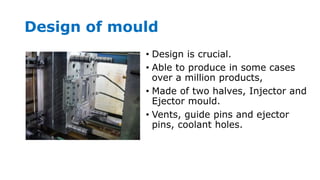
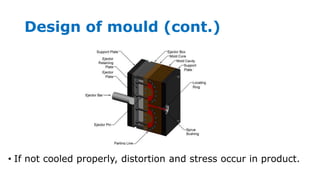
Design of mould
• Design is crucial.
• Able to produce in some cases
over a million products,
• Made of two halves, Injector and
Ejector mould.
• Vents, guide pins and ejector
pins, coolant holes.
Design of mould (cont.)
• Typical moulds are made out of hardened steel,
Aluminium or beryllium-copper alloy
• Modern Aluminium alloys can produce hundreds of
thousands of products.
• 3D printing photopolymers
• Only when the melting point of the material being
injected is lower than that of the photo polymer.
• As a general rule the higher the upfront cost the longer
the lifespan of the mould.
Design of mould (cont.)
• If not cooled properly, distortion and stress occur in product.
Clamping
• The two halves of the mould are clamped
together by hydraulic presses.
• Forces exerted are between 4 and 9000
tonnes.
• The ejector mould is forced against the
injector mould by a hydraulic press.
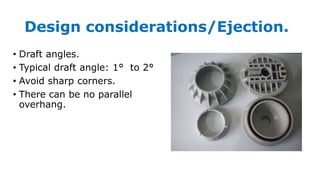
Design considerations/Ejection.
• Draft angles.
• Typical draft angle: 1° to 2°
• Avoid sharp corners.
• There can be no parallel
overhang.
Machining of mould
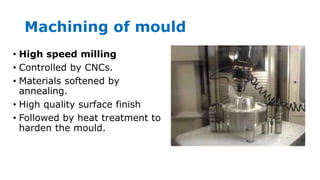
• High speed milling
• Controlled by CNCs.
• Materials softened by
annealing.
• High quality surface finish
• Followed by heat treatment to
harden the mould.
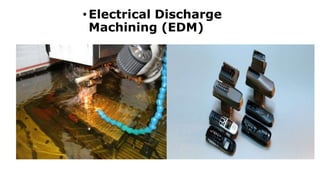
•Electrical Discharge
Machining (EDM)
Comparisons with other
processes
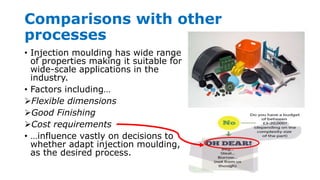
• Injection moulding has wide range
of properties making it suitable for
wide-scale applications in the
industry.
• Factors including…
Flexible dimensions
Good Finishing
Cost requirements
• …influence vastly on decisions to
whether adapt injection moulding,
as the desired process.
Comparisons with other
processes (cont.)
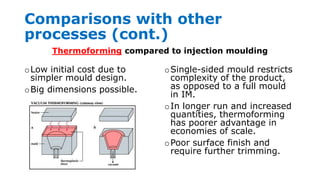
oLow initial cost due to
simpler mould design.
oBig dimensions possible.
oSingle-sided mould restricts
complexity of the product,
as opposed to a full mould
in IM.
oIn longer run and increased
quantities, thermoforming
has poorer advantage in
economies of scale.
oPoor surface finish and
require further trimming.
Thermoforming compared to injection moulding
Comparisons with other
processes (cont.)
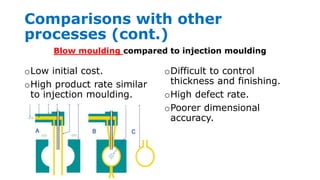
oLow initial cost.
oHigh product rate similar
to injection moulding.
oDifficult to control
thickness and finishing.
oHigh defect rate.
oPoorer dimensional
accuracy.
Blow moulding compared to injection moulding
Comparisons with other
processes (cont.)
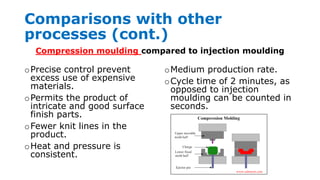
oPrecise control prevent
excess use of expensive
materials.
oPermits the product of
intricate and good surface
finish parts.
oFewer knit lines in the
product.
oHeat and pressure is
consistent.
oMedium production rate.
oCycle time of 2 minutes, as
opposed to injection
moulding can be counted in
seconds.
Compression moulding compared to injection moulding
Comparisons with other
processes (cont.)
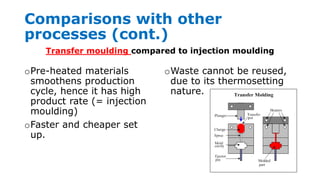
oPre-heated materials
smoothens production
cycle, hence it has high
product rate (= injection
moulding)
oFaster and cheaper set
up.
oWaste cannot be reused,
due to its thermosetting
nature.
Transfer moulding compared to injection moulding
Comparisons with other
processes (cont.)
oRapid and cheap for initial
set ups.
oLow product cost.
oSimilar production
duration (per unit).
oLimited to only rod- or
tube-like products.
oProducts has to be cooled
evenly or mechanical
properties jeopardised.
Injection moulding is
‘batched’ so it can be
cooled evenly.
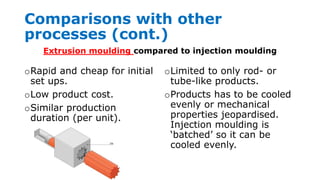
Extrusion moulding compared to injection moulding
Any questions?
I want my lunch, now! Hell no!
Naaaaaaaaaaaaaaaaaaa…. Huh? What? zzzz
Injection Moulding

Injection Moulding

  • 1.
  • 2.
    Aims 1. History ofInjection Moulding 2. Business context 3. Process 4. Mould design 5. Comparison to other alternative processes 6. Q&A
  • 3.
  • 4.
  • 5.
    1930s • Polystyrene • PVC •Polyolefins • Nylon (for moulds) • WW2 – huge boost in production
  • 6.
    1946 – JamesWatson Hendry Extrusion screw injection machine • 1945-55 huge fall in cost polystyrene and polyethylene
  • 7.
    1956 – WH Willert Reciprocating Screw From mid 50s: high density polyethylenes and polypropylene
  • 8.
    1970s – JamesWatson Hendry (again) • Gas assisted injection process
  • 9.
    1970s – largescale use of added fibres
  • 10.
    • 1979 -Plastic production overtakes steel production by value • 1985 - First all electric injection moulding machine developed in Japan • 1990 - Aluminium moulds widely used for the first time • 2000 - 2 stage IMMs have surpassed reciprocating screw machines in popularity
  • 11.
    Today • Co-injecting machines •Piezoelectric sensors • 5 axis machines
  • 12.
    Business context • Mouldtool: 5-12 weeks, £3000 - £20000 • Production costs – low • Cost of plant – quite low – machines for under $50,000 • Last decade – huge move to China • UK plastics sector 2002 - £18 billion, 2014 £3.5 billion • China plastics sector 2015 - £194 billion (9.6% annual growth in revenue)
  • 13.
    Injection Process – Reciprocatingscrew • Solid granules are fed through the hopper into the barrel • Rotation of the screw, powered by an electric or hydraulic motor, drives the granules forward. • 3 stage screw:  Feed zone 50%  Melt zone 25% (decreasing flight depth)  Metering zone 25% • Plastic heated. Pressure increase and volume decrease hence friction. ‘Drag flow’.
  • 14.
    • Plastic meltsand is forced through a one way valve • Resulting pressure forces valve and screw backwards forming a chamber of plastic • When enough plastic builds up, screw is pulled back to decompress • Screw pushed forward by hydraulic press and one way valve closed • Molten plastic pushed through the nozzle and into the mould Injection Process – Reciprocating screw (cont.)
  • 15.
  • 16.
    Injection Process –Two Stage • Two separate barrels, screw and plunger. • Solid granules initially go through the same process as in the single stage machine. • Once melted it is fed to a chamber or ‘accumulator’. • Screw then shut off (as shown) and plastic forced through the nozzle by the plunger.
  • 17.
  • 18.
    • Two stagecan provide comparable size shot from a smaller machine • Reciprocating screw machine normally bigger so greater production costs • Two stage system provides 100% of the shot volume unlike the reciprocating IMM • Reciprocating IMM more suited to larger shots, hydraulic power advantage Injection Process – Comparisons
  • 19.
    Design of mould •Design is crucial. • Able to produce in some cases over a million products, • Made of two halves, Injector and Ejector mould. • Vents, guide pins and ejector pins, coolant holes.
  • 20.
    Design of mould(cont.) • Typical moulds are made out of hardened steel, Aluminium or beryllium-copper alloy • Modern Aluminium alloys can produce hundreds of thousands of products. • 3D printing photopolymers • Only when the melting point of the material being injected is lower than that of the photo polymer. • As a general rule the higher the upfront cost the longer the lifespan of the mould.
  • 21.
    Design of mould(cont.) • If not cooled properly, distortion and stress occur in product.
  • 22.
    Clamping • The twohalves of the mould are clamped together by hydraulic presses. • Forces exerted are between 4 and 9000 tonnes. • The ejector mould is forced against the injector mould by a hydraulic press.
  • 23.
    Design considerations/Ejection. • Draftangles. • Typical draft angle: 1° to 2° • Avoid sharp corners. • There can be no parallel overhang.
  • 25.
    Machining of mould •High speed milling • Controlled by CNCs. • Materials softened by annealing. • High quality surface finish • Followed by heat treatment to harden the mould.
  • 26.
  • 27.
    Comparisons with other processes •Injection moulding has wide range of properties making it suitable for wide-scale applications in the industry. • Factors including… Flexible dimensions Good Finishing Cost requirements • …influence vastly on decisions to whether adapt injection moulding, as the desired process.
  • 28.
    Comparisons with other processes(cont.) oLow initial cost due to simpler mould design. oBig dimensions possible. oSingle-sided mould restricts complexity of the product, as opposed to a full mould in IM. oIn longer run and increased quantities, thermoforming has poorer advantage in economies of scale. oPoor surface finish and require further trimming. Thermoforming compared to injection moulding
  • 29.
    Comparisons with other processes(cont.) oLow initial cost. oHigh product rate similar to injection moulding. oDifficult to control thickness and finishing. oHigh defect rate. oPoorer dimensional accuracy. Blow moulding compared to injection moulding
  • 30.
    Comparisons with other processes(cont.) oPrecise control prevent excess use of expensive materials. oPermits the product of intricate and good surface finish parts. oFewer knit lines in the product. oHeat and pressure is consistent. oMedium production rate. oCycle time of 2 minutes, as opposed to injection moulding can be counted in seconds. Compression moulding compared to injection moulding
  • 31.
    Comparisons with other processes(cont.) oPre-heated materials smoothens production cycle, hence it has high product rate (= injection moulding) oFaster and cheaper set up. oWaste cannot be reused, due to its thermosetting nature. Transfer moulding compared to injection moulding
  • 32.
    Comparisons with other processes(cont.) oRapid and cheap for initial set ups. oLow product cost. oSimilar production duration (per unit). oLimited to only rod- or tube-like products. oProducts has to be cooled evenly or mechanical properties jeopardised. Injection moulding is ‘batched’ so it can be cooled evenly. Extrusion moulding compared to injection moulding
  • 33.
    Any questions? I wantmy lunch, now! Hell no! Naaaaaaaaaaaaaaaaaaa…. Huh? What? zzzz

Editor's Notes

  • #32 In transfer moulding, it has a similarly low set up cost as it is rather simple, but still give rise to a similar production rate as injection moulding. However, due to the use of thermosetting materials, waste and scrap from the sprues and grooves from mould parting line has to be disposed of, as they cannot be reused. So injection moulding offer a better advantage in this regard.
  • #33 Extrusion moulding is quite a simple process that can offer cheap and extremely rapid set up cost, and also the production cycle has an average of 12 seconds, which is significantly lower than that of IM. However, products are only limited to rod- or tube-like products (IM can do anything), and as it is a continuous process, we need to take extra care to cool the materials evenly hence it does not cross-knit differently, changing the materials property.