Common Plastic Production Processing
MAE 250L
Common Plastic Production
Processing
• Extrusion
• Injection Moulding
• Blow Moulding
• Vacuum Forming
• Compression Moulding
• Rotational Moulding
Extrusion
Extrusion
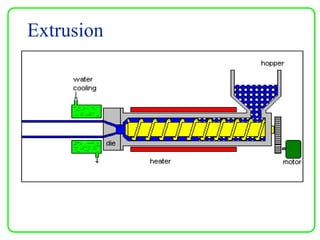
Continuous process used to produce both solid and hollow products
that have a constant cross-section. E.g. window frames, hose pipe,
curtain track, garden trellis.
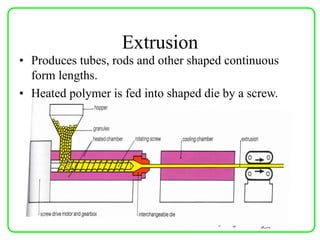
Thermoplastic granules are fed from a hopper by a rotating screw
(auger) through a heated cylinder.
The tapered screw compacts the plastic as it becomes heated and
elasticised. The die which is fitted to the end of the extruder
barrel determines the cross-section of the extrusion.
Thicker cross-sections are extruded more slowly as more time is
required for the initial heating and subsequent cooling of the larger
quantities of material which are involved. As the extrusion leaves
the die it is cooled by passing through a cooling trough (below)
containing cold water.
Extrusion
• Produces tubes, rods and other shaped continuous
form lengths.
• Heated polymer is fed into shaped die by a screw.
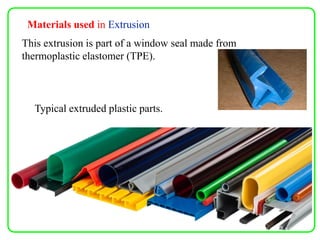
Materials used in Extrusion
This extrusion is part of a window seal made from
thermoplastic elastomer (TPE).
Typical extruded plastic parts.
Common extruded products
pipe/tubing, weatherstripping, fencing,
deck railings, window frames, plastic
films and sheeting, thermoplastic
coatings, and wire insulation…
Common Extuded Plastic Materials
Polyethylene (PE), Polypropylene,
Acetal (Delrin), Acrylic (plexiglass),
Nylon (polyamides), Polystyrene,
PolyVinyl Chloride (PVC),
Acrylonitrile Butadiene Styrene (ABS),
Polycarbonate
https://upload.wikimedia.org/wikipedia/
commons/transcoded/6/62/Plastic_Inject
ion_Molding.webm/Plastic_Injection_M
olding.webm.480p.vp9.webm
Injection Moulding Video
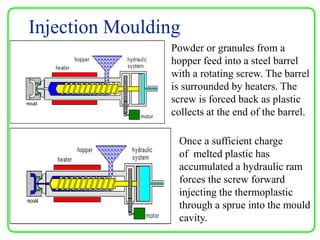
Injection Moulding
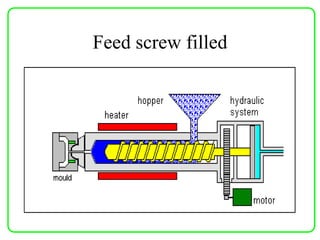
Powder or granules from a
hopper feed into a steel barrel
with a rotating screw. The barrel
is surrounded by heaters. The
screw is forced back as plastic
collects at the end of the barrel.
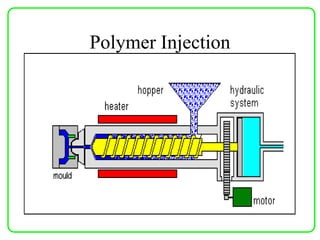
Once a sufficient charge
of melted plastic has
accumulated a hydraulic ram
forces the screw forward
injecting the thermoplastic
through a sprue into the mould
cavity.
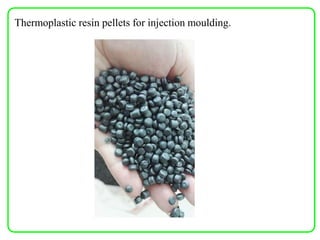
Thermoplastic resin pellets for injection moulding.
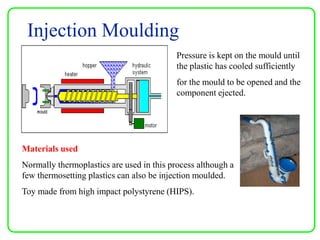
Injection Moulding
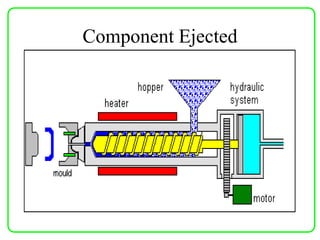
Pressure is kept on the mould until
the plastic has cooled sufficiently
for the mould to be opened and the
component ejected.
Materials used
Normally thermoplastics are used in this process although a
few thermosetting plastics can also be injection moulded.
Toy made from high impact polystyrene (HIPS).
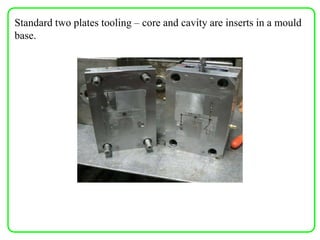
Standard two plates tooling – core and cavity are inserts in a mould
base.
Feed screw filled
Polymer Injection
Component Ejected
Injection Moulding
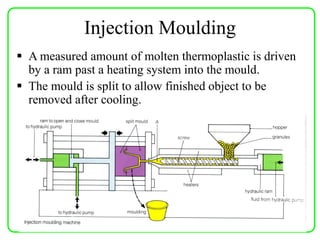
 A measured amount of molten thermoplastic is driven
by a ram past a heating system into the mould.
 The mould is split to allow finished object to be
removed after cooling.
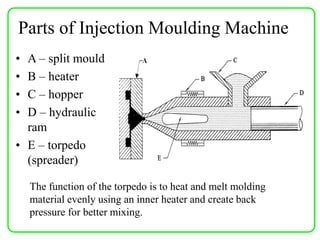
• A – split mould
• B – heater
• C – hopper
• D – hydraulic
ram
• E – torpedo
(spreader)
Parts of Injection Moulding Machine
The function of the torpedo is to heat and melt molding
material evenly using an inner heater and create back
pressure for better mixing.
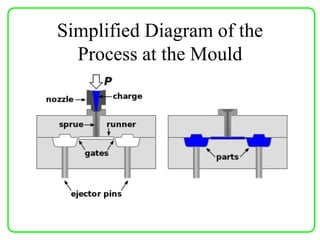
Simplified Diagram of the
Process at the Mould
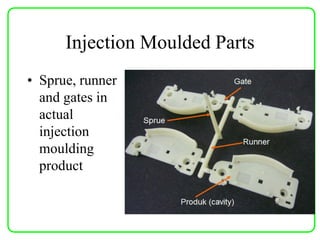
Injection Moulded Parts
• Sprue, runner
and gates in
actual
injection
moulding
product
Materials for Injection Moulding
• Both thermoplastic
and thermosetting
polymers are used
Common polymers
• Epoxy
• Phenolic
• Nylon
• Polyethylene
• Polystyrene
• Injection moulding produces accurate and
complex products with high quality finish.
• Production is fast with little waste.
• Wide range of products including bowls,
buckets, containers, toys, electrical parts and
car parts.
• Injection moulded parts can be recognised by
the distinctive circular marks (5-10mm) caused
by pins used to remove object from it’s mould.
Injection Moulding
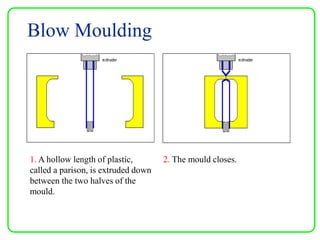
Blow Moulding
1. A hollow length of plastic,
called a parison, is extruded down
between the two halves of the
mould.
2. The mould closes.
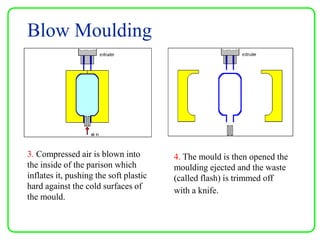
Blow Moulding
3. Compressed air is blown into
the inside of the parison which
inflates it, pushing the soft plastic
hard against the cold surfaces of
the mould.
4. The mould is then opened the
moulding ejected and the waste
(called flash) is trimmed off
with a knife.
Materials used in blow moulding
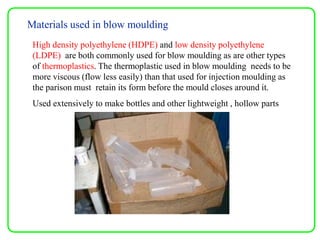
High density polyethylene (HDPE) and low density polyethylene
(LDPE) are both commonly used for blow moulding as are other types
of thermoplastics. The thermoplastic used in blow moulding needs to be
more viscous (flow less easily) than that used for injection moulding as
the parison must retain its form before the mould closes around it.
Used extensively to make bottles and other lightweight , hollow parts
Blow Moulding
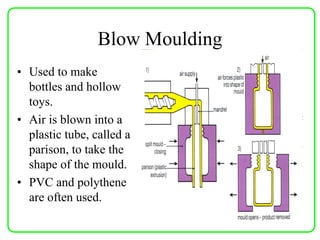
• Used to make
bottles and hollow
toys.
• Air is blown into a
plastic tube, called a
parison, to take the
shape of the mould.
• PVC and polythene
are often used.
Vacuum Forming
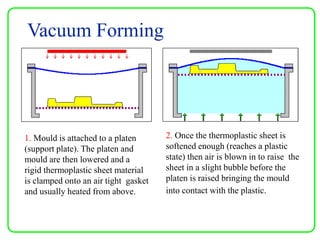
1. Mould is attached to a platen
(support plate). The platen and
mould are then lowered and a
rigid thermoplastic sheet material
is clamped onto an air tight gasket
and usually heated from above.
2. Once the thermoplastic sheet is
softened enough (reaches a plastic
state) then air is blown in to raise the
sheet in a slight bubble before the
platen is raised bringing the mould
into contact with the plastic.
Vacuum Forming
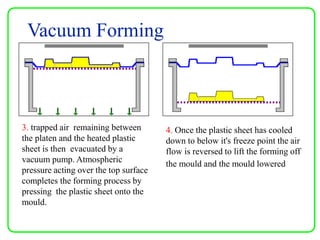
3. trapped air remaining between
the platen and the heated plastic
sheet is then evacuated by a
vacuum pump. Atmospheric
pressure acting over the top surface
completes the forming process by
pressing the plastic sheet onto the
mould.
4. Once the plastic sheet has cooled
down to below it's freeze point the air
flow is reversed to lift the forming off
the mould and the mould lowered
Materials used in Vacuum forming
Many types of thermoplastics are suitable for vacuum
forming. The most popular is High Impact Polystyrene
(HIPS). It is relatively cheap, comes in a wide range of
colours and is easy to form. This process is used to
manufacture a variety of products in thermoplastic
materials. These products range in size from garden pond
liners to food trays used in supermarkets.
Vacuum Forming
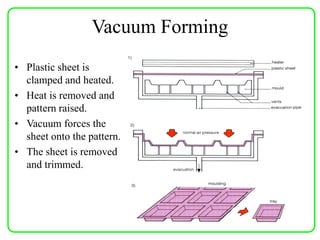
• Plastic sheet is
clamped and heated.
• Heat is removed and
pattern raised.
• Vacuum forces the
sheet onto the pattern.
• The sheet is removed
and trimmed.
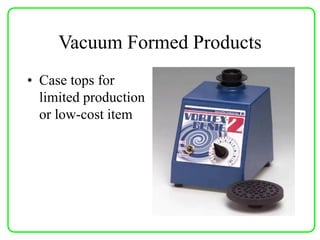
Vacuum Formed Products
• Case tops for
limited production
or low-cost item
Compression Moulding
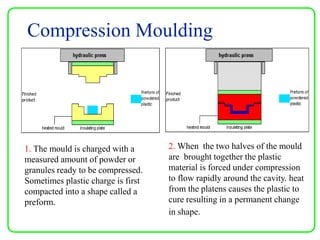
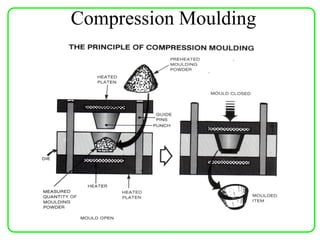
1. The mould is charged with a
measured amount of powder or
granules ready to be compressed.
Sometimes plastic charge is first
compacted into a shape called a
preform.
2. When the two halves of the mould
are brought together the plastic
material is forced under compression
to flow rapidly around the cavity. heat
from the platens causes the plastic to
cure resulting in a permanent change
in shape.
Compression Moulding
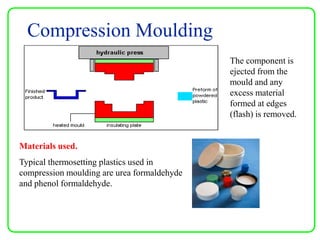
The component is
ejected from the
mould and any
excess material
formed at edges
(flash) is removed.
Materials used.
Typical thermosetting plastics used in
compression moulding are urea formaldehyde
and phenol formaldehyde.
Compression Moulding
• Thermoset plastics are shaped with heat and
pressure causing cross-linking.
• The polymer can be in powder or slug (cube)
form.
• Products such as electrical fittings, saucepan
handles and bottle tops are often formed out of
formaldehyde plastics.
• High quality finishes are achieved with only the
removal of ‘flash’ (excess material usually at the
mould split) for finished products.
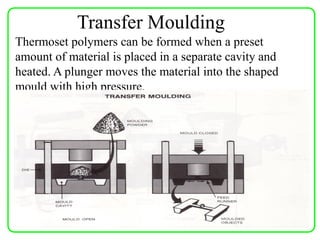
Transfer Moulding
Thermoset polymers can be formed when a preset
amount of material is placed in a separate cavity and
heated. A plunger moves the material into the shaped
mould with high pressure.
Rotational Moulding
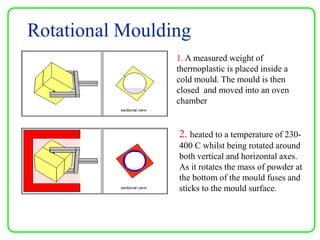
1. A measured weight of
thermoplastic is placed inside a
cold mould. The mould is then
closed and moved into an oven
chamber
2. heated to a temperature of 230-
400 C whilst being rotated around
both vertical and horizontal axes.
As it rotates the mass of powder at
the bottom of the mould fuses and
sticks to the mould surface.
Rotational Moulding
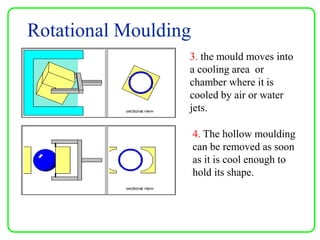
3. the mould moves into
a cooling area or
chamber where it is
cooled by air or water
jets.
4. The hollow moulding
can be removed as soon
as it is cool enough to
hold its shape.
Materials used
90% of rotational mouldings are made from polyethylene
(PE), used mainly to manufacture hollow shaped products
such as footballs, road cones and storage tanks up to 3m³
capacity.
PROCESSING PLASTICS
• Calendering – produces sheets by rolling
into shape.
• Lamination – layers of materials (eg paper,
cloth) are bonded with a resin into a strong
solid structure, often with heat and pressure.
• Foaming – expansion into sponge-like
material by a foaming agent.

8_Plastics_processing.pdf

  • 1.
    Common Plastic ProductionProcessing MAE 250L
  • 2.
    Common Plastic Production Processing •Extrusion • Injection Moulding • Blow Moulding • Vacuum Forming • Compression Moulding • Rotational Moulding
  • 3.
  • 4.
    Extrusion Continuous process usedto produce both solid and hollow products that have a constant cross-section. E.g. window frames, hose pipe, curtain track, garden trellis. Thermoplastic granules are fed from a hopper by a rotating screw (auger) through a heated cylinder. The tapered screw compacts the plastic as it becomes heated and elasticised. The die which is fitted to the end of the extruder barrel determines the cross-section of the extrusion. Thicker cross-sections are extruded more slowly as more time is required for the initial heating and subsequent cooling of the larger quantities of material which are involved. As the extrusion leaves the die it is cooled by passing through a cooling trough (below) containing cold water.
  • 5.
    Extrusion • Produces tubes,rods and other shaped continuous form lengths. • Heated polymer is fed into shaped die by a screw.
  • 6.
    Materials used inExtrusion This extrusion is part of a window seal made from thermoplastic elastomer (TPE). Typical extruded plastic parts.
  • 7.
    Common extruded products pipe/tubing,weatherstripping, fencing, deck railings, window frames, plastic films and sheeting, thermoplastic coatings, and wire insulation…
  • 8.
    Common Extuded PlasticMaterials Polyethylene (PE), Polypropylene, Acetal (Delrin), Acrylic (plexiglass), Nylon (polyamides), Polystyrene, PolyVinyl Chloride (PVC), Acrylonitrile Butadiene Styrene (ABS), Polycarbonate
  • 9.
  • 10.
    Injection Moulding Powder orgranules from a hopper feed into a steel barrel with a rotating screw. The barrel is surrounded by heaters. The screw is forced back as plastic collects at the end of the barrel. Once a sufficient charge of melted plastic has accumulated a hydraulic ram forces the screw forward injecting the thermoplastic through a sprue into the mould cavity.
  • 11.
    Thermoplastic resin pelletsfor injection moulding.
  • 12.
    Injection Moulding Pressure iskept on the mould until the plastic has cooled sufficiently for the mould to be opened and the component ejected. Materials used Normally thermoplastics are used in this process although a few thermosetting plastics can also be injection moulded. Toy made from high impact polystyrene (HIPS).
  • 13.
    Standard two platestooling – core and cavity are inserts in a mould base.
  • 14.
  • 15.
  • 16.
  • 17.
    Injection Moulding  Ameasured amount of molten thermoplastic is driven by a ram past a heating system into the mould.  The mould is split to allow finished object to be removed after cooling.
  • 18.
    • A –split mould • B – heater • C – hopper • D – hydraulic ram • E – torpedo (spreader) Parts of Injection Moulding Machine The function of the torpedo is to heat and melt molding material evenly using an inner heater and create back pressure for better mixing.
  • 19.
    Simplified Diagram ofthe Process at the Mould
  • 20.
    Injection Moulded Parts •Sprue, runner and gates in actual injection moulding product
  • 21.
    Materials for InjectionMoulding • Both thermoplastic and thermosetting polymers are used Common polymers • Epoxy • Phenolic • Nylon • Polyethylene • Polystyrene
  • 22.
    • Injection mouldingproduces accurate and complex products with high quality finish. • Production is fast with little waste. • Wide range of products including bowls, buckets, containers, toys, electrical parts and car parts. • Injection moulded parts can be recognised by the distinctive circular marks (5-10mm) caused by pins used to remove object from it’s mould. Injection Moulding
  • 23.
    Blow Moulding 1. Ahollow length of plastic, called a parison, is extruded down between the two halves of the mould. 2. The mould closes.
  • 24.
    Blow Moulding 3. Compressedair is blown into the inside of the parison which inflates it, pushing the soft plastic hard against the cold surfaces of the mould. 4. The mould is then opened the moulding ejected and the waste (called flash) is trimmed off with a knife.
  • 25.
    Materials used inblow moulding High density polyethylene (HDPE) and low density polyethylene (LDPE) are both commonly used for blow moulding as are other types of thermoplastics. The thermoplastic used in blow moulding needs to be more viscous (flow less easily) than that used for injection moulding as the parison must retain its form before the mould closes around it. Used extensively to make bottles and other lightweight , hollow parts
  • 26.
    Blow Moulding • Usedto make bottles and hollow toys. • Air is blown into a plastic tube, called a parison, to take the shape of the mould. • PVC and polythene are often used.
  • 27.
    Vacuum Forming 1. Mouldis attached to a platen (support plate). The platen and mould are then lowered and a rigid thermoplastic sheet material is clamped onto an air tight gasket and usually heated from above. 2. Once the thermoplastic sheet is softened enough (reaches a plastic state) then air is blown in to raise the sheet in a slight bubble before the platen is raised bringing the mould into contact with the plastic.
  • 28.
    Vacuum Forming 3. trappedair remaining between the platen and the heated plastic sheet is then evacuated by a vacuum pump. Atmospheric pressure acting over the top surface completes the forming process by pressing the plastic sheet onto the mould. 4. Once the plastic sheet has cooled down to below it's freeze point the air flow is reversed to lift the forming off the mould and the mould lowered
  • 29.
    Materials used inVacuum forming Many types of thermoplastics are suitable for vacuum forming. The most popular is High Impact Polystyrene (HIPS). It is relatively cheap, comes in a wide range of colours and is easy to form. This process is used to manufacture a variety of products in thermoplastic materials. These products range in size from garden pond liners to food trays used in supermarkets.
  • 30.
    Vacuum Forming • Plasticsheet is clamped and heated. • Heat is removed and pattern raised. • Vacuum forces the sheet onto the pattern. • The sheet is removed and trimmed.
  • 31.
    Vacuum Formed Products •Case tops for limited production or low-cost item
  • 32.
    Compression Moulding 1. Themould is charged with a measured amount of powder or granules ready to be compressed. Sometimes plastic charge is first compacted into a shape called a preform. 2. When the two halves of the mould are brought together the plastic material is forced under compression to flow rapidly around the cavity. heat from the platens causes the plastic to cure resulting in a permanent change in shape.
  • 33.
    Compression Moulding The componentis ejected from the mould and any excess material formed at edges (flash) is removed. Materials used. Typical thermosetting plastics used in compression moulding are urea formaldehyde and phenol formaldehyde.
  • 34.
  • 35.
    • Thermoset plasticsare shaped with heat and pressure causing cross-linking. • The polymer can be in powder or slug (cube) form. • Products such as electrical fittings, saucepan handles and bottle tops are often formed out of formaldehyde plastics. • High quality finishes are achieved with only the removal of ‘flash’ (excess material usually at the mould split) for finished products.
  • 36.
    Transfer Moulding Thermoset polymerscan be formed when a preset amount of material is placed in a separate cavity and heated. A plunger moves the material into the shaped mould with high pressure.
  • 37.
    Rotational Moulding 1. Ameasured weight of thermoplastic is placed inside a cold mould. The mould is then closed and moved into an oven chamber 2. heated to a temperature of 230- 400 C whilst being rotated around both vertical and horizontal axes. As it rotates the mass of powder at the bottom of the mould fuses and sticks to the mould surface.
  • 38.
    Rotational Moulding 3. themould moves into a cooling area or chamber where it is cooled by air or water jets. 4. The hollow moulding can be removed as soon as it is cool enough to hold its shape.
  • 39.
    Materials used 90% ofrotational mouldings are made from polyethylene (PE), used mainly to manufacture hollow shaped products such as footballs, road cones and storage tanks up to 3m³ capacity.
  • 40.
    PROCESSING PLASTICS • Calendering– produces sheets by rolling into shape. • Lamination – layers of materials (eg paper, cloth) are bonded with a resin into a strong solid structure, often with heat and pressure. • Foaming – expansion into sponge-like material by a foaming agent.