Genetic code
The genetic code
• Introduction:-
– There are 20 amino acids required for protein synthesis, thus their must be at
least 20 codons (one for each amino acid) that make the genetic code.
• Codon: - is the sequence of 3 nucleotide bases on mRNA that
determines the type and position of amino acid on a protein.
• There are 4 different nucleotides in the mRNA and the genetic codon
is triplet thus there are (4)3
= 64 codons e.g. AUG codes for
methionine.
• The genetic code: - is the collection of the genetic codons.
• Nonsense (termination) codons: - there are 3 codons (UAA, UAG
and UGA) don't code for amino acids and are called nonsense codons
or termination codons as they terminate the translation process.
Characteristics of the genetic code
1. Degeneracy:-
– Definition:- It means that multiple codons can code for
one amino acid.
– There are 61 codons and only 20 amino acids, this means
that there must be more than one codon code for the same
amino acid.
– Example: - Arginine amino acid has sex codons.
– The first 2 bases of the codon for certain amino acid are
constant, while the 3rd
base is changing (this is called
wobbling). Also the 3rd
base doesn't necessarily obey
the base pairing rule.
2. Unambiguous: - It means that each codon codes only
for a single amino acid.
3. Non overlapping:- It means that the reading of the
genetic codons during protein synthesis doesn't
involve any overlap of codons.
4. No punctuation:- It means that there is no
punctuation between codons and the message is read
in a continuing sequence of nucleotide triplets until a
translation stop codon is reached.
5. Universal:-
– Until recently, the genetic code was thought to be universal.
– But now it was found that a set of tRNA molecules in
mitochondria reads 4 codons differently from the tRNA in
the cytoplasm of even the same cell.
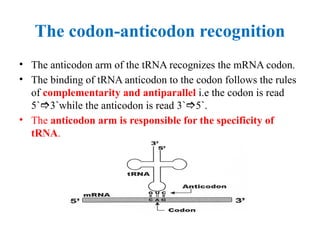
The codon-anticodon recognition
• The anticodon arm of the tRNA recognizes the mRNA codon.
• The binding of tRNA anticodon to the codon follows the rules
of complementarity and antiparallel i.e the codon is read
5ˋ3 while the anticodon is read 3
ˋ ˋ5 .
ˋ
• The anticodon arm is responsible for the specificity of
tRNA.
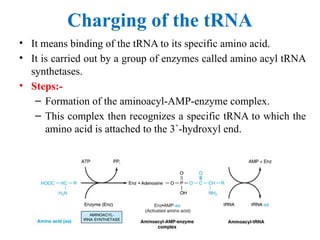
Charging of the tRNA
• It means binding of the tRNA to its specific amino acid.
• It is carried out by a group of enzymes called amino acyl tRNA
synthetases.
• Steps:-
– Formation of the aminoacyl-AMP-enzyme complex.
– This complex then recognizes a specific tRNA to which the
amino acid is attached to the 3 -hydroxyl end.
ˋ
Mutation
• Definition: - It is a change in the nucleotide sequence of
the DNA.
• Types: - There are 2 types of mutations.
• 1- Point mutation (single base changes).
• 2- Frame shift mutation.
1. Point mutation (single base changes):-
– There is a substitution of one base by another.
– There are 2 types
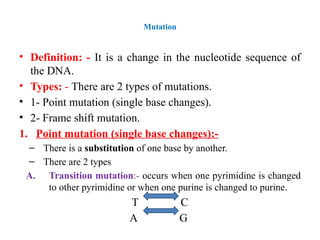
A. Transition mutation:- occurs when one pyrimidine is changed
to other pyrimidine or when one purine is changed to purine.
T C
A G
B. Transversion mutation: - Occurs when a purine is
changed to either of the 2 pyrimidines or when a
pyrimidine is changed to either of the 2 purines.
• Effects of point mutation:-
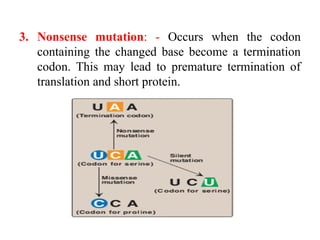
1. Silent mutation: - It means that the codon containing the
changed base still code for the same amino acid.
– It is due to degeneracy of the genetic code:- i.e the changed
base is the 3rd
base of the codon.
– e.g In Hb Bristol [it has aspartic acid at position 67 that is coded
by 2 codons GAU and GAC].
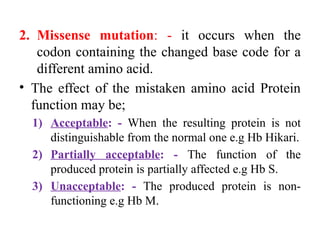
2. Missense mutation: - it occurs when the
codon containing the changed base code for a
different amino acid.
• The effect of the mistaken amino acid Protein
function may be;
1) Acceptable: - When the resulting protein is not
distinguishable from the normal one e.g Hb Hikari.
2) Partially acceptable: - The function of the
produced protein is partially affected e.g Hb S.
3) Unacceptable: - The produced protein is non-
functioning e.g Hb M.
3. Nonsense mutation: - Occurs when the codon
containing the changed base become a termination
codon. This may lead to premature termination of
translation and short protein.
2. Frameshift mutation
• It may be produced either due to deletion or insertion
of nucleotide (s) from the coding strand of a gene.
1) Deletion:-
I. If there is deletion of a single nucleotide, this
may lead to:-
– Garbled translation of the mRNA distal to the single
nucleotide deletion.
– Nonsense codons: - May result from deletion, leading to
premature termination of translation.
II. If there is deletion of 3 nucleotides or
multiple of 3 from the coding region, this
result in a protein with missed amino acid or
acids.
2) Insertion: - Give the same effects of deletions.
Translation
(Protein synthesis)
Protein synthesis = Translation
• Protein synthesis: - Is the translation of
mRNA nucleotides sequence into sequence
of amino acids of specific protein.
• The message is read from 5 to 3 .
ˋ ˋ
• Steps of protein synthesis include initiation,
elongation and termination.
A. Initiation:-
– Requirements of initiation: - [tRNA,
ribosome, mRNA, amino acids, GTP and
ATP, and at least 10 eukaryotic initiation
factors (eIFc)].
– Initiation includes 4 stages:-
1. Ribosomal dissociation
2. Formation of the 43s pre-initiation
complex
3. Formation of the 48s initiation complex
4. Formation of the 80s initiation complex
Protein synthesis = Translation
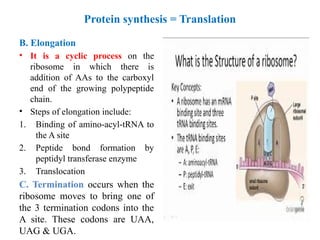
B. Elongation
• It is a cyclic process on the
ribosome in which there is
addition of AAs to the carboxyl
end of the growing polypeptide
chain.
• Steps of elongation include:
1. Binding of amino-acyl-tRNA to
the A site
2. Peptide bond formation by
peptidyl transferase enzyme
3. Translocation
C. Termination occurs when the
ribosome moves to bring one of
the 3 termination codons into the
A site. These codons are UAA,
UAG & UGA.
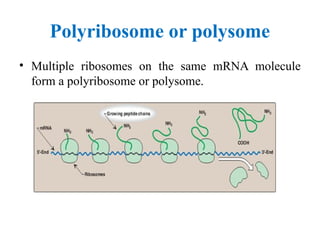
Polyribosome or polysome
• Multiple ribosomes on the same mRNA molecule
form a polyribosome or polysome.
Posttranslational processing of proteins
• Polypeptide chains may need some
modifications to perform their function.
• These include:-
1. Trimming:-
– It means removal of part of the translated region of
the protein for activation.
– Removal of C- peptide from proinsulin to form the
active insulin hormone.
2. Covalent modifications:-
• Proteins, both enzymatic and structural may be activated
or inactivated by covalent attachment of a variety of
chemical groups such as:-
A. Phosphorylation:-
– Phosphate is usually added to the OH groups of serine,
threonine or less frequently, tyrosine of proteins.
– It is catalyzed by protein kinases and removed by
protein phosphatases.
– Phosphorylation may activate or inactivate the protein.
B. Glycosylation:-
– Proteoglycans and glycoproteins have complex carbohydrate
attached either to OH group of amino acid (O-linked) or to
amide group of aspargine (N-linked).
– These sugars are added post-translationally.
C. Hydroxylation:-
– Proline and lysine residues of the collagen are extensively
hydroxylated in the endoplasmic reticulum.
D. Carboxylation:-
– Activation of clotting factors occurs by carboxylation of the
γ-carboxyl group of glutamic acid to form γ-
carboxyglutamate.
– This allows binding of Ca2+
to clotting factors and clot
formation.
Genetic code & mutation types and effects.pptx

Genetic code & mutation types and effects.pptx

  • 1.
  • 2.
    The genetic code •Introduction:- – There are 20 amino acids required for protein synthesis, thus their must be at least 20 codons (one for each amino acid) that make the genetic code. • Codon: - is the sequence of 3 nucleotide bases on mRNA that determines the type and position of amino acid on a protein. • There are 4 different nucleotides in the mRNA and the genetic codon is triplet thus there are (4)3 = 64 codons e.g. AUG codes for methionine. • The genetic code: - is the collection of the genetic codons. • Nonsense (termination) codons: - there are 3 codons (UAA, UAG and UGA) don't code for amino acids and are called nonsense codons or termination codons as they terminate the translation process.
  • 3.
    Characteristics of thegenetic code 1. Degeneracy:- – Definition:- It means that multiple codons can code for one amino acid. – There are 61 codons and only 20 amino acids, this means that there must be more than one codon code for the same amino acid. – Example: - Arginine amino acid has sex codons. – The first 2 bases of the codon for certain amino acid are constant, while the 3rd base is changing (this is called wobbling). Also the 3rd base doesn't necessarily obey the base pairing rule.
  • 4.
    2. Unambiguous: -It means that each codon codes only for a single amino acid. 3. Non overlapping:- It means that the reading of the genetic codons during protein synthesis doesn't involve any overlap of codons. 4. No punctuation:- It means that there is no punctuation between codons and the message is read in a continuing sequence of nucleotide triplets until a translation stop codon is reached. 5. Universal:- – Until recently, the genetic code was thought to be universal. – But now it was found that a set of tRNA molecules in mitochondria reads 4 codons differently from the tRNA in the cytoplasm of even the same cell.
  • 5.
    The codon-anticodon recognition •The anticodon arm of the tRNA recognizes the mRNA codon. • The binding of tRNA anticodon to the codon follows the rules of complementarity and antiparallel i.e the codon is read 5ˋ3 while the anticodon is read 3 ˋ ˋ5 . ˋ • The anticodon arm is responsible for the specificity of tRNA.
  • 6.
    Charging of thetRNA • It means binding of the tRNA to its specific amino acid. • It is carried out by a group of enzymes called amino acyl tRNA synthetases. • Steps:- – Formation of the aminoacyl-AMP-enzyme complex. – This complex then recognizes a specific tRNA to which the amino acid is attached to the 3 -hydroxyl end. ˋ
  • 7.
    Mutation • Definition: -It is a change in the nucleotide sequence of the DNA. • Types: - There are 2 types of mutations. • 1- Point mutation (single base changes). • 2- Frame shift mutation. 1. Point mutation (single base changes):- – There is a substitution of one base by another. – There are 2 types A. Transition mutation:- occurs when one pyrimidine is changed to other pyrimidine or when one purine is changed to purine. T C A G
  • 8.
    B. Transversion mutation:- Occurs when a purine is changed to either of the 2 pyrimidines or when a pyrimidine is changed to either of the 2 purines. • Effects of point mutation:- 1. Silent mutation: - It means that the codon containing the changed base still code for the same amino acid. – It is due to degeneracy of the genetic code:- i.e the changed base is the 3rd base of the codon. – e.g In Hb Bristol [it has aspartic acid at position 67 that is coded by 2 codons GAU and GAC].
  • 9.
    2. Missense mutation:- it occurs when the codon containing the changed base code for a different amino acid. • The effect of the mistaken amino acid Protein function may be; 1) Acceptable: - When the resulting protein is not distinguishable from the normal one e.g Hb Hikari. 2) Partially acceptable: - The function of the produced protein is partially affected e.g Hb S. 3) Unacceptable: - The produced protein is non- functioning e.g Hb M.
  • 10.
    3. Nonsense mutation:- Occurs when the codon containing the changed base become a termination codon. This may lead to premature termination of translation and short protein.
  • 11.
    2. Frameshift mutation •It may be produced either due to deletion or insertion of nucleotide (s) from the coding strand of a gene. 1) Deletion:- I. If there is deletion of a single nucleotide, this may lead to:- – Garbled translation of the mRNA distal to the single nucleotide deletion. – Nonsense codons: - May result from deletion, leading to premature termination of translation.
  • 12.
    II. If thereis deletion of 3 nucleotides or multiple of 3 from the coding region, this result in a protein with missed amino acid or acids. 2) Insertion: - Give the same effects of deletions.
  • 13.
  • 14.
    Protein synthesis =Translation • Protein synthesis: - Is the translation of mRNA nucleotides sequence into sequence of amino acids of specific protein. • The message is read from 5 to 3 . ˋ ˋ • Steps of protein synthesis include initiation, elongation and termination. A. Initiation:- – Requirements of initiation: - [tRNA, ribosome, mRNA, amino acids, GTP and ATP, and at least 10 eukaryotic initiation factors (eIFc)]. – Initiation includes 4 stages:- 1. Ribosomal dissociation 2. Formation of the 43s pre-initiation complex 3. Formation of the 48s initiation complex 4. Formation of the 80s initiation complex
  • 15.
    Protein synthesis =Translation B. Elongation • It is a cyclic process on the ribosome in which there is addition of AAs to the carboxyl end of the growing polypeptide chain. • Steps of elongation include: 1. Binding of amino-acyl-tRNA to the A site 2. Peptide bond formation by peptidyl transferase enzyme 3. Translocation C. Termination occurs when the ribosome moves to bring one of the 3 termination codons into the A site. These codons are UAA, UAG & UGA.
  • 16.
    Polyribosome or polysome •Multiple ribosomes on the same mRNA molecule form a polyribosome or polysome.
  • 17.
    Posttranslational processing ofproteins • Polypeptide chains may need some modifications to perform their function. • These include:- 1. Trimming:- – It means removal of part of the translated region of the protein for activation. – Removal of C- peptide from proinsulin to form the active insulin hormone.
  • 18.
    2. Covalent modifications:- •Proteins, both enzymatic and structural may be activated or inactivated by covalent attachment of a variety of chemical groups such as:- A. Phosphorylation:- – Phosphate is usually added to the OH groups of serine, threonine or less frequently, tyrosine of proteins. – It is catalyzed by protein kinases and removed by protein phosphatases. – Phosphorylation may activate or inactivate the protein.
  • 19.
    B. Glycosylation:- – Proteoglycansand glycoproteins have complex carbohydrate attached either to OH group of amino acid (O-linked) or to amide group of aspargine (N-linked). – These sugars are added post-translationally. C. Hydroxylation:- – Proline and lysine residues of the collagen are extensively hydroxylated in the endoplasmic reticulum. D. Carboxylation:- – Activation of clotting factors occurs by carboxylation of the γ-carboxyl group of glutamic acid to form γ- carboxyglutamate. – This allows binding of Ca2+ to clotting factors and clot formation.