Genetic Code,
Mutations
&
Translation
The Genetic Code
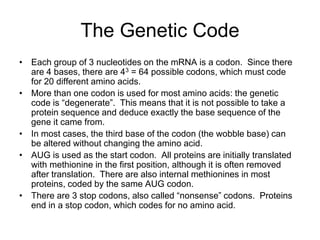
• Each group of 3 nucleotides on the mRNA is a codon. Since there
are 4 bases, there are 43 = 64 possible codons, which must code
for 20 different amino acids.
• More than one codon is used for most amino acids: the genetic
code is “degenerate”. This means that it is not possible to take a
protein sequence and deduce exactly the base sequence of the
gene it came from.
• In most cases, the third base of the codon (the wobble base) can
be altered without changing the amino acid.
• AUG is used as the start codon. All proteins are initially translated
with methionine in the first position, although it is often removed
after translation. There are also internal methionines in most
proteins, coded by the same AUG codon.
• There are 3 stop codons, also called “nonsense” codons. Proteins
end in a stop codon, which codes for no amino acid.
More Genetic Code
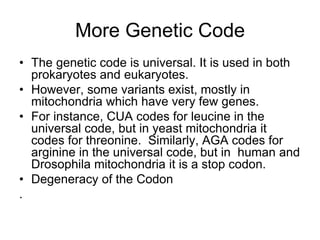
• The genetic code is universal. It is used in both
prokaryotes and eukaryotes.
• However, some variants exist, mostly in
mitochondria which have very few genes.
• For instance, CUA codes for leucine in the
universal code, but in yeast mitochondria it
codes for threonine. Similarly, AGA codes for
arginine in the universal code, but in human and
Drosophila mitochondria it is a stop codon.
• Degeneracy of the Codon
.
Types of Mutations
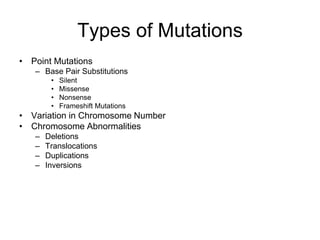
• Point Mutations
– Base Pair Substitutions
• Silent
• Missense
• Nonsense
• Frameshift Mutations
• Variation in Chromosome Number
• Chromosome Abnormalities
– Deletions
– Translocations
– Duplications
– Inversions
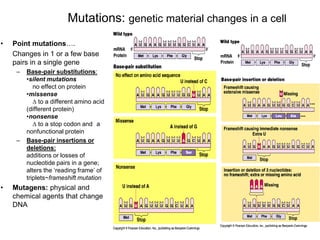
Mutations: genetic material changes in a cell
• Point mutations….
Changes in 1 or a few base
pairs in a single gene
– Base-pair substitutions:
•silent mutations
no effect on protein
•missense
∆ to a different amino acid
(different protein)
•nonsense
∆ to a stop codon and a
nonfunctional protein
– Base-pair insertions or
deletions:
additions or losses of
nucleotide pairs in a gene;
alters the „reading frame‟ of
triplets~frameshift mutation
• Mutagens: physical and
chemical agents that change
DNA
Point Mutations
Base-Pair Substitution Ex) Missense
Mutation
• One Amino Acid Substituted for Another
• Sickle Cell Anemia
– Valine is replaced with Glutamic Acid
Sickle Cell Anemia
Deletion
Shifts Reading Frame
• A deletion of
one or more
bases on a
section of the
chromosome.
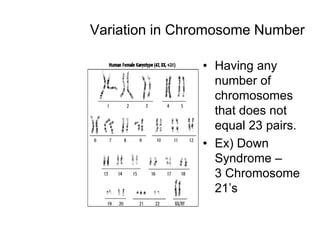
Variation in Chromosome Number
• Having any
number of
chromosomes
that does not
equal 23 pairs.
• Ex) Down
Syndrome –
3 Chromosome
21‟s
Chromosome
Abnormalities
Translocations
• When one piece of
a chromosome
breaks off and
attaches to
another
chromosome
Duplications
• Occurs during crossing over and
one chromosome ends up with
more genes than it received.
Inversions
• A reversal in the order of a
segment of a chromosome
Translation
• Translation of mRNA into protein is accomplished by the
ribosome.
• Ribosomes bind to the translation initiation sequence on
the mRNA, then move down the RNA in a 5‟ to 3‟
direction.
• Each group of 3 nucleotides in the mRNA is a “codon”,
which codes for 1 amino acids. Transfer RNA is the
adapter between the 3 bases of the codon and the
corresponding amino acid.
Transfer RNA
• Transfer RNA molecules are short RNAs
that fold into a characteristic cloverleaf
pattern.
• Each tRNA has 3 bases that make up the
anticodon. These bases pair with the 3
bases of the codon on mRNA during
translation.
• Each tRNA has its corresponding amino
acid attached to the 3‟ end. A set of
enzymes, the “aminoacyl tRNA
synthetases”, are used to “charge” the
tRNA with the proper amino acid.
• Some tRNAs can pair with more than one
codon. The third base of the anticodon is
called the “wobble position”, and it can form
base pairs with several different
nucleotides.
Initiation of Translation
• In prokaryotes, ribosomes bind to specific translation
initiation sites. There can be several different initiation
sites on a messenger RNA: a prokaryotic mRNA can
code for several different proteins. Translation begins at
an AUG codon. The modified amino acid methionine is
always the first amino acid of the new polypeptide.
• In eukaryotes, ribosomes bind to the 5‟ cap, then move
down the mRNA until they reach the first AUG, the
codon for methionine. Translation starts from this point.
Eukaryotic mRNAs code for only a single gene.
• Note that translation does not start at the first base of the
mRNA. There is an untranslated region at the beginning
of the mRNA, the 5‟ untranslated region (5‟ UTR).
More Initiation
• The initiation process
involves first joining the
mRNA, the initiator
methionine-tRNA, and the
small ribosomal subunit.
• Several “initiation
factors”--additional
proteins--are also
involved.
• The large ribosomal
subunit then joins the
complex.
LE 17-13
Polypeptide
tRNA with
amino acid
attached
Ribosome
tRNA
Anticodon
3
5
mRNA
Amino
acids
Codons
1. a correct match between tRNA and an amino acid
- Catalyzed by aminoacyl-tRNA synthetase
Accurate translation requires two steps
2. a correct match between the tRNA anticodon and an mRNA
codon
LE 17-15
Amino acid Aminoacyl-tRNA
synthetase (enzyme)
Pyrophosphate
Phosphates
tRNA
AMP
Aminoacyl tRNA
(an “activated
amino acid”)
1.
Elongation
• The ribosome has 2 sites for tRNAs, called P and A. The initial
tRNA with attached amino acid is in the P site. A new tRNA,
corresponding to the next codon on the mRNA, binds to the A site.
The ribosome catalyzes a transfer of the amino acid from the P site
onto the amino acid at the A site, forming a new peptide bond.
• The ribosome then moves down one codon. The now-empty tRNA
at the P site is displaced off the ribosome, and the tRNA that has the
growing peptide chain on it is moved from the A site to the P site.
• The process is then repeated:
– the tRNA at the P site holds the peptide chain, and a new tRNA binds to
the A site.
– the peptide chain is transferred onto the amino acid attached to the A
site tRNA.
– the ribosome moves down one codon, displacing the empty P site tRNA
and moving the tRNA with the peptide chain from the A site to the P
site.
LE 17-16b
P site (Peptidyl-tRNA
binding site)
E site
(Exit site)
mRNA
binding site
A site (Aminoacyl-
tRNA binding site)
Large
subunit
Small
subunit
Schematic model showing binding sites on ribosome
E P A
LE 17-16c
Amino end
mRNA
5
3
Growing polypeptide
Next amino acid
to be added to
polypeptide chain
tRNA
Codons
Schematic model with mRNA and tRNA
E
Ribosome translates 5‟ to 3‟ on mRNA.
Polypeptide chain grows amino end first, carboxyl end last.
Elongation
Termination
• Three codons are called “stop
codons”. They code for no amino
acid, and all protein-coding
regions end in a stop codon.
• When the ribosome reaches a
stop codon, there is no tRNA that
binds to it. Instead, proteins
called “release factors” bind, and
cause the ribosome, the mRNA,
and the new polypeptide to
separate. The new polypeptide is
completed.
Post-Translational Modification
• New polypeptides usually fold themselves spontaneously
into their active conformation. However, some proteins
are helped and guided in the folding process by
chaperone proteins
• Many proteins have sugars, phosphate groups, fatty
acids, and other molecules covalently attached to certain
amino acids. Most of this is done in the endoplasmic
reticulum.
• Many proteins are targeted to specific organelles within
the cell. Targeting is accomplished through “signal
sequences” on the polypeptide. In the case of proteins
that go into the endoplasmic reticulum, the signal
sequence is a group of amino acids at the N terminal of
the polypeptide, which are removed from the final protein
after translation.

Translation Genetic code & Mutations.pdf

  • 1.
  • 2.
    The Genetic Code •Each group of 3 nucleotides on the mRNA is a codon. Since there are 4 bases, there are 43 = 64 possible codons, which must code for 20 different amino acids. • More than one codon is used for most amino acids: the genetic code is “degenerate”. This means that it is not possible to take a protein sequence and deduce exactly the base sequence of the gene it came from. • In most cases, the third base of the codon (the wobble base) can be altered without changing the amino acid. • AUG is used as the start codon. All proteins are initially translated with methionine in the first position, although it is often removed after translation. There are also internal methionines in most proteins, coded by the same AUG codon. • There are 3 stop codons, also called “nonsense” codons. Proteins end in a stop codon, which codes for no amino acid.
  • 4.
    More Genetic Code •The genetic code is universal. It is used in both prokaryotes and eukaryotes. • However, some variants exist, mostly in mitochondria which have very few genes. • For instance, CUA codes for leucine in the universal code, but in yeast mitochondria it codes for threonine. Similarly, AGA codes for arginine in the universal code, but in human and Drosophila mitochondria it is a stop codon. • Degeneracy of the Codon .
  • 5.
    Types of Mutations •Point Mutations – Base Pair Substitutions • Silent • Missense • Nonsense • Frameshift Mutations • Variation in Chromosome Number • Chromosome Abnormalities – Deletions – Translocations – Duplications – Inversions
  • 6.
    Mutations: genetic materialchanges in a cell • Point mutations…. Changes in 1 or a few base pairs in a single gene – Base-pair substitutions: •silent mutations no effect on protein •missense ∆ to a different amino acid (different protein) •nonsense ∆ to a stop codon and a nonfunctional protein – Base-pair insertions or deletions: additions or losses of nucleotide pairs in a gene; alters the „reading frame‟ of triplets~frameshift mutation • Mutagens: physical and chemical agents that change DNA
  • 7.
  • 8.
    Base-Pair Substitution Ex)Missense Mutation • One Amino Acid Substituted for Another • Sickle Cell Anemia – Valine is replaced with Glutamic Acid
  • 9.
  • 10.
    Deletion Shifts Reading Frame •A deletion of one or more bases on a section of the chromosome.
  • 11.
    Variation in ChromosomeNumber • Having any number of chromosomes that does not equal 23 pairs. • Ex) Down Syndrome – 3 Chromosome 21‟s
  • 12.
  • 13.
    Translocations • When onepiece of a chromosome breaks off and attaches to another chromosome
  • 14.
    Duplications • Occurs duringcrossing over and one chromosome ends up with more genes than it received.
  • 15.
    Inversions • A reversalin the order of a segment of a chromosome
  • 16.
    Translation • Translation ofmRNA into protein is accomplished by the ribosome. • Ribosomes bind to the translation initiation sequence on the mRNA, then move down the RNA in a 5‟ to 3‟ direction. • Each group of 3 nucleotides in the mRNA is a “codon”, which codes for 1 amino acids. Transfer RNA is the adapter between the 3 bases of the codon and the corresponding amino acid.
  • 17.
    Transfer RNA • TransferRNA molecules are short RNAs that fold into a characteristic cloverleaf pattern. • Each tRNA has 3 bases that make up the anticodon. These bases pair with the 3 bases of the codon on mRNA during translation. • Each tRNA has its corresponding amino acid attached to the 3‟ end. A set of enzymes, the “aminoacyl tRNA synthetases”, are used to “charge” the tRNA with the proper amino acid. • Some tRNAs can pair with more than one codon. The third base of the anticodon is called the “wobble position”, and it can form base pairs with several different nucleotides.
  • 18.
    Initiation of Translation •In prokaryotes, ribosomes bind to specific translation initiation sites. There can be several different initiation sites on a messenger RNA: a prokaryotic mRNA can code for several different proteins. Translation begins at an AUG codon. The modified amino acid methionine is always the first amino acid of the new polypeptide. • In eukaryotes, ribosomes bind to the 5‟ cap, then move down the mRNA until they reach the first AUG, the codon for methionine. Translation starts from this point. Eukaryotic mRNAs code for only a single gene. • Note that translation does not start at the first base of the mRNA. There is an untranslated region at the beginning of the mRNA, the 5‟ untranslated region (5‟ UTR).
  • 19.
    More Initiation • Theinitiation process involves first joining the mRNA, the initiator methionine-tRNA, and the small ribosomal subunit. • Several “initiation factors”--additional proteins--are also involved. • The large ribosomal subunit then joins the complex.
  • 20.
    LE 17-13 Polypeptide tRNA with aminoacid attached Ribosome tRNA Anticodon 3 5 mRNA Amino acids Codons
  • 21.
    1. a correctmatch between tRNA and an amino acid - Catalyzed by aminoacyl-tRNA synthetase Accurate translation requires two steps 2. a correct match between the tRNA anticodon and an mRNA codon
  • 22.
    LE 17-15 Amino acidAminoacyl-tRNA synthetase (enzyme) Pyrophosphate Phosphates tRNA AMP Aminoacyl tRNA (an “activated amino acid”) 1.
  • 23.
    Elongation • The ribosomehas 2 sites for tRNAs, called P and A. The initial tRNA with attached amino acid is in the P site. A new tRNA, corresponding to the next codon on the mRNA, binds to the A site. The ribosome catalyzes a transfer of the amino acid from the P site onto the amino acid at the A site, forming a new peptide bond. • The ribosome then moves down one codon. The now-empty tRNA at the P site is displaced off the ribosome, and the tRNA that has the growing peptide chain on it is moved from the A site to the P site. • The process is then repeated: – the tRNA at the P site holds the peptide chain, and a new tRNA binds to the A site. – the peptide chain is transferred onto the amino acid attached to the A site tRNA. – the ribosome moves down one codon, displacing the empty P site tRNA and moving the tRNA with the peptide chain from the A site to the P site.
  • 24.
    LE 17-16b P site(Peptidyl-tRNA binding site) E site (Exit site) mRNA binding site A site (Aminoacyl- tRNA binding site) Large subunit Small subunit Schematic model showing binding sites on ribosome E P A
  • 26.
    LE 17-16c Amino end mRNA 5 3 Growingpolypeptide Next amino acid to be added to polypeptide chain tRNA Codons Schematic model with mRNA and tRNA E Ribosome translates 5‟ to 3‟ on mRNA. Polypeptide chain grows amino end first, carboxyl end last.
  • 27.
  • 28.
    Termination • Three codonsare called “stop codons”. They code for no amino acid, and all protein-coding regions end in a stop codon. • When the ribosome reaches a stop codon, there is no tRNA that binds to it. Instead, proteins called “release factors” bind, and cause the ribosome, the mRNA, and the new polypeptide to separate. The new polypeptide is completed.
  • 29.
    Post-Translational Modification • Newpolypeptides usually fold themselves spontaneously into their active conformation. However, some proteins are helped and guided in the folding process by chaperone proteins • Many proteins have sugars, phosphate groups, fatty acids, and other molecules covalently attached to certain amino acids. Most of this is done in the endoplasmic reticulum. • Many proteins are targeted to specific organelles within the cell. Targeting is accomplished through “signal sequences” on the polypeptide. In the case of proteins that go into the endoplasmic reticulum, the signal sequence is a group of amino acids at the N terminal of the polypeptide, which are removed from the final protein after translation.