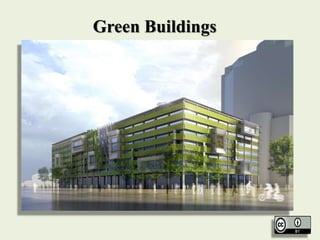
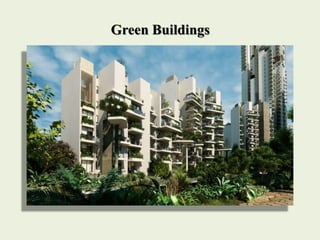
Green Buildings
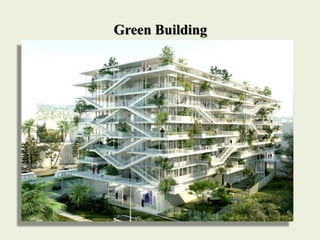
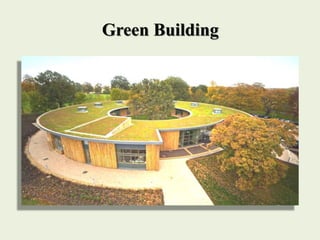
• Green building (also known as green
construction or sustainable building)
expands and complements the building design
concerns of economy, utility, durability, and
comfort.
• A Green Building is one which uses less
water, optimizes energy efficiency, conserves
natural resources, generates less waste and
provides healthier space for occupants as
compared to conventional buildings.
Introduction
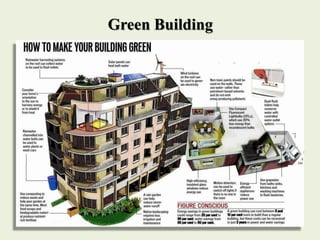
Green Building
Introduction
• Green building is the practice of creating
structures and processes that are
environment friendly and resource-efficient
throughout the life span of a building right
from site selection to design, construction,
operation, maintenance, renovation and
deconstruction.
Green Building
Introduction
• Green Buildings are designed to reduce the
overall impact on human health and the
natural environment by the following ways:
• Using energy, water and other resources
efficiently.
• By reducing waste, pollution, and
environmental degradation.
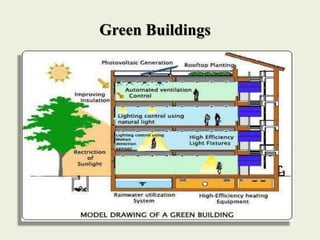
Green Buildings
Objectives Of Green Building
• The aim of green building design is to minimize
resources, maximize the reuse, recycling and
utilization of renewable resources.
• It maximizes the reuse, recycling, and utilization of
renewable resources.
• It maximizes the use of efficient building material and
construction practices, optimizes the use of onsite
resources and use of renewable sources of energy, use
efficient waste management practices and provide
comfortable and hygienic indoor working conditions.
Green Building
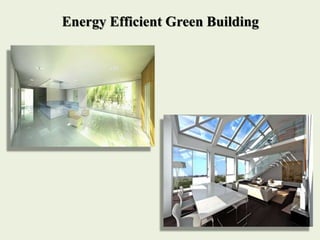
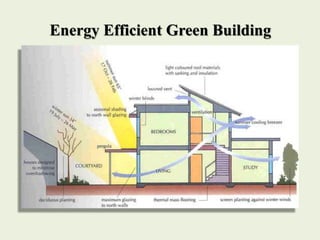
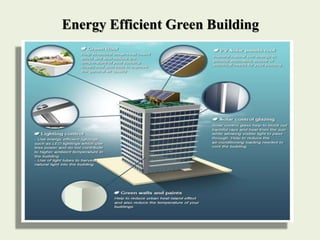
Energy Efficient Green Building
Objectives Of Green Building
• Low Impact
• Minimize impact on natural environment
• Energy Efficient
• Reduced Energy usage and Water usage
• Healthy
• Protect occupant health and increase productivity
• Minimize waste
• Designed and constructed in a manner that
minimizes waste, pollution, and environmental
degradation
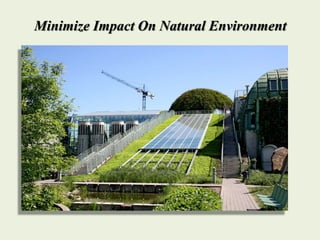
Minimize Impact On Natural Environment
Energy Efficient Green Building
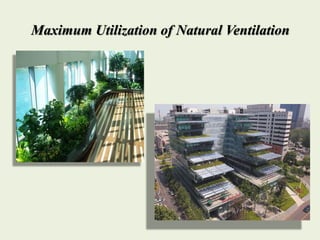
Maximum Utilization of Natural Ventilation
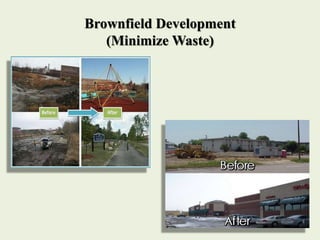
Brownfield Development
(Minimize Waste)
Features of Sustainable Building
• Consideration of sustainability aspects in all
phases of building design and planning
• Use of healthy and environmentally friendly
building materials and products
• Use of efficient systems
• Use of constructions and systems which are
easy to maintain and service
• High aesthetic and urban design quality;
high public acceptance
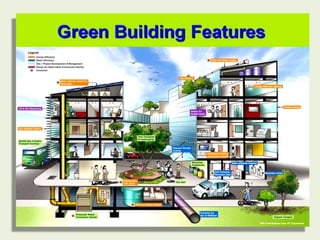
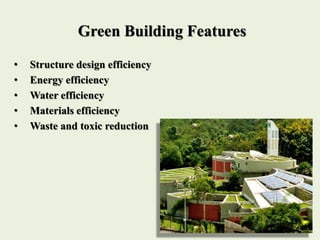
Green Building Features
• Structure design efficiency
• Energy efficiency
• Water efficiency
• Materials efficiency
• Waste and toxic reduction
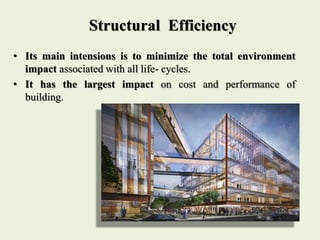
• Its main intensions is to minimize the total environment
impact associated with all life- cycles.
• It has the largest impact on cost and performance of
building.
Structural Efficiency
Energy Efficiency
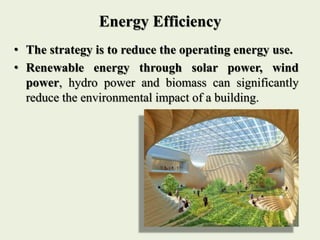
• The strategy is to reduce the operating energy use.
• Renewable energy through solar power, wind
power, hydro power and biomass can significantly
reduce the environmental impact of a building.
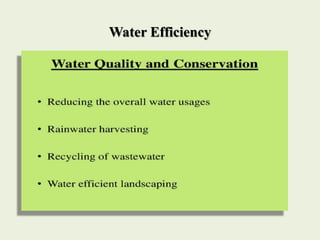
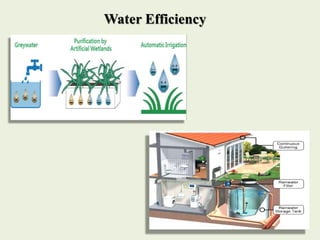
Water Efficiency
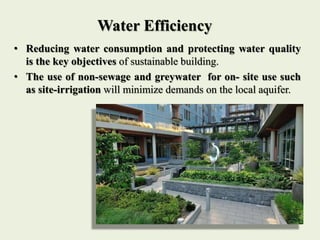
• Reducing water consumption and protecting water quality
is the key objectives of sustainable building.
• The use of non-sewage and greywater for on- site use such
as site-irrigation will minimize demands on the local aquifer.
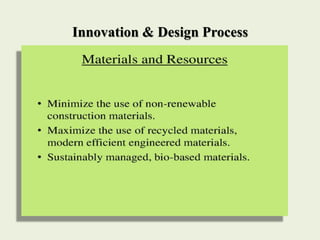
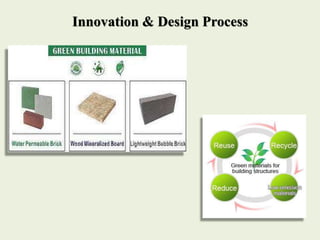
Materials Efficiency
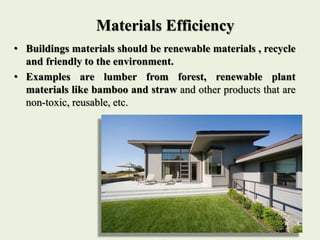
• Buildings materials should be renewable materials , recycle
and friendly to the environment.
• Examples are lumber from forest, renewable plant
materials like bamboo and straw and other products that are
non-toxic, reusable, etc.
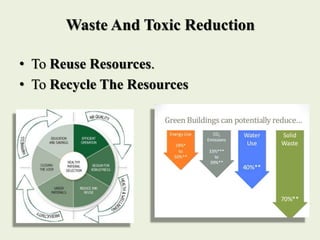
Waste And Toxic Reduction
• To Reuse Resources.
• To Recycle The Resources
Green Building Rating Systems
• The objective of green building rating systems is to
evaluate the performance of green buildings.
• The performance of the building is evaluated
based on following parameters
• Site planning
• Building envelope design
• Building system design (HVAC)
• Integration of renewable energy sources to generate
energy on site
• Planning designing, construction and operation.
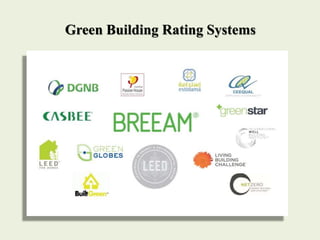
Green Building Rating Systems
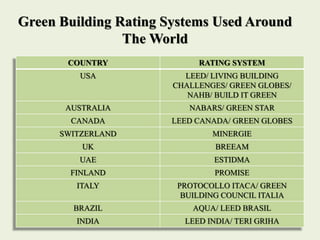
Green Building Rating Systems Used Around
The World
COUNTRY RATING SYSTEM
USA LEED/ LIVING BUILDING
CHALLENGES/ GREEN GLOBES/
NAHB/ BUILD IT GREEN
AUSTRALIA NABARS/ GREEN STAR
CANADA LEED CANADA/ GREEN GLOBES
SWITZERLAND MINERGIE
UK BREEAM
UAE ESTIDMA
FINLAND PROMISE
ITALY PROTOCOLLO ITACA/ GREEN
BUILDING COUNCIL ITALIA
BRAZIL AQUA/ LEED BRASIL
INDIA LEED INDIA/ TERI GRIHA
Green Building Rating Systems In INDIA
• LEED INDIA: An Indian adaptation of LEED USA, by
Indian green building council
• TERI- GRIHA:
• A National Rating System for Green Buildings developed
by MN RE in association with TERI.
IGBC GREEN Buildings
• The Indian Green Building Council (IGBC)
provides LEED ratings to structures in India
• Each rating system divided into different level of
certification is as follows:
• ‘Certified’ to recognise best practices.
• ‘Silver’ to recognise outstanding performances.
• ‘Gold’ to recognise national excellence.
• ‘Platinum’ to recognise global leadership.
Different Levels Of Green Building
Certification
The various levels of rating awarded are;
‘ certified’ to recognize best practices
• (30-36 Pts)
‘Silver’ to recognize outstanding performance
• (37- 44 Pts)
‘gold’ to recognize national excellence
• ( 45- 55 Pts)
‘platinum’ to recognize global leadership
• (56-75 Pts)
Different Levels Of Green Building
Certification
• IGBC Green Buildings addresses green features
under following categories:
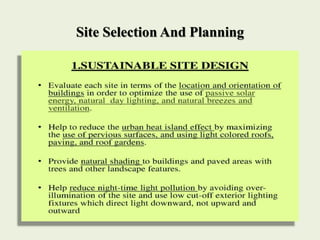
• Site selection and planning
• Water efficiency
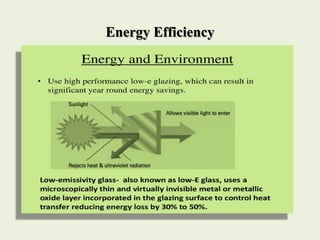
• Energy efficiency
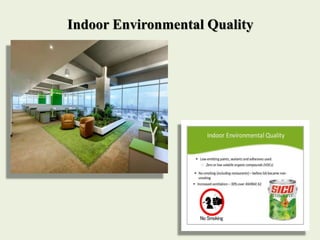
• Indoor environmental quality
• Innovation & design process
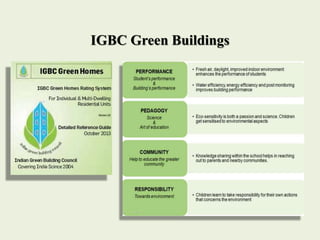
IGBC Green Buildings
TERI - GRIHA
GRIHA- GREEN RATING FOR INTEGRATED HABITAT
ASSESSMENT
• GRIHA rating system consists of 34 criteria categorized
under various sections such as Site Selection and Site
Planning, Conservation and efficient utilization of resources,
Building operation and maintenance, and Innovation points.
Eight of these 34 criteria are mandatory, four are partly
mandatory, while the rest are optional.
• Each criterion has a number of points assigned to it. It means
that a project intending to meet the criterion would qualify
for the points. Different levels of certification (one star to five
stars) are awarded based on the number of points earned.
TERI - GRIHA
Teri - Griha
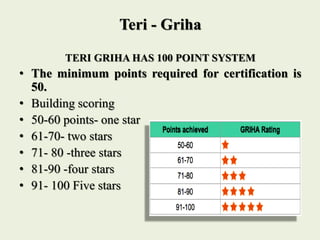
TERI GRIHA HAS 100 POINT SYSTEM
• The minimum points required for certification is
50.
• Building scoring
• 50-60 points- one star
• 61-70- two stars
• 71- 80 -three stars
• 81-90 -four stars
• 91- 100 Five stars
Site Selection And Planning
Indoor Environmental Quality
Energy Efficiency
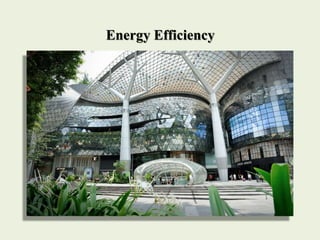
Energy Efficiency
Water Efficiency
Water Efficiency
Innovation & Design Process
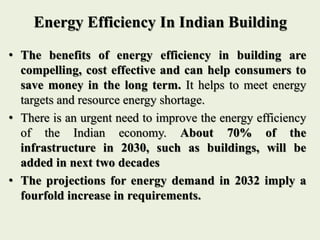
Energy Efficiency In Indian Building
• The benefits of energy efficiency in building are
compelling, cost effective and can help consumers to
save money in the long term. It helps to meet energy
targets and resource energy shortage.
• There is an urgent need to improve the energy efficiency
of the Indian economy. About 70% of the
infrastructure in 2030, such as buildings, will be
added in next two decades
• The projections for energy demand in 2032 imply a
fourfold increase in requirements.
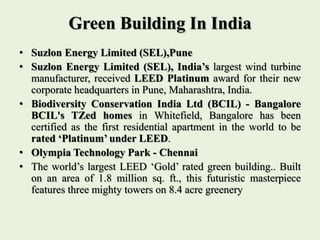
Green Building In India
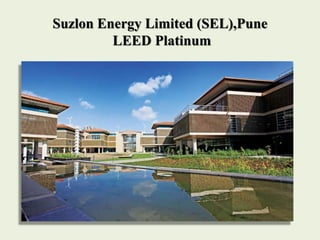
• Suzlon Energy Limited (SEL),Pune
• Suzlon Energy Limited (SEL), India’s largest wind turbine
manufacturer, received LEED Platinum award for their new
corporate headquarters in Pune, Maharashtra, India.
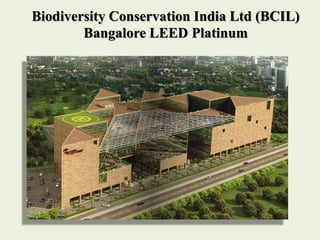
• Biodiversity Conservation India Ltd (BCIL) - Bangalore
BCIL's TZed homes in Whitefield, Bangalore has been
certified as the first residential apartment in the world to be
rated ‘Platinum’ under LEED.
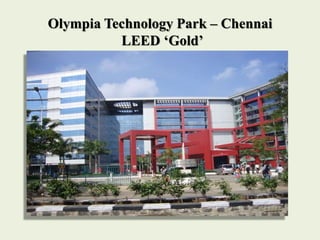
• Olympia Technology Park - Chennai
• The world’s largest LEED ‘Gold’ rated green building.. Built
on an area of 1.8 million sq. ft., this futuristic masterpiece
features three mighty towers on 8.4 acre greenery
Suzlon Energy Limited (SEL),Pune
LEED Platinum
Biodiversity Conservation India Ltd (BCIL)
Bangalore LEED Platinum
Olympia Technology Park – Chennai
LEED ‘Gold’
Green Building In India
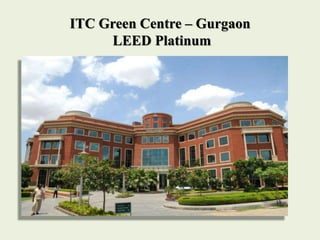
• ITC Green Centre - Gurgaon
• The ITC Green Centre was the first 'Platinum' rated
building in India and has endeavoured to adopt green
practices that go beyond recycled waste and day-lit
offices.
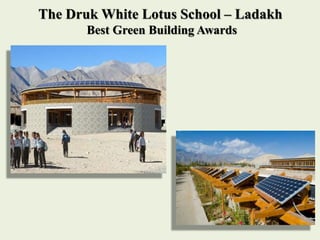
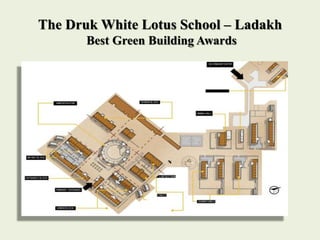
• The Druk White Lotus School - Ladakh
• A modest school that is adjudged as an outstanding
example of sustainable, green, cost effective building
development. This multi-award winning structure is the
recipient of the Best Asian Building, Best Education
Building and Best Green Building awards.
ITC Green Centre – Gurgaon
LEED Platinum
The Druk White Lotus School – Ladakh
Best Green Building Awards
The Druk White Lotus School – Ladakh
Best Green Building Awards
Green Building In India
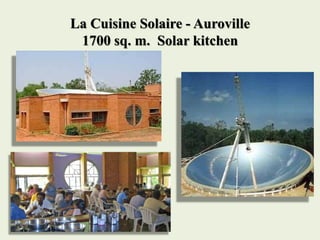
• La Cuisine Solaire - Auroville
• The solar kitchen at Auroville is perhaps the best example
of demonstrating the use of solar energy to produce steam.
This 1700 sq. m. kitchen is named thus because of the huge
15 diameter solar bowl that has been fixed at the top of the
structure to harvest solar energy.
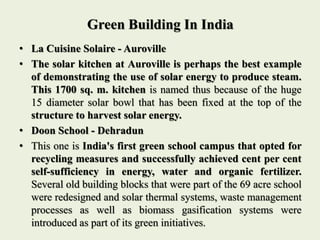
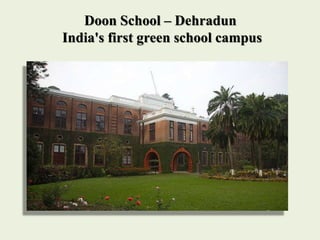
• Doon School - Dehradun
• This one is India's first green school campus that opted for
recycling measures and successfully achieved cent per cent
self-sufficiency in energy, water and organic fertilizer.
Several old building blocks that were part of the 69 acre school
were redesigned and solar thermal systems, waste management
processes as well as biomass gasification systems were
introduced as part of its green initiatives.
La Cuisine Solaire - Auroville
1700 sq. m. Solar kitchen
Doon School – Dehradun
India's first green school campus
Green Building In India
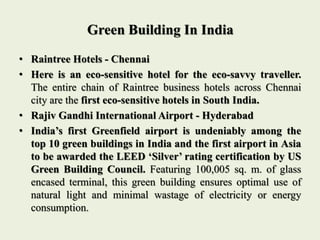
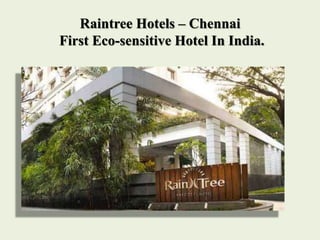
• Raintree Hotels - Chennai
• Here is an eco-sensitive hotel for the eco-savvy traveller.
The entire chain of Raintree business hotels across Chennai
city are the first eco-sensitive hotels in South India.
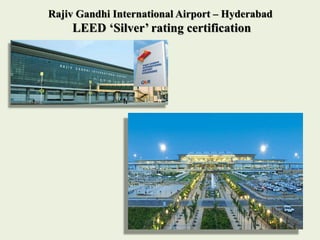
• Rajiv Gandhi International Airport - Hyderabad
• India’s first Greenfield airport is undeniably among the
top 10 green buildings in India and the first airport in Asia
to be awarded the LEED ‘Silver’ rating certification by US
Green Building Council. Featuring 100,005 sq. m. of glass
encased terminal, this green building ensures optimal use of
natural light and minimal wastage of electricity or energy
consumption.
Raintree Hotels – Chennai
First Eco-sensitive Hotel In India.
Rajiv Gandhi International Airport – Hyderabad
LEED ‘Silver’ rating certification
Green Building In India
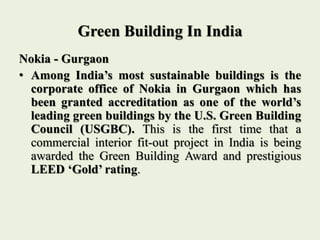
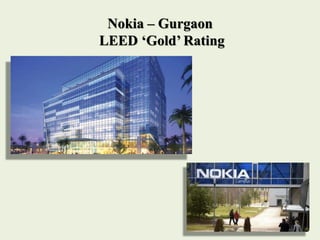
Nokia - Gurgaon
• Among India’s most sustainable buildings is the
corporate office of Nokia in Gurgaon which has
been granted accreditation as one of the world’s
leading green buildings by the U.S. Green Building
Council (USGBC). This is the first time that a
commercial interior fit-out project in India is being
awarded the Green Building Award and prestigious
LEED ‘Gold’ rating.
Nokia – Gurgaon
LEED ‘Gold’ Rating
Green Building Economy And
Investment
• It is predicted that energy efficiency in
building and appliances can reduce 1.6 Gt
CO2 in 2020 and up to 7Gt CO2 in 2050.
• In terms of region, the fastest growing
regional green building market is Asia.
• Over 85% firms expect rapid or steady
growth in sales and profit levels associated
with green building.
• GB is a win – win situation for all stake
holders: developers, builders, policy makers
and the world as whole.
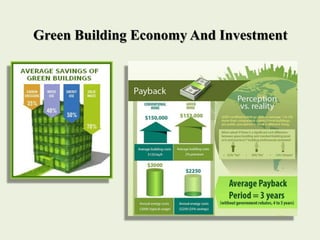
Green Building Economy And Investment
• Buildings have a large effect on the
enviornment,human health and the economy.
• The successful adoption of GREEN BUILDING
development can maximize both the economic and
enviornmental performance of the buildings.
Benefits of Green Buildings
• A Green Building can have tremendous benefits,
both tangible and intangible. The immediate and
most tangible benefit is in the reduction in water
and operating energy costs right from day one,
during the entire life cycle of the building.
Benefits of Green Buildings
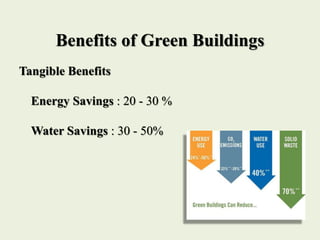
Tangible Benefits
Energy Savings : 20 - 30 %
Water Savings : 30 - 50%
Benefits of Green Buildings
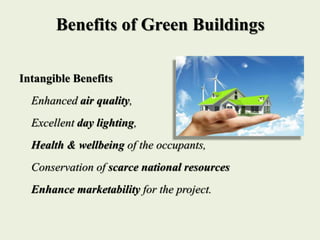
Intangible Benefits
Enhanced air quality,
Excellent day lighting,
Health & wellbeing of the occupants,
Conservation of scarce national resources
Enhance marketability for the project.
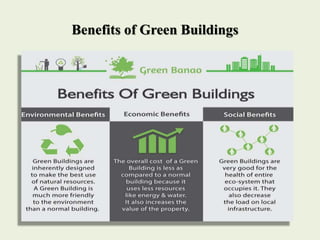
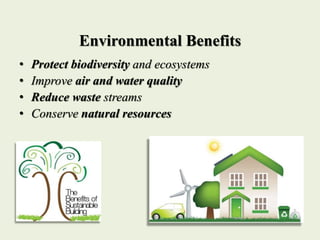
Environmental Benefits
• Protect biodiversity and ecosystems
• Improve air and water quality
• Reduce waste streams
• Conserve natural resources
Economic Benefits
• Reduce operating costs
• Create, expand, and shape markets for green product
and services
• Improve occupant productivity
Social Benefits
• Enhance occupant comfort and health.
• Heighten aesthetic qualities.
• Minimize strain on local infrastructure.
• Improve overall quality of life.
Conclusion
• Green Buildings are dynamic environments
that respond to their occupants’ changing
needs and lifestyles.
• “greener building” can be achieved using
intelligent technology and that this
“greening” will provide a tangible and
significant return on investment.
Green Buildings
Conclusion
• With the convergence of urbanization,
globalization and rapidly changing and
expanding economy, using these green
building concepts will help the world as well
as India in satisfying the shortage of
valuable resources and also will prevent
environmental degradation.
• Thus, Green building provides significant
return on investment to contractors,
architects and building owners.
References
• Fundamentals of Town Planning : G.K. Hiraskar
• Internet Websites
• https://igbc.in/igbc/
• http://grihaindia.org/
• http://www.worldgbc.org/
• https://greenbuildingsindia.wordpress.com/
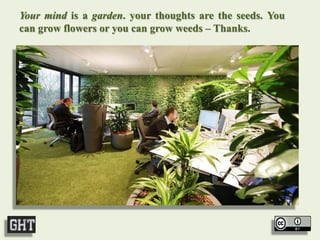
Your mind is a garden. your thoughts are the seeds. You
can grow flowers or you can grow weeds – Thanks.

greenbuilding-170903100330.pdf

  • 1.
  • 2.
    • Green building(also known as green construction or sustainable building) expands and complements the building design concerns of economy, utility, durability, and comfort. • A Green Building is one which uses less water, optimizes energy efficiency, conserves natural resources, generates less waste and provides healthier space for occupants as compared to conventional buildings. Introduction
  • 3.
  • 4.
    Introduction • Green buildingis the practice of creating structures and processes that are environment friendly and resource-efficient throughout the life span of a building right from site selection to design, construction, operation, maintenance, renovation and deconstruction.
  • 5.
  • 6.
    Introduction • Green Buildingsare designed to reduce the overall impact on human health and the natural environment by the following ways: • Using energy, water and other resources efficiently. • By reducing waste, pollution, and environmental degradation.
  • 7.
  • 8.
    Objectives Of GreenBuilding • The aim of green building design is to minimize resources, maximize the reuse, recycling and utilization of renewable resources. • It maximizes the reuse, recycling, and utilization of renewable resources. • It maximizes the use of efficient building material and construction practices, optimizes the use of onsite resources and use of renewable sources of energy, use efficient waste management practices and provide comfortable and hygienic indoor working conditions.
  • 9.
  • 10.
  • 11.
    Objectives Of GreenBuilding • Low Impact • Minimize impact on natural environment • Energy Efficient • Reduced Energy usage and Water usage • Healthy • Protect occupant health and increase productivity • Minimize waste • Designed and constructed in a manner that minimizes waste, pollution, and environmental degradation
  • 12.
    Minimize Impact OnNatural Environment
  • 13.
  • 14.
  • 15.
    Maximum Utilization ofNatural Ventilation
  • 16.
  • 17.
    Features of SustainableBuilding • Consideration of sustainability aspects in all phases of building design and planning • Use of healthy and environmentally friendly building materials and products • Use of efficient systems • Use of constructions and systems which are easy to maintain and service • High aesthetic and urban design quality; high public acceptance
  • 19.
    Green Building Features •Structure design efficiency • Energy efficiency • Water efficiency • Materials efficiency • Waste and toxic reduction
  • 20.
    • Its mainintensions is to minimize the total environment impact associated with all life- cycles. • It has the largest impact on cost and performance of building. Structural Efficiency
  • 21.
    Energy Efficiency • Thestrategy is to reduce the operating energy use. • Renewable energy through solar power, wind power, hydro power and biomass can significantly reduce the environmental impact of a building.
  • 22.
    Water Efficiency • Reducingwater consumption and protecting water quality is the key objectives of sustainable building. • The use of non-sewage and greywater for on- site use such as site-irrigation will minimize demands on the local aquifer.
  • 23.
    Materials Efficiency • Buildingsmaterials should be renewable materials , recycle and friendly to the environment. • Examples are lumber from forest, renewable plant materials like bamboo and straw and other products that are non-toxic, reusable, etc.
  • 24.
    Waste And ToxicReduction • To Reuse Resources. • To Recycle The Resources
  • 25.
    Green Building RatingSystems • The objective of green building rating systems is to evaluate the performance of green buildings. • The performance of the building is evaluated based on following parameters • Site planning • Building envelope design • Building system design (HVAC) • Integration of renewable energy sources to generate energy on site • Planning designing, construction and operation.
  • 26.
  • 27.
    Green Building RatingSystems Used Around The World COUNTRY RATING SYSTEM USA LEED/ LIVING BUILDING CHALLENGES/ GREEN GLOBES/ NAHB/ BUILD IT GREEN AUSTRALIA NABARS/ GREEN STAR CANADA LEED CANADA/ GREEN GLOBES SWITZERLAND MINERGIE UK BREEAM UAE ESTIDMA FINLAND PROMISE ITALY PROTOCOLLO ITACA/ GREEN BUILDING COUNCIL ITALIA BRAZIL AQUA/ LEED BRASIL INDIA LEED INDIA/ TERI GRIHA
  • 28.
    Green Building RatingSystems In INDIA • LEED INDIA: An Indian adaptation of LEED USA, by Indian green building council • TERI- GRIHA: • A National Rating System for Green Buildings developed by MN RE in association with TERI.
  • 29.
    IGBC GREEN Buildings •The Indian Green Building Council (IGBC) provides LEED ratings to structures in India • Each rating system divided into different level of certification is as follows: • ‘Certified’ to recognise best practices. • ‘Silver’ to recognise outstanding performances. • ‘Gold’ to recognise national excellence. • ‘Platinum’ to recognise global leadership.
  • 30.
    Different Levels OfGreen Building Certification The various levels of rating awarded are; ‘ certified’ to recognize best practices • (30-36 Pts) ‘Silver’ to recognize outstanding performance • (37- 44 Pts) ‘gold’ to recognize national excellence • ( 45- 55 Pts) ‘platinum’ to recognize global leadership • (56-75 Pts)
  • 31.
    Different Levels OfGreen Building Certification • IGBC Green Buildings addresses green features under following categories: • Site selection and planning • Water efficiency • Energy efficiency • Indoor environmental quality • Innovation & design process
  • 32.
  • 33.
    TERI - GRIHA GRIHA-GREEN RATING FOR INTEGRATED HABITAT ASSESSMENT • GRIHA rating system consists of 34 criteria categorized under various sections such as Site Selection and Site Planning, Conservation and efficient utilization of resources, Building operation and maintenance, and Innovation points. Eight of these 34 criteria are mandatory, four are partly mandatory, while the rest are optional. • Each criterion has a number of points assigned to it. It means that a project intending to meet the criterion would qualify for the points. Different levels of certification (one star to five stars) are awarded based on the number of points earned.
  • 34.
  • 35.
    Teri - Griha TERIGRIHA HAS 100 POINT SYSTEM • The minimum points required for certification is 50. • Building scoring • 50-60 points- one star • 61-70- two stars • 71- 80 -three stars • 81-90 -four stars • 91- 100 Five stars
  • 37.
  • 38.
  • 39.
  • 40.
  • 41.
  • 42.
  • 43.
  • 44.
  • 45.
  • 46.
  • 47.
    Energy Efficiency InIndian Building • The benefits of energy efficiency in building are compelling, cost effective and can help consumers to save money in the long term. It helps to meet energy targets and resource energy shortage. • There is an urgent need to improve the energy efficiency of the Indian economy. About 70% of the infrastructure in 2030, such as buildings, will be added in next two decades • The projections for energy demand in 2032 imply a fourfold increase in requirements.
  • 48.
    Green Building InIndia • Suzlon Energy Limited (SEL),Pune • Suzlon Energy Limited (SEL), India’s largest wind turbine manufacturer, received LEED Platinum award for their new corporate headquarters in Pune, Maharashtra, India. • Biodiversity Conservation India Ltd (BCIL) - Bangalore BCIL's TZed homes in Whitefield, Bangalore has been certified as the first residential apartment in the world to be rated ‘Platinum’ under LEED. • Olympia Technology Park - Chennai • The world’s largest LEED ‘Gold’ rated green building.. Built on an area of 1.8 million sq. ft., this futuristic masterpiece features three mighty towers on 8.4 acre greenery
  • 49.
    Suzlon Energy Limited(SEL),Pune LEED Platinum
  • 50.
    Biodiversity Conservation IndiaLtd (BCIL) Bangalore LEED Platinum
  • 51.
    Olympia Technology Park– Chennai LEED ‘Gold’
  • 52.
    Green Building InIndia • ITC Green Centre - Gurgaon • The ITC Green Centre was the first 'Platinum' rated building in India and has endeavoured to adopt green practices that go beyond recycled waste and day-lit offices. • The Druk White Lotus School - Ladakh • A modest school that is adjudged as an outstanding example of sustainable, green, cost effective building development. This multi-award winning structure is the recipient of the Best Asian Building, Best Education Building and Best Green Building awards.
  • 53.
    ITC Green Centre– Gurgaon LEED Platinum
  • 54.
    The Druk WhiteLotus School – Ladakh Best Green Building Awards
  • 55.
    The Druk WhiteLotus School – Ladakh Best Green Building Awards
  • 56.
    Green Building InIndia • La Cuisine Solaire - Auroville • The solar kitchen at Auroville is perhaps the best example of demonstrating the use of solar energy to produce steam. This 1700 sq. m. kitchen is named thus because of the huge 15 diameter solar bowl that has been fixed at the top of the structure to harvest solar energy. • Doon School - Dehradun • This one is India's first green school campus that opted for recycling measures and successfully achieved cent per cent self-sufficiency in energy, water and organic fertilizer. Several old building blocks that were part of the 69 acre school were redesigned and solar thermal systems, waste management processes as well as biomass gasification systems were introduced as part of its green initiatives.
  • 57.
    La Cuisine Solaire- Auroville 1700 sq. m. Solar kitchen
  • 58.
    Doon School –Dehradun India's first green school campus
  • 59.
    Green Building InIndia • Raintree Hotels - Chennai • Here is an eco-sensitive hotel for the eco-savvy traveller. The entire chain of Raintree business hotels across Chennai city are the first eco-sensitive hotels in South India. • Rajiv Gandhi International Airport - Hyderabad • India’s first Greenfield airport is undeniably among the top 10 green buildings in India and the first airport in Asia to be awarded the LEED ‘Silver’ rating certification by US Green Building Council. Featuring 100,005 sq. m. of glass encased terminal, this green building ensures optimal use of natural light and minimal wastage of electricity or energy consumption.
  • 60.
    Raintree Hotels –Chennai First Eco-sensitive Hotel In India.
  • 61.
    Rajiv Gandhi InternationalAirport – Hyderabad LEED ‘Silver’ rating certification
  • 62.
    Green Building InIndia Nokia - Gurgaon • Among India’s most sustainable buildings is the corporate office of Nokia in Gurgaon which has been granted accreditation as one of the world’s leading green buildings by the U.S. Green Building Council (USGBC). This is the first time that a commercial interior fit-out project in India is being awarded the Green Building Award and prestigious LEED ‘Gold’ rating.
  • 63.
    Nokia – Gurgaon LEED‘Gold’ Rating
  • 64.
    Green Building EconomyAnd Investment • It is predicted that energy efficiency in building and appliances can reduce 1.6 Gt CO2 in 2020 and up to 7Gt CO2 in 2050. • In terms of region, the fastest growing regional green building market is Asia. • Over 85% firms expect rapid or steady growth in sales and profit levels associated with green building. • GB is a win – win situation for all stake holders: developers, builders, policy makers and the world as whole.
  • 65.
    Green Building EconomyAnd Investment
  • 66.
    Green Building EconomyAnd Investment • Buildings have a large effect on the enviornment,human health and the economy. • The successful adoption of GREEN BUILDING development can maximize both the economic and enviornmental performance of the buildings.
  • 67.
    Benefits of GreenBuildings • A Green Building can have tremendous benefits, both tangible and intangible. The immediate and most tangible benefit is in the reduction in water and operating energy costs right from day one, during the entire life cycle of the building.
  • 68.
  • 69.
    Benefits of GreenBuildings Tangible Benefits Energy Savings : 20 - 30 % Water Savings : 30 - 50%
  • 70.
    Benefits of GreenBuildings Intangible Benefits Enhanced air quality, Excellent day lighting, Health & wellbeing of the occupants, Conservation of scarce national resources Enhance marketability for the project.
  • 71.
    Environmental Benefits • Protectbiodiversity and ecosystems • Improve air and water quality • Reduce waste streams • Conserve natural resources
  • 72.
    Economic Benefits • Reduceoperating costs • Create, expand, and shape markets for green product and services • Improve occupant productivity
  • 73.
    Social Benefits • Enhanceoccupant comfort and health. • Heighten aesthetic qualities. • Minimize strain on local infrastructure. • Improve overall quality of life.
  • 74.
    Conclusion • Green Buildingsare dynamic environments that respond to their occupants’ changing needs and lifestyles. • “greener building” can be achieved using intelligent technology and that this “greening” will provide a tangible and significant return on investment.
  • 75.
  • 76.
    Conclusion • With theconvergence of urbanization, globalization and rapidly changing and expanding economy, using these green building concepts will help the world as well as India in satisfying the shortage of valuable resources and also will prevent environmental degradation. • Thus, Green building provides significant return on investment to contractors, architects and building owners.
  • 78.
    References • Fundamentals ofTown Planning : G.K. Hiraskar • Internet Websites • https://igbc.in/igbc/ • http://grihaindia.org/ • http://www.worldgbc.org/ • https://greenbuildingsindia.wordpress.com/
  • 79.
    Your mind isa garden. your thoughts are the seeds. You can grow flowers or you can grow weeds – Thanks.