INTRODUCTION TO GREEN BUILDING
1
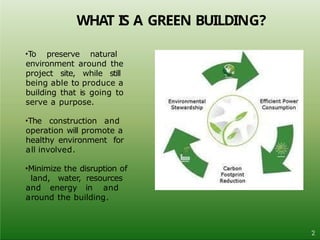
•To preserve natural
environment around the
project site, while still
being able to produce a
building that is going to
serve a purpose.
•The construction and
operation will promote a
healthy environment for
all involved.
•Minimize the disruption of
land, water, resources
and energy in and
around the building.
WHAT IS A GREEN BUILDING?
2
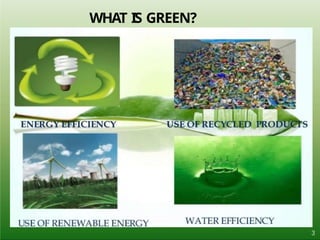
WHAT IS GREEN?
3
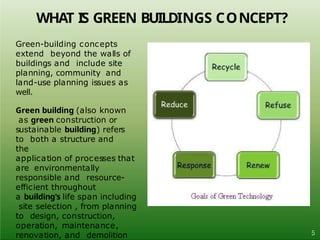
WHAT IS GREEN BUILDINGS CONCEPT?
Green-building concepts
extend beyond the walls of
buildings and include site
planning, community and
land-use planning issues as
well.
Green building (also known
as green construction or
sustainable building) refers
to both a structure and
the
application of processes that
are environmentally
responsible and resource-
efficient throughout
a building's life span including
site selection , from planning
to design, construction,
operation, maintenance,
renovation, and demolition 5
•Uses less water
•Optimizes energy efficiency
•Conserves natural resources
•Generates less waste and use efficient waste management
practices
•Provides comfortable, hygienic and healthier spac for occupants
compared to conventional buildings
• To maximize the reuse, recycling and utilization of renewable resources
• Imaximizes the use efficient building material and
construction practices
5
OBJECTIVES OF GREEN BUILDING
NEED FOR GREEN BUILDINGS
6
WHY DO WE NEED GREEN BUILDINGS?
7
Green buildings are designed in such a way to reduce overall
impact
on environment and human health by:
•Reducing trash,
•pollution and
• degradation of environment.
Efficiently using energy, water and other resources.
Protecting occupant health and improving productivity.
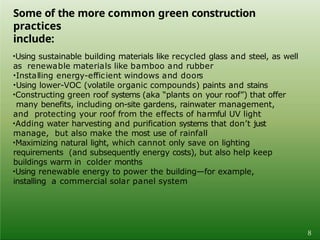
Some of the more common green construction
practices
include:
8
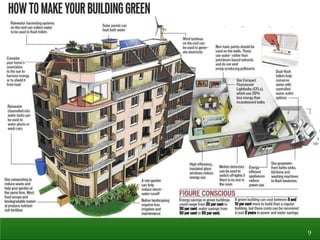
•Using sustainable building materials like recycled glass and steel, as well
as renewable materials like bamboo and rubber
•Installing energy-efficient windows and doors
•Using lower-VOC (volatile organic compounds) paints and stains
•Constructing green roof systems (aka “plants on your roof”) that offer
many benefits, including on-site gardens, rainwater management,
and protecting your roof from the effects of harmful UV light
•Adding water harvesting and purification systems that don’t just
manage, but also make the most use of rainfall
•Maximizing natural light, which cannot only save on lighting
requirements (and subsequently energy costs), but also help keep
buildings warm in colder months
•Using renewable energy to power the building—for example,
installing a commercial solar panel system
9
10
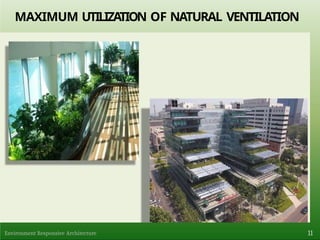
MAXIMUM UTILIZATION OF NATURAL VENTILATION
11
Environment Responsive Architecture
13
WHAT GREEN BUILDING TAUGHT US?
13
14
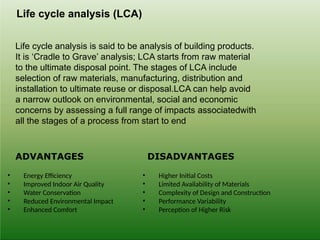
ADVANTAGES DISADVANTAGES
• Energy Efficiency
• Improved Indoor Air Quality
• Water Conservation
• Reduced Environmental Impact
• Enhanced Comfort
• Higher Initial Costs
• Limited Availability of Materials
• Complexity of Design and Construction
• Performance Variability
• Perception of Higher Risk
Life cycle analysis (LCA)
Life cycle analysis is said to be analysis of building products.
It is ‘Cradle to Grave’ analysis; LCA starts from raw material
to the ultimate disposal point. The stages of LCA include
selection of raw materials, manufacturing, distribution and
installation to ultimate reuse or disposal.LCA can help avoid
a narrow outlook on environmental, social and economic
concerns by assessing a full range of impacts associatedwith
all the stages of a process from start to end
GREEN BUILDING
RATING SYSTEM
16
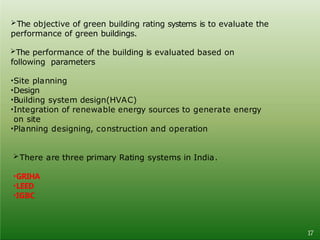
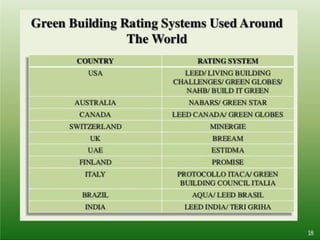
The objective of green building rating systems is to evaluate the
performance of green buildings.
The performance of the building is evaluated based on
following parameters
•Site planning
•Design
•Building system design(HVAC)
•Integration of renewable energy sources to generate energy
on site
•Planning designing, construction and operation
There are three primary Rating systems in India.
•GRIHA
•LEED
•IGBC
17
18
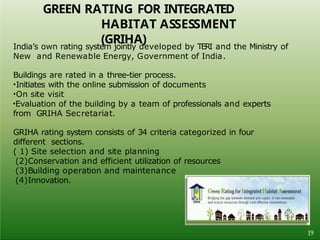
GREEN RATING FOR INTEGRATED
HABITAT ASSESSMENT
(GRIHA)
India’s own rating system jointly developed by TERI and the Ministry of
New and Renewable Energy, Government of India.
Buildings are rated in a three-tier process.
•Initiates with the online submission of documents
•On site visit
•Evaluation of the building by a team of professionals and experts
from GRIHA Secretariat.
GRIHA rating system consists of 34 criteria categorized in four
different sections.
( 1) Site selection and site planning
(2)Conservation and efficient utilization of resources
(3)Building operation and maintenance
(4)Innovation.
19
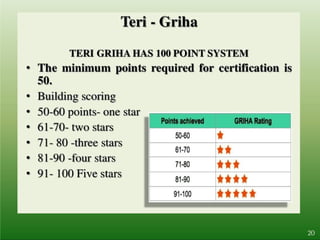
20
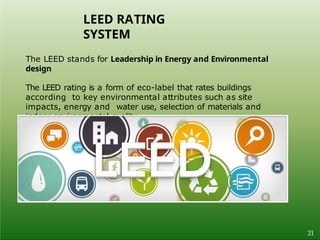
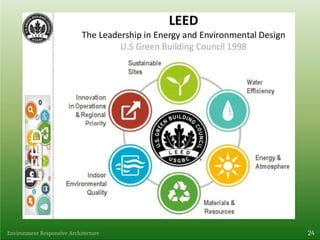
The LEED stands for Leadership in Energy and Environmental
design
The LEED rating is a form of eco-label that rates buildings
according to key environmental attributes such as site
impacts, energy and water use, selection of materials and
indoor environmental quality.
LEED RATING
SYSTEM
21
BREAKDOWN OF LEED
DESIGNATIONS
22
Environment Responsive Architecture
 LEED –NC for New Construction,commercial,institutional,and
high-rise residential buildings
 LEED-CS for Core and Shell (building envelope, mechanical,
electrical, plumbing systems)
 LEED-EB for existing buildings
 LEED-CI for commercial interiors
 LEED-H for Homes (single and multiunit)
 LEED for Schools
 LEED for Retail
LEED CERTIFICATION PROCEDURE
•Project registration
•Application
•Reviews
•Process
•Fees
•Certification award
•Appeals
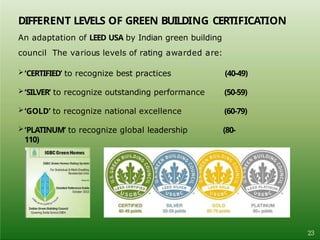
‘CERTIFIED’ to recognize best practices (40-49)
‘SILVER’ to recognize outstanding performance (50-59)
‘GOLD’ to recognize national excellence (60-79)
‘PLATINUM’ to recognize global leadership (80-
110)
DIFFERENT LEVELS OF GREEN BUILDING CERTIFICATION
An adaptation of LEED USA by Indian green building
council The various levels of rating awarded are:
23
24
Environment Responsive Architecture
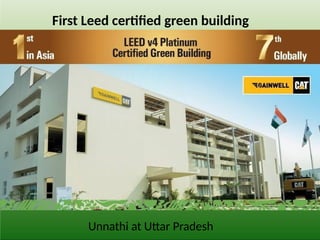
First Leed certified green building
Unnathi at Uttar Pradesh
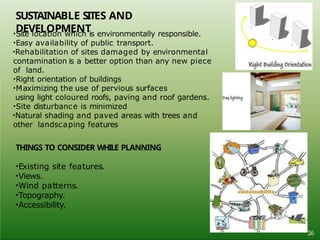
•Site location which is environmentally responsible.
•Easy availability of public transport.
•Rehabilitation of sites damaged by environmental
contamination is a better option than any new piece
of land.
•Right orientation of buildings
•Maximizing the use of pervious surfaces
using light coloured roofs, paving and roof gardens.
•Site disturbance is minimized
•Natural shading and paved areas with trees and
other landscaping features
THINGS TO CONSIDER WHILE PLANNING
•Existing site features.
•Views.
•Wind patterns.
•Topography.
•Accessibility.
SUSTAINABLE SITES AND
DEVELOPMENT
26
SUSTAINABLE SITE SELECTION
27
Environment Responsive Architecture
Development Density
-Is a previously developed site, in a Community with minimum density of 60,00 sft
per acre.
For schools, physical education areas (playfields, concession stands, etc) are
excluded from density calculations.
Community Connectivity
- Is a previously developed site, Within 1/2 mile of residential area with average
density of 10 units per acre
-Within 1/2 mile of 10 basic services of which 8 must be existing and others should
become operational within 1 year.
-Has pedestrian access between the building and the services
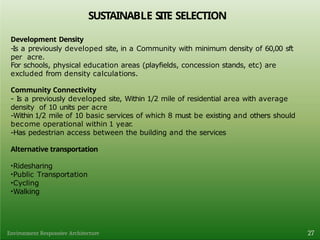
Alternative transportation
•Ridesharing
•Public Transportation
•Cycling
•Walking
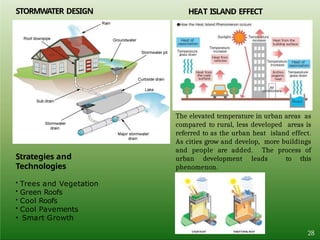
STORMWATER DESIGN HEAT ISLAND EFFECT
The elevated temperature in urban areas as
compared to rural, less developed areas is
referred to as the urban heat island effect.
As cities grow and develop, more buildings
and people are added. The process of
urban development leads to this
phenomenon.
Strategies and
Technologies
• Trees and Vegetation
• Green Roofs
• Cool Roofs
• Cool Pavements
• Smart Growth
28
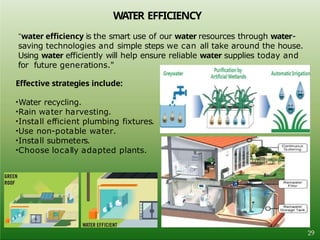
WATER EFFICIENCY
"water efficiency is the smart use of our water resources through water-
saving technologies and simple steps we can all take around the house.
Using water efficiently will help ensure reliable water supplies today and
for future generations."
Effective strategies include:
•Water recycling.
•Rain water harvesting.
•Install efficient plumbing fixtures.
•Use non-potable water.
•Install submeters.
•Choose locally adapted plants.
29
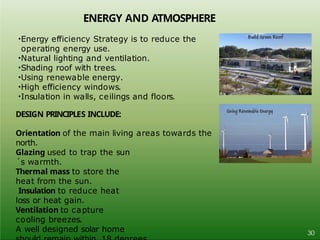
ENERGY AND ATMOSPHERE
•Energy efficiency Strategy is to reduce the
operating energy use.
•Natural lighting and ventilation.
•Shading roof with trees.
•Using renewable energy.
•High efficiency windows.
•Insulation in walls, ceilings and floors.
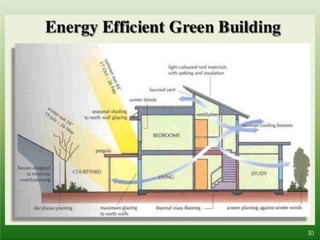
DESIGN PRINCIPLES INCLUDE:
Orientation of the main living areas towards the
north.
Glazing used to trap the sun
´s warmth.
Thermal mass to store the
heat from the sun.
Insulation to reduce heat
loss or heat gain.
Ventilation to capture
cooling breezes.
A well designed solar home 30
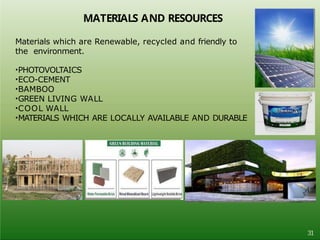
MATERIALS AND RESOURCES
Materials which are Renewable, recycled and friendly to
the environment.
•PHOTOVOLTAICS
•ECO-CEMENT
•BAMBOO
•GREEN LIVING WALL
•COOL WALL
•MATERIALS WHICH ARE LOCALLY AVAILABLE AND DURABLE
31
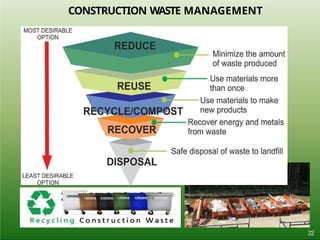
CONSTRUCTION WASTE MANAGEMENT
32
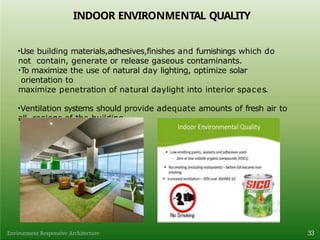
INDOOR ENVIRONMENTAL QUALITY
•Use building materials,adhesives,finishes and furnishings which do
not contain, generate or release gaseous contaminants.
•To maximize the use of natural day lighting, optimize solar
orientation to
maximize penetration of natural daylight into interior spaces.
•Ventilation systems should provide adequate amounts of fresh air to
all regions of the building.
33
Environment Responsive Architecture
REGIONAL
PRIORITY
34
To provide an incentive for the project teams to address
geographically specific environmental priorities.
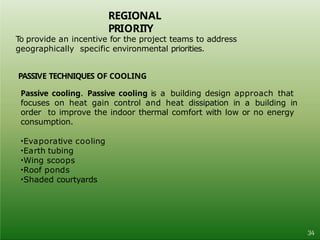
PASSIVE TECHNIQUES OF COOLING
Passive cooling. Passive cooling is a building design approach that
focuses on heat gain control and heat dissipation in a building in
order to improve the indoor thermal comfort with low or no energy
consumption.
•Evaporative cooling
•Earth tubing
•Wing scoops
•Roof ponds
•Shaded courtyards
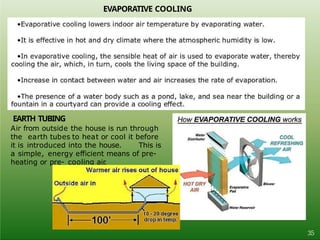
EARTH TUBING
Air from outside the house is run through
the earth tubes to heat or cool it before
it is introduced into the house. This is
a simple, energy efficient means of pre-
heating or pre- cooling air
.
EVAPORATIVE COOLING
35
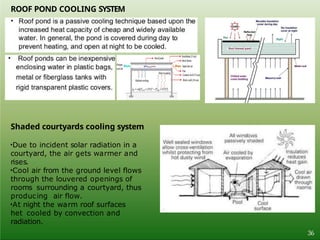
ROOF POND COOLING SYSTEM
Shaded courtyards cooling system
•Due to incident solar radiation in a
courtyard, the air gets warmer and
rises.
•Cool air from the ground level flows
through the louvered openings of
rooms surrounding a courtyard, thus
producing air flow.
•At night the warm roof surfaces
het cooled by convection and
radiation.
36
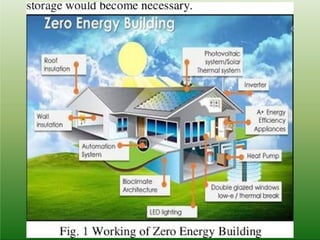
ZERO ENERGY BUILDING
CONCEPTS
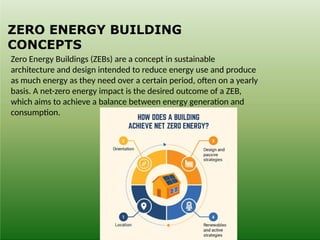
Zero Energy Buildings (ZEBs) are a concept in sustainable
architecture and design intended to reduce energy use and produce
as much energy as they need over a certain period, often on a yearly
basis. A net-zero energy impact is the desired outcome of a ZEB,
which aims to achieve a balance between energy generation and
consumption.
The energy demand is reduced in a zero energy building using a variety of
energy-efficient design techniques, and the residual energy requirements are
satisfied by on-site renewable energy generation. The structure is made to
be extremely energy-efficient by making use of passive design ideas,
cutting-edge building systems, and energy-saving technologies.
➢ To provide clean and sustainable energy on-site, renewable energy
technologies, such solar photovoltaic panels or wind turbines, are included
into the building design. These systems have a net-zero energy balance
because they create more energy than the building needs.
ZERO ENERGY BUILDING
CONCEPTS
Energy Efficiency: Energy efficiency is a top priority for ZEBs, and this is
demonstrated by a variety of features like excellent insulation, airtight
building envelopes, effective lighting systems, and energy-efficient
appliances. These architectural features minimise energy loss and lower the
building's overall energy requirement.
Passive Design: Using natural resources and climatic factors to ensure a
comfortable indoor environment is the emphasis of passive design
solutions. This entails carefully planning a building's orientation to make
the most of solar gain in the winter and the least amount possible in the
summer, maximising natural ventilation for cooling, and including shade
components to regulate solar heat gain.
Systems for Renewable Energy: ZEBs rely largely on renewable energy resources to meet their
energy needs. In order to produce heat and power, solar panels (photovoltaic or solar thermal) are
frequently utilised. Depending on the area and resources available, different renewable energy
sources such as wind turbines or geothermal systems can potentially be implemented.
❖ Energy Storage: To store extra energy produced during periods of peak
production, ZEBs frequently employ energy storage technologies like
batteries. When demand exceeds the capacity of the on-site generation
system or during periods of low production, this stored energy may be used.
❖ Advanced Building Controls: To reduce energy usage, ZEBs make use of
sophisticated building management systems and controls. These systems
maintain optimal effectiveness and occupant comfort by monitoring and
controlling numerous building operations like lighting, heating, cooling, and
ventilation.
❖ Life Cycle Assessment (LCA): ZEB design takes into account a building's
complete life cycle, including the energy embodied in the building's
materials, operation, and maintenance. Architects and engineers can reduce
the overall energy footprint by making decisions that minimise the
environmental impact at each stage.
Net Metering and Grid Interaction:ZEBs frequently have electrical grid
connections, enabling them to import energy when demand exceeds on-site
generation and export excess energy when they produce more than they
need. ZEBs can sustain a balanced energy budget over time.
❖ With less reliance on fossil fuels, zero energy buildings have the potential to drastically lower
greenhouse gas emissions, advance sustainability in the built environment, and more. They
participate in the larger drive towards a more sustainable and energy-efficient society and serve
as cutting-edge role
models for the future of construction.
BIO WASTE ZERO ENERGY BUILDING CONCEPTS
Bio waste from a building can be utilized in several ways to
contribute to the energy performance
of a zero energy building. Here are a few examples…
1. Anaerobic Digestion: Bio waste, such as food scraps and
organic materials, can be
processed through anaerobic digestion. This involves
breaking down the waste in an
oxygen-free environment to produce biogas, which can be
used as a renewable energy
source. Biogas can be burned to generate heat or converted
into electricity through
combined heat and power (CHP) systems.
2. Biomass Heating: Some types of bio waste, such as wood
waste or agricultural residues,
can be converted into biomass pellets or briquettes. These
can be used as a renewable fuel
source for heating purposes in boilers or stoves. Biomass
heating systems can provide
space heating, hot water, and even support radiant floor
heating in a zero energy building
Composting: Organic waste can be composted to produce nutrient-rich soil
amendments.
This compost can be used for landscaping, rooftop gardens, or urban
agriculture initiatives
associated with the zero energy building. By diverting organic waste from
landfills and
utilizing it for composting, the building reduces methane emissions and
fosters a sustainable
waste management system.
2. Biogas from Wastewater: Wastewater from the building, particularly
from kitchens and
bathrooms, can be treated through anaerobic digestion or other biological
processes to
produce biogas. Biogas can be used for heating, electricity generation, or
even as a fuel for
cooking in the building.
BIO WASTE ZERO ENERGY BUILDING CONCEPTS
3. Biofuel Production: In some cases, bio waste can be converted into
biofuels through
processes like pyrolysis or gasification. These technologies can transform
bio waste into
liquid or gaseous fuels that can be used for transportation or as a backup
energy source in
the zero energy building. It's important to note that the feasibility and
applicability
of utilizing bio waste for zero energy buildings may vary
depending on factors such as the quantity and type of
waste generated, available infrastructure, local
regulations, and specific project requirements. An
integrated waste management plan, incorporating waste
reduction, recycling, and appropriate treatment methods,
can maximize the potential of bio waste for energy
production in a zero energy building.
BIO WASTE ZERO ENERGY BUILDING CONCEPTS
ADVANTAGES
Energy Efficiency: Because ZEBs are so energy-efficiently made,
building
occupants use less energy and pay less for utilities.
2. Environmental Benefits: By reducing dependency on fossil
fuels for energy
production, ZEBs aid in lowering greenhouse gas emissions and
mitigating climate change.
3. Cost savings: Although the initial expenses of building a ZEB
may be higher than those of a conventional structure, the long-
term reductions in energyexpenditures
can more than make up for this. Furthermore, as renewable
energy technologies
become more affordable, ZEBs are probably going to become
more cost-effective.
4. Energy Independence: By generating their own electricity,
ZEBs with on-site
renewable energy generation can reach a certain level of energy
independence. In
the event of a power loss, this increases resilience and lessens
reliance on the
electrical grid.
5. Improved Indoor Comfort: ZEBs frequently employ passive
design principles that maximise natural lighting, ventilation, and
thermal comfort. This may result in more comfortable interior air
quality.
6. Positive Public Image: ZEBs have a favourable public
perception since they are
viewed as progressive and environmentally conscious. An
organization's or
company's reputation can be improved by building and running a
ZEB, which can
also advance sustainability objectives.
Higher Initial expenses: When compared to
conventional buildings, developing and erecting a ZEB
can have higher initial expenses. The combination of
energy-efficient technologies, renewable energy sources,
and sophisticated building controls is mostly to blame for
this.
2. Technical Difficulty: Developing and putting into place
the systems necessary for a ZEB can be challenging.
Integration of energy storage, sophisticated building
controls, and renewable energy sources necessitates
specialised knowledge and
experience, potentially increasing design and
construction complexity.
3. Site Appropriateness: The efficiency of renewable
energy systems, such as solar panels or wind turbines,
depends on the accessibility of appropriate resources. It's
possible that not all areas have the best circumstances
for producing renewable
energy, which can affect how efficiently a ZEB uses its
energy overall.
4. Maintenance and Monitoring: To ensure optimal
operation, ZEBs need routine monitoring and
maintenance. In order to maintain energy savings and
performance over the course of a building's life cycle,
proper maintenance of energy-efficient systems,
renewable energy technology, and controls is crucial.
5. Limited Scalability: Not all building types or sizes may
be suitable for designing
and constructing ZEBs. In large buildings with larger
energy demands or structures
with complicated operations and systems, it could be
harder to attain zero energy
performance
DISADVANTAGES
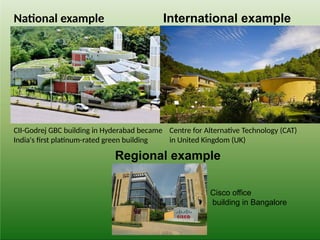
CII-Godrej GBC building in Hyderabad became
India's first platinum-rated green building
National example International example
Centre for Alternative Technology (CAT)
in United Kingdom (UK)
Regional example
Cisco office
building in Bangalore
46

green building mmbc 8.pptx green building

  • 1.
  • 2.
    •To preserve natural environmentaround the project site, while still being able to produce a building that is going to serve a purpose. •The construction and operation will promote a healthy environment for all involved. •Minimize the disruption of land, water, resources and energy in and around the building. WHAT IS A GREEN BUILDING? 2
  • 3.
  • 4.
    WHAT IS GREENBUILDINGS CONCEPT? Green-building concepts extend beyond the walls of buildings and include site planning, community and land-use planning issues as well. Green building (also known as green construction or sustainable building) refers to both a structure and the application of processes that are environmentally responsible and resource- efficient throughout a building's life span including site selection , from planning to design, construction, operation, maintenance, renovation, and demolition 5
  • 5.
    •Uses less water •Optimizesenergy efficiency •Conserves natural resources •Generates less waste and use efficient waste management practices •Provides comfortable, hygienic and healthier spac for occupants compared to conventional buildings • To maximize the reuse, recycling and utilization of renewable resources • Imaximizes the use efficient building material and construction practices 5 OBJECTIVES OF GREEN BUILDING
  • 6.
    NEED FOR GREENBUILDINGS 6
  • 7.
    WHY DO WENEED GREEN BUILDINGS? 7 Green buildings are designed in such a way to reduce overall impact on environment and human health by: •Reducing trash, •pollution and • degradation of environment. Efficiently using energy, water and other resources. Protecting occupant health and improving productivity.
  • 8.
    Some of themore common green construction practices include: 8 •Using sustainable building materials like recycled glass and steel, as well as renewable materials like bamboo and rubber •Installing energy-efficient windows and doors •Using lower-VOC (volatile organic compounds) paints and stains •Constructing green roof systems (aka “plants on your roof”) that offer many benefits, including on-site gardens, rainwater management, and protecting your roof from the effects of harmful UV light •Adding water harvesting and purification systems that don’t just manage, but also make the most use of rainfall •Maximizing natural light, which cannot only save on lighting requirements (and subsequently energy costs), but also help keep buildings warm in colder months •Using renewable energy to power the building—for example, installing a commercial solar panel system
  • 9.
  • 10.
  • 11.
    MAXIMUM UTILIZATION OFNATURAL VENTILATION 11 Environment Responsive Architecture
  • 12.
  • 13.
  • 14.
  • 15.
    ADVANTAGES DISADVANTAGES • EnergyEfficiency • Improved Indoor Air Quality • Water Conservation • Reduced Environmental Impact • Enhanced Comfort • Higher Initial Costs • Limited Availability of Materials • Complexity of Design and Construction • Performance Variability • Perception of Higher Risk Life cycle analysis (LCA) Life cycle analysis is said to be analysis of building products. It is ‘Cradle to Grave’ analysis; LCA starts from raw material to the ultimate disposal point. The stages of LCA include selection of raw materials, manufacturing, distribution and installation to ultimate reuse or disposal.LCA can help avoid a narrow outlook on environmental, social and economic concerns by assessing a full range of impacts associatedwith all the stages of a process from start to end
  • 16.
  • 17.
    The objective ofgreen building rating systems is to evaluate the performance of green buildings. The performance of the building is evaluated based on following parameters •Site planning •Design •Building system design(HVAC) •Integration of renewable energy sources to generate energy on site •Planning designing, construction and operation There are three primary Rating systems in India. •GRIHA •LEED •IGBC 17
  • 18.
  • 19.
    GREEN RATING FORINTEGRATED HABITAT ASSESSMENT (GRIHA) India’s own rating system jointly developed by TERI and the Ministry of New and Renewable Energy, Government of India. Buildings are rated in a three-tier process. •Initiates with the online submission of documents •On site visit •Evaluation of the building by a team of professionals and experts from GRIHA Secretariat. GRIHA rating system consists of 34 criteria categorized in four different sections. ( 1) Site selection and site planning (2)Conservation and efficient utilization of resources (3)Building operation and maintenance (4)Innovation. 19
  • 20.
  • 21.
    The LEED standsfor Leadership in Energy and Environmental design The LEED rating is a form of eco-label that rates buildings according to key environmental attributes such as site impacts, energy and water use, selection of materials and indoor environmental quality. LEED RATING SYSTEM 21
  • 22.
    BREAKDOWN OF LEED DESIGNATIONS 22 EnvironmentResponsive Architecture  LEED –NC for New Construction,commercial,institutional,and high-rise residential buildings  LEED-CS for Core and Shell (building envelope, mechanical, electrical, plumbing systems)  LEED-EB for existing buildings  LEED-CI for commercial interiors  LEED-H for Homes (single and multiunit)  LEED for Schools  LEED for Retail LEED CERTIFICATION PROCEDURE •Project registration •Application •Reviews •Process •Fees •Certification award •Appeals
  • 23.
    ‘CERTIFIED’ to recognizebest practices (40-49) ‘SILVER’ to recognize outstanding performance (50-59) ‘GOLD’ to recognize national excellence (60-79) ‘PLATINUM’ to recognize global leadership (80- 110) DIFFERENT LEVELS OF GREEN BUILDING CERTIFICATION An adaptation of LEED USA by Indian green building council The various levels of rating awarded are: 23
  • 24.
  • 25.
    First Leed certifiedgreen building Unnathi at Uttar Pradesh
  • 26.
    •Site location whichis environmentally responsible. •Easy availability of public transport. •Rehabilitation of sites damaged by environmental contamination is a better option than any new piece of land. •Right orientation of buildings •Maximizing the use of pervious surfaces using light coloured roofs, paving and roof gardens. •Site disturbance is minimized •Natural shading and paved areas with trees and other landscaping features THINGS TO CONSIDER WHILE PLANNING •Existing site features. •Views. •Wind patterns. •Topography. •Accessibility. SUSTAINABLE SITES AND DEVELOPMENT 26
  • 27.
    SUSTAINABLE SITE SELECTION 27 EnvironmentResponsive Architecture Development Density -Is a previously developed site, in a Community with minimum density of 60,00 sft per acre. For schools, physical education areas (playfields, concession stands, etc) are excluded from density calculations. Community Connectivity - Is a previously developed site, Within 1/2 mile of residential area with average density of 10 units per acre -Within 1/2 mile of 10 basic services of which 8 must be existing and others should become operational within 1 year. -Has pedestrian access between the building and the services Alternative transportation •Ridesharing •Public Transportation •Cycling •Walking
  • 28.
    STORMWATER DESIGN HEATISLAND EFFECT The elevated temperature in urban areas as compared to rural, less developed areas is referred to as the urban heat island effect. As cities grow and develop, more buildings and people are added. The process of urban development leads to this phenomenon. Strategies and Technologies • Trees and Vegetation • Green Roofs • Cool Roofs • Cool Pavements • Smart Growth 28
  • 29.
    WATER EFFICIENCY "water efficiencyis the smart use of our water resources through water- saving technologies and simple steps we can all take around the house. Using water efficiently will help ensure reliable water supplies today and for future generations." Effective strategies include: •Water recycling. •Rain water harvesting. •Install efficient plumbing fixtures. •Use non-potable water. •Install submeters. •Choose locally adapted plants. 29
  • 30.
    ENERGY AND ATMOSPHERE •Energyefficiency Strategy is to reduce the operating energy use. •Natural lighting and ventilation. •Shading roof with trees. •Using renewable energy. •High efficiency windows. •Insulation in walls, ceilings and floors. DESIGN PRINCIPLES INCLUDE: Orientation of the main living areas towards the north. Glazing used to trap the sun ´s warmth. Thermal mass to store the heat from the sun. Insulation to reduce heat loss or heat gain. Ventilation to capture cooling breezes. A well designed solar home 30
  • 31.
    MATERIALS AND RESOURCES Materialswhich are Renewable, recycled and friendly to the environment. •PHOTOVOLTAICS •ECO-CEMENT •BAMBOO •GREEN LIVING WALL •COOL WALL •MATERIALS WHICH ARE LOCALLY AVAILABLE AND DURABLE 31
  • 32.
  • 33.
    INDOOR ENVIRONMENTAL QUALITY •Usebuilding materials,adhesives,finishes and furnishings which do not contain, generate or release gaseous contaminants. •To maximize the use of natural day lighting, optimize solar orientation to maximize penetration of natural daylight into interior spaces. •Ventilation systems should provide adequate amounts of fresh air to all regions of the building. 33 Environment Responsive Architecture
  • 34.
    REGIONAL PRIORITY 34 To provide anincentive for the project teams to address geographically specific environmental priorities. PASSIVE TECHNIQUES OF COOLING Passive cooling. Passive cooling is a building design approach that focuses on heat gain control and heat dissipation in a building in order to improve the indoor thermal comfort with low or no energy consumption. •Evaporative cooling •Earth tubing •Wing scoops •Roof ponds •Shaded courtyards
  • 35.
    EARTH TUBING Air fromoutside the house is run through the earth tubes to heat or cool it before it is introduced into the house. This is a simple, energy efficient means of pre- heating or pre- cooling air . EVAPORATIVE COOLING 35
  • 36.
    ROOF POND COOLINGSYSTEM Shaded courtyards cooling system •Due to incident solar radiation in a courtyard, the air gets warmer and rises. •Cool air from the ground level flows through the louvered openings of rooms surrounding a courtyard, thus producing air flow. •At night the warm roof surfaces het cooled by convection and radiation. 36
  • 37.
    ZERO ENERGY BUILDING CONCEPTS ZeroEnergy Buildings (ZEBs) are a concept in sustainable architecture and design intended to reduce energy use and produce as much energy as they need over a certain period, often on a yearly basis. A net-zero energy impact is the desired outcome of a ZEB, which aims to achieve a balance between energy generation and consumption.
  • 38.
    The energy demandis reduced in a zero energy building using a variety of energy-efficient design techniques, and the residual energy requirements are satisfied by on-site renewable energy generation. The structure is made to be extremely energy-efficient by making use of passive design ideas, cutting-edge building systems, and energy-saving technologies. ➢ To provide clean and sustainable energy on-site, renewable energy technologies, such solar photovoltaic panels or wind turbines, are included into the building design. These systems have a net-zero energy balance because they create more energy than the building needs. ZERO ENERGY BUILDING CONCEPTS Energy Efficiency: Energy efficiency is a top priority for ZEBs, and this is demonstrated by a variety of features like excellent insulation, airtight building envelopes, effective lighting systems, and energy-efficient appliances. These architectural features minimise energy loss and lower the building's overall energy requirement. Passive Design: Using natural resources and climatic factors to ensure a comfortable indoor environment is the emphasis of passive design solutions. This entails carefully planning a building's orientation to make the most of solar gain in the winter and the least amount possible in the summer, maximising natural ventilation for cooling, and including shade components to regulate solar heat gain.
  • 40.
    Systems for RenewableEnergy: ZEBs rely largely on renewable energy resources to meet their energy needs. In order to produce heat and power, solar panels (photovoltaic or solar thermal) are frequently utilised. Depending on the area and resources available, different renewable energy sources such as wind turbines or geothermal systems can potentially be implemented. ❖ Energy Storage: To store extra energy produced during periods of peak production, ZEBs frequently employ energy storage technologies like batteries. When demand exceeds the capacity of the on-site generation system or during periods of low production, this stored energy may be used. ❖ Advanced Building Controls: To reduce energy usage, ZEBs make use of sophisticated building management systems and controls. These systems maintain optimal effectiveness and occupant comfort by monitoring and controlling numerous building operations like lighting, heating, cooling, and ventilation. ❖ Life Cycle Assessment (LCA): ZEB design takes into account a building's complete life cycle, including the energy embodied in the building's materials, operation, and maintenance. Architects and engineers can reduce the overall energy footprint by making decisions that minimise the environmental impact at each stage. Net Metering and Grid Interaction:ZEBs frequently have electrical grid connections, enabling them to import energy when demand exceeds on-site generation and export excess energy when they produce more than they need. ZEBs can sustain a balanced energy budget over time. ❖ With less reliance on fossil fuels, zero energy buildings have the potential to drastically lower greenhouse gas emissions, advance sustainability in the built environment, and more. They participate in the larger drive towards a more sustainable and energy-efficient society and serve as cutting-edge role models for the future of construction.
  • 41.
    BIO WASTE ZEROENERGY BUILDING CONCEPTS Bio waste from a building can be utilized in several ways to contribute to the energy performance of a zero energy building. Here are a few examples… 1. Anaerobic Digestion: Bio waste, such as food scraps and organic materials, can be processed through anaerobic digestion. This involves breaking down the waste in an oxygen-free environment to produce biogas, which can be used as a renewable energy source. Biogas can be burned to generate heat or converted into electricity through combined heat and power (CHP) systems. 2. Biomass Heating: Some types of bio waste, such as wood waste or agricultural residues, can be converted into biomass pellets or briquettes. These can be used as a renewable fuel source for heating purposes in boilers or stoves. Biomass heating systems can provide space heating, hot water, and even support radiant floor heating in a zero energy building
  • 42.
    Composting: Organic wastecan be composted to produce nutrient-rich soil amendments. This compost can be used for landscaping, rooftop gardens, or urban agriculture initiatives associated with the zero energy building. By diverting organic waste from landfills and utilizing it for composting, the building reduces methane emissions and fosters a sustainable waste management system. 2. Biogas from Wastewater: Wastewater from the building, particularly from kitchens and bathrooms, can be treated through anaerobic digestion or other biological processes to produce biogas. Biogas can be used for heating, electricity generation, or even as a fuel for cooking in the building. BIO WASTE ZERO ENERGY BUILDING CONCEPTS
  • 43.
    3. Biofuel Production:In some cases, bio waste can be converted into biofuels through processes like pyrolysis or gasification. These technologies can transform bio waste into liquid or gaseous fuels that can be used for transportation or as a backup energy source in the zero energy building. It's important to note that the feasibility and applicability of utilizing bio waste for zero energy buildings may vary depending on factors such as the quantity and type of waste generated, available infrastructure, local regulations, and specific project requirements. An integrated waste management plan, incorporating waste reduction, recycling, and appropriate treatment methods, can maximize the potential of bio waste for energy production in a zero energy building. BIO WASTE ZERO ENERGY BUILDING CONCEPTS
  • 44.
    ADVANTAGES Energy Efficiency: BecauseZEBs are so energy-efficiently made, building occupants use less energy and pay less for utilities. 2. Environmental Benefits: By reducing dependency on fossil fuels for energy production, ZEBs aid in lowering greenhouse gas emissions and mitigating climate change. 3. Cost savings: Although the initial expenses of building a ZEB may be higher than those of a conventional structure, the long- term reductions in energyexpenditures can more than make up for this. Furthermore, as renewable energy technologies become more affordable, ZEBs are probably going to become more cost-effective. 4. Energy Independence: By generating their own electricity, ZEBs with on-site renewable energy generation can reach a certain level of energy independence. In the event of a power loss, this increases resilience and lessens reliance on the electrical grid. 5. Improved Indoor Comfort: ZEBs frequently employ passive design principles that maximise natural lighting, ventilation, and thermal comfort. This may result in more comfortable interior air quality. 6. Positive Public Image: ZEBs have a favourable public perception since they are viewed as progressive and environmentally conscious. An organization's or company's reputation can be improved by building and running a ZEB, which can also advance sustainability objectives. Higher Initial expenses: When compared to conventional buildings, developing and erecting a ZEB can have higher initial expenses. The combination of energy-efficient technologies, renewable energy sources, and sophisticated building controls is mostly to blame for this. 2. Technical Difficulty: Developing and putting into place the systems necessary for a ZEB can be challenging. Integration of energy storage, sophisticated building controls, and renewable energy sources necessitates specialised knowledge and experience, potentially increasing design and construction complexity. 3. Site Appropriateness: The efficiency of renewable energy systems, such as solar panels or wind turbines, depends on the accessibility of appropriate resources. It's possible that not all areas have the best circumstances for producing renewable energy, which can affect how efficiently a ZEB uses its energy overall. 4. Maintenance and Monitoring: To ensure optimal operation, ZEBs need routine monitoring and maintenance. In order to maintain energy savings and performance over the course of a building's life cycle, proper maintenance of energy-efficient systems, renewable energy technology, and controls is crucial. 5. Limited Scalability: Not all building types or sizes may be suitable for designing and constructing ZEBs. In large buildings with larger energy demands or structures with complicated operations and systems, it could be harder to attain zero energy performance DISADVANTAGES
  • 45.
    CII-Godrej GBC buildingin Hyderabad became India's first platinum-rated green building National example International example Centre for Alternative Technology (CAT) in United Kingdom (UK) Regional example Cisco office building in Bangalore
  • 46.