BY
R.SOWMYA
M.Tech 1styr
131574
 What are passive solar buildings?
 Constructional Elements for residential buildings
 How does passive solar design use the sun’s power?
 How does it work?
 Systems involved
 Radiant panels
 Thermal storage walls
 Trombe walls
 Concrete walls
 Concrete block walls
 Water walls
 Material considerations
 Benefits
 Levels of application
 Conclusion
 Industrial and technological innovations, population growth,
and rapid urbanization lead to an increase in energy
consumption.
 Dependency on foreign sources of energy and their negative
environmental impact have made energy efficiency and
conservation critical issues.
 35–40% of our energy is consumed by buildings, and 85% of
that is need solely for heating.
 “In PASSIVE SOLAR BUILDINGS, windows, walls,
and floors are made to collect, store, and
distribute ’SOLAR ENERGY’ in the form of heat in
the winter and reject solar heat in the summer.
 Placement of room-types, internal doors
& walls, & equipment in the house.
 Orienting the building to face the equator.
 Extending the building dimension along
the east/west axis
 Adequately sizing windows to face the
midday sun in the winter, and be shaded
in the summer.
 Minimising windows on other sides,
especially western windows.
 Using thermal mass to store excess solar
energy during the winter day (which is
then re-radiated during the night).
Procedures for design of buildings to passively use solar energy
for heating buildings may typically involve:
 Use of shading devices to reduce heating by radiant (solar) energy
in the summer and allow it in winter,
 Utilize thermal convection (i.e. hot air rises) to maximize heating
by convection in winter, and
 Utilize thermal storage (mass-effect) to transfer excess heating
capacity from daylight to night time hours.
 Passive solar buildings are designed to let the heat into the
building during the winter months, and block out the sun
during hot summer days. This can be achieved by passive
solar design elements such as shading, implementing large
south-facing windows, and building materials that absorb and
slowly release the sun’s heat.
How does it work
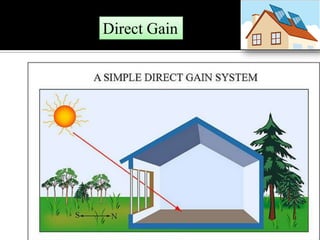
Direct Gain
Indirect Gain
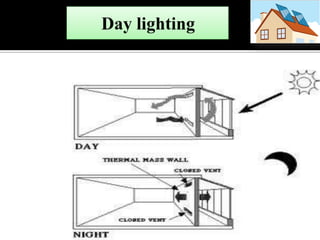
Day lighting
Direct Gain
Radiant panels are simple passive solar systems that are
inexpensive and well suited as retrofits to metal buildings.
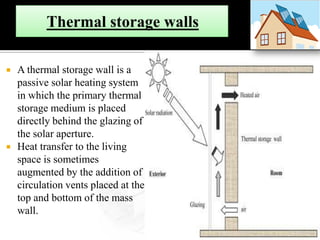
 A thermal storage wall is a
passive solar heating system
in which the primary thermal
storage medium is placed
directly behind the glazing of
the solar aperture.
 Heat transfer to the living
space is sometimes
augmented by the addition of
circulation vents placed at the
top and bottom of the mass
wall.
In summer
The density of the materials in
the Trombe wall acts as a
method of slow heat absorption
and transfer.
 In winter
 In the winter, when the sun is allowed
to shine on them, they can be
‘charged’ up to help to warm the
house by transferring the sun’s heat
inside.
 In the winter, when the surrounding
outside air temperature drops as the
air cools after the sun has gone down,
the object with thermal mass will
continue to release its stored heat
energy.
 When all the heat is discharged, it is
ready to once again ‘charge’ up or
absorb heat again.
Continued…
 Concrete block buildings are very common they may offer
opportunities for passive solar retrofits.
 Concrete floor slabs and massive partitions between zones help
prevent overheating and otherwise improve the performance of
concrete block thermal storage walls
 For new construction, superior performance of solid masonry walls
by filling the cores of the block in the thermal storage wall with
mortar as it is erected.
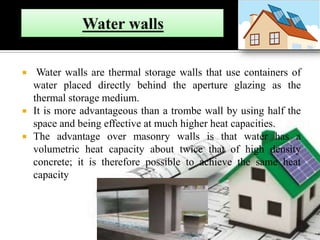
 Water walls are thermal storage walls that use containers of
water placed directly behind the aperture glazing as the
thermal storage medium.
 It is more advantageous than a trombe wall by using half the
space and being effective at much higher heat capacities.
 The advantage over masonry walls is that water has a
volumetric heat capacity about twice that of high density
concrete; it is therefore possible to achieve the same heat
capacity
 When designing energy-efficient buildings, it’s necessary to know
the solar heat gain of materials used on the structure’s exterior
 Glass and plastic blocks
 Patterned glazing
 Skylights
 Sunshades
 Roof structures
 Tubular daylighting devices
 Solar screens
 Electrochromic and photochromic glazings
 Translucent or solar-absorbent product.
Skylights are a simple way of introducing light to rooms right below roof level. Both
fixed and operable skylights are available.
Angled (splayed) walls broadcast the most light, and placing skylights near a wall
creates a pleasant light-washing effect on the wall surface.
. Skylights also can produce unexpected glare and uncomfortably warm indoor
temperatures unless they have shades. With this in mind, in most climates it is wise to
limit skylights to north roof slopes
 In terms of energy efficiency, glazing is a very
important element of the building envelope.
 Glazing transfers both radiant and conducted heat
 Daytime heat gain must be balanced against night
time heat loss when selecting glazing areas.
 Window frames can conduct heat. Use timber or
thermally separated metal window frames in cooler
climates.
 when outside temperatures are significantly higher or lower than
inside temperatures, heat pours through the weakest thermal link in
the building envelop .
 Insulated glazing helps in keeping the heat from passing through.
 heat gain must be balanced against night time heat loss when
selecting glazing areas.
 Lightweight prefabricated buildings have high levels of heat
transmission; they are very influenced by outdoor conditions.
Cooling in summer and heating in winter become less efficient and
consume more energy. The use of insulation materials is especially
beneficial in winter; they are not as efficient for summer.
Bright interiors and transmits
visible light:
 Transmits all the visible
light frequencies making
the home interiors brighter.
 Provides glare control in
bright, sunny climates.
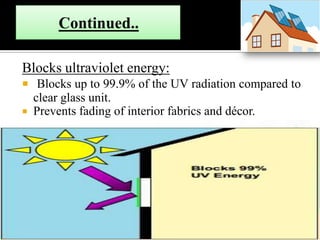
Blocks ultraviolet energy:
 Blocks up to 99.9% of the UV radiation compared to
clear glass unit.
 Prevents fading of interior fabrics and décor.
Cooler and comfortable in summer:
 Low SHGC numbers mean less summer heat.
 Keeps interior cooler and comfortable.
 Helps to reduce cooling energy costs.
Warmer in winter:
 Low-e-characteristics reflects furnace hear back into the room
and provides low u-value insulation properties.
 Reduces furnace heat loss
 Helps to reduce heating energy costs.
Pragmatic
Annualized
Minimum machinery
Zero energy building
List of pioneering solar buildings
 Rosenberg House, Tucson, Arizona,
 MIT Solar House #1, Massachusetts, USA
 Howard Sloan House, Glenview, Illinois, USA
 Rose Elementary School, Tucson, Arizona, USA
 University of Toronto House, Toronto, Canada
 New Mexico State College House, New Mexico.
 They can perform effortlessly and quietly without
mechanical or electrical assistance.
 Reductions can be made to heating bills by as much as
40% annually, and also improve the comfort of living
spaces.
 Simple techniques can make a huge difference in the
comfort and energy consumption through the years.
 The economical solution to a warmer house in the
winter and a cooler house in the summer is to insulate it
well, while understanding the movement of heat.
it is the better solution.
 http://en.wikipedia.org/wiki/Passive_solar_building_design.
 "U.S. Department of Energy - Energy Efficiency and Renewable Energy -
Passive Solar Building Design". Retrieved 2011-03-27
 http://www.srrb.noaa.gov/highlights/sunrise/fig5_90n.gif
 Your Home - Insulation
 "BERC – Air tightness". Ornl.gov. 2004-05-26. Retrieved 2010-03-16.
 Your Home - Passive Cooling.
 Passive Solar Design (PDF 233 KB). (December 2000). DOE/GO102000-
0790. Work Performed by the NAHB Research Centre, South face Ene.
 www.PassiveSolarEnergy.info - Passive Solar Energy Technology
Overview
Passive solar buildings

Passive solar buildings

  • 1.
  • 2.
     What arepassive solar buildings?  Constructional Elements for residential buildings  How does passive solar design use the sun’s power?  How does it work?  Systems involved  Radiant panels  Thermal storage walls  Trombe walls  Concrete walls  Concrete block walls  Water walls  Material considerations  Benefits  Levels of application  Conclusion
  • 3.
     Industrial andtechnological innovations, population growth, and rapid urbanization lead to an increase in energy consumption.  Dependency on foreign sources of energy and their negative environmental impact have made energy efficiency and conservation critical issues.  35–40% of our energy is consumed by buildings, and 85% of that is need solely for heating.
  • 4.
     “In PASSIVESOLAR BUILDINGS, windows, walls, and floors are made to collect, store, and distribute ’SOLAR ENERGY’ in the form of heat in the winter and reject solar heat in the summer.
  • 5.
     Placement ofroom-types, internal doors & walls, & equipment in the house.  Orienting the building to face the equator.  Extending the building dimension along the east/west axis  Adequately sizing windows to face the midday sun in the winter, and be shaded in the summer.  Minimising windows on other sides, especially western windows.  Using thermal mass to store excess solar energy during the winter day (which is then re-radiated during the night).
  • 6.
    Procedures for designof buildings to passively use solar energy for heating buildings may typically involve:  Use of shading devices to reduce heating by radiant (solar) energy in the summer and allow it in winter,  Utilize thermal convection (i.e. hot air rises) to maximize heating by convection in winter, and  Utilize thermal storage (mass-effect) to transfer excess heating capacity from daylight to night time hours.
  • 7.
     Passive solarbuildings are designed to let the heat into the building during the winter months, and block out the sun during hot summer days. This can be achieved by passive solar design elements such as shading, implementing large south-facing windows, and building materials that absorb and slowly release the sun’s heat. How does it work
  • 8.
  • 9.
  • 12.
    Radiant panels aresimple passive solar systems that are inexpensive and well suited as retrofits to metal buildings.
  • 13.
     A thermalstorage wall is a passive solar heating system in which the primary thermal storage medium is placed directly behind the glazing of the solar aperture.  Heat transfer to the living space is sometimes augmented by the addition of circulation vents placed at the top and bottom of the mass wall.
  • 14.
    In summer The densityof the materials in the Trombe wall acts as a method of slow heat absorption and transfer.
  • 15.
     In winter In the winter, when the sun is allowed to shine on them, they can be ‘charged’ up to help to warm the house by transferring the sun’s heat inside.  In the winter, when the surrounding outside air temperature drops as the air cools after the sun has gone down, the object with thermal mass will continue to release its stored heat energy.  When all the heat is discharged, it is ready to once again ‘charge’ up or absorb heat again. Continued…
  • 16.
     Concrete blockbuildings are very common they may offer opportunities for passive solar retrofits.  Concrete floor slabs and massive partitions between zones help prevent overheating and otherwise improve the performance of concrete block thermal storage walls  For new construction, superior performance of solid masonry walls by filling the cores of the block in the thermal storage wall with mortar as it is erected.
  • 17.
     Water wallsare thermal storage walls that use containers of water placed directly behind the aperture glazing as the thermal storage medium.  It is more advantageous than a trombe wall by using half the space and being effective at much higher heat capacities.  The advantage over masonry walls is that water has a volumetric heat capacity about twice that of high density concrete; it is therefore possible to achieve the same heat capacity
  • 18.
     When designingenergy-efficient buildings, it’s necessary to know the solar heat gain of materials used on the structure’s exterior  Glass and plastic blocks  Patterned glazing  Skylights  Sunshades  Roof structures  Tubular daylighting devices  Solar screens  Electrochromic and photochromic glazings  Translucent or solar-absorbent product.
  • 19.
    Skylights are asimple way of introducing light to rooms right below roof level. Both fixed and operable skylights are available. Angled (splayed) walls broadcast the most light, and placing skylights near a wall creates a pleasant light-washing effect on the wall surface. . Skylights also can produce unexpected glare and uncomfortably warm indoor temperatures unless they have shades. With this in mind, in most climates it is wise to limit skylights to north roof slopes
  • 20.
     In termsof energy efficiency, glazing is a very important element of the building envelope.  Glazing transfers both radiant and conducted heat  Daytime heat gain must be balanced against night time heat loss when selecting glazing areas.  Window frames can conduct heat. Use timber or thermally separated metal window frames in cooler climates.
  • 21.
     when outsidetemperatures are significantly higher or lower than inside temperatures, heat pours through the weakest thermal link in the building envelop .  Insulated glazing helps in keeping the heat from passing through.  heat gain must be balanced against night time heat loss when selecting glazing areas.  Lightweight prefabricated buildings have high levels of heat transmission; they are very influenced by outdoor conditions. Cooling in summer and heating in winter become less efficient and consume more energy. The use of insulation materials is especially beneficial in winter; they are not as efficient for summer.
  • 22.
    Bright interiors andtransmits visible light:  Transmits all the visible light frequencies making the home interiors brighter.  Provides glare control in bright, sunny climates.
  • 23.
    Blocks ultraviolet energy: Blocks up to 99.9% of the UV radiation compared to clear glass unit.  Prevents fading of interior fabrics and décor.
  • 24.
    Cooler and comfortablein summer:  Low SHGC numbers mean less summer heat.  Keeps interior cooler and comfortable.  Helps to reduce cooling energy costs.
  • 25.
    Warmer in winter: Low-e-characteristics reflects furnace hear back into the room and provides low u-value insulation properties.  Reduces furnace heat loss  Helps to reduce heating energy costs.
  • 26.
  • 27.
    List of pioneeringsolar buildings  Rosenberg House, Tucson, Arizona,  MIT Solar House #1, Massachusetts, USA  Howard Sloan House, Glenview, Illinois, USA  Rose Elementary School, Tucson, Arizona, USA  University of Toronto House, Toronto, Canada  New Mexico State College House, New Mexico.
  • 28.
     They canperform effortlessly and quietly without mechanical or electrical assistance.  Reductions can be made to heating bills by as much as 40% annually, and also improve the comfort of living spaces.  Simple techniques can make a huge difference in the comfort and energy consumption through the years.  The economical solution to a warmer house in the winter and a cooler house in the summer is to insulate it well, while understanding the movement of heat. it is the better solution.
  • 29.
     http://en.wikipedia.org/wiki/Passive_solar_building_design.  "U.S.Department of Energy - Energy Efficiency and Renewable Energy - Passive Solar Building Design". Retrieved 2011-03-27  http://www.srrb.noaa.gov/highlights/sunrise/fig5_90n.gif  Your Home - Insulation  "BERC – Air tightness". Ornl.gov. 2004-05-26. Retrieved 2010-03-16.  Your Home - Passive Cooling.  Passive Solar Design (PDF 233 KB). (December 2000). DOE/GO102000- 0790. Work Performed by the NAHB Research Centre, South face Ene.  www.PassiveSolarEnergy.info - Passive Solar Energy Technology Overview