LOW COST
HOUSING
 Low Cost housing means the total
construction cost of houses (buildings)
is minimum (low) by using proper
materials, methods, techniques ,etc.
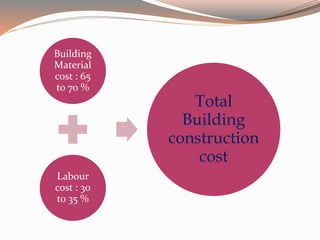
The building construction cost
can be divided into two parts
namely:
1) Building material cost
2) Labour cost
Building
Material
cost : 65
to 70 %
Labour
cost : 30
to 35 %
Total
Building
construction
cost
CONCEPT OF LOW COST
HOUSING
Low Cost Housing Aims to reduce the
cost of construction and at the same
time do not sacrifice any element of
safety or serviceability of the house
over the life cycle.
 In low cost housing, building material
cost is reduced because we make use of the
locally available & low cost materials.

 Also the labour cost can be reduced by
properly making the time schedule of our
work.
 Cost reduction is achieved by selection
of more efficient material or by an improved
design.
FACTORS AFFECTING HIGH
BUILDING COSTS
 Expensive materials
 Lack of necessary building skills
 Lack of guidelines in selection of appropriate
building practices
• Designs
• Materials
• Methods
• equipment
Various aspects for cost reduction
 Optimization of land use
 Functional design of buildings
 Optimum use of building materials
 Rationalization of specifications
 New construction materials and techniques
Factors affecting Choice of Materials
and Technologies
• Scale (Quantity) of construction
• Availability of skilled labour
• Availability/suitability of raw materials
• Cost variation with conventional materials
• Assortment based on geo-climatic conditions
• Environmental aspects
• Disaster-resistant requirements
• Acceptability by people
Technology Selection Criteria
• Saving in cost, initial as well as recurring.
• Saving in consumption of imported or scare
materials, even if no saving in cost is achieved.
• Saving in time of construction.
• Utilization of waste materials even if no saving is
achieved.
Technology Selection Criteria
• Saving in quantum of skilled labour even if no
saving in cost is achieved.
• Achieving better utilization of equipment but not
necessary leading to optimum saving in cost.
• Better utilization of space.
• Better layout for economy in external services
USE OF
WASTE
PRODUCTS
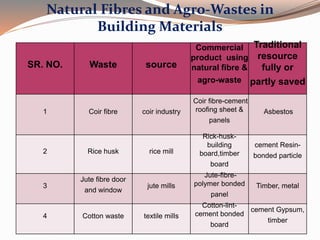
Natural Fibres and Agro-Wastes in
Building Materials
SR. NO. Waste source
Commercial
product using
natural fibre &
agro-waste
Traditional
resource
fully or
partly saved
1 Coir fibre coir industry
Coir fibre-cement
roofing sheet &
panels
Asbestos
2 Rice husk rice mill
Rick-husk-
building
board,timber
board
cement Resin-
bonded particle
3
Jute fibre door
and window
jute mills
Jute-fibre-
polymer bonded
panel
Timber, metal
4 Cotton waste textile mills
Cotton-lint-
cement bonded
board
cement Gypsum,
timber
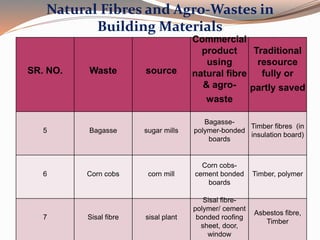
Natural Fibres and Agro-Wastes in
Building Materials
SR. NO. Waste source
Commercial
product
using
natural fibre
& agro-
waste
Traditional
resource
fully or
partly saved
5 Bagasse sugar mills
Bagasse-
polymer-bonded
boards
Timber fibres (in
insulation board)
6 Corn cobs corn mill
Corn cobs-
cement bonded
boards
Timber, polymer
7 Sisal fibre sisal plant
Sisal fibre-
polymer/ cement
bonded roofing
sheet, door,
window
Asbestos fibre,
Timber
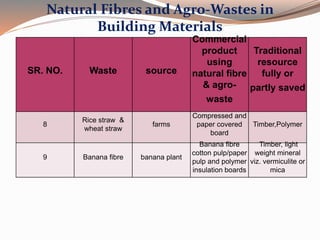
Natural Fibres and Agro-Wastes in
Building Materials
SR. NO. Waste source
Commercial
product
using
natural fibre
& agro-
waste
Traditional
resource
fully or
partly saved
8
Rice straw &
wheat straw
farms
Compressed and
paper covered
board
Timber,Polymer
9 Banana fibre banana plant
Banana fibre
cotton pulp/paper
pulp and polymer
insulation boards
Timber, light
weight mineral
viz. vermiculite or
mica
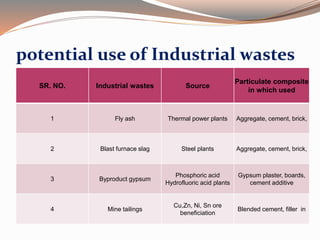
potential use of Industrial wastes
SR. NO. Industrial wastes Source
Particulate composite
in which used
1 Fly ash Thermal power plants Aggregate, cement, brick,
2 Blast furnace slag Steel plants Aggregate, cement, brick,
3 Byproduct gypsum
Phosphoric acid
Hydrofluoric acid plants
Gypsum plaster, boards,
cement additive
4 Mine tailings
Cu,Zn, Ni, Sn ore
beneficiation
Blended cement, filler in
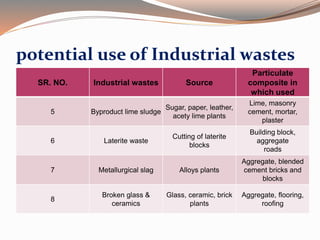
potential use of Industrial wastes
SR. NO. Industrial wastes Source
Particulate
composite in
which used
5 Byproduct lime sludge
Sugar, paper, leather,
acety lime plants
Lime, masonry
cement, mortar,
plaster
6 Laterite waste
Cutting of laterite
blocks
Building block,
aggregate
roads
7 Metallurgical slag Alloys plants
Aggregate, blended
cement bricks and
blocks
8
Broken glass &
ceramics
Glass, ceramic, brick
plants
Aggregate, flooring,
roofing
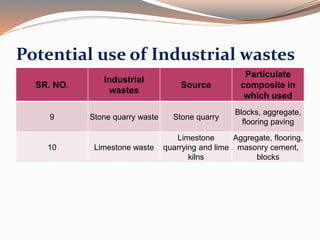
Potential use of Industrial wastes
SR. NO.
Industrial
wastes
Source
Particulate
composite in
which used
9 Stone quarry waste Stone quarry
Blocks, aggregate,
flooring paving
10 Limestone waste
Limestone
quarrying and lime
kilns
Aggregate, flooring,
masonry cement,
blocks
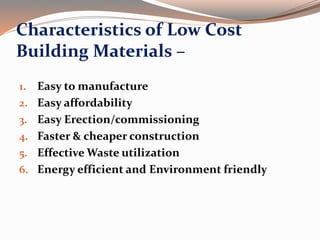
Characteristics of Low Cost
Building Materials –
1. Easy to manufacture
2. Easy affordability
3. Easy Erection/commissioning
4. Faster & cheaper construction
5. Effective Waste utilization
6. Energy efficient and Environment friendly
BUILDING MATERIALS
• Calcium Silicate Bricks
• Fly ash–Lime Bricks
• Clay–Fly ash Bricks
• Clay Flooring Tiles
• Burnt Clay Flat Terracing Tiles
• Fibrous Gypsum Plaster Boards
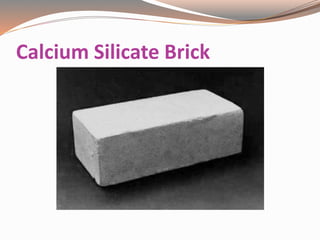
Calcium Silicate Brick
BUILDING COMPONENTS
• Precast Solid Cement Concrete Blocks
• Precast Concrete Stone Masonry Blocks
• Hollow & Solid Light Weight Concrete
Masonry Units
• Precast Reinforced Concrete Door and
Window Frames
• Ferrocement Door Shutters
• Ferrocement Roofing Channels
• Precast Ferrocement Water Tanks
• Precast Concrete Manhole Covers & Frames
• Bamboo Mat Corrugated Roofing Sheets
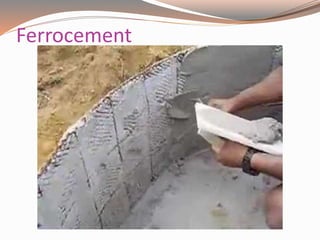
Ferrocement
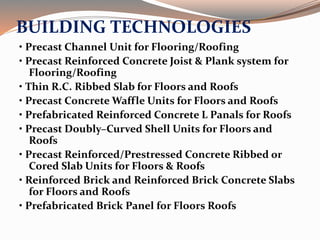
BUILDING TECHNOLOGIES
• Precast Channel Unit for Flooring/Roofing
• Precast Reinforced Concrete Joist & Plank system for
Flooring/Roofing
• Thin R.C. Ribbed Slab for Floors and Roofs
• Precast Concrete Waffle Units for Floors and Roofs
• Prefabricated Reinforced Concrete L Panals for Roofs
• Precast Doubly–Curved Shell Units for Floors and
Roofs
• Precast Reinforced/Prestressed Concrete Ribbed or
Cored Slab Units for Floors & Roofs
• Reinforced Brick and Reinforced Brick Concrete Slabs
for Floors and Roofs
• Prefabricated Brick Panel for Floors Roofs
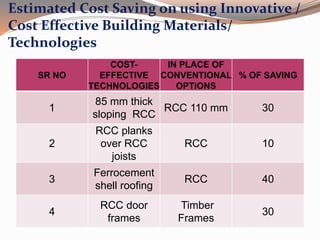
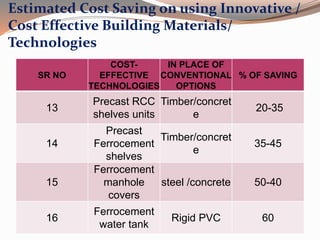
Estimated Cost Saving on using Innovative /
Cost Effective Building Materials/
Technologies
SR NO
COST-
EFFECTIVE
TECHNOLOGIES
IN PLACE OF
CONVENTIONAL
OPTIONS
% OF SAVING
1
85 mm thick
sloping RCC
RCC 110 mm 30
2
RCC planks
over RCC
joists
RCC 10
3
Ferrocement
shell roofing
RCC 40
4
RCC door
frames
Timber
Frames
30
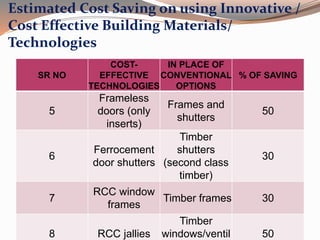
Estimated Cost Saving on using Innovative /
Cost Effective Building Materials/
Technologies
SR NO
COST-
EFFECTIVE
TECHNOLOGIES
IN PLACE OF
CONVENTIONAL
OPTIONS
% OF SAVING
5
Frameless
doors (only
inserts)
Frames and
shutters
50
6
Ferrocement
door shutters
Timber
shutters
(second class
timber)
30
7
RCC window
frames
Timber frames 30
8 RCC jallies
Timber
windows/ventil 50
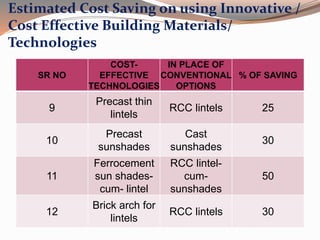
Estimated Cost Saving on using Innovative /
Cost Effective Building Materials/
Technologies
SR NO
COST-
EFFECTIVE
TECHNOLOGIES
IN PLACE OF
CONVENTIONAL
OPTIONS
% OF SAVING
9
Precast thin
lintels
RCC lintels 25
10
Precast
sunshades
Cast
sunshades
30
11
Ferrocement
sun shades-
cum- lintel
RCC lintel-
cum-
sunshades
50
12
Brick arch for
lintels
RCC lintels 30
Estimated Cost Saving on using Innovative /
Cost Effective Building Materials/
Technologies
SR NO
COST-
EFFECTIVE
TECHNOLOGIES
IN PLACE OF
CONVENTIONAL
OPTIONS
% OF SAVING
13
Precast RCC
shelves units
Timber/concret
e
20-35
14
Precast
Ferrocement
shelves
Timber/concret
e
35-45
15
Ferrocement
manhole
covers
steel /concrete 50-40
16
Ferrocement
water tank
Rigid PVC 60
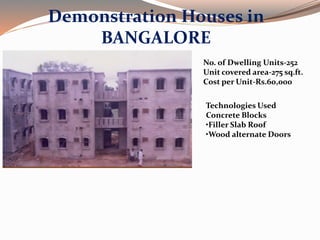
Demonstration Houses in
BANGALORE
No. of Dwelling Units-252
Unit covered area-275 sq.ft.
Cost per Unit-Rs.60,000
Technologies Used
Concrete Blocks
•Filler Slab Roof
•Wood alternate Doors
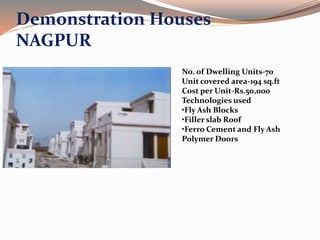
Demonstration Houses
NAGPUR
No. of Dwelling Units-70
Unit covered area-194 sq.ft
Cost per Unit-Rs.50,000
Technologies used
•Fly Ash Blocks
•Filler slab Roof
•Ferro Cement and Fly Ash
Polymer Doors
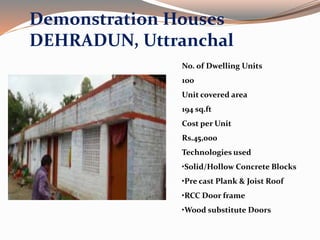
Demonstration Houses
DEHRADUN, Uttranchal
No. of Dwelling Units
100
Unit covered area
194 sq.ft
Cost per Unit
Rs.45,000
Technologies used
•Solid/Hollow Concrete Blocks
•Pre cast Plank & Joist Roof
•RCC Door frame
•Wood substitute Doors
Demonstration Houses
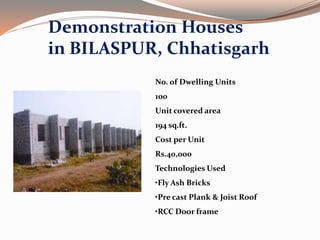
in BILASPUR, Chhatisgarh
No. of Dwelling Units
100
Unit covered area
194 sq.ft.
Cost per Unit
Rs.40,000
Technologies Used
•Fly Ash Bricks
•Pre cast Plank & Joist Roof
•RCC Door frame
Demonstration Houses
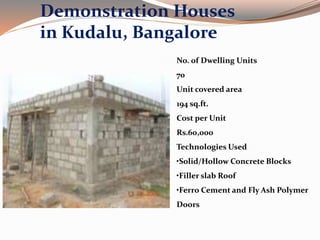
in Kudalu, Bangalore
No. of Dwelling Units
70
Unit covered area
194 sq.ft.
Cost per Unit
Rs.60,000
Technologies Used
•Solid/Hollow Concrete Blocks
•Filler slab Roof
•Ferro Cement and Fly Ash Polymer
Doors
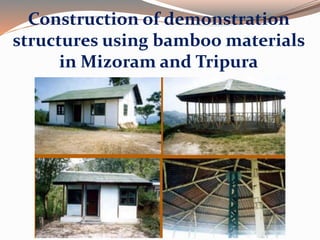
Construction of demonstration
structures using bamboo materials
in Mizoram and Tripura
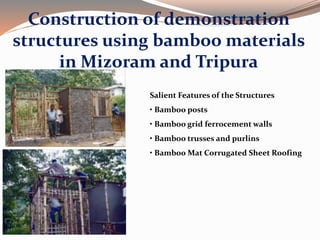
Construction of demonstration
structures using bamboo materials
in Mizoram and Tripura
Salient Features of the Structures
• Bamboo posts
• Bamboo grid ferrocement walls
• Bamboo trusses and purlins
• Bamboo Mat Corrugated Sheet Roofing
References
 http://www.engineeringcivil.com/low-cost-
housing.html
 http://slideplayer.com
 http://www.bmtpc.org/
THANK YOU!

Low cost housing

  • 1.
  • 2.
     Low Costhousing means the total construction cost of houses (buildings) is minimum (low) by using proper materials, methods, techniques ,etc.
  • 3.
    The building constructioncost can be divided into two parts namely: 1) Building material cost 2) Labour cost
  • 4.
    Building Material cost : 65 to70 % Labour cost : 30 to 35 % Total Building construction cost
  • 5.
    CONCEPT OF LOWCOST HOUSING Low Cost Housing Aims to reduce the cost of construction and at the same time do not sacrifice any element of safety or serviceability of the house over the life cycle.
  • 6.
     In lowcost housing, building material cost is reduced because we make use of the locally available & low cost materials.  Also the labour cost can be reduced by properly making the time schedule of our work.  Cost reduction is achieved by selection of more efficient material or by an improved design.
  • 7.
    FACTORS AFFECTING HIGH BUILDINGCOSTS  Expensive materials  Lack of necessary building skills  Lack of guidelines in selection of appropriate building practices • Designs • Materials • Methods • equipment
  • 8.
    Various aspects forcost reduction  Optimization of land use  Functional design of buildings  Optimum use of building materials  Rationalization of specifications  New construction materials and techniques
  • 9.
    Factors affecting Choiceof Materials and Technologies • Scale (Quantity) of construction • Availability of skilled labour • Availability/suitability of raw materials • Cost variation with conventional materials • Assortment based on geo-climatic conditions • Environmental aspects • Disaster-resistant requirements • Acceptability by people
  • 10.
    Technology Selection Criteria •Saving in cost, initial as well as recurring. • Saving in consumption of imported or scare materials, even if no saving in cost is achieved. • Saving in time of construction. • Utilization of waste materials even if no saving is achieved.
  • 11.
    Technology Selection Criteria •Saving in quantum of skilled labour even if no saving in cost is achieved. • Achieving better utilization of equipment but not necessary leading to optimum saving in cost. • Better utilization of space. • Better layout for economy in external services
  • 12.
  • 13.
    Natural Fibres andAgro-Wastes in Building Materials SR. NO. Waste source Commercial product using natural fibre & agro-waste Traditional resource fully or partly saved 1 Coir fibre coir industry Coir fibre-cement roofing sheet & panels Asbestos 2 Rice husk rice mill Rick-husk- building board,timber board cement Resin- bonded particle 3 Jute fibre door and window jute mills Jute-fibre- polymer bonded panel Timber, metal 4 Cotton waste textile mills Cotton-lint- cement bonded board cement Gypsum, timber
  • 14.
    Natural Fibres andAgro-Wastes in Building Materials SR. NO. Waste source Commercial product using natural fibre & agro- waste Traditional resource fully or partly saved 5 Bagasse sugar mills Bagasse- polymer-bonded boards Timber fibres (in insulation board) 6 Corn cobs corn mill Corn cobs- cement bonded boards Timber, polymer 7 Sisal fibre sisal plant Sisal fibre- polymer/ cement bonded roofing sheet, door, window Asbestos fibre, Timber
  • 15.
    Natural Fibres andAgro-Wastes in Building Materials SR. NO. Waste source Commercial product using natural fibre & agro- waste Traditional resource fully or partly saved 8 Rice straw & wheat straw farms Compressed and paper covered board Timber,Polymer 9 Banana fibre banana plant Banana fibre cotton pulp/paper pulp and polymer insulation boards Timber, light weight mineral viz. vermiculite or mica
  • 16.
    potential use ofIndustrial wastes SR. NO. Industrial wastes Source Particulate composite in which used 1 Fly ash Thermal power plants Aggregate, cement, brick, 2 Blast furnace slag Steel plants Aggregate, cement, brick, 3 Byproduct gypsum Phosphoric acid Hydrofluoric acid plants Gypsum plaster, boards, cement additive 4 Mine tailings Cu,Zn, Ni, Sn ore beneficiation Blended cement, filler in
  • 17.
    potential use ofIndustrial wastes SR. NO. Industrial wastes Source Particulate composite in which used 5 Byproduct lime sludge Sugar, paper, leather, acety lime plants Lime, masonry cement, mortar, plaster 6 Laterite waste Cutting of laterite blocks Building block, aggregate roads 7 Metallurgical slag Alloys plants Aggregate, blended cement bricks and blocks 8 Broken glass & ceramics Glass, ceramic, brick plants Aggregate, flooring, roofing
  • 18.
    Potential use ofIndustrial wastes SR. NO. Industrial wastes Source Particulate composite in which used 9 Stone quarry waste Stone quarry Blocks, aggregate, flooring paving 10 Limestone waste Limestone quarrying and lime kilns Aggregate, flooring, masonry cement, blocks
  • 19.
    Characteristics of LowCost Building Materials – 1. Easy to manufacture 2. Easy affordability 3. Easy Erection/commissioning 4. Faster & cheaper construction 5. Effective Waste utilization 6. Energy efficient and Environment friendly
  • 20.
    BUILDING MATERIALS • CalciumSilicate Bricks • Fly ash–Lime Bricks • Clay–Fly ash Bricks • Clay Flooring Tiles • Burnt Clay Flat Terracing Tiles • Fibrous Gypsum Plaster Boards
  • 21.
  • 22.
    BUILDING COMPONENTS • PrecastSolid Cement Concrete Blocks • Precast Concrete Stone Masonry Blocks • Hollow & Solid Light Weight Concrete Masonry Units • Precast Reinforced Concrete Door and Window Frames • Ferrocement Door Shutters • Ferrocement Roofing Channels • Precast Ferrocement Water Tanks • Precast Concrete Manhole Covers & Frames • Bamboo Mat Corrugated Roofing Sheets
  • 23.
  • 24.
    BUILDING TECHNOLOGIES • PrecastChannel Unit for Flooring/Roofing • Precast Reinforced Concrete Joist & Plank system for Flooring/Roofing • Thin R.C. Ribbed Slab for Floors and Roofs • Precast Concrete Waffle Units for Floors and Roofs • Prefabricated Reinforced Concrete L Panals for Roofs • Precast Doubly–Curved Shell Units for Floors and Roofs • Precast Reinforced/Prestressed Concrete Ribbed or Cored Slab Units for Floors & Roofs • Reinforced Brick and Reinforced Brick Concrete Slabs for Floors and Roofs • Prefabricated Brick Panel for Floors Roofs
  • 25.
    Estimated Cost Savingon using Innovative / Cost Effective Building Materials/ Technologies SR NO COST- EFFECTIVE TECHNOLOGIES IN PLACE OF CONVENTIONAL OPTIONS % OF SAVING 1 85 mm thick sloping RCC RCC 110 mm 30 2 RCC planks over RCC joists RCC 10 3 Ferrocement shell roofing RCC 40 4 RCC door frames Timber Frames 30
  • 26.
    Estimated Cost Savingon using Innovative / Cost Effective Building Materials/ Technologies SR NO COST- EFFECTIVE TECHNOLOGIES IN PLACE OF CONVENTIONAL OPTIONS % OF SAVING 5 Frameless doors (only inserts) Frames and shutters 50 6 Ferrocement door shutters Timber shutters (second class timber) 30 7 RCC window frames Timber frames 30 8 RCC jallies Timber windows/ventil 50
  • 27.
    Estimated Cost Savingon using Innovative / Cost Effective Building Materials/ Technologies SR NO COST- EFFECTIVE TECHNOLOGIES IN PLACE OF CONVENTIONAL OPTIONS % OF SAVING 9 Precast thin lintels RCC lintels 25 10 Precast sunshades Cast sunshades 30 11 Ferrocement sun shades- cum- lintel RCC lintel- cum- sunshades 50 12 Brick arch for lintels RCC lintels 30
  • 28.
    Estimated Cost Savingon using Innovative / Cost Effective Building Materials/ Technologies SR NO COST- EFFECTIVE TECHNOLOGIES IN PLACE OF CONVENTIONAL OPTIONS % OF SAVING 13 Precast RCC shelves units Timber/concret e 20-35 14 Precast Ferrocement shelves Timber/concret e 35-45 15 Ferrocement manhole covers steel /concrete 50-40 16 Ferrocement water tank Rigid PVC 60
  • 29.
    Demonstration Houses in BANGALORE No.of Dwelling Units-252 Unit covered area-275 sq.ft. Cost per Unit-Rs.60,000 Technologies Used Concrete Blocks •Filler Slab Roof •Wood alternate Doors
  • 30.
    Demonstration Houses NAGPUR No. ofDwelling Units-70 Unit covered area-194 sq.ft Cost per Unit-Rs.50,000 Technologies used •Fly Ash Blocks •Filler slab Roof •Ferro Cement and Fly Ash Polymer Doors
  • 31.
    Demonstration Houses DEHRADUN, Uttranchal No.of Dwelling Units 100 Unit covered area 194 sq.ft Cost per Unit Rs.45,000 Technologies used •Solid/Hollow Concrete Blocks •Pre cast Plank & Joist Roof •RCC Door frame •Wood substitute Doors
  • 32.
    Demonstration Houses in BILASPUR,Chhatisgarh No. of Dwelling Units 100 Unit covered area 194 sq.ft. Cost per Unit Rs.40,000 Technologies Used •Fly Ash Bricks •Pre cast Plank & Joist Roof •RCC Door frame
  • 33.
    Demonstration Houses in Kudalu,Bangalore No. of Dwelling Units 70 Unit covered area 194 sq.ft. Cost per Unit Rs.60,000 Technologies Used •Solid/Hollow Concrete Blocks •Filler slab Roof •Ferro Cement and Fly Ash Polymer Doors
  • 34.
    Construction of demonstration structuresusing bamboo materials in Mizoram and Tripura
  • 35.
    Construction of demonstration structuresusing bamboo materials in Mizoram and Tripura Salient Features of the Structures • Bamboo posts • Bamboo grid ferrocement walls • Bamboo trusses and purlins • Bamboo Mat Corrugated Sheet Roofing
  • 36.
  • 37.