

Spectroscopy 
Infrared Spectra 
By- Saurav K. Rawat 
(Rawat DA Greatt)
Infrared spectra in this presentation are taken by 
permission from the SDBS web site: 
SDBSWeb: http://www.aist.go.jp/RIODB/SDBS/
?????????????????
Spectroscopy 
“seeing the unseeable” 
Using electromagnetic radiation as a probe to 
obtain information about atoms and molecules 
that are too small to see. 
Electromagnetic radiation is propagated at the 
speed of light through a vacuum as an oscillating 
wave.
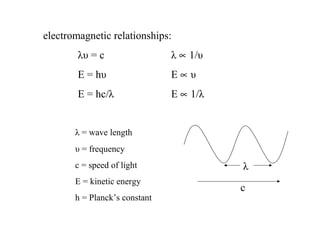
electromagnetic relationships: 
λυ = c λ µ 1/υ 
E = hυ E µ υ 
E = hc/λ E µ 1/λ 
λ = wave length 
υ = frequency 
c = speed of light 
E = kinetic energy 
h = Planck’s constant 
λ 
c
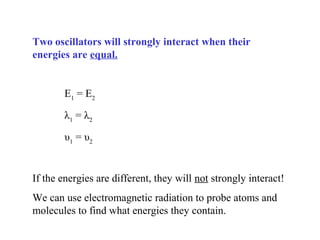
Two oscillators will strongly interact when their 
energies are equal. 
E1 = E2 
λ1 = λ2 
υ1 = υ2 
If the energies are different, they will not strongly interact! 
We can use electromagnetic radiation to probe atoms and 
molecules to find what energies they contain.
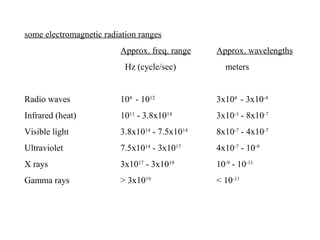
some electromagnetic radiation ranges 
Approx. freq. range Approx. wavelengths 
Hz (cycle/sec) meters 
Radio waves 104 - 1012 3x10⁴ - 3x10⁻⁴ 
Infrared (heat) 1011 - 3.8x10¹⁴ 3x10⁻³ - 8x10⁻⁷ 
Visible light 3.8x10¹⁴ - 7.5x10¹⁴ 8x10⁻⁷ - 4x10⁻⁷ 
Ultraviolet 7.5x10¹⁴ - 3x10¹⁷ 4x10⁻⁷ - 10-9 
X rays 3x10¹⁷ - 3x10¹⁹ 10-9 - 10-11 
Gamma rays > 3x10¹⁹ < 10-11
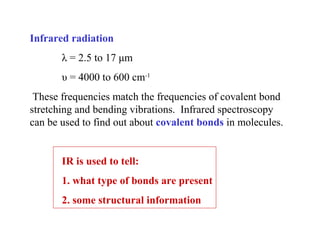
Infrared radiation 
λ = 2.5 to 17 μm 
υ = 4000 to 600 cm-1 
These frequencies match the frequencies of covalent bond 
stretching and bending vibrations. Infrared spectroscopy 
can be used to find out about covalent bonds in molecules. 
IR is used to tell: 
1. what type of bonds are present 
2. some structural information
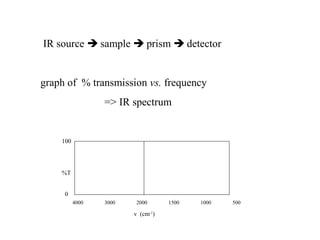
IR source  sample  prism  detector 
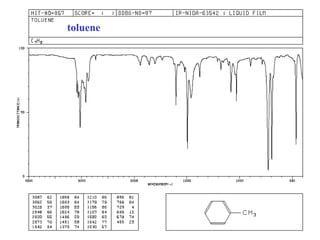
graph of % transmission vs. frequency 
=> IR spectrum 
4000 3000 2000 1500 1000 500 
v (cm-1) 
100 
%T 
0
toluene
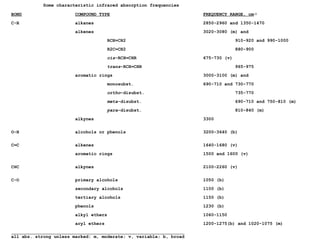
Some characteristic infrared absorption frequencies 
BOND COMPOUND TYPE FREQUENCY RANGE, cm-1 
C-H alkanes 2850-2960 and 1350-1470 
alkenes 3020-3080 (m) and 
RCH=CH2 910-920 and 990-1000 
R2C=CH2 880-900 
cis-RCH=CHR 675-730 (v) 
trans-RCH=CHR 965-975 
aromatic rings 3000-3100 (m) and 
monosubst. 690-710 and 730-770 
ortho-disubst. 735-770 
meta-disubst. 690-710 and 750-810 (m) 
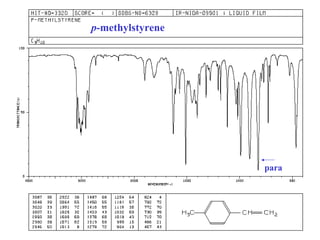
para-disubst. 810-840 (m) 
alkynes 3300 
O-H alcohols or phenols 3200-3640 (b) 
C=C alkenes 1640-1680 (v) 
aromatic rings 1500 and 1600 (v) 
C≡C alkynes 2100-2260 (v) 
C-O primary alcohols 1050 (b) 
secondary alcohols 1100 (b) 
tertiary alcohols 1150 (b) 
phenols 1230 (b) 
alkyl ethers 1060-1150 
aryl ethers 1200-1275(b) and 1020-1075 (m) 
all abs. strong unless marked: m, moderate; v, variable; b, broad
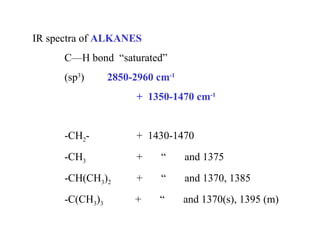
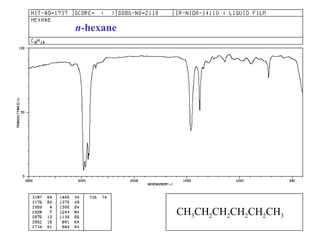
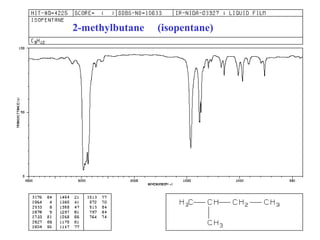
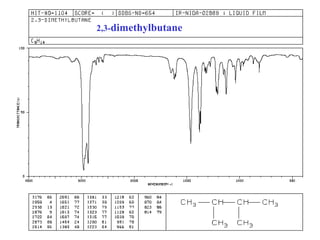
IR spectra of ALKANES 
C—H bond “saturated” 
(sp3) 2850-2960 cm-1 
+ 1350-1470 cm-1 
-CH2- + 1430-1470 
-CH3 + “ and 1375 
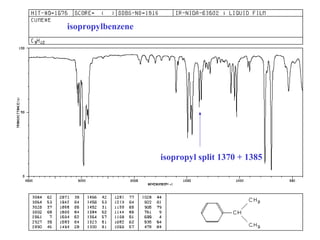
-CH(CH3)2 + “ and 1370, 1385 
-C(CH3)3 + “ and 1370(s), 1395 (m)
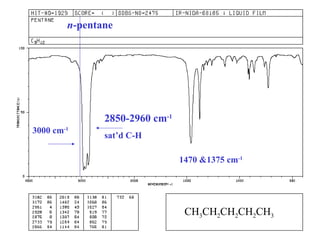
n-pentane 
CH3CH2CH2CH2CH3 
3000 cm-1 
1470 &1375 cm-1 
2850-2960 cm-1 
sat’d C-H
CH3CH2CH2CH2CH2CH3 
n-hexane
2-methylbutane (isopentane)
2,3-dimethylbutane
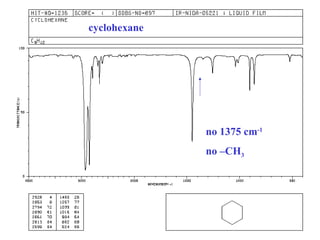
cyclohexane 
no 1375 cm-1 
no –CH3
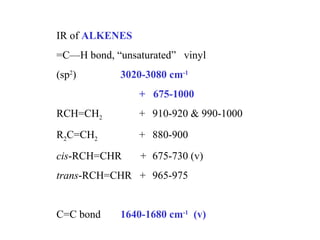
IR of ALKENES 
=C—H bond, “unsaturated” vinyl 
(sp2) 3020-3080 cm-1 
+ 675-1000 
RCH=CH2 + 910-920 & 990-1000 
R2C=CH2 + 880-900 
cis-RCH=CHR + 675-730 (v) 
trans-RCH=CHR + 965-975 
C=C bond 1640-1680 cm-1 (v)
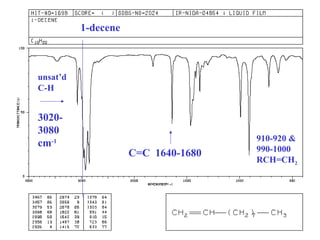
1-decene 
910-920 & 
990-1000 
RCH=CH2 
C=C 1640-1680 
unsat’d 
C-H 
3020- 
3080 
cm-1
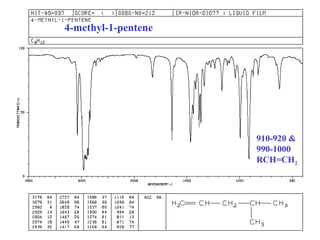
4-methyl-1-pentene 
910-920 & 
990-1000 
RCH=CH2
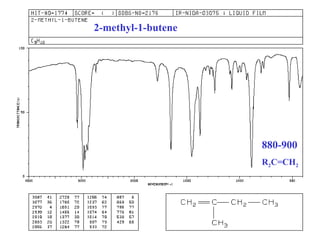
2-methyl-1-butene 
880-900 
R2C=CH2
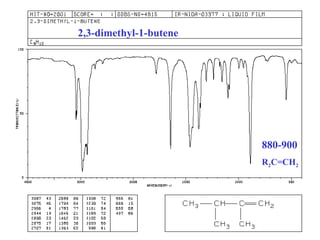
2,3-dimethyl-1-butene 
880-900 
R2C=CH2
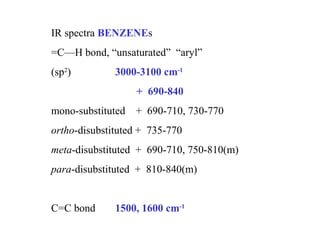
IR spectra BENZENEs 
=C—H bond, “unsaturated” “aryl” 
(sp2) 3000-3100 cm-1 
+ 690-840 
mono-substituted + 690-710, 730-770 
ortho-disubstituted + 735-770 
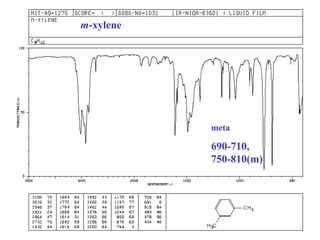
meta-disubstituted + 690-710, 750-810(m) 
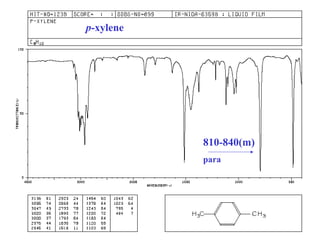
para-disubstituted + 810-840(m) 
C=C bond 1500, 1600 cm-1
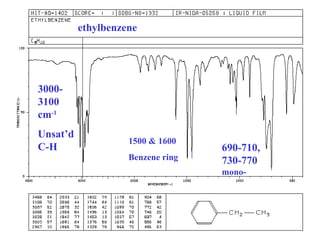
ethylbenzene 
690-710, 
730-770 
mono- 
1500 & 1600 
Benzene ring 
3000- 
3100 
cm-1 
Unsat’d 
C-H
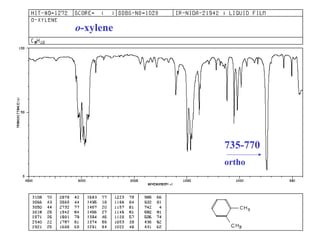
o-xylene 
735-770 
ortho
p-xylene 
810-840(m) 
para
m-xylene 
meta 
690-710, 
750-810(m)
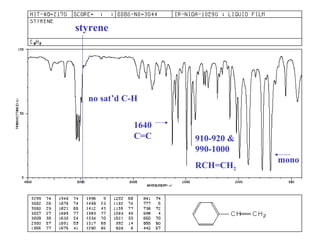
styrene 
no sat’d C-H 
910-920 & 
990-1000 
RCH=CH2 
mono 
1640 
C=C
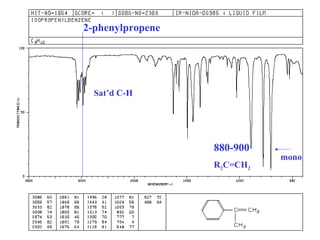
2-phenylpropene 
mono 
880-900 
R2C=CH2 
Sat’d C-H
p-methylstyrene 
para
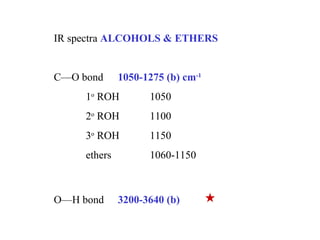
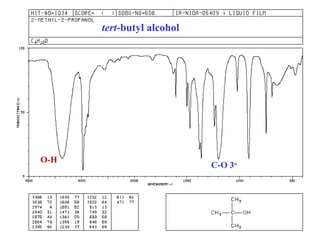
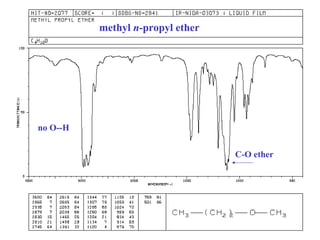
IR spectra ALCOHOLS & ETHERS 
C—O bond 1050-1275 (b) cm-1 
1o ROH 1050 
2o ROH 1100 
3o ROH 1150 
ethers 1060-1150 
O—H bond 3200-3640 (b) 
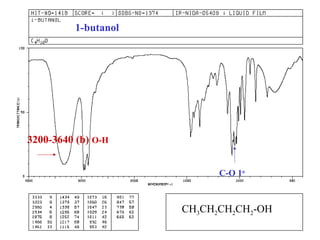
1-butanol 
C-O 1o 
CH3CH2CH2CH2-OH 
3200-3640 (b) O-H
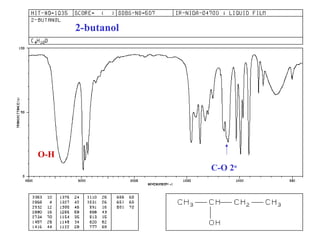
2-butanol 
C-O 2o 
O-H
tert-butyl alcohol 
C-O 3o O-H
methyl n-propyl ether 
no O--H 
C-O ether
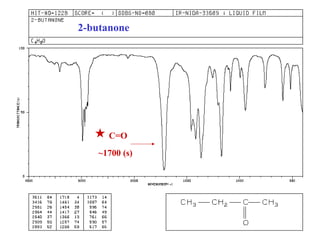
2-butanone 
 C=O 
~1700 (s)
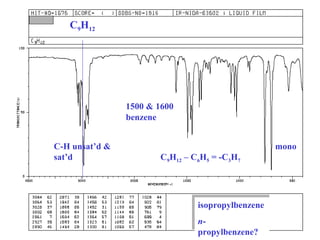
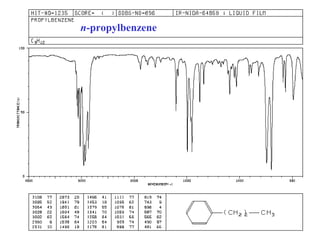
C9H12 
C-H unsat’d & 
sat’d 
1500 & 1600 
benzene 
mono 
C9H12 – C6H5 = -C3H7 
isopropylbenzene 
n-propylbenzene?
n-propylbenzene
isopropyl split 1370 + 1385 
isopropylbenzene
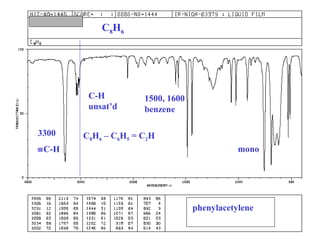
C8H6 
C-H 
unsat’d 
1500, 1600 
benzene 
mono 
C8H6 – C6H5 = C2H 
phenylacetylene 
3300 
ºC-H
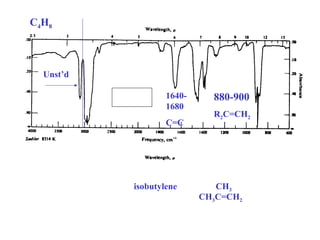
C4H8 
1640- 
1680 
C=C 
880-900 
R2C=CH2 
isobutylene CH3 
CH3C=CH2 
Unst’d
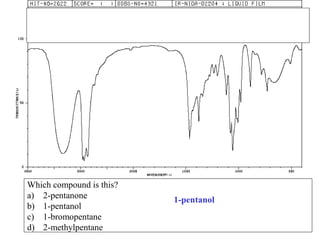
Which compound is this? 
a) 2-pentanone 
b) 1-pentanol 
c) 1-bromopentane 
d) 2-methylpentane 
1-pentanol
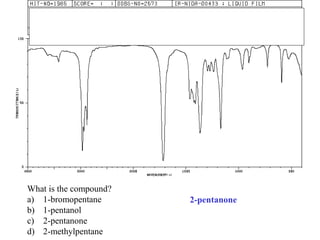
What is the compound? 
a) 1-bromopentane 
b) 1-pentanol 
c) 2-pentanone 
d) 2-methylpentane 
2-pentanone
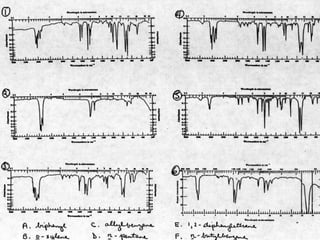
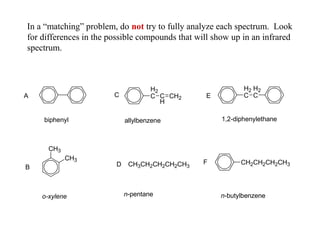
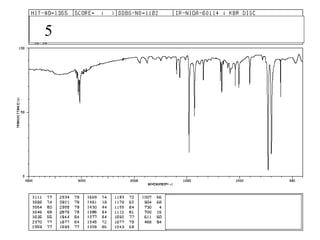
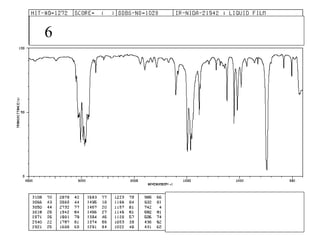
In a “matching” problem, do not try to fully analyze each spectrum. Look 
for differences in the possible compounds that will show up in an infrared 
spectrum. 
H2 
C CH 
CH2 
biphenyl allylbenzene 1,2-diphenylethane 
CH3 
CH3 CH3CH2CH2CH2CH3 
H2 
C 
H2 
C 
CH2CH2CH2CH3 
o-xylene n-pentane n-butylbenzene 
A 
B 
C 
D 
E 
F
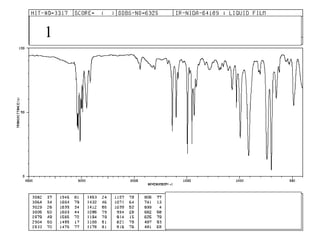
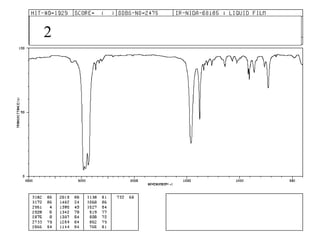
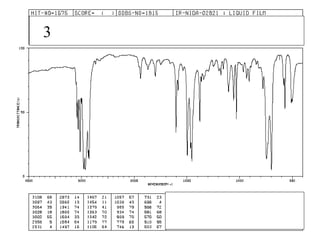
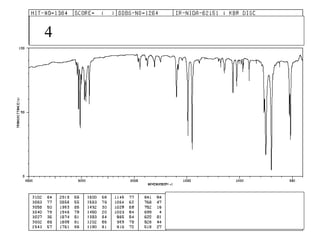
1
2
3
4
5
6
Rawat’s Creation-rwtdgreat@ 
gmail.com 
rwtdgreat@yahoo.co.uk 
RawatDAgreatt/LinkedIn 
www.slideshare.net/ 
RawatDAgreatt 
Google+/blogger/Facebook 
/ 
Twitter-@RawatDAgreatt 
+919808050301 
+919958249693

Infrared spectoscopy

  • 1.
    Spectroscopy Infrared Spectra By- Saurav K. Rawat (Rawat DA Greatt)
  • 2.
    Infrared spectra inthis presentation are taken by permission from the SDBS web site: SDBSWeb: http://www.aist.go.jp/RIODB/SDBS/
  • 3.
  • 4.
    Spectroscopy “seeing theunseeable” Using electromagnetic radiation as a probe to obtain information about atoms and molecules that are too small to see. Electromagnetic radiation is propagated at the speed of light through a vacuum as an oscillating wave.
  • 5.
    electromagnetic relationships: λυ= c λ µ 1/υ E = hυ E µ υ E = hc/λ E µ 1/λ λ = wave length υ = frequency c = speed of light E = kinetic energy h = Planck’s constant λ c
  • 6.
    Two oscillators willstrongly interact when their energies are equal. E1 = E2 λ1 = λ2 υ1 = υ2 If the energies are different, they will not strongly interact! We can use electromagnetic radiation to probe atoms and molecules to find what energies they contain.
  • 7.
    some electromagnetic radiationranges Approx. freq. range Approx. wavelengths Hz (cycle/sec) meters Radio waves 104 - 1012 3x10⁴ - 3x10⁻⁴ Infrared (heat) 1011 - 3.8x10¹⁴ 3x10⁻³ - 8x10⁻⁷ Visible light 3.8x10¹⁴ - 7.5x10¹⁴ 8x10⁻⁷ - 4x10⁻⁷ Ultraviolet 7.5x10¹⁴ - 3x10¹⁷ 4x10⁻⁷ - 10-9 X rays 3x10¹⁷ - 3x10¹⁹ 10-9 - 10-11 Gamma rays > 3x10¹⁹ < 10-11
  • 8.
    Infrared radiation λ= 2.5 to 17 μm υ = 4000 to 600 cm-1 These frequencies match the frequencies of covalent bond stretching and bending vibrations. Infrared spectroscopy can be used to find out about covalent bonds in molecules. IR is used to tell: 1. what type of bonds are present 2. some structural information
  • 9.
    IR source sample  prism  detector graph of % transmission vs. frequency => IR spectrum 4000 3000 2000 1500 1000 500 v (cm-1) 100 %T 0
  • 10.
  • 11.
    Some characteristic infraredabsorption frequencies BOND COMPOUND TYPE FREQUENCY RANGE, cm-1 C-H alkanes 2850-2960 and 1350-1470 alkenes 3020-3080 (m) and RCH=CH2 910-920 and 990-1000 R2C=CH2 880-900 cis-RCH=CHR 675-730 (v) trans-RCH=CHR 965-975 aromatic rings 3000-3100 (m) and monosubst. 690-710 and 730-770 ortho-disubst. 735-770 meta-disubst. 690-710 and 750-810 (m) para-disubst. 810-840 (m) alkynes 3300 O-H alcohols or phenols 3200-3640 (b) C=C alkenes 1640-1680 (v) aromatic rings 1500 and 1600 (v) C≡C alkynes 2100-2260 (v) C-O primary alcohols 1050 (b) secondary alcohols 1100 (b) tertiary alcohols 1150 (b) phenols 1230 (b) alkyl ethers 1060-1150 aryl ethers 1200-1275(b) and 1020-1075 (m) all abs. strong unless marked: m, moderate; v, variable; b, broad
  • 12.
    IR spectra ofALKANES C—H bond “saturated” (sp3) 2850-2960 cm-1 + 1350-1470 cm-1 -CH2- + 1430-1470 -CH3 + “ and 1375 -CH(CH3)2 + “ and 1370, 1385 -C(CH3)3 + “ and 1370(s), 1395 (m)
  • 13.
    n-pentane CH3CH2CH2CH2CH3 3000cm-1 1470 &1375 cm-1 2850-2960 cm-1 sat’d C-H
  • 14.
  • 15.
  • 16.
  • 17.
    cyclohexane no 1375cm-1 no –CH3
  • 18.
    IR of ALKENES =C—H bond, “unsaturated” vinyl (sp2) 3020-3080 cm-1 + 675-1000 RCH=CH2 + 910-920 & 990-1000 R2C=CH2 + 880-900 cis-RCH=CHR + 675-730 (v) trans-RCH=CHR + 965-975 C=C bond 1640-1680 cm-1 (v)
  • 19.
    1-decene 910-920 & 990-1000 RCH=CH2 C=C 1640-1680 unsat’d C-H 3020- 3080 cm-1
  • 20.
  • 21.
  • 22.
  • 23.
    IR spectra BENZENEs =C—H bond, “unsaturated” “aryl” (sp2) 3000-3100 cm-1 + 690-840 mono-substituted + 690-710, 730-770 ortho-disubstituted + 735-770 meta-disubstituted + 690-710, 750-810(m) para-disubstituted + 810-840(m) C=C bond 1500, 1600 cm-1
  • 24.
    ethylbenzene 690-710, 730-770 mono- 1500 & 1600 Benzene ring 3000- 3100 cm-1 Unsat’d C-H
  • 25.
  • 26.
  • 27.
  • 28.
    styrene no sat’dC-H 910-920 & 990-1000 RCH=CH2 mono 1640 C=C
  • 29.
    2-phenylpropene mono 880-900 R2C=CH2 Sat’d C-H
  • 30.
  • 31.
    IR spectra ALCOHOLS& ETHERS C—O bond 1050-1275 (b) cm-1 1o ROH 1050 2o ROH 1100 3o ROH 1150 ethers 1060-1150 O—H bond 3200-3640 (b) 
  • 32.
    1-butanol C-O 1o CH3CH2CH2CH2-OH 3200-3640 (b) O-H
  • 33.
  • 34.
  • 35.
    methyl n-propyl ether no O--H C-O ether
  • 36.
  • 37.
    C9H12 C-H unsat’d& sat’d 1500 & 1600 benzene mono C9H12 – C6H5 = -C3H7 isopropylbenzene n-propylbenzene?
  • 38.
  • 39.
    isopropyl split 1370+ 1385 isopropylbenzene
  • 40.
    C8H6 C-H unsat’d 1500, 1600 benzene mono C8H6 – C6H5 = C2H phenylacetylene 3300 ºC-H
  • 41.
    C4H8 1640- 1680 C=C 880-900 R2C=CH2 isobutylene CH3 CH3C=CH2 Unst’d
  • 42.
    Which compound isthis? a) 2-pentanone b) 1-pentanol c) 1-bromopentane d) 2-methylpentane 1-pentanol
  • 43.
    What is thecompound? a) 1-bromopentane b) 1-pentanol c) 2-pentanone d) 2-methylpentane 2-pentanone
  • 45.
    In a “matching”problem, do not try to fully analyze each spectrum. Look for differences in the possible compounds that will show up in an infrared spectrum. H2 C CH CH2 biphenyl allylbenzene 1,2-diphenylethane CH3 CH3 CH3CH2CH2CH2CH3 H2 C H2 C CH2CH2CH2CH3 o-xylene n-pentane n-butylbenzene A B C D E F
  • 46.
  • 47.
  • 48.
  • 49.
  • 50.
  • 51.
  • 52.
    Rawat’s Creation-rwtdgreat@ gmail.com rwtdgreat@yahoo.co.uk RawatDAgreatt/LinkedIn www.slideshare.net/ RawatDAgreatt Google+/blogger/Facebook / Twitter-@RawatDAgreatt +919808050301 +919958249693