‫جهاز‬ ‫استخدام‬
ATR-FTIR
‫م‬
.
‫م‬
.
‫رشيد‬ ‫حميد‬ ‫أسامة‬
‫م‬
.
‫م‬
.
‫عيسى‬ ‫طاهر‬ ‫محمد‬
‫م‬
.
‫م‬
.
‫عبيد‬ ‫حبيب‬ ‫ندى‬
www.uokerbala.edu.iq
2
2
2
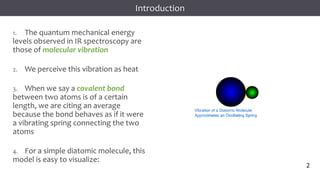
1. The quantum mechanical energy
levels observed in IR spectroscopy are
those of molecular vibration
2. We perceive this vibration as heat
3. When we say a covalent bond
between two atoms is of a certain
length, we are citing an average
because the bond behaves as if it were
a vibrating spring connecting the two
atoms
4. For a simple diatomic molecule, this
model is easy to visualize:
Introduction
2
3
3
3
H
H
C
H
H
C
scissor
asymmetric
H
H
C
C
H
H
C
C
H
H
C
C
H
H
C
C
symmetric
rock twist wag
in plane out of plane
Introduction
3
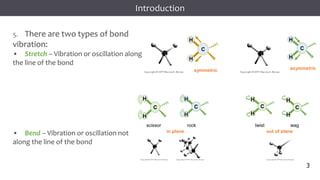
5. There are two types of bond
vibration:
• Stretch – Vibration or oscillation along
the line of the bond
• Bend – Vibration or oscillation not
along the line of the bond
4
4
4
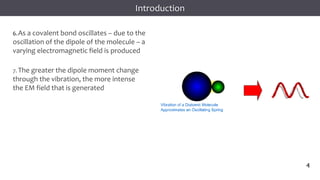
6.As a covalent bond oscillates – due to the
oscillation of the dipole of the molecule – a
varying electromagnetic field is produced
7. The greater the dipole moment change
through the vibration, the more intense
the EM field that is generated
Introduction
4
5
5
5
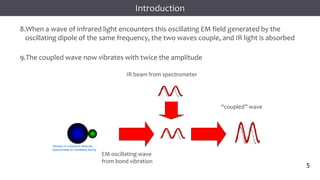
8.When a wave of infrared light encounters this oscillating EM field generated by the
oscillating dipole of the same frequency, the two waves couple, and IR light is absorbed
9.The coupled wave now vibrates with twice the amplitude
Introduction
5
IR beam from spectrometer
EM oscillating wave
from bond vibration
“coupled” wave
6
6
6
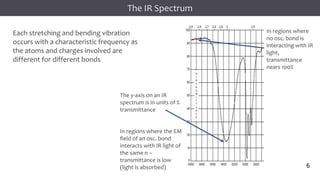
The y-axis on an IR
spectrum is in units of %
transmittance
In regions where the EM
field of an osc. bond
interacts with IR light of
the same n –
transmittance is low
(light is absorbed)
In regions where
no osc. bond is
interacting with IR
light,
transmittance
nears 100%
Infrared Spectroscopy
Each stretching and bending vibration
occurs with a characteristic frequency as
the atoms and charges involved are
different for different bonds
The IR Spectrum
6
7
7
7
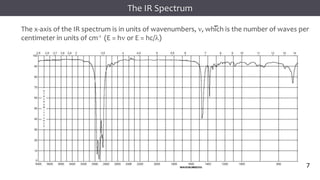
The x-axis of the IR spectrum is in units of wavenumbers, n, which is the number of waves per
centimeter in units of cm-1 (E = hn or E = hc/l)
The IR Spectrum
7
8
8
8
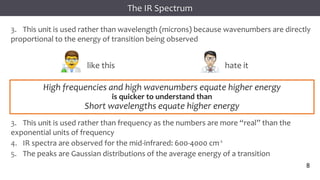
3. This unit is used rather than wavelength (microns) because wavenumbers are directly
proportional to the energy of transition being observed
3. This unit is used rather than frequency as the numbers are more “real” than the
exponential units of frequency
4. IR spectra are observed for the mid-infrared: 600-4000 cm-1
5. The peaks are Gaussian distributions of the average energy of a transition
The IR Spectrum
8
High frequencies and high wavenumbers equate higher energy
is quicker to understand than
Short wavelengths equate higher energy
hate it
like this
9
9
9
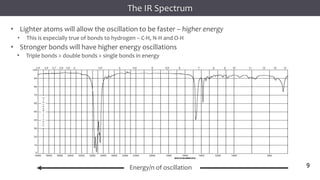
• Lighter atoms will allow the oscillation to be faster – higher energy
• This is especially true of bonds to hydrogen – C-H, N-H and O-H
• Stronger bonds will have higher energy oscillations
• Triple bonds > double bonds > single bonds in energy
Energy/n of oscillation
The IR Spectrum
9
10
10
10
Infrared Spectroscopy
7. As opposed to chromatography or other spectroscopic methods, the area of a IR band (or
peak) is not directly proportional to concentration of the functional group producing the peak
8. The intensity of an IR band is affected by two primary factors:
• Whether the vibration is one of stretching or bending
• Electronegativity difference of the atoms involved in the bond
• For both effects, the greater the change in dipole moment in a given vibration or bend, the larger the
peak.
• The greater the difference in electronegativity between the atoms involved in bonding, the larger the
dipole moment
• Typically, stretching will change dipole moment more than bending
The detection of different bonds
10
11
11
11
Infrared Spectroscopy
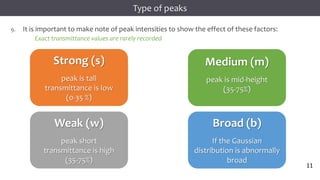
9. It is important to make note of peak intensities to show the effect of these factors:
Exact transmittance values are rarely recorded
Type of peaks
11
Strong (s)
peak is tall
transmittance is low
(0-35 %)
Medium (m)
peak is mid-height
(35-75%)
Weak (w)
peak short
transmittance is high
(35-75%)
Broad (b)
If the Gaussian
distribution is abnormally
broad
12
12
12
Infrared Spectroscopy
1. The primary use of the IR is to detect functional groups
2. Because the IR looks at the interaction of the EM spectrum with actual bonds, it
provides a unique qualitative probe into the functionality of a molecule, as functional
groups are merely different configurations of different types of bonds
3. Since most “types” of bonds in covalent molecules have roughly the same energy,
i.e., C=C and C=O bonds, C-H and N-H bonds they show up in similar regions of the IR
spectrum
4. Remember all organic functional groups are made of multiple bonds and therefore
show up as multiple IR bands (peaks)
IR Group Analysis
12
13
13
13
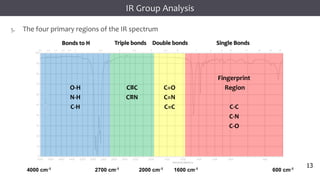
5. The four primary regions of the IR spectrum
4000 cm-1 2700 cm-1 2000 cm-1 1600 cm-1 600 cm-1
O-H
N-H
C-H
C≡C
C≡N
C=O
C=N
C=C
Fingerprint
Region
C-C
C-N
C-O
Infrared Spectroscopy
Bonds to H Triple bonds Double bonds Single Bonds
IR Group Analysis
13
14
14
14
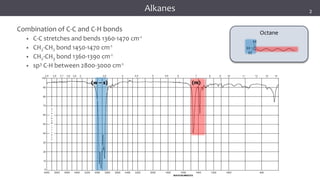
Alkanes
Combination of C-C and C-H bonds
• C-C stretches and bends 1360-1470 cm-1
• CH2-CH2 bond 1450-1470 cm-1
• CH2-CH3 bond 1360-1390 cm-1
• sp3 C-H between 2800-3000 cm-1
Octane
(w – s) (m)
2
15
15
15
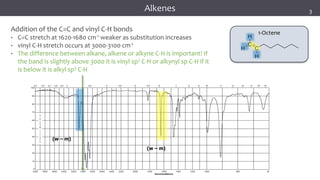
Alkenes
Addition of the C=C and vinyl C-H bonds
• C=C stretch at 1620-1680 cm-1 weaker as substitution increases
• vinyl C-H stretch occurs at 3000-3100 cm-1
• The difference between alkane, alkene or alkyne C-H is important! If
the band is slightly above 3000 it is vinyl sp2 C-H or alkynyl sp C-H if it
is below it is alkyl sp3 C-H
1-Octene
(w – m)
(w – m)
3
16
16
16
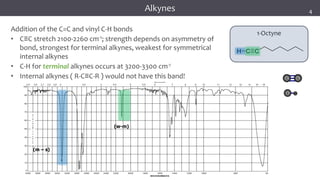
Addition of the C=C and vinyl C-H bonds
• C≡C stretch 2100-2260 cm-1; strength depends on asymmetry of
bond, strongest for terminal alkynes, weakest for symmetrical
internal alkynes
• C-H for terminal alkynes occurs at 3200-3300 cm-1
• Internal alkynes ( R-C≡C-R ) would not have this band!
1-Octyne
Infrared Spectroscopy
(m – s)
(w-m)
Alkynes 4
17
17
17
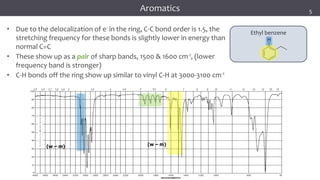
Aromatics
Ethyl benzene
(w – m) (w – m)
• Due to the delocalization of e- in the ring, C-C bond order is 1.5, the
stretching frequency for these bonds is slightly lower in energy than
normal C=C
• These show up as a pair of sharp bands, 1500 & 1600 cm-1, (lower
frequency band is stronger)
• C-H bonds off the ring show up similar to vinyl C-H at 3000-3100 cm-1
5
18
18
18
Monosubstituted
1,2 disubstituted (ortho or o-)
1,2 disubstituted (meta or m-)
1,4 disubstituted (para or p-)
G
G
G
G
G
G
G
Infrared Spectroscopy
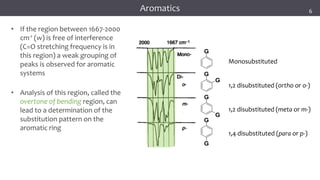
• If the region between 1667-2000
cm-1 (w) is free of interference
(C=O stretching frequency is in
this region) a weak grouping of
peaks is observed for aromatic
systems
• Analysis of this region, called the
overtone of bending region, can
lead to a determination of the
substitution pattern on the
aromatic ring
Aromatics 6
19
19
19
R
C
H
C
R
C
H
CH2
R
C
H
C
R
C
R
CH2
R
C
R
C
R
H
R
H
R
H
985-997
905-915
cm-1
960-980
665-730
885-895
790-840
R
R
R
R
R
R
R
cm-1
730-770
690-710
735-770
860-900
750-810
680-725
800-860
Infrared Spectroscopy
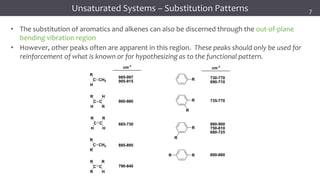
• The substitution of aromatics and alkenes can also be discerned through the out-of-plane
bending vibration region
• However, other peaks often are apparent in this region. These peaks should only be used for
reinforcement of what is known or for hypothesizing as to the functional pattern.
Unsaturated Systems – Substitution Patterns 7
20
20
20
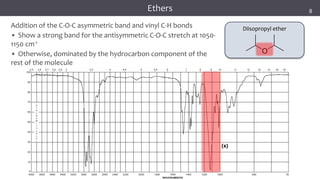
Diisopropyl ether
Infrared Spectroscopy
(s)
Addition of the C-O-C asymmetric band and vinyl C-H bonds
• Show a strong band for the antisymmetric C-O-C stretch at 1050-
1150 cm-1
• Otherwise, dominated by the hydrocarbon component of the
rest of the molecule
Ethers 8
21
21
21
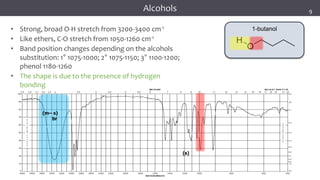
1-butanol
Infrared Spectroscopy
(m– s)
br
(s)
• Strong, broad O-H stretch from 3200-3400 cm-1
• Like ethers, C-O stretch from 1050-1260 cm-1
• Band position changes depending on the alcohols
substitution: 1° 1075-1000; 2° 1075-1150; 3° 1100-1200;
phenol 1180-1260
• The shape is due to the presence of hydrogen
bonding
Alcohols 9
22
22
22
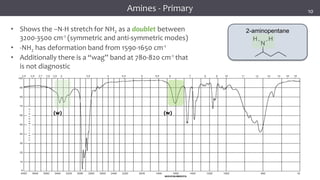
2-aminopentane
Infrared Spectroscopy
(w) (w)
• Shows the –N-H stretch for NH2 as a doublet between
3200-3500 cm-1 (symmetric and anti-symmetric modes)
• -NH2 has deformation band from 1590-1650 cm-1
• Additionally there is a “wag” band at 780-820 cm-1 that
is not diagnostic
Amines - Primary 10
23
23
23
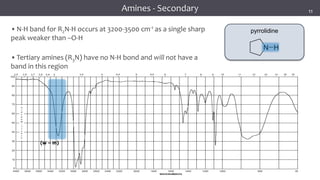
pyrrolidine
Infrared Spectroscopy
(w – m)
•N-H band for R2N-H occurs at 3200-3500 cm-1 as a single sharp
peak weaker than –O-H
•Tertiary amines (R3N) have no N-H bond and will not have a
band in this region
Amines - Secondary 11
24
24
24
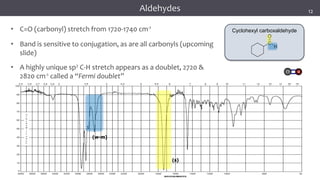
Cyclohexyl carboxaldehyde
Infrared Spectroscopy
(w-m)
(s)
• C=O (carbonyl) stretch from 1720-1740 cm-1
• Band is sensitive to conjugation, as are all carbonyls (upcoming
slide)
• A highly unique sp2 C-H stretch appears as a doublet, 2720 &
2820 cm-1 called a “Fermi doublet”
Aldehydes 12
25
25
25
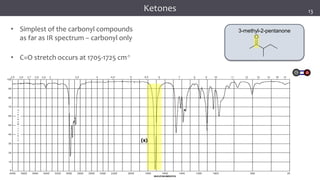
3-methyl-2-pentanone
Infrared Spectroscopy
(s)
• Simplest of the carbonyl compounds
as far as IR spectrum – carbonyl only
• C=O stretch occurs at 1705-1725 cm-1
Ketones 13
26
26
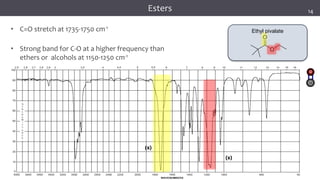
26
Infrared Spectroscopy
Ethyl pivalate
(s)
(s)
• C=O stretch at 1735-1750 cm-1
• Strong band for C-O at a higher frequency than
ethers or alcohols at 1150-1250 cm-1
Esters 14
27
27
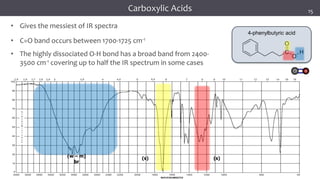
27
4-phenylbutyric acid
Infrared Spectroscopy
(w – m)
br
(s) (s)
• Gives the messiest of IR spectra
• C=O band occurs between 1700-1725 cm-1
• The highly dissociated O-H bond has a broad band from 2400-
3500 cm-1 covering up to half the IR spectrum in some cases
Carboxylic Acids 15
28
28
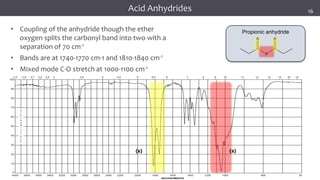
28
Propionic anhydride
Infrared Spectroscopy
O
O O
(s) (s)
• Coupling of the anhydride though the ether
oxygen splits the carbonyl band into two with a
separation of 70 cm-1
• Bands are at 1740-1770 cm-1 and 1810-1840 cm-1
• Mixed mode C-O stretch at 1000-1100 cm-1
Acid Anhydrides 16
29
29
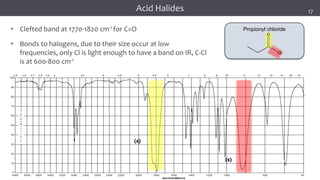
29
Propionyl chloride
Cl
O
Infrared Spectroscopy
(s)
(s)
• Clefted band at 1770-1820 cm-1 for C=O
• Bonds to halogens, due to their size occur at low
frequencies, only Cl is light enough to have a band on IR, C-Cl
is at 600-800 cm-1
Acid Halides 17
30
30
30
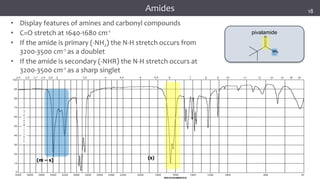
pivalamide
NH2
O
Infrared Spectroscopy
(m – s) (s)
• Display features of amines and carbonyl compounds
• C=O stretch at 1640-1680 cm-1
• If the amide is primary (-NH2) the N-H stretch occurs from
3200-3500 cm-1 as a doublet
• If the amide is secondary (-NHR) the N-H stretch occurs at
3200-3500 cm-1 as a sharp singlet
Amides 18
31
31
31
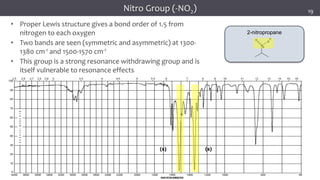
2-nitropropane
N
O
O
Infrared Spectroscopy
(s) (s)
• Proper Lewis structure gives a bond order of 1.5 from
nitrogen to each oxygen
• Two bands are seen (symmetric and asymmetric) at 1300-
1380 cm-1 and 1500-1570 cm-1
• This group is a strong resonance withdrawing group and is
itself vulnerable to resonance effects
Nitro Group (-NO2) 19
32
32
32
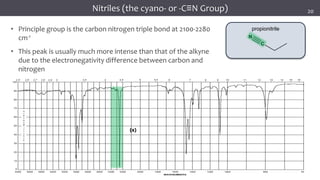
propionitrile
N
C
Infrared Spectroscopy
(s)
• Principle group is the carbon nitrogen triple bond at 2100-2280
cm-1
• This peak is usually much more intense than that of the alkyne
due to the electronegativity difference between carbon and
nitrogen
Nitriles (the cyano- or -C≡N Group) 20
33
33
33
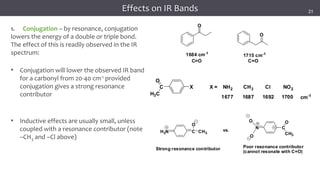
1. Conjugation – by resonance, conjugation
lowers the energy of a double or triple bond.
The effect of this is readily observed in the IR
spectrum:
• Conjugation will lower the observed IR band
for a carbonyl from 20-40 cm-1 provided
conjugation gives a strong resonance
contributor
• Inductive effects are usually small, unless
coupled with a resonance contributor (note
–CH3 and –Cl above)
O
O
1684 cm-1
1715 cm-1
C=O C=O
C
H3C
O
X X = NH2 CH3 Cl NO2
1677 1687 1692 1700 cm-1
H2N C CH3
O
Strong resonance contributor
vs.
N
O
O
C
CH3
O
Poor resonance contributor
(cannot resonate with C=O)
Infrared Spectroscopy
Effects on IR Bands 21
34
34
34
O
C=O: 1686 cm-1
O
C=O: 1693 cm-1
CH3
O O O O O
1815 cm-1
1775 cm-1
1750 cm-1
1715 cm-1
1705 cm-1
Infrared Spectroscopy
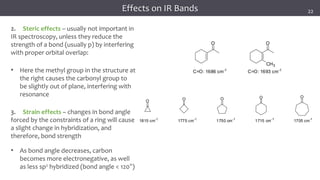
2. Steric effects – usually not important in
IR spectroscopy, unless they reduce the
strength of a bond (usually p) by interfering
with proper orbital overlap:
• Here the methyl group in the structure at
the right causes the carbonyl group to
be slightly out of plane, interfering with
resonance
3. Strain effects – changes in bond angle
forced by the constraints of a ring will cause
a slight change in hybridization, and
therefore, bond strength
• As bond angle decreases, carbon
becomes more electronegative, as well
as less sp2 hybridized (bond angle < 120°)
Effects on IR Bands 22
35
35
35
OH
C=O; 1701 cm-1
O
O
H
Infrared Spectroscopy
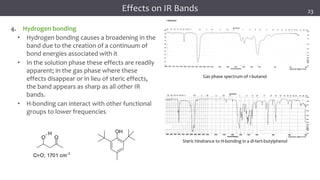
4. Hydrogen bonding
• Hydrogen bonding causes a broadening in the
band due to the creation of a continuum of
bond energies associated with it
• In the solution phase these effects are readily
apparent; in the gas phase where these
effects disappear or in lieu of steric effects,
the band appears as sharp as all other IR
bands.
• H-bonding can interact with other functional
groups to lower frequencies
Effects on IR Bands
Gas phase spectrum of 1-butanol
Steric hindrance to H-bonding in a di-tert-butylphenol
23
36
36
36
Transmission FTIR
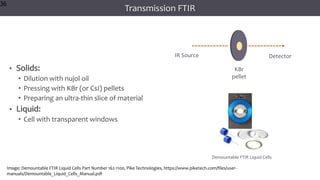
• Solids:
• Dilution with nujol oil
• Pressing with KBr (or CsI) pellets
• Preparing an ultra-thin slice of material
• Liquid:
• Cell with transparent windows
36
KBr
pellet
IR Source Detector
Image: Demountable FTIR Liquid Cells Part Number 162-1100, Pike Technologies, https://www.piketech.com/files/user-
manuals/Demountable_Liquid_Cells_Manual.pdf
Demountable FTIR Liquid Cells
37
37
37
ATR-FTIR
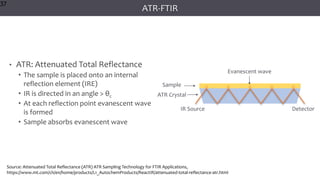
• ATR: Attenuated Total Reflectance
• The sample is placed onto an internal
reflection element (IRE)
• IR is directed in an angle > θc
• At each reflection point evanescent wave
is formed
• Sample absorbs evanescent wave
37
Source: Attenuated Total Reflectance (ATR) ATR Sampling Technology for FTIR Applications,
https://www.mt.com/ch/en/home/products/L1_AutochemProducts/ReactIR/attenuated-total-reflectance-atr.html
IR Source Detector
Sample
ATR Crystal
Evanescent wave
38
38
38
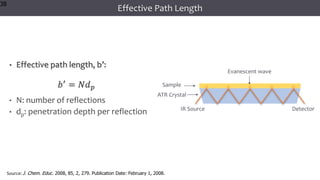
Effective Path Length
• Effective path length, b’:
𝑏′ = 𝑁𝑑𝑝
• N: number of reflections
• dp: penetration depth per reflection
38
IR Source Detector
Sample
ATR Crystal
Evanescent wave
Source: J. Chem. Educ. 2008, 85, 2, 279. Publication Date: February 1, 2008.
39
39
39
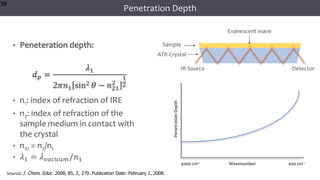
Penetration Depth
• Peneteration depth:
𝑑𝑝 =
𝜆1
2𝜋𝑛1 sin2 𝜃 − 𝑛21
2
1
2
• n1: index of refraction of IRE
• n2: index of refraction of the
sample medium in contact with
the crystal
• n21 = n2/n1
• 𝜆1 = 𝜆𝑣𝑎𝑐𝑢𝑢𝑚/𝑛1
39
IR Source Detector
Sample
ATR Crystal
Evanescent wave
Source: J. Chem. Educ. 2008, 85, 2, 279. Publication Date: February 1, 2008.
Penetration
Depth
Wavenumber
4000 cm-1 400 cm-1
40
40
40
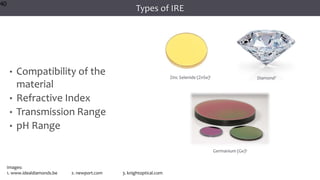
Types of IRE
• Compatibility of the
material
• Refractive Index
• Transmission Range
• pH Range
40
Zinc Selenide (ZnSe)1
Diamond2
Germanium (Ge)3
Images:
1. www.idealdiamonds.be 2. newport.com 3. knightoptical.com
41
41
41
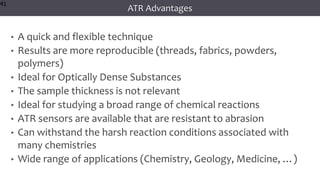
ATR Advantages
• A quick and flexible technique
• Results are more reproducible (threads, fabrics, powders,
polymers)
• Ideal for Optically Dense Substances
• The sample thickness is not relevant
• Ideal for studying a broad range of chemical reactions
• ATR sensors are available that are resistant to abrasion
• Can withstand the harsh reaction conditions associated with
many chemistries
• Wide range of applications (Chemistry, Geology, Medicine, …)
41
THANK YOU
FOR ATTENDING

استخدام جهاز ATR-FTIR

  • 1.
    ‫جهاز‬ ‫استخدام‬ ATR-FTIR ‫م‬ . ‫م‬ . ‫رشيد‬ ‫حميد‬‫أسامة‬ ‫م‬ . ‫م‬ . ‫عيسى‬ ‫طاهر‬ ‫محمد‬ ‫م‬ . ‫م‬ . ‫عبيد‬ ‫حبيب‬ ‫ندى‬ www.uokerbala.edu.iq
  • 2.
    2 2 2 1. The quantummechanical energy levels observed in IR spectroscopy are those of molecular vibration 2. We perceive this vibration as heat 3. When we say a covalent bond between two atoms is of a certain length, we are citing an average because the bond behaves as if it were a vibrating spring connecting the two atoms 4. For a simple diatomic molecule, this model is easy to visualize: Introduction 2
  • 3.
    3 3 3 H H C H H C scissor asymmetric H H C C H H C C H H C C H H C C symmetric rock twist wag inplane out of plane Introduction 3 5. There are two types of bond vibration: • Stretch – Vibration or oscillation along the line of the bond • Bend – Vibration or oscillation not along the line of the bond
  • 4.
    4 4 4 6.As a covalentbond oscillates – due to the oscillation of the dipole of the molecule – a varying electromagnetic field is produced 7. The greater the dipole moment change through the vibration, the more intense the EM field that is generated Introduction 4
  • 5.
    5 5 5 8.When a waveof infrared light encounters this oscillating EM field generated by the oscillating dipole of the same frequency, the two waves couple, and IR light is absorbed 9.The coupled wave now vibrates with twice the amplitude Introduction 5 IR beam from spectrometer EM oscillating wave from bond vibration “coupled” wave
  • 6.
    6 6 6 The y-axis onan IR spectrum is in units of % transmittance In regions where the EM field of an osc. bond interacts with IR light of the same n – transmittance is low (light is absorbed) In regions where no osc. bond is interacting with IR light, transmittance nears 100% Infrared Spectroscopy Each stretching and bending vibration occurs with a characteristic frequency as the atoms and charges involved are different for different bonds The IR Spectrum 6
  • 7.
    7 7 7 The x-axis ofthe IR spectrum is in units of wavenumbers, n, which is the number of waves per centimeter in units of cm-1 (E = hn or E = hc/l) The IR Spectrum 7
  • 8.
    8 8 8 3. This unitis used rather than wavelength (microns) because wavenumbers are directly proportional to the energy of transition being observed 3. This unit is used rather than frequency as the numbers are more “real” than the exponential units of frequency 4. IR spectra are observed for the mid-infrared: 600-4000 cm-1 5. The peaks are Gaussian distributions of the average energy of a transition The IR Spectrum 8 High frequencies and high wavenumbers equate higher energy is quicker to understand than Short wavelengths equate higher energy hate it like this
  • 9.
    9 9 9 • Lighter atomswill allow the oscillation to be faster – higher energy • This is especially true of bonds to hydrogen – C-H, N-H and O-H • Stronger bonds will have higher energy oscillations • Triple bonds > double bonds > single bonds in energy Energy/n of oscillation The IR Spectrum 9
  • 10.
    10 10 10 Infrared Spectroscopy 7. Asopposed to chromatography or other spectroscopic methods, the area of a IR band (or peak) is not directly proportional to concentration of the functional group producing the peak 8. The intensity of an IR band is affected by two primary factors: • Whether the vibration is one of stretching or bending • Electronegativity difference of the atoms involved in the bond • For both effects, the greater the change in dipole moment in a given vibration or bend, the larger the peak. • The greater the difference in electronegativity between the atoms involved in bonding, the larger the dipole moment • Typically, stretching will change dipole moment more than bending The detection of different bonds 10
  • 11.
    11 11 11 Infrared Spectroscopy 9. Itis important to make note of peak intensities to show the effect of these factors: Exact transmittance values are rarely recorded Type of peaks 11 Strong (s) peak is tall transmittance is low (0-35 %) Medium (m) peak is mid-height (35-75%) Weak (w) peak short transmittance is high (35-75%) Broad (b) If the Gaussian distribution is abnormally broad
  • 12.
    12 12 12 Infrared Spectroscopy 1. Theprimary use of the IR is to detect functional groups 2. Because the IR looks at the interaction of the EM spectrum with actual bonds, it provides a unique qualitative probe into the functionality of a molecule, as functional groups are merely different configurations of different types of bonds 3. Since most “types” of bonds in covalent molecules have roughly the same energy, i.e., C=C and C=O bonds, C-H and N-H bonds they show up in similar regions of the IR spectrum 4. Remember all organic functional groups are made of multiple bonds and therefore show up as multiple IR bands (peaks) IR Group Analysis 12
  • 13.
    13 13 13 5. The fourprimary regions of the IR spectrum 4000 cm-1 2700 cm-1 2000 cm-1 1600 cm-1 600 cm-1 O-H N-H C-H C≡C C≡N C=O C=N C=C Fingerprint Region C-C C-N C-O Infrared Spectroscopy Bonds to H Triple bonds Double bonds Single Bonds IR Group Analysis 13
  • 14.
    14 14 14 Alkanes Combination of C-Cand C-H bonds • C-C stretches and bends 1360-1470 cm-1 • CH2-CH2 bond 1450-1470 cm-1 • CH2-CH3 bond 1360-1390 cm-1 • sp3 C-H between 2800-3000 cm-1 Octane (w – s) (m) 2
  • 15.
    15 15 15 Alkenes Addition of theC=C and vinyl C-H bonds • C=C stretch at 1620-1680 cm-1 weaker as substitution increases • vinyl C-H stretch occurs at 3000-3100 cm-1 • The difference between alkane, alkene or alkyne C-H is important! If the band is slightly above 3000 it is vinyl sp2 C-H or alkynyl sp C-H if it is below it is alkyl sp3 C-H 1-Octene (w – m) (w – m) 3
  • 16.
    16 16 16 Addition of theC=C and vinyl C-H bonds • C≡C stretch 2100-2260 cm-1; strength depends on asymmetry of bond, strongest for terminal alkynes, weakest for symmetrical internal alkynes • C-H for terminal alkynes occurs at 3200-3300 cm-1 • Internal alkynes ( R-C≡C-R ) would not have this band! 1-Octyne Infrared Spectroscopy (m – s) (w-m) Alkynes 4
  • 17.
    17 17 17 Aromatics Ethyl benzene (w –m) (w – m) • Due to the delocalization of e- in the ring, C-C bond order is 1.5, the stretching frequency for these bonds is slightly lower in energy than normal C=C • These show up as a pair of sharp bands, 1500 & 1600 cm-1, (lower frequency band is stronger) • C-H bonds off the ring show up similar to vinyl C-H at 3000-3100 cm-1 5
  • 18.
    18 18 18 Monosubstituted 1,2 disubstituted (orthoor o-) 1,2 disubstituted (meta or m-) 1,4 disubstituted (para or p-) G G G G G G G Infrared Spectroscopy • If the region between 1667-2000 cm-1 (w) is free of interference (C=O stretching frequency is in this region) a weak grouping of peaks is observed for aromatic systems • Analysis of this region, called the overtone of bending region, can lead to a determination of the substitution pattern on the aromatic ring Aromatics 6
  • 19.
    19 19 19 R C H C R C H CH2 R C H C R C R CH2 R C R C R H R H R H 985-997 905-915 cm-1 960-980 665-730 885-895 790-840 R R R R R R R cm-1 730-770 690-710 735-770 860-900 750-810 680-725 800-860 Infrared Spectroscopy • Thesubstitution of aromatics and alkenes can also be discerned through the out-of-plane bending vibration region • However, other peaks often are apparent in this region. These peaks should only be used for reinforcement of what is known or for hypothesizing as to the functional pattern. Unsaturated Systems – Substitution Patterns 7
  • 20.
    20 20 20 Diisopropyl ether Infrared Spectroscopy (s) Additionof the C-O-C asymmetric band and vinyl C-H bonds • Show a strong band for the antisymmetric C-O-C stretch at 1050- 1150 cm-1 • Otherwise, dominated by the hydrocarbon component of the rest of the molecule Ethers 8
  • 21.
    21 21 21 1-butanol Infrared Spectroscopy (m– s) br (s) •Strong, broad O-H stretch from 3200-3400 cm-1 • Like ethers, C-O stretch from 1050-1260 cm-1 • Band position changes depending on the alcohols substitution: 1° 1075-1000; 2° 1075-1150; 3° 1100-1200; phenol 1180-1260 • The shape is due to the presence of hydrogen bonding Alcohols 9
  • 22.
    22 22 22 2-aminopentane Infrared Spectroscopy (w) (w) •Shows the –N-H stretch for NH2 as a doublet between 3200-3500 cm-1 (symmetric and anti-symmetric modes) • -NH2 has deformation band from 1590-1650 cm-1 • Additionally there is a “wag” band at 780-820 cm-1 that is not diagnostic Amines - Primary 10
  • 23.
    23 23 23 pyrrolidine Infrared Spectroscopy (w –m) •N-H band for R2N-H occurs at 3200-3500 cm-1 as a single sharp peak weaker than –O-H •Tertiary amines (R3N) have no N-H bond and will not have a band in this region Amines - Secondary 11
  • 24.
    24 24 24 Cyclohexyl carboxaldehyde Infrared Spectroscopy (w-m) (s) •C=O (carbonyl) stretch from 1720-1740 cm-1 • Band is sensitive to conjugation, as are all carbonyls (upcoming slide) • A highly unique sp2 C-H stretch appears as a doublet, 2720 & 2820 cm-1 called a “Fermi doublet” Aldehydes 12
  • 25.
    25 25 25 3-methyl-2-pentanone Infrared Spectroscopy (s) • Simplestof the carbonyl compounds as far as IR spectrum – carbonyl only • C=O stretch occurs at 1705-1725 cm-1 Ketones 13
  • 26.
    26 26 26 Infrared Spectroscopy Ethyl pivalate (s) (s) •C=O stretch at 1735-1750 cm-1 • Strong band for C-O at a higher frequency than ethers or alcohols at 1150-1250 cm-1 Esters 14
  • 27.
    27 27 27 4-phenylbutyric acid Infrared Spectroscopy (w– m) br (s) (s) • Gives the messiest of IR spectra • C=O band occurs between 1700-1725 cm-1 • The highly dissociated O-H bond has a broad band from 2400- 3500 cm-1 covering up to half the IR spectrum in some cases Carboxylic Acids 15
  • 28.
    28 28 28 Propionic anhydride Infrared Spectroscopy O OO (s) (s) • Coupling of the anhydride though the ether oxygen splits the carbonyl band into two with a separation of 70 cm-1 • Bands are at 1740-1770 cm-1 and 1810-1840 cm-1 • Mixed mode C-O stretch at 1000-1100 cm-1 Acid Anhydrides 16
  • 29.
    29 29 29 Propionyl chloride Cl O Infrared Spectroscopy (s) (s) •Clefted band at 1770-1820 cm-1 for C=O • Bonds to halogens, due to their size occur at low frequencies, only Cl is light enough to have a band on IR, C-Cl is at 600-800 cm-1 Acid Halides 17
  • 30.
    30 30 30 pivalamide NH2 O Infrared Spectroscopy (m –s) (s) • Display features of amines and carbonyl compounds • C=O stretch at 1640-1680 cm-1 • If the amide is primary (-NH2) the N-H stretch occurs from 3200-3500 cm-1 as a doublet • If the amide is secondary (-NHR) the N-H stretch occurs at 3200-3500 cm-1 as a sharp singlet Amides 18
  • 31.
    31 31 31 2-nitropropane N O O Infrared Spectroscopy (s) (s) •Proper Lewis structure gives a bond order of 1.5 from nitrogen to each oxygen • Two bands are seen (symmetric and asymmetric) at 1300- 1380 cm-1 and 1500-1570 cm-1 • This group is a strong resonance withdrawing group and is itself vulnerable to resonance effects Nitro Group (-NO2) 19
  • 32.
    32 32 32 propionitrile N C Infrared Spectroscopy (s) • Principlegroup is the carbon nitrogen triple bond at 2100-2280 cm-1 • This peak is usually much more intense than that of the alkyne due to the electronegativity difference between carbon and nitrogen Nitriles (the cyano- or -C≡N Group) 20
  • 33.
    33 33 33 1. Conjugation –by resonance, conjugation lowers the energy of a double or triple bond. The effect of this is readily observed in the IR spectrum: • Conjugation will lower the observed IR band for a carbonyl from 20-40 cm-1 provided conjugation gives a strong resonance contributor • Inductive effects are usually small, unless coupled with a resonance contributor (note –CH3 and –Cl above) O O 1684 cm-1 1715 cm-1 C=O C=O C H3C O X X = NH2 CH3 Cl NO2 1677 1687 1692 1700 cm-1 H2N C CH3 O Strong resonance contributor vs. N O O C CH3 O Poor resonance contributor (cannot resonate with C=O) Infrared Spectroscopy Effects on IR Bands 21
  • 34.
    34 34 34 O C=O: 1686 cm-1 O C=O:1693 cm-1 CH3 O O O O O 1815 cm-1 1775 cm-1 1750 cm-1 1715 cm-1 1705 cm-1 Infrared Spectroscopy 2. Steric effects – usually not important in IR spectroscopy, unless they reduce the strength of a bond (usually p) by interfering with proper orbital overlap: • Here the methyl group in the structure at the right causes the carbonyl group to be slightly out of plane, interfering with resonance 3. Strain effects – changes in bond angle forced by the constraints of a ring will cause a slight change in hybridization, and therefore, bond strength • As bond angle decreases, carbon becomes more electronegative, as well as less sp2 hybridized (bond angle < 120°) Effects on IR Bands 22
  • 35.
    35 35 35 OH C=O; 1701 cm-1 O O H InfraredSpectroscopy 4. Hydrogen bonding • Hydrogen bonding causes a broadening in the band due to the creation of a continuum of bond energies associated with it • In the solution phase these effects are readily apparent; in the gas phase where these effects disappear or in lieu of steric effects, the band appears as sharp as all other IR bands. • H-bonding can interact with other functional groups to lower frequencies Effects on IR Bands Gas phase spectrum of 1-butanol Steric hindrance to H-bonding in a di-tert-butylphenol 23
  • 36.
    36 36 36 Transmission FTIR • Solids: •Dilution with nujol oil • Pressing with KBr (or CsI) pellets • Preparing an ultra-thin slice of material • Liquid: • Cell with transparent windows 36 KBr pellet IR Source Detector Image: Demountable FTIR Liquid Cells Part Number 162-1100, Pike Technologies, https://www.piketech.com/files/user- manuals/Demountable_Liquid_Cells_Manual.pdf Demountable FTIR Liquid Cells
  • 37.
    37 37 37 ATR-FTIR • ATR: AttenuatedTotal Reflectance • The sample is placed onto an internal reflection element (IRE) • IR is directed in an angle > θc • At each reflection point evanescent wave is formed • Sample absorbs evanescent wave 37 Source: Attenuated Total Reflectance (ATR) ATR Sampling Technology for FTIR Applications, https://www.mt.com/ch/en/home/products/L1_AutochemProducts/ReactIR/attenuated-total-reflectance-atr.html IR Source Detector Sample ATR Crystal Evanescent wave
  • 38.
    38 38 38 Effective Path Length •Effective path length, b’: 𝑏′ = 𝑁𝑑𝑝 • N: number of reflections • dp: penetration depth per reflection 38 IR Source Detector Sample ATR Crystal Evanescent wave Source: J. Chem. Educ. 2008, 85, 2, 279. Publication Date: February 1, 2008.
  • 39.
    39 39 39 Penetration Depth • Peneterationdepth: 𝑑𝑝 = 𝜆1 2𝜋𝑛1 sin2 𝜃 − 𝑛21 2 1 2 • n1: index of refraction of IRE • n2: index of refraction of the sample medium in contact with the crystal • n21 = n2/n1 • 𝜆1 = 𝜆𝑣𝑎𝑐𝑢𝑢𝑚/𝑛1 39 IR Source Detector Sample ATR Crystal Evanescent wave Source: J. Chem. Educ. 2008, 85, 2, 279. Publication Date: February 1, 2008. Penetration Depth Wavenumber 4000 cm-1 400 cm-1
  • 40.
    40 40 40 Types of IRE •Compatibility of the material • Refractive Index • Transmission Range • pH Range 40 Zinc Selenide (ZnSe)1 Diamond2 Germanium (Ge)3 Images: 1. www.idealdiamonds.be 2. newport.com 3. knightoptical.com
  • 41.
    41 41 41 ATR Advantages • Aquick and flexible technique • Results are more reproducible (threads, fabrics, powders, polymers) • Ideal for Optically Dense Substances • The sample thickness is not relevant • Ideal for studying a broad range of chemical reactions • ATR sensors are available that are resistant to abrasion • Can withstand the harsh reaction conditions associated with many chemistries • Wide range of applications (Chemistry, Geology, Medicine, …) 41
  • 42.