1
INFRARED SPECTROSCOPY
(IR)
Theory and Interpretation of
IR spectra
ASSIGNED READINGS
• Introduction to technique 25 (p. 833-834 in
lab textbook)
• Uses of the Infrared Spectrum (p. 847-853)
• Look over pages 853-866 after viewing this
presentation for additional examples of
various functional groups.
• Emphasis is on data interpretation, not on
data memorization.
2
ORGANIC STRUCTURE DETERMINATION
How do we know:
• how atoms are connected together?
• Which bonds are single, double, or triple?
• What functional groups exist in the
molecule?
• If we have a specific stereoisomer?
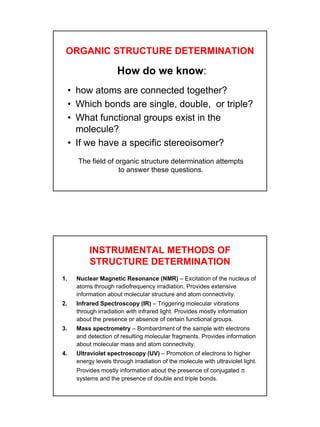
The field of organic structure determination attempts
to answer these questions.
INSTRUMENTAL METHODS OF
STRUCTURE DETERMINATION
1. Nuclear Magnetic Resonance (NMR) – Excitation of the nucleus of
atoms through radiofrequency irradiation. Provides extensive
information about molecular structure and atom connectivity.
2. Infrared Spectroscopy (IR) – Triggering molecular vibrations
through irradiation with infrared light. Provides mostly information
about the presence or absence of certain functional groups.
3. Mass spectrometry – Bombardment of the sample with electrons
and detection of resulting molecular fragments. Provides information
about molecular mass and atom connectivity.
4. Ultraviolet spectroscopy (UV) – Promotion of electrons to higher
energy levels through irradiation of the molecule with ultraviolet light.
Provides mostly information about the presence of conjugated π
systems and the presence of double and triple bonds.
3
Physical
stimulus
Molecule response Detecting
instrument
Visual (most common)
representation, or
Spectrum
SPECTROSCOPY - Study of spectral
information
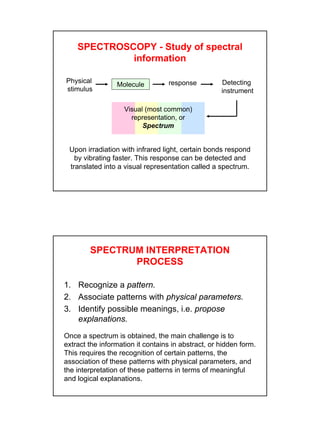
Upon irradiation with infrared light, certain bonds respond
by vibrating faster. This response can be detected and
translated into a visual representation called a spectrum.
SPECTRUM INTERPRETATION
PROCESS
1. Recognize a pattern.
2. Associate patterns with physical parameters.
3. Identify possible meanings, i.e. propose
explanations.
Once a spectrum is obtained, the main challenge is to
extract the information it contains in abstract, or hidden form.
This requires the recognition of certain patterns, the
association of these patterns with physical parameters, and
the interpretation of these patterns in terms of meaningful
and logical explanations.
4
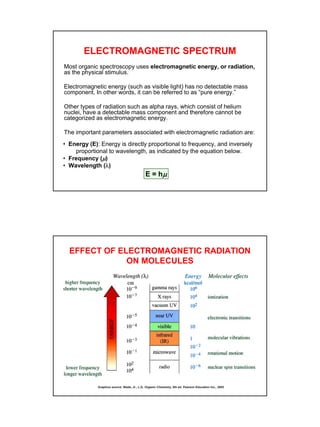
ELECTROMAGNETIC SPECTRUM
Most organic spectroscopy uses electromagnetic energy, or radiation,
as the physical stimulus.
Electromagnetic energy (such as visible light) has no detectable mass
component. In other words, it can be referred to as “pure energy.”
Other types of radiation such as alpha rays, which consist of helium
nuclei, have a detectable mass component and therefore cannot be
categorized as electromagnetic energy.
The important parameters associated with electromagnetic radiation are:
• Energy (E): Energy is directly proportional to frequency, and inversely
proportional to wavelength, as indicated by the equation below.
• Frequency (μ)
• Wavelength (λ)
E = hμ
EFFECT OF ELECTROMAGNETIC RADIATION
ON MOLECULES
Graphics source: Wade, Jr., L.G. Organic Chemistry, 5th ed. Pearson Education Inc., 2003
5
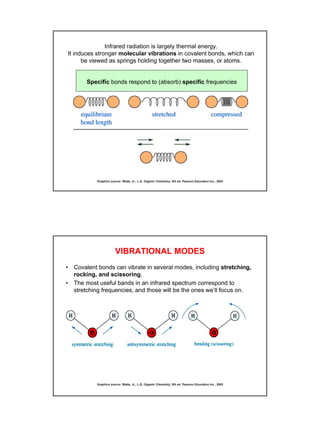
Infrared radiation is largely thermal energy.
It induces stronger molecular vibrations in covalent bonds, which can
be viewed as springs holding together two masses, or atoms.
Graphics source: Wade, Jr., L.G. Organic Chemistry, 5th ed. Pearson Education Inc., 2003
Specific bonds respond to (absorb) specific frequencies
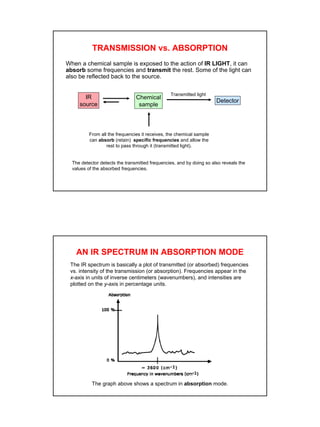
VIBRATIONAL MODES
• Covalent bonds can vibrate in several modes, including stretching,
rocking, and scissoring.
• The most useful bands in an infrared spectrum correspond to
stretching frequencies, and those will be the ones we’ll focus on.
Graphics source: Wade, Jr., L.G. Organic Chemistry, 5th ed. Pearson Education Inc., 2003
6
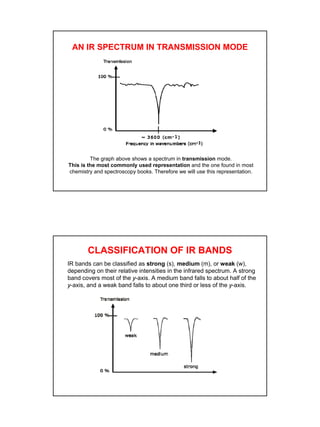
TRANSMISSION vs. ABSORPTION
When a chemical sample is exposed to the action of IR LIGHT, it can
absorb some frequencies and transmit the rest. Some of the light can
also be reflected back to the source.
Chemical
sample
IR
source
Transmitted light
From all the frequencies it receives, the chemical sample
can absorb (retain) specific frequencies and allow the
rest to pass through it (transmitted light).
Detector
The detector detects the transmitted frequencies, and by doing so also reveals the
values of the absorbed frequencies.
AN IR SPECTRUM IN ABSORPTION MODE
The IR spectrum is basically a plot of transmitted (or absorbed) frequencies
vs. intensity of the transmission (or absorption). Frequencies appear in the
x-axis in units of inverse centimeters (wavenumbers), and intensities are
plotted on the y-axis in percentage units.
The graph above shows a spectrum in absorption mode.
7
AN IR SPECTRUM IN TRANSMISSION MODE
The graph above shows a spectrum in transmission mode.
This is the most commonly used representation and the one found in most
chemistry and spectroscopy books. Therefore we will use this representation.
CLASSIFICATION OF IR BANDS
IR bands can be classified as strong (s), medium (m), or weak (w),
depending on their relative intensities in the infrared spectrum. A strong
band covers most of the y-axis. A medium band falls to about half of the
y-axis, and a weak band falls to about one third or less of the y-axis.
8
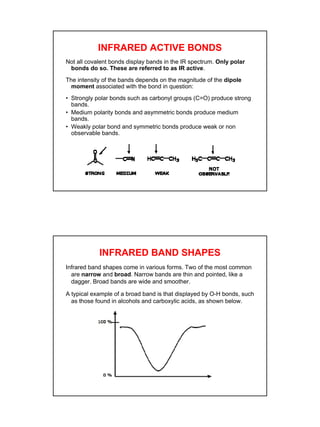
INFRARED ACTIVE BONDS
Not all covalent bonds display bands in the IR spectrum. Only polar
bonds do so. These are referred to as IR active.
The intensity of the bands depends on the magnitude of the dipole
moment associated with the bond in question:
• Strongly polar bonds such as carbonyl groups (C=O) produce strong
bands.
• Medium polarity bonds and asymmetric bonds produce medium
bands.
• Weakly polar bond and symmetric bonds produce weak or non
observable bands.
INFRARED BAND SHAPES
Infrared band shapes come in various forms. Two of the most common
are narrow and broad. Narrow bands are thin and pointed, like a
dagger. Broad bands are wide and smoother.
A typical example of a broad band is that displayed by O-H bonds, such
as those found in alcohols and carboxylic acids, as shown below.
9
INFORMATION OBTAINED FROM IR SPECTRA
• IR is most useful in providing information about the presence or
absence of specific functional groups.
• IR can provide a molecular fingerprint that can be used when
comparing samples. If two pure samples display the same IR
spectrum it can be argued that they are the same compound.
• IR does not provide detailed information or proof of molecular
formula or structure. It provides information on molecular fragments,
specifically functional groups.
• Therefore it is very limited in scope, and must be used in conjunction
with other techniques to provide a more complete picture of the
molecular structure.
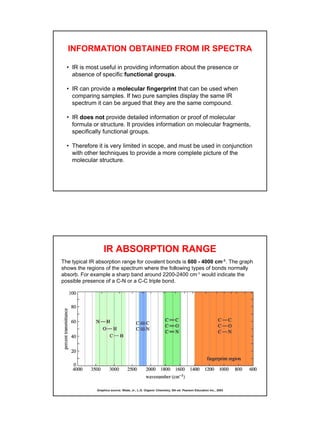
IR ABSORPTION RANGE
The typical IR absorption range for covalent bonds is 600 - 4000 cm-1. The graph
shows the regions of the spectrum where the following types of bonds normally
absorb. For example a sharp band around 2200-2400 cm-1 would indicate the
possible presence of a C-N or a C-C triple bond.
Graphics source: Wade, Jr., L.G. Organic Chemistry, 5th ed. Pearson Education Inc., 2003
10
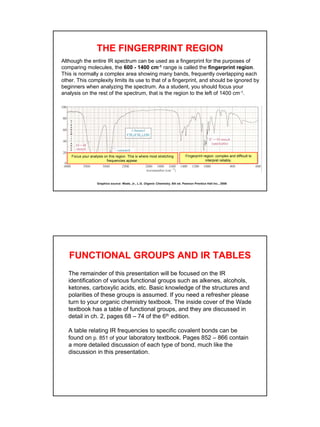
THE FINGERPRINT REGION
Although the entire IR spectrum can be used as a fingerprint for the purposes of
comparing molecules, the 600 - 1400 cm-1 range is called the fingerprint region.
This is normally a complex area showing many bands, frequently overlapping each
other. This complexity limits its use to that of a fingerprint, and should be ignored by
beginners when analyzing the spectrum. As a student, you should focus your
analysis on the rest of the spectrum, that is the region to the left of 1400 cm-1.
Fingerprint region: complex and difficult to
interpret reliably.
Focus your analysis on this region. This is where most stretching
frequencies appear.
Graphics source: Wade, Jr., L.G. Organic Chemistry, 6th ed. Pearson Prentice Hall Inc., 2006
FUNCTIONAL GROUPS AND IR TABLES
The remainder of this presentation will be focused on the IR
identification of various functional groups such as alkenes, alcohols,
ketones, carboxylic acids, etc. Basic knowledge of the structures and
polarities of these groups is assumed. If you need a refresher please
turn to your organic chemistry textbook. The inside cover of the Wade
textbook has a table of functional groups, and they are discussed in
detail in ch. 2, pages 68 – 74 of the 6th edition.
A table relating IR frequencies to specific covalent bonds can be
found on p. 851 of your laboratory textbook. Pages 852 – 866 contain
a more detailed discussion of each type of bond, much like the
discussion in this presentation.
11
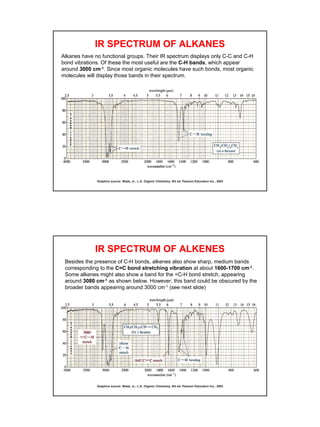
IR SPECTRUM OF ALKANES
Alkanes have no functional groups. Their IR spectrum displays only C-C and C-H
bond vibrations. Of these the most useful are the C-H bands, which appear
around 3000 cm-1. Since most organic molecules have such bonds, most organic
molecules will display those bands in their spectrum.
Graphics source: Wade, Jr., L.G. Organic Chemistry, 5th ed. Pearson Education Inc., 2003
IR SPECTRUM OF ALKENES
Besides the presence of C-H bonds, alkenes also show sharp, medium bands
corresponding to the C=C bond stretching vibration at about 1600-1700 cm-1.
Some alkenes might also show a band for the =C-H bond stretch, appearing
around 3080 cm-1 as shown below. However, this band could be obscured by the
broader bands appearing around 3000 cm-1 (see next slide)
Graphics source: Wade, Jr., L.G. Organic Chemistry, 5th ed. Pearson Education Inc., 2003
12
IR SPECTRUM OF ALKENES
This spectrum shows that the band appearing around 3080 cm-1 can be obscured
by the broader bands appearing around 3000 cm-1.
Graphics source: Wade, Jr., L.G. Organic Chemistry, 6th ed. Pearson Prentice Hall Inc., 2006
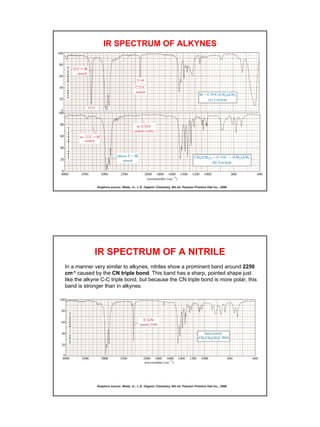
IR SPECTRUM OF ALKYNES
The most prominent band in alkynes corresponds to the carbon-carbon
triple bond. It shows as a sharp, weak band at about 2100 cm-1. The
reason it’s weak is because the triple bond is not very polar. In some
cases, such as in highly symmetrical alkynes, it may not show at all due to
the low polarity of the triple bond associated with those alkynes.
Terminal alkynes, that is to say those where the triple bond is at the end of
a carbon chain, have C-H bonds involving the sp carbon (the carbon that
forms part of the triple bond). Therefore they may also show a sharp, weak
band at about 3300 cm-1 corresponding to the C-H stretch.
Internal alkynes, that is those where the triple bond is in the middle of a
carbon chain, do not have C-H bonds to the sp carbon and therefore lack
the aforementioned band.
The following slide shows a comparison between an unsymmetrical
terminal alkyne (1-octyne) and a symmetrical internal alkyne (4-octyne).
13
IR SPECTRUM OF ALKYNES
Graphics source: Wade, Jr., L.G. Organic Chemistry, 6th ed. Pearson Prentice Hall Inc., 2006
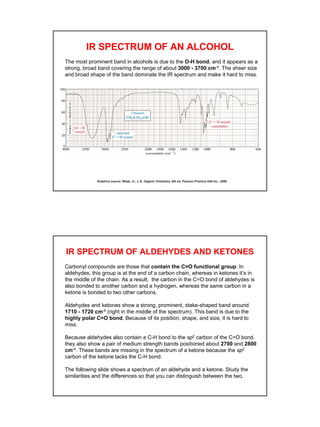
IR SPECTRUM OF A NITRILE
In a manner very similar to alkynes, nitriles show a prominent band around 2250
cm-1 caused by the CN triple bond. This band has a sharp, pointed shape just
like the alkyne C-C triple bond, but because the CN triple bond is more polar, this
band is stronger than in alkynes.
Graphics source: Wade, Jr., L.G. Organic Chemistry, 6th ed. Pearson Prentice Hall Inc., 2006
14
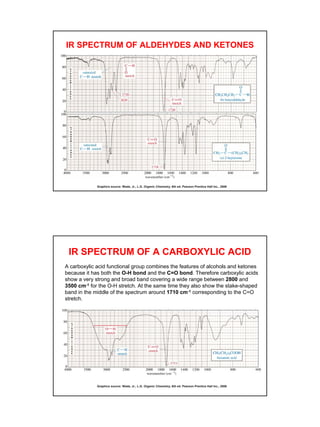
IR SPECTRUM OF AN ALCOHOL
The most prominent band in alcohols is due to the O-H bond, and it appears as a
strong, broad band covering the range of about 3000 - 3700 cm-1. The sheer size
and broad shape of the band dominate the IR spectrum and make it hard to miss.
Graphics source: Wade, Jr., L.G. Organic Chemistry, 6th ed. Pearson Prentice Hall Inc., 2006
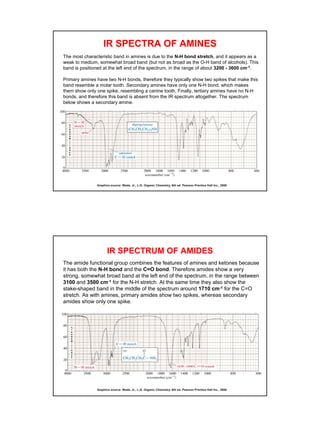
IR SPECTRUM OF ALDEHYDES AND KETONES
Carbonyl compounds are those that contain the C=O functional group. In
aldehydes, this group is at the end of a carbon chain, whereas in ketones it’s in
the middle of the chain. As a result, the carbon in the C=O bond of aldehydes is
also bonded to another carbon and a hydrogen, whereas the same carbon in a
ketone is bonded to two other carbons.
Aldehydes and ketones show a strong, prominent, stake-shaped band around
1710 - 1720 cm-1 (right in the middle of the spectrum). This band is due to the
highly polar C=O bond. Because of its position, shape, and size, it is hard to
miss.
Because aldehydes also contain a C-H bond to the sp2 carbon of the C=O bond,
they also show a pair of medium strength bands positioned about 2700 and 2800
cm-1. These bands are missing in the spectrum of a ketone because the sp2
carbon of the ketone lacks the C-H bond.
The following slide shows a spectrum of an aldehyde and a ketone. Study the
similarities and the differences so that you can distinguish between the two.
15
IR SPECTRUM OF ALDEHYDES AND KETONES
Graphics source: Wade, Jr., L.G. Organic Chemistry, 6th ed. Pearson Prentice Hall Inc., 2006
IR SPECTRUM OF A CARBOXYLIC ACID
A carboxylic acid functional group combines the features of alcohols and ketones
because it has both the O-H bond and the C=O bond. Therefore carboxylic acids
show a very strong and broad band covering a wide range between 2800 and
3500 cm-1 for the O-H stretch. At the same time they also show the stake-shaped
band in the middle of the spectrum around 1710 cm-1 corresponding to the C=O
stretch.
Graphics source: Wade, Jr., L.G. Organic Chemistry, 6th ed. Pearson Prentice Hall Inc., 2006
16
IR SPECTRA OF AMINES
The most characteristic band in amines is due to the N-H bond stretch, and it appears as a
weak to medium, somewhat broad band (but not as broad as the O-H band of alcohols). This
band is positioned at the left end of the spectrum, in the range of about 3200 - 3600 cm-1.
Primary amines have two N-H bonds, therefore they typically show two spikes that make this
band resemble a molar tooth. Secondary amines have only one N-H bond, which makes
them show only one spike, resembling a canine tooth. Finally, tertiary amines have no N-H
bonds, and therefore this band is absent from the IR spectrum altogether. The spectrum
below shows a secondary amine.
Graphics source: Wade, Jr., L.G. Organic Chemistry, 6th ed. Pearson Prentice Hall Inc., 2006
IR SPECTRUM OF AMIDES
The amide functional group combines the features of amines and ketones because
it has both the N-H bond and the C=O bond. Therefore amides show a very
strong, somewhat broad band at the left end of the spectrum, in the range between
3100 and 3500 cm-1 for the N-H stretch. At the same time they also show the
stake-shaped band in the middle of the spectrum around 1710 cm-1 for the C=O
stretch. As with amines, primary amides show two spikes, whereas secondary
amides show only one spike.
Graphics source: Wade, Jr., L.G. Organic Chemistry, 6th ed. Pearson Prentice Hall Inc., 2006
17
IR EXERCISE GUIDELINES
Now that you are an IR whiz, you’re ready to download the IR Interpretation
Exercise posted in Dr. Cortes’ website and work on it. The due date is
indicated in the syllabus. If you have any questions please ask Dr. Cortes or
your lab instructor.
Go to http://utdallas.edu/~scortes/ochem
Have fun, and good luck!

Ir spectroscopy

  • 1.
    1 INFRARED SPECTROSCOPY (IR) Theory andInterpretation of IR spectra ASSIGNED READINGS • Introduction to technique 25 (p. 833-834 in lab textbook) • Uses of the Infrared Spectrum (p. 847-853) • Look over pages 853-866 after viewing this presentation for additional examples of various functional groups. • Emphasis is on data interpretation, not on data memorization.
  • 2.
    2 ORGANIC STRUCTURE DETERMINATION Howdo we know: • how atoms are connected together? • Which bonds are single, double, or triple? • What functional groups exist in the molecule? • If we have a specific stereoisomer? The field of organic structure determination attempts to answer these questions. INSTRUMENTAL METHODS OF STRUCTURE DETERMINATION 1. Nuclear Magnetic Resonance (NMR) – Excitation of the nucleus of atoms through radiofrequency irradiation. Provides extensive information about molecular structure and atom connectivity. 2. Infrared Spectroscopy (IR) – Triggering molecular vibrations through irradiation with infrared light. Provides mostly information about the presence or absence of certain functional groups. 3. Mass spectrometry – Bombardment of the sample with electrons and detection of resulting molecular fragments. Provides information about molecular mass and atom connectivity. 4. Ultraviolet spectroscopy (UV) – Promotion of electrons to higher energy levels through irradiation of the molecule with ultraviolet light. Provides mostly information about the presence of conjugated π systems and the presence of double and triple bonds.
  • 3.
    3 Physical stimulus Molecule response Detecting instrument Visual(most common) representation, or Spectrum SPECTROSCOPY - Study of spectral information Upon irradiation with infrared light, certain bonds respond by vibrating faster. This response can be detected and translated into a visual representation called a spectrum. SPECTRUM INTERPRETATION PROCESS 1. Recognize a pattern. 2. Associate patterns with physical parameters. 3. Identify possible meanings, i.e. propose explanations. Once a spectrum is obtained, the main challenge is to extract the information it contains in abstract, or hidden form. This requires the recognition of certain patterns, the association of these patterns with physical parameters, and the interpretation of these patterns in terms of meaningful and logical explanations.
  • 4.
    4 ELECTROMAGNETIC SPECTRUM Most organicspectroscopy uses electromagnetic energy, or radiation, as the physical stimulus. Electromagnetic energy (such as visible light) has no detectable mass component. In other words, it can be referred to as “pure energy.” Other types of radiation such as alpha rays, which consist of helium nuclei, have a detectable mass component and therefore cannot be categorized as electromagnetic energy. The important parameters associated with electromagnetic radiation are: • Energy (E): Energy is directly proportional to frequency, and inversely proportional to wavelength, as indicated by the equation below. • Frequency (μ) • Wavelength (λ) E = hμ EFFECT OF ELECTROMAGNETIC RADIATION ON MOLECULES Graphics source: Wade, Jr., L.G. Organic Chemistry, 5th ed. Pearson Education Inc., 2003
  • 5.
    5 Infrared radiation islargely thermal energy. It induces stronger molecular vibrations in covalent bonds, which can be viewed as springs holding together two masses, or atoms. Graphics source: Wade, Jr., L.G. Organic Chemistry, 5th ed. Pearson Education Inc., 2003 Specific bonds respond to (absorb) specific frequencies VIBRATIONAL MODES • Covalent bonds can vibrate in several modes, including stretching, rocking, and scissoring. • The most useful bands in an infrared spectrum correspond to stretching frequencies, and those will be the ones we’ll focus on. Graphics source: Wade, Jr., L.G. Organic Chemistry, 5th ed. Pearson Education Inc., 2003
  • 6.
    6 TRANSMISSION vs. ABSORPTION Whena chemical sample is exposed to the action of IR LIGHT, it can absorb some frequencies and transmit the rest. Some of the light can also be reflected back to the source. Chemical sample IR source Transmitted light From all the frequencies it receives, the chemical sample can absorb (retain) specific frequencies and allow the rest to pass through it (transmitted light). Detector The detector detects the transmitted frequencies, and by doing so also reveals the values of the absorbed frequencies. AN IR SPECTRUM IN ABSORPTION MODE The IR spectrum is basically a plot of transmitted (or absorbed) frequencies vs. intensity of the transmission (or absorption). Frequencies appear in the x-axis in units of inverse centimeters (wavenumbers), and intensities are plotted on the y-axis in percentage units. The graph above shows a spectrum in absorption mode.
  • 7.
    7 AN IR SPECTRUMIN TRANSMISSION MODE The graph above shows a spectrum in transmission mode. This is the most commonly used representation and the one found in most chemistry and spectroscopy books. Therefore we will use this representation. CLASSIFICATION OF IR BANDS IR bands can be classified as strong (s), medium (m), or weak (w), depending on their relative intensities in the infrared spectrum. A strong band covers most of the y-axis. A medium band falls to about half of the y-axis, and a weak band falls to about one third or less of the y-axis.
  • 8.
    8 INFRARED ACTIVE BONDS Notall covalent bonds display bands in the IR spectrum. Only polar bonds do so. These are referred to as IR active. The intensity of the bands depends on the magnitude of the dipole moment associated with the bond in question: • Strongly polar bonds such as carbonyl groups (C=O) produce strong bands. • Medium polarity bonds and asymmetric bonds produce medium bands. • Weakly polar bond and symmetric bonds produce weak or non observable bands. INFRARED BAND SHAPES Infrared band shapes come in various forms. Two of the most common are narrow and broad. Narrow bands are thin and pointed, like a dagger. Broad bands are wide and smoother. A typical example of a broad band is that displayed by O-H bonds, such as those found in alcohols and carboxylic acids, as shown below.
  • 9.
    9 INFORMATION OBTAINED FROMIR SPECTRA • IR is most useful in providing information about the presence or absence of specific functional groups. • IR can provide a molecular fingerprint that can be used when comparing samples. If two pure samples display the same IR spectrum it can be argued that they are the same compound. • IR does not provide detailed information or proof of molecular formula or structure. It provides information on molecular fragments, specifically functional groups. • Therefore it is very limited in scope, and must be used in conjunction with other techniques to provide a more complete picture of the molecular structure. IR ABSORPTION RANGE The typical IR absorption range for covalent bonds is 600 - 4000 cm-1. The graph shows the regions of the spectrum where the following types of bonds normally absorb. For example a sharp band around 2200-2400 cm-1 would indicate the possible presence of a C-N or a C-C triple bond. Graphics source: Wade, Jr., L.G. Organic Chemistry, 5th ed. Pearson Education Inc., 2003
  • 10.
    10 THE FINGERPRINT REGION Althoughthe entire IR spectrum can be used as a fingerprint for the purposes of comparing molecules, the 600 - 1400 cm-1 range is called the fingerprint region. This is normally a complex area showing many bands, frequently overlapping each other. This complexity limits its use to that of a fingerprint, and should be ignored by beginners when analyzing the spectrum. As a student, you should focus your analysis on the rest of the spectrum, that is the region to the left of 1400 cm-1. Fingerprint region: complex and difficult to interpret reliably. Focus your analysis on this region. This is where most stretching frequencies appear. Graphics source: Wade, Jr., L.G. Organic Chemistry, 6th ed. Pearson Prentice Hall Inc., 2006 FUNCTIONAL GROUPS AND IR TABLES The remainder of this presentation will be focused on the IR identification of various functional groups such as alkenes, alcohols, ketones, carboxylic acids, etc. Basic knowledge of the structures and polarities of these groups is assumed. If you need a refresher please turn to your organic chemistry textbook. The inside cover of the Wade textbook has a table of functional groups, and they are discussed in detail in ch. 2, pages 68 – 74 of the 6th edition. A table relating IR frequencies to specific covalent bonds can be found on p. 851 of your laboratory textbook. Pages 852 – 866 contain a more detailed discussion of each type of bond, much like the discussion in this presentation.
  • 11.
    11 IR SPECTRUM OFALKANES Alkanes have no functional groups. Their IR spectrum displays only C-C and C-H bond vibrations. Of these the most useful are the C-H bands, which appear around 3000 cm-1. Since most organic molecules have such bonds, most organic molecules will display those bands in their spectrum. Graphics source: Wade, Jr., L.G. Organic Chemistry, 5th ed. Pearson Education Inc., 2003 IR SPECTRUM OF ALKENES Besides the presence of C-H bonds, alkenes also show sharp, medium bands corresponding to the C=C bond stretching vibration at about 1600-1700 cm-1. Some alkenes might also show a band for the =C-H bond stretch, appearing around 3080 cm-1 as shown below. However, this band could be obscured by the broader bands appearing around 3000 cm-1 (see next slide) Graphics source: Wade, Jr., L.G. Organic Chemistry, 5th ed. Pearson Education Inc., 2003
  • 12.
    12 IR SPECTRUM OFALKENES This spectrum shows that the band appearing around 3080 cm-1 can be obscured by the broader bands appearing around 3000 cm-1. Graphics source: Wade, Jr., L.G. Organic Chemistry, 6th ed. Pearson Prentice Hall Inc., 2006 IR SPECTRUM OF ALKYNES The most prominent band in alkynes corresponds to the carbon-carbon triple bond. It shows as a sharp, weak band at about 2100 cm-1. The reason it’s weak is because the triple bond is not very polar. In some cases, such as in highly symmetrical alkynes, it may not show at all due to the low polarity of the triple bond associated with those alkynes. Terminal alkynes, that is to say those where the triple bond is at the end of a carbon chain, have C-H bonds involving the sp carbon (the carbon that forms part of the triple bond). Therefore they may also show a sharp, weak band at about 3300 cm-1 corresponding to the C-H stretch. Internal alkynes, that is those where the triple bond is in the middle of a carbon chain, do not have C-H bonds to the sp carbon and therefore lack the aforementioned band. The following slide shows a comparison between an unsymmetrical terminal alkyne (1-octyne) and a symmetrical internal alkyne (4-octyne).
  • 13.
    13 IR SPECTRUM OFALKYNES Graphics source: Wade, Jr., L.G. Organic Chemistry, 6th ed. Pearson Prentice Hall Inc., 2006 IR SPECTRUM OF A NITRILE In a manner very similar to alkynes, nitriles show a prominent band around 2250 cm-1 caused by the CN triple bond. This band has a sharp, pointed shape just like the alkyne C-C triple bond, but because the CN triple bond is more polar, this band is stronger than in alkynes. Graphics source: Wade, Jr., L.G. Organic Chemistry, 6th ed. Pearson Prentice Hall Inc., 2006
  • 14.
    14 IR SPECTRUM OFAN ALCOHOL The most prominent band in alcohols is due to the O-H bond, and it appears as a strong, broad band covering the range of about 3000 - 3700 cm-1. The sheer size and broad shape of the band dominate the IR spectrum and make it hard to miss. Graphics source: Wade, Jr., L.G. Organic Chemistry, 6th ed. Pearson Prentice Hall Inc., 2006 IR SPECTRUM OF ALDEHYDES AND KETONES Carbonyl compounds are those that contain the C=O functional group. In aldehydes, this group is at the end of a carbon chain, whereas in ketones it’s in the middle of the chain. As a result, the carbon in the C=O bond of aldehydes is also bonded to another carbon and a hydrogen, whereas the same carbon in a ketone is bonded to two other carbons. Aldehydes and ketones show a strong, prominent, stake-shaped band around 1710 - 1720 cm-1 (right in the middle of the spectrum). This band is due to the highly polar C=O bond. Because of its position, shape, and size, it is hard to miss. Because aldehydes also contain a C-H bond to the sp2 carbon of the C=O bond, they also show a pair of medium strength bands positioned about 2700 and 2800 cm-1. These bands are missing in the spectrum of a ketone because the sp2 carbon of the ketone lacks the C-H bond. The following slide shows a spectrum of an aldehyde and a ketone. Study the similarities and the differences so that you can distinguish between the two.
  • 15.
    15 IR SPECTRUM OFALDEHYDES AND KETONES Graphics source: Wade, Jr., L.G. Organic Chemistry, 6th ed. Pearson Prentice Hall Inc., 2006 IR SPECTRUM OF A CARBOXYLIC ACID A carboxylic acid functional group combines the features of alcohols and ketones because it has both the O-H bond and the C=O bond. Therefore carboxylic acids show a very strong and broad band covering a wide range between 2800 and 3500 cm-1 for the O-H stretch. At the same time they also show the stake-shaped band in the middle of the spectrum around 1710 cm-1 corresponding to the C=O stretch. Graphics source: Wade, Jr., L.G. Organic Chemistry, 6th ed. Pearson Prentice Hall Inc., 2006
  • 16.
    16 IR SPECTRA OFAMINES The most characteristic band in amines is due to the N-H bond stretch, and it appears as a weak to medium, somewhat broad band (but not as broad as the O-H band of alcohols). This band is positioned at the left end of the spectrum, in the range of about 3200 - 3600 cm-1. Primary amines have two N-H bonds, therefore they typically show two spikes that make this band resemble a molar tooth. Secondary amines have only one N-H bond, which makes them show only one spike, resembling a canine tooth. Finally, tertiary amines have no N-H bonds, and therefore this band is absent from the IR spectrum altogether. The spectrum below shows a secondary amine. Graphics source: Wade, Jr., L.G. Organic Chemistry, 6th ed. Pearson Prentice Hall Inc., 2006 IR SPECTRUM OF AMIDES The amide functional group combines the features of amines and ketones because it has both the N-H bond and the C=O bond. Therefore amides show a very strong, somewhat broad band at the left end of the spectrum, in the range between 3100 and 3500 cm-1 for the N-H stretch. At the same time they also show the stake-shaped band in the middle of the spectrum around 1710 cm-1 for the C=O stretch. As with amines, primary amides show two spikes, whereas secondary amides show only one spike. Graphics source: Wade, Jr., L.G. Organic Chemistry, 6th ed. Pearson Prentice Hall Inc., 2006
  • 17.
    17 IR EXERCISE GUIDELINES Nowthat you are an IR whiz, you’re ready to download the IR Interpretation Exercise posted in Dr. Cortes’ website and work on it. The due date is indicated in the syllabus. If you have any questions please ask Dr. Cortes or your lab instructor. Go to http://utdallas.edu/~scortes/ochem Have fun, and good luck!