MICROWAVE
DIATHERMY
Microwave Diathermy
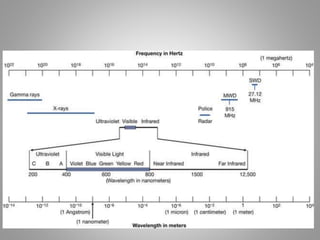
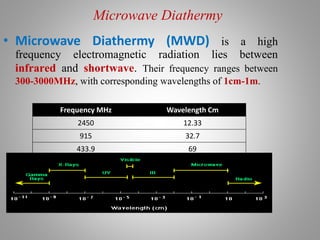
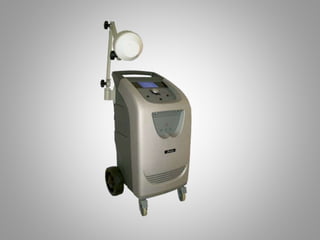
• Microwave Diathermy (MWD) is a high
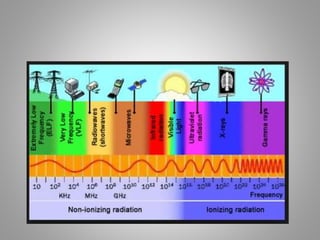
frequency electromagnetic radiation lies between
infrared and shortwave. Their frequency ranges between
300-3000MHz, with corresponding wavelengths of 1cm-1m.
Frequency MHz Wavelength Cm
2450 12.33
915 32.7
433.9 69
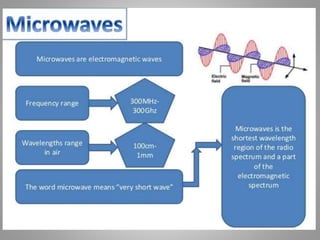
• Microwaves are extremely high frequency
radio-waves.
• In a mobile phone, they are made by a
transmitter chip and antenna.
• In microwave diathermy and in microwave
oven they are made by a “magnetron”.
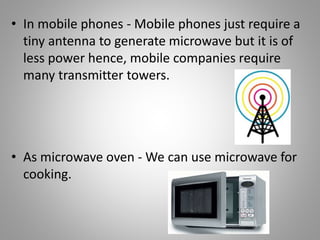
• In mobile phones - Mobile phones just require a
tiny antenna to generate microwave but it is of
less power hence, mobile companies require
many transmitter towers.
• As microwave oven - We can use microwave for
cooking.
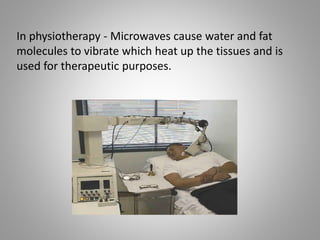
In physiotherapy - Microwaves cause water and fat
molecules to vibrate which heat up the tissues and is
used for therapeutic purposes.
DIFFERENT FREQUENCES
• Microwave diathermy (2450 MHz) reached
therapeutic values at 1.85 cm with skin
temperature above 45C.
• Microwave diathermy (915 MHz with surface
cooling, a prototype of modern hyperthermia
machines) reached therapeutic values from 1
to 4 cm below the skin surface, keeping the
skin temperature under 36C
Microwave Diathermy (decimeter waves)
• MWD is irradiation of tissues with radiation in shorter
wireless electromagnetic spectrum (Hertzian rays).
• Wave length is between infra red and Short Wave
Diathermy i.e. 1-100cm.
• It can penetrate deep into the tissue to some extent
and strongly absorbed by water and high vascular
tissues.
• Most commonly used wavelength- 12.25 cm
frequency- 2450 MHz.
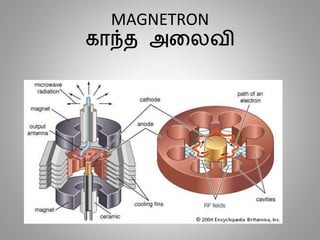
MAGNETRON
காந்த அலைவி
• The magnetron is characterized by a centrally
placed cathode (high emission material)
supported by filament in the center and a
surrounding circular metal (copper) anode.
• In magnetron electrons flow through the donut
like construction with tiny holes, in a manner
similar to air being blown across the top of an
empty bottle, creating a frequency response,
that varies depending upon the velocity and
driving force of electron flow.
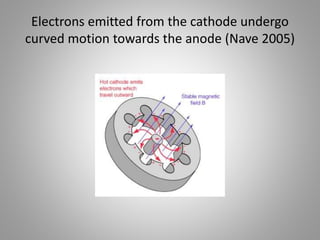
Electrons emitted from the cathode undergo
curved motion towards the anode (Nave 2005)
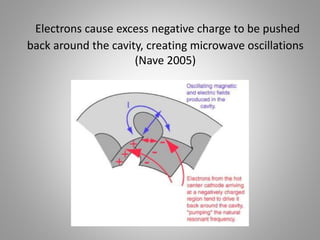
Electrons cause excess negative charge to be pushed
back around the cavity, creating microwave oscillations
(Nave 2005)
• Magnetron requires time to warm up so
output is not obtained immediately.
• A stand-by switch should be provided for use
between treatments – this enables the output
circuit to be disconnected without cutting off
the current to the valves, so repeated heating
and cooling of valve is avoided.
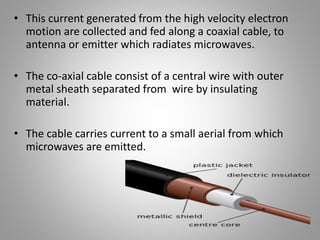
• This current generated from the high velocity electron
motion are collected and fed along a coaxial cable, to
antenna or emitter which radiates microwaves.
• The co-axial cable consist of a central wire with outer
metal sheath separated from wire by insulating
material.
• The cable carries current to a small aerial from which
microwaves are emitted.
• The aerial is mounted in a reflector which is
packed with some material which transmit the
waves and forming solid unit.
• The whole device is used to transmits the
waves onto the tissues and termed as emitter,
director or applicator.
• Microwaves are subjected to reflection,
refraction, interference and absorption.
• As with short wave diathermy, microwaves can
interfere with radio communications so
generator must be constructed so as to
minimize interference.
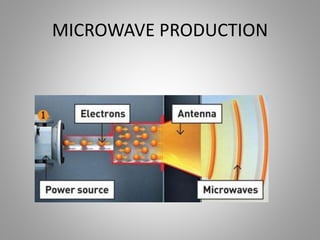
MICROWAVE PRODUCTION
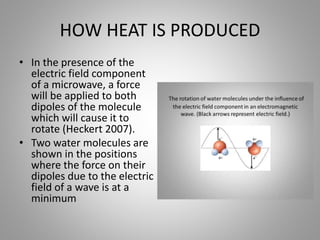
HOW HEAT IS PRODUCED
• In the presence of the
electric field component
of a microwave, a force
will be applied to both
dipoles of the molecule
which will cause it to
rotate (Heckert 2007).
• Two water molecules are
shown in the positions
where the force on their
dipoles due to the electric
field of a wave is at a
minimum
Application of microwaves
• Magnetron requires times to warm up so output is not
obtained immediately the apparatus is switched on, a stand
by switch should be provided for use between treatments.
• Select the particular emitter required depending on the size
and nature of the area to be treated.
• Various types of emitters are used.
• Most commonly rectangular or circular emitter is used.
• These are placed at a distance from the body and the waves
pass through the intervening air to reach the tissue.
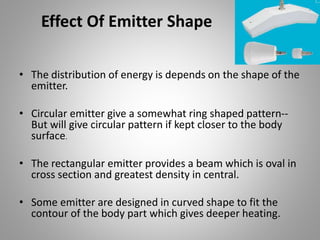
Effect Of Emitter Shape
• The distribution of energy is depends on the shape of the
emitter.
• Circular emitter give a somewhat ring shaped pattern--
But will give circular pattern if kept closer to the body
surface.
• The rectangular emitter provides a beam which is oval in
cross section and greatest density in central.
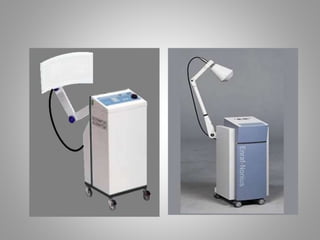
• Some emitter are designed in curved shape to fit the
contour of the body part which gives deeper heating.
Contact emitters
• They are quite small 1.5 or 3.5 cm in diameter.
• Microwave transmission is better in contact
emitters.
• If the skin is water or air cooled higher out put
can be achieved.
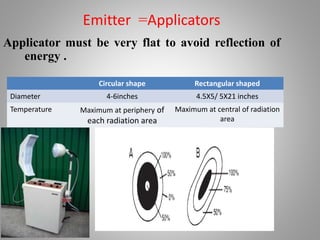
Emitter =Applicators
Applicator must be very flat to avoid reflection of
energy .
Circular shape Rectangular shaped
Diameter 4-6inches 4.5X5/ 5X21 inches
Temperature Maximum at periphery of
each radiation area
Maximum at central of radiation
area
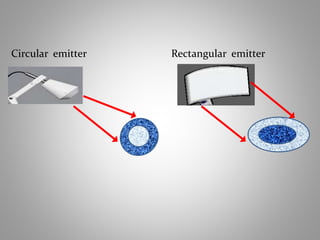
• The circular emitter gives a beam of rays which
is circular in cross - section and is more dense in
periphery than in center.
• The rectangular emitter provides a beam which
is oval in cross - section and greatest density in
centrally.
• In both cases rays given off from emitter
diverge, so that their density becomes less as
the distance from the emitter increases.
Circular emitter Rectangular emitter
• Reduction in intensity of beam is also caused by
absorption of the rays.
• The distance from the skin at which these
emitters are used depends on,
Particular emitter
Output of the generator
Structure to be treated
• Commonly it is – between 10 and 20 cm.
LARGER AREA
GREATER DISTANCE
HENCE, GREATER OUTPUT IS REQUIRED
• Small emitters are kept in contact with the
tissues for the treatment of cavities.
• An emitter with concave surface which fits
round the body gives deeper effect.
Physiological effects
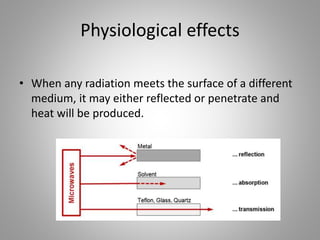
• When any radiation meets the surface of a different
medium, it may either reflected or penetrate and
heat will be produced.
Physiological effects
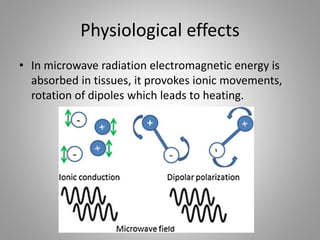
• In microwave radiation electromagnetic energy is
absorbed in tissues, it provokes ionic movements,
rotation of dipoles which leads to heating.
Physiological effects
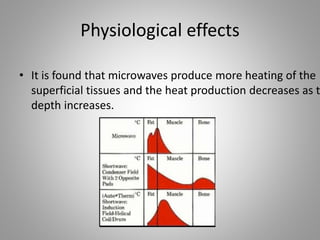
• It is found that microwaves produce more heating of the
superficial tissues and the heat production decreases as t
depth increases.
Physiological Effects
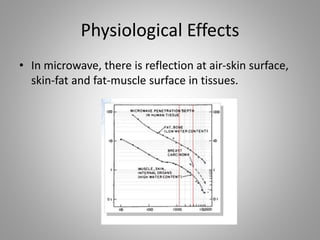
• In microwave, there is reflection at air-skin surface,
skin-fat and fat-muscle surface in tissues.
Physiological Effects
• Thus effects are deeper than infra-red rays but
less suitable for deeply placed structures as
they do not pass right through the tissues in
any appreciable density like electric field used
in short wave diathermy.
Physiological effects
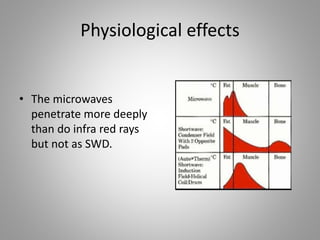
• The microwaves
penetrate more deeply
than do infra red rays
but not as SWD.
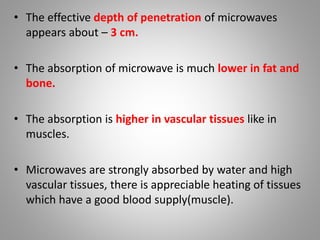
• The effective depth of penetration of microwaves
appears about – 3 cm.
• The absorption of microwave is much lower in fat and
bone.
• The absorption is higher in vascular tissues like in
muscles.
• Microwaves are strongly absorbed by water and high
vascular tissues, there is appreciable heating of tissues
which have a good blood supply(muscle).
Morphological Effects
• The shape of the tissue to which the microwave
beam is being applied will have significant effects
due to both reflection and refraction
• The reflection of the microwaves will be more if
the microwave radiations are not applied
perpendicular to the skin surface
• Radiations passing through the skin are subject
to refraction as the wave velocity decreases from
air ------ skin ------ fat ------ muscle.
Heating Effects
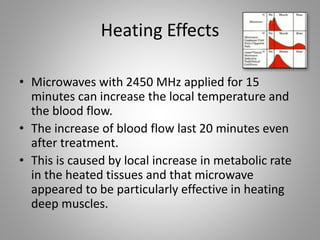
• Microwaves with 2450 MHz applied for 15
minutes can increase the local temperature and
the blood flow.
• The increase of blood flow last 20 minutes even
after treatment.
• This is caused by local increase in metabolic rate
in the heated tissues and that microwave
appeared to be particularly effective in heating
deep muscles.
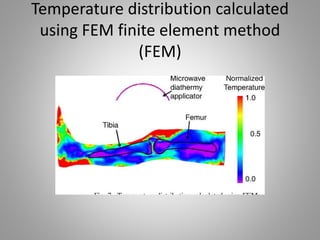
Temperature distribution calculated
using FEM finite element method
(FEM)
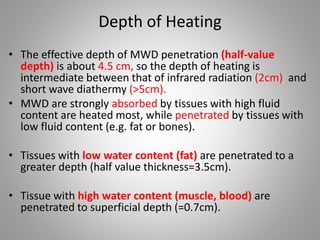
Depth of Heating
• The effective depth of MWD penetration (half-value
depth) is about 4.5 cm, so the depth of heating is
intermediate between that of infrared radiation (2cm) and
short wave diathermy (>5cm).
• MWD are strongly absorbed by tissues with high fluid
content are heated most, while penetrated by tissues with
low fluid content (e.g. fat or bones).
• Tissues with low water content (fat) are penetrated to a
greater depth (half value thickness=3.5cm).
• Tissue with high water content (muscle, blood) are
penetrated to superficial depth (=0.7cm).
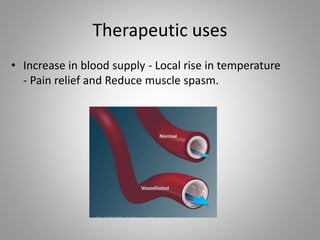
Therapeutic uses
• Increase in blood supply - Local rise in temperature
- Pain relief and Reduce muscle spasm.
Therapeutic Uses
• It is most commonly used for lesions of the
superficial tissues as well as localised problems.
• The presence of emitter and short wave length of
microwave radiations allow this type of
diathermy to be focused and applied to small,
defined areas. Therefore these devices can be
useful during rehabilitation when small areas of
tissue are involved.
Therapeutic uses
• Suitable for the treatment of traumatic and
rheumatic conditions affecting the soft tissues
and small superficial joints.
• In treating bacterial infections – increase in blood
supply brings more white blood cells and
antibodies to the area and reinforces the body’s
normal defence mechanism.
• In lengthening of tissue when combined with
stretching.
Dosage
• Treatment is usually ranges from 10 - 30
minutes.
• Acute : 5-10 minutes/ Chronic: 15-30 minutes
• Deeper tissues take longer time to reach the
maximum heating.
Treatment Parameters
SPACING OF APPLICATORS
 For small treatment area is 2-6cm
 For large treatment area is 10-15cm
The MWD requires warm-up period of 4 minutes, to allowed the
magnetron to develop enough energy
INTENSITY OF TREATMENT
 Sensation of warmth
 Feel no more than a mild comfortable warmth.
TRIM OF TREATMENT: 20 -30minutes
FREQUENCY OF TREATMENT:
daily or alternating days depending on
 Response to treatment
 Patients condition/availability
Dangers Of Microwave Diathermy
• Burns
Because of excessive heat production.
Water is heated rapidly by waves so, skin must
be dry.
Concentration of waves cause over heating
when emitter is unevenly placed.
Metal objects should be removed from the
part.
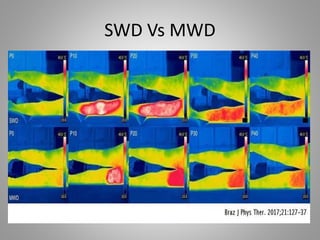
SWD Vs MWD
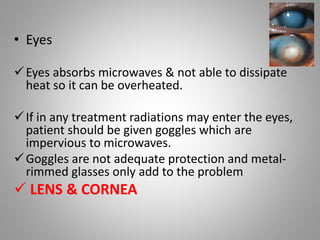
• Eyes
Eyes absorbs microwaves & not able to dissipate
heat so it can be overheated.
If in any treatment radiations may enter the eyes,
patient should be given goggles which are
impervious to microwaves.
Goggles are not adequate protection and metal-
rimmed glasses only add to the problem
 LENS & CORNEA
• Cardiac pacemaker
Frequency of cardiac pacemaker is affected
when applied directly to that region.
• Pregnancy
It should not be given to pregnant uterus.
Damage to equipment
• Damage to magnetron results from leaving the
apparatus on with the emitter facing a metal
plate which reflects the waves.
• According Delpizzo and Joyner (1987), atleast 2
meter distance between machines is normally
adequate to avoid exceeding agreed safety limits.
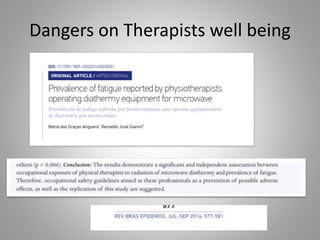
Dangers on Therapists well being
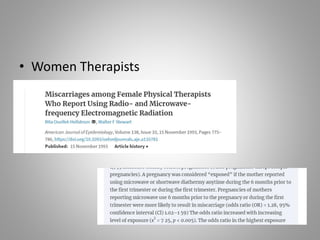
• Women Therapists
Recommendations for Therapists
• Delpizzo and Joyner (1987) recommended
remaining at distances of 2 m from the
applicator and avoiding the direct beam.
• Martin eta/ (1990, 1991) suggest that
therapists rarely stay in the field long enough
to exceed the recommended whole body
safety limits suggested by the NRPB
(1989),provided they do not stand directly
adjacent t o the machine.
Contraindications
• Diminished thermal sensations
• Circulatory defects: Such as hemorrhage, thrombosis,
phlebitis and other vascular lesions.
• Acute inflammation
• Recent hemorrhage
• Malignancy
• Intrauterine devices
• Implanted cardiac pacemakers
• Eyes and testes, due to poor heat dissipation and
opacity of the lens of the eye
• Pregnant uterus
• Metal in area under treatment
• Genital area (sterility).
Treatment procedures:
Selection of the treatment head (Director):
- Circular: In which heat is denser at the
periphery more than at the center. Two sizes of
circular directors are available:
-Small: for small areas.
-Large: for large areas.
- Rectangular: for elongated areas.
• Director depends on the shape and the
anatomical configuration of the treated area.
Preparation of the patient:
• The target area should be bare skin.
• Clean the skin thoroughly.
• Choose the comfortable position for the
patient.
• No towel is needed.
Monitoring the treatment:
• The target distance will determine the power
levels, as the closer the director to the skin,
the lower the power levels and vice-versa.
• A warm-up period must be allowed to permit
the magnetron to develop enough efficiency.
• The desired sensation of the patient is gentle
warmth. Thus, reports of hot spots should be
attended immediately either by reducing the
power or increasing the distance.
Technique of application
Preparation of apparatus
• Testing the apparatus by physiotherapist by
keeping the dorsum of the hand in front of the
emitter and increasing the output until a
sensation of warmth is experienced.
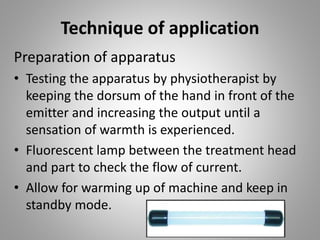
• Fluorescent lamp between the treatment head
and part to check the flow of current.
• Allow for warming up of machine and keep in
standby mode.
Preparation of the patient
• Nature of the treatment should be explained.
• Giving comfortable position to the patient.
• Wire mesh goggles to protect eyes.
• Check the thermal sensitivity of the patient.
• Patient is warned to avoid excessive movement once
the emitter has been arranged.
• To inform immediately if heating is excessive.
Preparation of the part
• The patient should be positioned so that the
area is comfortably supported & exposed.
• It should not be applied through clothing or
where there is metal.
• Its wise to use wooden furnitures otherwise
metal may reflect the radiations
Setting-up
• Position the emitter so that the radiations
strike at right angle(90 ̊)over skin.
• If a small area is to be treated, emitter should
be placed close to the skin at 2-5 cm.
• If larger area is to be treated, spacing can be
increased to 10-15 cm.
• Distance of 10 cm is most commonly used.
• Application of emitter – emitter is arranged so
that its surface is parallel to the skin and at
appropriate distance.
• Irradiation – patient is reminded of the sensation to
be expected and need to report accurately.
• Output is increased slowly until a sensation of
warmth is experienced.
• Physiotherapist should visiting the patient
frequently to ensure any discomfort.
Termination of the treatment
• Output is reduced and switched off. After
switching off remove the apparatus.
• The treated area is examined for skin
temperature and the presence of erythema.
General Guideline & Safety When Using MWD
1. Question patients (contraindications and previous treatment).
2. Position patient ( comfort, support, relaxed).
3. Inspect part to be treated (check for skin rashes, infection, or open
wound).
4. If indicated, drape area with toweling.
5. Place Applicator on treated area then switch on the machine.
6. Set pulse duration, pulse frequency, treatment time, and adjust
intensity.
7. Periodically ask patient if heating is too vigorous.
8. When timer shuts off, terminating the treatment and turn all dials to
zero.
9. Assess treatment efficiency ( inspect area, feedback from patients ).
10. Record treatment parameters
THANK
YOU

Microwave diathermy for physiotherapists

  • 1.
  • 7.
    Microwave Diathermy • MicrowaveDiathermy (MWD) is a high frequency electromagnetic radiation lies between infrared and shortwave. Their frequency ranges between 300-3000MHz, with corresponding wavelengths of 1cm-1m. Frequency MHz Wavelength Cm 2450 12.33 915 32.7 433.9 69
  • 9.
    • Microwaves areextremely high frequency radio-waves. • In a mobile phone, they are made by a transmitter chip and antenna. • In microwave diathermy and in microwave oven they are made by a “magnetron”.
  • 10.
    • In mobilephones - Mobile phones just require a tiny antenna to generate microwave but it is of less power hence, mobile companies require many transmitter towers. • As microwave oven - We can use microwave for cooking.
  • 11.
    In physiotherapy -Microwaves cause water and fat molecules to vibrate which heat up the tissues and is used for therapeutic purposes.
  • 12.
    DIFFERENT FREQUENCES • Microwavediathermy (2450 MHz) reached therapeutic values at 1.85 cm with skin temperature above 45C. • Microwave diathermy (915 MHz with surface cooling, a prototype of modern hyperthermia machines) reached therapeutic values from 1 to 4 cm below the skin surface, keeping the skin temperature under 36C
  • 14.
    Microwave Diathermy (decimeterwaves) • MWD is irradiation of tissues with radiation in shorter wireless electromagnetic spectrum (Hertzian rays). • Wave length is between infra red and Short Wave Diathermy i.e. 1-100cm. • It can penetrate deep into the tissue to some extent and strongly absorbed by water and high vascular tissues. • Most commonly used wavelength- 12.25 cm frequency- 2450 MHz.
  • 15.
  • 16.
    • The magnetronis characterized by a centrally placed cathode (high emission material) supported by filament in the center and a surrounding circular metal (copper) anode. • In magnetron electrons flow through the donut like construction with tiny holes, in a manner similar to air being blown across the top of an empty bottle, creating a frequency response, that varies depending upon the velocity and driving force of electron flow.
  • 17.
    Electrons emitted fromthe cathode undergo curved motion towards the anode (Nave 2005)
  • 18.
    Electrons cause excessnegative charge to be pushed back around the cavity, creating microwave oscillations (Nave 2005)
  • 19.
    • Magnetron requirestime to warm up so output is not obtained immediately. • A stand-by switch should be provided for use between treatments – this enables the output circuit to be disconnected without cutting off the current to the valves, so repeated heating and cooling of valve is avoided.
  • 20.
    • This currentgenerated from the high velocity electron motion are collected and fed along a coaxial cable, to antenna or emitter which radiates microwaves. • The co-axial cable consist of a central wire with outer metal sheath separated from wire by insulating material. • The cable carries current to a small aerial from which microwaves are emitted.
  • 21.
    • The aerialis mounted in a reflector which is packed with some material which transmit the waves and forming solid unit. • The whole device is used to transmits the waves onto the tissues and termed as emitter, director or applicator. • Microwaves are subjected to reflection, refraction, interference and absorption.
  • 22.
    • As withshort wave diathermy, microwaves can interfere with radio communications so generator must be constructed so as to minimize interference.
  • 23.
  • 24.
    HOW HEAT ISPRODUCED • In the presence of the electric field component of a microwave, a force will be applied to both dipoles of the molecule which will cause it to rotate (Heckert 2007). • Two water molecules are shown in the positions where the force on their dipoles due to the electric field of a wave is at a minimum
  • 25.
    Application of microwaves •Magnetron requires times to warm up so output is not obtained immediately the apparatus is switched on, a stand by switch should be provided for use between treatments. • Select the particular emitter required depending on the size and nature of the area to be treated. • Various types of emitters are used. • Most commonly rectangular or circular emitter is used. • These are placed at a distance from the body and the waves pass through the intervening air to reach the tissue.
  • 26.
    Effect Of EmitterShape • The distribution of energy is depends on the shape of the emitter. • Circular emitter give a somewhat ring shaped pattern-- But will give circular pattern if kept closer to the body surface. • The rectangular emitter provides a beam which is oval in cross section and greatest density in central. • Some emitter are designed in curved shape to fit the contour of the body part which gives deeper heating.
  • 27.
    Contact emitters • Theyare quite small 1.5 or 3.5 cm in diameter. • Microwave transmission is better in contact emitters. • If the skin is water or air cooled higher out put can be achieved.
  • 28.
    Emitter =Applicators Applicator mustbe very flat to avoid reflection of energy . Circular shape Rectangular shaped Diameter 4-6inches 4.5X5/ 5X21 inches Temperature Maximum at periphery of each radiation area Maximum at central of radiation area
  • 29.
    • The circularemitter gives a beam of rays which is circular in cross - section and is more dense in periphery than in center. • The rectangular emitter provides a beam which is oval in cross - section and greatest density in centrally. • In both cases rays given off from emitter diverge, so that their density becomes less as the distance from the emitter increases.
  • 30.
  • 31.
    • Reduction inintensity of beam is also caused by absorption of the rays. • The distance from the skin at which these emitters are used depends on, Particular emitter Output of the generator Structure to be treated • Commonly it is – between 10 and 20 cm.
  • 32.
    LARGER AREA GREATER DISTANCE HENCE,GREATER OUTPUT IS REQUIRED
  • 33.
    • Small emittersare kept in contact with the tissues for the treatment of cavities. • An emitter with concave surface which fits round the body gives deeper effect.
  • 35.
    Physiological effects • Whenany radiation meets the surface of a different medium, it may either reflected or penetrate and heat will be produced.
  • 36.
    Physiological effects • Inmicrowave radiation electromagnetic energy is absorbed in tissues, it provokes ionic movements, rotation of dipoles which leads to heating.
  • 37.
    Physiological effects • Itis found that microwaves produce more heating of the superficial tissues and the heat production decreases as t depth increases.
  • 38.
    Physiological Effects • Inmicrowave, there is reflection at air-skin surface, skin-fat and fat-muscle surface in tissues.
  • 39.
    Physiological Effects • Thuseffects are deeper than infra-red rays but less suitable for deeply placed structures as they do not pass right through the tissues in any appreciable density like electric field used in short wave diathermy.
  • 40.
    Physiological effects • Themicrowaves penetrate more deeply than do infra red rays but not as SWD.
  • 41.
    • The effectivedepth of penetration of microwaves appears about – 3 cm. • The absorption of microwave is much lower in fat and bone. • The absorption is higher in vascular tissues like in muscles. • Microwaves are strongly absorbed by water and high vascular tissues, there is appreciable heating of tissues which have a good blood supply(muscle).
  • 42.
    Morphological Effects • Theshape of the tissue to which the microwave beam is being applied will have significant effects due to both reflection and refraction • The reflection of the microwaves will be more if the microwave radiations are not applied perpendicular to the skin surface • Radiations passing through the skin are subject to refraction as the wave velocity decreases from air ------ skin ------ fat ------ muscle.
  • 43.
    Heating Effects • Microwaveswith 2450 MHz applied for 15 minutes can increase the local temperature and the blood flow. • The increase of blood flow last 20 minutes even after treatment. • This is caused by local increase in metabolic rate in the heated tissues and that microwave appeared to be particularly effective in heating deep muscles.
  • 44.
    Temperature distribution calculated usingFEM finite element method (FEM)
  • 45.
    Depth of Heating •The effective depth of MWD penetration (half-value depth) is about 4.5 cm, so the depth of heating is intermediate between that of infrared radiation (2cm) and short wave diathermy (>5cm). • MWD are strongly absorbed by tissues with high fluid content are heated most, while penetrated by tissues with low fluid content (e.g. fat or bones). • Tissues with low water content (fat) are penetrated to a greater depth (half value thickness=3.5cm). • Tissue with high water content (muscle, blood) are penetrated to superficial depth (=0.7cm).
  • 46.
    Therapeutic uses • Increasein blood supply - Local rise in temperature - Pain relief and Reduce muscle spasm.
  • 47.
    Therapeutic Uses • Itis most commonly used for lesions of the superficial tissues as well as localised problems. • The presence of emitter and short wave length of microwave radiations allow this type of diathermy to be focused and applied to small, defined areas. Therefore these devices can be useful during rehabilitation when small areas of tissue are involved.
  • 48.
    Therapeutic uses • Suitablefor the treatment of traumatic and rheumatic conditions affecting the soft tissues and small superficial joints. • In treating bacterial infections – increase in blood supply brings more white blood cells and antibodies to the area and reinforces the body’s normal defence mechanism. • In lengthening of tissue when combined with stretching.
  • 49.
    Dosage • Treatment isusually ranges from 10 - 30 minutes. • Acute : 5-10 minutes/ Chronic: 15-30 minutes • Deeper tissues take longer time to reach the maximum heating.
  • 50.
    Treatment Parameters SPACING OFAPPLICATORS  For small treatment area is 2-6cm  For large treatment area is 10-15cm The MWD requires warm-up period of 4 minutes, to allowed the magnetron to develop enough energy INTENSITY OF TREATMENT  Sensation of warmth  Feel no more than a mild comfortable warmth. TRIM OF TREATMENT: 20 -30minutes FREQUENCY OF TREATMENT: daily or alternating days depending on  Response to treatment  Patients condition/availability
  • 51.
    Dangers Of MicrowaveDiathermy • Burns Because of excessive heat production. Water is heated rapidly by waves so, skin must be dry. Concentration of waves cause over heating when emitter is unevenly placed. Metal objects should be removed from the part.
  • 52.
  • 53.
    • Eyes Eyes absorbsmicrowaves & not able to dissipate heat so it can be overheated. If in any treatment radiations may enter the eyes, patient should be given goggles which are impervious to microwaves. Goggles are not adequate protection and metal- rimmed glasses only add to the problem  LENS & CORNEA
  • 54.
    • Cardiac pacemaker Frequencyof cardiac pacemaker is affected when applied directly to that region. • Pregnancy It should not be given to pregnant uterus.
  • 55.
    Damage to equipment •Damage to magnetron results from leaving the apparatus on with the emitter facing a metal plate which reflects the waves. • According Delpizzo and Joyner (1987), atleast 2 meter distance between machines is normally adequate to avoid exceeding agreed safety limits.
  • 56.
  • 57.
  • 58.
    Recommendations for Therapists •Delpizzo and Joyner (1987) recommended remaining at distances of 2 m from the applicator and avoiding the direct beam. • Martin eta/ (1990, 1991) suggest that therapists rarely stay in the field long enough to exceed the recommended whole body safety limits suggested by the NRPB (1989),provided they do not stand directly adjacent t o the machine.
  • 59.
    Contraindications • Diminished thermalsensations • Circulatory defects: Such as hemorrhage, thrombosis, phlebitis and other vascular lesions. • Acute inflammation • Recent hemorrhage • Malignancy • Intrauterine devices • Implanted cardiac pacemakers • Eyes and testes, due to poor heat dissipation and opacity of the lens of the eye • Pregnant uterus • Metal in area under treatment • Genital area (sterility).
  • 60.
    Treatment procedures: Selection ofthe treatment head (Director): - Circular: In which heat is denser at the periphery more than at the center. Two sizes of circular directors are available: -Small: for small areas. -Large: for large areas. - Rectangular: for elongated areas. • Director depends on the shape and the anatomical configuration of the treated area.
  • 61.
    Preparation of thepatient: • The target area should be bare skin. • Clean the skin thoroughly. • Choose the comfortable position for the patient. • No towel is needed.
  • 62.
    Monitoring the treatment: •The target distance will determine the power levels, as the closer the director to the skin, the lower the power levels and vice-versa. • A warm-up period must be allowed to permit the magnetron to develop enough efficiency. • The desired sensation of the patient is gentle warmth. Thus, reports of hot spots should be attended immediately either by reducing the power or increasing the distance.
  • 63.
    Technique of application Preparationof apparatus • Testing the apparatus by physiotherapist by keeping the dorsum of the hand in front of the emitter and increasing the output until a sensation of warmth is experienced. • Fluorescent lamp between the treatment head and part to check the flow of current. • Allow for warming up of machine and keep in standby mode.
  • 64.
    Preparation of thepatient • Nature of the treatment should be explained. • Giving comfortable position to the patient. • Wire mesh goggles to protect eyes. • Check the thermal sensitivity of the patient. • Patient is warned to avoid excessive movement once the emitter has been arranged. • To inform immediately if heating is excessive.
  • 65.
    Preparation of thepart • The patient should be positioned so that the area is comfortably supported & exposed. • It should not be applied through clothing or where there is metal. • Its wise to use wooden furnitures otherwise metal may reflect the radiations
  • 66.
    Setting-up • Position theemitter so that the radiations strike at right angle(90 ̊)over skin. • If a small area is to be treated, emitter should be placed close to the skin at 2-5 cm. • If larger area is to be treated, spacing can be increased to 10-15 cm. • Distance of 10 cm is most commonly used.
  • 67.
    • Application ofemitter – emitter is arranged so that its surface is parallel to the skin and at appropriate distance. • Irradiation – patient is reminded of the sensation to be expected and need to report accurately. • Output is increased slowly until a sensation of warmth is experienced. • Physiotherapist should visiting the patient frequently to ensure any discomfort.
  • 68.
    Termination of thetreatment • Output is reduced and switched off. After switching off remove the apparatus. • The treated area is examined for skin temperature and the presence of erythema.
  • 69.
    General Guideline &Safety When Using MWD 1. Question patients (contraindications and previous treatment). 2. Position patient ( comfort, support, relaxed). 3. Inspect part to be treated (check for skin rashes, infection, or open wound). 4. If indicated, drape area with toweling. 5. Place Applicator on treated area then switch on the machine. 6. Set pulse duration, pulse frequency, treatment time, and adjust intensity. 7. Periodically ask patient if heating is too vigorous. 8. When timer shuts off, terminating the treatment and turn all dials to zero. 9. Assess treatment efficiency ( inspect area, feedback from patients ). 10. Record treatment parameters
  • 70.