Dr.Arjun Patel MPT, DNHE
 Diadynamic is one of the most common devices of
electro-therapy, which uses a low current for its
analgesic and spasmolytic effect.
 Diadynamic currents are mixed currents, which use
effects of the concurrent application of galvanic and
faraday, or other impulse-like currents.
 This results in combined effects of both types of
currents, especially induction of hyperaemia and
analgesia. The galvanic current component is
combined with impulse component.
 Sinusoid-like impulse currents have inhibitory or
facilitation effect, which depends on the frequency,
intensity and other parameters.
 The current with predominantly inhibitory effect has
the frequency 100 Hz, current with frequency 50 Hz
acts rather dynamogenically, i.e. causing excitation,
facilitation and supporting muscle tone, it eliminates
oedema around the nerve envelope, reducing pain and
supporting muscle tone.
 Two main types which are characterized by the
different types of waveforms produced by the device.
 Half-wave rectification (single phase or monophasé
fixe (MF)
 Eliminates the second half of each AC cycle to produce
a monophasic pulsed current with a pulse duration
equal to the interpulse interval and a frequency equal
to that of the original AC
 Full-wave rectification (double phase or diphasé fixe
(DF))
 Produces a monophasic pulsed current with no
interpulse internal at twice the original AC frequency
Diadynamic currents are
basically a variation of sinusoidal
current. They are monophasic
sinusoidal currents (rectified
alternating current) with
duration of 10 ms
It has five classic current types:
1- DF (diphase Fixe)
2- MF (monophase Fixe)
3-CP (Courtes Periodes),
4- LP (Longues Periodes)
5-RS( Syncopal Ryhthm)
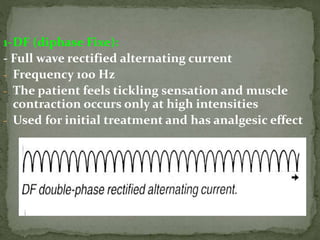
1-DF (diphase Fixe):
- Full wave rectified alternating current
- Frequency 100 Hz
- The patient feels tickling sensation and muscle
contraction occurs only at high intensities
- Used for initial treatment and has analgesic effect
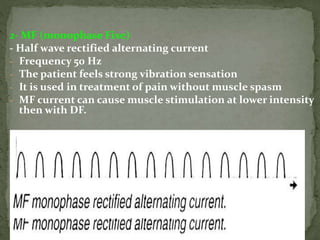
2- MF (monophase Fixe)
- Half wave rectified alternating current
- Frequency 50 Hz
- The patient feels strong vibration sensation
- It is used in treatment of pain without muscle spasm
- MF current can cause muscle stimulation at lower intensity
then with DF.
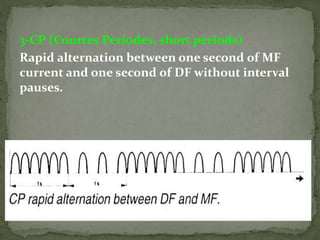
3-CP (Courtes Periodes, short periods)
Rapid alternation between one second of MF
current and one second of DF without interval
pauses.
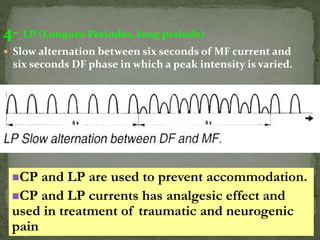
4- LP (Longues Periodes, long periods)
 Slow alternation between six seconds of MF current and
six seconds DF phase in which a peak intensity is varied.
CP and LP are used to prevent accommodation.
CP and LP currents has analgesic effect and
used in treatment of traumatic and neurogenic
pain
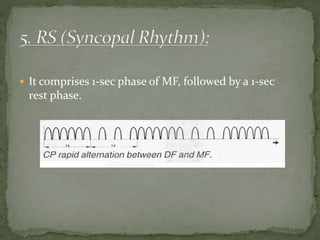
 It comprises 1-sec phase of MF, followed by a 1-sec
rest phase.
1- Relief of pain due to
Direct mechanism
 Stimulation of sensory nerves leading to pain
relief through stimulation of pain gate
mechanism
Indirect mechanism
 Improving circulation through pumping action
of muscle contraction with subsequent removal
of irritant wastes
2- Increase local circulation due to
 Release of H -like substance due to polar effect
 Altering autonomic activity
3- Decrease inflammation and swelling
Due to increased local circulation and change of cell
membrane permeability
4- Muscle re-education due to
stimulation of motor nerves but it is not the current
of choice for muscle strengthening
 Diadynamic current has relative high DC
amplitude, so that there is a significant chance of
skin damage occurrence.
 Skin damage is due to electrochemical changes
and changes in the pH value of the skin.
 To keep the risk of skin damage to minimum,
treatment time should be limited to ten minutes.
 Soft tissue injury as sprains,
contusions and epicondylitis
 Treating pain especially in small
joints.
 Sudeck’s atrophy.
 Peripheral nerve disorders as
neuralgia, radiculopathy and herpes
zoster.
 Open skin as the current tend to concentrate
 Bony areas
 Loss of sensation
 Infection
 Unreliable patients
 Superficial metals
 Thrombosis.
 Cardiac pace makers.
Intensity: It should be increased gradually until definite
vibration or prickling sensation occurs.
Duration: Not more than 12 minutes; each type for 3
minutes.
Frequency: Daily or every other day for 12 sessions.
DF: It is used for the initial treatment and before
application of other currents. The patient feels a
prickling sensation, which subsides after a short time.
MF: The patient feels a strong vibration for longer time
than the sensation of DF. It is used for treatment of
pain without muscle spasm.
 CP: In DF phase, there are fine tremors in MF phase
(strong and constant vibration). There are rhythmic
contractions, being used for treatment of traumatic
pain.
 LP: It has a long-lasting analgesic effect. It is used with
combination of CP in treatment of neuralgia.
 RS: It can be used for faradic stimulation of the
muscle and as a test for motor nerve excitability.
THANK YOU

Diadynamic current

  • 1.
  • 2.
     Diadynamic isone of the most common devices of electro-therapy, which uses a low current for its analgesic and spasmolytic effect.  Diadynamic currents are mixed currents, which use effects of the concurrent application of galvanic and faraday, or other impulse-like currents.  This results in combined effects of both types of currents, especially induction of hyperaemia and analgesia. The galvanic current component is combined with impulse component.
  • 3.
     Sinusoid-like impulsecurrents have inhibitory or facilitation effect, which depends on the frequency, intensity and other parameters.  The current with predominantly inhibitory effect has the frequency 100 Hz, current with frequency 50 Hz acts rather dynamogenically, i.e. causing excitation, facilitation and supporting muscle tone, it eliminates oedema around the nerve envelope, reducing pain and supporting muscle tone.
  • 4.
     Two maintypes which are characterized by the different types of waveforms produced by the device.  Half-wave rectification (single phase or monophasé fixe (MF)  Eliminates the second half of each AC cycle to produce a monophasic pulsed current with a pulse duration equal to the interpulse interval and a frequency equal to that of the original AC
  • 5.
     Full-wave rectification(double phase or diphasé fixe (DF))  Produces a monophasic pulsed current with no interpulse internal at twice the original AC frequency
  • 6.
    Diadynamic currents are basicallya variation of sinusoidal current. They are monophasic sinusoidal currents (rectified alternating current) with duration of 10 ms
  • 7.
    It has fiveclassic current types: 1- DF (diphase Fixe) 2- MF (monophase Fixe) 3-CP (Courtes Periodes), 4- LP (Longues Periodes) 5-RS( Syncopal Ryhthm)
  • 8.
    1-DF (diphase Fixe): -Full wave rectified alternating current - Frequency 100 Hz - The patient feels tickling sensation and muscle contraction occurs only at high intensities - Used for initial treatment and has analgesic effect
  • 9.
    2- MF (monophaseFixe) - Half wave rectified alternating current - Frequency 50 Hz - The patient feels strong vibration sensation - It is used in treatment of pain without muscle spasm - MF current can cause muscle stimulation at lower intensity then with DF.
  • 10.
    3-CP (Courtes Periodes,short periods) Rapid alternation between one second of MF current and one second of DF without interval pauses.
  • 11.
    4- LP (LonguesPeriodes, long periods)  Slow alternation between six seconds of MF current and six seconds DF phase in which a peak intensity is varied. CP and LP are used to prevent accommodation. CP and LP currents has analgesic effect and used in treatment of traumatic and neurogenic pain
  • 12.
     It comprises1-sec phase of MF, followed by a 1-sec rest phase.
  • 13.
    1- Relief ofpain due to Direct mechanism  Stimulation of sensory nerves leading to pain relief through stimulation of pain gate mechanism Indirect mechanism  Improving circulation through pumping action of muscle contraction with subsequent removal of irritant wastes 2- Increase local circulation due to  Release of H -like substance due to polar effect  Altering autonomic activity
  • 14.
    3- Decrease inflammationand swelling Due to increased local circulation and change of cell membrane permeability 4- Muscle re-education due to stimulation of motor nerves but it is not the current of choice for muscle strengthening
  • 15.
     Diadynamic currenthas relative high DC amplitude, so that there is a significant chance of skin damage occurrence.  Skin damage is due to electrochemical changes and changes in the pH value of the skin.  To keep the risk of skin damage to minimum, treatment time should be limited to ten minutes.
  • 16.
     Soft tissueinjury as sprains, contusions and epicondylitis  Treating pain especially in small joints.  Sudeck’s atrophy.  Peripheral nerve disorders as neuralgia, radiculopathy and herpes zoster.
  • 17.
     Open skinas the current tend to concentrate  Bony areas  Loss of sensation  Infection  Unreliable patients  Superficial metals  Thrombosis.  Cardiac pace makers.
  • 18.
    Intensity: It shouldbe increased gradually until definite vibration or prickling sensation occurs. Duration: Not more than 12 minutes; each type for 3 minutes. Frequency: Daily or every other day for 12 sessions.
  • 19.
    DF: It isused for the initial treatment and before application of other currents. The patient feels a prickling sensation, which subsides after a short time. MF: The patient feels a strong vibration for longer time than the sensation of DF. It is used for treatment of pain without muscle spasm.
  • 20.
     CP: InDF phase, there are fine tremors in MF phase (strong and constant vibration). There are rhythmic contractions, being used for treatment of traumatic pain.  LP: It has a long-lasting analgesic effect. It is used with combination of CP in treatment of neuralgia.  RS: It can be used for faradic stimulation of the muscle and as a test for motor nerve excitability.
  • 21.