Dr.Arjun Patel (MPT, DNHE)
Light
Amplification
by Stimulated
Emission of
Radiation
•Low intensity LASER therapy is the application of light to injuries and lesions to
stimulate healing process.
•It helps to resolve inflammation, reduce pain, increase speed, quality and strength
of tissue repair and resolve infection.
•Orthopedics, traumatology,
rheumatology
•Neurology
•Dermatology
•Odontology
•ENT
•Gynecology
• There are three characteristics of laser emission that make it clearly distinct from
ordinary light.
1. Monchromaticity
2. Coherence
3. Collimation
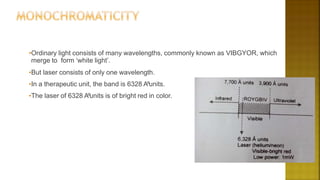
•Ordinary light consists of many wavelengths, commonly known as VIBGYOR, which
merge to form ‘white light’.
•But laser consists of only one wavelength.
•In a therapeutic unit, the band is 6328 A⁰units.
•The laser of 6328 A⁰units is of bright red in color.
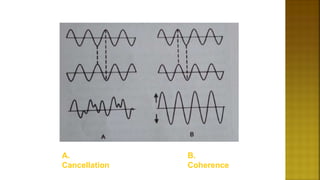
•As the wavelengths of ordinary light are so variable and do not match in waveform
frequencies, or shapes there is much scrambling of waveforms, cancellations and
reinforcement of individual waves and interference in energy production.
•This factor minimizes the power of ordinary light as an energy source.
•The laser comprises identical wavelength and forms, cause it to be greatly amplified.
•The ‘crests’ and ‘troughs’ of radiation are reinforced because they are parallel and in
line with each other, they are termed coherent.
A.
Cancellation
B.
Coherence
•As a consequences of spatial coherence, laser remains in parallel beam, because the
radiations do not diverge the energy even if propagated over very long distance.
•Easy to apply, non-invasive
•Adverse events are rarely reported
•It not produce significant heating .
•Lack of heating makes the therapy applicable during the acute stage of
injury.
•Accelerate tissue repair and reduce pain.
•Soft tissue injuries (tendinitis, myofascial
pain)
•Wounds and ulcers
•Osteoarthritis
•Rheumatoid arthritis
•Low back pain
•Neurogenic pain
•Fracture healing
•Plantar fascitis etc..
•Certain patients, like those having epilepsy, cardiac patients and patients with
pacemakers, are not treated in the chest region with laser.
•Skin Infections – When treated in contact, the treatment head must be sterilized
with a suitable solution after being placed on infected skin.
•Neoplastic tissue.
•Pregnant uterus.
•Haemorrhage and infected tissue.
•Haemophilia
• Do not apply on eye
•Extreme age
•Under heavy medication
•With thick eschar
•With considerable scar
tissue
•With extremely dry skin
•With active infection
•Increase cell metabolism
•Improve blood circulation and vasodilatation
•Increase ATP production
•Stimulation of wound healing by promoting faster healing and generate new and healthy
tissue
•Increase collagen production
•Increase macrophage activity
•Alter nerve conduction velocity
•Analgesic effect by relives acute/chronic pain by altering endogenous opioid
production.
•Reduce inflammation.
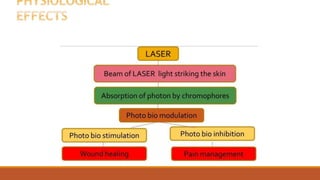
•Tissue healing
•Pain relief
•Reduction of
inflammation
□Ruby laser
□Helium-neon
laser
□Diode laser
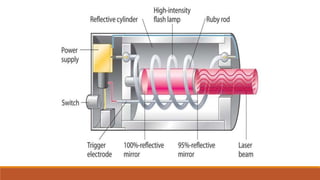
• It consists of small synthetic ruby rod made of aluminum oxide.
• A helical xenon flash tube wound around it gives an intense
flash of white light.
•Both ends of the rod are made flat and silvered, one end
being totally reflecting and other partially transparent for
the radiation to come out.
•This brief light pulse (0.5msecs) excites the ruby molecules and
raises many electrons to higher levels which they occupy for a
very short time before falling to the metastable level where
they remain for much longer average times.
•Thus, for a time, there are more electrons in the metastable level than the ground level
and so population inversion has occurred.
•When the transition form metastable to ground state does occur, a photon with a
wavelength of
694.3nm is emitted.
•The process rapidly accelerates as more and more photons are released; i.e.
stimulated emission of radiation occurs.
•The released photons having a wavelength of 694.3nm are reflected up and down the
short ruby rod, rapidly increasing the effect.
•Thus all the energy stored in the ruby molecules is released in a very brief time, as a
pulse of red light of identical photons and so of a single wavelength of coherent
radiation, and this emerges from the rod at the partially transparent end.
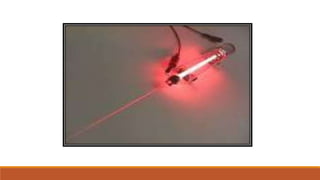
•Consists of a long tube contiainng Helium and Neon gases at low pressure
surrounded by a flashgun tube.
•Excitation of these atoms leads to different energy levels between them and the
transfer of energy.
•The photons are reflected to and fro along the tube giving rise to further photon
emission and emerging as a narrow beam from the partially transparent end.
•He-Ne lasers give radiation in the visible region at 632.8nm.
•Diode laser are commonly made from the semiconductive materials gallium and
aluminium arsenide(GaAlAs).
•As with any diode, electrons can flow more readily in one direction than in other.
•The special property of diode laser is that when current flows through the diode, the
electrical energy is converted into laser radiation energy.
•Wave length 630 – 1550 nm
•Diode lasers are conveniently small, relatively cheap devices
•Semiconductor diode laser can give either a continuous or a pulsed output.
•Continuous wave diode lasers are usually of relatively low power.
•To obtain a laser, a tube filled with a gaseous mixture of helium and neon is
stimulated electrically to emission level.
•Within the highly reflective polished walls of the tube, the molecules reverberate the
carom of the walls in a highly agitated state.
•When a critical level is reached, the flow of the energy literally bursts through semi
silvered front end of the tube and is channeled along an optic fiber to the beam
applicator or probe, for clinical application
Current laser equipment offers two modes
1. Continuous Beam: The continuous mode is recommended for acute pain and fresh
wounds.
2. Pulsed Beam: The pulsed mode has been found more effective with chronic
conditions. Pulsed models vary from 1 to 80 pulse per second, depending on
manufacturer.
•Preparation of patient
•Preparation of
apparatus
•Preparation of part
•Application
•Termination
•‘In contact’ technique should be used whenever possible
•Treat the site of pain or injury in comprehensive manner
•Use the most appropriate treatment probe for the site and condition
•Use gridding to standardized single diode application over larger
areas
•Where thermal modalities are used, consider the sequence of
application
•Use ice to increase the effective depth of penetration
•Treatment should be systematically and comprehensively applied
•Progress dosage over the course of treatment
•Vary pulsing to enhance tissue stimulation
•Treat early and often for best result
LASER

LASER

  • 1.
  • 2.
  • 3.
    •Low intensity LASERtherapy is the application of light to injuries and lesions to stimulate healing process. •It helps to resolve inflammation, reduce pain, increase speed, quality and strength of tissue repair and resolve infection.
  • 4.
  • 5.
    • There arethree characteristics of laser emission that make it clearly distinct from ordinary light. 1. Monchromaticity 2. Coherence 3. Collimation
  • 6.
    •Ordinary light consistsof many wavelengths, commonly known as VIBGYOR, which merge to form ‘white light’. •But laser consists of only one wavelength. •In a therapeutic unit, the band is 6328 A⁰units. •The laser of 6328 A⁰units is of bright red in color.
  • 7.
    •As the wavelengthsof ordinary light are so variable and do not match in waveform frequencies, or shapes there is much scrambling of waveforms, cancellations and reinforcement of individual waves and interference in energy production. •This factor minimizes the power of ordinary light as an energy source. •The laser comprises identical wavelength and forms, cause it to be greatly amplified. •The ‘crests’ and ‘troughs’ of radiation are reinforced because they are parallel and in line with each other, they are termed coherent.
  • 8.
  • 9.
    •As a consequencesof spatial coherence, laser remains in parallel beam, because the radiations do not diverge the energy even if propagated over very long distance.
  • 10.
    •Easy to apply,non-invasive •Adverse events are rarely reported •It not produce significant heating . •Lack of heating makes the therapy applicable during the acute stage of injury. •Accelerate tissue repair and reduce pain.
  • 11.
    •Soft tissue injuries(tendinitis, myofascial pain) •Wounds and ulcers •Osteoarthritis •Rheumatoid arthritis •Low back pain •Neurogenic pain •Fracture healing •Plantar fascitis etc..
  • 12.
    •Certain patients, likethose having epilepsy, cardiac patients and patients with pacemakers, are not treated in the chest region with laser. •Skin Infections – When treated in contact, the treatment head must be sterilized with a suitable solution after being placed on infected skin. •Neoplastic tissue. •Pregnant uterus. •Haemorrhage and infected tissue. •Haemophilia • Do not apply on eye
  • 13.
    •Extreme age •Under heavymedication •With thick eschar •With considerable scar tissue •With extremely dry skin •With active infection
  • 15.
    •Increase cell metabolism •Improveblood circulation and vasodilatation •Increase ATP production •Stimulation of wound healing by promoting faster healing and generate new and healthy tissue •Increase collagen production •Increase macrophage activity •Alter nerve conduction velocity
  • 16.
    •Analgesic effect byrelives acute/chronic pain by altering endogenous opioid production. •Reduce inflammation.
  • 17.
  • 18.
  • 19.
    • It consistsof small synthetic ruby rod made of aluminum oxide. • A helical xenon flash tube wound around it gives an intense flash of white light. •Both ends of the rod are made flat and silvered, one end being totally reflecting and other partially transparent for the radiation to come out. •This brief light pulse (0.5msecs) excites the ruby molecules and raises many electrons to higher levels which they occupy for a very short time before falling to the metastable level where they remain for much longer average times.
  • 21.
    •Thus, for atime, there are more electrons in the metastable level than the ground level and so population inversion has occurred. •When the transition form metastable to ground state does occur, a photon with a wavelength of 694.3nm is emitted. •The process rapidly accelerates as more and more photons are released; i.e. stimulated emission of radiation occurs. •The released photons having a wavelength of 694.3nm are reflected up and down the short ruby rod, rapidly increasing the effect. •Thus all the energy stored in the ruby molecules is released in a very brief time, as a pulse of red light of identical photons and so of a single wavelength of coherent radiation, and this emerges from the rod at the partially transparent end.
  • 22.
    •Consists of along tube contiainng Helium and Neon gases at low pressure surrounded by a flashgun tube. •Excitation of these atoms leads to different energy levels between them and the transfer of energy. •The photons are reflected to and fro along the tube giving rise to further photon emission and emerging as a narrow beam from the partially transparent end. •He-Ne lasers give radiation in the visible region at 632.8nm.
  • 24.
    •Diode laser arecommonly made from the semiconductive materials gallium and aluminium arsenide(GaAlAs). •As with any diode, electrons can flow more readily in one direction than in other. •The special property of diode laser is that when current flows through the diode, the electrical energy is converted into laser radiation energy. •Wave length 630 – 1550 nm •Diode lasers are conveniently small, relatively cheap devices •Semiconductor diode laser can give either a continuous or a pulsed output. •Continuous wave diode lasers are usually of relatively low power.
  • 26.
    •To obtain alaser, a tube filled with a gaseous mixture of helium and neon is stimulated electrically to emission level. •Within the highly reflective polished walls of the tube, the molecules reverberate the carom of the walls in a highly agitated state. •When a critical level is reached, the flow of the energy literally bursts through semi silvered front end of the tube and is channeled along an optic fiber to the beam applicator or probe, for clinical application
  • 27.
    Current laser equipmentoffers two modes 1. Continuous Beam: The continuous mode is recommended for acute pain and fresh wounds. 2. Pulsed Beam: The pulsed mode has been found more effective with chronic conditions. Pulsed models vary from 1 to 80 pulse per second, depending on manufacturer.
  • 29.
    •Preparation of patient •Preparationof apparatus •Preparation of part •Application •Termination
  • 30.
    •‘In contact’ techniqueshould be used whenever possible •Treat the site of pain or injury in comprehensive manner •Use the most appropriate treatment probe for the site and condition •Use gridding to standardized single diode application over larger areas •Where thermal modalities are used, consider the sequence of application •Use ice to increase the effective depth of penetration •Treatment should be systematically and comprehensively applied •Progress dosage over the course of treatment •Vary pulsing to enhance tissue stimulation •Treat early and often for best result