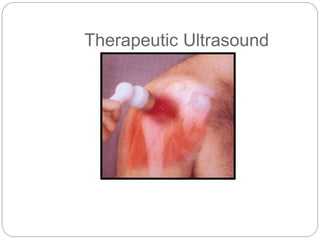
Therapeutic Ultrasound
 One of the most widely used modalities in sports
medicine
 It is a inaudible, acoustic vibrations of high
frequency that produce either thermal or non-
thermal physiologic effects
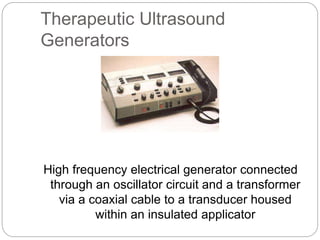
Therapeutic Ultrasound
Generators
High frequency electrical generator connected
through an oscillator circuit and a transformer
via a coaxial cable to a transducer housed
within an insulated applicator
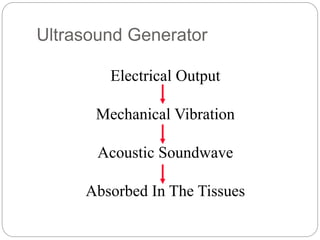
Ultrasound Generator
Electrical Output
Mechanical Vibration
Acoustic Soundwave
Absorbed In The Tissues
Piezoelectric Effect
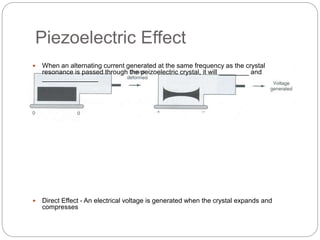
 When an alternating current generated at the same frequency as the crystal
resonance is passed through the peizoelectric crystal, it will ________ and
_______________
 Direct Effect - An electrical voltage is generated when the crystal expands and
compresses
Piezoelectric Effect
 ____________ = generation of electrical voltage
across the crystal when it is expanded or
compressed
 __________________________ = the alternating
current moving through the crystal reverses its
_______ as it expands and compresses resulting in
vibration of the crystal at the frequency of the
electrical oscillation
 This produces the desired therapeutic ultrasound
frequency
Frequency of Therapeutic Ultrasound
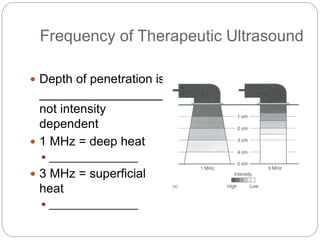
 Depth of penetration is
__________________
not intensity
dependent
 1 MHz = deep heat
 _______________
 3 MHz = superficial
heat
 _______________
The Ultrasound Beam
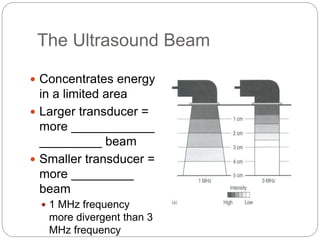
 Concentrates energy
in a limited area
 Larger transducer =
more ____________
_________ beam
 Smaller transducer =
more _________
beam
 1 MHz frequency
more divergent than 3
MHz frequency
Ultrasound Beam
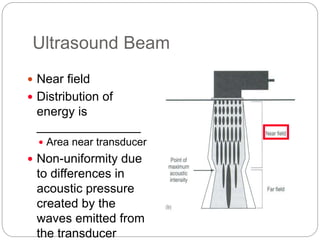
 Near field
 Distribution of
energy is
_______________
 Area near transducer
 Non-uniformity due
to differences in
acoustic pressure
created by the
waves emitted from
the transducer
Ultrasound Beam
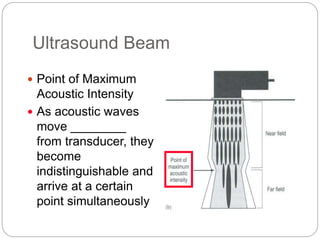
 Point of Maximum
Acoustic Intensity
 As acoustic waves
move ________
from transducer, they
become
indistinguishable and
arrive at a certain
point simultaneously
Ultrasound Beam
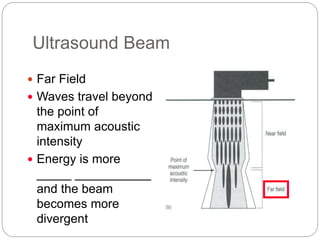
 Far Field
 Waves travel beyond
the point of
maximum acoustic
intensity
 Energy is more
_____ ___________
and the beam
becomes more
divergent
Pulsed vs. Continuous
Ultrasound
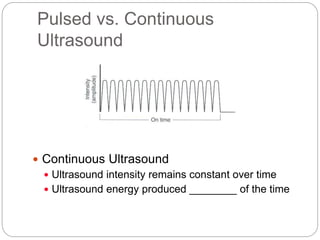
 Continuous Ultrasound
 Ultrasound intensity remains constant over time
 Ultrasound energy produced ________ of the time
Pulsed vs. Continuous
Ultrasound
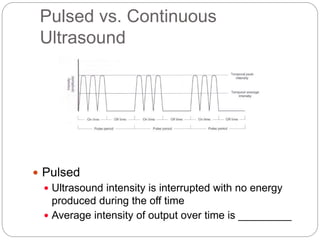
 Pulsed
 Ultrasound intensity is interrupted with no energy
produced during the off time
 Average intensity of output over time is _________
Pulsed Ultrasound and Duty
Cycle
 Duty Cycle
 Percentage of time that ultrasound is being
generated (pulse duration) over one pulse period
 Pulse period = mark:space ratio
 Duty Cycle = duration of pulse (on time) x100
pulse period (on time + off time)
 Duty Cycle may be set to 20% or 50%
 Total amount of energy delivered would be only
20% or 50% of the energy delivered if a continuous
ultrasound wave was being used
Amplitude
 May be defined 3 ways…
 Magnitude of vibration in an ultrasound wave
 Movement of particles in the medium through which
the ultrasound wave travels
 Measured in units of distance (____________)
 Vibration in pressure found along the ultrasound
wave
 Measured in units of pressure (______________)
Power vs. Intensity
 Both power and intensity are unevenly distributed in
the ultrasound beam
 ______ = total amount of ultrasound energy in the
beam
 Measured in watts
 _______ = measure of the rate at which energy is
being delivered per unit area
Intensity
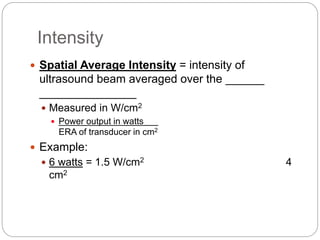
 Spatial Average Intensity = intensity of
ultrasound beam averaged over the ______
_______________
 Measured in W/cm2
 Power output in watts
ERA of transducer in cm2
 Example:
 6 watts = 1.5 W/cm2 4
cm2
Intensity
 Spatial Peak Intensity = _________ value
occurring with the beam over time
 Therapeutic ultrasound maximum intensities range
between ___ and ___ W/cm2
 Temporal Peak Intensity = __________ intensity
during the __ period with pulsed ultrasound
 Measured in W/cm2
Intensity
 Temporal-averaged Intensity
 Only important with ___________ ultrasound
 Calculated by averaging the power during both the
on and off periods (mean on/off intensity)
 Intensity settings on ultrasound generators may
indicate _________________________ while
others indicate ______________________
Intensity
 There are no specific guidelines which dictate
specific intensities that should be used during
treatment
 Recommendation: use the _______ intensity
at the _________ frequency which transmits
energy to a specific tissue to achieve a
desired therapeutic effect
 Any adjustment in the intensity must be
countered with an adjustment in
_______________
 Treatments are temperature dependent, not time
dependent
Physiologic Effects of Ultrasound
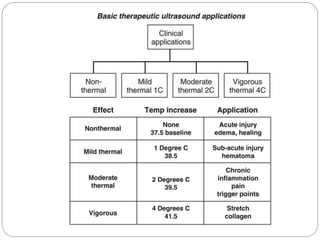
Thermal vs. Non-Thermal Effects
 Thermal effects
 Tissue heating
 Non-Thermal effects
 Tissue repair at the cellular level
 Thermal effects occur whenever the spatial
average intensity is > _______________
 Whenever there is a thermal effect there will
always be a non-thermal effect
Thermal vs. Non-Thermal Effects
 To elicit thermal therapeutic effects, tissue
temperature must be raised to a level of 40-45°C for
a minimum of ___ minutes
 Baseline muscle temperature is _________
 Mild heating: temperature  of _____
  metabolism healing and healing
 Moderate heating: temperature  of ______
  pain and muscle spasm
 Vigorous heating: temperature  of ____
  extensibility of collagen and  joint stiffness
 Increased collagen extensibility
 ________ blood flow
 ________ pain
 Reduction of muscle spasm
 ________ joint stiffness
 Reduction of _______________
Thermal Effects of Ultrasound
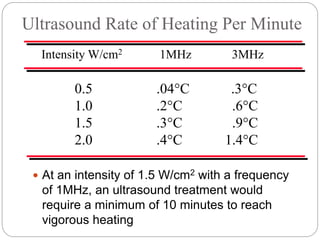
Ultrasound Rate of Heating Per Minute
Intensity W/cm2 1MHz 3MHz
0.5 .04°C .3°C
1.0 .2°C .6°C
1.5 .3°C .9°C
2.0 .4°C 1.4°C
 At an intensity of 1.5 W/cm2 with a frequency
of 1MHz, an ultrasound treatment would
require a minimum of 10 minutes to reach
vigorous heating
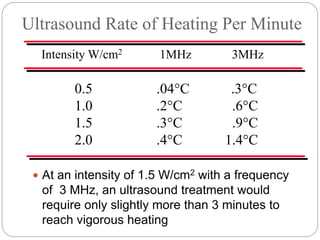
Ultrasound Rate of Heating Per Minute
Intensity W/cm2 1MHz 3MHz
0.5 .04°C .3°C
1.0 .2°C .6°C
1.5 .3°C .9°C
2.0 .4°C 1.4°C
 At an intensity of 1.5 W/cm2 with a frequency
of 3 MHz, an ultrasound treatment would
require only slightly more than 3 minutes to
reach vigorous heating
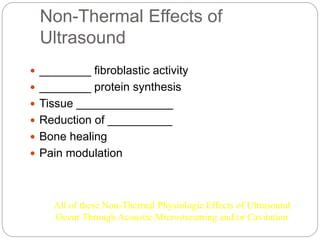
Non-Thermal Effects of
Ultrasound
 ________ fibroblastic activity
 ________ protein synthesis
 Tissue _______________
 Reduction of __________
 Bone healing
 Pain modulation
All of these Non-Thermal Physiologic Effects of Ultrasound
Occur Through Acoustic Microstreaming and/or Cavitation
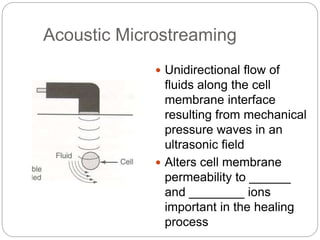
Acoustic Microstreaming
 Unidirectional flow of
fluids along the cell
membrane interface
resulting from mechanical
pressure waves in an
ultrasonic field
 Alters cell membrane
permeability to ______
and ________ ions
important in the healing
process
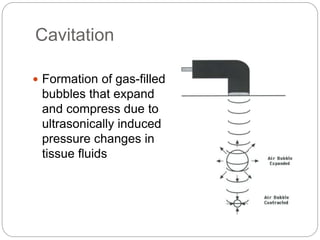
Cavitation
 Formation of gas-filled
bubbles that expand
and compress due to
ultrasonically induced
pressure changes in
tissue fluids
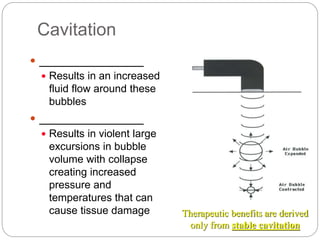
Cavitation
 _______________
 Results in an increased
fluid flow around these
bubbles
 _______________
 Results in violent large
excursions in bubble
volume with collapse
creating increased
pressure and
temperatures that can
cause tissue damage Therapeutic benefits are derived
only from stable cavitation
Non-Thermal Effects of
Ultrasound
 Can be maximized while minimizing the thermal
effects by:
 Using a ____________________ of 0.1-0.2
W/cm2 with continuous ultrasound
 Setting duty cycle at ________ at intensity of 1
W/cm2
 Setting duty cycle at ________ at intensity of 0.4
W/cm2
Techniques of Application
Frequency of Treatment
 Acute conditions require more frequent
treatments over a _________ period of time
 2 treatments/day for _______ days
 Chronic conditions require fewer treatments over
a _______ period of time
 Alternating days for ________ treatments
 Controversy
 Limit treatments to a total of 14
 Continue treatments if there is improvement
Duration of Treatment
Considerations for determining Tx time…
 Size of the area to be treated
 Intensity of treatment
 Frequency
 Treatment goals
 Thermal vs. non-thermal effects
Size of the Treatment Area
 Should be ___ times larger than the ERA of the
crystal in the transducer
 If the treatment area is larger than 2-3 times the
ERA, other modalities should be considered
 _______________, _______________, or
_______________
Intensity
 Recommendations for specific intensities make
little sense
 Ultrasound intensity should be adjusted to
_______ ____________
 Increase intensity to the point where the patient
feels _______, then decrease the intensity
slightly to elicit general heating in the treatment
area
 If you decrease intensity during treatment you
should increase _______________
 Ultrasound treatments should be temperature
dependent, not time dependent
Frequency
 Determines _______________
 Energy produced at 3 MHz is absorbed 3 times
faster than that produced from 1 MHz ultrasound
 Results in faster heating
 Reduce 3 MHz treatment durations by _________
Coupling Methods
 Greatest amount of energy reflection occurs at
the _______________
 Reduce amount of energy reflection by holding
transducer ____________ (90° angle) to treatment
area
 Coupling mediums further _________ reflection
 _______________ = substance used to
decrease acoustical impedance at the air-tissue
interface
 Maximize contact with the tissue to facilitate passage
of ultrasound energy
 Include gel, water, mineral oil, distilled water,
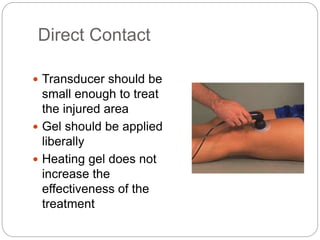
Direct Contact
 Transducer should be
small enough to treat
the injured area
 Gel should be applied
liberally
 Heating gel does not
increase the
effectiveness of the
treatment
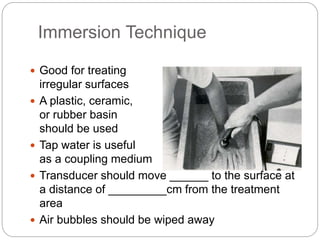
Immersion Technique
 Good for treating
irregular surfaces
 A plastic, ceramic,
or rubber basin
should be used
 Tap water is useful
as a coupling medium
 Transducer should move ______ to the surface at
a distance of _________cm from the treatment
area
 Air bubbles should be wiped away
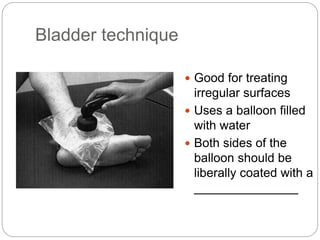
Bladder technique
 Good for treating
irregular surfaces
 Uses a balloon filled
with water
 Both sides of the
balloon should be
liberally coated with a
_______________
Moving The Transducer
 Applicator should be moved at a rate of
_______________
 An ultrasound generator with a low BNR allows
for ________ transducer movement
 An ultrasound generator with a high BNR may
cause unstable ___________ and “hot spots” if
the transducer is moved ______ _________
Clinical Applications For Ultrasound
 Ultrasound is recognized clinically as an effective
and widely used modality in the treatment of soft
tissue and boney lesions
 There is relatively little documented, data-based
evidence concerning its efficacy
 Most of the available data-based research is
unequivocal
Soft Tissue Healing and Repair
 During the __________________________ of
healing, stable cavitation and _______________
increase the transport of calcium across cell
membranes, thus releasing histamine
 Histamine stimulates…
 ___________ to “clean up” the injured area
 ___________ to produce collagen (Dyson, 1985, 1987)
Scar Tissue and Joint Contracture
 Increased tissue temperature causes an increase
in elasticity and a ___________ in viscocity of
collagen fibers (Ziskin, 1984)
 Increased tissue temperature ___________
mobility in mature scar tissue (Gann, 1991)
Chronic Inflammation
 Few clinical or experimental studies have
observed the effects of ultrasound treatment on
chronic inflammation
 Ultrasound does seem to be effective for
increasing blood flow to the treatment area, which
may facilitate the healing process and reduce
pain (Downing, 1986)
Bone Healing
 Ultrasound ___________ fracture repair
 (Dyson, 1982, Pilla et al., 1990)
 Ultrasound given to an __________ fracture during
cartilage formation may cause cartilage
proliferation and delay union
 (Dyson, 1989)
 No effect on _______________, but may help
reduce surrounding inflammation
 (Ziskin, 1990)
 Not effective in detecting _______________
Pain Reduction
 Ultrasound treatments are not used specifically for pain
modulation
 Ultrasound may increase the ___________
____________ of free nerve endings
 (McDiarmid, 1987)
 Superficial heating may effect gating of pain impulses -
_______________
 (Williams et al. 1987)
 Increased nerve conduction velocity creates a
_______________ effect
 (Kitchen, 1990)
Placebo Effects
 A number of studies have demonstrated a
placebo effect in patients using ultrasound
 (Lundeberg, 1988, Dyson, 1987, Hashish et al., 1986)
Phonophoresis
 Ultrasound energy used to drive topical
application of selected medications into the
tissues
 _______________
 Cortisol
 Salicylates
 Dexamethasone
 _______________
 Lidocaine
Phonophoresis
 ___________ effects of ultrasound increase
tissue permeability and acoustic pressure drives
molecules into the tissue
 Effectiveness of phonophoresis is debatable
 Early studies demonstrated effective penetration
 (Griffin, 1982, Kleinkort, 1975)
 More recent studies show ineffectiveness
 (Oziomek et al, 1991, Benson et al., 1989)
Ultrasound and Other Modalities
 US and Hot Packs = _______________
 US and Cold Packs = _______________
 Cooling the tissues does not facilitate an increase in
temperature (Remmington 1994, Draper, 1995)
 Analgesic effects of ice can interfere with perception
of heating
 Pulsed US may be beneficial during Inflammatory-
Response Phase of healing
 US and E-Stim = _______________
 Effective in treating myofascial trigger points when
used in combination with stretching (Girardi, et al. 1984)
Ultrasound Treatment Indications
and Contraindications
 Table 5-8, p. 127 --- Memorize!!!
 Guidelines for the safe use of ultrasound equipment,
p. 126-127

1. ultrasound

  • 1.
  • 2.
    Therapeutic Ultrasound  Oneof the most widely used modalities in sports medicine  It is a inaudible, acoustic vibrations of high frequency that produce either thermal or non- thermal physiologic effects
  • 3.
    Therapeutic Ultrasound Generators High frequencyelectrical generator connected through an oscillator circuit and a transformer via a coaxial cable to a transducer housed within an insulated applicator
  • 4.
    Ultrasound Generator Electrical Output MechanicalVibration Acoustic Soundwave Absorbed In The Tissues
  • 5.
    Piezoelectric Effect  Whenan alternating current generated at the same frequency as the crystal resonance is passed through the peizoelectric crystal, it will ________ and _______________  Direct Effect - An electrical voltage is generated when the crystal expands and compresses
  • 6.
    Piezoelectric Effect  ____________= generation of electrical voltage across the crystal when it is expanded or compressed  __________________________ = the alternating current moving through the crystal reverses its _______ as it expands and compresses resulting in vibration of the crystal at the frequency of the electrical oscillation  This produces the desired therapeutic ultrasound frequency
  • 7.
    Frequency of TherapeuticUltrasound  Depth of penetration is __________________ not intensity dependent  1 MHz = deep heat  _______________  3 MHz = superficial heat  _______________
  • 8.
    The Ultrasound Beam Concentrates energy in a limited area  Larger transducer = more ____________ _________ beam  Smaller transducer = more _________ beam  1 MHz frequency more divergent than 3 MHz frequency
  • 9.
    Ultrasound Beam  Nearfield  Distribution of energy is _______________  Area near transducer  Non-uniformity due to differences in acoustic pressure created by the waves emitted from the transducer
  • 10.
    Ultrasound Beam  Pointof Maximum Acoustic Intensity  As acoustic waves move ________ from transducer, they become indistinguishable and arrive at a certain point simultaneously
  • 11.
    Ultrasound Beam  FarField  Waves travel beyond the point of maximum acoustic intensity  Energy is more _____ ___________ and the beam becomes more divergent
  • 12.
    Pulsed vs. Continuous Ultrasound Continuous Ultrasound  Ultrasound intensity remains constant over time  Ultrasound energy produced ________ of the time
  • 13.
    Pulsed vs. Continuous Ultrasound Pulsed  Ultrasound intensity is interrupted with no energy produced during the off time  Average intensity of output over time is _________
  • 14.
    Pulsed Ultrasound andDuty Cycle  Duty Cycle  Percentage of time that ultrasound is being generated (pulse duration) over one pulse period  Pulse period = mark:space ratio  Duty Cycle = duration of pulse (on time) x100 pulse period (on time + off time)  Duty Cycle may be set to 20% or 50%  Total amount of energy delivered would be only 20% or 50% of the energy delivered if a continuous ultrasound wave was being used
  • 15.
    Amplitude  May bedefined 3 ways…  Magnitude of vibration in an ultrasound wave  Movement of particles in the medium through which the ultrasound wave travels  Measured in units of distance (____________)  Vibration in pressure found along the ultrasound wave  Measured in units of pressure (______________)
  • 16.
    Power vs. Intensity Both power and intensity are unevenly distributed in the ultrasound beam  ______ = total amount of ultrasound energy in the beam  Measured in watts  _______ = measure of the rate at which energy is being delivered per unit area
  • 17.
    Intensity  Spatial AverageIntensity = intensity of ultrasound beam averaged over the ______ _______________  Measured in W/cm2  Power output in watts ERA of transducer in cm2  Example:  6 watts = 1.5 W/cm2 4 cm2
  • 18.
    Intensity  Spatial PeakIntensity = _________ value occurring with the beam over time  Therapeutic ultrasound maximum intensities range between ___ and ___ W/cm2  Temporal Peak Intensity = __________ intensity during the __ period with pulsed ultrasound  Measured in W/cm2
  • 19.
    Intensity  Temporal-averaged Intensity Only important with ___________ ultrasound  Calculated by averaging the power during both the on and off periods (mean on/off intensity)  Intensity settings on ultrasound generators may indicate _________________________ while others indicate ______________________
  • 20.
    Intensity  There areno specific guidelines which dictate specific intensities that should be used during treatment  Recommendation: use the _______ intensity at the _________ frequency which transmits energy to a specific tissue to achieve a desired therapeutic effect  Any adjustment in the intensity must be countered with an adjustment in _______________  Treatments are temperature dependent, not time dependent
  • 21.
  • 22.
    Thermal vs. Non-ThermalEffects  Thermal effects  Tissue heating  Non-Thermal effects  Tissue repair at the cellular level  Thermal effects occur whenever the spatial average intensity is > _______________  Whenever there is a thermal effect there will always be a non-thermal effect
  • 23.
    Thermal vs. Non-ThermalEffects  To elicit thermal therapeutic effects, tissue temperature must be raised to a level of 40-45°C for a minimum of ___ minutes  Baseline muscle temperature is _________  Mild heating: temperature  of _____   metabolism healing and healing  Moderate heating: temperature  of ______   pain and muscle spasm  Vigorous heating: temperature  of ____   extensibility of collagen and  joint stiffness
  • 24.
     Increased collagenextensibility  ________ blood flow  ________ pain  Reduction of muscle spasm  ________ joint stiffness  Reduction of _______________ Thermal Effects of Ultrasound
  • 25.
    Ultrasound Rate ofHeating Per Minute Intensity W/cm2 1MHz 3MHz 0.5 .04°C .3°C 1.0 .2°C .6°C 1.5 .3°C .9°C 2.0 .4°C 1.4°C  At an intensity of 1.5 W/cm2 with a frequency of 1MHz, an ultrasound treatment would require a minimum of 10 minutes to reach vigorous heating
  • 26.
    Ultrasound Rate ofHeating Per Minute Intensity W/cm2 1MHz 3MHz 0.5 .04°C .3°C 1.0 .2°C .6°C 1.5 .3°C .9°C 2.0 .4°C 1.4°C  At an intensity of 1.5 W/cm2 with a frequency of 3 MHz, an ultrasound treatment would require only slightly more than 3 minutes to reach vigorous heating
  • 27.
    Non-Thermal Effects of Ultrasound ________ fibroblastic activity  ________ protein synthesis  Tissue _______________  Reduction of __________  Bone healing  Pain modulation All of these Non-Thermal Physiologic Effects of Ultrasound Occur Through Acoustic Microstreaming and/or Cavitation
  • 28.
    Acoustic Microstreaming  Unidirectionalflow of fluids along the cell membrane interface resulting from mechanical pressure waves in an ultrasonic field  Alters cell membrane permeability to ______ and ________ ions important in the healing process
  • 29.
    Cavitation  Formation ofgas-filled bubbles that expand and compress due to ultrasonically induced pressure changes in tissue fluids
  • 30.
    Cavitation  _______________  Resultsin an increased fluid flow around these bubbles  _______________  Results in violent large excursions in bubble volume with collapse creating increased pressure and temperatures that can cause tissue damage Therapeutic benefits are derived only from stable cavitation
  • 31.
    Non-Thermal Effects of Ultrasound Can be maximized while minimizing the thermal effects by:  Using a ____________________ of 0.1-0.2 W/cm2 with continuous ultrasound  Setting duty cycle at ________ at intensity of 1 W/cm2  Setting duty cycle at ________ at intensity of 0.4 W/cm2
  • 32.
  • 33.
    Frequency of Treatment Acute conditions require more frequent treatments over a _________ period of time  2 treatments/day for _______ days  Chronic conditions require fewer treatments over a _______ period of time  Alternating days for ________ treatments  Controversy  Limit treatments to a total of 14  Continue treatments if there is improvement
  • 34.
    Duration of Treatment Considerationsfor determining Tx time…  Size of the area to be treated  Intensity of treatment  Frequency  Treatment goals  Thermal vs. non-thermal effects
  • 35.
    Size of theTreatment Area  Should be ___ times larger than the ERA of the crystal in the transducer  If the treatment area is larger than 2-3 times the ERA, other modalities should be considered  _______________, _______________, or _______________
  • 36.
    Intensity  Recommendations forspecific intensities make little sense  Ultrasound intensity should be adjusted to _______ ____________  Increase intensity to the point where the patient feels _______, then decrease the intensity slightly to elicit general heating in the treatment area  If you decrease intensity during treatment you should increase _______________  Ultrasound treatments should be temperature dependent, not time dependent
  • 37.
    Frequency  Determines _______________ Determines _______________  Energy produced at 3 MHz is absorbed 3 times faster than that produced from 1 MHz ultrasound  Results in faster heating  Reduce 3 MHz treatment durations by _________
  • 39.
    Coupling Methods  Greatestamount of energy reflection occurs at the _______________  Reduce amount of energy reflection by holding transducer ____________ (90° angle) to treatment area  Coupling mediums further _________ reflection  _______________ = substance used to decrease acoustical impedance at the air-tissue interface  Maximize contact with the tissue to facilitate passage of ultrasound energy  Include gel, water, mineral oil, distilled water,
  • 40.
    Direct Contact  Transducershould be small enough to treat the injured area  Gel should be applied liberally  Heating gel does not increase the effectiveness of the treatment
  • 41.
    Immersion Technique  Goodfor treating irregular surfaces  A plastic, ceramic, or rubber basin should be used  Tap water is useful as a coupling medium  Transducer should move ______ to the surface at a distance of _________cm from the treatment area  Air bubbles should be wiped away
  • 42.
    Bladder technique  Goodfor treating irregular surfaces  Uses a balloon filled with water  Both sides of the balloon should be liberally coated with a _______________
  • 43.
    Moving The Transducer Applicator should be moved at a rate of _______________  An ultrasound generator with a low BNR allows for ________ transducer movement  An ultrasound generator with a high BNR may cause unstable ___________ and “hot spots” if the transducer is moved ______ _________
  • 44.
    Clinical Applications ForUltrasound  Ultrasound is recognized clinically as an effective and widely used modality in the treatment of soft tissue and boney lesions  There is relatively little documented, data-based evidence concerning its efficacy  Most of the available data-based research is unequivocal
  • 45.
    Soft Tissue Healingand Repair  During the __________________________ of healing, stable cavitation and _______________ increase the transport of calcium across cell membranes, thus releasing histamine  Histamine stimulates…  ___________ to “clean up” the injured area  ___________ to produce collagen (Dyson, 1985, 1987)
  • 46.
    Scar Tissue andJoint Contracture  Increased tissue temperature causes an increase in elasticity and a ___________ in viscocity of collagen fibers (Ziskin, 1984)  Increased tissue temperature ___________ mobility in mature scar tissue (Gann, 1991)
  • 47.
    Chronic Inflammation  Fewclinical or experimental studies have observed the effects of ultrasound treatment on chronic inflammation  Ultrasound does seem to be effective for increasing blood flow to the treatment area, which may facilitate the healing process and reduce pain (Downing, 1986)
  • 48.
    Bone Healing  Ultrasound___________ fracture repair  (Dyson, 1982, Pilla et al., 1990)  Ultrasound given to an __________ fracture during cartilage formation may cause cartilage proliferation and delay union  (Dyson, 1989)  No effect on _______________, but may help reduce surrounding inflammation  (Ziskin, 1990)  Not effective in detecting _______________
  • 49.
    Pain Reduction  Ultrasoundtreatments are not used specifically for pain modulation  Ultrasound may increase the ___________ ____________ of free nerve endings  (McDiarmid, 1987)  Superficial heating may effect gating of pain impulses - _______________  (Williams et al. 1987)  Increased nerve conduction velocity creates a _______________ effect  (Kitchen, 1990)
  • 50.
    Placebo Effects  Anumber of studies have demonstrated a placebo effect in patients using ultrasound  (Lundeberg, 1988, Dyson, 1987, Hashish et al., 1986)
  • 51.
    Phonophoresis  Ultrasound energyused to drive topical application of selected medications into the tissues  _______________  Cortisol  Salicylates  Dexamethasone  _______________  Lidocaine
  • 52.
    Phonophoresis  ___________ effectsof ultrasound increase tissue permeability and acoustic pressure drives molecules into the tissue  Effectiveness of phonophoresis is debatable  Early studies demonstrated effective penetration  (Griffin, 1982, Kleinkort, 1975)  More recent studies show ineffectiveness  (Oziomek et al, 1991, Benson et al., 1989)
  • 53.
    Ultrasound and OtherModalities  US and Hot Packs = _______________  US and Cold Packs = _______________  Cooling the tissues does not facilitate an increase in temperature (Remmington 1994, Draper, 1995)  Analgesic effects of ice can interfere with perception of heating  Pulsed US may be beneficial during Inflammatory- Response Phase of healing  US and E-Stim = _______________  Effective in treating myofascial trigger points when used in combination with stretching (Girardi, et al. 1984)
  • 54.
    Ultrasound Treatment Indications andContraindications  Table 5-8, p. 127 --- Memorize!!!  Guidelines for the safe use of ultrasound equipment, p. 126-127