UNIT I
Information Systems & It’s Types
By Dr. Dhobale J V
Associate Professor
RNB Global University, Bikaner
RNB Global University, Bikaner. 1Course Code - 11009400
Objectives
 Introduction to IS.
 Definition IS.
 Purpose of IS.
 Objectives and Role of MIS at Managerial
Level.
 MIS in the Organization.
 TPs, DSs, EIs, Expert Systems .
2RNB Global University, Bikaner.Course Code - 11009400
Introduction
3RNB Global University, Bikaner.Course Code - 11009400
546585688531475
D145 Main Road
Bikaner Rajasthan
Ramesh Gupta
IDB00015751
IDBI Bank Customer Details
Address
Cont…
 Information can be defined as meaningfully
interpreted data.
 So, from a system analyst's point of view,
information is a sequence of symbols that can
be construed to a useful message.
4RNB Global University, Bikaner.Course Code - 11009400
Cont…
 An Information System is a system that
gathers data and disseminates information
with the sole purpose of providing information
to its users.
 An information system is a set of interrelated
components that collect, manipulate, store
data and disseminate information and provide
a feedback mechanism to monitor
performance.
5RNB Global University, Bikaner.Course Code - 11009400
Cont…
 Information System is an organized
combination of people, hardware, software,
communications networks, and data resources
that collects data, transforms it, and
disseminates information.
 The main object of an information system is to
provide information to its users. Information
systems vary according to the type of users
who use the system.
6RNB Global University, Bikaner.Course Code - 11009400
Cont…
 A Management Information System (MIS) is
an information system that evaluates,
analyzes, and processes an organization's
data to produce meaningful and useful
information based on which the management
can take right decisions to ensure future
growth of the organization.
7RNB Global University, Bikaner.Course Code - 11009400
Data Vs Information
 Data: Raw unorganized facts.
Ex. ?, a, 2, y, =, /.
Information:
A collection of facts organized in such a
way that they have additional value
beyond the value of the facts themselves.
Ex. a+y/2 = ?
8RNB Global University, Bikaner.Course Code - 11009400
Information
 Information can be recorded as signs, or
transmitted as signals. Information is any kind
of event that affects the state of a dynamic
system that can interpret the information.
 The value of Information is directly linked to
how it helps decision makers achieve their
organization’s goals.
9RNB Global University, Bikaner.Course Code - 11009400
Information
 Conceptually, information is the message
(utterance or expression) being conveyed.
Therefore, in a general sense, information is
"Knowledge communicated or received,
concerning a particular fact or circumstance".
 According to Davis and Olson: "Information is
a data that has been processed into a form
that is meaningful to recipient and is of real or
perceived value in the current or the
prospective action or decision of recipient."
10RNB Global University, Bikaner.Course Code - 11009400
Information
11RNB Global University, Bikaner.Course Code - 11009400
DATA Processing Information
Information, Knowledge and
Business Intelligence
 Professor Ray R. Larson of the School of
Information at the University of California,
Berkeley, provides an Information Hierarchy,
which is:
 Data - The raw material of information.
 Information - Data organized and presented by
someone.
 Knowledge - Information read, heard, or seen,
and understood.
 Wisdom - Distilled and integrated knowledge
and understanding..
12RNB Global University, Bikaner.Course Code - 11009400
Information, Knowledge and
Business Intelligence
 Scott Andrews' explains Information
Continuum as follows:
 Data - A Fact or a piece of information, or a
series thereof.
 Information - Knowledge discerned from data.
 Business Intelligence - Information
Management pertaining to an organization's
policy or decision-making, particularly when
tied to strategic or operational objectives.
13RNB Global University, Bikaner.Course Code - 11009400
Management Information System
 Simply MIS stand For Management
Information System. For Simply
Understanding Management Information
System (MIS) we can divide in to three Word
and Understand Part by part.
1. Management
2. Information
3. System
14RNB Global University, Bikaner.Course Code - 11009400
Management Information System
1. Management : Management is function to do
the work at the Right time, by the right
Person, For the Right Job.
2. Information : Information is the Collection of
Organized data which plays a Vital Role for
decision making.
3. System: System Consist for a set of elements
which Provides a Framework to convert
Unorganized (Data) into Organized
Information.
15RNB Global University, Bikaner.Course Code - 11009400
Management Information System
 Management information system refers to
such system which provides accurate
information to the entire level of management
for decision making process. For right job at
the right time, by the right person.
16RNB Global University, Bikaner.Course Code - 11009400
Role of MIS
1. Satisfied diverse need of organization
2. Helps in Decision Making.
3. Helps in Coordination.
4. Helps in finding out problems.
5. Helps in Business performance Improvement.
17RNB Global University, Bikaner.Course Code - 11009400
Impact of MIS
 Handling of Management functions
becomes more efficient.
 Tracking and Monitoring becomes
easier.
 Early alerts about problems.
 Exceptional situations can be brought
into the notice of concerned authorities.
18RNB Global University, Bikaner.Course Code - 11009400
Impact of MIS
 Gets a structured and knowledge
infrastructure in the organization.
 Decision making becomes faster and
easier.
 Brings clarity in the communication.
 It pulls entire organizations towards
goal attainments.
19RNB Global University, Bikaner.Course Code - 11009400
Importance of MIS
 Reliable.
 Timely availability of information.
 Supports globalization.
 Supports Analysis and Decision
Making.
 Supports Organizational structure and
effective and efficient management of
organizations functions.
20RNB Global University, Bikaner.Course Code - 11009400
Classification of Information
21RNB Global University, Bikaner.Course Code - 11009400
Classification of Information by
Characteristics
 Based on Anthony's classification of
Management, information used in business for
decision-making is generally categorized into
three types:
 Strategic Information: Strategic information is
concerned with long term policy decisions .
Ex. acquiring a new plant, a new product,
diversification of business etc., comes under
strategic information.
22RNB Global University, Bikaner.Course Code - 11009400
Classification of Information by
Characteristics
 Tactical Information: Tactical information is
concerned with the information needed for
exercising control over business resources.
Ex budgeting, quality control, service level,
inventory level, productivity level etc.
23RNB Global University, Bikaner.Course Code - 11009400
Classification of Information by
Characteristics
 Operational Information: Operational
information is concerned with plant/business
level information and is used to ensure proper
conduction of specific operational tasks as
planned/intended.
 Various operator specific, machine specific
and shift specific jobs for quality control
checks comes under this category.
24RNB Global University, Bikaner.Course Code - 11009400
Classification of Information by
Application
 Planning Information: These are the
information needed for establishing standard
norms and specifications in an organization.
 This information is used in strategic, tactical,
and operation planning of any activity.
Examples of such information are time
standards, design standards.
25RNB Global University, Bikaner.Course Code - 11009400
Classification of Information by
Application
 Control Information: This information is
needed for establishing control over all
business activities through feedback
mechanism.
 This information is used for controlling
attainment, nature and utilization of important
processes in a system.
 When such information reflects a deviation
from the established standards, the system
should induce a decision or an action leading
to control.
26RNB Global University, Bikaner.Course Code - 11009400
Classification of Information by
Application
 Knowledge Information: Knowledge is defined
as "information about information".
 Knowledge information is acquired through
experience and learning, and collected from
archival data and research studies.
27RNB Global University, Bikaner.Course Code - 11009400
Classification of Information by
Application
 Organizational Information: Organizational
information deals with an organization's
environment, culture in the light of its
objectives.
 Karl Weick's Organizational Information
Theory emphasizes that an organization
reduces its equivocality or uncertainty by
collecting, managing and using these
information prudently.
 This information is used by everybody in the
organization; examples of such information are
employee and payroll information. 28RNB Global University, Bikaner.Course Code - 11009400
Classification of Information by
Application
 Functional/Operational Information: This is
operation specific information.
 Ex daily schedules in a manufacturing plant
that refers to the detailed assignment of jobs
to machines or machines to operators.
 This information is mostly internal to the
organization.
29RNB Global University, Bikaner.Course Code - 11009400
Classification of Information by
Application
 Database Information: Database information
construes large quantities of information that
has multiple usage and application.
 Such information is stored, retrieved and
managed to create databases.
Ex. material specification or supplier
information is stored for multiple users.
30RNB Global University, Bikaner.Course Code - 11009400
Impact of Business on IS
 Following are factors which impacts
functioning of IS:
 Size of Organization.
 Size of User population.
 Scale of operations.
 Nature of Business.
 User interaction.
 Level of Automation.
 Organizational culture.
31RNB Global University, Bikaner.Course Code - 11009400
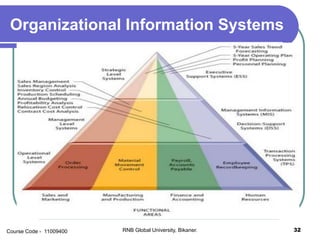
Organizational Information Systems
32RNB Global University, Bikaner.Course Code - 11009400
Transaction Processing Systems
 Transaction is an exchange involving goods or
services.
 Computerized system that performs and
records the daily routine transactions
necessary to conduct the business; these
systems serve the operational level of the
organization.
 Information system used to support and record
transactions.
33RNB Global University, Bikaner.Course Code - 11009400
Transaction Processing Systems
 Primary goal of transaction system is To
provide all the information needed by law
and/or by organizational policies to keep the
business running properly and efficiently.
34RNB Global University, Bikaner.Course Code - 11009400
Transaction Processing Systems
35RNB Global University, Bikaner.Course Code - 11009400
Transaction Processing System
Transaction Processing Systems
 Objectives of TPs:
 To allow for efficient & effective operation of the
organization.
 To provide timely documents and reports.
 To increase the competitive advantage of the
corporation.
 To provide the necessary data for tactical &
strategic systems, such as Web-based
applications.
 To ensure accuracy & integrity of data &
information.
 To safeguard assets & security of information.
36RNB Global University, Bikaner.Course Code - 11009400
Transaction Processing Systems
 The purpose of TPs:
 To keep records about the state of the organization.
 To process transactions that affect the records.
 To produce output that report on transactions that
have occurred.
 Ex. Payroll System.
37RNB Global University, Bikaner.Course Code - 11009400
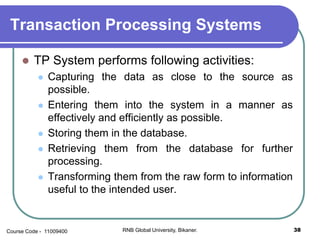
Transaction Processing Systems
 TP System performs following activities:
 Capturing the data as close to the source as
possible.
 Entering them into the system in a manner as
effectively and efficiently as possible.
 Storing them in the database.
 Retrieving them from the database for further
processing.
 Transforming them from the raw form to information
useful to the intended user.
38RNB Global University, Bikaner.Course Code - 11009400
Transaction Processing Systems
 Characteristics of TPs:
 Large amounts of input/output.
 Large number of users.
 Huge storage requirements.
 Low computational complexity.
 Fast input/output as well as processing capabilities.
 A high degree of concern for potential security
related problems.
 A high degree of concern for reliability and fault
tolerance.
39RNB Global University, Bikaner.Course Code - 11009400
Management Information Systems
 Objectives of MIS:
 Capturing Data.
 Processing Data.
 Information Storage.
 Information Retrieval.
 Information Propagation.
40RNB Global University, Bikaner.Course Code - 11009400
Management Information Systems
 Characteristics of MIS:
 It should be able to process data accurately and
with high speed, using various techniques like
operations research, simulation, heuristics, etc.
 It should be able to collect, organize, manipulate,
and update large amount of raw data of both
related and unrelated nature, coming from various
internal and external sources at different periods of
time.
 It should provide real time information on ongoing
events without any delay.
41RNB Global University, Bikaner.Course Code - 11009400
Management Information Systems
 Characteristics of MIS:
 It should support various output formats and
follow latest rules and regulations in
practice.
 It should provide organized and relevant
information for all levels of management:
strategic, operational, and tactical.
 It should aim at extreme flexibility in data
storage and retrieval.
42RNB Global University, Bikaner.Course Code - 11009400
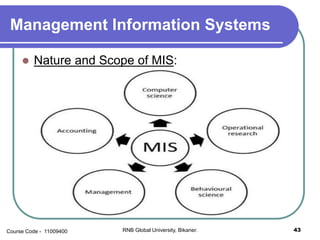
Management Information Systems
 Nature and Scope of MIS:
43RNB Global University, Bikaner.Course Code - 11009400
Decision Support Systems
 Decision support systems (DSS) are
interactive software-based systems
intended to help managers in decision-
making.
 A decision support system helps in
decision-making but does not
necessarily give a decision itself.
44RNB Global University, Bikaner.Course Code - 11009400
Decision Support Systems
 There are two types of decisions:
1. Programmed decision: Programmed
decisions are basically automated
processes, general routine work.
Ex- Selecting a reorder level for
inventories.
2. Non-programmed decisions: Non-
programmed decisions occur in unusual
& non-addressed situations.
45RNB Global University, Bikaner.Course Code - 11009400
Decision Support Systems
 Attributes of a DSS:
 Adaptability and flexibility.
 High level of Interactivity.
 Ease of use.
 Efficiency and effectiveness.
 Complete control by decision-makers.
46RNB Global University, Bikaner.Course Code - 11009400
Decision Support Systems
 Attributes of a DSS:
 Ease of development.
 Extendibility.
 Support for modeling and analysis.
 Support for data access.
 Standalone, integrated, and Web-based.
47RNB Global University, Bikaner.Course Code - 11009400
Decision Support Systems
 Characteristics of a DSS:
 Supports decision-makers in semi-
structured and unstructured problems.
 Support for managers at various managerial
levels, ranging from top executive to line
managers.
 Support for individuals and groups.
 Support for interdependent or sequential
decisions.
48RNB Global University, Bikaner.Course Code - 11009400
Decision Support Systems
 Characteristics of a DSS:
 Support for intelligence, design, choice, and
implementation.
 Support for variety of decision processes
and styles.
 DSSs are adaptive over time.
49RNB Global University, Bikaner.Course Code - 11009400
Decision Support Systems
 Benefits of DSS:
 Improves efficiency and speed of decision-
making activities.
 Increases the control, competitiveness and
capability of futuristic decision-making of the
organization.
 Facilitates interpersonal communication.
 Encourages learning or training.
 Helps automate managerial processes.
50RNB Global University, Bikaner.Course Code - 11009400
Decision Support Systems
 Components of DSS:
 Database management Systems(DBMS).
 Model Management System.
 Support Tools.
51RNB Global University, Bikaner.Course Code - 11009400
Decision Support Systems
 Classification of DSS:
 Text Oriented DSS.
 Database Oriented DSS.
 Spreadsheet Oriented DSS.
 Solver Oriented DSS.
 Rules Oriented DSS.
 Compound DSS.
52RNB Global University, Bikaner.Course Code - 11009400
Decision Support Systems
 Types of DSS:
 Status Inquiry System: Daily schedule of
Jobs to machine.
 Data Analysis System: Inventory Analysis.
 Information Analysis System: Sales
Analysis.
 Accounting System: Accounts receivables.
 Model Based System: Optimization,
Transportation.
53RNB Global University, Bikaner.Course Code - 11009400
IS Levels in a Firm
54RNB Global University, Bikaner.Course Code - 11009400
Business Value driven by IT
55RNB Global University, Bikaner.Course Code - 11009400
Executive Information System
 Executive Information Systems
(Executive Support Systems) are
intended to be used by the senior
managers directly to provide support to
non-programmed decisions in strategic
management.
 These information are external,
unstructured and even uncertain.
56RNB Global University, Bikaner.Course Code - 11009400
Executive Information System
 Following are some examples of
intelligent information, which is often the
source of an EIS/ESS.
 External Databases.
 Technology reports like patent records etc.
 Technical reports from consultants.
57RNB Global University, Bikaner.Course Code - 11009400
Executive Information System
 Market reports.
 Confidential information about competitors.
 Speculative information like market
conditions .
 Government policies.
 Financial reports and information.
58RNB Global University, Bikaner.Course Code - 11009400
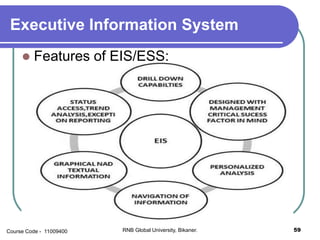
Executive Information System
 Features of EIS/ESS:

59RNB Global University, Bikaner.Course Code - 11009400
Executive Information System
 Advantages of EIS/ESS:
 Easy for upper level executive to use.
 Ability to analyze trends.
 Augmentation of managers' leadership
capabilities.
 Enhance personal thinking and decision-
making.
 Contribution to strategic control flexibility.
60RNB Global University, Bikaner.Course Code - 11009400
Executive Information System
 Advantages of EIS/ESS:
 Enhance organizational competitiveness in
the market place.
 Instruments of change.
 Increased executive time horizons.
 Better reporting system.
 Improved mental model of business
executive .
 Help improve consensus building and
communication.
61RNB Global University, Bikaner.Course Code - 11009400
Executive Information System
 Advantages of EIS/ESS:
 Improve office automation .
 Reduce time for finding information.
 Early identification of company
performance.
 Detail examination of critical success factor.
 Better understanding.
 Time management .
 Increased communication capacity and
quality .
62RNB Global University, Bikaner.Course Code - 11009400
Executive Information System
 Disadvantages of EIS/ESS:
 Functions are limited.
 Hard to quantify benefits.
 Executive may encounter information
overload.
 System may become slow.
 Difficult to keep current data, May lead to
less reliable and insecure data.
 Excessive cost for small company.
63RNB Global University, Bikaner.Course Code - 11009400
Expert System
 Support professionals faced with
complex situations requiring expert
knowledge in a well-defined area.
 They represent human expertise also
called knowledge-based systems.
 A knowledge management system is just
extends the already existing systems by
assimilating more information.
64RNB Global University, Bikaner.Course Code - 11009400
Expert System
 Support professionals faced with
complex situations requiring expert
knowledge in a well-defined area.
 They represent human expertise also
called knowledge-based systems.
 A knowledge management system is just
extends the already existing systems by
assimilating more information.
65RNB Global University, Bikaner.Course Code - 11009400
Expert System
 What is Knowledge?:
 Personalized information .
 State of knowing and understanding.
 An object to be stored and manipulated.
 A process of applying expertise.
 A condition of access to information.
 Potential to influence action.
66RNB Global University, Bikaner.Course Code - 11009400
Expert System
 Sources of Knowledge of an
Organization:
 Intranet .
 Data warehouses and knowledge
repositories.
 Decision support tools.
 Groupware for supporting collaboration.
 Networks of knowledge workers .
 Internal expertise.
67RNB Global University, Bikaner.Course Code - 11009400
Expert System
 Knowledge Management: A knowledge
management system comprises a range
of practices used in an organization to
identify, create, represent, distribute, and
enable adoption to insight and
experience.
 Such insights and experience comprise
knowledge, either embodied in individual
or embedded in organizational
processes and practices.
68RNB Global University, Bikaner.Course Code - 11009400
Expert System
 Levels of Knowledge Management:
69RNB Global University, Bikaner.Course Code - 11009400
Expert System
 Activities in Knowledge Management:
 Start with the business problem and the
business value to be delivered first.
 Identify what kind of strategy to pursue to
deliver this value and address the KM
problem.
 Think about the system required from a
people and process point of view.
70RNB Global University, Bikaner.Course Code - 11009400
Expert System
 Activities in Knowledge Management:
 Finally, think about what kind of technical
infrastructure are required to support the
people and processes.
 Implement system and processes with
appropriate change management and
iterative staged release.
71RNB Global University, Bikaner.Course Code - 11009400
Review
 Introduction to IS.
 Definition IS.
 Purpose of IS.
 Objectives and Role of MIS at Managerial
Level.
 MIS in the Organization.
 TPs, DSs, EIs, Expert Systems .
72RNB Global University, Bikaner.Course Code - 11009400
Thank You!
RNB Global University, Bikaner. 73Course Code - 11009400

Information systems and it's types

  • 1.
    UNIT I Information Systems& It’s Types By Dr. Dhobale J V Associate Professor RNB Global University, Bikaner RNB Global University, Bikaner. 1Course Code - 11009400
  • 2.
    Objectives  Introduction toIS.  Definition IS.  Purpose of IS.  Objectives and Role of MIS at Managerial Level.  MIS in the Organization.  TPs, DSs, EIs, Expert Systems . 2RNB Global University, Bikaner.Course Code - 11009400
  • 3.
    Introduction 3RNB Global University,Bikaner.Course Code - 11009400 546585688531475 D145 Main Road Bikaner Rajasthan Ramesh Gupta IDB00015751 IDBI Bank Customer Details Address
  • 4.
    Cont…  Information canbe defined as meaningfully interpreted data.  So, from a system analyst's point of view, information is a sequence of symbols that can be construed to a useful message. 4RNB Global University, Bikaner.Course Code - 11009400
  • 5.
    Cont…  An InformationSystem is a system that gathers data and disseminates information with the sole purpose of providing information to its users.  An information system is a set of interrelated components that collect, manipulate, store data and disseminate information and provide a feedback mechanism to monitor performance. 5RNB Global University, Bikaner.Course Code - 11009400
  • 6.
    Cont…  Information Systemis an organized combination of people, hardware, software, communications networks, and data resources that collects data, transforms it, and disseminates information.  The main object of an information system is to provide information to its users. Information systems vary according to the type of users who use the system. 6RNB Global University, Bikaner.Course Code - 11009400
  • 7.
    Cont…  A ManagementInformation System (MIS) is an information system that evaluates, analyzes, and processes an organization's data to produce meaningful and useful information based on which the management can take right decisions to ensure future growth of the organization. 7RNB Global University, Bikaner.Course Code - 11009400
  • 8.
    Data Vs Information Data: Raw unorganized facts. Ex. ?, a, 2, y, =, /. Information: A collection of facts organized in such a way that they have additional value beyond the value of the facts themselves. Ex. a+y/2 = ? 8RNB Global University, Bikaner.Course Code - 11009400
  • 9.
    Information  Information canbe recorded as signs, or transmitted as signals. Information is any kind of event that affects the state of a dynamic system that can interpret the information.  The value of Information is directly linked to how it helps decision makers achieve their organization’s goals. 9RNB Global University, Bikaner.Course Code - 11009400
  • 10.
    Information  Conceptually, informationis the message (utterance or expression) being conveyed. Therefore, in a general sense, information is "Knowledge communicated or received, concerning a particular fact or circumstance".  According to Davis and Olson: "Information is a data that has been processed into a form that is meaningful to recipient and is of real or perceived value in the current or the prospective action or decision of recipient." 10RNB Global University, Bikaner.Course Code - 11009400
  • 11.
    Information 11RNB Global University,Bikaner.Course Code - 11009400 DATA Processing Information
  • 12.
    Information, Knowledge and BusinessIntelligence  Professor Ray R. Larson of the School of Information at the University of California, Berkeley, provides an Information Hierarchy, which is:  Data - The raw material of information.  Information - Data organized and presented by someone.  Knowledge - Information read, heard, or seen, and understood.  Wisdom - Distilled and integrated knowledge and understanding.. 12RNB Global University, Bikaner.Course Code - 11009400
  • 13.
    Information, Knowledge and BusinessIntelligence  Scott Andrews' explains Information Continuum as follows:  Data - A Fact or a piece of information, or a series thereof.  Information - Knowledge discerned from data.  Business Intelligence - Information Management pertaining to an organization's policy or decision-making, particularly when tied to strategic or operational objectives. 13RNB Global University, Bikaner.Course Code - 11009400
  • 14.
    Management Information System Simply MIS stand For Management Information System. For Simply Understanding Management Information System (MIS) we can divide in to three Word and Understand Part by part. 1. Management 2. Information 3. System 14RNB Global University, Bikaner.Course Code - 11009400
  • 15.
    Management Information System 1.Management : Management is function to do the work at the Right time, by the right Person, For the Right Job. 2. Information : Information is the Collection of Organized data which plays a Vital Role for decision making. 3. System: System Consist for a set of elements which Provides a Framework to convert Unorganized (Data) into Organized Information. 15RNB Global University, Bikaner.Course Code - 11009400
  • 16.
    Management Information System Management information system refers to such system which provides accurate information to the entire level of management for decision making process. For right job at the right time, by the right person. 16RNB Global University, Bikaner.Course Code - 11009400
  • 17.
    Role of MIS 1.Satisfied diverse need of organization 2. Helps in Decision Making. 3. Helps in Coordination. 4. Helps in finding out problems. 5. Helps in Business performance Improvement. 17RNB Global University, Bikaner.Course Code - 11009400
  • 18.
    Impact of MIS Handling of Management functions becomes more efficient.  Tracking and Monitoring becomes easier.  Early alerts about problems.  Exceptional situations can be brought into the notice of concerned authorities. 18RNB Global University, Bikaner.Course Code - 11009400
  • 19.
    Impact of MIS Gets a structured and knowledge infrastructure in the organization.  Decision making becomes faster and easier.  Brings clarity in the communication.  It pulls entire organizations towards goal attainments. 19RNB Global University, Bikaner.Course Code - 11009400
  • 20.
    Importance of MIS Reliable.  Timely availability of information.  Supports globalization.  Supports Analysis and Decision Making.  Supports Organizational structure and effective and efficient management of organizations functions. 20RNB Global University, Bikaner.Course Code - 11009400
  • 21.
    Classification of Information 21RNBGlobal University, Bikaner.Course Code - 11009400
  • 22.
    Classification of Informationby Characteristics  Based on Anthony's classification of Management, information used in business for decision-making is generally categorized into three types:  Strategic Information: Strategic information is concerned with long term policy decisions . Ex. acquiring a new plant, a new product, diversification of business etc., comes under strategic information. 22RNB Global University, Bikaner.Course Code - 11009400
  • 23.
    Classification of Informationby Characteristics  Tactical Information: Tactical information is concerned with the information needed for exercising control over business resources. Ex budgeting, quality control, service level, inventory level, productivity level etc. 23RNB Global University, Bikaner.Course Code - 11009400
  • 24.
    Classification of Informationby Characteristics  Operational Information: Operational information is concerned with plant/business level information and is used to ensure proper conduction of specific operational tasks as planned/intended.  Various operator specific, machine specific and shift specific jobs for quality control checks comes under this category. 24RNB Global University, Bikaner.Course Code - 11009400
  • 25.
    Classification of Informationby Application  Planning Information: These are the information needed for establishing standard norms and specifications in an organization.  This information is used in strategic, tactical, and operation planning of any activity. Examples of such information are time standards, design standards. 25RNB Global University, Bikaner.Course Code - 11009400
  • 26.
    Classification of Informationby Application  Control Information: This information is needed for establishing control over all business activities through feedback mechanism.  This information is used for controlling attainment, nature and utilization of important processes in a system.  When such information reflects a deviation from the established standards, the system should induce a decision or an action leading to control. 26RNB Global University, Bikaner.Course Code - 11009400
  • 27.
    Classification of Informationby Application  Knowledge Information: Knowledge is defined as "information about information".  Knowledge information is acquired through experience and learning, and collected from archival data and research studies. 27RNB Global University, Bikaner.Course Code - 11009400
  • 28.
    Classification of Informationby Application  Organizational Information: Organizational information deals with an organization's environment, culture in the light of its objectives.  Karl Weick's Organizational Information Theory emphasizes that an organization reduces its equivocality or uncertainty by collecting, managing and using these information prudently.  This information is used by everybody in the organization; examples of such information are employee and payroll information. 28RNB Global University, Bikaner.Course Code - 11009400
  • 29.
    Classification of Informationby Application  Functional/Operational Information: This is operation specific information.  Ex daily schedules in a manufacturing plant that refers to the detailed assignment of jobs to machines or machines to operators.  This information is mostly internal to the organization. 29RNB Global University, Bikaner.Course Code - 11009400
  • 30.
    Classification of Informationby Application  Database Information: Database information construes large quantities of information that has multiple usage and application.  Such information is stored, retrieved and managed to create databases. Ex. material specification or supplier information is stored for multiple users. 30RNB Global University, Bikaner.Course Code - 11009400
  • 31.
    Impact of Businesson IS  Following are factors which impacts functioning of IS:  Size of Organization.  Size of User population.  Scale of operations.  Nature of Business.  User interaction.  Level of Automation.  Organizational culture. 31RNB Global University, Bikaner.Course Code - 11009400
  • 32.
    Organizational Information Systems 32RNBGlobal University, Bikaner.Course Code - 11009400
  • 33.
    Transaction Processing Systems Transaction is an exchange involving goods or services.  Computerized system that performs and records the daily routine transactions necessary to conduct the business; these systems serve the operational level of the organization.  Information system used to support and record transactions. 33RNB Global University, Bikaner.Course Code - 11009400
  • 34.
    Transaction Processing Systems Primary goal of transaction system is To provide all the information needed by law and/or by organizational policies to keep the business running properly and efficiently. 34RNB Global University, Bikaner.Course Code - 11009400
  • 35.
    Transaction Processing Systems 35RNBGlobal University, Bikaner.Course Code - 11009400 Transaction Processing System
  • 36.
    Transaction Processing Systems Objectives of TPs:  To allow for efficient & effective operation of the organization.  To provide timely documents and reports.  To increase the competitive advantage of the corporation.  To provide the necessary data for tactical & strategic systems, such as Web-based applications.  To ensure accuracy & integrity of data & information.  To safeguard assets & security of information. 36RNB Global University, Bikaner.Course Code - 11009400
  • 37.
    Transaction Processing Systems The purpose of TPs:  To keep records about the state of the organization.  To process transactions that affect the records.  To produce output that report on transactions that have occurred.  Ex. Payroll System. 37RNB Global University, Bikaner.Course Code - 11009400
  • 38.
    Transaction Processing Systems TP System performs following activities:  Capturing the data as close to the source as possible.  Entering them into the system in a manner as effectively and efficiently as possible.  Storing them in the database.  Retrieving them from the database for further processing.  Transforming them from the raw form to information useful to the intended user. 38RNB Global University, Bikaner.Course Code - 11009400
  • 39.
    Transaction Processing Systems Characteristics of TPs:  Large amounts of input/output.  Large number of users.  Huge storage requirements.  Low computational complexity.  Fast input/output as well as processing capabilities.  A high degree of concern for potential security related problems.  A high degree of concern for reliability and fault tolerance. 39RNB Global University, Bikaner.Course Code - 11009400
  • 40.
    Management Information Systems Objectives of MIS:  Capturing Data.  Processing Data.  Information Storage.  Information Retrieval.  Information Propagation. 40RNB Global University, Bikaner.Course Code - 11009400
  • 41.
    Management Information Systems Characteristics of MIS:  It should be able to process data accurately and with high speed, using various techniques like operations research, simulation, heuristics, etc.  It should be able to collect, organize, manipulate, and update large amount of raw data of both related and unrelated nature, coming from various internal and external sources at different periods of time.  It should provide real time information on ongoing events without any delay. 41RNB Global University, Bikaner.Course Code - 11009400
  • 42.
    Management Information Systems Characteristics of MIS:  It should support various output formats and follow latest rules and regulations in practice.  It should provide organized and relevant information for all levels of management: strategic, operational, and tactical.  It should aim at extreme flexibility in data storage and retrieval. 42RNB Global University, Bikaner.Course Code - 11009400
  • 43.
    Management Information Systems Nature and Scope of MIS: 43RNB Global University, Bikaner.Course Code - 11009400
  • 44.
    Decision Support Systems Decision support systems (DSS) are interactive software-based systems intended to help managers in decision- making.  A decision support system helps in decision-making but does not necessarily give a decision itself. 44RNB Global University, Bikaner.Course Code - 11009400
  • 45.
    Decision Support Systems There are two types of decisions: 1. Programmed decision: Programmed decisions are basically automated processes, general routine work. Ex- Selecting a reorder level for inventories. 2. Non-programmed decisions: Non- programmed decisions occur in unusual & non-addressed situations. 45RNB Global University, Bikaner.Course Code - 11009400
  • 46.
    Decision Support Systems Attributes of a DSS:  Adaptability and flexibility.  High level of Interactivity.  Ease of use.  Efficiency and effectiveness.  Complete control by decision-makers. 46RNB Global University, Bikaner.Course Code - 11009400
  • 47.
    Decision Support Systems Attributes of a DSS:  Ease of development.  Extendibility.  Support for modeling and analysis.  Support for data access.  Standalone, integrated, and Web-based. 47RNB Global University, Bikaner.Course Code - 11009400
  • 48.
    Decision Support Systems Characteristics of a DSS:  Supports decision-makers in semi- structured and unstructured problems.  Support for managers at various managerial levels, ranging from top executive to line managers.  Support for individuals and groups.  Support for interdependent or sequential decisions. 48RNB Global University, Bikaner.Course Code - 11009400
  • 49.
    Decision Support Systems Characteristics of a DSS:  Support for intelligence, design, choice, and implementation.  Support for variety of decision processes and styles.  DSSs are adaptive over time. 49RNB Global University, Bikaner.Course Code - 11009400
  • 50.
    Decision Support Systems Benefits of DSS:  Improves efficiency and speed of decision- making activities.  Increases the control, competitiveness and capability of futuristic decision-making of the organization.  Facilitates interpersonal communication.  Encourages learning or training.  Helps automate managerial processes. 50RNB Global University, Bikaner.Course Code - 11009400
  • 51.
    Decision Support Systems Components of DSS:  Database management Systems(DBMS).  Model Management System.  Support Tools. 51RNB Global University, Bikaner.Course Code - 11009400
  • 52.
    Decision Support Systems Classification of DSS:  Text Oriented DSS.  Database Oriented DSS.  Spreadsheet Oriented DSS.  Solver Oriented DSS.  Rules Oriented DSS.  Compound DSS. 52RNB Global University, Bikaner.Course Code - 11009400
  • 53.
    Decision Support Systems Types of DSS:  Status Inquiry System: Daily schedule of Jobs to machine.  Data Analysis System: Inventory Analysis.  Information Analysis System: Sales Analysis.  Accounting System: Accounts receivables.  Model Based System: Optimization, Transportation. 53RNB Global University, Bikaner.Course Code - 11009400
  • 54.
    IS Levels ina Firm 54RNB Global University, Bikaner.Course Code - 11009400
  • 55.
    Business Value drivenby IT 55RNB Global University, Bikaner.Course Code - 11009400
  • 56.
    Executive Information System Executive Information Systems (Executive Support Systems) are intended to be used by the senior managers directly to provide support to non-programmed decisions in strategic management.  These information are external, unstructured and even uncertain. 56RNB Global University, Bikaner.Course Code - 11009400
  • 57.
    Executive Information System Following are some examples of intelligent information, which is often the source of an EIS/ESS.  External Databases.  Technology reports like patent records etc.  Technical reports from consultants. 57RNB Global University, Bikaner.Course Code - 11009400
  • 58.
    Executive Information System Market reports.  Confidential information about competitors.  Speculative information like market conditions .  Government policies.  Financial reports and information. 58RNB Global University, Bikaner.Course Code - 11009400
  • 59.
    Executive Information System Features of EIS/ESS:  59RNB Global University, Bikaner.Course Code - 11009400
  • 60.
    Executive Information System Advantages of EIS/ESS:  Easy for upper level executive to use.  Ability to analyze trends.  Augmentation of managers' leadership capabilities.  Enhance personal thinking and decision- making.  Contribution to strategic control flexibility. 60RNB Global University, Bikaner.Course Code - 11009400
  • 61.
    Executive Information System Advantages of EIS/ESS:  Enhance organizational competitiveness in the market place.  Instruments of change.  Increased executive time horizons.  Better reporting system.  Improved mental model of business executive .  Help improve consensus building and communication. 61RNB Global University, Bikaner.Course Code - 11009400
  • 62.
    Executive Information System Advantages of EIS/ESS:  Improve office automation .  Reduce time for finding information.  Early identification of company performance.  Detail examination of critical success factor.  Better understanding.  Time management .  Increased communication capacity and quality . 62RNB Global University, Bikaner.Course Code - 11009400
  • 63.
    Executive Information System Disadvantages of EIS/ESS:  Functions are limited.  Hard to quantify benefits.  Executive may encounter information overload.  System may become slow.  Difficult to keep current data, May lead to less reliable and insecure data.  Excessive cost for small company. 63RNB Global University, Bikaner.Course Code - 11009400
  • 64.
    Expert System  Supportprofessionals faced with complex situations requiring expert knowledge in a well-defined area.  They represent human expertise also called knowledge-based systems.  A knowledge management system is just extends the already existing systems by assimilating more information. 64RNB Global University, Bikaner.Course Code - 11009400
  • 65.
    Expert System  Supportprofessionals faced with complex situations requiring expert knowledge in a well-defined area.  They represent human expertise also called knowledge-based systems.  A knowledge management system is just extends the already existing systems by assimilating more information. 65RNB Global University, Bikaner.Course Code - 11009400
  • 66.
    Expert System  Whatis Knowledge?:  Personalized information .  State of knowing and understanding.  An object to be stored and manipulated.  A process of applying expertise.  A condition of access to information.  Potential to influence action. 66RNB Global University, Bikaner.Course Code - 11009400
  • 67.
    Expert System  Sourcesof Knowledge of an Organization:  Intranet .  Data warehouses and knowledge repositories.  Decision support tools.  Groupware for supporting collaboration.  Networks of knowledge workers .  Internal expertise. 67RNB Global University, Bikaner.Course Code - 11009400
  • 68.
    Expert System  KnowledgeManagement: A knowledge management system comprises a range of practices used in an organization to identify, create, represent, distribute, and enable adoption to insight and experience.  Such insights and experience comprise knowledge, either embodied in individual or embedded in organizational processes and practices. 68RNB Global University, Bikaner.Course Code - 11009400
  • 69.
    Expert System  Levelsof Knowledge Management: 69RNB Global University, Bikaner.Course Code - 11009400
  • 70.
    Expert System  Activitiesin Knowledge Management:  Start with the business problem and the business value to be delivered first.  Identify what kind of strategy to pursue to deliver this value and address the KM problem.  Think about the system required from a people and process point of view. 70RNB Global University, Bikaner.Course Code - 11009400
  • 71.
    Expert System  Activitiesin Knowledge Management:  Finally, think about what kind of technical infrastructure are required to support the people and processes.  Implement system and processes with appropriate change management and iterative staged release. 71RNB Global University, Bikaner.Course Code - 11009400
  • 72.
    Review  Introduction toIS.  Definition IS.  Purpose of IS.  Objectives and Role of MIS at Managerial Level.  MIS in the Organization.  TPs, DSs, EIs, Expert Systems . 72RNB Global University, Bikaner.Course Code - 11009400
  • 73.
    Thank You! RNB GlobalUniversity, Bikaner. 73Course Code - 11009400