UNIT I
Introduction to System Development
By Dr. Dhobale J V
Associate Professor
School of Engineering & Technology
RNB Global University, Bikaner
RNB Global University, Bikaner. 1Course Code - 19003400
Objectives
 Information Systems.
 Categories of Information Systems.
 System Development.
 Structured Analysis Method.
 System Prototype Method.
 Succeeding as System Analyst.
 Analysis – Feasibility Study.
 Feasibility considerations.
 Steps in Feasibility analysis.
 Cost and Benefit Analysis.
 Procedure for cost and benefit determination. 2RNB Global University, Bikaner.Course Code - 19003400
Information Systems
 An information system is a software system to
capture, transmit, store, retrieve, manipulate,
or display information, thereby supporting
people, organizations, or other software
systems.
 An information system may support not only
an organization or a person but also other
software systems and, hence, information
systems.
3RNB Global University, Bikaner.Course Code - 19003400
Information Systems
 An Information System is a system that
gathers data and disseminates information
with the sole purpose of providing information
to its users.
 An information system is a set of interrelated
components that collect, manipulate, store
data and disseminate information and provide
a feedback mechanism to monitor
performance.
4RNB Global University, Bikaner.Course Code - 19003400
Information Systems
 The main object of an information system is to
provide information to its users. Information
systems vary according to the type of users
who use the system.
5RNB Global University, Bikaner.Course Code - 19003400
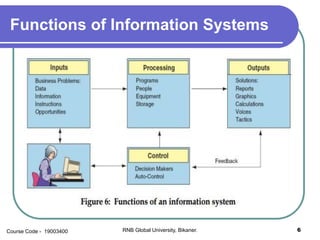
Functions of Information Systems
6RNB Global University, Bikaner.Course Code - 19003400
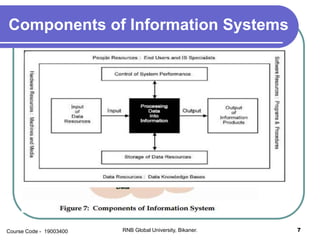
Components of Information Systems
7RNB Global University, Bikaner.Course Code - 19003400
Components of Information Systems
1. Hardware.
2. Software.
3. People.
4. Data Resources.
5. Network Components.
8RNB Global University, Bikaner.Course Code - 19003400
Types of Information Systems
 In any given organization information system
can be classified based on the usage of the
information.
 In an organization Information System can be
divided into operations support system and
management support system.
9RNB Global University, Bikaner.Course Code - 19003400
Types of Information Systems
10RNB Global University, Bikaner.Course Code - 19003400
IS
OSS
TPS PCS ECS
MSS
MIS DSS ES AIS
Types of Information Systems
1. Operations support system : In an
organization, data input is done by the end
user which is processed to generate
information products i.e. reports, which are
utilized by internal and or external users. Such
a system is called operation support system.
11RNB Global University, Bikaner.Course Code - 19003400
Types of Information Systems
 The purpose of the operation support system
is to facilitate business transaction, control
production, support internal as well as external
communication and update organization
central database.
 The operation support system is further
divided into a transaction-processing system,
processing control system and enterprise
collaboration system.
12RNB Global University, Bikaner.Course Code - 19003400
Types of Information Systems
a) Transaction Processing System (TPS) :In
manufacturing organization, there are several
types of transaction across department.
 Typical organizational departments are
Sales, Account, Finance, Plant, Engineering,
Human Resource and Marketing.
13RNB Global University, Bikaner.Course Code - 19003400
Types of Information Systems
 Across which following transaction may occur
sales order, sales return, cash receipts, credit
sales; credit slips, material accounting,
inventory management, depreciation
accounting, etc.
 These transactions can be categorized into
batch transaction processing, single
transaction processing and real time
transaction processing.
14RNB Global University, Bikaner.Course Code - 19003400
Types of Information Systems
b) Process Control Systems: In a
manufacturing organization, certain decisions
are made by a computer system without any
manual intervention.
 In this type of system, critical information is
fed to the system on a real-time basis thereby
enabling process control. This kind of
systems is referred as process control
systems.
15RNB Global University, Bikaner.Course Code - 19003400
Types of Information Systems
c) Enterprise Collaboration Systems: In
recent times, there is more stress on team
effort or collaboration across different
functional teams.
 A system which enables collaborative effort
by improving communication and sharing of
data is referred to as an enterprise
collaboration system.
16RNB Global University, Bikaner.Course Code - 19003400
Types of Information Systems
2. Management Support System: Managers
require precise information in a specific
format to undertake an organizational
decision.
 A system which facilitates an efficient
decision making process for managers is
called management support system.
 Management support systems are essentially
categorized as management information
system, decision support system, expert
system and accounting information system .
17RNB Global University, Bikaner.Course Code - 19003400
Types of Information Systems
a) Management Information System: Simply
MIS stand For Management Information
System. For Simply Understanding
Management Information System (MIS) we
can divide in to three Word and Understand
Part by part.
1. Management
2. Information
3. System
18RNB Global University, Bikaner.Course Code - 19003400
Types of Information Systems
1. Management : Management is function to do
the work at the Right time, by the right
Person, For the Right Job.
2. Information : Information is the Collection of
Organized data which plays a Vital Role for
decision making.
3. System: System Consist for a set of elements
which Provides a Framework to convert
Unorganized (Data) into Organized
Information.
19RNB Global University, Bikaner.Course Code - 19003400
Types of Information Systems
 Management information system refers to
such system which provides accurate
information to the entire level of management
for decision making process. For right job at
the right time, by the right person.
20RNB Global University, Bikaner.Course Code - 19003400
Types of Information Systems
b) Decision support systems (DSS) : are
interactive software-based systems intended
to help managers in decision-making.
 A decision support system helps in decision-
making but does not necessarily give a
decision itself.
21RNB Global University, Bikaner.Course Code - 19003400
Types of Information Systems
 There are two types of decisions:
1. Programmed decision: Programmed
decisions are basically automated processes,
general routine work.
Ex- Selecting a reorder level for inventories.
2. Non-programmed decisions: Non-
programmed decisions occur in unusual &
non-addressed situations.
22RNB Global University, Bikaner.Course Code - 19003400
Types of Information Systems
c) Expert System: Support professionals faced
with complex situations requiring expert
knowledge in a well-defined area.
 They represent human expertise also called
knowledge-based systems.
 A knowledge management system is just
extends the already existing systems by
assimilating more information.
23RNB Global University, Bikaner.Course Code - 19003400
Types of Information Systems
d) An accounting information system (AIS) :
is a system of collecting, storing and
processing financial and accounting data
that are used by decision makers.
 An accounting information system is
generally a computer-based method for
tracking accounting activity in conjunction
with information technology resources.
24RNB Global University, Bikaner.Course Code - 19003400
Structured Systems Analysis and
Design Methodology (SSADM)
 Structured Systems Analysis and Design
Methodology (SSADM) is a systems approach
to the analysis and design of information
systems.
 SSADM is a waterfall method by which an IS
design can be arrived at.
25RNB Global University, Bikaner.Course Code - 19003400
Structured Systems Analysis and
Design Methodology (SSADM)
 System design methods are a discipline within
the software development industry which seek
to provide a framework for activity and the
capture, storage, transformation and
dissemination of information so as to enable
the economic development of computer
systems that are fit for purpose.
26RNB Global University, Bikaner.Course Code - 19003400
Structured Systems Analysis and
Design Methodology (SSADM)
 Objectives of SSADM :
1. Ensure that projects can successfully
continue should a loss of staff occur
without a damaging effect on the
project.
2. Develop overall better quality systems.
3. Improve the way in which projects are
controlled and managed.
27RNB Global University, Bikaner.Course Code - 19003400
Structured Systems Analysis and
Design Methodology (SSADM)
 Objectives of SSADM :
4. Allow more effective use of experienced
and inexperienced staff and their
development.
5. Make it possible for projects to be
supported by computer based tools e.g.
computer-aided software engineering
systems.
28RNB Global University, Bikaner.Course Code - 19003400
Structured Systems Analysis and
Design Methodology (SSADM)
 Objectives of SSADM :
6. Improve communication between
participants in a project so an effective
framework is in place.
29RNB Global University, Bikaner.Course Code - 19003400
Structured Systems Analysis and
Design Methodology (SSADM)
 Benefits of SSADM :
1. Timelines: Theoretically, SSADM allows
one to plan, manage and control a
project well. These points are essential
to deliver the product on time.
2. Usability: Within SSADM special
emphasis is put on the analysis of user
needs. System Model and
comprehensive demand analysis are
carried out to suite each other.
30RNB Global University, Bikaner.Course Code - 19003400
Structured Systems Analysis and
Design Methodology (SSADM)
 Benefits of SSADM :
3. Respond to changes in the business
environment - As in SSADM
documentation of the project’s progress
is taken very seriously, issues like
business objectives and business
needs are considered while the project
is being developed, which helps to tailor
the planning as per actual business
requirements.
31RNB Global University, Bikaner.Course Code - 19003400
Structured Systems Analysis and
Design Methodology (SSADM)
 Benefits of SSADM :
4. Effective use of skills - SSADM does
not require very special skills and can
easily be taught to the staff. Normally,
common modelling and diagramming
tools are used.
5. Better quality - SSADM reduces the
error rate of IS by defining a certain
quality level in the beginning and
constantly checking the system.
32RNB Global University, Bikaner.Course Code - 19003400
Structured Systems Analysis and
Design Methodology (SSADM)
 Benefits of SSADM :
6. Improvement of productivity – By
encouraging on-time delivery, meeting
business requirements, ensuring better
quality, using human resources
effectively as well as trying to avoid
bureaucracy, SSADM improves the
overall productivity of the specific
project and the company.
33RNB Global University, Bikaner.Course Code - 19003400
Structured Systems Analysis and
Design Methodology (SSADM)
 Benefits of SSADM :
7. Cut Costs - SSADM separates the
logical and the physical systems design.
So the system does not have to be
implemented again with new hard -or
software.
34RNB Global University, Bikaner.Course Code - 19003400
Structured Systems Analysis and
Design Methodology (SSADM)
 Disadvantages of SSADM :
1. SSADM puts special emphasis on the
analysis of the system and its
documentation which causes the over-
analysing.
2. Time and cost consuming.
3. Due to various types of description
methods, checks of consistency cannot
be carried out.
35RNB Global University, Bikaner.Course Code - 19003400
Structured Systems Analysis and
Design Methodology (SSADM)
 SSADM Techniques:
1. Logical Data Modelling: The data
requirements of the system being
designed are identified, modelled and
documented. This data is separated into
entities and relationships between these
entities identified.
36RNB Global University, Bikaner.Course Code - 19003400
Structured Systems Analysis and
Design Methodology (SSADM)
 SSADM Techniques:
2. Data Flow Modelling: Concerned with
how the data moves around the
information system. Examines
processes, data stores, external entities
and data flows.
37RNB Global University, Bikaner.Course Code - 19003400
Structured Systems Analysis and
Design Methodology (SSADM)
 SSADM Techniques:
3. Entity Behaviour Modelling – The
identifying, modelling and document
events with respect to the entities in the
system and the order in which these
events takes place.
38RNB Global University, Bikaner.Course Code - 19003400
Structured Systems Analysis and
Design Methodology (SSADM)
 Steps used in SSADM : SSADM is a
waterfall view approach whereby there
are sequences of events that run in
series and each step leads on from the
last.
1. Feasibility Study.
2. Requirement Analysis.
3. Requirement Specification.
4. Logical System Specification.
5. Physical Design. 39RNB Global University, Bikaner.Course Code - 19003400
System Development Methodology
 The methodology for system development has
a great variety of approaches.
 We call it as models of system development
life cycle (SDLC).
 Some of the most commonly used models are
the Spiral, Waterfall, V-shaped, and Agile
models.
40RNB Global University, Bikaner.Course Code - 19003400
The Waterfall Model
 The waterfall model was introduced by Royce
in (1970), specifically for spacecraft mission
software design.
 It is one of the most popular methods of
assessing the evolution of a product or
system.
 It is a step-by-step sequential description that
spans 7 different stages.
41RNB Global University, Bikaner.Course Code - 19003400
The Waterfall Model
 System Requirements, Software requirements,
Analysis, Program design, Coding, Testing
and Operations” (Royce 1970).
 The first premise in which this model is based
is that any development process of any
software or system starts off by two essential
steps: analysis and coding.
42RNB Global University, Bikaner.Course Code - 19003400
The Waterfall Model
 Analysis stage is broken down into two steps -
analysis of both system and software
requirements, while the coding stage is
preceded by program design (Royce 1970).
 It is useful set of guidelines for the
development of new programs or systems.
 Royce (1970) provides five key principles
(guidelines):
43RNB Global University, Bikaner.Course Code - 19003400
The Waterfall Model
1. Program Design comes first.
2. Document the design.
3. Do it twice.
4. Plan, Control and monitor testing.
5. Involve the Customer.
44RNB Global University, Bikaner.Course Code - 19003400
The Waterfall Model
 It is a sequential model.
 Each of its stages must be entirely concluded
before the next can begin.
 Similarly to the flow of a waterfall, the
development of the software is regarded as
continuously streaming downward throughout
its different stages(Massey and Satao 2012).
45RNB Global University, Bikaner.Course Code - 19003400
The Waterfall Model
 Each stage is regarded as a static component,
a rigid step in the process.
 The waterfall model took precedence over
other models in the 1980s and the beginning
of the 1990s.
 But this preponderance suffered an important
setback with the increasing speed of
technological evolution and the subsequent
need to swiftly deliver software systems.
46RNB Global University, Bikaner.Course Code - 19003400
The Waterfall Model
47RNB Global University, Bikaner.Course Code - 19003400
The Waterfall Model
 Viewing each stage as a single, “frozen”
moment of evolution can greatly delay the
implementation stage.
 This model is an idealized and greatly
simplified concept of SDLC.
 It is not very flexible, but it is still popular as a
conceptual basis for other frameworks or
models.
48RNB Global University, Bikaner.Course Code - 19003400
The Waterfall Model
 Its greatest strength lies in that it outlines
generally accepted positive habits of software
development, such as :
 Minute and accurate planning early in the project.
 extensive documentation of the entire process.
 Having robust design concepts before starting to
code.
49RNB Global University, Bikaner.Course Code - 19003400
System Prototype Method
 Prototyping is a development methodology in
which a model is quickly constructed to test or
illustrate design features and ideas, in order to
gather user feedback.
 This design methodology is sometimes known
as evolutionary design or incremental
development.
 Prototyping has been widely used for at least
30-35 years.
50RNB Global University, Bikaner.Course Code - 19003400
System Prototype Method
 It gradually replaced the older ‘waterfall’
model.
 Like a series of waterfalls, this older method
assumed a number of separate stages, each
self-contained and finally flowing into the next
stage.
 In this scenario users would first clearly state
all of their requirements for the system, and
then leave it to the systems analyst to design
the complete system.
51RNB Global University, Bikaner.Course Code - 19003400
System Prototype Method
 Next the programmer would create the system
code. Finally the testers would verify the
correctness of the system and it would be
presented to the users.
 Prototyping addresses these issues with an
iterative or spiral process, in which a simpler
model is continually refined toward the desired
end.
52RNB Global University, Bikaner.Course Code - 19003400
System Prototype Method
 Basically, prototyping consists of a series of
phases in which a model is discussed and
refined by the stakeholders, and then
implemented by the developers.
 Then the next phase follows the same pattern,
but with a slightly more detailed model.
 A prototype starts simply and grows in
complexity.
53RNB Global University, Bikaner.Course Code - 19003400
System Prototype Method
 All stakeholders – managers, users,
developers, researchers, etc. – are included
from the start and at all levels of development.
 The aim is to work together to realize the
common objective and minimize
misunderstanding and omissions.
 The methodology highlights flexibility to
accommodate change right up until the
product is finalized.
54RNB Global University, Bikaner.Course Code - 19003400
System Prototype Method
 Steps in prototyping :
1. decide on the goal of the project and its major
components or categories.
2. Choose one or two features to begin with.
3. Create a preliminary design on paper.
4. Discuss the design with stakeholders with the
aim of improving it.
5. Repeat steps 3 & 4 to generate a simple
design that all can agree on.
55RNB Global University, Bikaner.Course Code - 19003400
System Prototype Method
 Steps in prototyping :
6. Implement the design on the computer.
7. Repeat the consultation / refinement process
until the features are ‘good enough’ to
continue.
8. Add another feature and repeat the
prototyping process of consultation and
refinement.
56RNB Global University, Bikaner.Course Code - 19003400
Succeeding as System Analyst
 A systems analyst is a person who uses
analysis and design techniques to solve
business problems using information
technology.
 Systems analysts may serve as change
agents who identify the organizational
improvements needed, design systems to
implement those changes, and train and
motivate others to use the systems.
57RNB Global University, Bikaner.Course Code - 19003400
Succeeding as System Analyst
 System Analysts are the key individuals in the
system development process.
 To succeed as a system analyst, you will
need to develop four types of skills:
1. Analytical Skills.
2. Technical Skills.
3. Managerial Skills.
4. Interpersonal Skills.
58RNB Global University, Bikaner.Course Code - 19003400
Succeeding as System Analyst
 Relationship between System Analyst Skills
and SDLC..
59RNB Global University, Bikaner.Course Code - 19003400
Succeeding as System Analyst
1. Analytical skills: Analytical skills enables you to
understand the organization and its functions, to
identify opportunities and problems and to analyze
and solve problems.
 One of the most important analytical skills you can
develop is systems thinking, or the ability to see
organizations and information systems as systems.
 Along with this it incorporates Organizational
Knowledge, Problem identification, Problem
Analyzing and solving
60RNB Global University, Bikaner.Course Code - 19003400
Succeeding as System Analyst
2. Technical skills: Technical skills help you to
understand the potential and the limitations of
information system.
 As an Analyst you must be able to envision
an information system that will help users
solve problems and that will guide the
system’s design and development.
 He must be able to work with programming
languages, various operating systems and
computer hardware.
61RNB Global University, Bikaner.Course Code - 19003400
Succeeding as System Analyst
3. Management Skills: Management skills help
you the management resources, projects,
risks and change.
 It covers up planning, organizing,
implementation and optimum utilization of
available resources.
62RNB Global University, Bikaner.Course Code - 19003400
Succeeding as System Analyst
4. Interpersonal Skills: Interpersonal skills help
to work with end users as well as with other
analyst and programmers.
 As a System Analyst one can play a major
role as a liaison among users, programmers
and other system professionals.
 Effective written & oral communication
including competence in leading meetings,
interviewing and listening is a key skill analyst
must master.
63RNB Global University, Bikaner.Course Code - 19003400
Succeeding as System Analyst
 Effective analysts successfully combine these
four skills.
 As with any profession, becoming a good
system analyst takes years of study and
experience.
 Standards have been established and
practice, several aspects of standards:
 Standards of Practice.
 Ethics.
 Career Paths.
64RNB Global University, Bikaner.Course Code - 19003400
Analysis
 A systematic examination and evaluation of
data or information, by breaking it into its
component parts to uncover their
interrelationships.
65RNB Global University, Bikaner.Course Code - 19003400
Analysis – Feasibility Study
 Feasibility Study: Feasibility study is an
assessment of the practicality of a proposed
project or system.
 A feasibility study aims to objectively and
rationally uncover the strengths and
weaknesses of an existing business or
proposed venture, opportunities and threats
present in the environment,
the resources required to carry through, and
ultimately the prospects for success.
66RNB Global University, Bikaner.Course Code - 19003400
Analysis – Feasibility Study
 Feasibility Study:
 In its simplest terms, the two criteria to judge
feasibility are cost required and value to be
attained.
 A well-designed feasibility study should
provide a historical background of the
business or project, a description of
the product or service, accounting
statements, details of
the operations and management, marketing
research and policies, financial data, legal
requirements and tax obligations. 67RNB Global University, Bikaner.Course Code - 19003400
Analysis – Feasibility Study
 A feasibility study evaluates the project's
potential for success; therefore, perceived
objectivity is an important factor in the
credibility of the study for potential investors
and lending institutions.
 There are following types of Feasibility
studies: Technical, Economical, Legal,
Operational and Scheduling.
68RNB Global University, Bikaner.Course Code - 19003400
Analysis – Feasibility Study
 Technical Feasibility: This assessment is
based on an outline design of system
requirements, to determine whether the
company has the technical expertise to
handle completion of the project.
 The technical feasibility assessment is
focused on gaining an understanding of the
present technical resources of the
organization and their applicability to the
expected needs of the proposed system.
69RNB Global University, Bikaner.Course Code - 19003400
Analysis – Feasibility Study
 It is an evaluation of the hardware and
software and how it meets the need of the
proposed system.
 Economical Feasibility: The purpose of
an economic feasibility study (EFS) is to
demonstrate the net benefit of a proposed
project for accepting or disbursing electronic
funds/benefits, taking into consideration the
benefits and costs to the agency, other state
agencies, and the general public as a whole.
70RNB Global University, Bikaner.Course Code - 19003400
Analysis – Feasibility Study
 Legal Feasibility: Determines whether the
proposed system conflicts with legal
requirements, e.g. a data processing system
must comply with the local data protection
regulations and if the proposed venture is
acceptable in accordance to the laws of the
land.
71RNB Global University, Bikaner.Course Code - 19003400
Analysis – Feasibility Study
 Operational Feasibility: Operational feasibility
is the measure of how well a proposed
system solves the problems, and takes
advantage of the opportunities identified
during scope definition and how it satisfies
the requirements identified in the
requirements analysis phase of system
development.
72RNB Global University, Bikaner.Course Code - 19003400
Analysis – Feasibility Study
 The operational feasibility assessment
focuses on the degree to which the proposed
development projects fits in with the existing
business environment and objectives with
regard to development schedule, delivery
date, corporate culture and existing business
processes.
73RNB Global University, Bikaner.Course Code - 19003400
Analysis – Feasibility Study
 Schedule Feasibility: A project will fail if it
takes too long to be completed before it is
useful.
 Typically this means estimating how long the
system will take to develop, and if it can be
completed in a given time period using some
methods like payback period.
74RNB Global University, Bikaner.Course Code - 19003400
Analysis – Feasibility Study
 Schedule feasibility is a measure of how
reasonable the project timetable is. Given our
technical expertise, are the project deadlines
reasonable? Some projects are initiated with
specific deadlines. It is necessary to
determine whether the deadlines are
mandatory or desirable.
75RNB Global University, Bikaner.Course Code - 19003400
Analysis – Feasibility Study
 Feasibility Analysis: It is a process by which
we measure feasibility. It is an on going
evaluation of feasibility in the life cycle.
 Feasibility Focuses on :
 What are the user’s demonstrable needs, how
does a candidate system meet them ?
 What resources are available for given
system. Is the problem worth solving ?
 What the likely impact of the system on the
organisation.? How well does it fit within the
organisation’s ? 76RNB Global University, Bikaner.Course Code - 19003400
Analysis – Feasibility Considerations
 Feasibility Analysis involves three key
considerations:
1. Economic Feasibility
2. Technical Feasibility
3. Behavioural Feasibility
77RNB Global University, Bikaner.Course Code - 19003400
Analysis – Feasibility Considerations
1. Economic Feasibility: As the name suggest, it
deals with the term of money.
 It is the most frequent method for evaluating
the effectiveness of candidate system.
 Cost Benefit Analysis is done to determine
the benefits and savings that are expected
from the candidate system and compare
them with cost.
78RNB Global University, Bikaner.Course Code - 19003400
Analysis – Feasibility Considerations
2. Technical Feasibility: The possibility that
organization has or can procure the
necessary resources.
 This is demonstrated if the needed hardware
and software are available in the market
place or can be developed by the time of
implementation.
79RNB Global University, Bikaner.Course Code - 19003400
Analysis – Feasibility Considerations
3. Behavioural Feasibility: People are
inherently resistant to change, and computers
have been known to facilitate change.
 So, it is understandable that introduction of
candidate system requires special effort to
educate, sell and train the staff on new way.
80RNB Global University, Bikaner.Course Code - 19003400
Steps in Feasibility Analysis
 Feasibility analysis involves 8 steps:
1. Form a project team and appoint a project
leader.
2. Prepare System Flowcharts.
3. Enumerate Potential Candidate System.
4. Describe and Identify ‘Characteristics’ of
Candidate System.
5. Determine and Evaluate Performance and Cost
Effectiveness of each candidate System.
6. Weight System Performance and Cost Data.
7. Select the Best Candidate System.
8. Feasibility Report .
81RNB Global University, Bikaner.Course Code - 19003400
Cost Benefit Analysis
 From the analysis, system design
requirements are identified and alternative
systems are evaluated.
 The analysis of the costs and benefits of each
alternative guides the selection process.
Therefore, a knowledge of cost and benefit
categories and their evaluation methods is
important.
 Costs/Benefits analysis gives a picture of
various costs, benefits and rules associated
with each alternative system.
82RNB Global University, Bikaner.Course Code - 19003400
Cost Benefit Analysis
 Cost falls in two categories:
1. Costs associated with developing the system
: Costs which are associated with developing the
system, can be estimated from the outset of a
project and should be reviewed at the end of each
phase of the project.
2. Costs associated with operating system : Costs
which are associated with operating a system, can
be estimated only once specific computer-based
solutions have been defined (during the selection
phase or later).
83RNB Global University, Bikaner.Course Code - 19003400
Cost Benefit Analysis
 Cost & Benefit categories: In developing cost
estimates for a system, we consider several
cost elements
1. Facility Costs : These are expenses
incurred in the preparation of the physical
site where the application or the
computers will be in operation.
2. Hardware : Costs related to the actual
purchase or lease of the computer and
peripherals (e.g., printer, disk drives, tape
unit)
84RNB Global University, Bikaner.Course Code - 19003400
Cost Benefit Analysis
3. Supply Costs : These are variable costs
that increase with increased use of
resources. They should be estimated and
included in the overall cost of the system.
This includes the equipment costs also.
4. Training Costs : If the computer
personnel or end-users have to be trained,
the training courses may be charged out
on a flat fee per site, a student fee, or an
hourly fee.
85RNB Global University, Bikaner.Course Code - 19003400
Cost Benefit Analysis
5. Operating Costs : It includes all costs
associated with the day-to-day operation
of the system. The amount depends on
the number of shifts, the ‘nature of the
applications’ and the caliber of the
operating staff.
6. Supply Usage Cost : Computer time will
be used for one or more of the following
activities : programming, testing,
conversion, word processing, maintaining
a project dictionary, prototyping, loading
new data files etc. 86RNB Global University, Bikaner.Course Code - 19003400
Cost Benefit Analysis
7. Personnel Costs : It includes EDP staff
salaries and benefits (health insurance,
vacation time, sick pay, etc). as well as
pay for those involved in developing the
system. The salaries of systems analysts,
programmers, consultants, data entry
personnel, computer operator, secretaries,
and the like who work on the project make
up the personnel costs.
87RNB Global University, Bikaner.Course Code - 19003400
Cost Benefit Analysis
 Benefits: The two major benefits are:
1. Improving performance : The
performance category emphasizes
improvement in the accuracy of or access
to information and easier access to the
system by authority
2. Minimizing the cost of processing
: Minimizing costs through an efficient
system-error control or reduction of staff is
a benefit that should be measured and
included in Cost Benefit Analysis.
88RNB Global University, Bikaner.Course Code - 19003400
Cost Benefit Analysis
 Procedure for Cost/Benefit
Determination: The determination of
costs and benefits entails the following
step.
1. Identify the costs and benefits pertaining
to a given project.
2. Categorise the various costs and benefits
for analysis.
3. Select a method of analysis.
4. Interpret the results of the analysis.
5. Take action. 89RNB Global University, Bikaner.Course Code - 19003400
Cost Benefit Analysis
 Cost benefit identification: Some
costs and benefits are easily
identified, e.g., direct costs, i.e., price of
resource. Direct benefits often relate
one-to-one to direct costs, e.g., savings
from reducing costs.
90RNB Global University, Bikaner.Course Code - 19003400
Cost Benefit Analysis
 Cost benefit identification:
 Another category of cost and benefit
that is not easily discernable is
opportunity cost/benefit.
 A cost that measures the opportunity
which is cost or sacrificed, when choice
of one course of action requires that a
on alternative choice of action be given
up.
91RNB Global University, Bikaner.Course Code - 19003400
Cost Benefit Analysis
 Cost benefit identification:
 Fixed or Variable cost benefits.
 Tangible and Intangible cost benefits.
92RNB Global University, Bikaner.Course Code - 19003400
Review
 Information Systems.
 Categories of Information Systems.
 System Development.
 Structured Analysis Method.
 System Prototype Method.
 Succeeding as System Analyst.
 Analysis – Feasibility Study.
 Feasibility considerations.
 Steps in Feasibility analysis.
 Cost and Benefit Analysis.
 Procedure for cost and benefit determination. 93RNB Global University, Bikaner.Course Code - 19003400
Thank You!
RNB Global University, Bikaner. 94Course Code - 19003400

Introduction to system development

  • 1.
    UNIT I Introduction toSystem Development By Dr. Dhobale J V Associate Professor School of Engineering & Technology RNB Global University, Bikaner RNB Global University, Bikaner. 1Course Code - 19003400
  • 2.
    Objectives  Information Systems. Categories of Information Systems.  System Development.  Structured Analysis Method.  System Prototype Method.  Succeeding as System Analyst.  Analysis – Feasibility Study.  Feasibility considerations.  Steps in Feasibility analysis.  Cost and Benefit Analysis.  Procedure for cost and benefit determination. 2RNB Global University, Bikaner.Course Code - 19003400
  • 3.
    Information Systems  Aninformation system is a software system to capture, transmit, store, retrieve, manipulate, or display information, thereby supporting people, organizations, or other software systems.  An information system may support not only an organization or a person but also other software systems and, hence, information systems. 3RNB Global University, Bikaner.Course Code - 19003400
  • 4.
    Information Systems  AnInformation System is a system that gathers data and disseminates information with the sole purpose of providing information to its users.  An information system is a set of interrelated components that collect, manipulate, store data and disseminate information and provide a feedback mechanism to monitor performance. 4RNB Global University, Bikaner.Course Code - 19003400
  • 5.
    Information Systems  Themain object of an information system is to provide information to its users. Information systems vary according to the type of users who use the system. 5RNB Global University, Bikaner.Course Code - 19003400
  • 6.
    Functions of InformationSystems 6RNB Global University, Bikaner.Course Code - 19003400
  • 7.
    Components of InformationSystems 7RNB Global University, Bikaner.Course Code - 19003400
  • 8.
    Components of InformationSystems 1. Hardware. 2. Software. 3. People. 4. Data Resources. 5. Network Components. 8RNB Global University, Bikaner.Course Code - 19003400
  • 9.
    Types of InformationSystems  In any given organization information system can be classified based on the usage of the information.  In an organization Information System can be divided into operations support system and management support system. 9RNB Global University, Bikaner.Course Code - 19003400
  • 10.
    Types of InformationSystems 10RNB Global University, Bikaner.Course Code - 19003400 IS OSS TPS PCS ECS MSS MIS DSS ES AIS
  • 11.
    Types of InformationSystems 1. Operations support system : In an organization, data input is done by the end user which is processed to generate information products i.e. reports, which are utilized by internal and or external users. Such a system is called operation support system. 11RNB Global University, Bikaner.Course Code - 19003400
  • 12.
    Types of InformationSystems  The purpose of the operation support system is to facilitate business transaction, control production, support internal as well as external communication and update organization central database.  The operation support system is further divided into a transaction-processing system, processing control system and enterprise collaboration system. 12RNB Global University, Bikaner.Course Code - 19003400
  • 13.
    Types of InformationSystems a) Transaction Processing System (TPS) :In manufacturing organization, there are several types of transaction across department.  Typical organizational departments are Sales, Account, Finance, Plant, Engineering, Human Resource and Marketing. 13RNB Global University, Bikaner.Course Code - 19003400
  • 14.
    Types of InformationSystems  Across which following transaction may occur sales order, sales return, cash receipts, credit sales; credit slips, material accounting, inventory management, depreciation accounting, etc.  These transactions can be categorized into batch transaction processing, single transaction processing and real time transaction processing. 14RNB Global University, Bikaner.Course Code - 19003400
  • 15.
    Types of InformationSystems b) Process Control Systems: In a manufacturing organization, certain decisions are made by a computer system without any manual intervention.  In this type of system, critical information is fed to the system on a real-time basis thereby enabling process control. This kind of systems is referred as process control systems. 15RNB Global University, Bikaner.Course Code - 19003400
  • 16.
    Types of InformationSystems c) Enterprise Collaboration Systems: In recent times, there is more stress on team effort or collaboration across different functional teams.  A system which enables collaborative effort by improving communication and sharing of data is referred to as an enterprise collaboration system. 16RNB Global University, Bikaner.Course Code - 19003400
  • 17.
    Types of InformationSystems 2. Management Support System: Managers require precise information in a specific format to undertake an organizational decision.  A system which facilitates an efficient decision making process for managers is called management support system.  Management support systems are essentially categorized as management information system, decision support system, expert system and accounting information system . 17RNB Global University, Bikaner.Course Code - 19003400
  • 18.
    Types of InformationSystems a) Management Information System: Simply MIS stand For Management Information System. For Simply Understanding Management Information System (MIS) we can divide in to three Word and Understand Part by part. 1. Management 2. Information 3. System 18RNB Global University, Bikaner.Course Code - 19003400
  • 19.
    Types of InformationSystems 1. Management : Management is function to do the work at the Right time, by the right Person, For the Right Job. 2. Information : Information is the Collection of Organized data which plays a Vital Role for decision making. 3. System: System Consist for a set of elements which Provides a Framework to convert Unorganized (Data) into Organized Information. 19RNB Global University, Bikaner.Course Code - 19003400
  • 20.
    Types of InformationSystems  Management information system refers to such system which provides accurate information to the entire level of management for decision making process. For right job at the right time, by the right person. 20RNB Global University, Bikaner.Course Code - 19003400
  • 21.
    Types of InformationSystems b) Decision support systems (DSS) : are interactive software-based systems intended to help managers in decision-making.  A decision support system helps in decision- making but does not necessarily give a decision itself. 21RNB Global University, Bikaner.Course Code - 19003400
  • 22.
    Types of InformationSystems  There are two types of decisions: 1. Programmed decision: Programmed decisions are basically automated processes, general routine work. Ex- Selecting a reorder level for inventories. 2. Non-programmed decisions: Non- programmed decisions occur in unusual & non-addressed situations. 22RNB Global University, Bikaner.Course Code - 19003400
  • 23.
    Types of InformationSystems c) Expert System: Support professionals faced with complex situations requiring expert knowledge in a well-defined area.  They represent human expertise also called knowledge-based systems.  A knowledge management system is just extends the already existing systems by assimilating more information. 23RNB Global University, Bikaner.Course Code - 19003400
  • 24.
    Types of InformationSystems d) An accounting information system (AIS) : is a system of collecting, storing and processing financial and accounting data that are used by decision makers.  An accounting information system is generally a computer-based method for tracking accounting activity in conjunction with information technology resources. 24RNB Global University, Bikaner.Course Code - 19003400
  • 25.
    Structured Systems Analysisand Design Methodology (SSADM)  Structured Systems Analysis and Design Methodology (SSADM) is a systems approach to the analysis and design of information systems.  SSADM is a waterfall method by which an IS design can be arrived at. 25RNB Global University, Bikaner.Course Code - 19003400
  • 26.
    Structured Systems Analysisand Design Methodology (SSADM)  System design methods are a discipline within the software development industry which seek to provide a framework for activity and the capture, storage, transformation and dissemination of information so as to enable the economic development of computer systems that are fit for purpose. 26RNB Global University, Bikaner.Course Code - 19003400
  • 27.
    Structured Systems Analysisand Design Methodology (SSADM)  Objectives of SSADM : 1. Ensure that projects can successfully continue should a loss of staff occur without a damaging effect on the project. 2. Develop overall better quality systems. 3. Improve the way in which projects are controlled and managed. 27RNB Global University, Bikaner.Course Code - 19003400
  • 28.
    Structured Systems Analysisand Design Methodology (SSADM)  Objectives of SSADM : 4. Allow more effective use of experienced and inexperienced staff and their development. 5. Make it possible for projects to be supported by computer based tools e.g. computer-aided software engineering systems. 28RNB Global University, Bikaner.Course Code - 19003400
  • 29.
    Structured Systems Analysisand Design Methodology (SSADM)  Objectives of SSADM : 6. Improve communication between participants in a project so an effective framework is in place. 29RNB Global University, Bikaner.Course Code - 19003400
  • 30.
    Structured Systems Analysisand Design Methodology (SSADM)  Benefits of SSADM : 1. Timelines: Theoretically, SSADM allows one to plan, manage and control a project well. These points are essential to deliver the product on time. 2. Usability: Within SSADM special emphasis is put on the analysis of user needs. System Model and comprehensive demand analysis are carried out to suite each other. 30RNB Global University, Bikaner.Course Code - 19003400
  • 31.
    Structured Systems Analysisand Design Methodology (SSADM)  Benefits of SSADM : 3. Respond to changes in the business environment - As in SSADM documentation of the project’s progress is taken very seriously, issues like business objectives and business needs are considered while the project is being developed, which helps to tailor the planning as per actual business requirements. 31RNB Global University, Bikaner.Course Code - 19003400
  • 32.
    Structured Systems Analysisand Design Methodology (SSADM)  Benefits of SSADM : 4. Effective use of skills - SSADM does not require very special skills and can easily be taught to the staff. Normally, common modelling and diagramming tools are used. 5. Better quality - SSADM reduces the error rate of IS by defining a certain quality level in the beginning and constantly checking the system. 32RNB Global University, Bikaner.Course Code - 19003400
  • 33.
    Structured Systems Analysisand Design Methodology (SSADM)  Benefits of SSADM : 6. Improvement of productivity – By encouraging on-time delivery, meeting business requirements, ensuring better quality, using human resources effectively as well as trying to avoid bureaucracy, SSADM improves the overall productivity of the specific project and the company. 33RNB Global University, Bikaner.Course Code - 19003400
  • 34.
    Structured Systems Analysisand Design Methodology (SSADM)  Benefits of SSADM : 7. Cut Costs - SSADM separates the logical and the physical systems design. So the system does not have to be implemented again with new hard -or software. 34RNB Global University, Bikaner.Course Code - 19003400
  • 35.
    Structured Systems Analysisand Design Methodology (SSADM)  Disadvantages of SSADM : 1. SSADM puts special emphasis on the analysis of the system and its documentation which causes the over- analysing. 2. Time and cost consuming. 3. Due to various types of description methods, checks of consistency cannot be carried out. 35RNB Global University, Bikaner.Course Code - 19003400
  • 36.
    Structured Systems Analysisand Design Methodology (SSADM)  SSADM Techniques: 1. Logical Data Modelling: The data requirements of the system being designed are identified, modelled and documented. This data is separated into entities and relationships between these entities identified. 36RNB Global University, Bikaner.Course Code - 19003400
  • 37.
    Structured Systems Analysisand Design Methodology (SSADM)  SSADM Techniques: 2. Data Flow Modelling: Concerned with how the data moves around the information system. Examines processes, data stores, external entities and data flows. 37RNB Global University, Bikaner.Course Code - 19003400
  • 38.
    Structured Systems Analysisand Design Methodology (SSADM)  SSADM Techniques: 3. Entity Behaviour Modelling – The identifying, modelling and document events with respect to the entities in the system and the order in which these events takes place. 38RNB Global University, Bikaner.Course Code - 19003400
  • 39.
    Structured Systems Analysisand Design Methodology (SSADM)  Steps used in SSADM : SSADM is a waterfall view approach whereby there are sequences of events that run in series and each step leads on from the last. 1. Feasibility Study. 2. Requirement Analysis. 3. Requirement Specification. 4. Logical System Specification. 5. Physical Design. 39RNB Global University, Bikaner.Course Code - 19003400
  • 40.
    System Development Methodology The methodology for system development has a great variety of approaches.  We call it as models of system development life cycle (SDLC).  Some of the most commonly used models are the Spiral, Waterfall, V-shaped, and Agile models. 40RNB Global University, Bikaner.Course Code - 19003400
  • 41.
    The Waterfall Model The waterfall model was introduced by Royce in (1970), specifically for spacecraft mission software design.  It is one of the most popular methods of assessing the evolution of a product or system.  It is a step-by-step sequential description that spans 7 different stages. 41RNB Global University, Bikaner.Course Code - 19003400
  • 42.
    The Waterfall Model System Requirements, Software requirements, Analysis, Program design, Coding, Testing and Operations” (Royce 1970).  The first premise in which this model is based is that any development process of any software or system starts off by two essential steps: analysis and coding. 42RNB Global University, Bikaner.Course Code - 19003400
  • 43.
    The Waterfall Model Analysis stage is broken down into two steps - analysis of both system and software requirements, while the coding stage is preceded by program design (Royce 1970).  It is useful set of guidelines for the development of new programs or systems.  Royce (1970) provides five key principles (guidelines): 43RNB Global University, Bikaner.Course Code - 19003400
  • 44.
    The Waterfall Model 1.Program Design comes first. 2. Document the design. 3. Do it twice. 4. Plan, Control and monitor testing. 5. Involve the Customer. 44RNB Global University, Bikaner.Course Code - 19003400
  • 45.
    The Waterfall Model It is a sequential model.  Each of its stages must be entirely concluded before the next can begin.  Similarly to the flow of a waterfall, the development of the software is regarded as continuously streaming downward throughout its different stages(Massey and Satao 2012). 45RNB Global University, Bikaner.Course Code - 19003400
  • 46.
    The Waterfall Model Each stage is regarded as a static component, a rigid step in the process.  The waterfall model took precedence over other models in the 1980s and the beginning of the 1990s.  But this preponderance suffered an important setback with the increasing speed of technological evolution and the subsequent need to swiftly deliver software systems. 46RNB Global University, Bikaner.Course Code - 19003400
  • 47.
    The Waterfall Model 47RNBGlobal University, Bikaner.Course Code - 19003400
  • 48.
    The Waterfall Model Viewing each stage as a single, “frozen” moment of evolution can greatly delay the implementation stage.  This model is an idealized and greatly simplified concept of SDLC.  It is not very flexible, but it is still popular as a conceptual basis for other frameworks or models. 48RNB Global University, Bikaner.Course Code - 19003400
  • 49.
    The Waterfall Model Its greatest strength lies in that it outlines generally accepted positive habits of software development, such as :  Minute and accurate planning early in the project.  extensive documentation of the entire process.  Having robust design concepts before starting to code. 49RNB Global University, Bikaner.Course Code - 19003400
  • 50.
    System Prototype Method Prototyping is a development methodology in which a model is quickly constructed to test or illustrate design features and ideas, in order to gather user feedback.  This design methodology is sometimes known as evolutionary design or incremental development.  Prototyping has been widely used for at least 30-35 years. 50RNB Global University, Bikaner.Course Code - 19003400
  • 51.
    System Prototype Method It gradually replaced the older ‘waterfall’ model.  Like a series of waterfalls, this older method assumed a number of separate stages, each self-contained and finally flowing into the next stage.  In this scenario users would first clearly state all of their requirements for the system, and then leave it to the systems analyst to design the complete system. 51RNB Global University, Bikaner.Course Code - 19003400
  • 52.
    System Prototype Method Next the programmer would create the system code. Finally the testers would verify the correctness of the system and it would be presented to the users.  Prototyping addresses these issues with an iterative or spiral process, in which a simpler model is continually refined toward the desired end. 52RNB Global University, Bikaner.Course Code - 19003400
  • 53.
    System Prototype Method Basically, prototyping consists of a series of phases in which a model is discussed and refined by the stakeholders, and then implemented by the developers.  Then the next phase follows the same pattern, but with a slightly more detailed model.  A prototype starts simply and grows in complexity. 53RNB Global University, Bikaner.Course Code - 19003400
  • 54.
    System Prototype Method All stakeholders – managers, users, developers, researchers, etc. – are included from the start and at all levels of development.  The aim is to work together to realize the common objective and minimize misunderstanding and omissions.  The methodology highlights flexibility to accommodate change right up until the product is finalized. 54RNB Global University, Bikaner.Course Code - 19003400
  • 55.
    System Prototype Method Steps in prototyping : 1. decide on the goal of the project and its major components or categories. 2. Choose one or two features to begin with. 3. Create a preliminary design on paper. 4. Discuss the design with stakeholders with the aim of improving it. 5. Repeat steps 3 & 4 to generate a simple design that all can agree on. 55RNB Global University, Bikaner.Course Code - 19003400
  • 56.
    System Prototype Method Steps in prototyping : 6. Implement the design on the computer. 7. Repeat the consultation / refinement process until the features are ‘good enough’ to continue. 8. Add another feature and repeat the prototyping process of consultation and refinement. 56RNB Global University, Bikaner.Course Code - 19003400
  • 57.
    Succeeding as SystemAnalyst  A systems analyst is a person who uses analysis and design techniques to solve business problems using information technology.  Systems analysts may serve as change agents who identify the organizational improvements needed, design systems to implement those changes, and train and motivate others to use the systems. 57RNB Global University, Bikaner.Course Code - 19003400
  • 58.
    Succeeding as SystemAnalyst  System Analysts are the key individuals in the system development process.  To succeed as a system analyst, you will need to develop four types of skills: 1. Analytical Skills. 2. Technical Skills. 3. Managerial Skills. 4. Interpersonal Skills. 58RNB Global University, Bikaner.Course Code - 19003400
  • 59.
    Succeeding as SystemAnalyst  Relationship between System Analyst Skills and SDLC.. 59RNB Global University, Bikaner.Course Code - 19003400
  • 60.
    Succeeding as SystemAnalyst 1. Analytical skills: Analytical skills enables you to understand the organization and its functions, to identify opportunities and problems and to analyze and solve problems.  One of the most important analytical skills you can develop is systems thinking, or the ability to see organizations and information systems as systems.  Along with this it incorporates Organizational Knowledge, Problem identification, Problem Analyzing and solving 60RNB Global University, Bikaner.Course Code - 19003400
  • 61.
    Succeeding as SystemAnalyst 2. Technical skills: Technical skills help you to understand the potential and the limitations of information system.  As an Analyst you must be able to envision an information system that will help users solve problems and that will guide the system’s design and development.  He must be able to work with programming languages, various operating systems and computer hardware. 61RNB Global University, Bikaner.Course Code - 19003400
  • 62.
    Succeeding as SystemAnalyst 3. Management Skills: Management skills help you the management resources, projects, risks and change.  It covers up planning, organizing, implementation and optimum utilization of available resources. 62RNB Global University, Bikaner.Course Code - 19003400
  • 63.
    Succeeding as SystemAnalyst 4. Interpersonal Skills: Interpersonal skills help to work with end users as well as with other analyst and programmers.  As a System Analyst one can play a major role as a liaison among users, programmers and other system professionals.  Effective written & oral communication including competence in leading meetings, interviewing and listening is a key skill analyst must master. 63RNB Global University, Bikaner.Course Code - 19003400
  • 64.
    Succeeding as SystemAnalyst  Effective analysts successfully combine these four skills.  As with any profession, becoming a good system analyst takes years of study and experience.  Standards have been established and practice, several aspects of standards:  Standards of Practice.  Ethics.  Career Paths. 64RNB Global University, Bikaner.Course Code - 19003400
  • 65.
    Analysis  A systematicexamination and evaluation of data or information, by breaking it into its component parts to uncover their interrelationships. 65RNB Global University, Bikaner.Course Code - 19003400
  • 66.
    Analysis – FeasibilityStudy  Feasibility Study: Feasibility study is an assessment of the practicality of a proposed project or system.  A feasibility study aims to objectively and rationally uncover the strengths and weaknesses of an existing business or proposed venture, opportunities and threats present in the environment, the resources required to carry through, and ultimately the prospects for success. 66RNB Global University, Bikaner.Course Code - 19003400
  • 67.
    Analysis – FeasibilityStudy  Feasibility Study:  In its simplest terms, the two criteria to judge feasibility are cost required and value to be attained.  A well-designed feasibility study should provide a historical background of the business or project, a description of the product or service, accounting statements, details of the operations and management, marketing research and policies, financial data, legal requirements and tax obligations. 67RNB Global University, Bikaner.Course Code - 19003400
  • 68.
    Analysis – FeasibilityStudy  A feasibility study evaluates the project's potential for success; therefore, perceived objectivity is an important factor in the credibility of the study for potential investors and lending institutions.  There are following types of Feasibility studies: Technical, Economical, Legal, Operational and Scheduling. 68RNB Global University, Bikaner.Course Code - 19003400
  • 69.
    Analysis – FeasibilityStudy  Technical Feasibility: This assessment is based on an outline design of system requirements, to determine whether the company has the technical expertise to handle completion of the project.  The technical feasibility assessment is focused on gaining an understanding of the present technical resources of the organization and their applicability to the expected needs of the proposed system. 69RNB Global University, Bikaner.Course Code - 19003400
  • 70.
    Analysis – FeasibilityStudy  It is an evaluation of the hardware and software and how it meets the need of the proposed system.  Economical Feasibility: The purpose of an economic feasibility study (EFS) is to demonstrate the net benefit of a proposed project for accepting or disbursing electronic funds/benefits, taking into consideration the benefits and costs to the agency, other state agencies, and the general public as a whole. 70RNB Global University, Bikaner.Course Code - 19003400
  • 71.
    Analysis – FeasibilityStudy  Legal Feasibility: Determines whether the proposed system conflicts with legal requirements, e.g. a data processing system must comply with the local data protection regulations and if the proposed venture is acceptable in accordance to the laws of the land. 71RNB Global University, Bikaner.Course Code - 19003400
  • 72.
    Analysis – FeasibilityStudy  Operational Feasibility: Operational feasibility is the measure of how well a proposed system solves the problems, and takes advantage of the opportunities identified during scope definition and how it satisfies the requirements identified in the requirements analysis phase of system development. 72RNB Global University, Bikaner.Course Code - 19003400
  • 73.
    Analysis – FeasibilityStudy  The operational feasibility assessment focuses on the degree to which the proposed development projects fits in with the existing business environment and objectives with regard to development schedule, delivery date, corporate culture and existing business processes. 73RNB Global University, Bikaner.Course Code - 19003400
  • 74.
    Analysis – FeasibilityStudy  Schedule Feasibility: A project will fail if it takes too long to be completed before it is useful.  Typically this means estimating how long the system will take to develop, and if it can be completed in a given time period using some methods like payback period. 74RNB Global University, Bikaner.Course Code - 19003400
  • 75.
    Analysis – FeasibilityStudy  Schedule feasibility is a measure of how reasonable the project timetable is. Given our technical expertise, are the project deadlines reasonable? Some projects are initiated with specific deadlines. It is necessary to determine whether the deadlines are mandatory or desirable. 75RNB Global University, Bikaner.Course Code - 19003400
  • 76.
    Analysis – FeasibilityStudy  Feasibility Analysis: It is a process by which we measure feasibility. It is an on going evaluation of feasibility in the life cycle.  Feasibility Focuses on :  What are the user’s demonstrable needs, how does a candidate system meet them ?  What resources are available for given system. Is the problem worth solving ?  What the likely impact of the system on the organisation.? How well does it fit within the organisation’s ? 76RNB Global University, Bikaner.Course Code - 19003400
  • 77.
    Analysis – FeasibilityConsiderations  Feasibility Analysis involves three key considerations: 1. Economic Feasibility 2. Technical Feasibility 3. Behavioural Feasibility 77RNB Global University, Bikaner.Course Code - 19003400
  • 78.
    Analysis – FeasibilityConsiderations 1. Economic Feasibility: As the name suggest, it deals with the term of money.  It is the most frequent method for evaluating the effectiveness of candidate system.  Cost Benefit Analysis is done to determine the benefits and savings that are expected from the candidate system and compare them with cost. 78RNB Global University, Bikaner.Course Code - 19003400
  • 79.
    Analysis – FeasibilityConsiderations 2. Technical Feasibility: The possibility that organization has or can procure the necessary resources.  This is demonstrated if the needed hardware and software are available in the market place or can be developed by the time of implementation. 79RNB Global University, Bikaner.Course Code - 19003400
  • 80.
    Analysis – FeasibilityConsiderations 3. Behavioural Feasibility: People are inherently resistant to change, and computers have been known to facilitate change.  So, it is understandable that introduction of candidate system requires special effort to educate, sell and train the staff on new way. 80RNB Global University, Bikaner.Course Code - 19003400
  • 81.
    Steps in FeasibilityAnalysis  Feasibility analysis involves 8 steps: 1. Form a project team and appoint a project leader. 2. Prepare System Flowcharts. 3. Enumerate Potential Candidate System. 4. Describe and Identify ‘Characteristics’ of Candidate System. 5. Determine and Evaluate Performance and Cost Effectiveness of each candidate System. 6. Weight System Performance and Cost Data. 7. Select the Best Candidate System. 8. Feasibility Report . 81RNB Global University, Bikaner.Course Code - 19003400
  • 82.
    Cost Benefit Analysis From the analysis, system design requirements are identified and alternative systems are evaluated.  The analysis of the costs and benefits of each alternative guides the selection process. Therefore, a knowledge of cost and benefit categories and their evaluation methods is important.  Costs/Benefits analysis gives a picture of various costs, benefits and rules associated with each alternative system. 82RNB Global University, Bikaner.Course Code - 19003400
  • 83.
    Cost Benefit Analysis Cost falls in two categories: 1. Costs associated with developing the system : Costs which are associated with developing the system, can be estimated from the outset of a project and should be reviewed at the end of each phase of the project. 2. Costs associated with operating system : Costs which are associated with operating a system, can be estimated only once specific computer-based solutions have been defined (during the selection phase or later). 83RNB Global University, Bikaner.Course Code - 19003400
  • 84.
    Cost Benefit Analysis Cost & Benefit categories: In developing cost estimates for a system, we consider several cost elements 1. Facility Costs : These are expenses incurred in the preparation of the physical site where the application or the computers will be in operation. 2. Hardware : Costs related to the actual purchase or lease of the computer and peripherals (e.g., printer, disk drives, tape unit) 84RNB Global University, Bikaner.Course Code - 19003400
  • 85.
    Cost Benefit Analysis 3.Supply Costs : These are variable costs that increase with increased use of resources. They should be estimated and included in the overall cost of the system. This includes the equipment costs also. 4. Training Costs : If the computer personnel or end-users have to be trained, the training courses may be charged out on a flat fee per site, a student fee, or an hourly fee. 85RNB Global University, Bikaner.Course Code - 19003400
  • 86.
    Cost Benefit Analysis 5.Operating Costs : It includes all costs associated with the day-to-day operation of the system. The amount depends on the number of shifts, the ‘nature of the applications’ and the caliber of the operating staff. 6. Supply Usage Cost : Computer time will be used for one or more of the following activities : programming, testing, conversion, word processing, maintaining a project dictionary, prototyping, loading new data files etc. 86RNB Global University, Bikaner.Course Code - 19003400
  • 87.
    Cost Benefit Analysis 7.Personnel Costs : It includes EDP staff salaries and benefits (health insurance, vacation time, sick pay, etc). as well as pay for those involved in developing the system. The salaries of systems analysts, programmers, consultants, data entry personnel, computer operator, secretaries, and the like who work on the project make up the personnel costs. 87RNB Global University, Bikaner.Course Code - 19003400
  • 88.
    Cost Benefit Analysis Benefits: The two major benefits are: 1. Improving performance : The performance category emphasizes improvement in the accuracy of or access to information and easier access to the system by authority 2. Minimizing the cost of processing : Minimizing costs through an efficient system-error control or reduction of staff is a benefit that should be measured and included in Cost Benefit Analysis. 88RNB Global University, Bikaner.Course Code - 19003400
  • 89.
    Cost Benefit Analysis Procedure for Cost/Benefit Determination: The determination of costs and benefits entails the following step. 1. Identify the costs and benefits pertaining to a given project. 2. Categorise the various costs and benefits for analysis. 3. Select a method of analysis. 4. Interpret the results of the analysis. 5. Take action. 89RNB Global University, Bikaner.Course Code - 19003400
  • 90.
    Cost Benefit Analysis Cost benefit identification: Some costs and benefits are easily identified, e.g., direct costs, i.e., price of resource. Direct benefits often relate one-to-one to direct costs, e.g., savings from reducing costs. 90RNB Global University, Bikaner.Course Code - 19003400
  • 91.
    Cost Benefit Analysis Cost benefit identification:  Another category of cost and benefit that is not easily discernable is opportunity cost/benefit.  A cost that measures the opportunity which is cost or sacrificed, when choice of one course of action requires that a on alternative choice of action be given up. 91RNB Global University, Bikaner.Course Code - 19003400
  • 92.
    Cost Benefit Analysis Cost benefit identification:  Fixed or Variable cost benefits.  Tangible and Intangible cost benefits. 92RNB Global University, Bikaner.Course Code - 19003400
  • 93.
    Review  Information Systems. Categories of Information Systems.  System Development.  Structured Analysis Method.  System Prototype Method.  Succeeding as System Analyst.  Analysis – Feasibility Study.  Feasibility considerations.  Steps in Feasibility analysis.  Cost and Benefit Analysis.  Procedure for cost and benefit determination. 93RNB Global University, Bikaner.Course Code - 19003400
  • 94.
    Thank You! RNB GlobalUniversity, Bikaner. 94Course Code - 19003400