SystemSystem
VulnerabilityVulnerability
and Abuseand Abuse
• By Prakash Raval
Why Systems Are VulnerableWhy Systems Are Vulnerable
• Hardware problems
• Breakdowns, configuration errors, damage from improper use
or crime.
• Software problems
• Programming errors, installation errors, unauthorized
changes.
• Disasters
• Power failures, flood, fires, and so on.
System Vulnerability and Abuse
Contemporary Security Challenges and VulnerabilitiesContemporary Security Challenges and Vulnerabilities
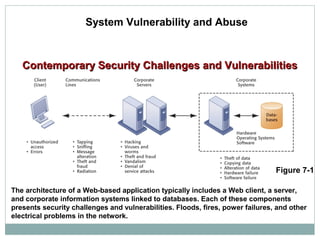
The architecture of a Web-based application typically includes a Web client, a server,
and corporate information systems linked to databases. Each of these components
presents security challenges and vulnerabilities. Floods, fires, power failures, and other
electrical problems in the network.
System Vulnerability and Abuse
Figure 7-1
• Internet vulnerabilities
• Network open to anyone
• Size of Internet means abuses can have wide impact
• Use of fixed Internet addresses with permanent
connections to Internet eases identification by hackers
• E-mail attachments
• E-mail used for transmitting trade secrets
• IM messages lack security, can be easily intercepted
System Vulnerability and Abuse
• Wireless security challenges
• SSIDs (service set identifiers)
• Identify access points.
• Broadcast multiple times.
• War driving
• Eavesdroppers drive by buildings and try to intercept network
traffic
• When hacker gains access to SSID, has access to network’s
resources
• WEP (Wired Equivalent Privacy)
• Security standard for 802.11
• Basic specification uses shared password for both users and
access point
• Users often fail to use security features
System Vulnerability and Abuse
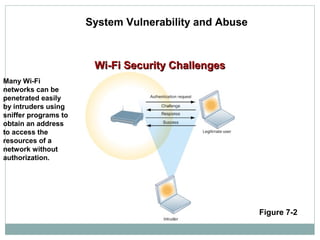
Wi-Fi Security ChallengesWi-Fi Security Challenges
Figure 7-2
Many Wi-Fi
networks can be
penetrated easily
by intruders using
sniffer programs to
obtain an address
to access the
resources of a
network without
authorization.
System Vulnerability and Abuse
Malicious Software: Viruses, Worms, Trojan Horses,Malicious Software: Viruses, Worms, Trojan Horses,
and Spywareand Spyware
• Malware
• Viruses
• Rogue software program that attaches itself to other
software programs or data files in order to be executed
• Worms
• Independent computer programs that copy themselves from
one computer to other computers over a network
• Trojan horses
• Software program that appears to be benign but then does
something other than expected.
System Vulnerability and Abuse
Malicious Software: Viruses, Worms, Trojan Horses,Malicious Software: Viruses, Worms, Trojan Horses,
and Spywareand Spyware
• Malware (cont.)
• Spyware
• Small programs install themselves surreptitiously on
computers to monitor user Web surfing activity and serve
up advertising
• Key loggers
• Record every keystroke on computer to steal serial
numbers, passwords, launch Internet attacks
System Vulnerability and Abuse
Hackers and Computer CrimeHackers and Computer Crime
System Vulnerability and Abuse
• Hackers versus crackers
• Activities include:
• System intrusion
• System damage
• Cybervandalism
• Intentional disruption, defacement,
destruction of Web site or corporate
information system
Hackers and Computer CrimeHackers and Computer Crime
System Vulnerability and Abuse
• Spoofing
• Misrepresenting oneself by using fake e-mail addresses or
masquerading as someone else
• Redirecting Web link to address different from intended one,
with site masquerading as intended destination
• Sniffer
• Eavesdropping program that monitors information traveling
over network
• Enables hackers to steal proprietary information such as e-
mail, company files, and so on
Hackers and Computer CrimeHackers and Computer Crime
System Vulnerability and Abuse
• Denial-of-service attacks (DoS)
• Flooding server with thousands of false requests to crash the
network.
• Distributed denial-of-service attacks (DDoS)
• Use of numerous computers to launch a DoS
• Botnets
• Networks of “zombie” PCs infiltrated by bot malware
Hackers and Computer CrimeHackers and Computer Crime
System Vulnerability and Abuse
• Computer crime
• Defined as “any violations of criminal law that involve a
knowledge of computer technology for their perpetration,
investigation, or prosecution”
• Computer may be target of crime:
• Breaching confidentiality of protected computerized data
• Accessing a computer system without authority
• Computer may be instrument of crime:
• Theft of trade secrets
• Using e-mail for threats or harassment
Hackers and Computer CrimeHackers and Computer Crime
System Vulnerability and Abuse
• Identity theft
• Theft of personal information (social security id, driver’s
license, or credit card numbers) to impersonate someone else
• Phishing
• Setting up fake Web sites or sending e-mail messages that
look like legitimate businesses to ask users for confidential
personal data
• Evil twins
• Wireless networks that pretend to offer trustworthy Wi-Fi
connections to the Internet
Hackers and Computer CrimeHackers and Computer Crime
System Vulnerability and Abuse
• Pharming
• Redirects users to a bogus Web page, even when
individual types correct Web page address into his
or her browser
• Click fraud
• Occurs when individual or computer program
fraudulently clicks on online ad without any intention
of learning more about the advertiser or making a
purchase

System vulnerability and abuse

  • 1.
  • 2.
    Why Systems AreVulnerableWhy Systems Are Vulnerable • Hardware problems • Breakdowns, configuration errors, damage from improper use or crime. • Software problems • Programming errors, installation errors, unauthorized changes. • Disasters • Power failures, flood, fires, and so on. System Vulnerability and Abuse
  • 3.
    Contemporary Security Challengesand VulnerabilitiesContemporary Security Challenges and Vulnerabilities The architecture of a Web-based application typically includes a Web client, a server, and corporate information systems linked to databases. Each of these components presents security challenges and vulnerabilities. Floods, fires, power failures, and other electrical problems in the network. System Vulnerability and Abuse Figure 7-1
  • 4.
    • Internet vulnerabilities •Network open to anyone • Size of Internet means abuses can have wide impact • Use of fixed Internet addresses with permanent connections to Internet eases identification by hackers • E-mail attachments • E-mail used for transmitting trade secrets • IM messages lack security, can be easily intercepted System Vulnerability and Abuse
  • 5.
    • Wireless securitychallenges • SSIDs (service set identifiers) • Identify access points. • Broadcast multiple times. • War driving • Eavesdroppers drive by buildings and try to intercept network traffic • When hacker gains access to SSID, has access to network’s resources • WEP (Wired Equivalent Privacy) • Security standard for 802.11 • Basic specification uses shared password for both users and access point • Users often fail to use security features System Vulnerability and Abuse
  • 6.
    Wi-Fi Security ChallengesWi-FiSecurity Challenges Figure 7-2 Many Wi-Fi networks can be penetrated easily by intruders using sniffer programs to obtain an address to access the resources of a network without authorization. System Vulnerability and Abuse
  • 7.
    Malicious Software: Viruses,Worms, Trojan Horses,Malicious Software: Viruses, Worms, Trojan Horses, and Spywareand Spyware • Malware • Viruses • Rogue software program that attaches itself to other software programs or data files in order to be executed • Worms • Independent computer programs that copy themselves from one computer to other computers over a network • Trojan horses • Software program that appears to be benign but then does something other than expected. System Vulnerability and Abuse
  • 8.
    Malicious Software: Viruses,Worms, Trojan Horses,Malicious Software: Viruses, Worms, Trojan Horses, and Spywareand Spyware • Malware (cont.) • Spyware • Small programs install themselves surreptitiously on computers to monitor user Web surfing activity and serve up advertising • Key loggers • Record every keystroke on computer to steal serial numbers, passwords, launch Internet attacks System Vulnerability and Abuse
  • 9.
    Hackers and ComputerCrimeHackers and Computer Crime System Vulnerability and Abuse • Hackers versus crackers • Activities include: • System intrusion • System damage • Cybervandalism • Intentional disruption, defacement, destruction of Web site or corporate information system
  • 10.
    Hackers and ComputerCrimeHackers and Computer Crime System Vulnerability and Abuse • Spoofing • Misrepresenting oneself by using fake e-mail addresses or masquerading as someone else • Redirecting Web link to address different from intended one, with site masquerading as intended destination • Sniffer • Eavesdropping program that monitors information traveling over network • Enables hackers to steal proprietary information such as e- mail, company files, and so on
  • 11.
    Hackers and ComputerCrimeHackers and Computer Crime System Vulnerability and Abuse • Denial-of-service attacks (DoS) • Flooding server with thousands of false requests to crash the network. • Distributed denial-of-service attacks (DDoS) • Use of numerous computers to launch a DoS • Botnets • Networks of “zombie” PCs infiltrated by bot malware
  • 12.
    Hackers and ComputerCrimeHackers and Computer Crime System Vulnerability and Abuse • Computer crime • Defined as “any violations of criminal law that involve a knowledge of computer technology for their perpetration, investigation, or prosecution” • Computer may be target of crime: • Breaching confidentiality of protected computerized data • Accessing a computer system without authority • Computer may be instrument of crime: • Theft of trade secrets • Using e-mail for threats or harassment
  • 13.
    Hackers and ComputerCrimeHackers and Computer Crime System Vulnerability and Abuse • Identity theft • Theft of personal information (social security id, driver’s license, or credit card numbers) to impersonate someone else • Phishing • Setting up fake Web sites or sending e-mail messages that look like legitimate businesses to ask users for confidential personal data • Evil twins • Wireless networks that pretend to offer trustworthy Wi-Fi connections to the Internet
  • 14.
    Hackers and ComputerCrimeHackers and Computer Crime System Vulnerability and Abuse • Pharming • Redirects users to a bogus Web page, even when individual types correct Web page address into his or her browser • Click fraud • Occurs when individual or computer program fraudulently clicks on online ad without any intention of learning more about the advertiser or making a purchase

Editor's Notes