Information and Network Security:27
Triple DES
Prof Neeraj Bhargava
Vaibhav Khanna
Department of Computer Science
School of Engineering and Systems Sciences
Maharshi Dayanand Saraswati University Ajmer
Multiple Encryption & DES
• clear a replacement for DES was needed
• theoretical attacks that can break it
• demonstrated exhaustive key search attacks
• AES is a new cipher alternative
• prior to this alternative was to use multiple encryption with DES
implementations
• Triple-DES is the chosen form
• Given the potential vulnerability of DES to a brute-force attack,there
has been considerable interest in finding an alternative.
• One approach is to design a completely new algorithm, of which AES
is a prime example.
• Another alternative, which would preserve the existing investment in
software and equipment, is to use multiple encryption with DES and
multiple keys.
• We examine the widely accepted triple DES (3DES) approach.
Double-DES?
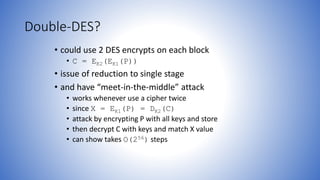
• could use 2 DES encrypts on each block
• C = EK2(EK1(P))
• issue of reduction to single stage
• and have “meet-in-the-middle” attack
• works whenever use a cipher twice
• since X = EK1(P) = DK2(C)
• attack by encrypting P with all keys and store
• then decrypt C with keys and match X value
• can show takes O(256) steps
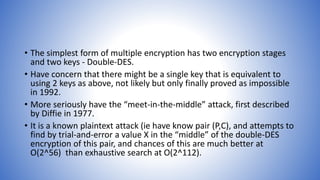
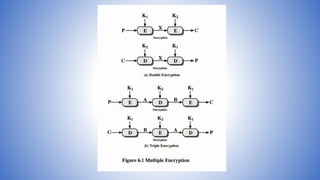
• The simplest form of multiple encryption has two encryption stages
and two keys - Double-DES.
• Have concern that there might be a single key that is equivalent to
using 2 keys as above, not likely but only finally proved as impossible
in 1992.
• More seriously have the “meet-in-the-middle” attack, first described
by Diffie in 1977.
• It is a known plaintext attack (ie have know pair (P,C), and attempts to
find by trial-and-error a value X in the “middle” of the double-DES
encryption of this pair, and chances of this are much better at
O(2^56) than exhaustive search at O(2^112).
Triple DES
• A replacement for DES was needed
• theoretical attacks that can break it
• demonstrated exhaustive key search attacks
• AES is a new cipher alternative
• Before AES alternative
• use multiple encryptions with DES
• Triple-DES is the chosen form
Why Triple-DES?
• why not Double-DES?
• NOT same as some other single-DES use, but have
• meet-in-the-middle attack
• works whenever use a cipher twice
• since X = EK1[P] = DK2[C]
• attack by encrypting P with all keys and store
• then decrypt C with keys and match X value
• can show takes O(256) steps
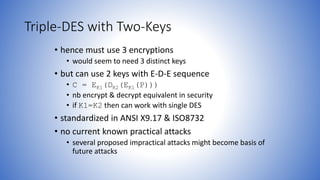
Triple-DES with Two-Keys
• hence must use 3 encryptions
• would seem to need 3 distinct keys
• but can use 2 keys with E-D-E sequence
• C = EK1(DK2(EK1(P)))
• nb encrypt & decrypt equivalent in security
• if K1=K2 then can work with single DES
• standardized in ANSI X9.17 & ISO8732
• no current known practical attacks
• several proposed impractical attacks might become basis of
future attacks
• Triple-DES with two keys is a popular alternative to single-DES, but
suffers from being 3 times slower to run.
• The use of encryption & decryption stages are equivalent, but the
chosen structure allows for compatibility with single-DES
implementations.
• 3DES with two keys is a relatively popular alternative to DES and has
been adopted for use in the key management standards ANS X9.17
and ISO 8732.
• Currently, there are no practical cryptanalytic attacks on 3DES.
Coppersmith notes that the cost of a brute-force key search on 3DES
is on the order of 2^112 (=5*10^33) and estimates that the cost of
differential cryptanalysis suffers an exponential growth, compared to
single DES, exceeding 10^52.
• There are several proposed attacks on 3DES that, although not
currently practical, give a flavor for the types of attacks that have
been considered and that could form the basis for more successful
future attacks. See text for details.
Triple-DES with Three-Keys
• although are no practical attacks on two-key Triple-DES have some
indications
• can use Triple-DES with Three-Keys to avoid even these
• C = EK3(DK2(EK1(P)))
• has been adopted by some Internet applications, eg PGP, S/MIME
• Although the attacks currently known appear impractical, anyone
using two-key 3DES may feel some concern.
• Thus, many researchers now feel that three-key 3DES is the preferred
alternative.
• Three-key 3DES has an effective key length of 168 bits and is defined
as shown. A number of Internet-based applications have adopted
three-key 3DES, including PGP and S/MIME
Assignment
• Describe the concept of Multiple Encryption and explain Triple DES

Information and network security 27 triple des

  • 1.
    Information and NetworkSecurity:27 Triple DES Prof Neeraj Bhargava Vaibhav Khanna Department of Computer Science School of Engineering and Systems Sciences Maharshi Dayanand Saraswati University Ajmer
  • 2.
    Multiple Encryption &DES • clear a replacement for DES was needed • theoretical attacks that can break it • demonstrated exhaustive key search attacks • AES is a new cipher alternative • prior to this alternative was to use multiple encryption with DES implementations • Triple-DES is the chosen form
  • 3.
    • Given thepotential vulnerability of DES to a brute-force attack,there has been considerable interest in finding an alternative. • One approach is to design a completely new algorithm, of which AES is a prime example. • Another alternative, which would preserve the existing investment in software and equipment, is to use multiple encryption with DES and multiple keys. • We examine the widely accepted triple DES (3DES) approach.
  • 4.
    Double-DES? • could use2 DES encrypts on each block • C = EK2(EK1(P)) • issue of reduction to single stage • and have “meet-in-the-middle” attack • works whenever use a cipher twice • since X = EK1(P) = DK2(C) • attack by encrypting P with all keys and store • then decrypt C with keys and match X value • can show takes O(256) steps
  • 5.
    • The simplestform of multiple encryption has two encryption stages and two keys - Double-DES. • Have concern that there might be a single key that is equivalent to using 2 keys as above, not likely but only finally proved as impossible in 1992. • More seriously have the “meet-in-the-middle” attack, first described by Diffie in 1977. • It is a known plaintext attack (ie have know pair (P,C), and attempts to find by trial-and-error a value X in the “middle” of the double-DES encryption of this pair, and chances of this are much better at O(2^56) than exhaustive search at O(2^112).
  • 6.
    Triple DES • Areplacement for DES was needed • theoretical attacks that can break it • demonstrated exhaustive key search attacks • AES is a new cipher alternative • Before AES alternative • use multiple encryptions with DES • Triple-DES is the chosen form
  • 8.
    Why Triple-DES? • whynot Double-DES? • NOT same as some other single-DES use, but have • meet-in-the-middle attack • works whenever use a cipher twice • since X = EK1[P] = DK2[C] • attack by encrypting P with all keys and store • then decrypt C with keys and match X value • can show takes O(256) steps
  • 9.
    Triple-DES with Two-Keys •hence must use 3 encryptions • would seem to need 3 distinct keys • but can use 2 keys with E-D-E sequence • C = EK1(DK2(EK1(P))) • nb encrypt & decrypt equivalent in security • if K1=K2 then can work with single DES • standardized in ANSI X9.17 & ISO8732 • no current known practical attacks • several proposed impractical attacks might become basis of future attacks
  • 10.
    • Triple-DES withtwo keys is a popular alternative to single-DES, but suffers from being 3 times slower to run. • The use of encryption & decryption stages are equivalent, but the chosen structure allows for compatibility with single-DES implementations. • 3DES with two keys is a relatively popular alternative to DES and has been adopted for use in the key management standards ANS X9.17 and ISO 8732.
  • 11.
    • Currently, thereare no practical cryptanalytic attacks on 3DES. Coppersmith notes that the cost of a brute-force key search on 3DES is on the order of 2^112 (=5*10^33) and estimates that the cost of differential cryptanalysis suffers an exponential growth, compared to single DES, exceeding 10^52. • There are several proposed attacks on 3DES that, although not currently practical, give a flavor for the types of attacks that have been considered and that could form the basis for more successful future attacks. See text for details.
  • 12.
    Triple-DES with Three-Keys •although are no practical attacks on two-key Triple-DES have some indications • can use Triple-DES with Three-Keys to avoid even these • C = EK3(DK2(EK1(P))) • has been adopted by some Internet applications, eg PGP, S/MIME
  • 13.
    • Although theattacks currently known appear impractical, anyone using two-key 3DES may feel some concern. • Thus, many researchers now feel that three-key 3DES is the preferred alternative. • Three-key 3DES has an effective key length of 168 bits and is defined as shown. A number of Internet-based applications have adopted three-key 3DES, including PGP and S/MIME
  • 14.
    Assignment • Describe theconcept of Multiple Encryption and explain Triple DES