Introduction to Symmetric
Block Cipher
Jing Deng
Based on
Prof. Rick Han’s Lecture Slides
Dr. Andreas Steffen’s Security
Tutorial
Cryptography
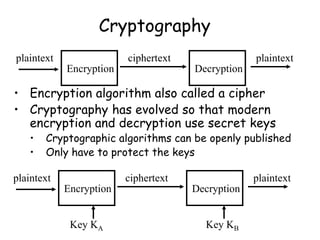
• Encryption algorithm also called a cipher
• Cryptography has evolved so that modern
encryption and decryption use secret keys
• Cryptographic algorithms can be openly published
• Only have to protect the keys
Encryption Decryption
plaintext ciphertext plaintext
Encryption Decryption
plaintext ciphertext plaintext
Key KA Key KB
Symmetric-Key Cryptography
• Both sender and receiver keys are the same: KA=KB
• The keys must be kept secret and securely
distributed
• Thus, also called “Secret Key Cryptography”
• Data Encryption Standard (DES)
Encryption Decryption
plaintext ciphertext plaintext
Key KA Key KB=KA
Secure Key Distribution
Cryptanalysis
• Brute force: try every key
• Ciphertext-only attack:
• Attacker knows ciphertext of several messages encrypted
with same key (but doesn’t know plaintext).
• Possible to recover plaintext (also possible to deduce key) by
looking at frequency of ciphertext letters
• Known-plaintext attack:
• Attackers observes pairs of plaintext/ciphertext encrypted
with same key.
• Possible to deduce key and/or devise algorithm to decrypt
ciphertext.
Cryptanalysis (2)
• Chosen-plaintext attack:
• Attacker can choose the plaintext and look at the paired
ciphertext
• Attacker has more control than known-plaintext attack and
may be able to gain more info about key
• Adaptive Chosen-Plaintext attack:
• Attacker chooses a series of plaintexts, basing the next
plaintext on the result of previous encryption
• Examples
• Differential cryptanalysis – DES is resistant it
• Linear cryptanalysis
• Cryptanalysis attacks often exploit the
redundancy of natural language
• Lossless compression before encryption removes
redundancy
Examples
• Simple and non-secure ciphers
– Shift Cipher – Caesar Cipher
– Affine Cipher
– Vigenere Cipher
– Hill Cipher
• Information-secure cipher
– One-Time Pad
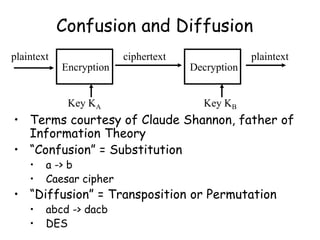
Confusion and Diffusion
• Terms courtesy of Claude Shannon, father of
Information Theory
• “Confusion” = Substitution
• a -> b
• Caesar cipher
• “Diffusion” = Transposition or Permutation
• abcd -> dacb
• DES
Encryption Decryption
plaintext ciphertext plaintext
Key KA Key KB
Confusion and Diffusion (2)
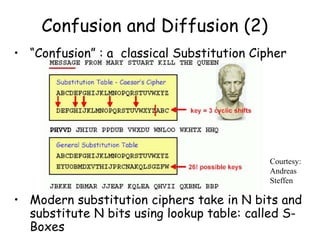
• Modern substitution ciphers take in N bits and
substitute N bits using lookup table: called S-
Boxes
• “Confusion” : a classical Substitution Cipher
Courtesy:
Andreas
Steffen
Confusion and Diffusion (3)
• “Diffusion” : a classical Transposition cipher
• modern Transposition ciphers take in N bits and
permute using lookup table : called P-Boxes
Courtesy:
Andreas
Steffen
Block Cipher
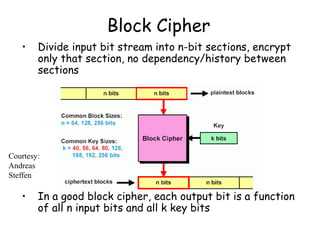
• Divide input bit stream into n-bit sections, encrypt
only that section, no dependency/history between
sections
• In a good block cipher, each output bit is a function
of all n input bits and all k key bits
Courtesy:
Andreas
Steffen
Example: DES
• Data Encryption Standard (DES)
• Encodes plaintext in 64-bit chunks using a 64-bit
key (56 bits + 8 bits parity)
• Uses a combination of diffusion and confusion to
achieve security
• Was cracked in 1997
• Parallel attack – exhaustively search key space
• Decryption in DES – it’s symmetric! Use KA again as
input and then the same keys except in reverse
order
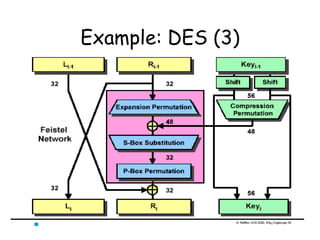
Example: DES (2)
• DES
• 64-bit input is permuted
• 16 stages of identical
operation
• differ in the 48-bit
key extracted from
56-bit key - complex
• R2= R1 is encrypted
with K1 and XOR’d
with L1
• L2=R1, …
• Final inverse permutation
stage
Example: DES (3)
Beyond DES
• Triple-DES: put the output of DES back as
input into DES again with a different key,
loop again: 3*56 = 168 bit key
• Advanced Encryption Standard (AES)
– Requirements:
• shall be designed so that the key length may be
increased as needed.
• block size n = 128 bits, key size k = 128, 192, 256 bits
– Candidates: MARS, twofish, RC6, Serpent,
Rijndael
– successor (Rijndael)
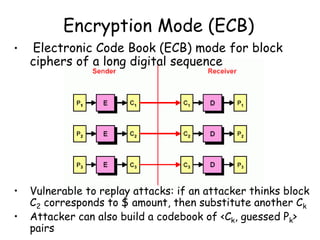
Encryption Mode (ECB)
• Electronic Code Book (ECB) mode for block
ciphers of a long digital sequence
• Vulnerable to replay attacks: if an attacker thinks block
C2 corresponds to $ amount, then substitute another Ck
• Attacker can also build a codebook of <Ck, guessed Pk>
pairs
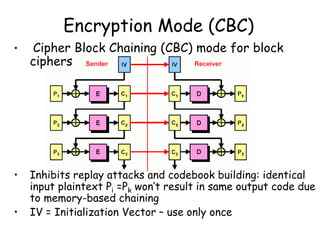
Encryption Mode (CBC)
• Cipher Block Chaining (CBC) mode for block
ciphers
• Inhibits replay attacks and codebook building: identical
input plaintext Pi =Pk won’t result in same output code due
to memory-based chaining
• IV = Initialization Vector – use only once
Stream Cipher
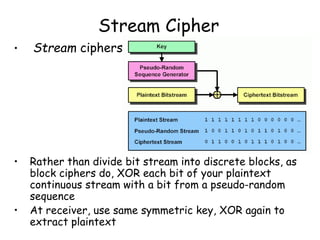
• Stream ciphers
• Rather than divide bit stream into discrete blocks, as
block ciphers do, XOR each bit of your plaintext
continuous stream with a bit from a pseudo-random
sequence
• At receiver, use same symmetric key, XOR again to
extract plaintext
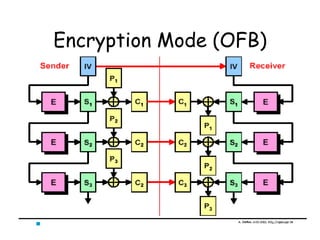
Encryption Mode (OFB)

Cryptography.ppt

  • 1.
    Introduction to Symmetric BlockCipher Jing Deng Based on Prof. Rick Han’s Lecture Slides Dr. Andreas Steffen’s Security Tutorial
  • 2.
    Cryptography • Encryption algorithmalso called a cipher • Cryptography has evolved so that modern encryption and decryption use secret keys • Cryptographic algorithms can be openly published • Only have to protect the keys Encryption Decryption plaintext ciphertext plaintext Encryption Decryption plaintext ciphertext plaintext Key KA Key KB
  • 3.
    Symmetric-Key Cryptography • Bothsender and receiver keys are the same: KA=KB • The keys must be kept secret and securely distributed • Thus, also called “Secret Key Cryptography” • Data Encryption Standard (DES) Encryption Decryption plaintext ciphertext plaintext Key KA Key KB=KA Secure Key Distribution
  • 4.
    Cryptanalysis • Brute force:try every key • Ciphertext-only attack: • Attacker knows ciphertext of several messages encrypted with same key (but doesn’t know plaintext). • Possible to recover plaintext (also possible to deduce key) by looking at frequency of ciphertext letters • Known-plaintext attack: • Attackers observes pairs of plaintext/ciphertext encrypted with same key. • Possible to deduce key and/or devise algorithm to decrypt ciphertext.
  • 5.
    Cryptanalysis (2) • Chosen-plaintextattack: • Attacker can choose the plaintext and look at the paired ciphertext • Attacker has more control than known-plaintext attack and may be able to gain more info about key • Adaptive Chosen-Plaintext attack: • Attacker chooses a series of plaintexts, basing the next plaintext on the result of previous encryption • Examples • Differential cryptanalysis – DES is resistant it • Linear cryptanalysis • Cryptanalysis attacks often exploit the redundancy of natural language • Lossless compression before encryption removes redundancy
  • 6.
    Examples • Simple andnon-secure ciphers – Shift Cipher – Caesar Cipher – Affine Cipher – Vigenere Cipher – Hill Cipher • Information-secure cipher – One-Time Pad
  • 7.
    Confusion and Diffusion •Terms courtesy of Claude Shannon, father of Information Theory • “Confusion” = Substitution • a -> b • Caesar cipher • “Diffusion” = Transposition or Permutation • abcd -> dacb • DES Encryption Decryption plaintext ciphertext plaintext Key KA Key KB
  • 8.
    Confusion and Diffusion(2) • Modern substitution ciphers take in N bits and substitute N bits using lookup table: called S- Boxes • “Confusion” : a classical Substitution Cipher Courtesy: Andreas Steffen
  • 9.
    Confusion and Diffusion(3) • “Diffusion” : a classical Transposition cipher • modern Transposition ciphers take in N bits and permute using lookup table : called P-Boxes Courtesy: Andreas Steffen
  • 10.
    Block Cipher • Divideinput bit stream into n-bit sections, encrypt only that section, no dependency/history between sections • In a good block cipher, each output bit is a function of all n input bits and all k key bits Courtesy: Andreas Steffen
  • 11.
    Example: DES • DataEncryption Standard (DES) • Encodes plaintext in 64-bit chunks using a 64-bit key (56 bits + 8 bits parity) • Uses a combination of diffusion and confusion to achieve security • Was cracked in 1997 • Parallel attack – exhaustively search key space • Decryption in DES – it’s symmetric! Use KA again as input and then the same keys except in reverse order
  • 12.
    Example: DES (2) •DES • 64-bit input is permuted • 16 stages of identical operation • differ in the 48-bit key extracted from 56-bit key - complex • R2= R1 is encrypted with K1 and XOR’d with L1 • L2=R1, … • Final inverse permutation stage
  • 13.
  • 14.
    Beyond DES • Triple-DES:put the output of DES back as input into DES again with a different key, loop again: 3*56 = 168 bit key • Advanced Encryption Standard (AES) – Requirements: • shall be designed so that the key length may be increased as needed. • block size n = 128 bits, key size k = 128, 192, 256 bits – Candidates: MARS, twofish, RC6, Serpent, Rijndael – successor (Rijndael)
  • 15.
    Encryption Mode (ECB) •Electronic Code Book (ECB) mode for block ciphers of a long digital sequence • Vulnerable to replay attacks: if an attacker thinks block C2 corresponds to $ amount, then substitute another Ck • Attacker can also build a codebook of <Ck, guessed Pk> pairs
  • 16.
    Encryption Mode (CBC) •Cipher Block Chaining (CBC) mode for block ciphers • Inhibits replay attacks and codebook building: identical input plaintext Pi =Pk won’t result in same output code due to memory-based chaining • IV = Initialization Vector – use only once
  • 17.
    Stream Cipher • Streamciphers • Rather than divide bit stream into discrete blocks, as block ciphers do, XOR each bit of your plaintext continuous stream with a bit from a pseudo-random sequence • At receiver, use same symmetric key, XOR again to extract plaintext
  • 18.