Information
Security
7/16/2021 1
System Security
7/16/2021 System Security 2
7/16/2021 System Security 3
7/16/2021 System Security 4
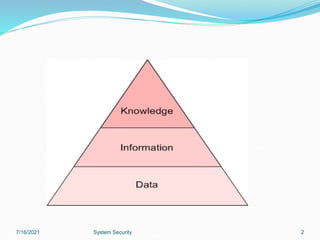
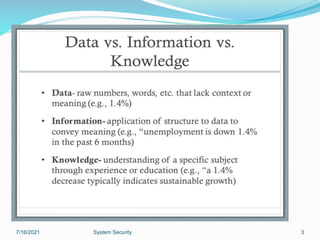
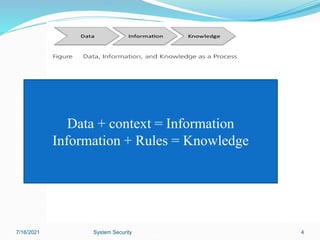
Data + context = Information
Information + Rules = Knowledge
Information
 Information is a form of knowledge that we acquire
through education,communication,Practical
experience , Research and Analysis.
 It consists of Data, Facts and conclusions.
7/16/2021 System Security 5
Information can be
 Created
 Modified
 Stored
 Destroyed
 Processed
 Used (for proper and improper purposes)
 Transmitted
 Corrupted
 Lost
 stolen
7/16/2021 System Security 6
Information can be
 Printed or written on paper
 Stored electronically
 Transmitted by post or using electronic means
 Shown on corporate videos
 Displayed and published on the web
 Verbal or spoken in conversations
7/16/2021 System Security 7
Information Security
 Information security, sometimes shortened to InfoSec,
is the practice of preventing unauthorized access, use,
disclosure, disruption, modification, inspection,
recording or destruction of information
 Information security in today’s enterprise is “well
informed sense of assurance that the information risks
and control are in balance
 Security is a non functional requirement assumes that
the system is correctly implemented according to
functional requirement.
 Security is a process not a product
7/16/2021 System Security 8
Various Securities
 Data security
 Data security is the means of ensuring that data is kept safe from
corruption and that access to it is suitably controlled.
 Computer Security
 The objective of computer security includes protection of information
and property from theft, corruption, or natural disaster, Malware:
malicious software
 includes computer viruses, worms, Trojan horses,,
Network Security
 protect the network and the network-accessible resources from
unauthorized access, consistent and continuous monitoring and
measurement of its effectiveness
9
7/16/2021 System Security
10
The Need for Computer Security
 Why the need for Computer Security?
 The value of computer assets and services
 What is the new IT environment?
 Networks and distributed applications/services
 Electronic Commerce (E-commerce, E-business)
7/16/2021 System Security
11
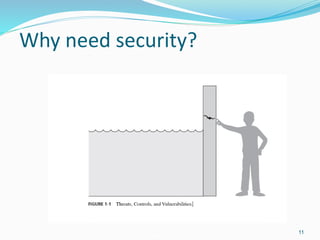
Why need security?
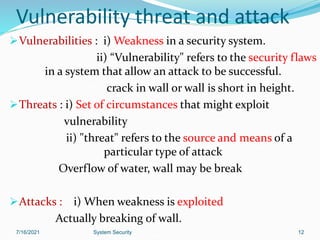
Vulnerability threat and attack
Vulnerabilities : i) Weakness in a security system.
ii) “Vulnerability" refers to the security flaws
in a system that allow an attack to be successful.
crack in wall or wall is short in height.
Threats : i) Set of circumstances that might exploit
vulnerability
ii) "threat" refers to the source and means of a
particular type of attack
Overflow of water, wall may be break
Attacks : i) When weakness is exploited
Actually breaking of wall.
7/16/2021 System Security 12
7/16/2021 System Security 13
7/16/2021 System Security 14
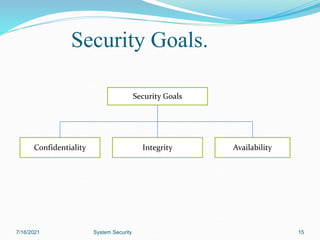
Security Goals.
Security Goals
Confidentiality Integrity Availability
7/16/2021 15
System Security
16
17
Threats, Vulnerabilities, and Controls
A vulnerability is a weakness in the security system, for example,
in procedures, design, or implementation, that might be exploited
to cause loss or harm.
A threat to a computing system is a set of circumstances
that has the potential to cause loss or harm.
A threat is blocked by control of a vulnerability.
18
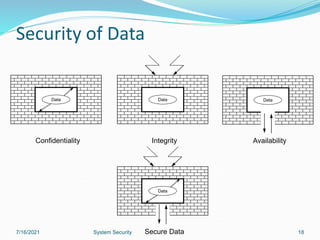
Security of Data
Data
Confidentiality
Data
Integrity
Data
Availability
Secure Data
Data
7/16/2021 System Security
7/16/2021 System Security 19
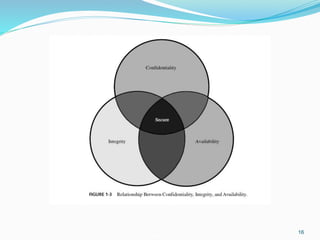
"Ensures that only authorized users
(confidentiality) have access to accurate and
complete information (integrity) when
required (availability)
16.20
Attacks
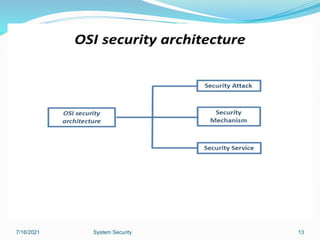
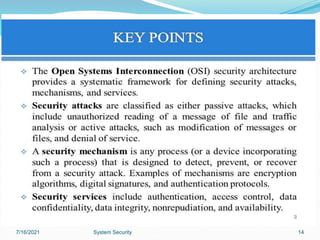
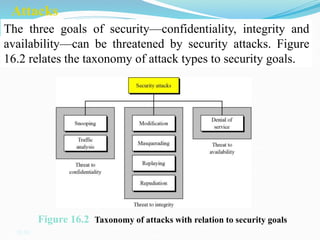
The three goals of security—confidentiality, integrity and
availability—can be threatened by security attacks. Figure
16.2 relates the taxonomy of attack types to security goals.
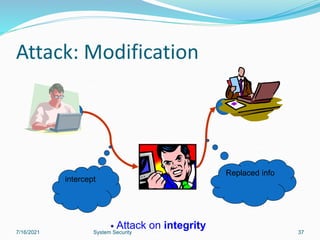
Figure 16.2 Taxonomy of attacks with relation to security goals
21
Computer Security Requirements
 Confidentiality(Secrecy)
 Integrity
 Availability
 Authenticity
 Non-repudiation
7/16/2021 System Security
22
Secrecy (Confidentiality)
 Secrecy requires that the information in a computer
system only be accessible for reading by authorized
parties.
 This type of access includes:
 Printing
 Displaying
 Other forms of disclosure,
7/16/2021 System Security
23
Integrity
 Integrity requires that the computer system asset can
be modified only by authorized parties.
 Modification includes:
 Writing
 Changing
 Changing status
 Deleting and
 Creating
7/16/2021 System Security
24
Availability
 Availability requires that computer system assets are
available to authorized parties.
 Availability is a requirement intended to assure that
systems work promptly and service is not denied to
authorized users.
7/16/2021 System Security
25
Authenticity
 Authenticity means that parties in a information
services can ascertain the identity of parties trying to
access information services.
 Also means that the origin of the message is certain.
 Receiver should be ensure about sender’s identity, that
false sender(imposter) should has not sent the message
7/16/2021 System Security
26
Non-repudiation
 Originator of communications can’t deny it later.
 Without non-repudiation you could place an order for
1 million dollars of equipment online and then simply
deny it later.
 Or you could send an email inviting a friend to the
dinner and then disclaim it later.
 Non-repudiation associates the identity of the
originator with the transaction in a non-deniable way.
7/16/2021 System Security
27
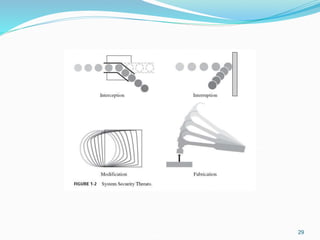
Type of Attacks/Threats in Computer Systems
 A threat is a danger which could affect the security
(confidentiality, integrity, availability) of assets, leading
to a potential loss or damage.
Hacker using computer is a subject of an attack remote
system that is the object of an attack
 Interruption
 Interception
 Modification
 Fabrication
7/16/2021 System Security
Security attacks
29
30
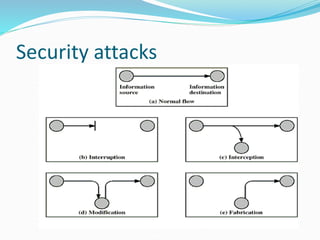
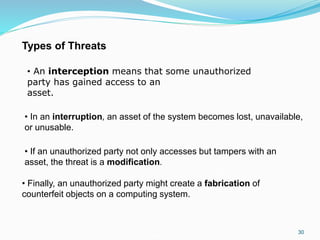
• In an interruption, an asset of the system becomes lost, unavailable,
or unusable.
• If an unauthorized party not only accesses but tampers with an
asset, the threat is a modification.
• Finally, an unauthorized party might create a fabrication of
counterfeit objects on a computing system.
Types of Threats
• An interception means that some unauthorized
party has gained access to an
asset.
31
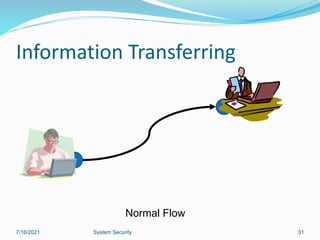
Information Transferring
Normal Flow
7/16/2021 System Security
32
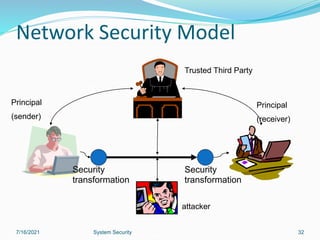
Network Security Model
Trusted Third Party
Principal
(sender)
Principal
(receiver)
Security
transformation
Security
transformation
attacker
7/16/2021 System Security
33
Attack: Interruption
Cut wire lines,
Jam wireless
signals,
Drop packets,
• Attack on availability
7/16/2021 System Security
34
Attack: Interruption
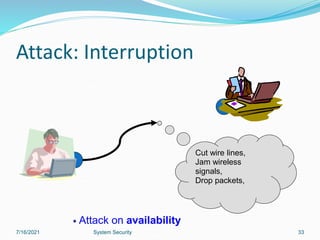
 An asset of the system is destroyed or becomes
unavailable or unusable. This is an attack on the
availability.
 Examples include destruction of a piece of hardware,
such as a hard disk, the cutting of a communication
link, or the disabling of the file management system.
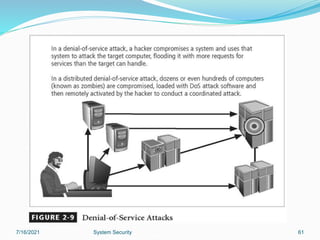
 DOS - Denial of Service Attacks have become very well
known.
7/16/2021 System Security
35
Attack: Interception
Wiring,
eavesdrop
• Attack on confidentiality
7/16/2021 System Security
36
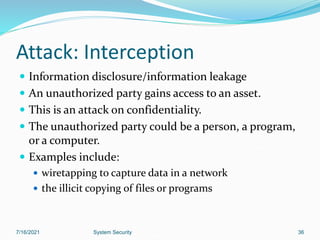
Attack: Interception
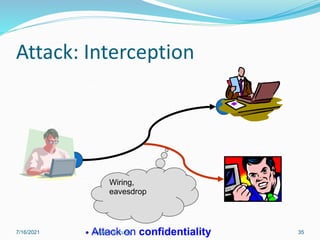
 Information disclosure/information leakage
 An unauthorized party gains access to an asset.
 This is an attack on confidentiality.
 The unauthorized party could be a person, a program,
or a computer.
 Examples include:
 wiretapping to capture data in a network
 the illicit copying of files or programs
7/16/2021 System Security
37
Attack: Modification
intercept
Replaced info
• Attack on integrity
7/16/2021 System Security
38
Attack: Modification
 Modification is integrity violation.
 An unauthorized party not only gains access to but
tampers with an asset.
 This is an attack on the integrity.
 Examples include changing values in a data file,
altering a program so that it performs differently, and
modifying the content of a message being transmitted
in a network.
7/16/2021 System Security
39
Attack: Fabrication
Also called impersonation
Ali: this is …
Ali: this is …
• Attack on authenticity
7/16/2021 System Security
40
Attack: Fabrication
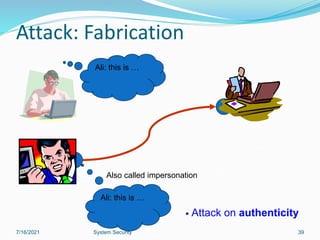
 An unauthorized party inserts counterfeit objects into
the system. This is an attack on the authenticity.
7/16/2021 System Security
41
Classification of Attacks
 Computer Security attacks can be classified into two
broad categories:
 Passive Attacks can only observe communications or
data.
 Active Attacks can actively modify communications or
data. Often difficult to perform, but very powerful.
Examples include
 Mail forgery/modification
7/16/2021 System Security
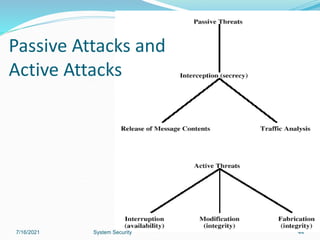
Passive and active attacks
 Passive attacks
 No modification of content or fabrication
 Eavesdropping to learn contents or other information
(transfer patterns, traffic flows etc.)
 Active attacks
 Modification of content and/or participation in
communication to
 Impersonate legitimate parties
 Modify the content in transit
 Launch denial of service attacks
43
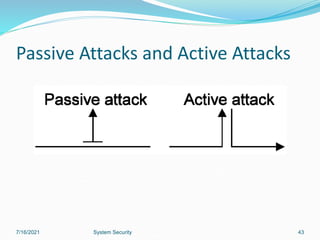
Passive Attacks and Active Attacks
7/16/2021 System Security
44
Passive Attacks and
Active Attacks
7/16/2021 System Security
45
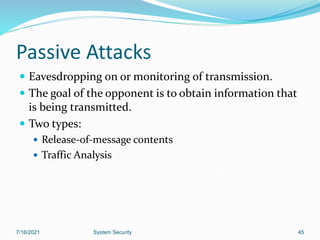
Passive Attacks
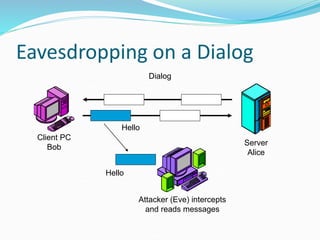
 Eavesdropping on or monitoring of transmission.
 The goal of the opponent is to obtain information that
is being transmitted.
 Two types:
 Release-of-message contents
 Traffic Analysis
7/16/2021 System Security
46
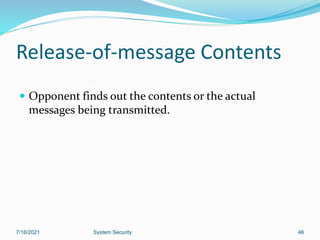
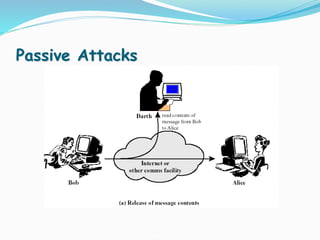
Release-of-message Contents
 Opponent finds out the contents or the actual
messages being transmitted.
7/16/2021 System Security
Passive Attacks
Eavesdropping on a Dialog
Client PC
Bob
Server
Alice
Dialog
Attacker (Eve) intercepts
and reads messages
Hello
Hello
49
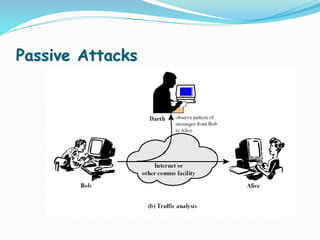
Traffic Analysis
 More subtle than release-of-message contents.
 The opponent figures out information being carried by
the messages based on the frequency and timings of
the message.
7/16/2021 System Security
Passive Attacks
51
Passive Attacks Problems
 Difficult to detect because there is no modification of
data.
 Protection approach should be based on prevention
rather than detection.
7/16/2021 System Security
52
Active Attacks
 Active attacks involve some sort of modification of the
data stream or the creation of a false stream.
 Four sub-categories:
 Masquerade
 Replay
 Modification of Messages
 Denial of service
7/16/2021 System Security
53
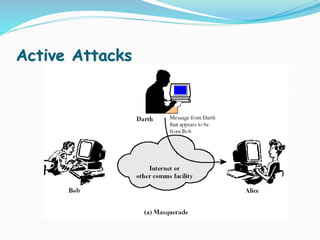
Masquerade
 An entity pretends to be another.
 For the purpose of doing some other form of attack.
 Example a system claims its IP address to be what it is
not, IP spoofing.
7/16/2021 System Security
Active Attacks
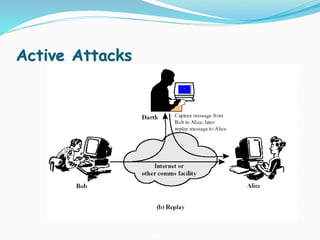
55
Replay
 First passive capture of data and then its
retransmission to produce an unauthorized effect.
 Could be disastrous in case of critical messages such as
authentication sequences, even if the password were
encrypted.
7/16/2021 System Security
Active Attacks
57
Modification of Messages
 Some portion of a legitimate message is altered or
messages are delayed or reordered to produce an
unauthorized effect.
7/16/2021 System Security
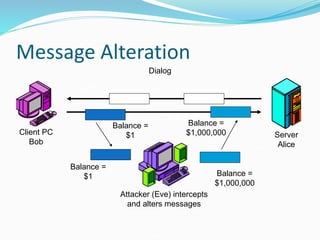
Message Alteration
Client PC
Bob
Server
Alice
Dialog
Attacker (Eve) intercepts
and alters messages
Balance =
$1
Balance =
$1 Balance =
$1,000,000
Balance =
$1,000,000
59
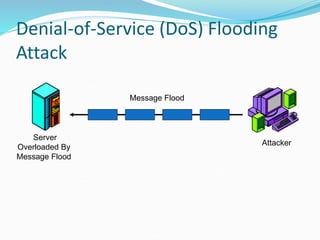
Denial of Service - DOS
 Prevents the normal use or management of
communication facilities.
 Such attacks have become very common on the
Internet especially against web servers.
7/16/2021 System Security
Denial-of-Service (DoS) Flooding
Attack
Message Flood
Server
Overloaded By
Message Flood
Attacker
7/16/2021 System Security 61

Information security and Attacks

  • 1.
  • 2.
  • 3.
  • 4.
    7/16/2021 System Security4 Data + context = Information Information + Rules = Knowledge
  • 5.
    Information  Information isa form of knowledge that we acquire through education,communication,Practical experience , Research and Analysis.  It consists of Data, Facts and conclusions. 7/16/2021 System Security 5
  • 6.
    Information can be Created  Modified  Stored  Destroyed  Processed  Used (for proper and improper purposes)  Transmitted  Corrupted  Lost  stolen 7/16/2021 System Security 6
  • 7.
    Information can be Printed or written on paper  Stored electronically  Transmitted by post or using electronic means  Shown on corporate videos  Displayed and published on the web  Verbal or spoken in conversations 7/16/2021 System Security 7
  • 8.
    Information Security  Informationsecurity, sometimes shortened to InfoSec, is the practice of preventing unauthorized access, use, disclosure, disruption, modification, inspection, recording or destruction of information  Information security in today’s enterprise is “well informed sense of assurance that the information risks and control are in balance  Security is a non functional requirement assumes that the system is correctly implemented according to functional requirement.  Security is a process not a product 7/16/2021 System Security 8
  • 9.
    Various Securities  Datasecurity  Data security is the means of ensuring that data is kept safe from corruption and that access to it is suitably controlled.  Computer Security  The objective of computer security includes protection of information and property from theft, corruption, or natural disaster, Malware: malicious software  includes computer viruses, worms, Trojan horses,, Network Security  protect the network and the network-accessible resources from unauthorized access, consistent and continuous monitoring and measurement of its effectiveness 9 7/16/2021 System Security
  • 10.
    10 The Need forComputer Security  Why the need for Computer Security?  The value of computer assets and services  What is the new IT environment?  Networks and distributed applications/services  Electronic Commerce (E-commerce, E-business) 7/16/2021 System Security
  • 11.
  • 12.
    Vulnerability threat andattack Vulnerabilities : i) Weakness in a security system. ii) “Vulnerability" refers to the security flaws in a system that allow an attack to be successful. crack in wall or wall is short in height. Threats : i) Set of circumstances that might exploit vulnerability ii) "threat" refers to the source and means of a particular type of attack Overflow of water, wall may be break Attacks : i) When weakness is exploited Actually breaking of wall. 7/16/2021 System Security 12
  • 13.
  • 14.
  • 15.
    Security Goals. Security Goals ConfidentialityIntegrity Availability 7/16/2021 15 System Security
  • 16.
  • 17.
    17 Threats, Vulnerabilities, andControls A vulnerability is a weakness in the security system, for example, in procedures, design, or implementation, that might be exploited to cause loss or harm. A threat to a computing system is a set of circumstances that has the potential to cause loss or harm. A threat is blocked by control of a vulnerability.
  • 18.
  • 19.
    7/16/2021 System Security19 "Ensures that only authorized users (confidentiality) have access to accurate and complete information (integrity) when required (availability)
  • 20.
    16.20 Attacks The three goalsof security—confidentiality, integrity and availability—can be threatened by security attacks. Figure 16.2 relates the taxonomy of attack types to security goals. Figure 16.2 Taxonomy of attacks with relation to security goals
  • 21.
    21 Computer Security Requirements Confidentiality(Secrecy)  Integrity  Availability  Authenticity  Non-repudiation 7/16/2021 System Security
  • 22.
    22 Secrecy (Confidentiality)  Secrecyrequires that the information in a computer system only be accessible for reading by authorized parties.  This type of access includes:  Printing  Displaying  Other forms of disclosure, 7/16/2021 System Security
  • 23.
    23 Integrity  Integrity requiresthat the computer system asset can be modified only by authorized parties.  Modification includes:  Writing  Changing  Changing status  Deleting and  Creating 7/16/2021 System Security
  • 24.
    24 Availability  Availability requiresthat computer system assets are available to authorized parties.  Availability is a requirement intended to assure that systems work promptly and service is not denied to authorized users. 7/16/2021 System Security
  • 25.
    25 Authenticity  Authenticity meansthat parties in a information services can ascertain the identity of parties trying to access information services.  Also means that the origin of the message is certain.  Receiver should be ensure about sender’s identity, that false sender(imposter) should has not sent the message 7/16/2021 System Security
  • 26.
    26 Non-repudiation  Originator ofcommunications can’t deny it later.  Without non-repudiation you could place an order for 1 million dollars of equipment online and then simply deny it later.  Or you could send an email inviting a friend to the dinner and then disclaim it later.  Non-repudiation associates the identity of the originator with the transaction in a non-deniable way. 7/16/2021 System Security
  • 27.
    27 Type of Attacks/Threatsin Computer Systems  A threat is a danger which could affect the security (confidentiality, integrity, availability) of assets, leading to a potential loss or damage. Hacker using computer is a subject of an attack remote system that is the object of an attack  Interruption  Interception  Modification  Fabrication 7/16/2021 System Security
  • 28.
  • 29.
  • 30.
    30 • In aninterruption, an asset of the system becomes lost, unavailable, or unusable. • If an unauthorized party not only accesses but tampers with an asset, the threat is a modification. • Finally, an unauthorized party might create a fabrication of counterfeit objects on a computing system. Types of Threats • An interception means that some unauthorized party has gained access to an asset.
  • 31.
  • 32.
    32 Network Security Model TrustedThird Party Principal (sender) Principal (receiver) Security transformation Security transformation attacker 7/16/2021 System Security
  • 33.
    33 Attack: Interruption Cut wirelines, Jam wireless signals, Drop packets, • Attack on availability 7/16/2021 System Security
  • 34.
    34 Attack: Interruption  Anasset of the system is destroyed or becomes unavailable or unusable. This is an attack on the availability.  Examples include destruction of a piece of hardware, such as a hard disk, the cutting of a communication link, or the disabling of the file management system.  DOS - Denial of Service Attacks have become very well known. 7/16/2021 System Security
  • 35.
    35 Attack: Interception Wiring, eavesdrop • Attackon confidentiality 7/16/2021 System Security
  • 36.
    36 Attack: Interception  Informationdisclosure/information leakage  An unauthorized party gains access to an asset.  This is an attack on confidentiality.  The unauthorized party could be a person, a program, or a computer.  Examples include:  wiretapping to capture data in a network  the illicit copying of files or programs 7/16/2021 System Security
  • 37.
    37 Attack: Modification intercept Replaced info •Attack on integrity 7/16/2021 System Security
  • 38.
    38 Attack: Modification  Modificationis integrity violation.  An unauthorized party not only gains access to but tampers with an asset.  This is an attack on the integrity.  Examples include changing values in a data file, altering a program so that it performs differently, and modifying the content of a message being transmitted in a network. 7/16/2021 System Security
  • 39.
    39 Attack: Fabrication Also calledimpersonation Ali: this is … Ali: this is … • Attack on authenticity 7/16/2021 System Security
  • 40.
    40 Attack: Fabrication  Anunauthorized party inserts counterfeit objects into the system. This is an attack on the authenticity. 7/16/2021 System Security
  • 41.
    41 Classification of Attacks Computer Security attacks can be classified into two broad categories:  Passive Attacks can only observe communications or data.  Active Attacks can actively modify communications or data. Often difficult to perform, but very powerful. Examples include  Mail forgery/modification 7/16/2021 System Security
  • 42.
    Passive and activeattacks  Passive attacks  No modification of content or fabrication  Eavesdropping to learn contents or other information (transfer patterns, traffic flows etc.)  Active attacks  Modification of content and/or participation in communication to  Impersonate legitimate parties  Modify the content in transit  Launch denial of service attacks
  • 43.
    43 Passive Attacks andActive Attacks 7/16/2021 System Security
  • 44.
    44 Passive Attacks and ActiveAttacks 7/16/2021 System Security
  • 45.
    45 Passive Attacks  Eavesdroppingon or monitoring of transmission.  The goal of the opponent is to obtain information that is being transmitted.  Two types:  Release-of-message contents  Traffic Analysis 7/16/2021 System Security
  • 46.
    46 Release-of-message Contents  Opponentfinds out the contents or the actual messages being transmitted. 7/16/2021 System Security
  • 47.
  • 48.
    Eavesdropping on aDialog Client PC Bob Server Alice Dialog Attacker (Eve) intercepts and reads messages Hello Hello
  • 49.
    49 Traffic Analysis  Moresubtle than release-of-message contents.  The opponent figures out information being carried by the messages based on the frequency and timings of the message. 7/16/2021 System Security
  • 50.
  • 51.
    51 Passive Attacks Problems Difficult to detect because there is no modification of data.  Protection approach should be based on prevention rather than detection. 7/16/2021 System Security
  • 52.
    52 Active Attacks  Activeattacks involve some sort of modification of the data stream or the creation of a false stream.  Four sub-categories:  Masquerade  Replay  Modification of Messages  Denial of service 7/16/2021 System Security
  • 53.
    53 Masquerade  An entitypretends to be another.  For the purpose of doing some other form of attack.  Example a system claims its IP address to be what it is not, IP spoofing. 7/16/2021 System Security
  • 54.
  • 55.
    55 Replay  First passivecapture of data and then its retransmission to produce an unauthorized effect.  Could be disastrous in case of critical messages such as authentication sequences, even if the password were encrypted. 7/16/2021 System Security
  • 56.
  • 57.
    57 Modification of Messages Some portion of a legitimate message is altered or messages are delayed or reordered to produce an unauthorized effect. 7/16/2021 System Security
  • 58.
    Message Alteration Client PC Bob Server Alice Dialog Attacker(Eve) intercepts and alters messages Balance = $1 Balance = $1 Balance = $1,000,000 Balance = $1,000,000
  • 59.
    59 Denial of Service- DOS  Prevents the normal use or management of communication facilities.  Such attacks have become very common on the Internet especially against web servers. 7/16/2021 System Security
  • 60.
    Denial-of-Service (DoS) Flooding Attack MessageFlood Server Overloaded By Message Flood Attacker
  • 61.