Mifare Has 2 type Technology :

• Mifare Sector/Block Card (Classic Mifare)

• Mifare Desfire (File System, More secured, fast & reliable) with Crypto


     • DES (Data Encryption Standard )
     • What is Crypto in Desfire Cards
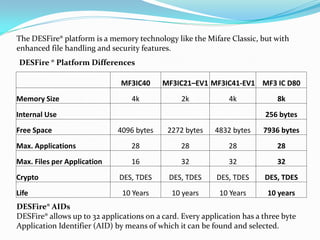
The DESFire® platform is a memory technology like the Mifare Classic, but with
enhanced file handling and security features.
DESFire ® Platform Differences

                               MF3IC40     MF3IC21–EV1 MF3IC41-EV1 MF3 IC D80
Memory Size                       4k            2k             4k            8k
Internal Use                                                             256 bytes
Free Space                    4096 bytes    2272 bytes    4832 bytes     7936 bytes
Max. Applications                 28            28             28            28
Max. Files per Application        16            32             32            32
Crypto                        DES, TDES      DES, TDES     DES, TDES     DES, TDES
Life                           10 Years       10 years      10 Years      10 years
DESFire® AIDs
DESFire® allows up to 32 applications on a card. Every application has a three byte
Application Identifier (AID) by means of which it can be found and selected.
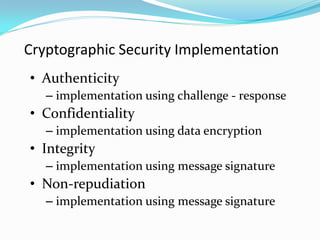
Cryptographic Security Implementation
• Authenticity
   – implementation using challenge - response
• Confidentiality
   – implementation using data encryption
• Integrity
   – implementation using message signature
• Non-repudiation
   – implementation using message signature
DES - Data Encryption Standard
• symmetrical key algorithm
• manipulate data in 8 bytes block
• only known attack is exhaustive key search,
  2 to the power of 56 computations
• 2 million years for today’s PC @1ms per
  computation or a few hours with special
  designed hardware, parallel processing
• security can be increased using triple DES
Symmetrical Algorithm
• Symmetrical e.g. DES (or triple DES)
   – good for many-to-one and one-to-one security for e.g.
     bank customers , Personal Identification &
     Verification
   – simple key management (Public & Private)
   – Cannot achieve non-repudiation
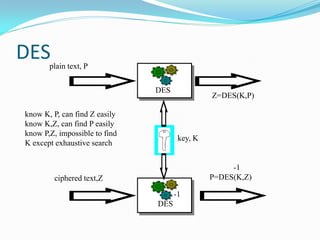
DES    plain text, P


                               DES
                                               Z=DES(K,P)

know K, P, can find Z easily
know K,Z, can find P easily
know P,Z, impossible to find
                                      key, K
K except exhaustive search


                                                    -1
        ciphered text,Z                        P=DES(K,Z)

                                     -1
                               DES
DES / Triple DES
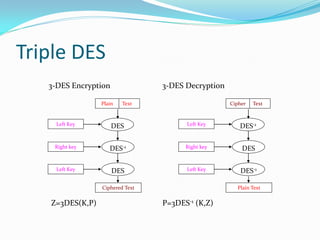
 Single DES uses single length key (8 bytes), K(8)
 3DES uses double length key (16 bytes), K(16) = KL(8)
  | KR(8) or KA(8) | KB(8)
 If the left and right part are the same, 3DES reduces
  to single DES
 Allows smooth migration from single DES to 3DES
 Least significant bit of each byte not used
Triple DES
   3-DES Encryption              3-DES Decryption

                 Plain   Text                       Cipher   Text


     Left Key         DES              Left Key        DES-1

    Right key       DES-1              Right key        DES

     Left Key         DES              Left Key        DES-1

                 Ciphered Text                        Plain Text


   Z=3DES(K,P)                   P=3DES-1 (K,Z)
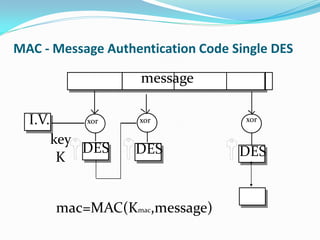
MAC - Message Authentication Code Single DES

                    message

  I.V.       xor    xor             xor

         key
             DES   DES             DES
          K


         mac=MAC(Kmac,message)
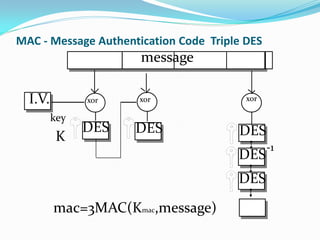
MAC - Message Authentication Code Triple DES
                      message

  I.V.         xor    xor                xor

         key
               DES   DES               DES
          K
                                               -1
                                       DES
                                       DES
         mac=3MAC(Kmac,message)
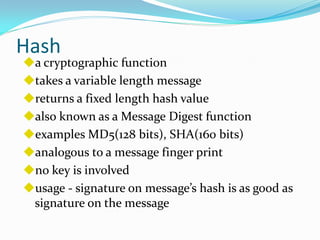
Hash
a cryptographic function
takes a variable length message
returns a fixed length hash value
also known as a Message Digest function
examples MD5(128 bits), SHA(160 bits)
analogous to a message finger print
no key is involved
usage - signature on message’s hash is as good as
 signature on the message
Public Key Algorithm

each party gets a public key and a private (secret)
 key which is unique
public key is published (free read access)
private key is secret (known only to the party)
public key is certified by a key certification body -
 key certificate
the public key of the certification body is public
 read access
Encryption   Using Public Key Algorithm
 Check receiver public key certificate with CA public key
 Check public key revocation list
 Generate random 3DES key
 Encrypt message using 3DES
 Encrypt 3DES Key using other party public key
 Append encrypted 3DES key with encrypted message

Decryption   Using Public Key Algorithm
 Decrypt 3DES key using the private key
 Use decrypted 3DES key to decrypt the message
Decryption Using Public Key Algorithm
 Decrypt 3DES key using the private key
 Use decrypted 3DES key to decrypt the message
Application
•   Advanced public transportation
•   High secure access control
•   Event ticketing
•   E-Government
•   Identity Verification without Central connectivity
•   E-Purse ( Canteen, Laundry & any payment)

Available file types
The files within an application can be any of the following types:

• Standard data files
• Backup data files
• Value files with backup
• Linear record files with backup
• Cyclic record files with backup
Q&A


THANKS
 Zahir B. Malik

Mifare Desfire Technology

  • 2.
    Mifare Has 2type Technology : • Mifare Sector/Block Card (Classic Mifare) • Mifare Desfire (File System, More secured, fast & reliable) with Crypto • DES (Data Encryption Standard ) • What is Crypto in Desfire Cards
  • 3.
    The DESFire® platformis a memory technology like the Mifare Classic, but with enhanced file handling and security features. DESFire ® Platform Differences MF3IC40 MF3IC21–EV1 MF3IC41-EV1 MF3 IC D80 Memory Size 4k 2k 4k 8k Internal Use 256 bytes Free Space 4096 bytes 2272 bytes 4832 bytes 7936 bytes Max. Applications 28 28 28 28 Max. Files per Application 16 32 32 32 Crypto DES, TDES DES, TDES DES, TDES DES, TDES Life 10 Years 10 years 10 Years 10 years DESFire® AIDs DESFire® allows up to 32 applications on a card. Every application has a three byte Application Identifier (AID) by means of which it can be found and selected.
  • 4.
    Cryptographic Security Implementation •Authenticity – implementation using challenge - response • Confidentiality – implementation using data encryption • Integrity – implementation using message signature • Non-repudiation – implementation using message signature
  • 5.
    DES - DataEncryption Standard • symmetrical key algorithm • manipulate data in 8 bytes block • only known attack is exhaustive key search, 2 to the power of 56 computations • 2 million years for today’s PC @1ms per computation or a few hours with special designed hardware, parallel processing • security can be increased using triple DES
  • 6.
    Symmetrical Algorithm • Symmetricale.g. DES (or triple DES) – good for many-to-one and one-to-one security for e.g. bank customers , Personal Identification & Verification – simple key management (Public & Private) – Cannot achieve non-repudiation
  • 7.
    DES plain text, P DES Z=DES(K,P) know K, P, can find Z easily know K,Z, can find P easily know P,Z, impossible to find key, K K except exhaustive search -1 ciphered text,Z P=DES(K,Z) -1 DES
  • 8.
    DES / TripleDES  Single DES uses single length key (8 bytes), K(8)  3DES uses double length key (16 bytes), K(16) = KL(8) | KR(8) or KA(8) | KB(8)  If the left and right part are the same, 3DES reduces to single DES  Allows smooth migration from single DES to 3DES  Least significant bit of each byte not used
  • 9.
    Triple DES 3-DES Encryption 3-DES Decryption Plain Text Cipher Text Left Key DES Left Key DES-1 Right key DES-1 Right key DES Left Key DES Left Key DES-1 Ciphered Text Plain Text Z=3DES(K,P) P=3DES-1 (K,Z)
  • 10.
    MAC - MessageAuthentication Code Single DES message I.V. xor xor xor key DES DES DES K mac=MAC(Kmac,message)
  • 11.
    MAC - MessageAuthentication Code Triple DES message I.V. xor xor xor key DES DES DES K -1 DES DES mac=3MAC(Kmac,message)
  • 12.
    Hash a cryptographic function takesa variable length message returns a fixed length hash value also known as a Message Digest function examples MD5(128 bits), SHA(160 bits) analogous to a message finger print no key is involved usage - signature on message’s hash is as good as signature on the message
  • 13.
    Public Key Algorithm eachparty gets a public key and a private (secret) key which is unique public key is published (free read access) private key is secret (known only to the party) public key is certified by a key certification body - key certificate the public key of the certification body is public read access
  • 14.
    Encryption Using Public Key Algorithm  Check receiver public key certificate with CA public key  Check public key revocation list  Generate random 3DES key  Encrypt message using 3DES  Encrypt 3DES Key using other party public key  Append encrypted 3DES key with encrypted message Decryption Using Public Key Algorithm  Decrypt 3DES key using the private key  Use decrypted 3DES key to decrypt the message
  • 15.
    Decryption Using PublicKey Algorithm  Decrypt 3DES key using the private key  Use decrypted 3DES key to decrypt the message
  • 16.
    Application • Advanced public transportation • High secure access control • Event ticketing • E-Government • Identity Verification without Central connectivity • E-Purse ( Canteen, Laundry & any payment) Available file types The files within an application can be any of the following types: • Standard data files • Backup data files • Value files with backup • Linear record files with backup • Cyclic record files with backup
  • 17.