Information and network security 38 birthday attacks and security of hash functions
The document discusses the vulnerabilities of hash functions, particularly against birthday attacks and cryptanalysis, highlighting that inadequate bit lengths (such as 128-bits) are susceptible to brute-force and collision resistance attacks. It explains the mechanics of these attacks, including preimage and collision attacks, referencing the birthday paradox as a fundamental concept that necessitates larger hash sizes to enhance security. The text also mentions alternative approaches to hashing using block ciphers and notes that these methods can still be vulnerable if not designed sufficiently secure.
Information and network security 38 birthday attacks and security of hash functions
1.
Information and NetworkSecurity:38
Birthday Attacks and Security of Hash Functions
Prof Neeraj Bhargava
Vaibhav Khanna
Department of Computer Science
School of Engineering and Systems Sciences
Maharshi Dayanand Saraswati University Ajmer
2.
Two Simple InsecureHash
Functions
• consider two simple insecure hash functions
• bit-by-bit exclusive-OR (XOR) of every block
• Ci = bi1 xor bi2 xor . . . xor bim
• a longitudinal redundancy check
• reasonably effective as data integrity check
• one-bit circular shift on hash value
• for each successive n-bit block
• rotate current hash value to left by1bit and XOR block
• good for data integrity but useless for security
3.
Attacks on HashFunctions
have brute-force attacks and cryptanalysis
a preimage or second preimage attack
find y s.t. H(y) equals a given hash value
collision resistance
find two messages x & y with same hash so H(x) =
H(y)
hence value 2m/2 determines strength of hash code
against brute-force attacks
128-bits inadequate, 160-bits suspect
4.
Attacks on HashFunctions
• As with encryption algorithms, there are two categories of attacks on
hash functions: brute-force attacks and cryptanalysis. A brute-force
attack does not depend on the specific algorithm but depends only
on bit length. In the case of a hash function, a brute-force attack
depends only on the bit length of the hash value. A cryptanalysis, in
contrast, is an attack based on weaknesses in a particular
cryptographic algorithm.
5.
Attacks on HashFunctions
• For a preimage or second preimage attack, an adversary wishes to
find a value y such that H(y) is equal to a given hash value h. The
brute force method is to pick values of y at random and try each value
until a collision occurs. For an m-bit hash value, the level of effort is
proportional to 2m. Specifically, the adversary would have to try, on
average, 2m–1 values of y to find one that generates a given hash
value h.
6.
Attacks on HashFunctions
• For a collision resistant attack, an adversary wishes to find two
messages or data blocks, x and y, that yield the same hash function:
H(x) = H(y). This requires much less effort than a preimage or second
preimage attack. The effort required is explained by a mathematical
result referred to as the birthday paradox (next slide).
7.
Attacks on HashFunctions
• If collision resistance is required, then the value 2m/2 determines the
strength of the hash code against brute-force attacks. Van Oorschot
and Wiener presented a design for a $10 million collision search
machine for MD5, which has a 128-bit hash length, that could find a
collision in 24 days. Thus a 128-bit code may be viewed as
inadequate. The next step up, if a hash code is treated as a sequence
of 32 bits, is a 160-bit hash length. With a hash length of 160 bits, the
same search machine would require over four thousand years to find
a collision. With today's technology, the time would be much shorter,
so that 160 bits now appears suspect.
8.
Birthday Attacks
• mightthink a 64-bit hash is secure
• but by Birthday Paradox is not
• birthday attack works thus:
• given user prepared to sign a valid message x
• opponent generates 2
m/2 variations x’ of x, all with
essentially the same meaning, and saves them
• opponent generates 2
m/2 variations y’ of a desired
fraudulent message y
• two sets of messages are compared to find pair with same
hash (probability > 0.5 by birthday paradox)
• have user sign the valid message, then substitute the
forgery which will have a valid signature
• conclusion is that need to use larger MAC/hash
9.
Birthday Attacks
• TheBirthday Attack exploits the birthday paradox – the chance that in
a group of people two will share the same birthday – only 23 people
are needed for a Pr>0.5 of this. Can generalize the problem to one
wanting a matching pair from any two sets, and show need 2m/2 in
each to get a matching m-bit hash.
• Yuval proposed the strategy shown to exploit the birthday paradox in
a collision resistant attack. Note that creating many message variants
is relatively easy, either by rewording or just varying the amount of
white-space in the message. All of which indicates that larger
MACs/Hashes are needed.
10.
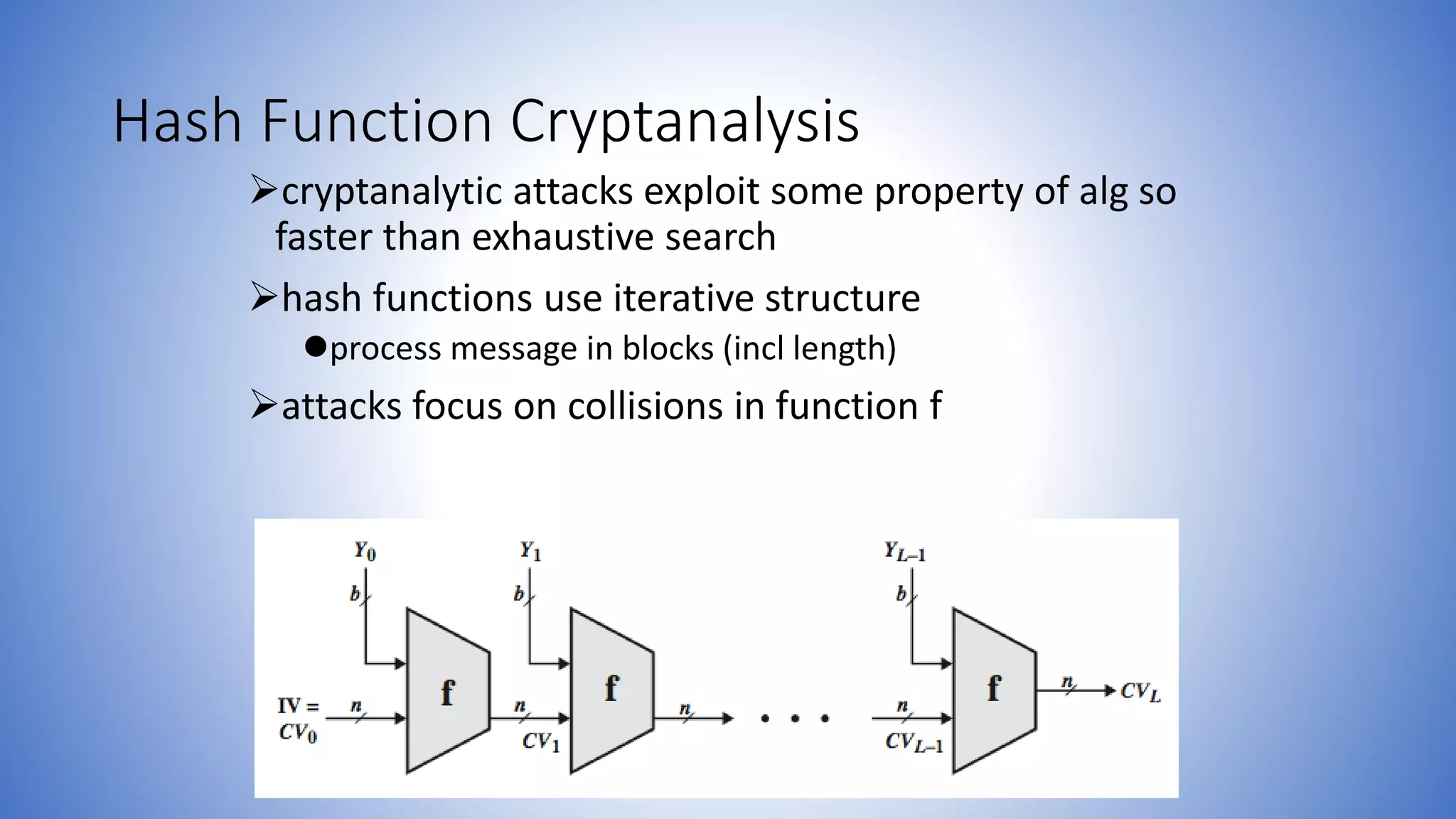
Hash Function Cryptanalysis
cryptanalyticattacks exploit some property of alg so
faster than exhaustive search
hash functions use iterative structure
process message in blocks (incl length)
attacks focus on collisions in function f
11.
• A numberof proposals have been made for hash functions based on
using a cipher block chaining technique, but without the secret key
(instead using the message blocks as keys).
• One of the first such proposals was that of Rabin, which divided a
message M into fixed-size blocks, and usde a symmetric encryption
system such as DES to compute the hash code G as shown.
• This is similar to the CBC technique, but in this case there is no secret
key. As with any hash code, this scheme is subject to the birthday
attack, and if the encryption algorithm is DES and only a 64-bit hash
code is produced, then the system is vulnerable.
12.
• Furthermore, anotherversion of the birthday attack can be used
even if the opponent has access to only one message and its valid
signature and cannot obtain multiple signings, known as a “meet-in-
the-middle” attack (see text).
• It can be shown that some form of birthday attack will succeed
against any hash scheme involving the use of cipher block chaining
without a secret key provided that either the resulting hash code is
small enough (e.g., 64 bits or less) or that a larger hash code can be
decomposed into independent subcodes.
• Thus, attention has been directed at finding other approaches to
hashing.
13.
Block Ciphers asHash Functions
• can use block ciphers as hash functions
• using H0=0 and zero-pad of final block
• compute: Hi = EMi
[Hi-1]
• and use final block as the hash value
• similar to CBC but without a key
• resulting hash is too small (64-bit)
• both due to direct birthday attack
• and to “meet-in-the-middle” attack
• other variants also susceptible to attack

![Block Ciphers as Hash Functions
• can use block ciphers as hash functions
• using H0=0 and zero-pad of final block
• compute: Hi = EMi
[Hi-1]
• and use final block as the hash value
• similar to CBC but without a key
• resulting hash is too small (64-bit)
• both due to direct birthday attack
• and to “meet-in-the-middle” attack
• other variants also susceptible to attack](https://image.slidesharecdn.com/informationandnetworksecurity38birthdayattacksandsecurityofhashfunctions-210723173907/75/Information-and-network-security-38-birthday-attacks-and-security-of-hash-functions-13-2048.jpg)