Michał Kuźba
Privacy-preserving
Machine Learning
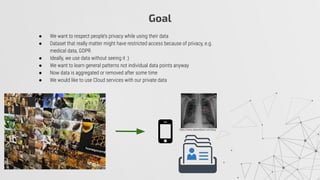
● We want to respect people’s privacy while using their data
● Dataset that really matter might have restricted access because of privacy, e.g.
medical data, GDPR
● Ideally, we use data without seeing it :)
● We want to learn general patterns not individual data points anyway
● Now data is aggregated or removed after some time
● We would like to use Cloud services with our private data
Goal
https://www.cleanerblast.com/blog
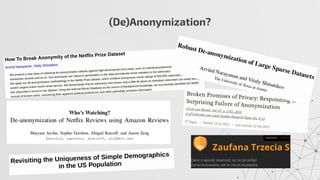
(De)Anonymization?
● Synthetic datasets
● Encryption
○ Encrypted Deep Learning
○ Data encryption
○ Homomorphic encryption
● Remote execution
○ Federated Learning
○ Secure Multi-Party Computation
● Differential Privacy
● Secure aggregation
Topics
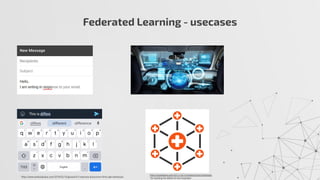
Federated Learning - usecases
https://lisabalboa.com/2017/10/15/network-level-strategies
-for-tackling-the-deficit-of-nhs-hospitals/https://www.androidpolice.com/2019/05/10/gboard-8-2-improves-autocorrect-hints-apk-download/
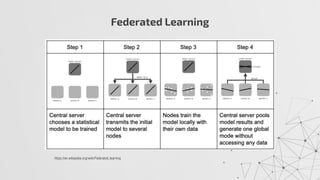
Federated Learning
https://en.wikipedia.org/wiki/Federated_learning
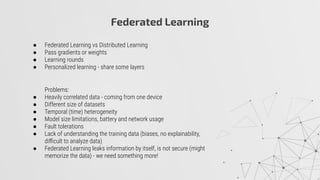
Federated Learning
Problems:
● Heavily correlated data - coming from one device
● Different size of datasets
● Temporal (time) heterogeneity
● Model size limitations, battery and network usage
● Fault tolerations
● Lack of understanding the training data (biases, no explainability,
difficult to analyze data)
● Federated Learning leaks information by itself, is not secure (might
memorize the data) - we need something more!
● Federated Learning vs Distributed Learning
● Pass gradients or weights
● Learning rounds
● Personalized learning - share some layers
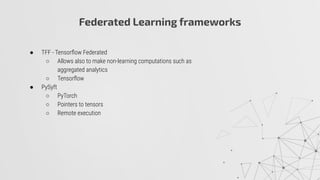
● TFF - Tensorflow Federated
○ Allows also to make non-learning computations such as
aggregated analytics
○ Tensorflow
● PySyft
○ PyTorch
○ Pointers to tensors
○ Remote execution
Federated Learning frameworks
https://federated.withgoogle.com/
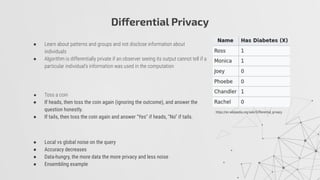
● Learn about patterns and groups and not disclose information about
individuals
● Algorithm is differentially private if an observer seeing its output cannot tell if a
particular individual's information was used in the computation
● Toss a coin
● If heads, then toss the coin again (ignoring the outcome), and answer the
question honestly.
● If tails, then toss the coin again and answer "Yes" if heads, "No" if tails.
● Local vs global noise on the query
● Accuracy decreases
● Data-hungry, the more data the more privacy and less noise
● Ensembling example
Differential Privacy
https://en.wikipedia.org/wiki/Differential_privacy
Differential Privacy
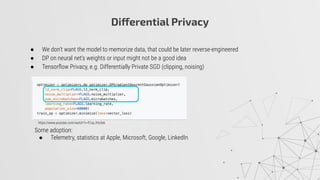
● We don’t want the model to memorize data, that could be later reverse-engineered
● DP on neural net’s weights or input might not be a good idea
● Tensorflow Privacy, e.g. Differentially Private SGD (clipping, noising)
Some adoption:
● Telemetry, statistics at Apple, Microsoft, Google, LinkedIn
https://www.youtube.com/watch?v=fCxp_lHo5ek
Enc(a + b) = Enc(a) ⊕ Enc(b) and
Enc(a * b) = Enc(a) ⊗Enc(b)
In other words, while performing any operations on data encrypted using a traditional
cipher would result in gibberish, homomorphic encryption allows you to do it without
corrupting the data. This goes further than basic operations. Being able to perform
addition and multiplication also means that you can compute polynomials. And, with
polynomials you can approximate essentially any function.
Homomorphic encryption
https://medium.com/blueprint-by-intuit/machine-learning-
on-encrypted-data-no-longer-a-fantasy-58e37e9f31d7
● Partial, Full HE
● Neural nets - cryptonets
● Performance downgrades for several reasons (sparsity, length, approximation,
some noise
● y is 1 if x>T, otherwise y is 0
○ The function is approximated by a polynomial which in turn can be
computed homomorphically. This becomes a building block in the
homomorphic evaluation of the decision tree, as the tree is a sequence
of conditional (“if”) statements.
● Ciphertext’s size might explode
● Frameworks:
○ Microsoft SEAL
○ Tensorflow Encrypted
○ Facebook Crypten
Homomorphic Encryption
https://github.com/tf-encrypted/tf-encrypted
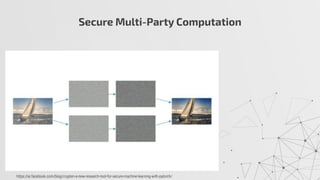
Secure Multi-Party Computation
https://ai.facebook.com/blog/crypten-a-new-research-tool-for-secure-machine-learning-with-pytorch/
Secure Multi-Party Computation
https://ai.facebook.com/blog/crypten-a-new-research-tool-for-secure-machine-learning-with-pytorch/
Secure Multi-Party Computation
y1
y2
y
dataset
Model
Data
Differential
Privacy
● How to do it well?
○ Preserve statistical properties
○ Remove personal information
● Fraud detection
● Keep some original data for sanity check
● https://www.kaggle.com/mlg-ulb/creditcardfraud - PCA features
● Generating differentially private datasets using GANs
Synthetic datasets
● https://www.udacity.com/course/secure-and-private-ai--ud185
● https://github.com/OpenMined/PySyft
● https://www.youtube.com/watch?v=4zrU54VIK6k - Andrew Trask, Lex Fridman
● https://medium.com/blueprint-by-intuit/machine-learning-on-encrypted-data-
no-longer-a-fantasy-58e37e9f31d7
● Workshop Nips ‘19
Resources
CREDITS: This presentation template was created by Slidesgo, including
icons by Flaticon, and infographics & images by Freepik.
Please keep this slide for attribution.
THANKS

Privacy preserving machine learning

  • 1.
  • 2.
    ● We wantto respect people’s privacy while using their data ● Dataset that really matter might have restricted access because of privacy, e.g. medical data, GDPR ● Ideally, we use data without seeing it :) ● We want to learn general patterns not individual data points anyway ● Now data is aggregated or removed after some time ● We would like to use Cloud services with our private data Goal https://www.cleanerblast.com/blog
  • 3.
  • 4.
    ● Synthetic datasets ●Encryption ○ Encrypted Deep Learning ○ Data encryption ○ Homomorphic encryption ● Remote execution ○ Federated Learning ○ Secure Multi-Party Computation ● Differential Privacy ● Secure aggregation Topics
  • 5.
    Federated Learning -usecases https://lisabalboa.com/2017/10/15/network-level-strategies -for-tackling-the-deficit-of-nhs-hospitals/https://www.androidpolice.com/2019/05/10/gboard-8-2-improves-autocorrect-hints-apk-download/
  • 6.
  • 7.
    Federated Learning Problems: ● Heavilycorrelated data - coming from one device ● Different size of datasets ● Temporal (time) heterogeneity ● Model size limitations, battery and network usage ● Fault tolerations ● Lack of understanding the training data (biases, no explainability, difficult to analyze data) ● Federated Learning leaks information by itself, is not secure (might memorize the data) - we need something more! ● Federated Learning vs Distributed Learning ● Pass gradients or weights ● Learning rounds ● Personalized learning - share some layers
  • 8.
    ● TFF -Tensorflow Federated ○ Allows also to make non-learning computations such as aggregated analytics ○ Tensorflow ● PySyft ○ PyTorch ○ Pointers to tensors ○ Remote execution Federated Learning frameworks
  • 9.
  • 10.
    ● Learn aboutpatterns and groups and not disclose information about individuals ● Algorithm is differentially private if an observer seeing its output cannot tell if a particular individual's information was used in the computation ● Toss a coin ● If heads, then toss the coin again (ignoring the outcome), and answer the question honestly. ● If tails, then toss the coin again and answer "Yes" if heads, "No" if tails. ● Local vs global noise on the query ● Accuracy decreases ● Data-hungry, the more data the more privacy and less noise ● Ensembling example Differential Privacy https://en.wikipedia.org/wiki/Differential_privacy
  • 11.
    Differential Privacy ● Wedon’t want the model to memorize data, that could be later reverse-engineered ● DP on neural net’s weights or input might not be a good idea ● Tensorflow Privacy, e.g. Differentially Private SGD (clipping, noising) Some adoption: ● Telemetry, statistics at Apple, Microsoft, Google, LinkedIn https://www.youtube.com/watch?v=fCxp_lHo5ek
  • 12.
    Enc(a + b)= Enc(a) ⊕ Enc(b) and Enc(a * b) = Enc(a) ⊗Enc(b) In other words, while performing any operations on data encrypted using a traditional cipher would result in gibberish, homomorphic encryption allows you to do it without corrupting the data. This goes further than basic operations. Being able to perform addition and multiplication also means that you can compute polynomials. And, with polynomials you can approximate essentially any function. Homomorphic encryption https://medium.com/blueprint-by-intuit/machine-learning- on-encrypted-data-no-longer-a-fantasy-58e37e9f31d7
  • 13.
    ● Partial, FullHE ● Neural nets - cryptonets ● Performance downgrades for several reasons (sparsity, length, approximation, some noise ● y is 1 if x>T, otherwise y is 0 ○ The function is approximated by a polynomial which in turn can be computed homomorphically. This becomes a building block in the homomorphic evaluation of the decision tree, as the tree is a sequence of conditional (“if”) statements. ● Ciphertext’s size might explode ● Frameworks: ○ Microsoft SEAL ○ Tensorflow Encrypted ○ Facebook Crypten Homomorphic Encryption https://github.com/tf-encrypted/tf-encrypted
  • 14.
  • 15.
  • 16.
  • 17.
    ● How todo it well? ○ Preserve statistical properties ○ Remove personal information ● Fraud detection ● Keep some original data for sanity check ● https://www.kaggle.com/mlg-ulb/creditcardfraud - PCA features ● Generating differentially private datasets using GANs Synthetic datasets
  • 18.
    ● https://www.udacity.com/course/secure-and-private-ai--ud185 ● https://github.com/OpenMined/PySyft ●https://www.youtube.com/watch?v=4zrU54VIK6k - Andrew Trask, Lex Fridman ● https://medium.com/blueprint-by-intuit/machine-learning-on-encrypted-data- no-longer-a-fantasy-58e37e9f31d7 ● Workshop Nips ‘19 Resources
  • 19.
    CREDITS: This presentationtemplate was created by Slidesgo, including icons by Flaticon, and infographics & images by Freepik. Please keep this slide for attribution. THANKS