Ajdabya University – Medical College
General Surgery Department
Dr. Abdulgadir M. Abdulrahman, MD
Inflammatory Bowel Disease (IBD)
Crohn's disease(CD) & Ulcerative colitis(UC)
Crohn’s Disease
• Definition : is an idiopathic chronic ,
granulomatous disease that can affect any
part of the GI tract from Mouth -to -Anus .
• This incurable, slowly progressive disease is
characterized by episodes of Exacerbation and
Remissions.
• The incidence is 4/100.000 , with a Bimodal
age distribution at :
• (15 to 29) and (55 to 70)years old .
Etiology of Crohn’s Disease
• The cause of CD. is Unknown .
• (Genetic vs. Environmental ) factors .
• Genetic : CD. is 25 times more common with
Family History+ 60 % in monozygotic twins .
• Environmental: Smoking ?
Bowel involvement in Crohn’s Disease
• NB: the Terminal ileum is the most common
site of disease and is involved in 75% of the
cases
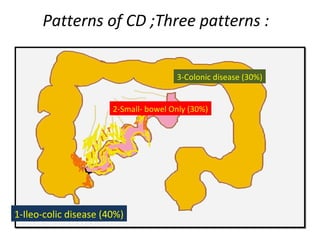
• Patterns of CD ;Three patterns :
• 1- Ileo-colic disease (40%) of patients
• 2-Small- bowel Only (30%) of patients
• 3-Colonic disease (30%) of patients
Patterns of CD ;Three patterns :
1-Ileo-colic disease (40%)
2-Small- bowel Only (30%)
3-Colonic disease (30%)
Histology of CD.
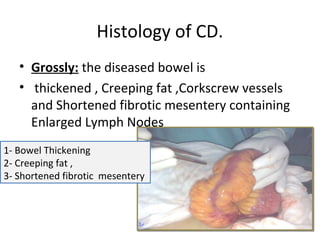
• Grossly: the diseased bowel is
• thickened , Creeping fat ,Corkscrew vessels
and Shortened fibrotic mesentery containing
Enlarged Lymph Nodes
1- Bowel Thickening
2- Creeping fat ,
3- Shortened fibrotic mesentery
Histology of CD.
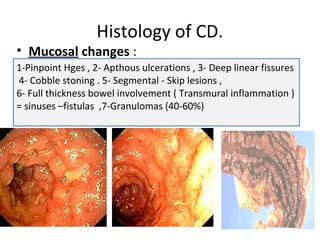
• Mucosal changes :
1-Pinpoint Hges , 2- Apthous ulcerations , 3- Deep linear fissures
4- Cobble stoning . 5- Segmental - Skip lesions ,
6- Full thickness bowel involvement ( Transmural inflammation )
= sinuses –fistulas ,7-Granulomas (40-60%)
Clinical Presentation of CD
Intestinal :
1-Diarrhea*(not bloody )
2-Abdominal pain
3-Weight loss
4-Anorectal=Fissure/fistulas
5- Constitutional:
malaise/ fever
Extra-intestinal
 Eyes =Conjunctivitis, Iritis,
Uveitis
 Skin= Pyoderma
ganrenosum , Erythema
nodosum , Aphtuos stomatitis
 M.sk = Arthritis
 Hepato-Biliry : sclerosing
cholangitis , Cirrhosis, liver
failure
Highly variable
No Pathognomonic phys. signs to CD
Examination of CD case
General Exam: Aphtuos stomatitis (ulcer)
Clubbing , Legs Pyoderma ganrenosum ,
Erythema nodosum ,
Abdominal Exam: A Palpable Mass =thick
edematous bowel, phlegmon, or abscess
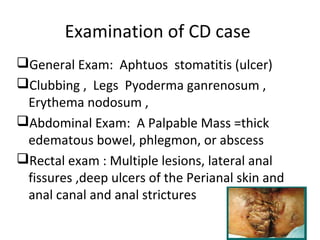
Rectal exam : Multiple lesions, lateral anal
fissures ,deep ulcers of the Perianal skin and
anal canal and anal strictures
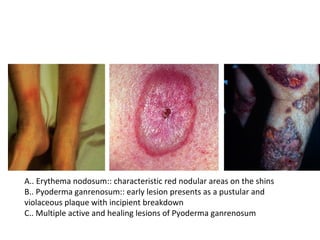
A.. Erythema nodosum:: characteristic red nodular areas on the shins
B.. Pyoderma ganrenosum:: early lesion presents as a pustular and
violaceous plaque with incipient breakdown
C.. Multiple active and healing lesions of Pyoderma ganrenosum
Imaging of CD
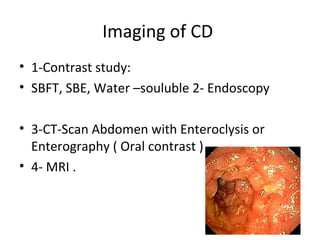
• 1-Contrast study:
• SBFT, SBE, Water –souluble 2- Endoscopy
• 3-CT-Scan Abdomen with Enteroclysis or
Enterography ( Oral contrast )
• 4- MRI .
Differential Diagnosis of CD
• 1-Ulcerative Colitis (UC)
• 2-Appendicitis
• 3-infection ileitis
• 4-others
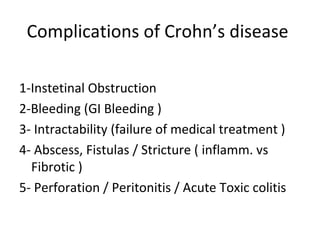
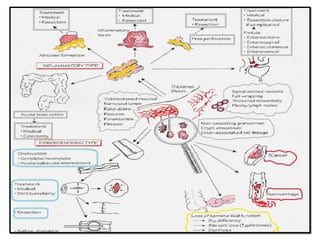
Complications of Crohn’s disease
1-Instetinal Obstruction
2-Bleeding (GI Bleeding )
3- Intractability (failure of medical treatment )
4- Abscess, Fistulas / Stricture ( inflamm. vs
Fibrotic )
5- Perforation / Peritonitis / Acute Toxic colitis
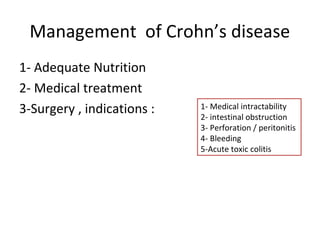
Management of Crohn’s disease
1- Adequate Nutrition
2- Medical treatment
3-Surgery , indications : 1- Medical intractability
2- intestinal obstruction
3- Perforation / peritonitis
4- Bleeding
5-Acute toxic colitis
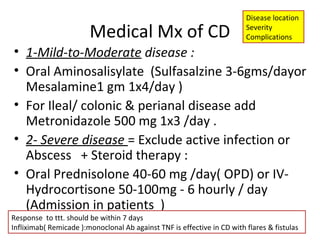
Medical Mx of CD
• 1-Mild-to-Moderate disease :
• Oral Aminosalisylate (Sulfasalzine 3-6gms/dayor
Mesalamine1 gm 1x4/day )
• For Ileal/ colonic & perianal disease add
Metronidazole 500 mg 1x3 /day .
• 2- Severe disease = Exclude active infection or
Abscess + Steroid therapy :
• Oral Prednisolone 40-60 mg /day( OPD) or IV-
Hydrocortisone 50-100mg - 6 hourly / day
(Admission in patients )
Disease location
Severity
Complications
Response to ttt. should be within 7 days
Infliximab( Remicade ):monoclonal Ab against TNF is effective in CD with flares & fistulas
Surgical therapy of CD.
• The most common indication for surgery iis disease activity that has
• been intractable (which is hard to define) to medical therapy..
• – persistent/progression of symptoms despite adequate medical therapy
• – dependence upon high dose steroids to maintain remission
• – significant treatment-related complications and side effects
• • Colitis/ileo--colitis/ileitis not responding to therapy
• • Obstruction (( e.g.: small bowel strictures))
• • Unequivocal dyspllasiia iin pattiientts wiitth llong--sttandiing colliittiis
• • Suspicion of a malliignantt sttriictture
• • Fistula nott responding to medical therapy
• • Toxic colliittiis/megacolon
• • Intra--abdominal abscesses ((which are most likely due to severe
• disease or ‘‘walled off’’ perforation)
• • Perianal disease (may require surgical drainage)
Prognosis of Crohn’s disease
• CD. is a chronic, relapsing, pan –intestinal
disease has No Cure and requires chronic,
• life –long treatment with operation( surgery )
reserved for the severe complications .
• Recently genetic ( NOD2/CARD15) has been
identified inpatients with CD.
UC
• Ulcerative colitis (UC) is a mucosal
inflammatory condition of the GI tract
confined to the colon and rectum.
• UC. is an inflammatory disease of the rectum
extending for a variable degree proximally in
the Colon .
• Females > males
• Age of incidence : 20 to 40 years
• Etiology : Unknown ; HLA-27 ass.
UC Pathology
• Site : Rectum & Sigmoid colon +/_ Whole colon =
Pan-colitis .
• Gross: Edematous mucosa / Bleeding petechial
Hges. / Extensive Ulcerations/ Pseudo polyps
• Microscopic :
• 1- Crypt abscesses
• 2- Ulcers lined with granulation tissues
• 3-smooth, thin atrophic bowel wall .
UC Presentation
Common symptoms associated with UC include
urgency, diarrhea, tenesmus and hematochezia
(Blood) and Mucous
+/- Cramping Abdominal pain
Constipation in 15–20% of patients
Examination :
Tender Left Iliac Fossa
Rectal Exam: Blood on Exam gloves /Edematous
Rectal mucosa
Fever/ Toxemia.
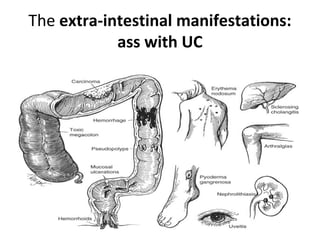
The extra-intestinal manifestations:
ass with UC
Diagnosis of UC
1- Sigmoidoscopy ( Diagnostic)/ +/_Biopsy
2- Colonoscopy ( Contra-indicated in acute toxic
colitis )= Surveillance T/O Colon cancer (8-10)
yrs
3- Barium Enema ( Contra-indicated in acute
toxic colitis )
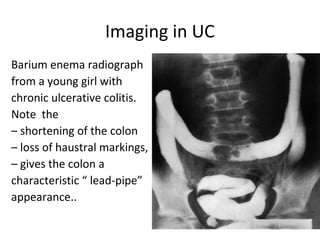
Imaging in UC
Barium enema radiograph
from a young girl with
chronic ulcerative colitis.
Note the
– shortening of the colon
– loss of haustral markings,
– gives the colon a
characteristic “ lead-pipe”
appearance..
Case Challenge
• 55 years old male Patient with history of
ulcerative colitis presented with abdominal
pain and bloody diarrhea.
• The looked sick , Febrile (39) , PR:110/min,
BP:90/60mmHg .
• The abdominal examination: revealed a
distended and mildly tender abdomen with
hypoactive bowel sounds.
Abdomen X-ray
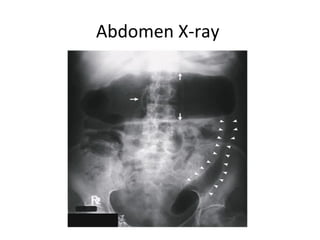
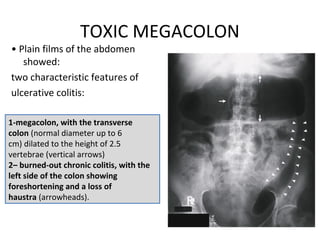
TOXIC MEGACOLON
• Plain films of the abdomen
showed:
two characteristic features of
ulcerative colitis:
1-megacolon, with the transverse
colon (normal diameter up to 6
cm) dilated to the height of 2.5
vertebrae (vertical arrows)
2– burned-out chronic colitis, with the
left side of the colon showing
foreshortening and a loss of
haustra (arrowheads).
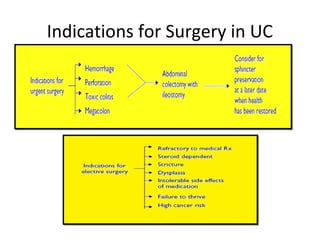
Indications for Surgery in UC
Thank You

Inflammatory Bowel Diseases (IBD)

  • 1.
    Ajdabya University –Medical College General Surgery Department Dr. Abdulgadir M. Abdulrahman, MD Inflammatory Bowel Disease (IBD) Crohn's disease(CD) & Ulcerative colitis(UC)
  • 2.
    Crohn’s Disease • Definition: is an idiopathic chronic , granulomatous disease that can affect any part of the GI tract from Mouth -to -Anus . • This incurable, slowly progressive disease is characterized by episodes of Exacerbation and Remissions. • The incidence is 4/100.000 , with a Bimodal age distribution at : • (15 to 29) and (55 to 70)years old .
  • 3.
    Etiology of Crohn’sDisease • The cause of CD. is Unknown . • (Genetic vs. Environmental ) factors . • Genetic : CD. is 25 times more common with Family History+ 60 % in monozygotic twins . • Environmental: Smoking ?
  • 4.
    Bowel involvement inCrohn’s Disease • NB: the Terminal ileum is the most common site of disease and is involved in 75% of the cases • Patterns of CD ;Three patterns : • 1- Ileo-colic disease (40%) of patients • 2-Small- bowel Only (30%) of patients • 3-Colonic disease (30%) of patients
  • 5.
    Patterns of CD;Three patterns : 1-Ileo-colic disease (40%) 2-Small- bowel Only (30%) 3-Colonic disease (30%)
  • 6.
    Histology of CD. •Grossly: the diseased bowel is • thickened , Creeping fat ,Corkscrew vessels and Shortened fibrotic mesentery containing Enlarged Lymph Nodes 1- Bowel Thickening 2- Creeping fat , 3- Shortened fibrotic mesentery
  • 7.
    Histology of CD. •Mucosal changes : 1-Pinpoint Hges , 2- Apthous ulcerations , 3- Deep linear fissures 4- Cobble stoning . 5- Segmental - Skip lesions , 6- Full thickness bowel involvement ( Transmural inflammation ) = sinuses –fistulas ,7-Granulomas (40-60%)
  • 8.
    Clinical Presentation ofCD Intestinal : 1-Diarrhea*(not bloody ) 2-Abdominal pain 3-Weight loss 4-Anorectal=Fissure/fistulas 5- Constitutional: malaise/ fever Extra-intestinal  Eyes =Conjunctivitis, Iritis, Uveitis  Skin= Pyoderma ganrenosum , Erythema nodosum , Aphtuos stomatitis  M.sk = Arthritis  Hepato-Biliry : sclerosing cholangitis , Cirrhosis, liver failure Highly variable No Pathognomonic phys. signs to CD
  • 9.
    Examination of CDcase General Exam: Aphtuos stomatitis (ulcer) Clubbing , Legs Pyoderma ganrenosum , Erythema nodosum , Abdominal Exam: A Palpable Mass =thick edematous bowel, phlegmon, or abscess Rectal exam : Multiple lesions, lateral anal fissures ,deep ulcers of the Perianal skin and anal canal and anal strictures
  • 10.
    A.. Erythema nodosum::characteristic red nodular areas on the shins B.. Pyoderma ganrenosum:: early lesion presents as a pustular and violaceous plaque with incipient breakdown C.. Multiple active and healing lesions of Pyoderma ganrenosum
  • 11.
    Imaging of CD •1-Contrast study: • SBFT, SBE, Water –souluble 2- Endoscopy • 3-CT-Scan Abdomen with Enteroclysis or Enterography ( Oral contrast ) • 4- MRI .
  • 12.
    Differential Diagnosis ofCD • 1-Ulcerative Colitis (UC) • 2-Appendicitis • 3-infection ileitis • 4-others
  • 13.
    Complications of Crohn’sdisease 1-Instetinal Obstruction 2-Bleeding (GI Bleeding ) 3- Intractability (failure of medical treatment ) 4- Abscess, Fistulas / Stricture ( inflamm. vs Fibrotic ) 5- Perforation / Peritonitis / Acute Toxic colitis
  • 15.
    Management of Crohn’sdisease 1- Adequate Nutrition 2- Medical treatment 3-Surgery , indications : 1- Medical intractability 2- intestinal obstruction 3- Perforation / peritonitis 4- Bleeding 5-Acute toxic colitis
  • 16.
    Medical Mx ofCD • 1-Mild-to-Moderate disease : • Oral Aminosalisylate (Sulfasalzine 3-6gms/dayor Mesalamine1 gm 1x4/day ) • For Ileal/ colonic & perianal disease add Metronidazole 500 mg 1x3 /day . • 2- Severe disease = Exclude active infection or Abscess + Steroid therapy : • Oral Prednisolone 40-60 mg /day( OPD) or IV- Hydrocortisone 50-100mg - 6 hourly / day (Admission in patients ) Disease location Severity Complications Response to ttt. should be within 7 days Infliximab( Remicade ):monoclonal Ab against TNF is effective in CD with flares & fistulas
  • 17.
    Surgical therapy ofCD. • The most common indication for surgery iis disease activity that has • been intractable (which is hard to define) to medical therapy.. • – persistent/progression of symptoms despite adequate medical therapy • – dependence upon high dose steroids to maintain remission • – significant treatment-related complications and side effects • • Colitis/ileo--colitis/ileitis not responding to therapy • • Obstruction (( e.g.: small bowel strictures)) • • Unequivocal dyspllasiia iin pattiientts wiitth llong--sttandiing colliittiis • • Suspicion of a malliignantt sttriictture • • Fistula nott responding to medical therapy • • Toxic colliittiis/megacolon • • Intra--abdominal abscesses ((which are most likely due to severe • disease or ‘‘walled off’’ perforation) • • Perianal disease (may require surgical drainage)
  • 18.
    Prognosis of Crohn’sdisease • CD. is a chronic, relapsing, pan –intestinal disease has No Cure and requires chronic, • life –long treatment with operation( surgery ) reserved for the severe complications . • Recently genetic ( NOD2/CARD15) has been identified inpatients with CD.
  • 21.
    UC • Ulcerative colitis(UC) is a mucosal inflammatory condition of the GI tract confined to the colon and rectum. • UC. is an inflammatory disease of the rectum extending for a variable degree proximally in the Colon . • Females > males • Age of incidence : 20 to 40 years • Etiology : Unknown ; HLA-27 ass.
  • 22.
    UC Pathology • Site: Rectum & Sigmoid colon +/_ Whole colon = Pan-colitis . • Gross: Edematous mucosa / Bleeding petechial Hges. / Extensive Ulcerations/ Pseudo polyps • Microscopic : • 1- Crypt abscesses • 2- Ulcers lined with granulation tissues • 3-smooth, thin atrophic bowel wall .
  • 23.
    UC Presentation Common symptomsassociated with UC include urgency, diarrhea, tenesmus and hematochezia (Blood) and Mucous +/- Cramping Abdominal pain Constipation in 15–20% of patients Examination : Tender Left Iliac Fossa Rectal Exam: Blood on Exam gloves /Edematous Rectal mucosa Fever/ Toxemia.
  • 24.
  • 25.
    Diagnosis of UC 1-Sigmoidoscopy ( Diagnostic)/ +/_Biopsy 2- Colonoscopy ( Contra-indicated in acute toxic colitis )= Surveillance T/O Colon cancer (8-10) yrs 3- Barium Enema ( Contra-indicated in acute toxic colitis )
  • 26.
    Imaging in UC Bariumenema radiograph from a young girl with chronic ulcerative colitis. Note the – shortening of the colon – loss of haustral markings, – gives the colon a characteristic “ lead-pipe” appearance..
  • 27.
    Case Challenge • 55years old male Patient with history of ulcerative colitis presented with abdominal pain and bloody diarrhea. • The looked sick , Febrile (39) , PR:110/min, BP:90/60mmHg . • The abdominal examination: revealed a distended and mildly tender abdomen with hypoactive bowel sounds.
  • 28.
  • 29.
    TOXIC MEGACOLON • Plainfilms of the abdomen showed: two characteristic features of ulcerative colitis: 1-megacolon, with the transverse colon (normal diameter up to 6 cm) dilated to the height of 2.5 vertebrae (vertical arrows) 2– burned-out chronic colitis, with the left side of the colon showing foreshortening and a loss of haustra (arrowheads).
  • 30.
  • 32.

Editor's Notes

  • #9 NB: Diarrhea occurs almost in all patients and usually not bloody unless the colon is involved 2-Abdominal pain= Typically intermittent , crampy , poorly localized , worse after meals and relieved by Defecation Exam: A Palpable Mass =thick edematous bowel , phlegmon , or abscess
  • #17 Infliximab( Remicade ):monoclonal Ab against TNF is effective in CD with flares & fistulas =Exclude Infections /TB(Negative PPD), particularly useful in poor surgical candidates who failed med mx . After recovery from acute face , the medical regime should simplified or tapered to prevent long term cxps .and S/E /add 6-Mercaptopurine(immuno modulator ) may help pts with refractory disease to tape off steroids .
  • #32 Source: Kaplan pathology 2008