ABNORMAL LABOUR OSAMA M. A.ALAZIM
1)OBSTRUCTED LABOUR Obstruction is ''the failure of the presenting part to descend in spite of uterine contractions‘ . What really distinguishes delay from obstruction is the secondary  signs and complications  that follow:- a)severe moulding and caput, b)fetal distress, c)a stretched lower segment, d)bloody urine, and E)fistulae and rupture of the uterus, etc.
CAUSES:- An abnormality in a mother's pelvis (a contracted pelvis).  An abnormality in her baby (hydrocephaly, etc) An abnormality in the relationship between them. This can either be:- an abnormal lie or presentation (a breech, a brow, or a face, or a shoulder presentation, or a prolapsed arm in a transverse lie), or  an unfortunate coincidence of their relative sizes (CPD #cephalopelvic disproportion#, he may be too big for her, or she may be too small for him).
4- Rarer causes, such as stenosis of the vagina, locked twins, or a pelvic tumor, particularly fibroids or an ovarian cyst CPD is the most important cause (two-thirds of cases), and an impacted transverse lie is the next In practice, when the presenting part stops moving through the birth canal, you may not be able to tell if this is because:- the uterine contractions are weak (uterine inertia), because the baby and the pelvis are such that one will not go through the other (CPD). Often, there is a combination of inertia and CPD .
PATHOPHYSIOLOGY In a labour that is going to obstruct, the first stage is often  prolonged , but it can be normal or even short. A mother's membranes rupture, and her liquor escapes. Her uterus contracts and retracts, and forces her baby into its lower segment, which gradually becomes overstretched. Obstruction prevents his escape, so her lower segment moulds closely round him and thins. The contractions of her uterus become hypertonic, and relaxation between them poor. The placenta is poorly perfused, there is fetal distress, and he dies.
Obstructed labour has two main dangers:- Her vagina, bladder, and rectum are trapped between his head and her pelvis, so that they become necrotic, slough, and develop fistulae. Her uterus ruptures. Primps usually develop fistulae, and multips usually rupture their uteri, but both can do either, and rupture and fistulae can occur in the same patient.
CONT, She is also at risk from septic shock, peritonitis, peritoneal abscesses, atonic postpartum hemorrhage ,and foot drop from the pressure of his head on her sciatic nerves. Even if her fistula can be repaired, and there is at best only about an 80% chance of this, she may be infertile, and her vagina may be so stenosed that sex is difficult. If it is repaired, and she becomes pregnant again, she must be sectioned to prevent the repair breaking down. If it is not repaired (in which case she is less likely to become pregnant), stenosis of her vagina is likely to prevent vaginal delivery
PREVENTION Preventing obstruction depends on: Good nutrition starting in childhood, so that mothers reach their genetically determined height, and their pelvis their genetically determined size.  Universal antenatal care, so that obstructed labour can be anticipated from a mother's history, and any risk factors for it identified. The monitoring of labour by skilled staff, so that she can be referred at the first sign of danger, before she obstructs.
 
2)UMBILICAL CORD  PROLAPSE is an  obstetric  emergency during  pregnancy  or labor that imminently endangers the life of the fetus. Cord prolapse is rare  , Statistics on cord prolapse vary, but the range is between 0.14% and 0.62% of all births in most studies It happens when the  umbilical cord  preceeds the fetus' exit from the  uterus . Cord prolapse is often concurrent with the rupture of the amniotic sac. After this happens the fetus moves downward into the pelvis and puts pressure on the cord. As a result, oxygen and blood supplies to the fetus are diminished or cut-off and the baby must be delivered quickly. Some practitioners will attempt reduce pressure on the cord and deliver the vaginally right away.
Frequently the attempt to resolve the prolapsed cord and deliver the baby vaginally fails, and an emergency  caesarean section  must be performed immediately. While the patient is being prepared for a caesarean, the woman is placed the Trendelenburg position or the knee-elbow position   and an attendant reaches into the  vagina  and pushes the presenting part out of the pelvic inlet and back into the pelvis to remove the pressure from the umbilical cord If attempts to deliver the baby promptly fail, the fetus' air and blood supply are occluded and brain damage or death will occur.
The  mortality rate  for the fetus is given as 11-17% This applies to hospital births or very quick transfers in a first world environment. One series is reported where there was no mortality in 24 cases with the novel intervention of infusing 500ml of fluid by catheter into the woman's bladder, in order to displace the presenting part of the fetus upward, and to reduce compression on the prolapsed cord
RISK FACTORS Potential predisposing risk factors include:- Premature  rupture of the  amniotic sac   polyhydramnios  (having a large volume of  amniotic fluid . The cord may be forced out with the more forceful gush of waters.  long umbilical cord  fetal malpresentation  multiparty  multiple gestation
 
 
3)UTERINE RUPTURE is a potentially catastrophic event during  childbirth  by which the integrity of the  myometrial  wall is breached. In an incomplete rupture the  peritoneum  is still intact. With a complete rupture the contents of the uterus may spill into the peritoneal cavity or the  broad ligament . A uterine rupture is a life-threatening event for mother and baby.
A uterine rupture typically occurs during early  labor , but may already develop during late pregnancy. A uterine scar from a previous  cesarean section  is the most common risk factor. Other forms of uterine surgery that result in full-thickness incisions (such as a  myomectomy ), dysfunctional labor, labor augmentation by  oxytocin  or  prostaglandins , and high  parity  may also set the stage for uterine rupture. In 2006, an extremely rare case of uterine rupture in a first pregnancy with no risk factors was reported.
Symptoms of a rupture may be initially quite subtle. An old cesarean scar may undergo  dehiscence , but with further labour, the woman may experience abdominal pain and vaginal bleeding. Often a  deterioration of the fetal heart rate  is a leading sign. Intra-abdominal bleeding, can lead to  Hypovlaemic shock  and death.
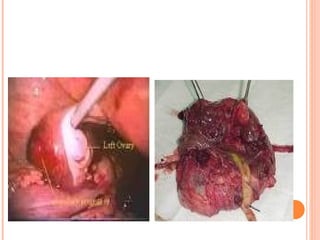
Emergency exploratory  laparotomy  with cesarean delivery accompanied by fluid and  blood transfusion  are indicated for the management of uterine rupture. Depending on the nature of the rupture and the condition of the patient the uterus may be either repaired or needs to be removed (cesarean hysterectomy).


Abnormal Labour

  • 1.
  • 2.
    1)OBSTRUCTED LABOUR Obstructionis ''the failure of the presenting part to descend in spite of uterine contractions‘ . What really distinguishes delay from obstruction is the secondary signs and complications that follow:- a)severe moulding and caput, b)fetal distress, c)a stretched lower segment, d)bloody urine, and E)fistulae and rupture of the uterus, etc.
  • 3.
    CAUSES:- An abnormalityin a mother's pelvis (a contracted pelvis). An abnormality in her baby (hydrocephaly, etc) An abnormality in the relationship between them. This can either be:- an abnormal lie or presentation (a breech, a brow, or a face, or a shoulder presentation, or a prolapsed arm in a transverse lie), or an unfortunate coincidence of their relative sizes (CPD #cephalopelvic disproportion#, he may be too big for her, or she may be too small for him).
  • 4.
    4- Rarer causes,such as stenosis of the vagina, locked twins, or a pelvic tumor, particularly fibroids or an ovarian cyst CPD is the most important cause (two-thirds of cases), and an impacted transverse lie is the next In practice, when the presenting part stops moving through the birth canal, you may not be able to tell if this is because:- the uterine contractions are weak (uterine inertia), because the baby and the pelvis are such that one will not go through the other (CPD). Often, there is a combination of inertia and CPD .
  • 5.
    PATHOPHYSIOLOGY In alabour that is going to obstruct, the first stage is often prolonged , but it can be normal or even short. A mother's membranes rupture, and her liquor escapes. Her uterus contracts and retracts, and forces her baby into its lower segment, which gradually becomes overstretched. Obstruction prevents his escape, so her lower segment moulds closely round him and thins. The contractions of her uterus become hypertonic, and relaxation between them poor. The placenta is poorly perfused, there is fetal distress, and he dies.
  • 6.
    Obstructed labour hastwo main dangers:- Her vagina, bladder, and rectum are trapped between his head and her pelvis, so that they become necrotic, slough, and develop fistulae. Her uterus ruptures. Primps usually develop fistulae, and multips usually rupture their uteri, but both can do either, and rupture and fistulae can occur in the same patient.
  • 7.
    CONT, She isalso at risk from septic shock, peritonitis, peritoneal abscesses, atonic postpartum hemorrhage ,and foot drop from the pressure of his head on her sciatic nerves. Even if her fistula can be repaired, and there is at best only about an 80% chance of this, she may be infertile, and her vagina may be so stenosed that sex is difficult. If it is repaired, and she becomes pregnant again, she must be sectioned to prevent the repair breaking down. If it is not repaired (in which case she is less likely to become pregnant), stenosis of her vagina is likely to prevent vaginal delivery
  • 8.
    PREVENTION Preventing obstructiondepends on: Good nutrition starting in childhood, so that mothers reach their genetically determined height, and their pelvis their genetically determined size. Universal antenatal care, so that obstructed labour can be anticipated from a mother's history, and any risk factors for it identified. The monitoring of labour by skilled staff, so that she can be referred at the first sign of danger, before she obstructs.
  • 9.
  • 10.
    2)UMBILICAL CORD PROLAPSE is an obstetric emergency during pregnancy or labor that imminently endangers the life of the fetus. Cord prolapse is rare , Statistics on cord prolapse vary, but the range is between 0.14% and 0.62% of all births in most studies It happens when the umbilical cord preceeds the fetus' exit from the uterus . Cord prolapse is often concurrent with the rupture of the amniotic sac. After this happens the fetus moves downward into the pelvis and puts pressure on the cord. As a result, oxygen and blood supplies to the fetus are diminished or cut-off and the baby must be delivered quickly. Some practitioners will attempt reduce pressure on the cord and deliver the vaginally right away.
  • 11.
    Frequently the attemptto resolve the prolapsed cord and deliver the baby vaginally fails, and an emergency caesarean section must be performed immediately. While the patient is being prepared for a caesarean, the woman is placed the Trendelenburg position or the knee-elbow position and an attendant reaches into the vagina and pushes the presenting part out of the pelvic inlet and back into the pelvis to remove the pressure from the umbilical cord If attempts to deliver the baby promptly fail, the fetus' air and blood supply are occluded and brain damage or death will occur.
  • 12.
    The mortalityrate for the fetus is given as 11-17% This applies to hospital births or very quick transfers in a first world environment. One series is reported where there was no mortality in 24 cases with the novel intervention of infusing 500ml of fluid by catheter into the woman's bladder, in order to displace the presenting part of the fetus upward, and to reduce compression on the prolapsed cord
  • 13.
    RISK FACTORS Potentialpredisposing risk factors include:- Premature rupture of the amniotic sac polyhydramnios (having a large volume of amniotic fluid . The cord may be forced out with the more forceful gush of waters. long umbilical cord fetal malpresentation multiparty multiple gestation
  • 14.
  • 15.
  • 16.
    3)UTERINE RUPTURE isa potentially catastrophic event during childbirth by which the integrity of the myometrial wall is breached. In an incomplete rupture the peritoneum is still intact. With a complete rupture the contents of the uterus may spill into the peritoneal cavity or the broad ligament . A uterine rupture is a life-threatening event for mother and baby.
  • 17.
    A uterine rupturetypically occurs during early labor , but may already develop during late pregnancy. A uterine scar from a previous cesarean section is the most common risk factor. Other forms of uterine surgery that result in full-thickness incisions (such as a myomectomy ), dysfunctional labor, labor augmentation by oxytocin or prostaglandins , and high parity may also set the stage for uterine rupture. In 2006, an extremely rare case of uterine rupture in a first pregnancy with no risk factors was reported.
  • 18.
    Symptoms of arupture may be initially quite subtle. An old cesarean scar may undergo dehiscence , but with further labour, the woman may experience abdominal pain and vaginal bleeding. Often a deterioration of the fetal heart rate is a leading sign. Intra-abdominal bleeding, can lead to Hypovlaemic shock and death.
  • 19.
    Emergency exploratory laparotomy with cesarean delivery accompanied by fluid and blood transfusion are indicated for the management of uterine rupture. Depending on the nature of the rupture and the condition of the patient the uterus may be either repaired or needs to be removed (cesarean hysterectomy).
  • 20.
  • 21.