Ulcerative colitis
DONE BY :- HAMAD EMAD THUHAYR
SUPERVISOR BY :- DR. MOHAMMED SADDIQE

2ST BGM

SOEPLE 4
Contents


Soepel



Introduction



Etiology



Histology



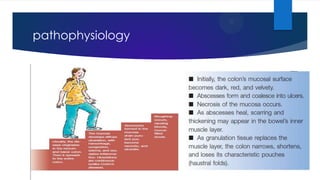
pathophysiology



Sings and Symptomes



Diagnosise



Complications



Prognosis



Treatment



References
SOEPEL


SUBJECT:



A 35-year-old female from Saudi. She is married has 2 children aged 3 and 8 years. They are both well.
lives and born in Unaizah.



Over the last 2–3 days she has become weak with the persistent diarrhea and her abdomen has
become more painful and bloated over the last 24 h.



she has a year-long history of intermittent diarrhea which has never been bad enough for her to seek
medical help in the past. However, she has become much worse over 1 week with episodes of bloody
diarrhea 10 times a day. She has had some cramp lower abdominal pain which lasts for 1–2 h and is
partially relieved by defecation. She took 2 days of amoxicillin after the diarrhea began with no
improvement or worsening of her bowels.



She has no relevant previous medical history. Up to 1 year ago, her bowels were regular. There is no
disturbance of micturition or menstruation.




In her family history, she thinks one of her maternal aunts may have had bowel problems.
She travelled to Egypt on holiday 6 months ago but has not travelled elsewhere.
SOEPEL


OBJECTIVE:

taking history, physical examination ( General and abdominal )


EVALUATION (DD):

Ulcerative colitis ,Crohn’s disease infectious, enterocolitis celiac sprue.


PLAN:

Blood tests, Stool sample, Colonoscopy, Flexible sigmoidoscopy, Barium enema ,X-ray and CT scan.


ELABORATION:

drug therapy or surgery.


LEARNING GOALS:

ulcerative colitis
Introduction


Ulcerative colitis:-

is an idiopathic chronic inflammatory disease of the colon that follows a course of relapse and
remission. In a small number of cases, ulcerative colitis is associated with extra-intestinal features.


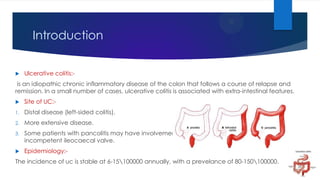
Site of UC:-

1.

Distal disease (left-sided colitis).

2.

More extensive disease.

3.

Some patients with pancolitis may have involvement of the terminal ileum due to an
incompetent ileocaecal valve.



Epidemiology:-

The incidence of uc is stable at 6-15100000 annually, with a prevelance of 80-150100000.
Etiology


The aetiology is unknown. Ulcerative colitis is probably an autoimmune condition triggered by
colonic bacteria causing inflammation in the gastrointestinal tract.



A family history is present in around 25-40% of children; siblings of an individual with Crohn's
disease are 17-35 times more likely than the general population to develop the condition.



There is concern that non-steroidal anti-inflammatory drugs (NSAIDs) may increase the risk of
relapse or exacerbation of inflammatory bowel disease (IBD) - ulcerative colitis and Crohn's
disease - but the evidence is not strong.



The risk of IBD is increased in women using oral contraceptives but the absolute increase in risk is
very low.



The risk of ulcerative colitis is decreased in smokers.
histology


The severity of the disease may also be quite variable
histologically, ranging from minimal to florid ulceration and
dysplasia.



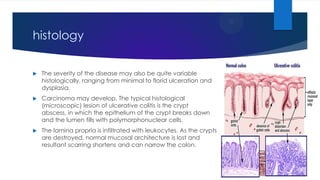
Carcinoma may develop. The typical histological
(microscopic) lesion of ulcerative colitis is the crypt
abscess, in which the epithelium of the crypt breaks down
and the lumen fills with polymorphonuclear cells.



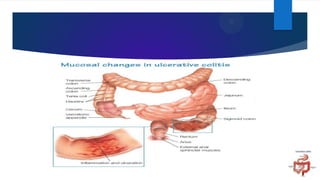
The lamina propria is infiltrated with leukocytes. As the crypts
are destroyed, normal mucosal architecture is lost and
resultant scarring shortens and can narrow the colon.
pathophysiology
Sings and Symptomes



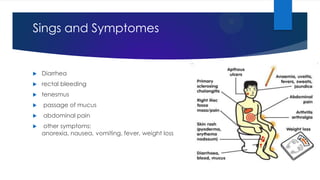
Diarrhea



rectal bleeding



tenesmus



passage of mucus



abdominal pain



other symptoms:
anorexia, nausea, vomiting, fever, weight loss
Test and Diagnosis


Blood tests, check for anemia or infection and type of inflammatory bowel disease



Stool sample, The presence of white blood cells in your stool indicates an inflammatory
disease, possibly ulcerative colitis.



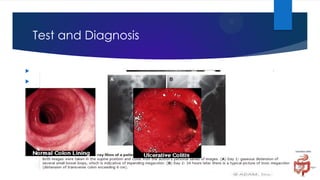
Colonoscopy, take small samples of tissue (biopsy) for laboratory analysis.



Flexible sigmoidoscopy, uses a slender, flexible, lighted tube to examine the sigmoid, the
last portion of colon.



Barium enema



X-ray



CT scan. reveal how much of the colon is inflamed.
Complications



Severe bleeding



A hole in the colon (perforated colon)



Severe dehydration



Liver disease (rare)



Kidney stones



Osteoporosis



Inflammation of your skin, joints and eyes



An increased risk of colon cancer



A rapidly swelling colon (toxic megacolon)
Prognosis


Ulcerative colitis is a lifelong condition, with unpredictable relapses and
remissions.



Mortality is slightly higher than in the general population.



One study in Norway found that:



83% of people initially had relapsing disease but half were relapse-free after five
years.





The cumulative colectomy rate after ten years was 9.8%.

About 20% of people with proctitis or left-sided colitis progressed to extensive colitis.

The prognosis for acute severe colitis depends on their initial response to
corticosteroid treatment.
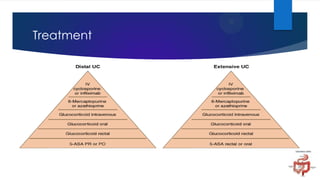
Treatment


Nutritional therapies :

- total parenteral nutrition


Surgical therapy

- indications: intractable disease, fulminant disease, toxic
megacolon, colonic perforation, massive colonic hemorrhage, colonic
obstruction, colon cancer prophylaxis, colon dysplasia or cancer
References



Kumar & clark’s- clinical medicine- 8 edition- page 272-282.



https://www.jhmicall.org/GDL_Disease.aspx?CurrentUDV=31&GDL_Disease
_ID=2A4995B2-DFA5-4954-B770-F1F5BAFED033&GDL_DC_ID=D03119D757A3-4890-A717-CF1E7426C8BA


http://www.patient.co.uk/doctor/ulcerative-colitis-pro
Ulcerative colitis

Ulcerative colitis

  • 1.
    Ulcerative colitis DONE BY:- HAMAD EMAD THUHAYR SUPERVISOR BY :- DR. MOHAMMED SADDIQE 2ST BGM SOEPLE 4
  • 2.
  • 3.
    SOEPEL  SUBJECT:  A 35-year-old femalefrom Saudi. She is married has 2 children aged 3 and 8 years. They are both well. lives and born in Unaizah.  Over the last 2–3 days she has become weak with the persistent diarrhea and her abdomen has become more painful and bloated over the last 24 h.  she has a year-long history of intermittent diarrhea which has never been bad enough for her to seek medical help in the past. However, she has become much worse over 1 week with episodes of bloody diarrhea 10 times a day. She has had some cramp lower abdominal pain which lasts for 1–2 h and is partially relieved by defecation. She took 2 days of amoxicillin after the diarrhea began with no improvement or worsening of her bowels.  She has no relevant previous medical history. Up to 1 year ago, her bowels were regular. There is no disturbance of micturition or menstruation.   In her family history, she thinks one of her maternal aunts may have had bowel problems. She travelled to Egypt on holiday 6 months ago but has not travelled elsewhere.
  • 4.
    SOEPEL  OBJECTIVE: taking history, physicalexamination ( General and abdominal )  EVALUATION (DD): Ulcerative colitis ,Crohn’s disease infectious, enterocolitis celiac sprue.  PLAN: Blood tests, Stool sample, Colonoscopy, Flexible sigmoidoscopy, Barium enema ,X-ray and CT scan.  ELABORATION: drug therapy or surgery.  LEARNING GOALS: ulcerative colitis
  • 5.
    Introduction  Ulcerative colitis:- is anidiopathic chronic inflammatory disease of the colon that follows a course of relapse and remission. In a small number of cases, ulcerative colitis is associated with extra-intestinal features.  Site of UC:- 1. Distal disease (left-sided colitis). 2. More extensive disease. 3. Some patients with pancolitis may have involvement of the terminal ileum due to an incompetent ileocaecal valve.  Epidemiology:- The incidence of uc is stable at 6-15100000 annually, with a prevelance of 80-150100000.
  • 6.
    Etiology  The aetiology isunknown. Ulcerative colitis is probably an autoimmune condition triggered by colonic bacteria causing inflammation in the gastrointestinal tract.  A family history is present in around 25-40% of children; siblings of an individual with Crohn's disease are 17-35 times more likely than the general population to develop the condition.  There is concern that non-steroidal anti-inflammatory drugs (NSAIDs) may increase the risk of relapse or exacerbation of inflammatory bowel disease (IBD) - ulcerative colitis and Crohn's disease - but the evidence is not strong.  The risk of IBD is increased in women using oral contraceptives but the absolute increase in risk is very low.  The risk of ulcerative colitis is decreased in smokers.
  • 7.
    histology  The severity ofthe disease may also be quite variable histologically, ranging from minimal to florid ulceration and dysplasia.  Carcinoma may develop. The typical histological (microscopic) lesion of ulcerative colitis is the crypt abscess, in which the epithelium of the crypt breaks down and the lumen fills with polymorphonuclear cells.  The lamina propria is infiltrated with leukocytes. As the crypts are destroyed, normal mucosal architecture is lost and resultant scarring shortens and can narrow the colon.
  • 8.
  • 10.
    Sings and Symptomes  Diarrhea  rectalbleeding  tenesmus  passage of mucus  abdominal pain  other symptoms: anorexia, nausea, vomiting, fever, weight loss
  • 11.
    Test and Diagnosis  Bloodtests, check for anemia or infection and type of inflammatory bowel disease  Stool sample, The presence of white blood cells in your stool indicates an inflammatory disease, possibly ulcerative colitis.  Colonoscopy, take small samples of tissue (biopsy) for laboratory analysis.  Flexible sigmoidoscopy, uses a slender, flexible, lighted tube to examine the sigmoid, the last portion of colon.  Barium enema  X-ray  CT scan. reveal how much of the colon is inflamed.
  • 12.
    Complications  Severe bleeding  A holein the colon (perforated colon)  Severe dehydration  Liver disease (rare)  Kidney stones  Osteoporosis  Inflammation of your skin, joints and eyes  An increased risk of colon cancer  A rapidly swelling colon (toxic megacolon)
  • 13.
    Prognosis  Ulcerative colitis isa lifelong condition, with unpredictable relapses and remissions.  Mortality is slightly higher than in the general population.  One study in Norway found that:  83% of people initially had relapsing disease but half were relapse-free after five years.   The cumulative colectomy rate after ten years was 9.8%. About 20% of people with proctitis or left-sided colitis progressed to extensive colitis. The prognosis for acute severe colitis depends on their initial response to corticosteroid treatment.
  • 14.
  • 15.
     Nutritional therapies : -total parenteral nutrition  Surgical therapy - indications: intractable disease, fulminant disease, toxic megacolon, colonic perforation, massive colonic hemorrhage, colonic obstruction, colon cancer prophylaxis, colon dysplasia or cancer
  • 16.
    References  Kumar & clark’s-clinical medicine- 8 edition- page 272-282.  https://www.jhmicall.org/GDL_Disease.aspx?CurrentUDV=31&GDL_Disease _ID=2A4995B2-DFA5-4954-B770-F1F5BAFED033&GDL_DC_ID=D03119D757A3-4890-A717-CF1E7426C8BA  http://www.patient.co.uk/doctor/ulcerative-colitis-pro