
TYPES OF A RELATION
Types of a relation
• Reflexive Relation
• Symmetric Relation
• Transitive Relation
• Equivalence Relation
6/28/2020 JANAK SINGH SAUD 2
Types of a relation
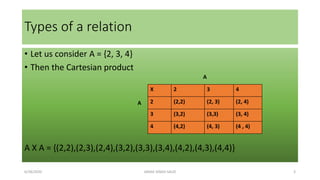
• Let us consider A = {2, 3, 4}
• Then the Cartesian product
A X A = {(2,2),(2,3),(2,4),(3,2),(3,3),(3,4),(4,2),(4,3),(4,4)}
A
A
X 2 3 4
2 (2,2) (2, 3) (2, 4)
3 (3,2) (3,3) (3, 4)
4 (4,2) (4, 3) (4 , 4)
6/28/2020 JANAK SINGH SAUD 3
(A) REFLEXIVE RELATION
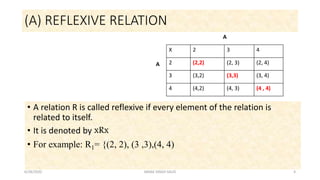
• A relation R is called reflexive if every element of the relation is
related to itself.
• It is denoted by xRx
• For example: R1= {(2, 2), (3 ,3),(4, 4)
A
A
X 2 3 4
2 (2,2) (2, 3) (2, 4)
3 (3,2) (3,3) (3, 4)
4 (4,2) (4, 3) (4 , 4)
6/28/2020 JANAK SINGH SAUD 4
(B) SYMMETIC RELATION
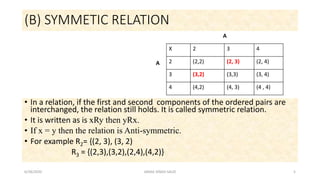
• In a relation, if the first and second components of the ordered pairs are
interchanged, the relation still holds. It is called symmetric relation.
• It is written as is xRy then yRx.
• If x = y then the relation is Anti-symmetric.
• For example R2= {(2, 3), (3, 2)
R3 = {(2,3),(3,2),(2,4),(4,2)}
A
A
X 2 3 4
2 (2,2) (2, 3) (2, 4)
3 (3,2) (3,3) (3, 4)
4 (4,2) (4, 3) (4 , 4)
6/28/2020 JANAK SINGH SAUD 5
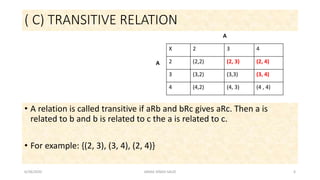
( C) TRANSITIVE RELATION
• A relation is called transitive if aRb and bRc gives aRc. Then a is
related to b and b is related to c the a is related to c.
• For example: {(2, 3), (3, 4), (2, 4)}
A
A
X 2 3 4
2 (2,2) (2, 3) (2, 4)
3 (3,2) (3,3) (3, 4)
4 (4,2) (4, 3) (4 , 4)
6/28/2020 JANAK SINGH SAUD 6
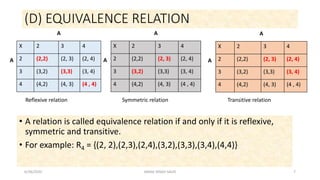
(D) EQUIVALENCE RELATION
• A relation is called equivalence relation if and only if it is reflexive,
symmetric and transitive.
• For example: R4 = {(2, 2),(2,3),(2,4),(3,2),(3,3),(3,4),(4,4)}
A
A
X 2 3 4
2 (2,2) (2, 3) (2, 4)
3 (3,2) (3,3) (3, 4)
4 (4,2) (4, 3) (4 , 4)
A
A
X 2 3 4
2 (2,2) (2, 3) (2, 4)
3 (3,2) (3,3) (3, 4)
4 (4,2) (4, 3) (4 , 4)
A
A
X 2 3 4
2 (2,2) (2, 3) (2, 4)
3 (3,2) (3,3) (3, 4)
4 (4,2) (4, 3) (4 , 4)
Reflexive relation Symmetric relation Transitive relation
6/28/2020 JANAK SINGH SAUD 7
Inverse Relation
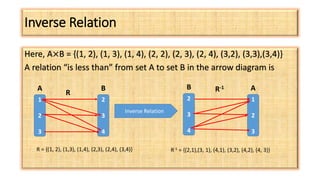
Here, A×B = {(1, 2), (1, 3), (1, 4), (2, 2), (2, 3), (2, 4), (3,2), (3,3),(3,4)}
A relation “is less than” from set A to set B in the arrow diagram is
1
2
3
A
2
3
4
B
R
2
3
4
B
1
2
3
A
Inverse Relation
R-1
R = {(1, 2), (1,3), (1,4), (2,3), (2,4), (3,4)} R-1 = {(2,1),(3, 1), (4,1), (3,2), (4,2), (4, 3)}
Inverse Relation
1
2
3
A
2
3
4
B
R
2
3
4
B
1
2
3
A
Inverse Relation
R-1
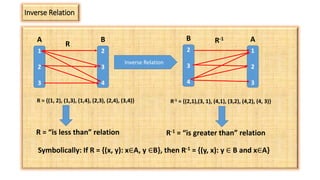
R = {(1, 2), (1,3), (1,4), (2,3), (2,4), (3,4)} R-1 = {(2,1),(3, 1), (4,1), (3,2), (4,2), (4, 3)}
R = “is less than” relation R-1 = “is greater than” relation
Symbolically: If R = {(x, y): x∈A, y ∈B}, then R-1 = {(y, x): y ∈ B and x∈A}
A relation is defined by R = {(x, y): 1< x < 4; y = 2x – 1}. Find the domain and range
of the function . Also find the inverse relation
• Domain x ∈ {2, 3}
• Range: when x = 2, y = 2x 2 – 1 = 3
• when x = 3, y = 2 x 3 – 1 = 5
• ∴Range = {3, 5]
• So, relation R = {(2, 3), (3, 5)}
Hence, Inverse relation R-1{(3, 2), (5, 3)}
https://www.youtube.com/channel/UCGxSYD_UZLzXfmAzxaRyYhw?vie
w_as=subscriber
https://www.facebook.com/janaksinghsaud
https://www.slideshare.net/janaksinghsaud
saudjanaksingh@gmail.com
6/28/2020 JANAK SINGH SAUD 11

Types of RELATIONS

  • 1.
    TYPES OF ARELATION
  • 2.
    Types of arelation • Reflexive Relation • Symmetric Relation • Transitive Relation • Equivalence Relation 6/28/2020 JANAK SINGH SAUD 2
  • 3.
    Types of arelation • Let us consider A = {2, 3, 4} • Then the Cartesian product A X A = {(2,2),(2,3),(2,4),(3,2),(3,3),(3,4),(4,2),(4,3),(4,4)} A A X 2 3 4 2 (2,2) (2, 3) (2, 4) 3 (3,2) (3,3) (3, 4) 4 (4,2) (4, 3) (4 , 4) 6/28/2020 JANAK SINGH SAUD 3
  • 4.
    (A) REFLEXIVE RELATION •A relation R is called reflexive if every element of the relation is related to itself. • It is denoted by xRx • For example: R1= {(2, 2), (3 ,3),(4, 4) A A X 2 3 4 2 (2,2) (2, 3) (2, 4) 3 (3,2) (3,3) (3, 4) 4 (4,2) (4, 3) (4 , 4) 6/28/2020 JANAK SINGH SAUD 4
  • 5.
    (B) SYMMETIC RELATION •In a relation, if the first and second components of the ordered pairs are interchanged, the relation still holds. It is called symmetric relation. • It is written as is xRy then yRx. • If x = y then the relation is Anti-symmetric. • For example R2= {(2, 3), (3, 2) R3 = {(2,3),(3,2),(2,4),(4,2)} A A X 2 3 4 2 (2,2) (2, 3) (2, 4) 3 (3,2) (3,3) (3, 4) 4 (4,2) (4, 3) (4 , 4) 6/28/2020 JANAK SINGH SAUD 5
  • 6.
    ( C) TRANSITIVERELATION • A relation is called transitive if aRb and bRc gives aRc. Then a is related to b and b is related to c the a is related to c. • For example: {(2, 3), (3, 4), (2, 4)} A A X 2 3 4 2 (2,2) (2, 3) (2, 4) 3 (3,2) (3,3) (3, 4) 4 (4,2) (4, 3) (4 , 4) 6/28/2020 JANAK SINGH SAUD 6
  • 7.
    (D) EQUIVALENCE RELATION •A relation is called equivalence relation if and only if it is reflexive, symmetric and transitive. • For example: R4 = {(2, 2),(2,3),(2,4),(3,2),(3,3),(3,4),(4,4)} A A X 2 3 4 2 (2,2) (2, 3) (2, 4) 3 (3,2) (3,3) (3, 4) 4 (4,2) (4, 3) (4 , 4) A A X 2 3 4 2 (2,2) (2, 3) (2, 4) 3 (3,2) (3,3) (3, 4) 4 (4,2) (4, 3) (4 , 4) A A X 2 3 4 2 (2,2) (2, 3) (2, 4) 3 (3,2) (3,3) (3, 4) 4 (4,2) (4, 3) (4 , 4) Reflexive relation Symmetric relation Transitive relation 6/28/2020 JANAK SINGH SAUD 7
  • 8.
    Inverse Relation Here, A×B= {(1, 2), (1, 3), (1, 4), (2, 2), (2, 3), (2, 4), (3,2), (3,3),(3,4)} A relation “is less than” from set A to set B in the arrow diagram is 1 2 3 A 2 3 4 B R 2 3 4 B 1 2 3 A Inverse Relation R-1 R = {(1, 2), (1,3), (1,4), (2,3), (2,4), (3,4)} R-1 = {(2,1),(3, 1), (4,1), (3,2), (4,2), (4, 3)}
  • 9.
    Inverse Relation 1 2 3 A 2 3 4 B R 2 3 4 B 1 2 3 A Inverse Relation R-1 R= {(1, 2), (1,3), (1,4), (2,3), (2,4), (3,4)} R-1 = {(2,1),(3, 1), (4,1), (3,2), (4,2), (4, 3)} R = “is less than” relation R-1 = “is greater than” relation Symbolically: If R = {(x, y): x∈A, y ∈B}, then R-1 = {(y, x): y ∈ B and x∈A}
  • 10.
    A relation isdefined by R = {(x, y): 1< x < 4; y = 2x – 1}. Find the domain and range of the function . Also find the inverse relation • Domain x ∈ {2, 3} • Range: when x = 2, y = 2x 2 – 1 = 3 • when x = 3, y = 2 x 3 – 1 = 5 • ∴Range = {3, 5] • So, relation R = {(2, 3), (3, 5)} Hence, Inverse relation R-1{(3, 2), (5, 3)}
  • 11.