Chapter 11: Sequences, Series, and Power Series
Section 11.4: Comparison Tests
Alea Wittig
SUNY Albany
Outline
The Direct Comparison Test
The Limit Comparison Test
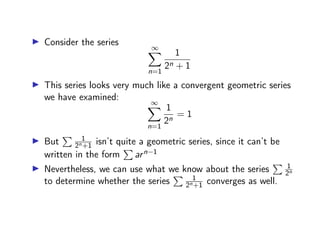
▶ Consider the series
∞
X
n=1
1
2n + 1
▶ This series looks very much like a convergent geometric series
we have examined:
∞
X
n=1
1
2n
= 1
▶ But
P 1
2n+1 isn’t quite a geometric series, since it can’t be
written in the form
P
arn−1
▶ Nevertheless, we can use what we know about the series
P 1
2n
to determine whether the series
P 1
2n+1 converges as well.
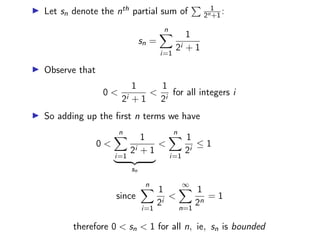
▶ Let sn denote the nth partial sum of
P 1
2n+1:
sn =
n
X
i=1
1
2i + 1
▶ Observe that
0 <
1
2i + 1
<
1
2i
for all integers i
▶ So adding up the first n terms we have
0 <
n
X
i=1
1
2i + 1
| {z }
sn
<
n
X
i=1
1
2i
≤ 1
since
n
X
i=1
1
2i
<
∞
X
n=1
1
2n
= 1
therefore 0 < sn < 1 for all n, ie, sn is bounded
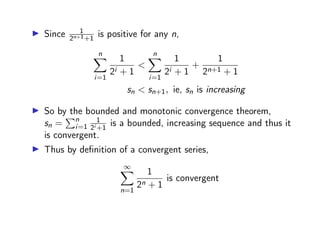
▶ Since 1
2n+1+1
is positive for any n,
n
X
i=1
1
2i + 1
<
n
X
i=1
1
2i + 1
+
1
2n+1 + 1
sn < sn+1, ie, sn is increasing
▶ So by the bounded and monotonic convergence theorem,
sn =
Pn
i=1
1
2i +1
is a bounded, increasing sequence and thus it
is convergent.
▶ Thus by definition of a convergent series,
∞
X
n=1
1
2n + 1
is convergent
The Direct Comparison Test
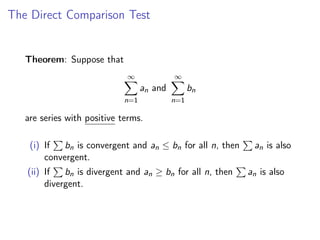
Theorem: Suppose that
∞
X
n=1
an and
∞
X
n=1
bn
are series with positive terms.
(i) If
P
bn is convergent and an ≤ bn for all n, then
P
an is also
convergent.
(ii) If
P
bn is divergent and an ≥ bn for all n, then
P
an is also
divergent.
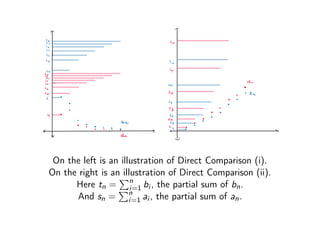
On the left is an illustration of Direct Comparison (i).
On the right is an illustration of Direct Comparison (ii).
Here tn =
Pn
i=1 bi , the partial sum of bn.
And sn =
Pn
i=1 ai , the partial sum of an.
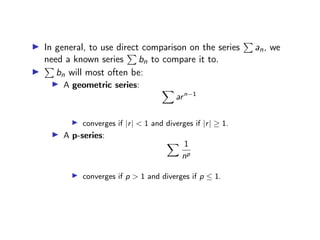
▶ In general, to use direct comparison on the series
P
an, we
need a known series
P
bn to compare it to.
▶
P
bn will most often be:
▶ A geometric series: X
arn−1
▶ converges if |r| < 1 and diverges if |r| ≥ 1.
▶ A p-series:
X 1
np
▶ converges if p > 1 and diverges if p ≤ 1.
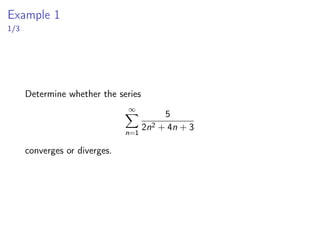
Example 1
1/3
Determine whether the series
∞
X
n=1
5
2n2 + 4n + 3
converges or diverges.
Example 1
2/3
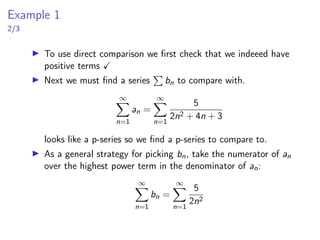
▶ To use direct comparison we first check that we indeeed have
positive terms ✓
▶ Next we must find a series
P
bn to compare with.
∞
X
n=1
an =
∞
X
n=1
5
2n2 + 4n + 3
looks like a p-series so we find a p-series to compare to.
▶ As a general strategy for picking bn, take the numerator of an
over the highest power term in the denominator of an:
∞
X
n=1
bn =
∞
X
n=1
5
2n2
Example 1
3/3
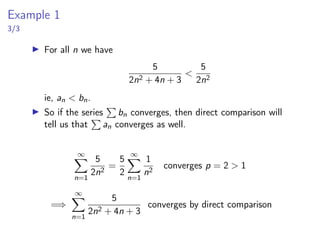
▶ For all n we have
5
2n2 + 4n + 3
<
5
2n2
ie, an < bn.
▶ So if the series
P
bn converges, then direct comparison will
tell us that
P
an converges as well.
∞
X
n=1
5
2n2
=
5
2
∞
X
n=1
1
n2
converges p = 2 > 1
=⇒
∞
X
n=1
5
2n2 + 4n + 3
converges by direct comparison
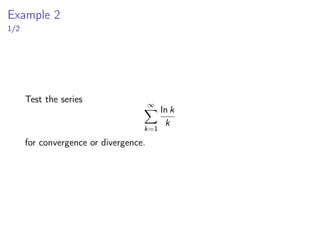
Example 2
1/2
Test the series
∞
X
k=1
ln k
k
for convergence or divergence.
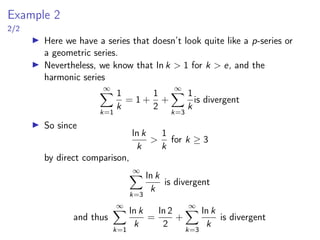
Example 2
2/2
▶ Here we have a series that doesn’t look quite like a p-series or
a geometric series.
▶ Nevertheless, we know that ln k > 1 for k > e, and the
harmonic series
∞
X
k=1
1
k
= 1 +
1
2
+
∞
X
k=3
1
k
is divergent
▶ So since
ln k
k
>
1
k
for k ≥ 3
by direct comparison,
∞
X
k=3
ln k
k
is divergent
and thus
∞
X
k=1
ln k
k
=
ln 2
2
+
∞
X
k=3
ln k
k
is divergent
The Limit Comparison Test
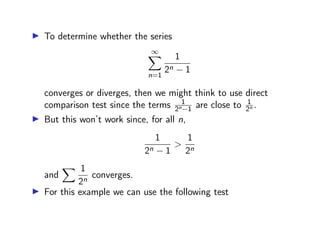
▶ To determine whether the series
∞
X
n=1
1
2n − 1
converges or diverges, then we might think to use direct
comparison test since the terms 1
2n−1 are close to 1
2n .
▶ But this won’t work since, for all n,
1
2n − 1
>
1
2n
and
X 1
2n
converges.
▶ For this example we can use the following test
The Limit Comparison Test
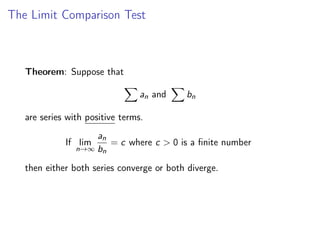
Theorem: Suppose that
X
an and
X
bn
are series with positive terms.
If lim
n→∞
an
bn
= c where c > 0 is a finite number
then either both series converge or both diverge.
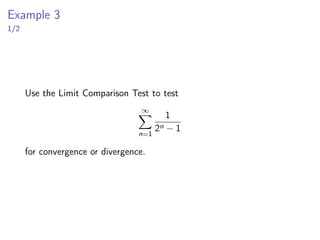
Example 3
1/2
Use the Limit Comparison Test to test
∞
X
n=1
1
2n − 1
for convergence or divergence.
Example 3
2/2
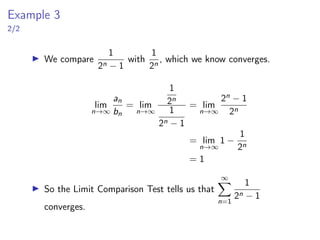
▶ We compare
1
2n − 1
with
1
2n
, which we know converges.
lim
n→∞
an
bn
= lim
n→∞
1
2n
1
2n − 1
= lim
n→∞
2n − 1
2n
= lim
n→∞
1 −
1
2n
= 1
▶ So the Limit Comparison Test tells us that
∞
X
n=1
1
2n − 1
converges.
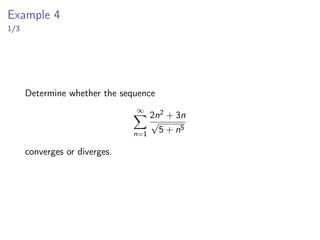
Example 4
1/3
Determine whether the sequence
∞
X
n=1
2n2 + 3n
√
5 + n5
converges or diverges.
Example 4
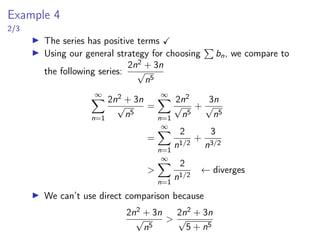
2/3
▶ The series has positive terms ✓
▶ Using our general strategy for choosing
P
bn, we compare to
the following series:
2n2 + 3n
√
n5
∞
X
n=1
2n2 + 3n
√
n5
=
∞
X
n=1
2n2
√
n5
+
3n
√
n5
=
∞
X
n=1
2
n1/2
+
3
n3/2
>
∞
X
n=1
2
n1/2
← diverges
▶ We can’t use direct comparison because
2n2 + 3n
√
n5
>
2n2 + 3n
√
5 + n5
Example 4
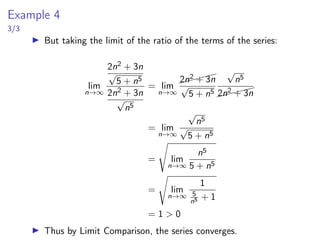
3/3
▶ But taking the limit of the ratio of the terms of the series:
lim
n→∞
2n2 + 3n
√
5 + n5
2n2 + 3n
√
n5
= lim
n→∞


2n2 + 3n
√
5 + n5
√
n5


2n2 + 3n
= lim
n→∞
√
n5
√
5 + n5
=
s
lim
n→∞
n5
5 + n5
=
s
lim
n→∞
1
5
n5 + 1
= 1  0
▶ Thus by Limit Comparison, the series converges.

Section 11.4

  • 1.
    Chapter 11: Sequences,Series, and Power Series Section 11.4: Comparison Tests Alea Wittig SUNY Albany
  • 2.
    Outline The Direct ComparisonTest The Limit Comparison Test
  • 3.
    ▶ Consider theseries ∞ X n=1 1 2n + 1 ▶ This series looks very much like a convergent geometric series we have examined: ∞ X n=1 1 2n = 1 ▶ But P 1 2n+1 isn’t quite a geometric series, since it can’t be written in the form P arn−1 ▶ Nevertheless, we can use what we know about the series P 1 2n to determine whether the series P 1 2n+1 converges as well.
  • 4.
    ▶ Let sndenote the nth partial sum of P 1 2n+1: sn = n X i=1 1 2i + 1 ▶ Observe that 0 < 1 2i + 1 < 1 2i for all integers i ▶ So adding up the first n terms we have 0 < n X i=1 1 2i + 1 | {z } sn < n X i=1 1 2i ≤ 1 since n X i=1 1 2i < ∞ X n=1 1 2n = 1 therefore 0 < sn < 1 for all n, ie, sn is bounded
  • 5.
    ▶ Since 1 2n+1+1 ispositive for any n, n X i=1 1 2i + 1 < n X i=1 1 2i + 1 + 1 2n+1 + 1 sn < sn+1, ie, sn is increasing ▶ So by the bounded and monotonic convergence theorem, sn = Pn i=1 1 2i +1 is a bounded, increasing sequence and thus it is convergent. ▶ Thus by definition of a convergent series, ∞ X n=1 1 2n + 1 is convergent
  • 6.
  • 7.
    The Direct ComparisonTest Theorem: Suppose that ∞ X n=1 an and ∞ X n=1 bn are series with positive terms. (i) If P bn is convergent and an ≤ bn for all n, then P an is also convergent. (ii) If P bn is divergent and an ≥ bn for all n, then P an is also divergent.
  • 8.
    On the leftis an illustration of Direct Comparison (i). On the right is an illustration of Direct Comparison (ii). Here tn = Pn i=1 bi , the partial sum of bn. And sn = Pn i=1 ai , the partial sum of an.
  • 9.
    ▶ In general,to use direct comparison on the series P an, we need a known series P bn to compare it to. ▶ P bn will most often be: ▶ A geometric series: X arn−1 ▶ converges if |r| < 1 and diverges if |r| ≥ 1. ▶ A p-series: X 1 np ▶ converges if p > 1 and diverges if p ≤ 1.
  • 10.
    Example 1 1/3 Determine whetherthe series ∞ X n=1 5 2n2 + 4n + 3 converges or diverges.
  • 11.
    Example 1 2/3 ▶ Touse direct comparison we first check that we indeeed have positive terms ✓ ▶ Next we must find a series P bn to compare with. ∞ X n=1 an = ∞ X n=1 5 2n2 + 4n + 3 looks like a p-series so we find a p-series to compare to. ▶ As a general strategy for picking bn, take the numerator of an over the highest power term in the denominator of an: ∞ X n=1 bn = ∞ X n=1 5 2n2
  • 12.
    Example 1 3/3 ▶ Forall n we have 5 2n2 + 4n + 3 < 5 2n2 ie, an < bn. ▶ So if the series P bn converges, then direct comparison will tell us that P an converges as well. ∞ X n=1 5 2n2 = 5 2 ∞ X n=1 1 n2 converges p = 2 > 1 =⇒ ∞ X n=1 5 2n2 + 4n + 3 converges by direct comparison
  • 13.
    Example 2 1/2 Test theseries ∞ X k=1 ln k k for convergence or divergence.
  • 14.
    Example 2 2/2 ▶ Herewe have a series that doesn’t look quite like a p-series or a geometric series. ▶ Nevertheless, we know that ln k > 1 for k > e, and the harmonic series ∞ X k=1 1 k = 1 + 1 2 + ∞ X k=3 1 k is divergent ▶ So since ln k k > 1 k for k ≥ 3 by direct comparison, ∞ X k=3 ln k k is divergent and thus ∞ X k=1 ln k k = ln 2 2 + ∞ X k=3 ln k k is divergent
  • 15.
  • 16.
    ▶ To determinewhether the series ∞ X n=1 1 2n − 1 converges or diverges, then we might think to use direct comparison test since the terms 1 2n−1 are close to 1 2n . ▶ But this won’t work since, for all n, 1 2n − 1 > 1 2n and X 1 2n converges. ▶ For this example we can use the following test
  • 17.
    The Limit ComparisonTest Theorem: Suppose that X an and X bn are series with positive terms. If lim n→∞ an bn = c where c > 0 is a finite number then either both series converge or both diverge.
  • 18.
    Example 3 1/2 Use theLimit Comparison Test to test ∞ X n=1 1 2n − 1 for convergence or divergence.
  • 19.
    Example 3 2/2 ▶ Wecompare 1 2n − 1 with 1 2n , which we know converges. lim n→∞ an bn = lim n→∞ 1 2n 1 2n − 1 = lim n→∞ 2n − 1 2n = lim n→∞ 1 − 1 2n = 1 ▶ So the Limit Comparison Test tells us that ∞ X n=1 1 2n − 1 converges.
  • 20.
    Example 4 1/3 Determine whetherthe sequence ∞ X n=1 2n2 + 3n √ 5 + n5 converges or diverges.
  • 21.
    Example 4 2/3 ▶ Theseries has positive terms ✓ ▶ Using our general strategy for choosing P bn, we compare to the following series: 2n2 + 3n √ n5 ∞ X n=1 2n2 + 3n √ n5 = ∞ X n=1 2n2 √ n5 + 3n √ n5 = ∞ X n=1 2 n1/2 + 3 n3/2 > ∞ X n=1 2 n1/2 ← diverges ▶ We can’t use direct comparison because 2n2 + 3n √ n5 > 2n2 + 3n √ 5 + n5
  • 22.
    Example 4 3/3 ▶ Buttaking the limit of the ratio of the terms of the series: lim n→∞ 2n2 + 3n √ 5 + n5 2n2 + 3n √ n5 = lim n→∞ 2n2 + 3n √ 5 + n5 √ n5 2n2 + 3n = lim n→∞ √ n5 √ 5 + n5 = s lim n→∞ n5 5 + n5 = s lim n→∞ 1 5 n5 + 1 = 1 0 ▶ Thus by Limit Comparison, the series converges.