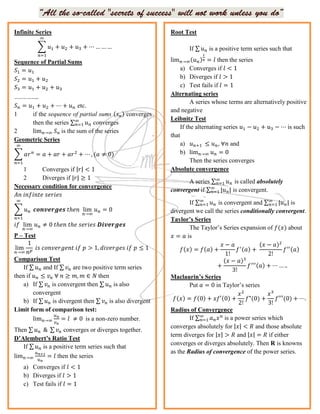
Infinite Series
∑ 𝑢1 + 𝑢2 + 𝑢3 + ⋯ … … …
∞
𝑛=1
Sequence of Partial Sums
𝑆1 = 𝑢1
𝑆2 = 𝑢1 + 𝑢2
𝑆3 = 𝑢1 + 𝑢2 + 𝑢3
……………..
𝑆 𝑛 = 𝑢1 + 𝑢2 + ⋯ + 𝑢 𝑛 etc.
1 if the sequence of partial sums (𝑠 𝑛) converges
then the series ∑ 𝑢 𝑛
∞
𝑛=1 converges
2 lim 𝑛→∞ 𝑆 𝑛 is the sum of the series
Geometric Series
∑ 𝑎𝑟 𝑛
∞
𝑛=1
= 𝑎 + 𝑎𝑟 + 𝑎𝑟2
+ ⋯ , (𝑎 ≠ 0)
1 Converges if |𝑟| < 1
2 Diverges if |𝑟| ≥ 1
Necessary condition for convergence
𝐴𝑛 𝑖𝑛𝑓𝑖𝑛𝑡𝑒 𝑠𝑒𝑟𝑖𝑒𝑠
∑ 𝑢 𝑛
∞
𝑛=1
𝒄𝒐𝒏𝒗𝒆𝒓𝒈𝒆𝒔 𝑡ℎ𝑒𝑛 lim
𝑛→∞
𝑢 𝑛 = 0
𝑖𝑓 lim
𝑛→∞
𝑢 𝑛 ≠ 0 𝑡ℎ𝑒𝑛 𝑡ℎ𝑒 𝑠𝑒𝑟𝑖𝑒𝑠 𝑫𝒊𝒗𝒆𝒓𝒈𝒆𝒔
P – Test
lim
𝑛→∞
1
𝑛 𝑝
𝑖𝑠 𝑐𝑜𝑛𝑣𝑒𝑟𝑔𝑒𝑛𝑡 𝑖𝑓 𝑝 > 1, 𝑑𝑖𝑣𝑒𝑟𝑔𝑒𝑠 𝑖𝑓 𝑝 ≤ 1
Comparison Test
If ∑ 𝑢 𝑛 and If ∑ 𝑣 𝑛 are two positive term series
then if 𝑢 𝑛 ≤ 𝑣 𝑛 ∀ 𝑛 ≥ 𝑚, 𝑚 ∈ 𝑁 then
a) If ∑ 𝑣 𝑛 is convergent then ∑ 𝑢 𝑛 is also
convergent
b) If ∑ 𝑢 𝑛 is divergent then ∑ 𝑣 𝑛 is also divergent
Limit form of comparison test:
lim 𝑛→∞
𝑢 𝑛
𝑣 𝑛
= 𝑙 ≠ 0 is a non-zero number.
Then ∑ 𝑢 𝑛 & ∑ 𝑣 𝑛 converges or diverges together.
D’Alembert’s Ratio Test
If ∑ 𝑢 𝑛 is a positive term series such that
lim 𝑛→∞
𝑢 𝑛+1
𝑢 𝑛
= 𝑙 then the series
a) Converges if 𝑙 < 1
b) Diverges if 𝑙 > 1
c) Test fails if 𝑙 = 1
Root Test
If ∑ 𝑢 𝑛 is a positive term series such that
lim 𝑛→∞(𝑢 𝑛)
1
𝑛 = 𝑙 then the series
a) Converges if 𝑙 < 1
b) Diverges if 𝑙 > 1
c) Test fails if 𝑙 = 1
Alternating series
A series whose terms are alternatively positive
and negative
Leibnitz Test
If the alternating series 𝑢1 − 𝑢2 + 𝑢3 − ⋯ is such
that
a) 𝑢 𝑛+1 ≤ 𝑢 𝑛, ∀𝑛 and
b) lim 𝑛→∞ 𝑢 𝑛 = 0
Then the series converges
Absolute convergence
A series ∑ 𝑢 𝑛
∞
𝑛=1 is called absolutely
convergent if ∑ |𝑢 𝑛|∞
𝑛=1 is convergent.
If ∑ 𝑢 𝑛
∞
𝑛=1 is convergent and ∑ |𝑢 𝑛|∞
𝑛=1 is
divergent we call the series conditionally convergent.
Taylor’s Series
The Taylor’s Series expansion of 𝑓(𝑥) about
𝑥 = 𝑎 is
𝑓(𝑥) = 𝑓(𝑎) +
𝑥 − 𝑎
1!
𝑓′(𝑎) +
(𝑥 − 𝑎)2
2!
𝑓′′(𝑎)
+
(𝑥 − 𝑎)3
3!
𝑓′′′(𝑎) + ⋯ … ..
Maclaurin’s Series
Put 𝑎 = 0 in Taylor’s series
𝑓(𝑥) = 𝑓(0) + 𝑥𝑓′(0) +
𝑥2
2!
𝑓"(0) +
𝑥3
3!
𝑓′′′(0) + ⋯.
Radius of Convergence
If ∑ 𝑎 𝑛 𝑥 𝑛∞
𝑛=1 is a power series which
converges absolutely for |𝑥| < 𝑅 and those absolute
term diverges for |𝑥| > 𝑅 and |𝑥| = 𝑅 if either
converges or diverges absolutely. Then R is knowns
as the Radius of convergence of the power series.

Ktu - s1 me module 1 (Calculus Module 1)

  • 1.
    Infinite Series ∑ 𝑢1+ 𝑢2 + 𝑢3 + ⋯ … … … ∞ 𝑛=1 Sequence of Partial Sums 𝑆1 = 𝑢1 𝑆2 = 𝑢1 + 𝑢2 𝑆3 = 𝑢1 + 𝑢2 + 𝑢3 …………….. 𝑆 𝑛 = 𝑢1 + 𝑢2 + ⋯ + 𝑢 𝑛 etc. 1 if the sequence of partial sums (𝑠 𝑛) converges then the series ∑ 𝑢 𝑛 ∞ 𝑛=1 converges 2 lim 𝑛→∞ 𝑆 𝑛 is the sum of the series Geometric Series ∑ 𝑎𝑟 𝑛 ∞ 𝑛=1 = 𝑎 + 𝑎𝑟 + 𝑎𝑟2 + ⋯ , (𝑎 ≠ 0) 1 Converges if |𝑟| < 1 2 Diverges if |𝑟| ≥ 1 Necessary condition for convergence 𝐴𝑛 𝑖𝑛𝑓𝑖𝑛𝑡𝑒 𝑠𝑒𝑟𝑖𝑒𝑠 ∑ 𝑢 𝑛 ∞ 𝑛=1 𝒄𝒐𝒏𝒗𝒆𝒓𝒈𝒆𝒔 𝑡ℎ𝑒𝑛 lim 𝑛→∞ 𝑢 𝑛 = 0 𝑖𝑓 lim 𝑛→∞ 𝑢 𝑛 ≠ 0 𝑡ℎ𝑒𝑛 𝑡ℎ𝑒 𝑠𝑒𝑟𝑖𝑒𝑠 𝑫𝒊𝒗𝒆𝒓𝒈𝒆𝒔 P – Test lim 𝑛→∞ 1 𝑛 𝑝 𝑖𝑠 𝑐𝑜𝑛𝑣𝑒𝑟𝑔𝑒𝑛𝑡 𝑖𝑓 𝑝 > 1, 𝑑𝑖𝑣𝑒𝑟𝑔𝑒𝑠 𝑖𝑓 𝑝 ≤ 1 Comparison Test If ∑ 𝑢 𝑛 and If ∑ 𝑣 𝑛 are two positive term series then if 𝑢 𝑛 ≤ 𝑣 𝑛 ∀ 𝑛 ≥ 𝑚, 𝑚 ∈ 𝑁 then a) If ∑ 𝑣 𝑛 is convergent then ∑ 𝑢 𝑛 is also convergent b) If ∑ 𝑢 𝑛 is divergent then ∑ 𝑣 𝑛 is also divergent Limit form of comparison test: lim 𝑛→∞ 𝑢 𝑛 𝑣 𝑛 = 𝑙 ≠ 0 is a non-zero number. Then ∑ 𝑢 𝑛 & ∑ 𝑣 𝑛 converges or diverges together. D’Alembert’s Ratio Test If ∑ 𝑢 𝑛 is a positive term series such that lim 𝑛→∞ 𝑢 𝑛+1 𝑢 𝑛 = 𝑙 then the series a) Converges if 𝑙 < 1 b) Diverges if 𝑙 > 1 c) Test fails if 𝑙 = 1 Root Test If ∑ 𝑢 𝑛 is a positive term series such that lim 𝑛→∞(𝑢 𝑛) 1 𝑛 = 𝑙 then the series a) Converges if 𝑙 < 1 b) Diverges if 𝑙 > 1 c) Test fails if 𝑙 = 1 Alternating series A series whose terms are alternatively positive and negative Leibnitz Test If the alternating series 𝑢1 − 𝑢2 + 𝑢3 − ⋯ is such that a) 𝑢 𝑛+1 ≤ 𝑢 𝑛, ∀𝑛 and b) lim 𝑛→∞ 𝑢 𝑛 = 0 Then the series converges Absolute convergence A series ∑ 𝑢 𝑛 ∞ 𝑛=1 is called absolutely convergent if ∑ |𝑢 𝑛|∞ 𝑛=1 is convergent. If ∑ 𝑢 𝑛 ∞ 𝑛=1 is convergent and ∑ |𝑢 𝑛|∞ 𝑛=1 is divergent we call the series conditionally convergent. Taylor’s Series The Taylor’s Series expansion of 𝑓(𝑥) about 𝑥 = 𝑎 is 𝑓(𝑥) = 𝑓(𝑎) + 𝑥 − 𝑎 1! 𝑓′(𝑎) + (𝑥 − 𝑎)2 2! 𝑓′′(𝑎) + (𝑥 − 𝑎)3 3! 𝑓′′′(𝑎) + ⋯ … .. Maclaurin’s Series Put 𝑎 = 0 in Taylor’s series 𝑓(𝑥) = 𝑓(0) + 𝑥𝑓′(0) + 𝑥2 2! 𝑓"(0) + 𝑥3 3! 𝑓′′′(0) + ⋯. Radius of Convergence If ∑ 𝑎 𝑛 𝑥 𝑛∞ 𝑛=1 is a power series which converges absolutely for |𝑥| < 𝑅 and those absolute term diverges for |𝑥| > 𝑅 and |𝑥| = 𝑅 if either converges or diverges absolutely. Then R is knowns as the Radius of convergence of the power series.