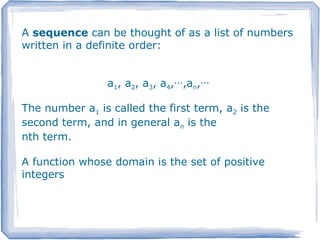
A sequence can be thought of as a list of numbers
written in a definite order:
The number a1 is called the first term, a2 is the
second term, and in general an is the
nth term.
A function whose domain is the set of positive
integers
a1, a2, a3, a4, ,a‧‧‧ n,‧‧‧
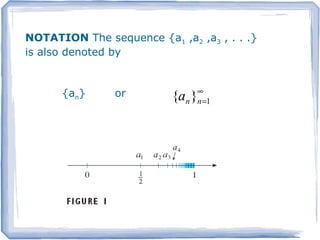
NOTATION The sequence {a1 ,a2 ,a3 , . . .}
is also denoted by
{an} or ∞
=1}{ nna
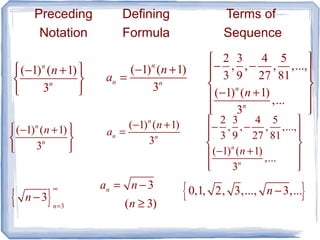
In the following examples, we give three
descriptions of the sequence:
1. Using the preceding notation
2. Using the defining formula
3. Writing out the terms of the sequence
Example 1
Preceding
Notation
Defining
Formula
Terms of
Sequence
( 1) ( 1)
3
n
n
n − +
 
 
( 1) ( 1)
3
n
n n
n
a
− +
=
2 3 4 5
, , , ,...,
3 9 27 81
( 1) ( 1)
,...
3
n
n
n
 
− −  
 
− + 
  
( 1) ( 1)
3
n
n n
n
a
− +
=( 1) ( 1)
3
n
n
n − +
 
 
2 3 4 5
, , , ,...,
3 9 27 81
( 1) ( 1)
,...
3
n
n
n
 
− −  
 
− + 
  
{ } 3
3
n
n
∞
=
−
3
( 3)
na n
n
= −
≥
{ }0,1, 2, 3,..., 3,...n −
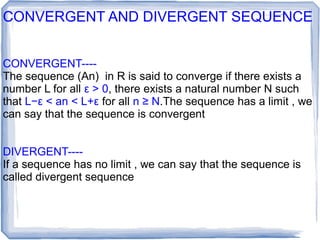
CONVERGENT AND DIVERGENT SEQUENCE
CONVERGENT----
The sequence (An) in R is said to converge if there exists a
number L for all ε > 0, there exists a natural number N such
that L−ε < an < L+ε for all n ≥ N.The sequence has a limit , we
can say that the sequence is convergent
DIVERGENT----
If a sequence has no limit , we can say that the sequence is
called divergent sequence
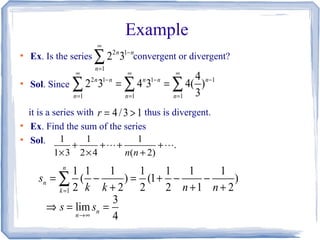
Example
●
Ex. Is the series convergent or divergent?
●
Sol. Since
it is a series with thus is divergent.
●
Ex. Find the sum of the series
●
Sol.
2 1
1
2 3n n
n
∞
−
=
∑
4/3 1r = >
2 1 1 1
1 1 1
4
2 3 4 3 4( )
3
n n n n n
n n n
∞ ∞ ∞
− − −
= = =
= =∑ ∑ ∑
1 1 1
.
1 3 2 4 ( 2)n n
+ + + +
× × +
L L
1
1 1 1 1 1 1 1
( ) (1 )
2 2 2 2 1 2
n
n
k
s
k k n n=
= − = + − −
+ + +
∑
3
lim
4
n
n
s s
→∞
⇒ = =
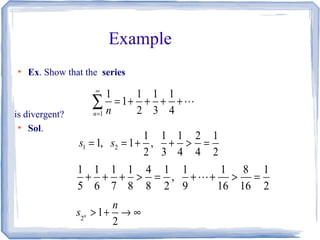
Example
●
Ex. Show that the series
is divergent?
●
Sol.
1
1 1 1 1
1
2 3 4n n
∞
=
= + + + +∑ L
1 2
1 1 1 2 1
1, 1 ,
2 3 4 4 2
s s= = + + > =
1 1 1 1 4 1 1 1 8 1
,
5 6 7 8 8 2 9 16 16 2
+ + + > = + + > =L
2
1
2
n
n
s > + → ∞
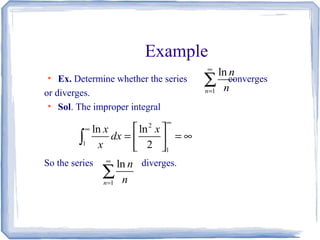
Example
●
Ex. Determine whether the series converges
or diverges.
●
Sol. The improper integral
So the series diverges.
2
1
1
ln ln
2
x x
dx
x
∞
∞  
= = ∞ 
 
∫
1
ln
n
n
n
∞
=
∑
1
ln
n
n
n
∞
=
∑
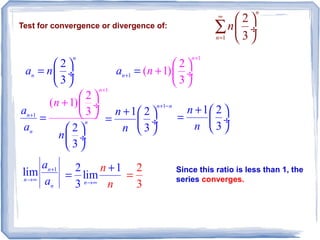
Test for convergence or divergence of:
2
3
n
na n
 
=  ÷
 
1
2
3
n
n
n
∞
=
 
 ÷
 
∑
1
1
2
( 1)
3
n
n
na
+
+
 
+  ÷
 
=
1
1
2
( 1)
2
3
3
n
n
n
n
n
a
a
n
+
+
 
+ 
=
 
 ÷

÷
 

1
1 2
3
n n
n
n
+ −
+  
=  ÷
 
1 2
3
n
n
+  
=  ÷
 
1
lim n
n
n
a
a
+
→∞
2 1
lim
3 n
n
n→∞
+
=
2
3
=
Since this ratio is less than 1, the
series converges.
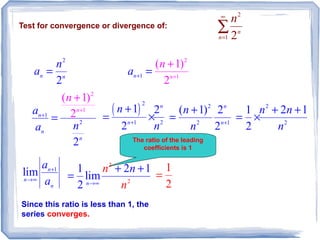
Test for convergence or divergence of:
2
2
n n
n
a =
2
11
( 1)
2nn
n
a ++
+
=
2
2
1
1
( 1)
2
2
n
n
n
n
na
n
a +
+
+
=
( )
2
1 2
1 2
2
n
n
n
n+
+
= ×
2
2 1
( 1) 2
2
n
n
n
n +
+
=
1
lim n
n
n
a
a
+
→∞
Since this ratio is less than 1, the
series converges.
2
1 2n
n
n∞
=
∑
2
2
1 2 1
2
n n
n
+ +
= ×
2
2
1 2 1
lim
2 n
n
n
n
→∞
+ +
=
The ratio of the leading
coefficients is 1
1
2
=
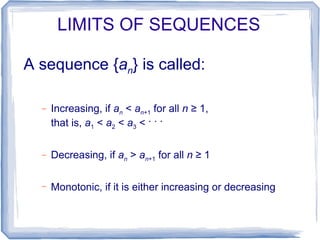
LIMITS OF SEQUENCES
A sequence {an} is called:
– Increasing, if an < an+1 for all n ≥ 1,
that is, a1 < a2 < a3 < · · ·
– Decreasing, if an > an+1 for all n ≥ 1
– Monotonic, if it is either increasing or decreasing
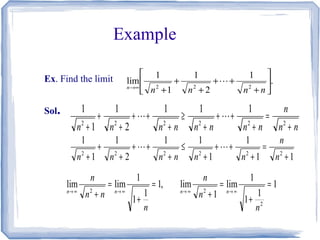
Example
Ex. Find the limit
Sol.
.
1
2
1
1
1
lim
222






+
++
+
+
+∞→
nnnnn
L
nn
n
nnnnnnnn +
=
+
++
+
≥
+
++
+
+
+ 222222
111
2
1
1
1
LL
11
1
1
11
2
1
1
1
222222
+
=
+
++
+
≤
+
++
+
+
+ n
n
nnnnnn
LL
1
1
1
1
lim
1
lim,1
1
1
1
limlim
2
22
=
+
=
+
=
+
=
+ ∞→∞→∞→∞→
n
n
n
n
nn
n
nnnn
SEQUENCES
SEQUENCES
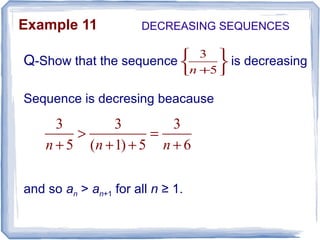
DECREASING SEQUENCES
Q-Show that the sequence is decreasing
Sequence is decresing beacause
and so an > an+1 for all n ≥ 1.
Example 11
3
5n
 
 
+ 
3 3 3
5 ( 1) 5 6n n n
> =
+ + + +
Q-Show that the sequence is decreasing.
2
1
n
n
a
n
=
+
2 2
1
( 1) 1 1
n n
n n
+
<
+ + +
We must show that an+1 < an,
that is,
The inequality is equivalent to the one we get by
cross-multiplication:
2 2
2 2
3 2 3 2
2
1
( 1)( 1) [( 1) 1]
( 1) 1 1
1 2 2
1
n n
n n n n
n n
n n n n n n
n n
+
< ⇔ + + < + +
+ + +
⇔ + + + < + +
⇔ < +
BOUNDED SEQUENCES
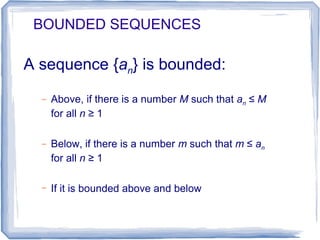
A sequence {an} is bounded:
– Above, if there is a number M such that an ≤ M
for all n ≥ 1
– Below, if there is a number m such that m ≤ an
for all n ≥ 1
– If it is bounded above and below
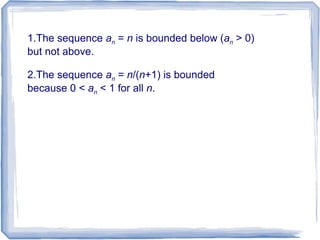
1.The sequence an = n is bounded below (an > 0)
but not above.
2.The sequence an = n/(n+1) is bounded
because 0 < an < 1 for all n.
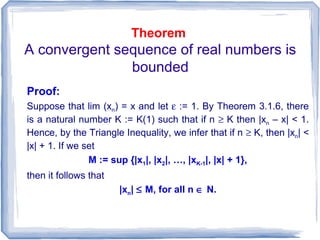
Theorem
A convergent sequence of real numbers is
bounded
Proof:
Suppose that lim (xn) = x and let ε := 1. By Theorem 3.1.6, there
is a natural number K := K(1) such that if n ≥ K then |xn – x| < 1.
Hence, by the Triangle Inequality, we infer that if n ≥ K, then |xn| <
|x| + 1. If we set
M := sup {|x1|, |x2|, …, |xK-1|, |x| + 1},
then it follows that
|xn| ≤ M, for all n ∈ N.

Analysis sequences and bounded sequences

  • 1.
    A sequence canbe thought of as a list of numbers written in a definite order: The number a1 is called the first term, a2 is the second term, and in general an is the nth term. A function whose domain is the set of positive integers a1, a2, a3, a4, ,a‧‧‧ n,‧‧‧
  • 2.
    NOTATION The sequence{a1 ,a2 ,a3 , . . .} is also denoted by {an} or ∞ =1}{ nna
  • 3.
    In the followingexamples, we give three descriptions of the sequence: 1. Using the preceding notation 2. Using the defining formula 3. Writing out the terms of the sequence Example 1
  • 4.
    Preceding Notation Defining Formula Terms of Sequence ( 1)( 1) 3 n n n − +     ( 1) ( 1) 3 n n n n a − + = 2 3 4 5 , , , ,..., 3 9 27 81 ( 1) ( 1) ,... 3 n n n   − −     − +     ( 1) ( 1) 3 n n n n a − + =( 1) ( 1) 3 n n n − +     2 3 4 5 , , , ,..., 3 9 27 81 ( 1) ( 1) ,... 3 n n n   − −     − +     { } 3 3 n n ∞ = − 3 ( 3) na n n = − ≥ { }0,1, 2, 3,..., 3,...n −
  • 5.
    CONVERGENT AND DIVERGENTSEQUENCE CONVERGENT---- The sequence (An) in R is said to converge if there exists a number L for all ε > 0, there exists a natural number N such that L−ε < an < L+ε for all n ≥ N.The sequence has a limit , we can say that the sequence is convergent DIVERGENT---- If a sequence has no limit , we can say that the sequence is called divergent sequence
  • 6.
    Example ● Ex. Is theseries convergent or divergent? ● Sol. Since it is a series with thus is divergent. ● Ex. Find the sum of the series ● Sol. 2 1 1 2 3n n n ∞ − = ∑ 4/3 1r = > 2 1 1 1 1 1 1 4 2 3 4 3 4( ) 3 n n n n n n n n ∞ ∞ ∞ − − − = = = = =∑ ∑ ∑ 1 1 1 . 1 3 2 4 ( 2)n n + + + + × × + L L 1 1 1 1 1 1 1 1 ( ) (1 ) 2 2 2 2 1 2 n n k s k k n n= = − = + − − + + + ∑ 3 lim 4 n n s s →∞ ⇒ = =
  • 7.
    Example ● Ex. Show thatthe series is divergent? ● Sol. 1 1 1 1 1 1 2 3 4n n ∞ = = + + + +∑ L 1 2 1 1 1 2 1 1, 1 , 2 3 4 4 2 s s= = + + > = 1 1 1 1 4 1 1 1 8 1 , 5 6 7 8 8 2 9 16 16 2 + + + > = + + > =L 2 1 2 n n s > + → ∞
  • 8.
    Example ● Ex. Determine whetherthe series converges or diverges. ● Sol. The improper integral So the series diverges. 2 1 1 ln ln 2 x x dx x ∞ ∞   = = ∞    ∫ 1 ln n n n ∞ = ∑ 1 ln n n n ∞ = ∑
  • 9.
    Test for convergenceor divergence of: 2 3 n na n   =  ÷   1 2 3 n n n ∞ =    ÷   ∑ 1 1 2 ( 1) 3 n n na + +   +  ÷   = 1 1 2 ( 1) 2 3 3 n n n n n a a n + +   +  =    ÷  ÷    1 1 2 3 n n n n + − +   =  ÷   1 2 3 n n +   =  ÷   1 lim n n n a a + →∞ 2 1 lim 3 n n n→∞ + = 2 3 = Since this ratio is less than 1, the series converges.
  • 10.
    Test for convergenceor divergence of: 2 2 n n n a = 2 11 ( 1) 2nn n a ++ + = 2 2 1 1 ( 1) 2 2 n n n n na n a + + + = ( ) 2 1 2 1 2 2 n n n n+ + = × 2 2 1 ( 1) 2 2 n n n n + + = 1 lim n n n a a + →∞ Since this ratio is less than 1, the series converges. 2 1 2n n n∞ = ∑ 2 2 1 2 1 2 n n n + + = × 2 2 1 2 1 lim 2 n n n n →∞ + + = The ratio of the leading coefficients is 1 1 2 =
  • 11.
    LIMITS OF SEQUENCES Asequence {an} is called: – Increasing, if an < an+1 for all n ≥ 1, that is, a1 < a2 < a3 < · · · – Decreasing, if an > an+1 for all n ≥ 1 – Monotonic, if it is either increasing or decreasing
  • 12.
    Example Ex. Find thelimit Sol. . 1 2 1 1 1 lim 222       + ++ + + +∞→ nnnnn L nn n nnnnnnnn + = + ++ + ≥ + ++ + + + 222222 111 2 1 1 1 LL 11 1 1 11 2 1 1 1 222222 + = + ++ + ≤ + ++ + + + n n nnnnnn LL 1 1 1 1 lim 1 lim,1 1 1 1 limlim 2 22 = + = + = + = + ∞→∞→∞→∞→ n n n n nn n nnnn
  • 15.
  • 16.
  • 17.
    DECREASING SEQUENCES Q-Show thatthe sequence is decreasing Sequence is decresing beacause and so an > an+1 for all n ≥ 1. Example 11 3 5n     +  3 3 3 5 ( 1) 5 6n n n > = + + + +
  • 18.
    Q-Show that thesequence is decreasing. 2 1 n n a n = + 2 2 1 ( 1) 1 1 n n n n + < + + + We must show that an+1 < an, that is, The inequality is equivalent to the one we get by cross-multiplication: 2 2 2 2 3 2 3 2 2 1 ( 1)( 1) [( 1) 1] ( 1) 1 1 1 2 2 1 n n n n n n n n n n n n n n n n + < ⇔ + + < + + + + + ⇔ + + + < + + ⇔ < +
  • 19.
    BOUNDED SEQUENCES A sequence{an} is bounded: – Above, if there is a number M such that an ≤ M for all n ≥ 1 – Below, if there is a number m such that m ≤ an for all n ≥ 1 – If it is bounded above and below
  • 20.
    1.The sequence an= n is bounded below (an > 0) but not above. 2.The sequence an = n/(n+1) is bounded because 0 < an < 1 for all n.
  • 21.
    Theorem A convergent sequenceof real numbers is bounded Proof: Suppose that lim (xn) = x and let ε := 1. By Theorem 3.1.6, there is a natural number K := K(1) such that if n ≥ K then |xn – x| < 1. Hence, by the Triangle Inequality, we infer that if n ≥ K, then |xn| < |x| + 1. If we set M := sup {|x1|, |x2|, …, |xK-1|, |x| + 1}, then it follows that |xn| ≤ M, for all n ∈ N.