Concepts of
Essential Medicines
DR. THIDA HLA
Director
(Medical Care, Medical Cover & Medical
Board)
Project Manager
Myanmar Essential Medicines Project
Department of Medical Services
Myanmar Essential Medicines Project
• It was started in 1988 with the long term
objectives aiming to ensure that every
citizen has regular access to safe, quality,
efficacious, low-cost and affordable
essential medicines in every health care
facility.
• The project has replicated its activities
phase by phase and now, all townships in
primary health care level have been
covered with essential medicines concepts
Major Activities
• Building Human Resource Capacity
• Production and Distribution of IEC
materials
• Review and revision of National List of
Essential Medicines
• Production and Distribution of Standard
Treatment Guidelines/
Hospital Formularies
• Integration with other health services
• Research
• Supervision, monitoring and evaluation
Future Plans
• Integration of concepts of essential
medicines into the curricula of under-
graduate and postgraduate courses of the
universities of medicines, dental medi-
cines, paramedical sciences, nursing and
pharmacy.
• Review and revision of National
Medicines Policy
• Educating and organizing the community
to participate actively in the implemen-
tation of activities of project with adoption
of cost recovery/ community cost sharing
scheme.
• Promotion of rational use of medicines by
educating to prescribers and consumers
Essential Medicines
(WHO Definition)
Essential Medicines are "those that
satisfy the priority health care needs of
the majority of the population".
Therefore should be available at all
times, in adequate amounts, in appro-
priate dosage forms and at a price that
the individual and the community can
afford.
Misleading beliefs
towards Essential Medicines
• Cheap medicines
• Medicines for health center
• Medicines for poor people
• Medicines for paramedics
• Medicines for general practitioners
• Medicines for mild diseases,
they do not work for severe
diseases.
• Etc.?
Concepts of Essential Medicines
1. Access- equitable availability and
affordability of essential medicines
2. Quality- the quality, safety and efficacy
of all medicines
3. Rational Use of Medicines
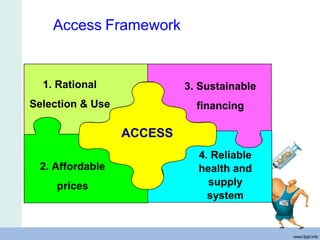
Access Framework
1. Rational
Selection & Use
3. Sustainable
financing
4. Reliable
health and
supply
system
2. Affordable
prices
ACCESS
 Use of a limited number of carefully
selected medicines based on agreed
clinical guidelines leads to a better supply
of medicines, to more rational prescribing
and to lower costs.
 Essential Medicines which are selected
on the basis of safe and cost-effective
clinical guidelines, give better quality of
care and better value for money.
 The procurement of fewer items in
larger quantities results in more price
competition and economics of scale.
 Quality assurance
 Procurement
 Storage
 Distribution and dispensing
are all easier with a reduced number of
medicines.
Rational Use of Medicines
Our goal
• Ensure therapeutically sound and cost –
effective use of medicines by health
professionals and consumers.
• Rational drug use could be defined as
patients receiving medication appropriate
to their clinical needs, in doses that meet
their own individual requirements for an
adequate period of time, and at the lowest
cost to them and their community.
This definition focuses on four
important aspects of the rational use
of medicines:-
- Correct medication
- Correct dose
- Correct duration of treatment
- Correct cost
- WHO estimated that more than 50 per
cent of all medicines world wide are
prescribed, dispensed or sold
inappropriately, while another 50
percent of patients fail to take them
correctly.
- The over use, underuse or misuse of
medicines results in wastage of scarce
resources and wide spread health
hazards.
Irrational use of medicines include;
• use of too many medicines per patient
(poly- pharmacy)
• inappropriate use of antimicrobials,
often inadequate dosage,
for non-bacterial infection
• over-use of injections
when oral formulation is more
appropriate
Irrational use of medicines include;
• failure to prescribe in accordance with
clinical guide lines
• inappropriate self medication,
often of prescription only medicines
• non adherence to dosing regimes
• Irrational prescribing practice of
doctors
• Dispensing by pharmacists and drug
sellers
• Drug pricing policies and promotional
activities
of the pharmaceutical industry
• Lack of information, education and
communication on rational use of
medicines
to providers and consumers
• Lack of effective control regulatory
mechanisms on use of medicines
• Lack of political will and leadership to
promote rational use
WHO advocates 12 key interventions to
promote more rational use:
1. Establishment of a multidisciplinary
national body to coordinate policies on
medicine use.
2. Use of clinical guide lines.
3. Development and use of essential
medicine list.
4. Establishment of drug and therapeutic
committees in districts and hospitals.
5. Inclusion of problem - based
pharmacotherapy training in
undergraduate curricula.
6. Continuing medical education as a
licensure requirement.
7. Supervision, audit and feedback
8. Use of independent information on
medicines
9. Public education about medicines
10. Avoidance of perverse financial
incentives
11. Use of appropriate and enforced
regulation
12. Sufficient government expenditure
to ensure availability of medicines and
staff
• Improving the use of medicines by
health workers and general public is
crucial both to reducing morbidity and
mortality from communicable and
non-communicable diseases, and to
containing drug expenditure.
• Therapeutically sound and cost
effective use of medicines by health
professionals and consumers is
achieved at all level of health system,
and in both the public and private
sectors.
• Dr Kathleen Holloway, Medicines Policy and
Standards, WHO headquarters, Geneva, said
that
“ Irrational use of medicines continues to be
a very serious global public health problem
that causes significant patient harm in
terms of antimicrobial resistance,
unnecessary adverse drug reactions,
medication errors, poor patient outcomes
and waste of resources”
• The cause of such irrational use is
multifactorial and includes
- prescriber knowledge and habit,
- availability of information,
- social and cultural factors, and
- health service infrastructure.
• WHO Regional Director for South-East Asia,
Dr Samlee Plianbangchang, had pointed out
that
“a medicine should not be seen as a
chemical but a chemical plus the
information for its correct use”.
The strategies to be developed shouldThe strategies to be developed should
address theaddress the
fundamental causes of irrational use.fundamental causes of irrational use.
Thank you

Concepts of em

  • 1.
    Concepts of Essential Medicines DR.THIDA HLA Director (Medical Care, Medical Cover & Medical Board) Project Manager Myanmar Essential Medicines Project Department of Medical Services
  • 2.
    Myanmar Essential MedicinesProject • It was started in 1988 with the long term objectives aiming to ensure that every citizen has regular access to safe, quality, efficacious, low-cost and affordable essential medicines in every health care facility.
  • 3.
    • The projecthas replicated its activities phase by phase and now, all townships in primary health care level have been covered with essential medicines concepts
  • 4.
    Major Activities • BuildingHuman Resource Capacity • Production and Distribution of IEC materials • Review and revision of National List of Essential Medicines
  • 5.
    • Production andDistribution of Standard Treatment Guidelines/ Hospital Formularies • Integration with other health services • Research • Supervision, monitoring and evaluation
  • 6.
    Future Plans • Integrationof concepts of essential medicines into the curricula of under- graduate and postgraduate courses of the universities of medicines, dental medi- cines, paramedical sciences, nursing and pharmacy. • Review and revision of National Medicines Policy
  • 7.
    • Educating andorganizing the community to participate actively in the implemen- tation of activities of project with adoption of cost recovery/ community cost sharing scheme. • Promotion of rational use of medicines by educating to prescribers and consumers
  • 8.
    Essential Medicines (WHO Definition) EssentialMedicines are "those that satisfy the priority health care needs of the majority of the population".
  • 9.
    Therefore should beavailable at all times, in adequate amounts, in appro- priate dosage forms and at a price that the individual and the community can afford.
  • 10.
    Misleading beliefs towards EssentialMedicines • Cheap medicines • Medicines for health center • Medicines for poor people • Medicines for paramedics • Medicines for general practitioners • Medicines for mild diseases, they do not work for severe diseases. • Etc.?
  • 11.
    Concepts of EssentialMedicines 1. Access- equitable availability and affordability of essential medicines 2. Quality- the quality, safety and efficacy of all medicines 3. Rational Use of Medicines
  • 12.
    Access Framework 1. Rational Selection& Use 3. Sustainable financing 4. Reliable health and supply system 2. Affordable prices ACCESS
  • 13.
     Use ofa limited number of carefully selected medicines based on agreed clinical guidelines leads to a better supply of medicines, to more rational prescribing and to lower costs.
  • 14.
     Essential Medicineswhich are selected on the basis of safe and cost-effective clinical guidelines, give better quality of care and better value for money.
  • 15.
     The procurementof fewer items in larger quantities results in more price competition and economics of scale.
  • 16.
     Quality assurance Procurement  Storage  Distribution and dispensing are all easier with a reduced number of medicines.
  • 17.
    Rational Use ofMedicines
  • 18.
    Our goal • Ensuretherapeutically sound and cost – effective use of medicines by health professionals and consumers. • Rational drug use could be defined as patients receiving medication appropriate to their clinical needs, in doses that meet their own individual requirements for an adequate period of time, and at the lowest cost to them and their community.
  • 19.
    This definition focuseson four important aspects of the rational use of medicines:- - Correct medication - Correct dose - Correct duration of treatment - Correct cost
  • 20.
    - WHO estimatedthat more than 50 per cent of all medicines world wide are prescribed, dispensed or sold inappropriately, while another 50 percent of patients fail to take them correctly. - The over use, underuse or misuse of medicines results in wastage of scarce resources and wide spread health hazards.
  • 21.
    Irrational use ofmedicines include; • use of too many medicines per patient (poly- pharmacy) • inappropriate use of antimicrobials, often inadequate dosage, for non-bacterial infection • over-use of injections when oral formulation is more appropriate
  • 22.
    Irrational use ofmedicines include; • failure to prescribe in accordance with clinical guide lines • inappropriate self medication, often of prescription only medicines • non adherence to dosing regimes
  • 23.
    • Irrational prescribingpractice of doctors • Dispensing by pharmacists and drug sellers • Drug pricing policies and promotional activities of the pharmaceutical industry
  • 24.
    • Lack ofinformation, education and communication on rational use of medicines to providers and consumers • Lack of effective control regulatory mechanisms on use of medicines • Lack of political will and leadership to promote rational use
  • 25.
    WHO advocates 12key interventions to promote more rational use: 1. Establishment of a multidisciplinary national body to coordinate policies on medicine use. 2. Use of clinical guide lines. 3. Development and use of essential medicine list. 4. Establishment of drug and therapeutic committees in districts and hospitals.
  • 26.
    5. Inclusion ofproblem - based pharmacotherapy training in undergraduate curricula. 6. Continuing medical education as a licensure requirement. 7. Supervision, audit and feedback 8. Use of independent information on medicines
  • 27.
    9. Public educationabout medicines 10. Avoidance of perverse financial incentives 11. Use of appropriate and enforced regulation 12. Sufficient government expenditure to ensure availability of medicines and staff
  • 28.
    • Improving theuse of medicines by health workers and general public is crucial both to reducing morbidity and mortality from communicable and non-communicable diseases, and to containing drug expenditure.
  • 29.
    • Therapeutically soundand cost effective use of medicines by health professionals and consumers is achieved at all level of health system, and in both the public and private sectors.
  • 30.
    • Dr KathleenHolloway, Medicines Policy and Standards, WHO headquarters, Geneva, said that “ Irrational use of medicines continues to be a very serious global public health problem that causes significant patient harm in terms of antimicrobial resistance, unnecessary adverse drug reactions, medication errors, poor patient outcomes and waste of resources”
  • 31.
    • The causeof such irrational use is multifactorial and includes - prescriber knowledge and habit, - availability of information, - social and cultural factors, and - health service infrastructure.
  • 32.
    • WHO RegionalDirector for South-East Asia, Dr Samlee Plianbangchang, had pointed out that “a medicine should not be seen as a chemical but a chemical plus the information for its correct use”.
  • 33.
    The strategies tobe developed shouldThe strategies to be developed should address theaddress the fundamental causes of irrational use.fundamental causes of irrational use.
  • 34.