What is an Essential Package of
Health Services and
Why Do We Need It?
Unfortunate reality
Health Care
Needs
Available
Resources
If you have limited resources, what do you spend them on?
Improvementinpopulationhealth
?
Intervention A Intervention B
Why an Essential Package of Health Services?
• To ensure the limited resources are spent wisely
• To improve equity
Not having a package is like an empty promise
[it implies that everything should be available,
while we very well know that is not possible]
Essential Package of Health Services – The Main Idea
By year _____:
• Everyone in the country should have access to the health
services and interventions included in that package
(irrespective of who delivers the services and interventions!)
• No one in the country should suffer financial hardship when
accessing the services and interventions included in that
package
→ It becomes a commitment from the government and
an entitlement for the population
Essential Package of Health Services – The Main Idea
→ The EPHS should be:
• Effective – it should include services and interventions that will
result in the greatest improvements in population health
• Realistic – it should include services and interventions for which
access can be guaranteed for everyone by year _____
[irrespective of who delivers those services and interventions]
• Affordable – its should be affordable for the country, considering
(i) the different sources of funding and (ii) the condition that
no-one should suffer financial hardship when using the services
and interventions
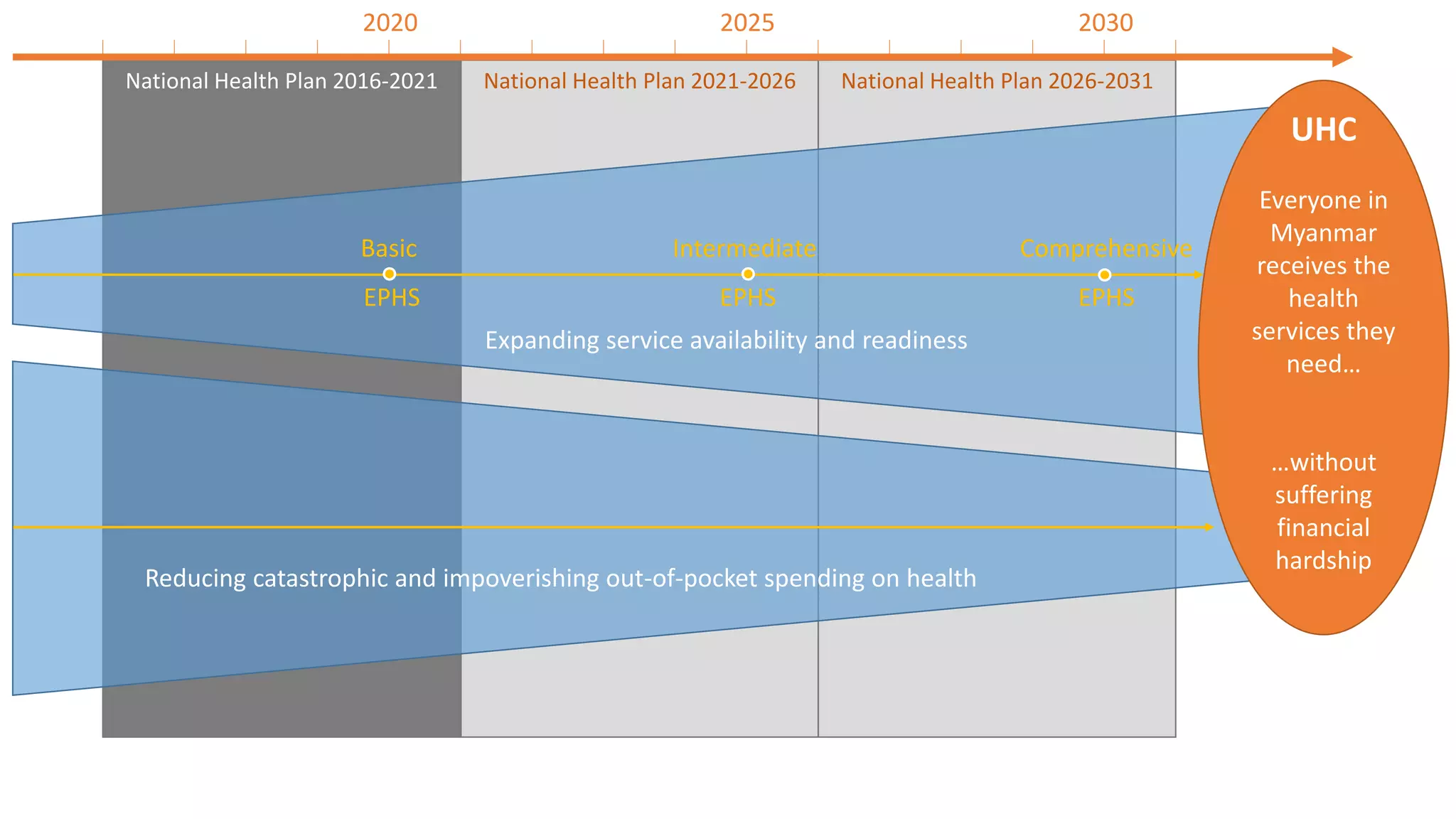
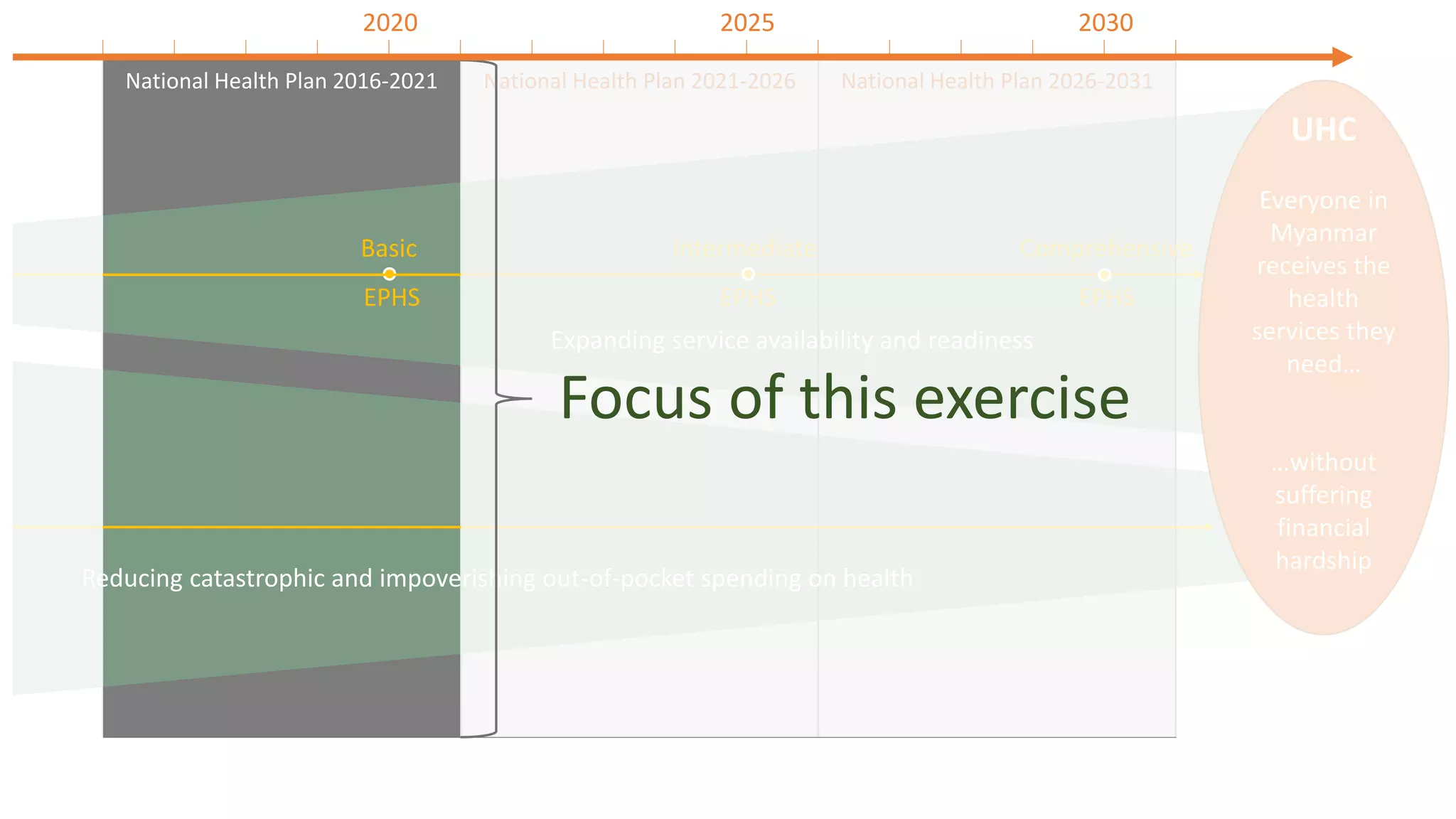
The Essential Package of Health Services will grow over time
National Health Plan 2016-2021 National Health Plan 2021-2026 National Health Plan 2026-2031
2020 2025 2030
Expanding service availability and readiness
Reducing catastrophic and impoverishing out-of-pocket spending on health
UHC
Everyone in
Myanmar
receives the
health
services they
need…
…without
suffering
financial
hardship
Basic
EPHS
Intermediate
EPHS
Comprehensive
EPHS
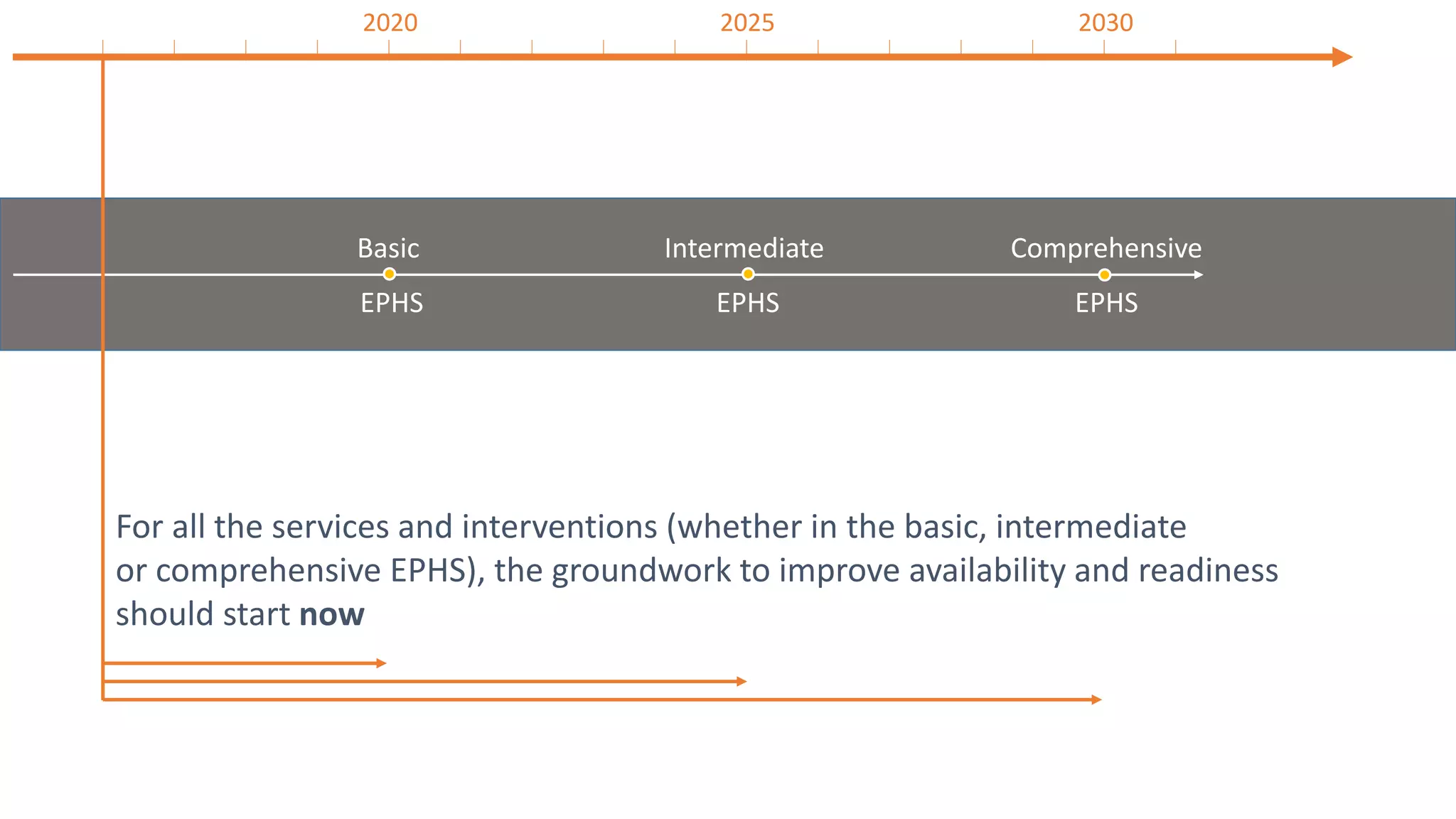
2020 2025 2030
Basic
EPHS
Intermediate
EPHS
Comprehensive
EPHS
For all the services and interventions (whether in the basic, intermediate
or comprehensive EPHS), the groundwork to improve availability and readiness
should start now
→Defining the EPHS (already on-going):
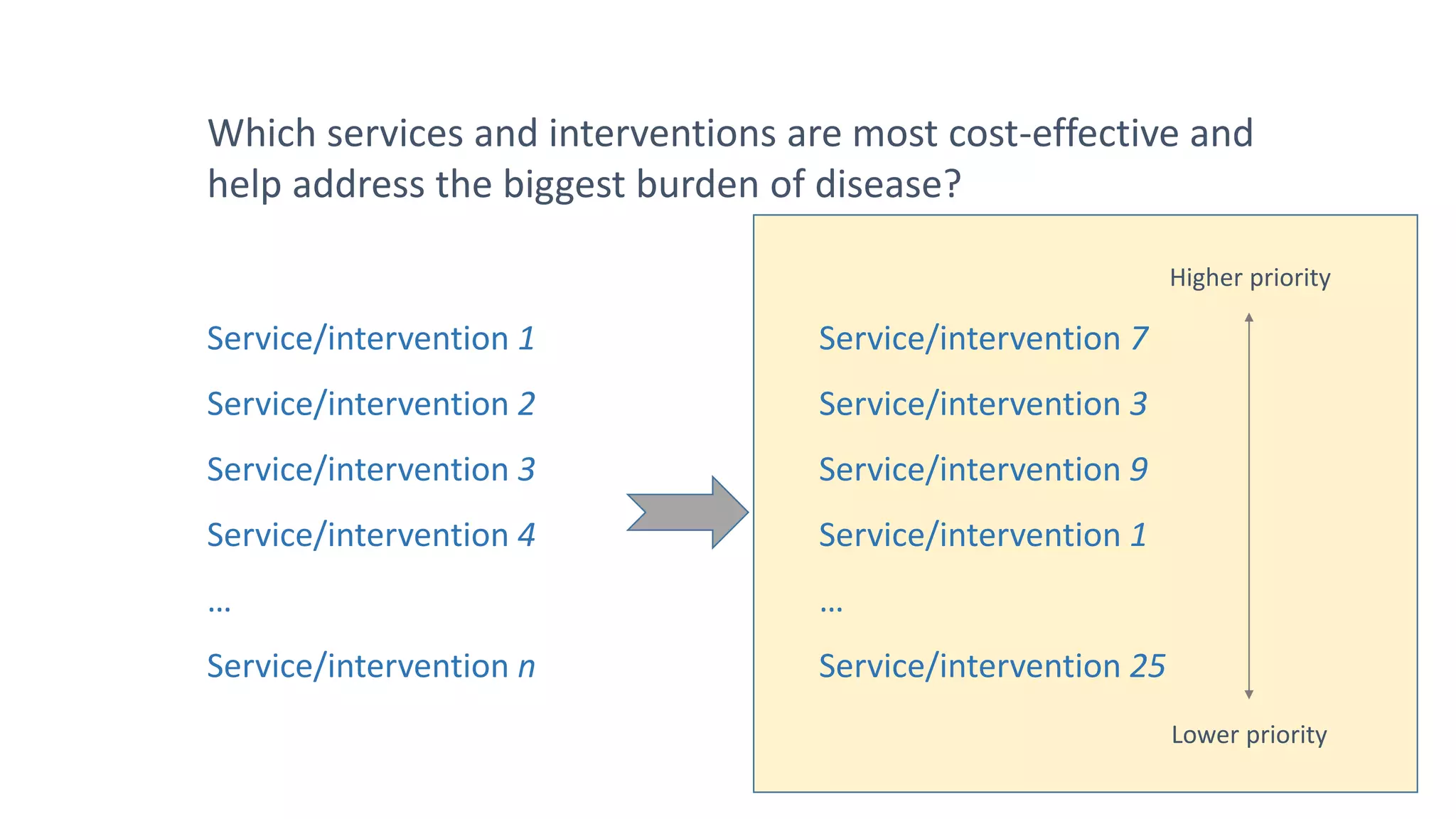
• Which services and interventions are most cost-effective and
help address the biggest burden of disease?
• Of these services and interventions, which ones can realistically
be made accessible to the entire population by year _____,
considering the different types of providers?
• Where do we draw the line in terms of what we can promise
by year _____ (what is affordable for the country at this point
in time)?
Which services and interventions are most cost-effective and
help address the biggest burden of disease?
Service/intervention 1
Service/intervention 2
Service/intervention 3
Service/intervention 4
…
Service/intervention n
Service/intervention 7
Service/intervention 3
Service/intervention 9
Service/intervention 1
…
Service/intervention 25
Higher priority
Lower priority
How much time will it realistically take to make each of these
services and interventions accessible to everyone, considering
all the different types of providers (public, private, EHO…)?
Service/intervention 7
Service/intervention 3
Service/intervention 9
Service/intervention 1
…
Service/intervention 25
2020 2025 2030
Service/intervention 7
Service/intervention 9
Service/intervention 3
Service/intervention 1
…
Service/intervention 25
2020 2025 2030
How much time will it realistically take to make each of these
services and interventions accessible to everyone, considering
all the different types of providers (public, private, EHO…)?
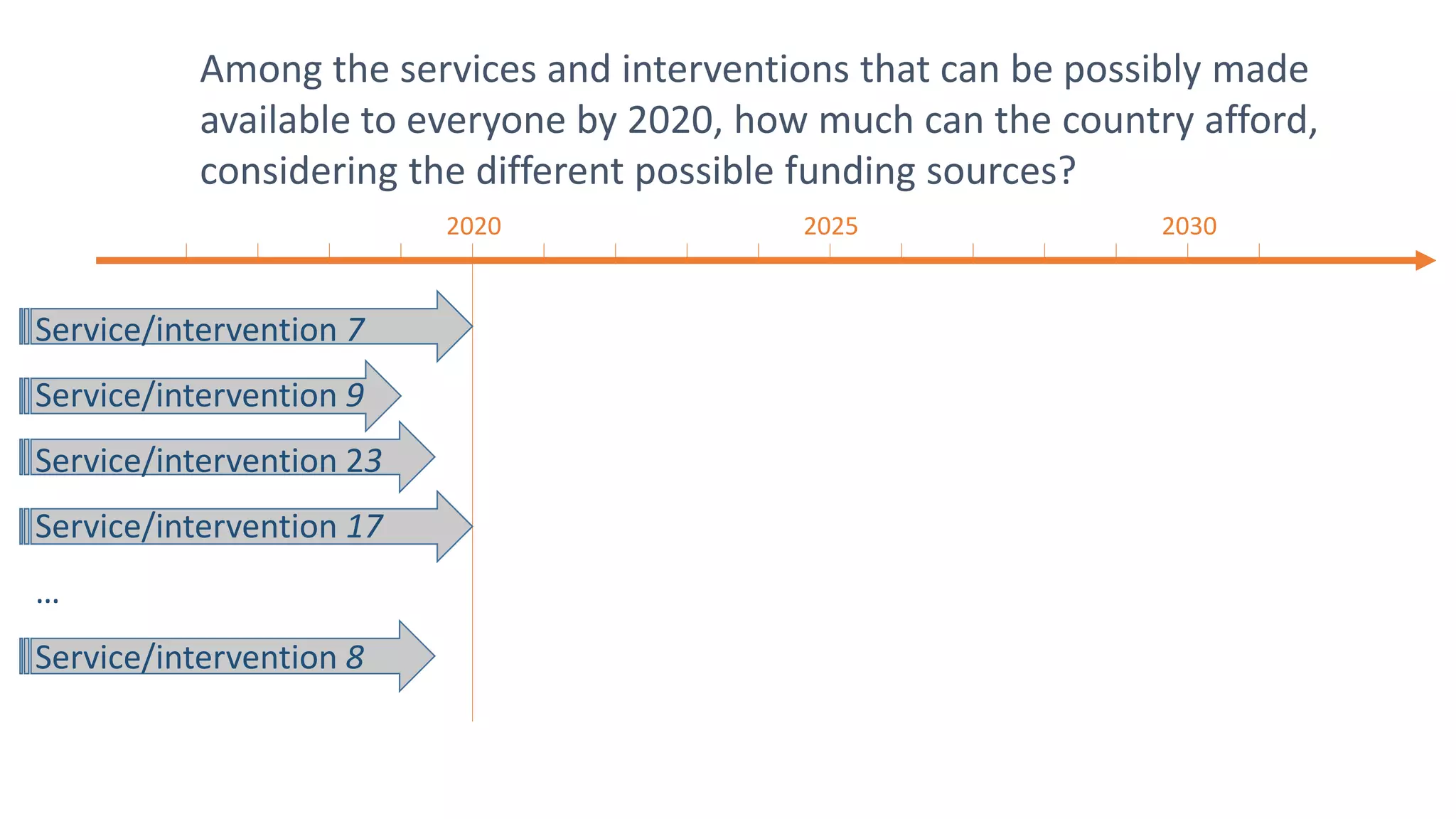
Among the services and interventions that can be possibly made
available to everyone by 2020, how much can the country afford,
considering the different possible funding sources?
Service/intervention 7
Service/intervention 9
Service/intervention 23
Service/intervention 17
…
Service/intervention 8
2020 2025 2030
Among the services and interventions that can be possibly made
available to everyone by 2020, how much can the country afford,
considering the different possible funding sources?
Service/intervention 7
Service/intervention 9
Service/intervention 23
Service/intervention 17
…
Service/intervention 8
2020 2025 2030
This becomes the basic EPHS
Key questions regarding the EPHS
• Who can deliver the services and interventions?
[this will vary by service/intervention and by location]
• Where will the money come from?
• To ensure service availability and readiness
• To actually ‘purchase’ the services
These questions should be the focus of the National
Health Plan, not the actual content of the basic EPHS
Universal Health Coverage
and the
National Health Plan 2016-2021
National Health Plan 2016-2021 National Health Plan 2021-2026 National Health Plan 2026-2031
2020 2025 2030
Expanding service availability and readiness
Reducing catastrophic and impoverishing out-of-pocket spending on health
UHC
Everyone in
Myanmar
receives the
health
services they
need…
…without
suffering
financial
hardship
Basic
EPHS
Intermediate
EPHS
Comprehensive
EPHS
National Health Plan 2016-2021 National Health Plan 2021-2026 National Health Plan 2026-2031
2020 2025 2030
Expanding service availability and readiness
Reducing catastrophic and impoverishing out-of-pocket spending on health
UHC
Everyone in
Myanmar
receives the
health
services they
need…
…without
suffering
financial
hardship
Basic
EPHS
Intermediate
EPHS
Comprehensive
EPHS
Focus of this exercise
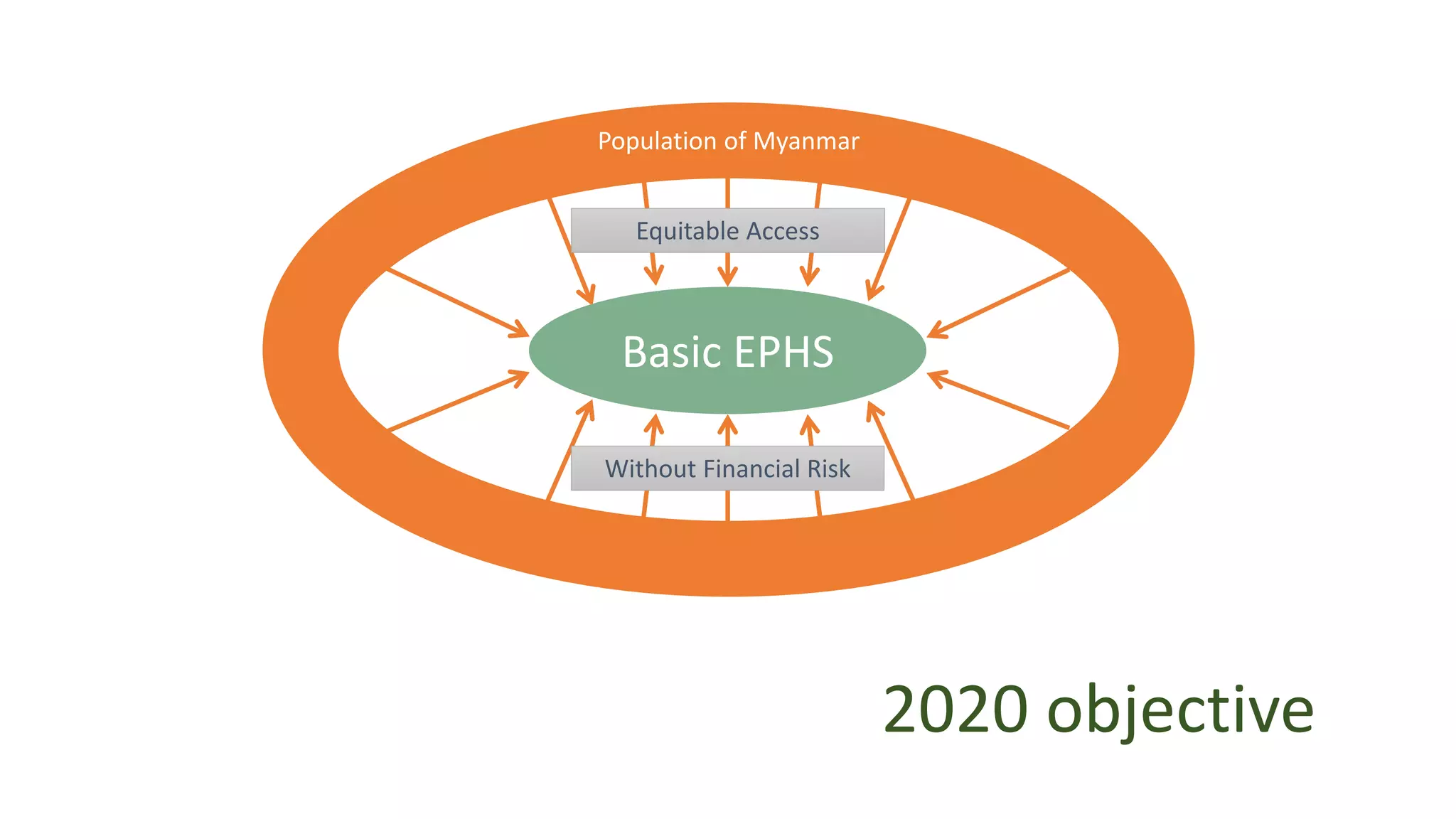
Basic EPHS
Population of Myanmar
2020 objective
Equitable Access
Without Financial Risk
Population of Myanmar
Large Not Well
Defined Package
Danger to avoid
Some have access to
a lot, while the majority
has access
to little of
nothing
Today, coverage varies greatly, favoring urban areas and
leaving parts of the country with limited infrastructure,
infrastructure in poor condition or no infrastructure at all.
Health
Infrastructure
Ensure
Equitable
Coverage
Challenge for
the NHP
Does it exclusively need to be government provision?
NO
NGOGVT EHO GP
It will depend on the area
Is infrastructure all that matters?
NO
All the other inputs, and all the
systems, are equally important!
Is infrastructure all that matters?
NO
+ + + + + systems
How do we know what is needed?
This will be based on the
delivery of the EPHS
What type of infrastructure, which skill mix,
which medical supplies, which supporting systems…
How do we know what is needed where?
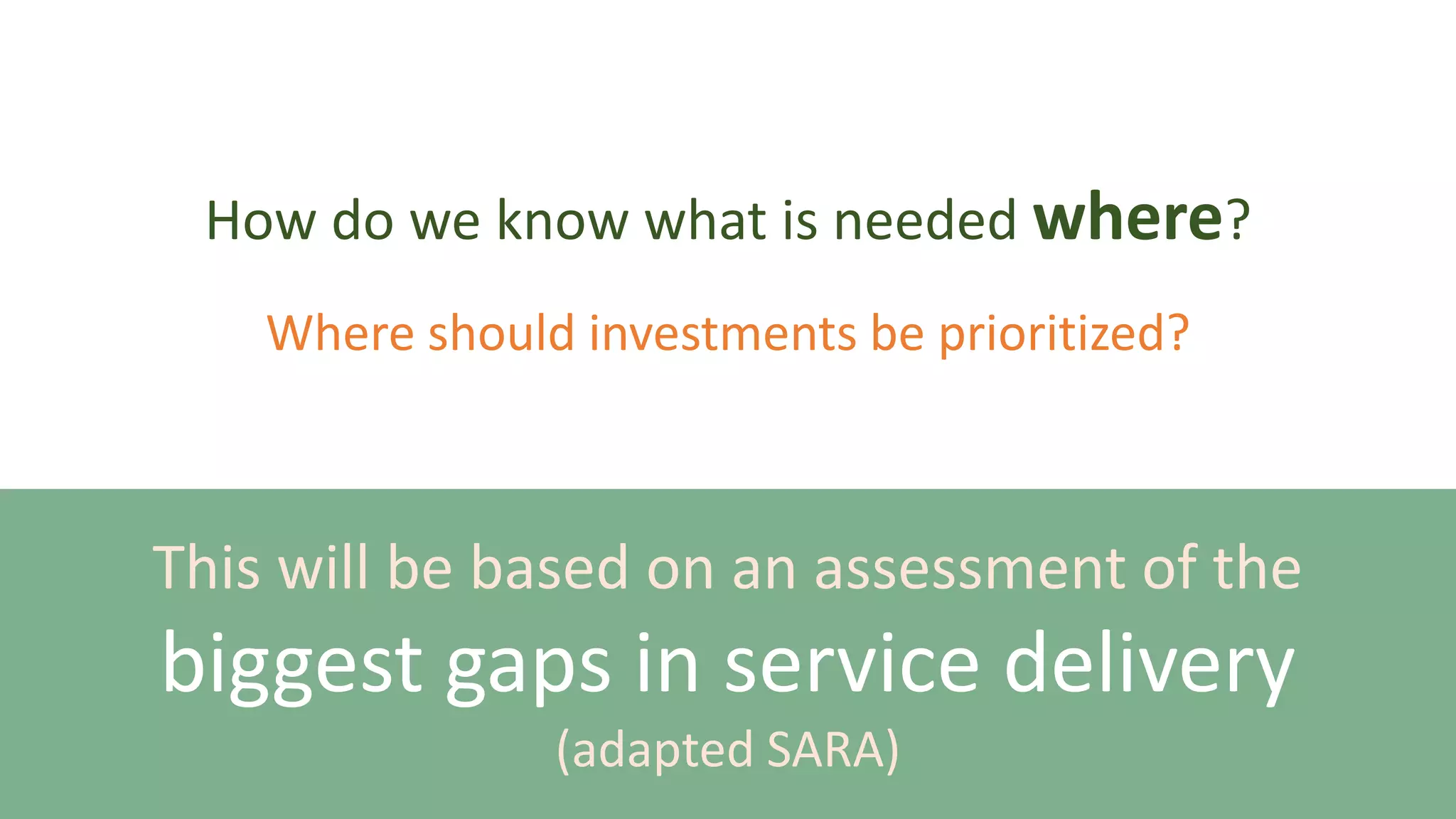
This will be based on an assessment of the
biggest gaps in service delivery
(adapted SARA)
Where should investments be prioritized?
Key steps for reaching NHP goals
• Finalize the basic EPHS
• Identify what is needed at the different levels of the health system
to deliver the basic EPHS (link with health programs)
• Identify the gaps in service availability and readiness, starting with
the areas with the greatest needs (expanded SARA)
• Define tailored approach to fill the gaps by 2020
Many
Challenges
to Overcome
• How can we ensure that human resources are
produced in sufficient number?
• How can we improve retention of human
resources?
• How can we make sure the budget is there to
finance expansion of services
• How can we strengthen all the supportive systems
(procurement, referrals, public financial
management, health management information...)
• How can the different types of providers (public,
EHO, NGO, private for profit) work together
Examples
Conceptual Framework of
NHP
National
State/Region
Township
and Below
BasicEPHS
COMMUNITIES
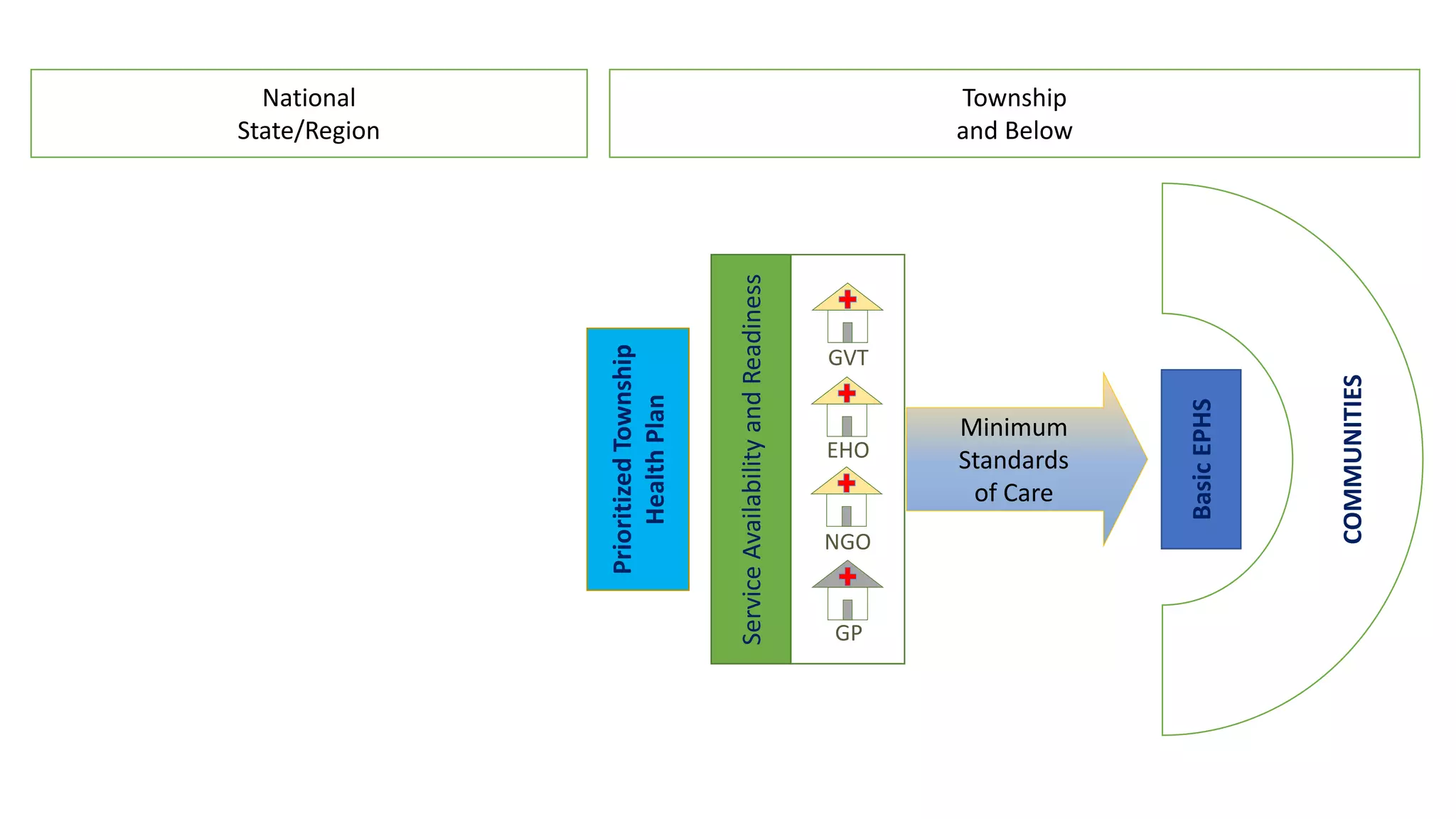
National
State/Region
Township
and Below
ServiceAvailabilityandReadiness
EHO
GVT
NGO
GP
Minimum
Standards
of Care
BasicEPHS
COMMUNITIES
National
State/Region
Township
and Below
PrioritizedTownship
HealthPlan
ServiceAvailabilityandReadiness
EHO
GVT
NGO
GP
Minimum
Standards
of Care
BasicEPHS
COMMUNITIES
National
State/Region
Township
and Below
Geographical
Prioritization
PrioritizedTownship
HealthPlan
ServiceAvailabilityandReadiness
EHO
GVT
NGO
GP
Minimum
Standards
of Care
BasicEPHS
COMMUNITIES
National
State/Region
Township
and Below
Geographical
Prioritization
Service
Prioritization
PrioritizedTownship
HealthPlan
ServiceAvailabilityandReadiness
EHO
GVT
NGO
GP
Minimum
Standards
of Care
BasicEPHS
COMMUNITIES
National
State/Region
Township
and Below
Geographical
Prioritization
Service
Prioritization
SystemsBuilding
Human Resources
Infrastructure
Service Delivery
Health Financing
PrioritizedTownship
HealthPlan
ServiceAvailabilityandReadiness
EHO
GVT
NGO
GP
Minimum
Standards
of Care
BasicEPHS
COMMUNITIES
National
State/Region
Township
and Below
Geographical
Prioritization
Service
Prioritization
SystemsBuilding
Human Resources
Infrastructure
Service Delivery
Health Financing
PrioritizedTownship
HealthPlan
ServiceAvailabilityandReadiness
EHO
GVT
NGO
GP
Minimum
Standards
of Care
BasicEPHS
Supportive Environment (policies, regulations, ethics, research, oversight…)
COMMUNITIES
Guiding Principles (Equity, Inclusiveness, Accountability, Efficiency, Sustainability, Quality)
National
State/Region
Township
and Below
Geographical
Prioritization
Service
Prioritization
SystemsBuilding
Human Resources
Infrastructure
Service Delivery
Health Financing
PrioritizedTownship
HealthPlan
ServiceAvailabilityandReadiness
EHO
GVT
NGO
GP
Minimum
Standards
of Care
BasicEPHS
Supportive Environment (policies, regulations, ethics, research, oversight…)
COMMUNITIES
Guiding Principles (Equity, Inclusiveness, Accountability, Efficiency, Sustainability, Quality)

Ephs and nhp

Editor's Notes

  • #28 ADD DRUGS, INFO!
  • #31 Main Messages of this Report Although planning effort remains fragmented and there is questionable ownership at the local level of planning initiatives, there is a wide consensus for the need to move towards a coordinated and comprehensive planning system   There are significant internal and external pressures for planning system reform – these include decentralisation, administrative reform and rapidly increasing resourcing of the sector.   The mandate for planning system reform needs to be clear. In order to develop a sustainable planning system, health policy frameworks for the planning system needs to be clearly established – particularly for EHP for UHC (what are we planning for?) , a national Monitoring and Evaluation Framework (what are our expected results?) and roles and functions of system levels in the sector (who is doing what?).   The planning system design needs to be conceptualised across all levels of the system. There cannot be Township Health System reform without corresponding reforms in planning roles at Regional/State and Central levels.   To realise the vision of One Plan, One Budget one M & E for the health sector, longer term institutional development strategies are required including management systems reform (PFM, social protection, national planning and budgeting guidelines) as well as human resource development and placement (finance and planning officers) according to agreed roles and functions of the various levels of the health planning system.   To support this longer term direction, short to medium terms steps can be undertaken for planning and management systems development which are outlined in the final section of this report. This will enable a more feasible and gradual process for decentralisation and systems development.   In order to realise the planning system vision, technical cooperation strategy will need to be well harmonised and aligned with national priorities and strategy, so that management systems development effort does not overlap or compete, but rather is synergistic and proceeds in a logical and planned sequence of events.  
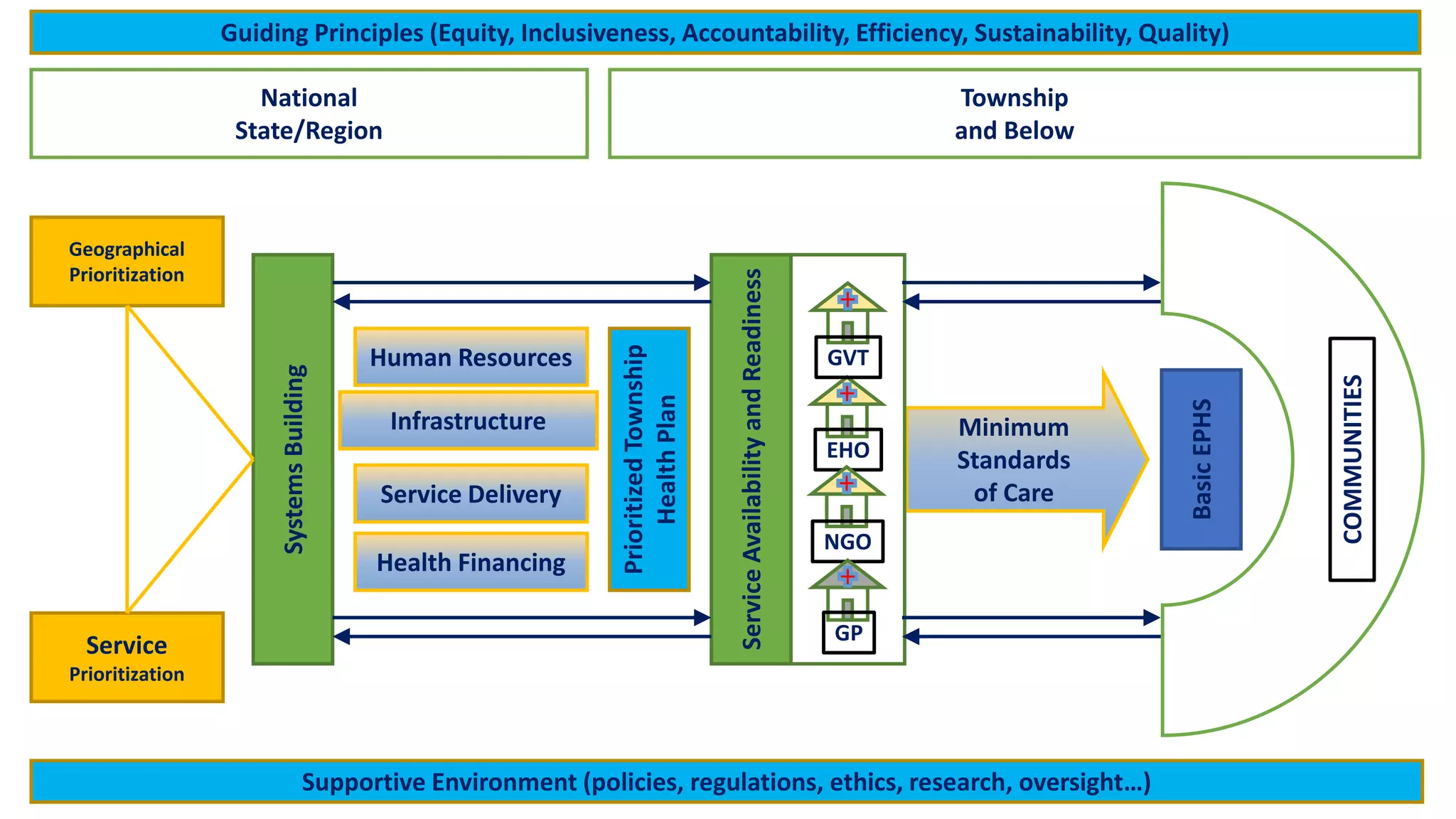
  • #34 The main goal of the NHP is to ensure that by 2020, everyone in the country has access to the Basic EPHS.
  • #35 Whether the services and interventions are provided by a government facility or by a provider outside MoHS, they should meet the same minimum standards of care. For government facilities to be able to deliver the Basic EPHS and ensure minimum standards of care are met, considerable investments in supply-side readiness will be needed, starting at the level of the community. Ensuring that other health providers, such as EHOs, NGOs and private GPs meet those same standards will require active engagement and strong MoHS oversight.
  • #36 Inclusive planning at the local level will be essential to achieve the NHP goal. The planning should be based on a good understanding of current situation: who is doing what where, which services and interventions reach which communities, where are the gaps and who could fill them. This information will be fed into a national database that will be regularly updated and that will support planning and monitoring efforts at all levels of the system. Using this information, stakeholders at Township level will be able to plan and cost actions that need to be taken to fill coverage gaps and meet the minimum standards of care. These actions will need to be prioritized to fall within the broad resource envelope (specifying human, material and financial resources) communicated by the State or Region. All of this will be captured in a Prioritized Township Health Plan (PTHP) using national guidelines and templates. States and Regions will have a key role to play in supporting and overseeing the planning and budgeting process, as well as the implementation of the PTHP.
  • #37 Given financial and capacity constraints, operationalization of the NHP at Township level will not happen in all Townships at once. Instead, it will be introduced in phased manner, with Townships being prioritized based on objective criteria. Initially relatively crude indices will be used, constructed using available data on infrastructure, human resources and performance in both public and private sectors; the indices will then be refined as more and better data becomes available. The number of Townships in which operationalization of the NHP will be initiated each year will be dictated largely by overall fiscal space for health and the capacity to deploy additional human resources to Townships.
  • #38 Another form of prioritization is in the definition of the Basic EPHS. The size and contents of the package largely depends on what the country can afford and on the country’s capacity to deliver. It is currently being defined based on objective criteria such as burden of disease and availability of cost-effective services and interventions. The Basic EPHS has a strong PHC focus.
  • #39 The provision of a Basic EPHS at Township level of below is conditional on a well-functioning health system. In conjunction with the operationalization of the NHP at the Township level, investments will be needed to strengthen key functions of the health system at all levels. Health systems strengthening efforts will be organized around four pillars: human resources, infrastructure, service delivery and health financing.
  • #40 Successful implementation of the NHP will also require a supportive environment. This includes adequate policies developed within a robust regulatory framework, strengthened MoHS leadership and oversight, a strong evidence base that can guide decision making, improved ethics, etc. It is important to note that some population groups may have special needs when it comes to health care (e.g. disabled, adolescents, pregnant teenagers, drug users, transgender...); while these special needs will have to be addressed and barriers to utilization for these groups will need to be removed, the complexity involved in doing so deserves more in-depth analysis and special attention. The NHP strategy will enhance equity in many ways. For example: Access to the Basic EPHS can be free at the point of care, at least in public facilities The Basic EPHS has a strong focus on primary health care services and interventions that the poor and vulnerable need most Priority will be given to the expansion of service delivery in the Townships with the greatest needs Increased government spending on health will allow reducing out-of-pocket payments by poor and vulnerable households
  • #41 A strong M&E framework will allow to track and measure progress in the implementation of the NHP. The framework will also look explicitly at equity. In addition to socio-economic equity in health, gender equity and other types of equity will also be closely monitored. Moreover, various dimensions of equity will be considered (e.g. equity in health outcomes, equity in utilisation, equity in access or equity in financial contribution). Efforts will need to be made to explicitly address equity under its various forms in implementation of the NHP.