INFECTIVE ENDOCARDITISINFECTIVE ENDOCARDITIS
It is the colonization or invasion of the heart valves orIt is the colonization or invasion of the heart valves or
the mural endocardium by athe mural endocardium by a microbemicrobe, leading to the, leading to the
formation of bulky, friableformation of bulky, friable vegetationsvegetations
Other sites of colonization- Aorta, aneurysmal sacs &Other sites of colonization- Aorta, aneurysmal sacs &
blood vesselsblood vessels
Vegetations are composed of thrombotic debris &Vegetations are composed of thrombotic debris &
organismsorganisms
Most cases are bacterial , others- fungi, rickettsiae (QMost cases are bacterial , others- fungi, rickettsiae (Q
fever) & Chlamydiaefever) & Chlamydiae
Acute endocarditisAcute endocarditis
 Frequently affects a previously normal heart valveFrequently affects a previously normal heart valve
 Highly virulent organismsHighly virulent organisms
 Mortality high despite treatment (> 50% )Mortality high despite treatment (> 50% )
 Lesions produced- Necrotizing, ulcerative,Lesions produced- Necrotizing, ulcerative,
invasive valvular infectionsinvasive valvular infections
Subacute endocarditisSubacute endocarditis
 Insidious onset & even if untreated pursue a protractedInsidious onset & even if untreated pursue a protracted
coursecourse
 Organisms of low virulenceOrganisms of low virulence
 Previously abnormal heart, particularly on deformed valvesPreviously abnormal heart, particularly on deformed valves
 Most patients recover after appropriate antibiotic therapyMost patients recover after appropriate antibiotic therapy
 Vegetations often show evidence of healingVegetations often show evidence of healing
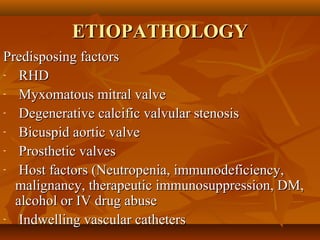
ETIOPATHOLOGYETIOPATHOLOGY
Predisposing factorsPredisposing factors
- RHDRHD
- Myxomatous mitral valveMyxomatous mitral valve
- Degenerative calcific valvular stenosisDegenerative calcific valvular stenosis
- Bicuspid aortic valveBicuspid aortic valve
- Prosthetic valvesProsthetic valves
- Host factors (Neutropenia, immunodeficiency,Host factors (Neutropenia, immunodeficiency,
malignancy, therapeutic immunosuppression, DM,malignancy, therapeutic immunosuppression, DM,
alcohol or IV drug abusealcohol or IV drug abuse
- Indwelling vascular cathetersIndwelling vascular catheters
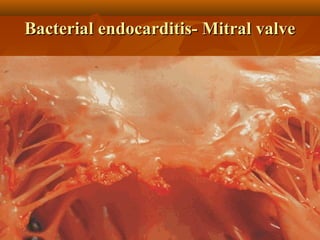
Bacterial endocarditis- Mitral valveBacterial endocarditis- Mitral valve
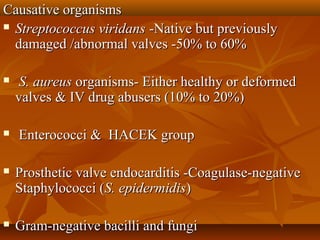
Causative organismsCausative organisms
 Streptococcus viridansStreptococcus viridans -Native but previously-Native but previously
damaged /abnormal valves -50% to 60%damaged /abnormal valves -50% to 60%
 S. aureusS. aureus organisms- Either healthy or deformedorganisms- Either healthy or deformed
valves & IV drug abusers (10% to 20%)valves & IV drug abusers (10% to 20%)
 Enterococci & HACEK groupEnterococci & HACEK group
 Prosthetic valve endocarditis -Coagulase-negativeProsthetic valve endocarditis -Coagulase-negative
Staphylococci (Staphylococci (S. epidermidisS. epidermidis))
 Gram-negative bacilli and fungiGram-negative bacilli and fungi
Culture-negative" endocarditis- 10% of casesCulture-negative" endocarditis- 10% of cases
Seeding of the blood with microbesSeeding of the blood with microbes
The portal of entry of bloodstreamThe portal of entry of bloodstream
- Obvious infection elsewhereObvious infection elsewhere
- Dental or surgical procedure that causes a transientDental or surgical procedure that causes a transient
bacteremiabacteremia
- Injection of contaminated material directly into theInjection of contaminated material directly into the
bloodstream by IV drug usersbloodstream by IV drug users
- Occult source from the gut, oral cavity or trivial injuriesOccult source from the gut, oral cavity or trivial injuries
MORPHOLOGYMORPHOLOGY
GROSSGROSS
HeartHeart
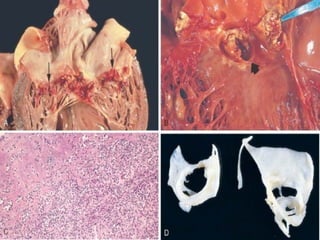
 Friable, bulky vegetationsFriable, bulky vegetations
 Vegetations may be single or multiple and mayVegetations may be single or multiple and may
involve more than one valveinvolve more than one valve
 Vegetations if erode into the underlyingVegetations if erode into the underlying
myocardium produce an abscess cavitymyocardium produce an abscess cavity (ring(ring
abscess)abscess)
SystemicSystemic
Emboli may cause infarcts in the brain, kidneys,Emboli may cause infarcts in the brain, kidneys,
myocardium & other tissues (septic infarcts)myocardium & other tissues (septic infarcts)
MicroscopicallyMicroscopically
 Vegetations are composed of thrombotic debris &Vegetations are composed of thrombotic debris &
organismsorganisms
 Vegetations of SABE often have granulation tissueVegetations of SABE often have granulation tissue
at their bases ,fibrosis, calcification & MNICsat their bases ,fibrosis, calcification & MNICs
CLINICAL FEATURESCLINICAL FEATURES
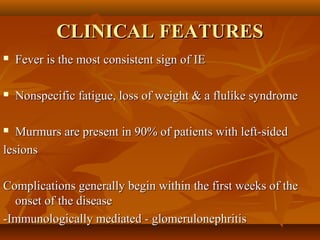
 Fever is the most consistent sign of IEFever is the most consistent sign of IE
 Nonspecific fatigue, loss of weight & a flulike syndromeNonspecific fatigue, loss of weight & a flulike syndrome
 Murmurs are present in 90% of patients with left-sidedMurmurs are present in 90% of patients with left-sided
lesionslesions
Complications generally begin within the first weeks of theComplications generally begin within the first weeks of the
onset of the diseaseonset of the disease
-Immunologically mediated - glomerulonephritis-Immunologically mediated - glomerulonephritis
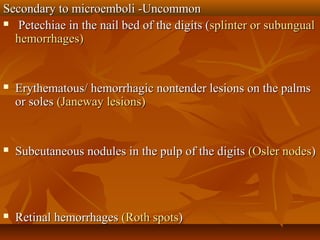
Secondary to microemboli -UncommonSecondary to microemboli -Uncommon
 Petechiae in the nail bed of the digits (Petechiae in the nail bed of the digits (splinter or subungualsplinter or subungual
hemorrhages)hemorrhages)
 Erythematous/ hemorrhagic nontender lesions on the palmsErythematous/ hemorrhagic nontender lesions on the palms
or solesor soles (Janeway lesions)(Janeway lesions)
 Subcutaneous nodules in the pulp of the digitsSubcutaneous nodules in the pulp of the digits (Osler nodes(Osler nodes))
 Retinal hemorrhagesRetinal hemorrhages (Roth spots(Roth spots))
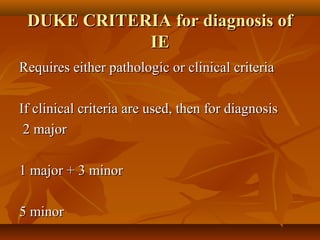
DUKE CRITERIA for diagnosis ofDUKE CRITERIA for diagnosis of
IEIE
Requires either pathologic or clinical criteriaRequires either pathologic or clinical criteria
If clinical criteria are used, then for diagnosisIf clinical criteria are used, then for diagnosis
2 major2 major
1 major + 3 minor1 major + 3 minor
5 minor5 minor
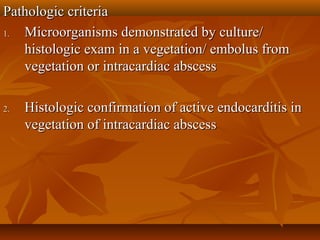
Pathologic criteriaPathologic criteria
1.1. Microorganisms demonstrated by culture/Microorganisms demonstrated by culture/
histologic exam in a vegetation/ embolus fromhistologic exam in a vegetation/ embolus from
vegetation or intracardiac abscessvegetation or intracardiac abscess
2.2. Histologic confirmation of active endocarditis inHistologic confirmation of active endocarditis in
vegetation of intracardiac abscessvegetation of intracardiac abscess
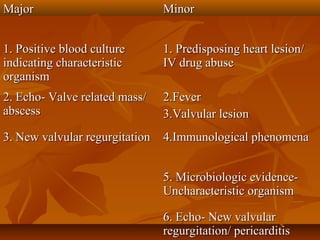
MajorMajor MinorMinor
1. Positive blood culture1. Positive blood culture
indicating characteristicindicating characteristic
organismorganism
1. Predisposing heart lesion/1. Predisposing heart lesion/
IV drug abuseIV drug abuse
2. Echo- Valve related mass/2. Echo- Valve related mass/
abscessabscess
2.Fever2.Fever
3.Valvular lesion3.Valvular lesion
3. New valvular regurgitation3. New valvular regurgitation 4.Immunological phenomena4.Immunological phenomena
5. Microbiologic evidence-5. Microbiologic evidence-
Uncharacteristic organismUncharacteristic organism
6. Echo- New valvular6. Echo- New valvular
regurgitation/ pericarditisregurgitation/ pericarditis
NONINFECTEDNONINFECTED
VEGETATIONSVEGETATIONS
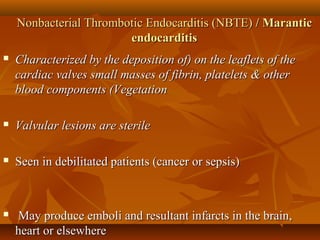
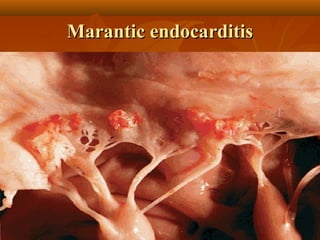
Nonbacterial Thrombotic Endocarditis (NBTE)Nonbacterial Thrombotic Endocarditis (NBTE) / Marantic/ Marantic
endocarditisendocarditis
 Characterized by the deposition of) on the leaflets of theCharacterized by the deposition of) on the leaflets of the
cardiac valves small masses of fibrin, platelets & othercardiac valves small masses of fibrin, platelets & other
blood components (Vegetationblood components (Vegetation
 Valvular lesions are sterileValvular lesions are sterile
 Seen in debilitated patients (cancer or sepsis)Seen in debilitated patients (cancer or sepsis)
 May produce emboli and resultant infarcts in the brain,May produce emboli and resultant infarcts in the brain,
heart or elsewhereheart or elsewhere
Marantic endocarditisMarantic endocarditis
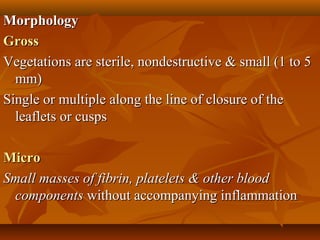
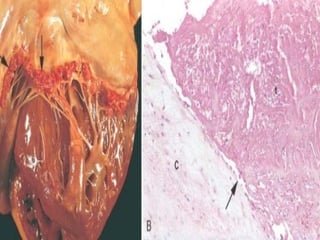
MorphologyMorphology
GrossGross
Vegetations are sterile, nondestructive & small (1 to 5Vegetations are sterile, nondestructive & small (1 to 5
mm)mm)
Single or multiple along the line of closure of theSingle or multiple along the line of closure of the
leaflets or cuspsleaflets or cusps
MicroMicro
Small masses of fibrin, platelets & other bloodSmall masses of fibrin, platelets & other blood
componentscomponents without accompanying inflammationwithout accompanying inflammation
Pathogenesis of NBTEPathogenesis of NBTE
Predisposing conditionsPredisposing conditions
1.Hypercoagulable state1.Hypercoagulable state
-DIC-DIC
-C-Cancerancer –Mucinous adenocacarcinoma, APML–Mucinous adenocacarcinoma, APML
- Hyperestrogenic states- Hyperestrogenic states
- Extensive burns or sepsis- Extensive burns or sepsis
2.Endocardial trauma-2.Endocardial trauma- an indwelling catheteran indwelling catheter
Endocarditis of SLE (Libman-SacksEndocarditis of SLE (Libman-Sacks ))
SLESLE
 Valvulitis with small, sterile vegetations (Valvulitis with small, sterile vegetations (Libman-SacksLibman-Sacks
endocarditisendocarditis ))
 Thrombotic heart valve lesions with sterile vegetations -Thrombotic heart valve lesions with sterile vegetations -
antiphospholipid syndrome due to circulatingantiphospholipid syndrome due to circulating
antiphospholipid antibodiesantiphospholipid antibodies
 The mitral valve is more frequently involved than the aorticThe mitral valve is more frequently involved than the aortic
 Regurgitation is the usual functional abnormalityRegurgitation is the usual functional abnormality
MorphologyMorphology
GrossGross
 Vegetations are small single/ multiple, sterile,Vegetations are small single/ multiple, sterile,
granular pink (1 to 4 mm in diameter)granular pink (1 to 4 mm in diameter)
 Located on the undersurfaces of the AV valves/ theLocated on the undersurfaces of the AV valves/ the
valvular endocardium / cords/ muralvalvular endocardium / cords/ mural
HistologicallyHistologically
 Finely granular, fibrinous eosinophilic material thatFinely granular, fibrinous eosinophilic material that
may contain hematoxylin bodiesmay contain hematoxylin bodies
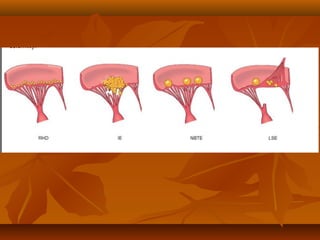
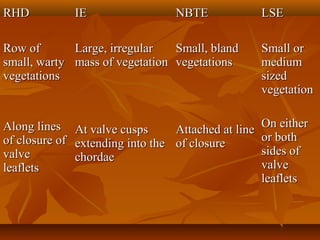
RHDRHD IEIE NBTENBTE LSELSE
Row ofRow of
small, wartysmall, warty
vegetationsvegetations
Along linesAlong lines
of closure ofof closure of
valvevalve
leafletsleaflets
Large, irregularLarge, irregular
mass of vegetationmass of vegetation
At valve cuspsAt valve cusps
extending into theextending into the
chordaechordae
Small, blandSmall, bland
vegetationsvegetations
Attached at lineAttached at line
of closureof closure
Small orSmall or
mediummedium
sizedsized
vegetationvegetation
On eitherOn either
or bothor both
sides ofsides of
valvevalve
leafletsleaflets
ARTIFICIAL VALVESARTIFICIAL VALVES
Primarily 2 categoriesPrimarily 2 categories
(1)(1) mechanical prosthesesmechanical prostheses using nonphysiologicusing nonphysiologic
biomaterialsbiomaterials
(caged balls, tilting disks, or hinged semicircular(caged balls, tilting disks, or hinged semicircular
flaps)flaps)
(2)(2) tissue valvestissue valves, usually, usually bioprosthesesbioprostheses consisting ofconsisting of
chemically treated animal tissuechemically treated animal tissue
( porcine aortic valve tissue preserved in a dilute( porcine aortic valve tissue preserved in a dilute
glutaraldehyde solution& mounted on a prostheticglutaraldehyde solution& mounted on a prosthetic
COMPLICATIONS OF ARTIFICIALCOMPLICATIONS OF ARTIFICIAL
VALVESVALVES
Approximately 60% of substitute valve recipientsApproximately 60% of substitute valve recipients
develop complications within 10 years postop.develop complications within 10 years postop.
Frequency of complications is same but the nature isFrequency of complications is same but the nature is
different with different types of artificial valvesdifferent with different types of artificial valves
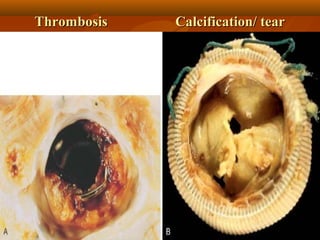
Thrombosis Calcification/ tearThrombosis Calcification/ tear
Cause of failure of cardiac valveCause of failure of cardiac valve
prosthesisprosthesis
 Thrombosis/thromboembolismThrombosis/thromboembolism
 Anticoagulant-related hemorrhageAnticoagulant-related hemorrhage
 Prosthetic valve endocarditisProsthetic valve endocarditis
 Structural deterioration - Wear, fracture, poppet failure in ball valves,Structural deterioration - Wear, fracture, poppet failure in ball valves,
cuspal tear, calcificationcuspal tear, calcification
 Nonstructural dysfunction- Granulation tissue, suture, tissueNonstructural dysfunction- Granulation tissue, suture, tissue
entrapment, paravalvular leak, disproportion, hemolytic anemiaentrapment, paravalvular leak, disproportion, hemolytic anemia
Prophylactic use of antibiotics in patients withProphylactic use of antibiotics in patients with
some form of cardiac anomaly /artificial valve who issome form of cardiac anomaly /artificial valve who is
to undergo a dental, surgical, or other invasiveto undergo a dental, surgical, or other invasive
procedureprocedure
Prompt diagnosis and effective treatment of IEPrompt diagnosis and effective treatment of IE
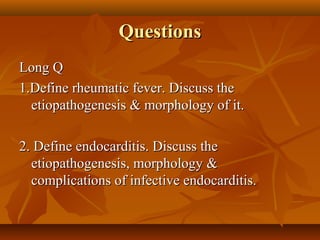
QuestionsQuestions
Long QLong Q
1.Define rheumatic fever. Discuss the1.Define rheumatic fever. Discuss the
etiopathogenesis & morphology of it.etiopathogenesis & morphology of it.
2. Define endocarditis. Discuss the2. Define endocarditis. Discuss the
etiopathogenesis, morphology &etiopathogenesis, morphology &
complications of infective endocarditis.complications of infective endocarditis.
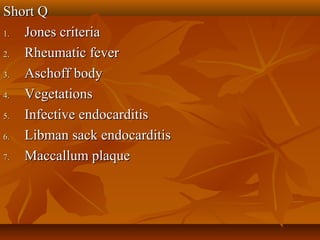
Short QShort Q
1.1. Jones criteriaJones criteria
2.2. Rheumatic feverRheumatic fever
3.3. Aschoff bodyAschoff body
4.4. VegetationsVegetations
5.5. Infective endocarditisInfective endocarditis
6.6. Libman sack endocarditisLibman sack endocarditis
7.7. Maccallum plaqueMaccallum plaque

Infective endocarditis 16 4-2016

  • 1.
  • 2.
    It is thecolonization or invasion of the heart valves orIt is the colonization or invasion of the heart valves or the mural endocardium by athe mural endocardium by a microbemicrobe, leading to the, leading to the formation of bulky, friableformation of bulky, friable vegetationsvegetations Other sites of colonization- Aorta, aneurysmal sacs &Other sites of colonization- Aorta, aneurysmal sacs & blood vesselsblood vessels Vegetations are composed of thrombotic debris &Vegetations are composed of thrombotic debris & organismsorganisms Most cases are bacterial , others- fungi, rickettsiae (QMost cases are bacterial , others- fungi, rickettsiae (Q fever) & Chlamydiaefever) & Chlamydiae
  • 3.
    Acute endocarditisAcute endocarditis Frequently affects a previously normal heart valveFrequently affects a previously normal heart valve  Highly virulent organismsHighly virulent organisms  Mortality high despite treatment (> 50% )Mortality high despite treatment (> 50% )  Lesions produced- Necrotizing, ulcerative,Lesions produced- Necrotizing, ulcerative, invasive valvular infectionsinvasive valvular infections
  • 4.
    Subacute endocarditisSubacute endocarditis Insidious onset & even if untreated pursue a protractedInsidious onset & even if untreated pursue a protracted coursecourse  Organisms of low virulenceOrganisms of low virulence  Previously abnormal heart, particularly on deformed valvesPreviously abnormal heart, particularly on deformed valves  Most patients recover after appropriate antibiotic therapyMost patients recover after appropriate antibiotic therapy  Vegetations often show evidence of healingVegetations often show evidence of healing
  • 5.
    ETIOPATHOLOGYETIOPATHOLOGY Predisposing factorsPredisposing factors -RHDRHD - Myxomatous mitral valveMyxomatous mitral valve - Degenerative calcific valvular stenosisDegenerative calcific valvular stenosis - Bicuspid aortic valveBicuspid aortic valve - Prosthetic valvesProsthetic valves - Host factors (Neutropenia, immunodeficiency,Host factors (Neutropenia, immunodeficiency, malignancy, therapeutic immunosuppression, DM,malignancy, therapeutic immunosuppression, DM, alcohol or IV drug abusealcohol or IV drug abuse - Indwelling vascular cathetersIndwelling vascular catheters
  • 6.
    Bacterial endocarditis- MitralvalveBacterial endocarditis- Mitral valve
  • 7.
    Causative organismsCausative organisms Streptococcus viridansStreptococcus viridans -Native but previously-Native but previously damaged /abnormal valves -50% to 60%damaged /abnormal valves -50% to 60%  S. aureusS. aureus organisms- Either healthy or deformedorganisms- Either healthy or deformed valves & IV drug abusers (10% to 20%)valves & IV drug abusers (10% to 20%)  Enterococci & HACEK groupEnterococci & HACEK group  Prosthetic valve endocarditis -Coagulase-negativeProsthetic valve endocarditis -Coagulase-negative Staphylococci (Staphylococci (S. epidermidisS. epidermidis))  Gram-negative bacilli and fungiGram-negative bacilli and fungi
  • 8.
    Culture-negative" endocarditis- 10%of casesCulture-negative" endocarditis- 10% of cases
  • 9.
    Seeding of theblood with microbesSeeding of the blood with microbes The portal of entry of bloodstreamThe portal of entry of bloodstream - Obvious infection elsewhereObvious infection elsewhere - Dental or surgical procedure that causes a transientDental or surgical procedure that causes a transient bacteremiabacteremia - Injection of contaminated material directly into theInjection of contaminated material directly into the bloodstream by IV drug usersbloodstream by IV drug users - Occult source from the gut, oral cavity or trivial injuriesOccult source from the gut, oral cavity or trivial injuries
  • 10.
    MORPHOLOGYMORPHOLOGY GROSSGROSS HeartHeart  Friable, bulkyvegetationsFriable, bulky vegetations  Vegetations may be single or multiple and mayVegetations may be single or multiple and may involve more than one valveinvolve more than one valve  Vegetations if erode into the underlyingVegetations if erode into the underlying myocardium produce an abscess cavitymyocardium produce an abscess cavity (ring(ring abscess)abscess)
  • 11.
    SystemicSystemic Emboli may causeinfarcts in the brain, kidneys,Emboli may cause infarcts in the brain, kidneys, myocardium & other tissues (septic infarcts)myocardium & other tissues (septic infarcts) MicroscopicallyMicroscopically  Vegetations are composed of thrombotic debris &Vegetations are composed of thrombotic debris & organismsorganisms  Vegetations of SABE often have granulation tissueVegetations of SABE often have granulation tissue at their bases ,fibrosis, calcification & MNICsat their bases ,fibrosis, calcification & MNICs
  • 13.
    CLINICAL FEATURESCLINICAL FEATURES Fever is the most consistent sign of IEFever is the most consistent sign of IE  Nonspecific fatigue, loss of weight & a flulike syndromeNonspecific fatigue, loss of weight & a flulike syndrome  Murmurs are present in 90% of patients with left-sidedMurmurs are present in 90% of patients with left-sided lesionslesions Complications generally begin within the first weeks of theComplications generally begin within the first weeks of the onset of the diseaseonset of the disease -Immunologically mediated - glomerulonephritis-Immunologically mediated - glomerulonephritis
  • 14.
    Secondary to microemboli-UncommonSecondary to microemboli -Uncommon  Petechiae in the nail bed of the digits (Petechiae in the nail bed of the digits (splinter or subungualsplinter or subungual hemorrhages)hemorrhages)  Erythematous/ hemorrhagic nontender lesions on the palmsErythematous/ hemorrhagic nontender lesions on the palms or solesor soles (Janeway lesions)(Janeway lesions)  Subcutaneous nodules in the pulp of the digitsSubcutaneous nodules in the pulp of the digits (Osler nodes(Osler nodes))  Retinal hemorrhagesRetinal hemorrhages (Roth spots(Roth spots))
  • 15.
    DUKE CRITERIA fordiagnosis ofDUKE CRITERIA for diagnosis of IEIE Requires either pathologic or clinical criteriaRequires either pathologic or clinical criteria If clinical criteria are used, then for diagnosisIf clinical criteria are used, then for diagnosis 2 major2 major 1 major + 3 minor1 major + 3 minor 5 minor5 minor
  • 16.
    Pathologic criteriaPathologic criteria 1.1.Microorganisms demonstrated by culture/Microorganisms demonstrated by culture/ histologic exam in a vegetation/ embolus fromhistologic exam in a vegetation/ embolus from vegetation or intracardiac abscessvegetation or intracardiac abscess 2.2. Histologic confirmation of active endocarditis inHistologic confirmation of active endocarditis in vegetation of intracardiac abscessvegetation of intracardiac abscess
  • 17.
    MajorMajor MinorMinor 1. Positiveblood culture1. Positive blood culture indicating characteristicindicating characteristic organismorganism 1. Predisposing heart lesion/1. Predisposing heart lesion/ IV drug abuseIV drug abuse 2. Echo- Valve related mass/2. Echo- Valve related mass/ abscessabscess 2.Fever2.Fever 3.Valvular lesion3.Valvular lesion 3. New valvular regurgitation3. New valvular regurgitation 4.Immunological phenomena4.Immunological phenomena 5. Microbiologic evidence-5. Microbiologic evidence- Uncharacteristic organismUncharacteristic organism 6. Echo- New valvular6. Echo- New valvular regurgitation/ pericarditisregurgitation/ pericarditis
  • 18.
  • 20.
    Nonbacterial Thrombotic Endocarditis(NBTE)Nonbacterial Thrombotic Endocarditis (NBTE) / Marantic/ Marantic endocarditisendocarditis  Characterized by the deposition of) on the leaflets of theCharacterized by the deposition of) on the leaflets of the cardiac valves small masses of fibrin, platelets & othercardiac valves small masses of fibrin, platelets & other blood components (Vegetationblood components (Vegetation  Valvular lesions are sterileValvular lesions are sterile  Seen in debilitated patients (cancer or sepsis)Seen in debilitated patients (cancer or sepsis)  May produce emboli and resultant infarcts in the brain,May produce emboli and resultant infarcts in the brain, heart or elsewhereheart or elsewhere
  • 21.
  • 22.
    MorphologyMorphology GrossGross Vegetations are sterile,nondestructive & small (1 to 5Vegetations are sterile, nondestructive & small (1 to 5 mm)mm) Single or multiple along the line of closure of theSingle or multiple along the line of closure of the leaflets or cuspsleaflets or cusps MicroMicro Small masses of fibrin, platelets & other bloodSmall masses of fibrin, platelets & other blood componentscomponents without accompanying inflammationwithout accompanying inflammation
  • 24.
    Pathogenesis of NBTEPathogenesisof NBTE Predisposing conditionsPredisposing conditions 1.Hypercoagulable state1.Hypercoagulable state -DIC-DIC -C-Cancerancer –Mucinous adenocacarcinoma, APML–Mucinous adenocacarcinoma, APML - Hyperestrogenic states- Hyperestrogenic states - Extensive burns or sepsis- Extensive burns or sepsis 2.Endocardial trauma-2.Endocardial trauma- an indwelling catheteran indwelling catheter
  • 25.
    Endocarditis of SLE(Libman-SacksEndocarditis of SLE (Libman-Sacks )) SLESLE  Valvulitis with small, sterile vegetations (Valvulitis with small, sterile vegetations (Libman-SacksLibman-Sacks endocarditisendocarditis ))  Thrombotic heart valve lesions with sterile vegetations -Thrombotic heart valve lesions with sterile vegetations - antiphospholipid syndrome due to circulatingantiphospholipid syndrome due to circulating antiphospholipid antibodiesantiphospholipid antibodies  The mitral valve is more frequently involved than the aorticThe mitral valve is more frequently involved than the aortic  Regurgitation is the usual functional abnormalityRegurgitation is the usual functional abnormality
  • 26.
    MorphologyMorphology GrossGross  Vegetations aresmall single/ multiple, sterile,Vegetations are small single/ multiple, sterile, granular pink (1 to 4 mm in diameter)granular pink (1 to 4 mm in diameter)  Located on the undersurfaces of the AV valves/ theLocated on the undersurfaces of the AV valves/ the valvular endocardium / cords/ muralvalvular endocardium / cords/ mural HistologicallyHistologically  Finely granular, fibrinous eosinophilic material thatFinely granular, fibrinous eosinophilic material that may contain hematoxylin bodiesmay contain hematoxylin bodies
  • 27.
    RHDRHD IEIE NBTENBTELSELSE Row ofRow of small, wartysmall, warty vegetationsvegetations Along linesAlong lines of closure ofof closure of valvevalve leafletsleaflets Large, irregularLarge, irregular mass of vegetationmass of vegetation At valve cuspsAt valve cusps extending into theextending into the chordaechordae Small, blandSmall, bland vegetationsvegetations Attached at lineAttached at line of closureof closure Small orSmall or mediummedium sizedsized vegetationvegetation On eitherOn either or bothor both sides ofsides of valvevalve leafletsleaflets
  • 28.
    ARTIFICIAL VALVESARTIFICIAL VALVES Primarily2 categoriesPrimarily 2 categories (1)(1) mechanical prosthesesmechanical prostheses using nonphysiologicusing nonphysiologic biomaterialsbiomaterials (caged balls, tilting disks, or hinged semicircular(caged balls, tilting disks, or hinged semicircular flaps)flaps) (2)(2) tissue valvestissue valves, usually, usually bioprosthesesbioprostheses consisting ofconsisting of chemically treated animal tissuechemically treated animal tissue ( porcine aortic valve tissue preserved in a dilute( porcine aortic valve tissue preserved in a dilute glutaraldehyde solution& mounted on a prostheticglutaraldehyde solution& mounted on a prosthetic
  • 29.
    COMPLICATIONS OF ARTIFICIALCOMPLICATIONSOF ARTIFICIAL VALVESVALVES Approximately 60% of substitute valve recipientsApproximately 60% of substitute valve recipients develop complications within 10 years postop.develop complications within 10 years postop. Frequency of complications is same but the nature isFrequency of complications is same but the nature is different with different types of artificial valvesdifferent with different types of artificial valves
  • 30.
  • 31.
    Cause of failureof cardiac valveCause of failure of cardiac valve prosthesisprosthesis  Thrombosis/thromboembolismThrombosis/thromboembolism  Anticoagulant-related hemorrhageAnticoagulant-related hemorrhage  Prosthetic valve endocarditisProsthetic valve endocarditis  Structural deterioration - Wear, fracture, poppet failure in ball valves,Structural deterioration - Wear, fracture, poppet failure in ball valves, cuspal tear, calcificationcuspal tear, calcification  Nonstructural dysfunction- Granulation tissue, suture, tissueNonstructural dysfunction- Granulation tissue, suture, tissue entrapment, paravalvular leak, disproportion, hemolytic anemiaentrapment, paravalvular leak, disproportion, hemolytic anemia
  • 32.
    Prophylactic use ofantibiotics in patients withProphylactic use of antibiotics in patients with some form of cardiac anomaly /artificial valve who issome form of cardiac anomaly /artificial valve who is to undergo a dental, surgical, or other invasiveto undergo a dental, surgical, or other invasive procedureprocedure Prompt diagnosis and effective treatment of IEPrompt diagnosis and effective treatment of IE
  • 33.
    QuestionsQuestions Long QLong Q 1.Definerheumatic fever. Discuss the1.Define rheumatic fever. Discuss the etiopathogenesis & morphology of it.etiopathogenesis & morphology of it. 2. Define endocarditis. Discuss the2. Define endocarditis. Discuss the etiopathogenesis, morphology &etiopathogenesis, morphology & complications of infective endocarditis.complications of infective endocarditis.
  • 34.
    Short QShort Q 1.1.Jones criteriaJones criteria 2.2. Rheumatic feverRheumatic fever 3.3. Aschoff bodyAschoff body 4.4. VegetationsVegetations 5.5. Infective endocarditisInfective endocarditis 6.6. Libman sack endocarditisLibman sack endocarditis 7.7. Maccallum plaqueMaccallum plaque