INFECTIVE
ENDOCARDITIS
- A REVIEW.
Dr Hasan Mahmud Iqbal
NHFH&RI.
Definition:
IE is defined as infection of heart valve(native or
prosthetic) , lining of a cardiac chamber or blood vessel
or congenital anomaly (eg septal defect) and implanted
devices caused by micro-organism that invariably fatal
if untreated.
Population Groups At Greater Risk:
•Congenital Heart Disease(Aortic valve-
BAV,VSD,Tetralogy
of Fallot, MVP, ASD primum)
•Acquired heart disease(eg. AR, MR)
•Hemodialysis
•Previous History Of Endocarditis
•Patients With Prosthetic Valves
•IV Drug Users (30% Risk Within 2 Years)
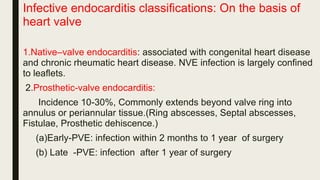
Infective endocarditis classifications: On the basis of
heart valve
1.Native–valve endocarditis: associated with congenital heart disease
and chronic rheumatic heart disease. NVE infection is largely confined
to leaflets.
2.Prosthetic-valve endocarditis:
Incidence 10-30%, Commonly extends beyond valve ring into
annulus or periannular tissue.(Ring abscesses, Septal abscesses,
Fistulae, Prosthetic dehiscence.)
(a)Early-PVE: infection within 2 months to 1 year of surgery
(b) Late -PVE: infection after 1 year of surgery
On the basis of culture:
Culture positive IE :
- up to 80%
Culture negative IE :
-Upto 20%, highly fastidious organism,
inadequate culture technique, non bacterial pathogen,
previous antibiotics therapy,non infectious endocarditis
like Libman sac(APS),marantic
endocarditis(malignancy).
On the basis micro-organism:
Bacterial- (predominant)- Staph Aureus is single
most common cause
Non-bacterial- Fungi -common in drug abuser,
immunosuppressed, cardiac surgery.
-Large, friable vegetation.
-High mortality(survival< 20%)
-Rickettsia, Chlamydia(Others)
Mode of clinical presentation
Acute:
-Toxic presentation, Progressive valve destruction &
metastatic infection developing in days to weeks.
-Most commonly caused by S.
aureus,Complications more.
Subacute:
Presentation over weeks to months, Rarely leads to
metastatic infection
- Most commonly S. viridans or enterococcus.
Causative agents:
●Staphylococci-S.aureus,S.albus
●Streptococci-S.vridians,S.faecalis,S.mutans,S.bovis
●Enterococci
●Coxiella burnetii-H/O Contract with farm animals
-Aortic valve affected mainly
-Hepatitis,pneumonia,purpura
-Life long antibiotic therapy
●HACEK group(Haemophillus,Actinobacillus actino
mycetem-comitans,Cardiobacterium hominis,Eikenella)
- Detected after prolonged culture
- Resistant to penicillin
● Brucella
-H/O contact with goats or cattle
-Affect mainly aortic valve
●Yeast & fungi
-Candida
-Aspergillus
DIAGNOSIS
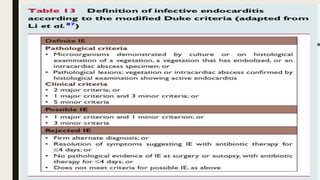
Modified Major Diagnostic Criteria –According to ESC
2015 Guideline: No :1
■ Modified Major Diagnostic Criteria –According to ESC
2015 Guideline: No:2.
Nail Fold Infarction:
MANAGEMENT APPROACH:
 DIET: No special diet ,If CCF – Salt restriction is
necessary
 Oxygen therapy –If necessary.
 3 Sets of blood for culture& we have to start
empirical antibiotic therapy.
 If ALVF & CCF : Appro. Medical management.
 Surgery – Carefully case selection.
Acutely I'll – Native Valve – Empirical Rx
Acutely I'll – Prosthetic Valve – Empirical Rx
Native Valve –Staphylococcal
Infection
Native Valve: Penicillin Allergic -
Staphylococcal
Prosthetic Valve –Staphylococcal Infection
Streptococcus- penicillin sensitive
Streptococcus- penicillin sensitive:
Streptococcus- penicillin allergic pt.
Treatment in Culture Negatives:
Indications for Surgery….
Chemoprophylaxis
Chemoprophylaxis:
Key Messages
 Antibiotics are the mainstay of treatment for
infective endocarditis (IE).
 Goals to maximize treatment success are early
diagnosis, accurate microorganism identification,
reliable susceptibility testing, prolonged intravenous
(IV) administration of bactericidal antimicrobial
agents, proper monitoring of potentially toxic
antimicrobial regimens, and aggressive surgical
management of correctable mechanical
complications.
5 min review  infec endocarditis

5 min review infec endocarditis