Dr. Mangala G
Learning Objectives
• Familiar with the different branches of genetics
• Able to recollect and understand the basic
concepts in genetics like penentrance, pleiotropy
etc.
• Able to explain the basis of classification of
genetic disorders
• Able to list the single gene disorders
• Able to explain the principles of Mendelian law
of inheritance
• Able to explain/discuss the biochemical/molecular
basis of single gene disorders
Cytogenetics
It deals with the study of chromosomes
and of sex chromatin
Developmental genetics
Genetic control of physiological
processes in the initial prenatal
period of 12 weeks
• Biochemical genetics
Proteins make a structural
protein/enzyme that control various
metabolic processes in the body
thereby influencing growth and
differentiation
Mutations in DNA --- VARIANT
protein synthesis --- phenotypic effect
1. Gene mutations leading to inborn errors
of metabolism
2. Haemoglobinopathies
3. Polymorphisms revealed by an altered
response to drugs
Immunogenetics
It deals with the genetic basis of the
immunological phenomenon in an
organism
Cancer genetics
Population genetics
It deals with the study of genes in
population.
It also tells us about distribution of genes
and how genotypes are maintained or
changed in population.
Pleiotropy
• Phenomenon in which a single gene mutation
leads to many phenotypic effects is called
pleiotropism
• Eg: Marfan’s syndrome
• Single gene mutation in gene fibrillin affects
connective tissue component of skeleton, eye
and CVS leading to dislocated lens, mitral
valve prolapse
Genetic heterogeneity
• Phenomenon in which mutations at different
genetic loci produce same result is called
genetic heterogeneity
• Eg: Retinitis pigmentosa
Penentrance
• Phenotypic expression of an inherited mutant
gene / percentage carriers of the gene that
express the trait is called penentrance
• When some individuals inherit the mutant gene
but are phenotypically normal (person may
have the abnormal gene but never expressed
the disease) trait is of reduced penentrance
Variable expressivity
• If a trait is seen in all individuals carrying the
mutant gene but express the disease with
different severity it is called variable
expressivity
• Eg: neurofibromatosis
Type of mutations
(based on the extent of damage)
Genome mutation: (whole chromosome)
loss or gain of whole chromosome giving rise to
monosomy or trisomy
Chromosome mutation:
(visible chromosome change)
Rearrangement of genetic material giving rise to
visible changes in the chromosome
– Gene mutation: (may, and often, result in a
single base error)
GENETIC DISORDERS
 Single gene mutations, following
classical Mendelian inheritance patterns
 Multifactorial inheritance
 Chromosomal disorders
Structural /numerical abnormalities in
autosomes and sex chromosomes
Multifactorial inheritance
Diseases involved by both genetics as well as
environmental influences
Caused by interaction between multiple variant
forms of genes and environmental factors
No single susceptible gene is individually sufficient
for inducing the disease
Eg: Cleft lip or palate
Congenital heart disease, Coronary heart disease
Hypertension, Type II DM
SINGLE-GENE DISORDERS
These disorders are the result of mutation of a
single gene of large effect
 Mutation refers to PERMANENT change in DNA
muatations that affect germ cells
- transmitted to progeny
- give rise to inherited disorders mutations in
somatic cells - not transmitted to progeny
- give rise to cancers and congenital malformations
GENE MUTATIONS
• Point mutation
• Substitution of a single nucleotide base by
a different base
• Val ----- Glutamic acid
• Frame shift mutation
• Insertion / deletion of one or two base
pairs in the DNA sequence
Eg: Cystic fibrosis of pancreas
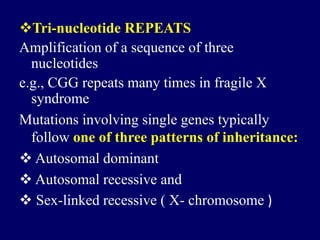
Tri-nucleotide REPEATS
Amplification of a sequence of three
nucleotides
e.g., CGG repeats many times in fragile X
syndrome
Mutations involving single genes typically
follow one of three patterns of inheritance:
 Autosomal dominant
 Autosomal recessive and
 Sex-linked recessive ( X- chromosome )
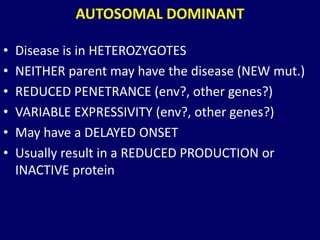
AUTOSOMAL DOMINANT
• Disease is in HETEROZYGOTES
• NEITHER parent may have the disease (NEW mut.)
• REDUCED PENETRANCE (env?, other genes?)
• VARIABLE EXPRESSIVITY (env?, other genes?)
• May have a DELAYED ONSET
• Usually result in a REDUCED PRODUCTION or
INACTIVE protein
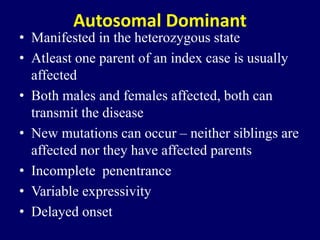
Autosomal Dominant
• Manifested in the heterozygous state
• Atleast one parent of an index case is usually
affected
• Both males and females affected, both can
transmit the disease
• New mutations can occur – neither siblings are
affected nor they have affected parents
• Incomplete penentrance
• Variable expressivity
• Delayed onset
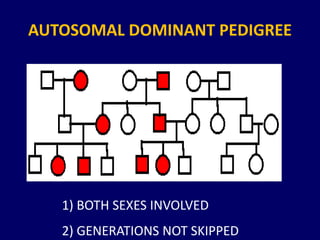
AUTOSOMAL DOMINANT PEDIGREE
1) BOTH SEXES INVOLVED
2) GENERATIONS NOT SKIPPED
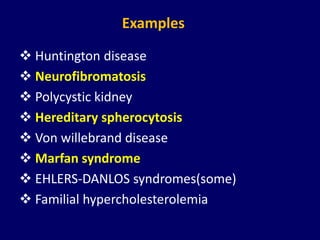
Examples
 Huntington disease
 Neurofibromatosis
 Polycystic kidney
 Hereditary spherocytosis
 Von willebrand disease
 Marfan syndrome
 EHLERS-DANLOS syndromes(some)
 Familial hypercholesterolemia
• Clinical features can be modified by
variations in penentrance and
expressivity
• Eg: Neurofibromatosis type 1
brownish spots on the skin to multiple skin
tumors and skeletal deformities
Autosomal recessive disorders
• Most common type of Mendelian disorder
• Parents may not show the disease, but siblings
may
• Siblings have one chance in four of having
trait
• Expression of defect more uniform than in AD
• Complete penentrance is common
• Early onset in life
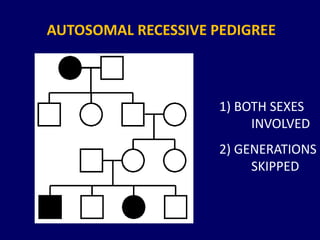
AUTOSOMAL RECESSIVE PEDIGREE
1) BOTH SEXES
INVOLVED
2) GENERATIONS
SKIPPED
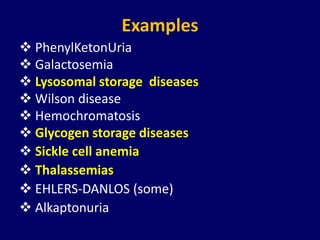
Examples
 PhenylKetonUria
 Galactosemia
 Lysosomal storage diseases
 Wilson disease
 Hemochromatosis
 Glycogen storage diseases
 Sickle cell anemia
 Thalassemias
 EHLERS-DANLOS (some)
 Alkaptonuria
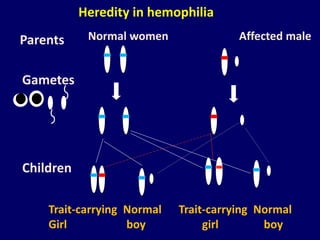
Heredity in hemophilia
Normal women Affected male
Gametes
Children
Parents
Trait-carrying Normal Trait-carrying Normal
Girl boy girl boy
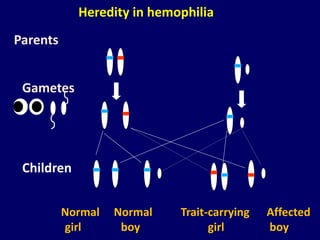
Heredity in hemophilia
Gametes
Children
Parents
Normal Normal Trait-carrying Affected
girl boy girl boy
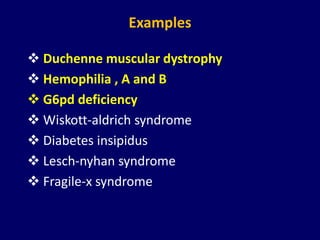
Examples
 Duchenne muscular dystrophy
 Hemophilia , A and B
 G6pd deficiency
 Wiskott-aldrich syndrome
 Diabetes insipidus
 Lesch-nyhan syndrome
 Fragile-x syndrome
Biochemical and molecular basis of
Single-gene (Mendelian) disorders
1. Enzyme defects and their
consequences
2. defects in membrane receptors and
transport systems
3. alteration in the structure, function or
quantity of non-enzyme proteins
4. Mutations involving unusual reaction
to drugs
Enzyme defects and their consequences
• Mutations result in the synthesis of an enzyme
with reduced activity / reduced amount of
normal enzyme
• Metabolic block
• A) accumalation of substrate
eg: accumalation of substrates in the lysosomes
due to deficiency of degradative enzymes –
lysosomal storage diseases
• an enzyme defect leading to decreased
amount of end product
• Eg: albinism
def. of tyrosinase leads to reduced synthesis
of melanin from tyrosine
Defects in the receptors and transport
systems
• Eg: reduced synthesis/function of LDL receptor
leads to defective transport of LDL into cells ---
excessive cholesterol synthesis --- familial
hypercholesterolemia
• Cystic fibrosis --- transport system for chloride
ions is defective in sweat glands, lungs and
pancreas
Alteration in structure, function /
quantity of non-enzyme proteins
• Thalassemia – reduced amount of
alpha/beta chains
• Defective structural proteins – collagen,
spectrin / dystrophin
• Osteogenesis imperfecta, hereditory
spherocytosis and muscular dystrophies
Genetically determined adverse
reaction to drugs
• Eg: G6PD
Hemolytic anemia on taking antimalarial drug
Primaquine
MCQ’s
1. Albinism results from deficiency of
A) Catalase
B) Tyrosinase
C) Xanthine oxidase
D) Pyruvate kinase
2. Most striking example of disease due to
point mutation
A) Sickle cell anemia
B) Down’s syndrome
3. In human beings, multiple genes are involved
in the inheritance of
A) Sickle cell anemia
B) Haemophilia
C) Phenylketonuria
D) Skin colour
4. G-6-PD is associated with the hemolysis of
A) Lymphocytes
B) Neutrophils
C) RBC’s
D) Platelets

Introduction to genetic disorders, classification 26 10-2016

  • 2.
  • 3.
    Learning Objectives • Familiarwith the different branches of genetics • Able to recollect and understand the basic concepts in genetics like penentrance, pleiotropy etc. • Able to explain the basis of classification of genetic disorders • Able to list the single gene disorders • Able to explain the principles of Mendelian law of inheritance • Able to explain/discuss the biochemical/molecular basis of single gene disorders
  • 4.
    Cytogenetics It deals withthe study of chromosomes and of sex chromatin Developmental genetics Genetic control of physiological processes in the initial prenatal period of 12 weeks
  • 5.
    • Biochemical genetics Proteinsmake a structural protein/enzyme that control various metabolic processes in the body thereby influencing growth and differentiation Mutations in DNA --- VARIANT protein synthesis --- phenotypic effect
  • 6.
    1. Gene mutationsleading to inborn errors of metabolism 2. Haemoglobinopathies 3. Polymorphisms revealed by an altered response to drugs Immunogenetics It deals with the genetic basis of the immunological phenomenon in an organism Cancer genetics
  • 7.
    Population genetics It dealswith the study of genes in population. It also tells us about distribution of genes and how genotypes are maintained or changed in population.
  • 8.
    Pleiotropy • Phenomenon inwhich a single gene mutation leads to many phenotypic effects is called pleiotropism • Eg: Marfan’s syndrome • Single gene mutation in gene fibrillin affects connective tissue component of skeleton, eye and CVS leading to dislocated lens, mitral valve prolapse
  • 9.
    Genetic heterogeneity • Phenomenonin which mutations at different genetic loci produce same result is called genetic heterogeneity • Eg: Retinitis pigmentosa
  • 10.
    Penentrance • Phenotypic expressionof an inherited mutant gene / percentage carriers of the gene that express the trait is called penentrance • When some individuals inherit the mutant gene but are phenotypically normal (person may have the abnormal gene but never expressed the disease) trait is of reduced penentrance
  • 11.
    Variable expressivity • Ifa trait is seen in all individuals carrying the mutant gene but express the disease with different severity it is called variable expressivity • Eg: neurofibromatosis
  • 12.
    Type of mutations (basedon the extent of damage) Genome mutation: (whole chromosome) loss or gain of whole chromosome giving rise to monosomy or trisomy Chromosome mutation: (visible chromosome change) Rearrangement of genetic material giving rise to visible changes in the chromosome – Gene mutation: (may, and often, result in a single base error)
  • 13.
    GENETIC DISORDERS  Singlegene mutations, following classical Mendelian inheritance patterns  Multifactorial inheritance  Chromosomal disorders Structural /numerical abnormalities in autosomes and sex chromosomes
  • 14.
    Multifactorial inheritance Diseases involvedby both genetics as well as environmental influences Caused by interaction between multiple variant forms of genes and environmental factors No single susceptible gene is individually sufficient for inducing the disease Eg: Cleft lip or palate Congenital heart disease, Coronary heart disease Hypertension, Type II DM
  • 15.
    SINGLE-GENE DISORDERS These disordersare the result of mutation of a single gene of large effect  Mutation refers to PERMANENT change in DNA muatations that affect germ cells - transmitted to progeny - give rise to inherited disorders mutations in somatic cells - not transmitted to progeny - give rise to cancers and congenital malformations
  • 16.
    GENE MUTATIONS • Pointmutation • Substitution of a single nucleotide base by a different base • Val ----- Glutamic acid • Frame shift mutation • Insertion / deletion of one or two base pairs in the DNA sequence Eg: Cystic fibrosis of pancreas
  • 17.
    Tri-nucleotide REPEATS Amplification ofa sequence of three nucleotides e.g., CGG repeats many times in fragile X syndrome Mutations involving single genes typically follow one of three patterns of inheritance:  Autosomal dominant  Autosomal recessive and  Sex-linked recessive ( X- chromosome )
  • 18.
    AUTOSOMAL DOMINANT • Diseaseis in HETEROZYGOTES • NEITHER parent may have the disease (NEW mut.) • REDUCED PENETRANCE (env?, other genes?) • VARIABLE EXPRESSIVITY (env?, other genes?) • May have a DELAYED ONSET • Usually result in a REDUCED PRODUCTION or INACTIVE protein
  • 19.
    Autosomal Dominant • Manifestedin the heterozygous state • Atleast one parent of an index case is usually affected • Both males and females affected, both can transmit the disease • New mutations can occur – neither siblings are affected nor they have affected parents • Incomplete penentrance • Variable expressivity • Delayed onset
  • 20.
    AUTOSOMAL DOMINANT PEDIGREE 1)BOTH SEXES INVOLVED 2) GENERATIONS NOT SKIPPED
  • 21.
    Examples  Huntington disease Neurofibromatosis  Polycystic kidney  Hereditary spherocytosis  Von willebrand disease  Marfan syndrome  EHLERS-DANLOS syndromes(some)  Familial hypercholesterolemia
  • 22.
    • Clinical featurescan be modified by variations in penentrance and expressivity • Eg: Neurofibromatosis type 1 brownish spots on the skin to multiple skin tumors and skeletal deformities
  • 23.
    Autosomal recessive disorders •Most common type of Mendelian disorder • Parents may not show the disease, but siblings may • Siblings have one chance in four of having trait • Expression of defect more uniform than in AD • Complete penentrance is common • Early onset in life
  • 24.
    AUTOSOMAL RECESSIVE PEDIGREE 1)BOTH SEXES INVOLVED 2) GENERATIONS SKIPPED
  • 25.
    Examples  PhenylKetonUria  Galactosemia Lysosomal storage diseases  Wilson disease  Hemochromatosis  Glycogen storage diseases  Sickle cell anemia  Thalassemias  EHLERS-DANLOS (some)  Alkaptonuria
  • 26.
    Heredity in hemophilia Normalwomen Affected male Gametes Children Parents Trait-carrying Normal Trait-carrying Normal Girl boy girl boy
  • 27.
    Heredity in hemophilia Gametes Children Parents NormalNormal Trait-carrying Affected girl boy girl boy
  • 28.
    Examples  Duchenne musculardystrophy  Hemophilia , A and B  G6pd deficiency  Wiskott-aldrich syndrome  Diabetes insipidus  Lesch-nyhan syndrome  Fragile-x syndrome
  • 29.
    Biochemical and molecularbasis of Single-gene (Mendelian) disorders 1. Enzyme defects and their consequences 2. defects in membrane receptors and transport systems 3. alteration in the structure, function or quantity of non-enzyme proteins 4. Mutations involving unusual reaction to drugs
  • 30.
    Enzyme defects andtheir consequences • Mutations result in the synthesis of an enzyme with reduced activity / reduced amount of normal enzyme • Metabolic block • A) accumalation of substrate eg: accumalation of substrates in the lysosomes due to deficiency of degradative enzymes – lysosomal storage diseases
  • 31.
    • an enzymedefect leading to decreased amount of end product • Eg: albinism def. of tyrosinase leads to reduced synthesis of melanin from tyrosine
  • 32.
    Defects in thereceptors and transport systems • Eg: reduced synthesis/function of LDL receptor leads to defective transport of LDL into cells --- excessive cholesterol synthesis --- familial hypercholesterolemia • Cystic fibrosis --- transport system for chloride ions is defective in sweat glands, lungs and pancreas
  • 33.
    Alteration in structure,function / quantity of non-enzyme proteins • Thalassemia – reduced amount of alpha/beta chains • Defective structural proteins – collagen, spectrin / dystrophin • Osteogenesis imperfecta, hereditory spherocytosis and muscular dystrophies
  • 34.
    Genetically determined adverse reactionto drugs • Eg: G6PD Hemolytic anemia on taking antimalarial drug Primaquine
  • 35.
    MCQ’s 1. Albinism resultsfrom deficiency of A) Catalase B) Tyrosinase C) Xanthine oxidase D) Pyruvate kinase 2. Most striking example of disease due to point mutation A) Sickle cell anemia B) Down’s syndrome
  • 36.
    3. In humanbeings, multiple genes are involved in the inheritance of A) Sickle cell anemia B) Haemophilia C) Phenylketonuria D) Skin colour 4. G-6-PD is associated with the hemolysis of A) Lymphocytes B) Neutrophils C) RBC’s D) Platelets

Editor's Notes

  • #19 Classical concept of a point mutation