Infective Endocarditis

    Dr.Khalid Hama salih, MD
       Pediatrics specialist
  M.B.Ch. D. C.H B.F.I.B.M.S.ped
Definition
Infectious Endocarditis (IE): an infection of
the heart’s endocardial surface
Classified into four groups:
– Native Valve IE
– Prosthetic Valve IE
– Intravenous drug abuse (IVDA) IE
– Nosocomial IE
Epidemiology
Incidence difficult to ascertain and varies
according to location
Much more common in males than in
females
May occur in persons of any age and
increasingly common in elderly
Mortality ranges from 20-30%
Risk Factors
Artificial heart valves and pacemakers
Acquired heart defects
– Calcific aortic stenosis
– Mitral valve prolapse with regurgitation
Congenital heart defects
Intravascular catheters
Infecting Organisms
Common bacteria
– S. aureus
– Streptococci
– Enterococci
Not so common:
– Fungi
– Pseudomonas
– HACEK group - Haemophilus spp,. Actinobacillus actinomycete comitants,
  Cardiobacterium hominis, Eikenella spp, and Kingella kingae.
Pathophysiology
  Turbulent blood flow disrupts the
  endocardium making it “sticky”
n Bacteremia delivers the organisms to
  the endocardial surface
– Adherence of the organisms to the
  endocardial surface
– Eventual invasion of the valvular
  leaflets
SIGNS:
SYMPTOMS:
                             Elevated temperature
 Fever, Chills
                             Tachycardia
                   Night     Embolic phenomena (Roth
 sweats                      spots, petechiae, splinter
 Weight loss, Malaise        hemorrhages, Osler nodes,
                             CNS or ocular lesions)
 CNS:manifestations(strok    Janeway lesions
 e,seizures,headache)        Splenomegaly
 Dyspnea                     Arthritis
                             Heart failure
 Chest and abdominal         Arrhythmias
 pain                        Metastatic infection
 Arthralgia, myalgia         (arthritis, meningitis,
                             mycotic arterial aneurysm,
                             pericarditis, abscesses)
                             Clubbing
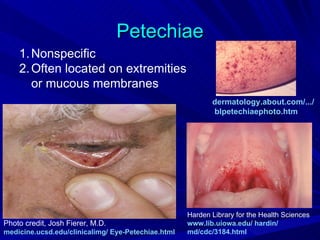
Petechiae
    1. Nonspecific
    2. Often located on extremities
       or mucous membranes
                                                           dermatology.about.com/.../
                                                           blpetechiaephoto.htm


                                                    Harden Library for the Health Sciences
Photo credit, Josh Fierer, M.D.                     www.lib.uiowa.edu/ hardin/
medicine.ucsd.edu/clinicalimg/ Eye-Petechiae.html   md/cdc/3184.html
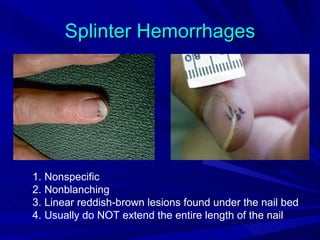
Splinter Hemorrhages


1. Nonspecific
2. Nonblanching
3. Linear reddish-brown lesions found under the nail bed
4. Usually do NOT extend the entire length of the nail
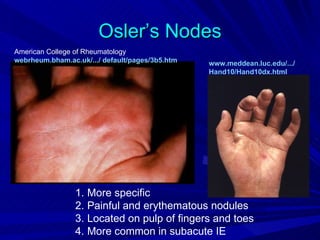
Osler’s Nodes
American College of Rheumatology
webrheum.bham.ac.uk/.../ default/pages/3b5.htm   www.meddean.luc.edu/.../
                                                 Hand10/Hand10dx.html


                 1. More specific
                 2. Painful and erythematous nodules
                 3. Located on pulp of fingers and toes
                 4. More common in subacute IE
Janeway Lesions


1. More specific
2. Erythematous, blanching macules
3. Nonpainful
4. Located on palms and soles
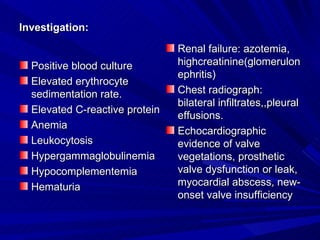
Investigation:

                                Renal failure: azotemia,
  Positive blood culture        highcreatinine(glomerulon
                                ephritis)
  Elevated erythrocyte
  sedimentation rate.           Chest radiograph:
                                bilateral infiltrates,,pleural
  Elevated C-reactive protein
                                effusions.
  Anemia
                                Echocardiographic
  Leukocytosis                  evidence of valve
  Hypergammaglobulinemia        vegetations, prosthetic
  Hypocomplementemia            valve dysfunction or leak,
  Hematuria                     myocardial abscess, new-
                                onset valve insufficiency
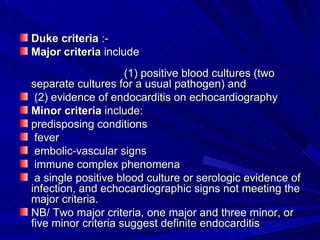
Duke criteria :-
Major criteria include
                     (1) positive blood cultures (two
separate cultures for a usual pathogen) and
 (2) evidence of endocarditis on echocardiography
Minor criteria include:
predisposing conditions
 fever
 embolic-vascular signs
 immune complex phenomena
 a single positive blood culture or serologic evidence of
infection, and echocardiographic signs not meeting the
major criteria.
NB/ Two major criteria, one major and three minor, or
five minor criteria suggest definite endocarditis
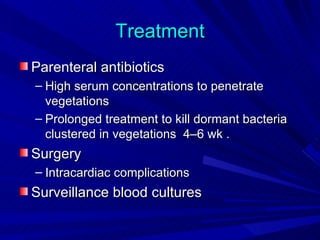
Treatment
Parenteral antibiotics
– High serum concentrations to penetrate
  vegetations
– Prolonged treatment to kill dormant bacteria
  clustered in vegetations 4–6 wk .
Surgery
– Intracardiac complications
Surveillance blood cultures
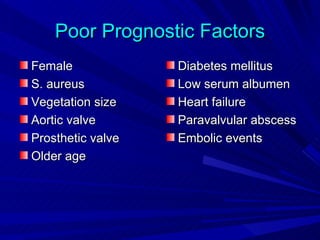
Poor Prognostic Factors
Female             Diabetes mellitus
S. aureus          Low serum albumen
Vegetation size    Heart failure
Aortic valve       Paravalvular abscess
Prosthetic valve   Embolic events
Older age
PREVENTION
Antimicrobial prophylaxis before various
procedures and other forms of dental
manipulation may reduce the incidence of
infective endocarditis in susceptible
patients

Infective endocarditis

  • 1.
    Infective Endocarditis Dr.Khalid Hama salih, MD Pediatrics specialist M.B.Ch. D. C.H B.F.I.B.M.S.ped
  • 2.
    Definition Infectious Endocarditis (IE):an infection of the heart’s endocardial surface Classified into four groups: – Native Valve IE – Prosthetic Valve IE – Intravenous drug abuse (IVDA) IE – Nosocomial IE
  • 3.
    Epidemiology Incidence difficult toascertain and varies according to location Much more common in males than in females May occur in persons of any age and increasingly common in elderly Mortality ranges from 20-30%
  • 4.
    Risk Factors Artificial heartvalves and pacemakers Acquired heart defects – Calcific aortic stenosis – Mitral valve prolapse with regurgitation Congenital heart defects Intravascular catheters
  • 5.
    Infecting Organisms Common bacteria –S. aureus – Streptococci – Enterococci Not so common: – Fungi – Pseudomonas – HACEK group - Haemophilus spp,. Actinobacillus actinomycete comitants, Cardiobacterium hominis, Eikenella spp, and Kingella kingae.
  • 6.
    Pathophysiology Turbulentblood flow disrupts the endocardium making it “sticky” n Bacteremia delivers the organisms to the endocardial surface – Adherence of the organisms to the endocardial surface – Eventual invasion of the valvular leaflets
  • 7.
    SIGNS: SYMPTOMS: Elevated temperature Fever, Chills Tachycardia Night Embolic phenomena (Roth sweats spots, petechiae, splinter Weight loss, Malaise hemorrhages, Osler nodes, CNS or ocular lesions) CNS:manifestations(strok Janeway lesions e,seizures,headache) Splenomegaly Dyspnea Arthritis Heart failure Chest and abdominal Arrhythmias pain Metastatic infection Arthralgia, myalgia (arthritis, meningitis, mycotic arterial aneurysm, pericarditis, abscesses) Clubbing
  • 8.
    Petechiae 1. Nonspecific 2. Often located on extremities or mucous membranes dermatology.about.com/.../ blpetechiaephoto.htm Harden Library for the Health Sciences Photo credit, Josh Fierer, M.D. www.lib.uiowa.edu/ hardin/ medicine.ucsd.edu/clinicalimg/ Eye-Petechiae.html md/cdc/3184.html
  • 9.
    Splinter Hemorrhages 1. Nonspecific 2.Nonblanching 3. Linear reddish-brown lesions found under the nail bed 4. Usually do NOT extend the entire length of the nail
  • 10.
    Osler’s Nodes American Collegeof Rheumatology webrheum.bham.ac.uk/.../ default/pages/3b5.htm www.meddean.luc.edu/.../ Hand10/Hand10dx.html 1. More specific 2. Painful and erythematous nodules 3. Located on pulp of fingers and toes 4. More common in subacute IE
  • 11.
    Janeway Lesions 1. Morespecific 2. Erythematous, blanching macules 3. Nonpainful 4. Located on palms and soles
  • 12.
    Investigation: Renal failure: azotemia, Positive blood culture highcreatinine(glomerulon ephritis) Elevated erythrocyte sedimentation rate. Chest radiograph: bilateral infiltrates,,pleural Elevated C-reactive protein effusions. Anemia Echocardiographic Leukocytosis evidence of valve Hypergammaglobulinemia vegetations, prosthetic Hypocomplementemia valve dysfunction or leak, Hematuria myocardial abscess, new- onset valve insufficiency
  • 13.
    Duke criteria :- Majorcriteria include (1) positive blood cultures (two separate cultures for a usual pathogen) and (2) evidence of endocarditis on echocardiography Minor criteria include: predisposing conditions fever embolic-vascular signs immune complex phenomena a single positive blood culture or serologic evidence of infection, and echocardiographic signs not meeting the major criteria. NB/ Two major criteria, one major and three minor, or five minor criteria suggest definite endocarditis
  • 14.
    Treatment Parenteral antibiotics – Highserum concentrations to penetrate vegetations – Prolonged treatment to kill dormant bacteria clustered in vegetations 4–6 wk . Surgery – Intracardiac complications Surveillance blood cultures
  • 15.
    Poor Prognostic Factors Female Diabetes mellitus S. aureus Low serum albumen Vegetation size Heart failure Aortic valve Paravalvular abscess Prosthetic valve Embolic events Older age
  • 16.
    PREVENTION Antimicrobial prophylaxis beforevarious procedures and other forms of dental manipulation may reduce the incidence of infective endocarditis in susceptible patients

Editor's Notes

  • #4 There is an estimated 10-15,000 new cases of IE diagnosed in the U.S. each year, although the exact incidence of IE is difficult to ascertain. IE is a relatively uncommon disease, is not a reportable disease, and different case definitions have existed throughout the years. Furthermore, the incidence varies greatly depending on geographic regions. IE is more common among males. The male:female ratio varies from 2:1 to 9:1 depending on the source. In the past, IE was a disease of children and young adults. It predominantly affected children with congenital heart disease and adults with rheumatic heart disease. Today, IE commonly affects the elderly, with almost 50% of cases in the U.S. occurring in patients over the age of 60. This may be due to the decreasing incidence of rheumatic heart disease and the increasing proportion of elderly in the U.S. Mortality from IE remains high, and ranges from 20-30% despite newer antibiotics and surgical options.
  • #5 The top three risk factors for IE include, IVDA, prosthetic heart valves, and structural heart disease. IVDA – one large study of IVDAs found that the use of cocaine was associated with a higher risk of IE than other injectable drugs. The most significant risk factor for right-sided IE is IVDA, although left sided disease is quite common among IVDAs. The most common infecting organism is clearly S. aureus, particularly in right-sided infection. Prosthetic valve IE comprises a small proportion of all cases of IE and occurs in only 1% of all patients with artificial heart valves. The greatest risk is in the first year following valve replacement. Structural heart disease – approximately ¾ of all cases of IE occur in patients with preexisting structural heart abnormalities. The most common underlying heart abnormalities include mitral valve prolapse with mitral regurgitation and aortic stenosis. The most common congenital heart defects include Tetralogy of Fallot, bicuspid aortic valves, coarctation of the aorta, VSDs, and patent ductus arteriosus. In general, the higher the gradient of the valvular insufficiency, the higher the risk of IE. One of the greatest risk factors of all is a prior episode of IE. Some studies have documented recurrence as high as 9%.
  • #6 Staphlococcal and Streptococcal organisms comprise over 80% of all infecting organisms.
  • #7 IE often occurs when there is an underlying cardiac abnormality that creates a high-low pressure gradient. The resultant turbulent blood flow disrupts the endocardial surface by peeling away the endothelium. The body’s natural response to endothelial damage is to repair it by laying down a sticky platelet-fibrin meshwork, which is a nidus for infection. Temporary bacteremia delivers the offending organism to the endocardial surface where is sticks to the platelet-fibrin meshwork. This festers into an infection that eventually invades the cardiac valves. The pathophysiology is slightly different with IVDA. It has been postulated that repeated injections of drugs and particulate material causes microtrauma to the cardiac valves, thereby starting the infection cascade.
  • #10 Subungal hemorrhages that extend the entire length of the nail or are primarily located at the proximal end of the nail (near the cuticle) are like due to trauma.