DIWALI
LET’s understand the meaning of the festival of Diwali.
COMPILED BY : VASANT G. OAK
DGM - EHSS
WHAT’s up - 9987592242
What is Diwali?
• Diwali is a Hindu festival which lasts for 6 days.
• It is also celebrated by Sikhs.
• Diwali means “row of lighted lamps” and is often called the
Festival of Lights.
• The festival celebrates good over evil; light over darkness.
• The Goddess of Wealth (Lakshmi) is honoured during Diwali
which is also considered to be the Hindu New Year.
• Because there are many regions in India, Diwali is
celebrated in many different ways (and also all over the
World.)
• Diwali is also used to celebrate a successful harvest.
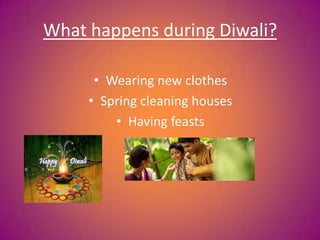
What happens during Diwali?
• Wearing new clothes
• Spring cleaning houses
• Having feasts
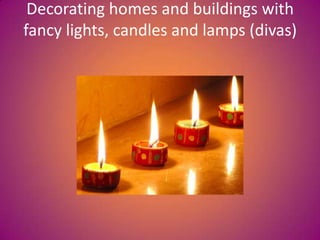
Decorating homes and buildings with
fancy lights, candles and lamps (divas)
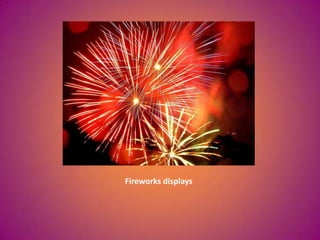
Fireworks displays
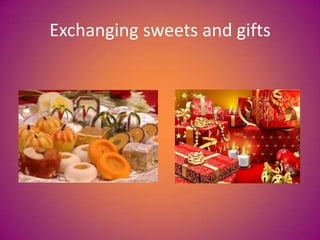
Exchanging sweets and gifts
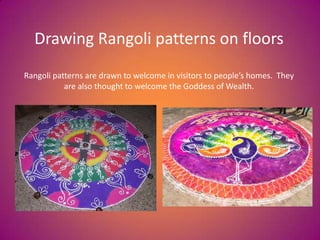
Drawing Rangoli patterns on floors
Rangoli patterns are drawn to welcome in visitors to people’s homes. They
are also thought to welcome the Goddess of Wealth.
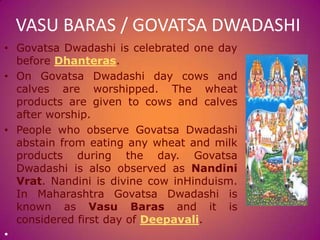
VASU BARAS / GOVATSA DWADASHI
• Govatsa Dwadashi is celebrated one day
before Dhanteras.
• On Govatsa Dwadashi day cows and
calves are worshipped. The wheat
products are given to cows and calves
after worship.
• People who observe Govatsa Dwadashi
abstain from eating any wheat and milk
products during the day. Govatsa
Dwadashi is also observed as Nandini
Vrat. Nandini is divine cow inHinduism.
In Maharashtra Govatsa Dwadashi is
known as Vasu Baras and it is
considered first day of Deepavali.
•
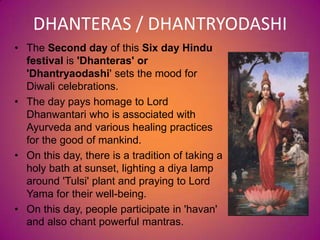
DHANTERAS / DHANTRYODASHI
• The Second day of this Six day Hindu
festival is 'Dhanteras' or
'Dhantryaodashi' sets the mood for
Diwali celebrations.
• The day pays homage to Lord
Dhanwantari who is associated with
Ayurveda and various healing practices
for the good of mankind.
• On this day, there is a tradition of taking a
holy bath at sunset, lighting a diya lamp
around 'Tulsi' plant and praying to Lord
Yama for their well-being.
• On this day, people participate in 'havan'
and also chant powerful mantras.
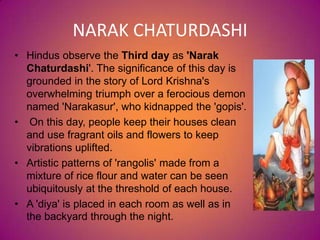
NARAK CHATURDASHI
• Hindus observe the Third day as 'Narak
Chaturdashi'. The significance of this day is
grounded in the story of Lord Krishna's
overwhelming triumph over a ferocious demon
named 'Narakasur', who kidnapped the 'gopis'.
• On this day, people keep their houses clean
and use fragrant oils and flowers to keep
vibrations uplifted.
• Artistic patterns of 'rangolis' made from a
mixture of rice flour and water can be seen
ubiquitously at the threshold of each house.
• A 'diya' is placed in each room as well as in
the backyard through the night.
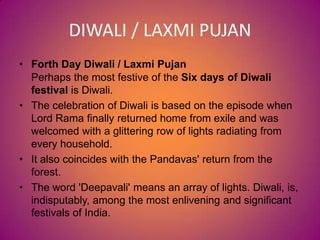
DIWALI / LAXMI PUJAN
• Forth Day Diwali / Laxmi Pujan
Perhaps the most festive of the Six days of Diwali
festival is Diwali.
• The celebration of Diwali is based on the episode when
Lord Rama finally returned home from exile and was
welcomed with a glittering row of lights radiating from
every household.
• It also coincides with the Pandavas' return from the
forest.
• The word 'Deepavali' means an array of lights. Diwali, is,
indisputably, among the most enlivening and significant
festivals of India.
• Well-illuminated houses, parks and public places make up
the landscape on Diwali night, while colorful fireworks dot
the sky.
• In the market place, people are spoilt for choices in their
new purchases. Households are abuzz with hectic activity
around the preparation for Lakshmi puja to honor the
Goddess of wealth.
• A pandit performs the puja ceremoniously while family
members participate in the rituals and offerings. Distribution
of sweets and 'prasad' follows.
• Businessmen also perform 'Chopda Pujan' on this day by
inaugurating their new books of accounts for the ensuing
year. Starting out on a good business proposition or venture
is seen as auspicious on this day.
• In West Bengal, the night is dedicated to the worship of
Goddess Kali.
BALI PRATIPADA / GOVERDHAN PUJA
• Fifth Day: Bali Pratipada / Govardhan Puja when
Govardhan Puja is performed. The legend goes that Lord
Indra was provoked and tried to submerge the town of
Gokul. Lord Krishna saved the people of Gokul from the
wrath of Lord Indra by lifting the Govardhan Mountain to
provide succor.
• A blessing was bestowed on the Govardhan Mountain that
it will be honored through the ages.
• The tradition has been followed ever since. Mathura and
Nathadwara also witnesses huge gathering of crowds in
temples, where deities are bathed ritualistically and
adorned with ornaments.
• This day is also observed as 'Padwa' as Vikram-Samvat
was started from this day.
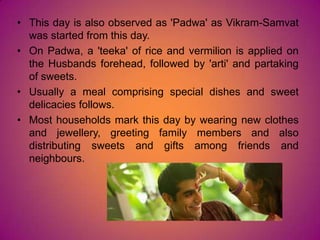
• On Padwa, a 'teeka' of rice and vermilion is applied on
the Husbands forehead, followed by 'arti' and partaking
of sweets.
• Usually a meal comprising special dishes and sweet
delicacies follows.
• Most households mark this day by wearing new clothes
and jewellery, greeting family members and also
distributing sweets and gifts among friends and
neighbours.
BHAI DOOJ / BHAU BIJ
• The Sixth day after Diwali is 'Bhai Dooj„ / “BHAU BIJ”,
marking the end of this six day Hindu festival.
• It is unique in nature as it is solely dedicated to the
strong bond of love between a brother and a sister.
• The festival is associated with the legendary tale of
brotherly love between Lord Yama and his sister Yami.
After several decades of separation, Lord Yama decided
to visit his sister. When he went to meet her, he was
touched by the warmth and hospitality she showed. Yami
welcomed her brother with full fanfare and respect and
put a tilak on his forehead to mark the occasion. Yamraj
blessed her and announced that henceforth a brother
who will greet his sister on this day will have a long life.
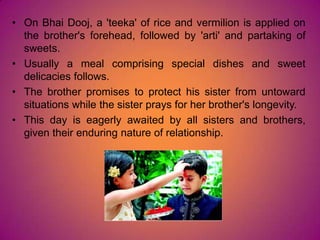
• On Bhai Dooj, a 'teeka' of rice and vermilion is applied on
the brother's forehead, followed by 'arti' and partaking of
sweets.
• Usually a meal comprising special dishes and sweet
delicacies follows.
• The brother promises to protect his sister from untoward
situations while the sister prays for her brother's longevity.
• This day is eagerly awaited by all sisters and brothers,
given their enduring nature of relationship.
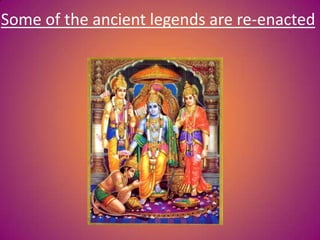
Some of the ancient legends are re-enacted
The story of the demon Narakaasura
• This demon was an evil king. He ruled with a
reign of terror, abducted 16,000 daughters of the
gods, and stole the earrings of Aditi, mother of
the gods.
• The gods asked Lord Krishna for help, and after a
mighty battle he killed the demon, freed the girls,
and recovered the earrings.
• After his victory Krishna returned very early in the
morning and was bathed and massaged with
scented oils. Taking an early morning bath with
oil is still a Diwali tradition.
The story of Rama and Sita
• This is probably the most famous Diwali legend
and many of the traditions practiced nowadays
relate to the story.
• The demon Ravana had 10 arms and 10 heads
and was a wicked King. He kidnapped Sita, the
wife of Rama.
• Rama killed the demon and rescued his wife and
returned to become King. The people lit rows of
lamps to guide them home.
• We are now going to watch the story of Rama
and Sita
What have you learned?
• What does Diwali mean?
• Who celebrates Diwali?
• What sorts of things do people do during
Diwali?
• Can you think of any similar things you do at a
special time of year?
• Do you know what the “moral of the story” is?
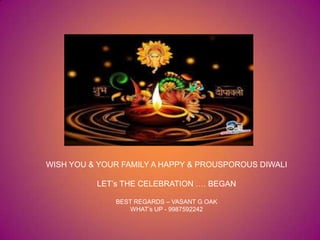
WISH YOU & YOUR FAMILY A HAPPY & PROUSPOROUS DIWALI
LET‟s THE CELEBRATION …. BEGAN
BEST REGARDS – VASANT G OAK
WHAT‟s UP - 9987592242

Diwali

  • 1.
    DIWALI LET’s understand themeaning of the festival of Diwali. COMPILED BY : VASANT G. OAK DGM - EHSS WHAT’s up - 9987592242
  • 3.
    What is Diwali? •Diwali is a Hindu festival which lasts for 6 days. • It is also celebrated by Sikhs. • Diwali means “row of lighted lamps” and is often called the Festival of Lights. • The festival celebrates good over evil; light over darkness. • The Goddess of Wealth (Lakshmi) is honoured during Diwali which is also considered to be the Hindu New Year. • Because there are many regions in India, Diwali is celebrated in many different ways (and also all over the World.) • Diwali is also used to celebrate a successful harvest.
  • 4.
    What happens duringDiwali? • Wearing new clothes • Spring cleaning houses • Having feasts
  • 5.
    Decorating homes andbuildings with fancy lights, candles and lamps (divas)
  • 6.
  • 7.
  • 8.
    Drawing Rangoli patternson floors Rangoli patterns are drawn to welcome in visitors to people’s homes. They are also thought to welcome the Goddess of Wealth.
  • 9.
    VASU BARAS /GOVATSA DWADASHI • Govatsa Dwadashi is celebrated one day before Dhanteras. • On Govatsa Dwadashi day cows and calves are worshipped. The wheat products are given to cows and calves after worship. • People who observe Govatsa Dwadashi abstain from eating any wheat and milk products during the day. Govatsa Dwadashi is also observed as Nandini Vrat. Nandini is divine cow inHinduism. In Maharashtra Govatsa Dwadashi is known as Vasu Baras and it is considered first day of Deepavali. •
  • 10.
    DHANTERAS / DHANTRYODASHI •The Second day of this Six day Hindu festival is 'Dhanteras' or 'Dhantryaodashi' sets the mood for Diwali celebrations. • The day pays homage to Lord Dhanwantari who is associated with Ayurveda and various healing practices for the good of mankind. • On this day, there is a tradition of taking a holy bath at sunset, lighting a diya lamp around 'Tulsi' plant and praying to Lord Yama for their well-being. • On this day, people participate in 'havan' and also chant powerful mantras.
  • 11.
    NARAK CHATURDASHI • Hindusobserve the Third day as 'Narak Chaturdashi'. The significance of this day is grounded in the story of Lord Krishna's overwhelming triumph over a ferocious demon named 'Narakasur', who kidnapped the 'gopis'. • On this day, people keep their houses clean and use fragrant oils and flowers to keep vibrations uplifted. • Artistic patterns of 'rangolis' made from a mixture of rice flour and water can be seen ubiquitously at the threshold of each house. • A 'diya' is placed in each room as well as in the backyard through the night.
  • 12.
    DIWALI / LAXMIPUJAN • Forth Day Diwali / Laxmi Pujan Perhaps the most festive of the Six days of Diwali festival is Diwali. • The celebration of Diwali is based on the episode when Lord Rama finally returned home from exile and was welcomed with a glittering row of lights radiating from every household. • It also coincides with the Pandavas' return from the forest. • The word 'Deepavali' means an array of lights. Diwali, is, indisputably, among the most enlivening and significant festivals of India.
  • 13.
    • Well-illuminated houses,parks and public places make up the landscape on Diwali night, while colorful fireworks dot the sky. • In the market place, people are spoilt for choices in their new purchases. Households are abuzz with hectic activity around the preparation for Lakshmi puja to honor the Goddess of wealth. • A pandit performs the puja ceremoniously while family members participate in the rituals and offerings. Distribution of sweets and 'prasad' follows. • Businessmen also perform 'Chopda Pujan' on this day by inaugurating their new books of accounts for the ensuing year. Starting out on a good business proposition or venture is seen as auspicious on this day. • In West Bengal, the night is dedicated to the worship of Goddess Kali.
  • 14.
    BALI PRATIPADA /GOVERDHAN PUJA • Fifth Day: Bali Pratipada / Govardhan Puja when Govardhan Puja is performed. The legend goes that Lord Indra was provoked and tried to submerge the town of Gokul. Lord Krishna saved the people of Gokul from the wrath of Lord Indra by lifting the Govardhan Mountain to provide succor. • A blessing was bestowed on the Govardhan Mountain that it will be honored through the ages. • The tradition has been followed ever since. Mathura and Nathadwara also witnesses huge gathering of crowds in temples, where deities are bathed ritualistically and adorned with ornaments.
  • 15.
    • This dayis also observed as 'Padwa' as Vikram-Samvat was started from this day. • On Padwa, a 'teeka' of rice and vermilion is applied on the Husbands forehead, followed by 'arti' and partaking of sweets. • Usually a meal comprising special dishes and sweet delicacies follows. • Most households mark this day by wearing new clothes and jewellery, greeting family members and also distributing sweets and gifts among friends and neighbours.
  • 16.
    BHAI DOOJ /BHAU BIJ • The Sixth day after Diwali is 'Bhai Dooj„ / “BHAU BIJ”, marking the end of this six day Hindu festival. • It is unique in nature as it is solely dedicated to the strong bond of love between a brother and a sister. • The festival is associated with the legendary tale of brotherly love between Lord Yama and his sister Yami. After several decades of separation, Lord Yama decided to visit his sister. When he went to meet her, he was touched by the warmth and hospitality she showed. Yami welcomed her brother with full fanfare and respect and put a tilak on his forehead to mark the occasion. Yamraj blessed her and announced that henceforth a brother who will greet his sister on this day will have a long life.
  • 17.
    • On BhaiDooj, a 'teeka' of rice and vermilion is applied on the brother's forehead, followed by 'arti' and partaking of sweets. • Usually a meal comprising special dishes and sweet delicacies follows. • The brother promises to protect his sister from untoward situations while the sister prays for her brother's longevity. • This day is eagerly awaited by all sisters and brothers, given their enduring nature of relationship.
  • 18.
    Some of theancient legends are re-enacted
  • 19.
    The story ofthe demon Narakaasura • This demon was an evil king. He ruled with a reign of terror, abducted 16,000 daughters of the gods, and stole the earrings of Aditi, mother of the gods. • The gods asked Lord Krishna for help, and after a mighty battle he killed the demon, freed the girls, and recovered the earrings. • After his victory Krishna returned very early in the morning and was bathed and massaged with scented oils. Taking an early morning bath with oil is still a Diwali tradition.
  • 20.
    The story ofRama and Sita • This is probably the most famous Diwali legend and many of the traditions practiced nowadays relate to the story. • The demon Ravana had 10 arms and 10 heads and was a wicked King. He kidnapped Sita, the wife of Rama. • Rama killed the demon and rescued his wife and returned to become King. The people lit rows of lamps to guide them home. • We are now going to watch the story of Rama and Sita
  • 21.
    What have youlearned? • What does Diwali mean? • Who celebrates Diwali? • What sorts of things do people do during Diwali? • Can you think of any similar things you do at a special time of year? • Do you know what the “moral of the story” is?
  • 22.
    WISH YOU &YOUR FAMILY A HAPPY & PROUSPOROUS DIWALI LET‟s THE CELEBRATION …. BEGAN BEST REGARDS – VASANT G OAK WHAT‟s UP - 9987592242